
12
C) Paleozoic era.
D) Cenozoic era.
46) The amniotic egg first appeared in which group of animals?
A) amphibians
B) reptiles
C) birds
D) mammals
47) The first vertebrates to develop jaws were the:
A) fish.
B) amphibians.
C) mammals.
D) reptiles.
48) Which of the following would support a hypothesis that insects preceded amphibians on land
and were flourishing when the first amphibians evolved?
A) Amphibians and insects both have lungs in their terrestrial stage.
B) Amphibians and insects have many adaptations in common.
C) Amphibians and insects share a recent common ancestor.
D) Many amphibians are insectivores in their terrestrial stage.
49) Mammals arose as a dominant life-form after which event?
A) the start of the Quaternary period
B) the Cretaceous extinction
C) the Devonian extinction
D) the Cambrian explosion
50) An important characteristic common to most primates is:
A) large, front-facing eyes.
B) short or absent tails.
C) grassland habitats.
D) the use of tools.
51) Which group of animals is the most recent to evolve?
A) invertebrates
B) amphibians
C) reptiles
D) mammals
52) The earliest evidence of life on Earth dates to about 3.8 billion years ago.
53) The metabolism-first model suggests that a self-replicating RNA molecule was responsible
for driving the evolution of the first forms of life.
54) Laboratory experiments suggest that many of the kinds of organic molecules needed to form
the first forms of life could have been made nonbiologically in Earth’s early history.
55) Some of the more advanced organisms in Domains Bacteria and Archaea have a nucleus.
56) Photosynthesis was first performed by bacteria about 3.4 billion years ago.
57) The Cambrian explosion followed extinction of the dinosaurs.
58) Vascular tissue is important for both efficient water distribution and taller growth in plants.
59) Both gymnosperms and angiosperms may be pollinated by animals.
60) Lobe-finned fish gave rise to tetrapods that successfully moved onto land.

Match the following.
A) first primates, whales, and early humans
B) first birds and flowering plants
C) first reptiles and gymnosperms
D) first significant oxygen in the atmosphere
E) modern humans; extinction of large mammals
61) Precambrian
Topic: Section 19.2
Skill: Knowledge/Comprehension
62) Carboniferous
Topic: Section 19.2
Skill: Knowledge/Comprehension
63) Jurassic
Topic: Section 19.2
Skill: Knowledge/Comprehension
64) Tertiary
Topic: Section 19.2
Skill: Knowledge/Comprehension
65) Quaternary
Topic: Section 19.2
Skill: Knowledge/Comprehension
Match the following.
A) gram-positive prokaryotes
B) methane-producing prokaryotes
C) invertebrates
D) yeast
E) diatoms
66) Domain Bacteria
Topic: Section 19.2
Skill: Knowledge/Comprehension
67) Domain Archaea
Topic: Section 19.2
Skill: Knowledge/Comprehension
68) Kingdom Protista
Topic: Section 19.2
Skill: Knowledge/Comprehension
69) Kingdom Animalia
Topic: Section 19.2
Skill: Knowledge/Comprehension
70) Kingdom Fungi
Topic: Section 19.2
Skill: Knowledge/Comprehension
71) The first single-celled organisms appeared around 3.5 ________ years ago.
72) The first dinosaurs appeared during the ________ period.
73) Life first evolved in and the earliest forms of life lived in ________.
74) Discuss why many scientists consider RNA to have been the basis for early forms of life.
75) The eukaryotic kingdom ________ has the greatest fundamental diversity, including some
species that are animal-like, plant-like, and fungus-like, as well as some algae.
76) Compare and contrast the life-forms found in Domains Bacteria, Archaea, and Eukarya.
77) The oxygen present in Earth’s atmosphere has been produced as a waste product of the
process of ________.
78) Angiosperms are unique among plants because they produce ________.
79) What adaptations did ancient algae have to achieve as they washed ashore and evolved into
the more advanced land plants we see today?
80) Defend the following statement: Vascular tissue was, arguably, the most important
evolutionary step, making possible the kinds of plant life we see today.
81) The first land vertebrates were the ________.
82) The early primates were specialized for life in the ________.
83) List three characteristics of all non-ape primates, and state an advantage for each of these
characteristics.
84) Propose reasons why major extinction events (or explosions of life-forms) are good dividing
lines for the geologic timescale. Support your answer.
85) Examine and explain the connections between Stanley Miller’s experiments and the
importance of the evolution of photosynthesis to the current state of life on Earth.
86) Most evolutionary “branches” on the tree of life can read like the story of stepwise challenge
and evolutionary innovation. For example, a cuticle solved the problem of maintaining moisture
in the first terrestrial plants. Outline and explain the steps in the evolution of terrestrial
vertebrates that lead to the evolution of mammals.
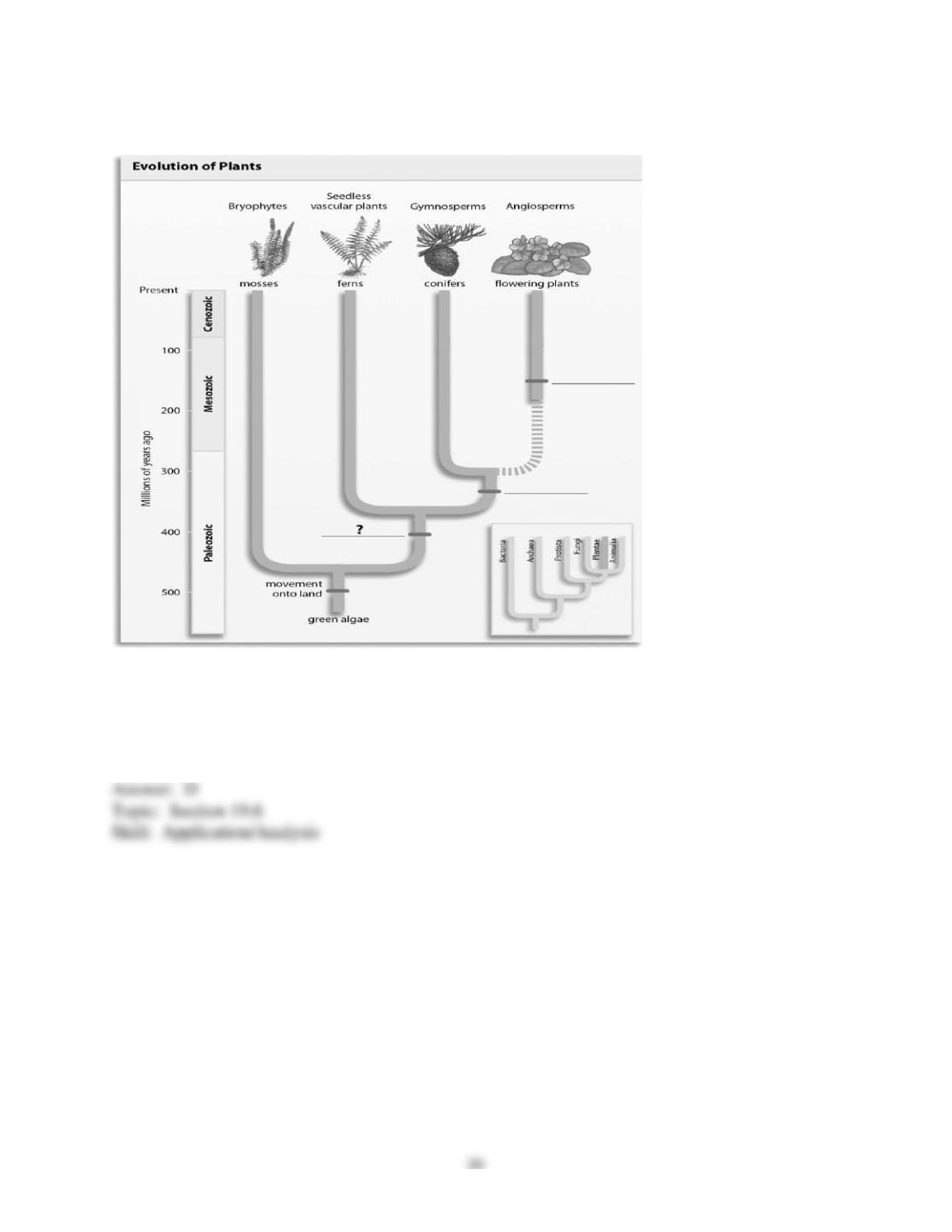
Refer to the figure below, and then answer the question that follows.
87) The missing label indicated with a question mark in the figure should be:
A) chloroplasts.
B) seeds.
C) flowers.
D) vascular tissue.
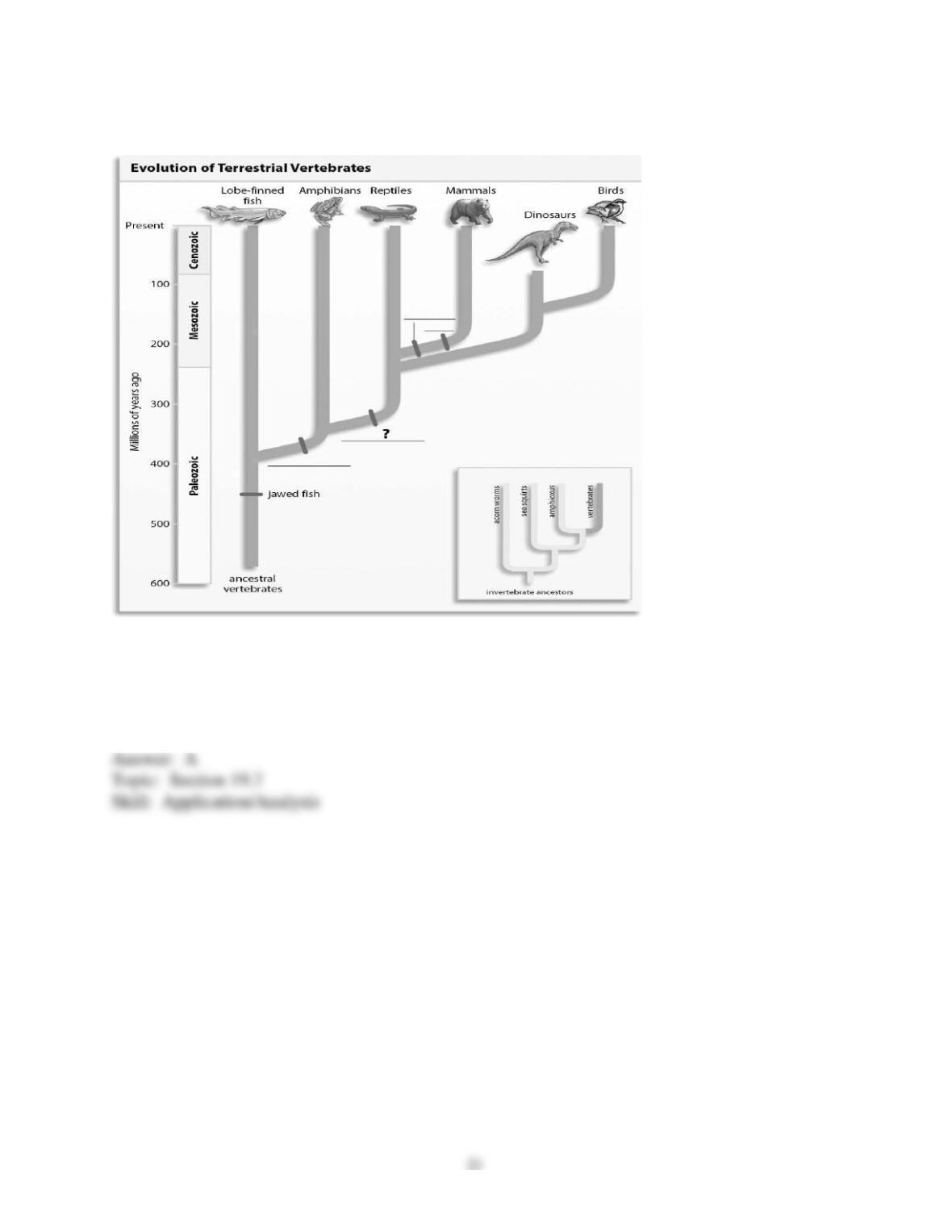
Refer to the figure below, and then answer the question that follows.
88) The missing label indicated with a question mark in the figure should be:
A) amniotic egg.
B) mammary glands.
C) scales.
D) lungs.