Chapter 19: Capital Investment
72. The following information pertains to an investment by the Town of Sutton:
Investment
$140,000
Annual revenues
$96,000
Annual variable costs
$32,000
Annual fixed out–of–pocket costs
$20,000
Salvage value
$12,000
Discount rate
12%
Expected life of project
8 years
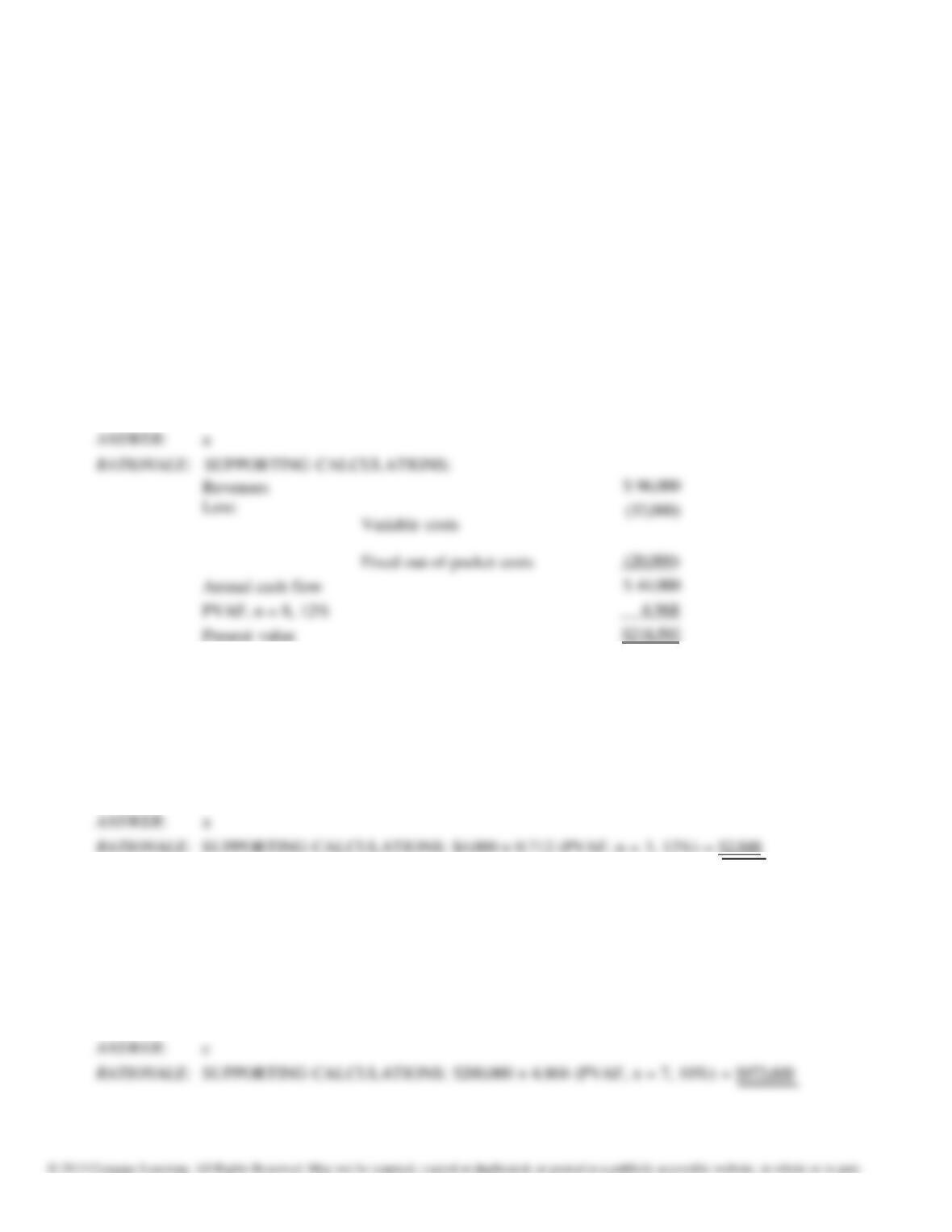
Ignore income taxes. The present value of the salvage value (rounded) is
a. $5,738.
b. $4,848.
c. $6,228.
d. $6,448.
73. The present value of $20,000 to be received five years from now and earning a 6 percent return (rounded) is
a. $14,000.
b. $14,940.
c. $15,784.
d. $16,420.
Chapter 19: Capital Investment
Investment
$140,000
Annual revenues
$96,000
Annual variable costs
$32,000
Annual fixed out–of–pocket costs
$20,000
Salvage value
$12,000
Discount rate
12%
Expected life of project
8 years
74. Spiritlight Ventures is considering the following investment:
Ignore income taxes. The present value of the annual cash flow (rounded) is
a. $218,592.
b. $204,884.
c. $152,538.
d. $136,822.
PVAF, n = 8, 12%
75. The present value of $4,000 to be received three years from now and earning a 12 percent return (rounded) is
a. $2,848.
b. $2,520.
c. $4,880.
d. $5,440.
76. A firm is considering a project with an annual cash flow of $200,000. The project would have a 7-year life, and the
company uses a discount rate of 10 percent. Ignoring income taxes, what is the maximum amount the company
could invest in the project and have the project still be acceptable?
a. $718,200
b. $1,400,000
c. $973,600
d. $200,000
Chapter 19: Capital Investment
77. A firm is considering a project with an annual cash flow of $80,000. The project would have a 10-year life, and the
company uses a discount rate of 8 percent. Ignoring income taxes, what is the maximum amount the company
could invest in the project and have the project still be acceptable (rounded)?
a. $800,000
b. $536,800
c. $406,420
d. $727,208
78. The following information pertains to an investment:
Investment
$240,000
Annual revenues
$140,000
Annual variable costs
$30,000
Annual fixed out–of–pocket costs
$22,000
Salvage value
$54,000
Discount rate
16%
Expected life of project
3 years
Ignoring income taxes, the present value of the salvage value (rounded) is
a. $31,346.
b. $34,614.
c. $35,500.
d. $46,440.
79. The present value of $4,000 to be received each year for three years and earning a 10 percent return (rounded) is
a. $11,120.
b. $9,948.
c. $9,822.
d. $9,200.
Chapter 19: Capital Investment
80. A capital investment project requires an investment of $100,000 and has an expected life of four years. Annual
cash flows at the end of each year are expected to be as follows:
Year
Amount
1
$40,000
2
$48,000
3
$76,000
4
$56,000
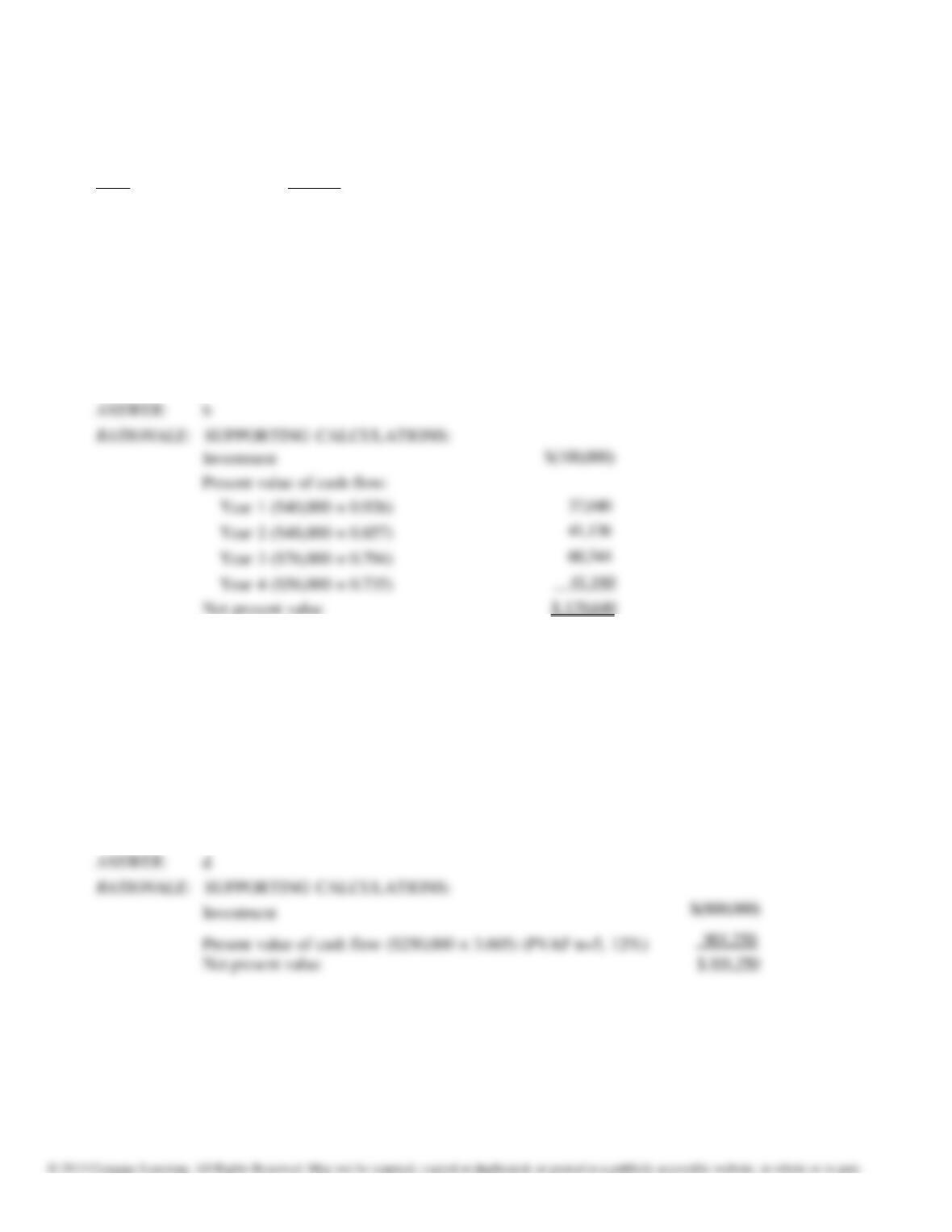
Ignoring income taxes, the net present value of the project using a 8 percent discount rate is
a. $20,320
b. $49,680
c. ($49,680)
d. ($20,320)
81. Vociferous Company is considering the purchase of production equipment that costs $800,000. The equipment is
expected to generate an annual cash flow of $250,000 and have a useful life of five years with no salvage value.
The firm’s cost of capital is 12 percent. The straight-line method with no mid-year convention is used.
Ignoring income taxes, the net present value of the project is
a. $80,960.
b. $97,250.
c. $108,900.
d. $101,250.
Chapter 19: Capital Investment
82. A firm is considering a project with an annual cash flow of $240,000. The project would have an 8-year life, and the
company uses a discount rate of 12 percent. Ignoring income taxes, what is the maximum amount the company
could invest in the project and have the project still be acceptable (rounded)?
a. $977,480
b. $1,125,228
c. $1,160,582
d. $1,192,320
83. The internal rate of return is defined as
a. a blend of the costs of capital from all sources.
b. the minimal acceptable interest rate on investments.
c. the difference between the present value of the cash inflows and outflows associated with a project.
d. the interest rate that sets the present value of a project’s cash inflows equal to the present value of a
project’s cost.
84. Which of the following methods consider the time value of money?
a. payback and accounting rate of return
b. payback and internal rate of return
c. internal rate of return and accounting rate of return
d. internal rate of return and net present value
85. Linda’s Graphic Designs is considering the purchase of a used color Laser Printer costing $38,400. The Printer
would generate an annual cash flow of $16,000 for three years. At the end of three years, the Printer would have
no salvage value. The company‘s cost of capital is 10 percent. The company uses straight–line depreciation with no
mid-year convention.
What is the internal rate of return to the nearest percent for the Printer, assuming no taxes are paid?
a. 8%
b. 10%
c. 12%
d. 42%
Chapter 19: Capital Investment
86. Heckrwee Industries is considering a project that would require an initial investment of $101,000. The project would
result in cost savings of $62,000 in year 1 and $70,000 in year 2. The internal rate of return is
a. under 15%.
b. between 16% and 17%.
c. between 18% and 20%.
d. none of the above.
87. Ursula Company is considering the purchase of a new machine for $160,000. The machine would generate an
annual cash flow before depreciation and taxes of $62,588 for four years. At the end of four years, the machine
would have no salvage value. The company‘s cost of capital is 12 percent. The company uses straight–line
depreciation with no mid-year convention and has a 40 percent tax rate.
What is the internal rate of return for the machine rounded to the nearest percent?
a. below 12%
b. between 16 and 18%
c. between 14 and 16%
d. between 12 and 14%
88. Chinchilla Company is considering the purchase of a new machine for $57,000. The machine would generate an
annual cash flow of $18,228 for five years. At the end of five years, the machine would have no salvage value. The
company’s cost of capital is 12 percent. The company uses straight-line depreciation with no mid-year convention.
What is the internal rate of return for the machine rounded to the nearest percent, assuming no taxes are paid?
a. 12%
b. 18%
c. 14%
d. 16%
Chapter 19: Capital Investment
89. A firm is considering a project requiring an investment of $200,000. The project would generate an
annual cash flow of $55,478 for the next five years. The company uses the straight-line method of
depreciation with no mid- year convention. Ignore income taxes. The approximate internal rate of
return for the project is
a. 9%.
b. 10%.
c. 12%.
d. 16%.
90. Callendula Company is considering the purchase of a new machine for $80,000. The machine would
generate an annual cash flow before depreciation and taxes of $28,778 for five years. At the end of five
years, the machine would have no salvage value. The company’s cost of capital is 12 percent. The
company uses straight-line depreciation with no mid-year convention and has a 40 percent tax rate.
What is the internal rate of return for the machine rounded to the nearest percent?
a. between 16 and 18%
b. between 14 and 16%
c. between 12 and 14%
d. below 12%
91. A firm is considering a project requiring an investment of $27,000. The project would generate an annual
cash flow of $6,296 for the next seven years. The company uses the straight-line method of depreciation
with no mid-year convention. Ignore income taxes. The approximate internal rate of return for the project
is
a. 6%.
b. 8%.
c. 12%.
d. 14%.
Chapter 19: Capital Investment
92. Which of the following capital investment models would be preferred when choosing among mutually
exclusive alternatives?
a. payback period
b. accounting rate of return
c. IRR
d. NPV
93. Five mutually exclusive projects had the following information:
V
W
X
Y
Z
NPV
$(6,000)
$40,000
$30,000
$10,000
$20,000
IRR
8%
11%
13%
10%
12%
Which project is preferred?
a. Project V
b. Project W
c. Project X
d. Project Y
94. NPV differs from IRR:
a. NPV measures profitability in absolute terms, whereas the IRR method measures profitability in relative
terms.
b. IRR should be used for choosing among competing, mutually exclusive projects.
c. NPV considers the time value of money and IRR does not.
d. Both NPV and IRR will generate the same decisions.
95. Five mutually exclusive projects had the following information:
A
B
C
D
E
NPV
$200
$400
$2,000
$1,000
$(400)
IRR
11%
13%
10%
12%
8%
Which project is preferred?
a. Project A
b. Project B
c. Project C
d. Project D
Chapter 19: Capital Investment
96. A firm is considering two mutually exclusive projects with the following cash flows:
Project X Project Y
Year 1 $ 40,000 $120,000
Year 2 80,000 80,000
Year 3 120,000 40,000
Each project requires an investment of $100,000. The cost of capital is 10 percent.
Which project will have the higher net present value?
a. Project X
b. Project Y
c. Project X and Project Y will have the same net present value.
d. It is not possible to answer the question based upon the information provided.
97. Macadamia Company is considering an investment in equipment for $55,000. Chocolate uses the straight–line
method of depreciation with no mid-year convention. In addition, its tax rate is 40 percent, and the life of the
equipment is five years with no salvage value. The expected income before depreciation and taxes is projected to
be $30,000 per year.
What is the annual cash flow for Year 1?
a. $33,000
b. $18,000
c. $22,000
d. $22,400
98. If the tax rate is 40 percent and a company has $800,000 of income, a depreciation deduction of $100,000 would
result in a tax savings of
a. $34,000.
b. $40,000.
c. $30,000.
d. $66,000.
Chapter 19: Capital Investment
99. A machine with a book value of $60,000 could be sold for $80,000. The corporation that owns the machine has
taxable income of $670,000 and a 40 percent tax rate. What would be the tax on the sale of the machine?
a. $-0–
b. $20,000
c. $12,000
d. $8,000
100. If the tax rate is 40 percent and a company has $800,000 of income, a depreciation deduction of $160,000 would
result in a tax savings of
a. $105,600.
b. $96,000.
c. $64,000.
d. $54,400.
101. Monocle Corporation is considering an investment in equipment for $50,000. Data related to the investment is as
follows:
Cash Flow before
Year Depreciation and Taxes
1 $25,000
2 25,000
3 25,000
4 25,000
Monocle uses the straight–line method of depreciation with no mid-year convention. In addition, its tax rate is 35
percent and the life of the equipment is four years with no salvage value. Cost of capital is 12 percent.
What is the annual cash flow for Year 1?
a. $15,375
b. $20,625
c. $25,625
d. $6,000
Chapter 19: Capital Investment
102. A corporation with taxable income of $400,000 and a 40 percent tax rate is considering the sale of an asset. The
original cost of the asset is $20,000, with $12,000 of it depreciated. How much total after–tax cash will be produced
from the sale of the asset for $24,000?
a. $17,600
b. $24,000
c. $22,400
d. ($6,400)
103. Bodacious Company is considering the purchase of a new machine for $80,000. The machine would generate an
annual cash flow before depreciation and taxes of $28,778 for five years. At the end of five years, the machine
would have no salvage value. The company‘s cost of capital is 12 percent. The company uses straight–line
depreciation with no mid-year convention and has a 40 percent tax rate.
What is the annual net after-tax cash flow (rounded)?
a. $23,667
b. $8,633
c. $6,400
d. $28,778
104. Clementine Company is considering the purchase of a new machine for $160,000. The machine would generate an
annual cash flow before depreciation and taxes of $62,588 for four years. At the end of four years, the machine
would have no salvage value. The company‘s cost of capital is 12 percent. The company uses straight–line
depreciation with no mid-year convention and has a 40 percent tax rate.
What is the annual net after–tax cash flow per year?
a. $62,588
b. $53,553
c. $37,552
d. $16,000
Chapter 19: Capital Investment
105. Vendome Company is considering the purchase of the following computer equipment, which is considered 5-year
property for tax purposes:
Acquisition cost
$500,000
Annual cash flow
$180,000
Annual operating costs
$30,000
Expected salvage value
$-0-
Cost of capital
12%
Tax rate
40%
Vendome plans to use MACRS and keep the production equipment for seven years. (Round amounts to dollars.)
The MACRS deduction in Year 2 would be
a. $172,000.
b. $160,000.
c. $170,000.
d. $140,000.
106. Vendome Company is considering the purchase of the following computer equipment, which is considered 5-year
property for tax purposes:
Acquisition cost
$500,000
Annual cash flow
$180,000
Annual operating costs
$30,000
Expected salvage value
$-0-
Cost of capital
12%
Tax rate
40%
Vendome plans to use MACRS and keep the production equipment for seven years. (Round amounts to dollars.)
The tax savings from depreciation in Year 3 would be
a. $38,400.
b. $28,570.
c. $71,428.
d. $96,000.
Chapter 19: Capital Investment
107. Colorform Company is considering the purchase of the following computer equipment, which is considered 5-year
property for tax purposes:
Acquisition cost
$400,000
Annual cash flow
$140,000
Annual operating costs
$20,000
Expected salvage value
0
Cost of capital
10%
Tax rate
40%
Colorform Company plans to use MACRS and keep the production equipment for seven years. (Round amounts to
dollars.)
Tax savings from depreciation in Year 3 would be
a. $54,400.
b. $30,720.
c. $22,856.
d. $35,360.
108. Information about a project Wunderbar Company is considering is as follows:
Investment
$600,000
Revenues
$380,000
Variable costs
$100,000
Fixed out-of-pocket costs
$50,000
Cost of capital
8%
Tax rate
40%
The property is considered 5-year property for tax purposes. The company plans to use MACRS and dispose of the
property at the end of the sixth year; no salvage value is expected. Assume all cash flows occur at the end of the
year. Round amounts to dollars.
The tax savings from depreciation in Year 2 would be
a. $48,000.
b. $64,800.
c. $82,400.
d. $76,800.