Cost Accounting: A Managerial Emphasis, 6e
Chapter 19 – Cost Management: Quality, Time, and the Theory of Constraints
60) Carl Clarkson and Lenny Lenid have been assigned to review the costs of quality at the Sprotton
Chemicals Ltd. for the month of September. All amounts are in thousands (000’s).
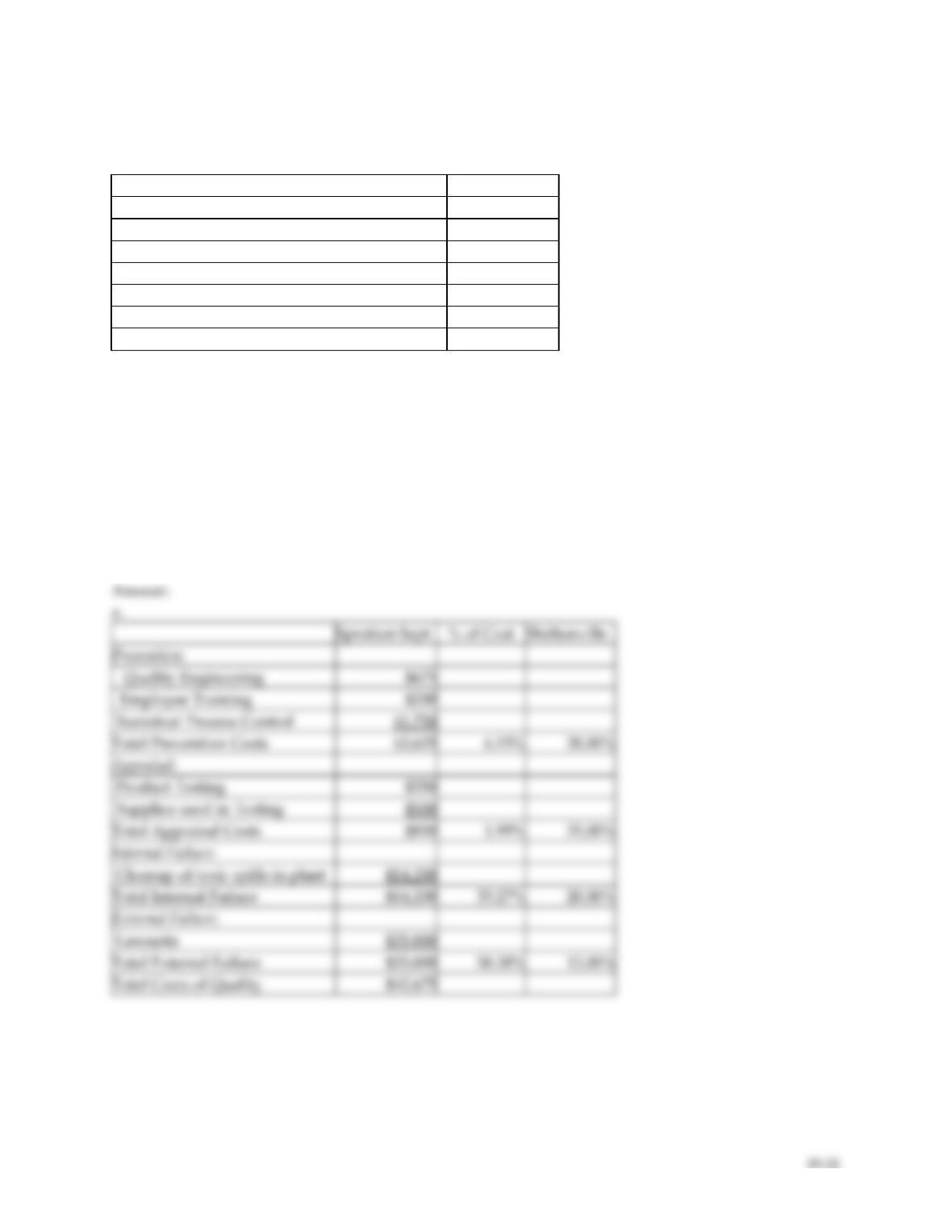
Cost Item
Amount
Product testing
$350
Clean up of toxic spills within the plant
$14,200
Employee training
$200
Quality Engineering
$675
Supplies used in testing
$500
Statistical Process Control
$1,750
Payments on lawsuits from product failures
$25,000
Some information from a competitor, Sheltonville Industries, has been leaked. You learn that
Sheltonville’s costs of quality (as a percentage of total costs of quality) is 15% on external failure, 20% on
internal failure, 35% on appraisal and the rest on prevention.
Required:
a. Prepare a cost of quality report for September for the Sprotton Chemicals including calculations of
each cost category as a percentage of total costs of quality.
b. Compare Sprotton’s approach to quality management to Sheltonville’s. Comment on your findings.
(What are the implications of the differences?)
Sprotton Sept
Sheltonville
Statistical Process Control
Total Prevention Costs
Product Testing
Supplies used in Testing
Total Appraisal Costs
Cleanup of toxic spills in plant
Total Internal Failure
Lawsuits
Total External Failure
Total Costs of Quality
Cost Accounting: A Managerial Emphasis, 6e
Chapter 19 – Cost Management: Quality, Time, and the Theory of Constraints
61) Wilson’s Language School manufactures CDs and DVDs to teach English as a Second Language.
Wilson has just prepared a Cost of Quality Report, and the staff has noticed a decline in prevention costs
as a percentage of total sales over a three-year period. What changes might Wilson expect to see in
appraisal costs as a percentage of sales, internal failure costs as a percentage of sales, and external failure
costs as a percentage of sales given this trend?
62) The Brick Shirt House is concerned about its declining sales, especially the reduction in the number of
customers. For the last two years its shirts have won industry awards for high quality and trend-setting
styles. At the latest executive managers’ meeting everyone was blaming everyone else for the decline.
After much discussion, and the presenting of some fact-finding information, it was determined that sales
relationships were the cause of most of the problems.
Required:
What may be some of the causes and how can the causes be detected if product quality is not an issue?
Cost Accounting: A Managerial Emphasis, 6e
Chapter 19 – Cost Management: Quality, Time, and the Theory of Constraints
19.2 Analyze quality-control problems using three methods.
1) A cause-and-effect diagram is used to help identify potential causes of failure or defects.
2) A control chart identifies potential causes of failures or defects.
3) When using a control chart, the observations outside the upper and lower product specification limits
are ordinarily regarded as nonrandom and worth investigating.
4) A Pareto Diagram is usually in a bar-chart format, and it shows how often a particular problem has
occurred.
5) Which of the following does NOT pertain to control charts?
A) They plot a series of successive observations of a particular step, procedure, or operation.
B) They plot each observation relative to specified ranges that represent the expected distribution.
C) They are used in statistical quality control.
D) They plot only those observations outside specified limits.
E) They plot each observation relative to specified ranges that represent the expected distribution, but
only those observations outside specified limits.
Cost Accounting: A Managerial Emphasis, 6e
Chapter 19 – Cost Management: Quality, Time, and the Theory of Constraints
6) When using a control chart, a manager does not investigate the activity when
A) most observations are outside the preset range.
B) all observations are outside the preset range.
C) all observations are within the range of preset standard deviations.
D) most observations are within the range of 2 standard deviations.
E) all observations are determined to be non-random.
7) Which of the following indicates how frequently each type of failure occurs?
A) cause-and-effect diagram
B) control chart
C) frequency chart
D) Pareto diagram
E) both frequency charts and Pareto diagrams
8) A graph of a series of successive observations of a particular step, procedure, or operation taken at
regular intervals of time is a
A) control chart.
B) Pareto diagram.
C) cause-and-effect diagram.
D) fishbone diagrams.
E) learning curve.
9) Statistical quality control includes a control chart that
A) graphs a series of random events of a process.
B) plots each observation relative to specified ranges that represent the expected distribution.
C) plots control observations over various periods of time.
D) plots only those observations outside specified limits.
E) plots only those observations within one standard deviation from the mean.
Cost Accounting: A Managerial Emphasis, 6e
Chapter 19 – Cost Management: Quality, Time, and the Theory of Constraints
10) Discuss the methods used to identify quality problems.
11) Three tools used to detect quality problems include control charts, Pareto charts, and cause and effect
diagrams. Briefly explain each of these tools.
12) Baby Care Products has just completed a very successful program of improving quality in its
manufacturing operations. The next step is to improve the operations of its administrative functions,
starting with the accounting information system. As the manager of the accounting operations, you are
requested to begin a quality improvement program.
Required:
What are some possibilities of finding out about the current status of quality in the accounting system?
Cost Accounting: A Managerial Emphasis, 6e
Chapter 19 – Cost Management: Quality, Time, and the Theory of Constraints
19.3 Analyze the benefits of using both financial and nonfinancial measures of quality.
1) Most companies do not measure the financial cost of design quality.
2) Lost contribution margin can result from either internal or external failure.
3) In order for management to initiate quality improvement programs and projects, a complete cost–
benefit analysis (including a projection of how the improvement will incrementally affect total costs and
total revenues) is necessary.
4) Allocated cost amounts are an important determinant of the costs of a quality improvement program.
5) The number of defects shipped to customers as a percentage of total units shipped is a type of
nonfinancial quality measure.
6) The financial cost of quality measures serves as a common denominator for evaluating trade-offs
among prevention costs and failure costs.
Cost Accounting: A Managerial Emphasis, 6e
Chapter 19 – Cost Management: Quality, Time, and the Theory of Constraints
Use the information below to answer the following question(s).
Capital Manufacturing expects to spend $200,000 in the current year in appraisal costs if it does not
change its incoming materials inspection method. If it decides to implement a new receiving method it
will save $20,000 in fixed appraisal costs and variable costs of $0.20 per item. The new method involves
$30,000 in training costs and an additional $80,000 in annual equipment rental. It takes two units of
material for each finished product.
Internal failure costs average $40 per failed unit of finished goods. During the previous year, 10 percent
of all completed items had to be reworked. External failure costs average $100 per failed unit. The
company’s average external failures are 2 percent of units sold. The company carries no ending
inventories, because all jobs are on a per order basis and a just–in-time inventory ordering method is
used.
7) What is the net effect on appraisal costs for the current year assuming the new receiving method is
implemented and that 400,000 material units are received?
A) $10,000 increase
B) $10,000 decrease
C) $100,000 decrease
D) $110,000 increase
E) $115,000 decrease
Cost Accounting: A Managerial Emphasis, 6e
Chapter 19 – Cost Management: Quality, Time, and the Theory of Constraints
8) How much will internal failure costs change assuming 400,000 units of materials are received and that
the new receiving method reduces the amount of unacceptable product units in the manufacturing
process by 20 percent?
A) $10,000 increase
B) $50,000 decrease
C) $160,000 decrease
D) $320,000 decrease
E) $500,000 decrease
9) How much will external failure costs change assuming 400,000 units of materials are received and that
the product failures with customers are cut in half with the new receiving method?
A) $10,000 increase
B) $200,000 decrease
C) $320,000 decrease
D) $400,000 decrease
E) $500,000 decrease
Cost Accounting: A Managerial Emphasis, 6e
Chapter 19 – Cost Management: Quality, Time, and the Theory of Constraints
Use the information below to answer the following question(s).
Imperial Products has a budget of $600,000 in the current year for prevention costs. If it decides to
automate a portion of its prevention activities it will save $40,000 in variable costs. The new method will
require $12,000 in training costs and $80,000 in annual equipment costs. Management is willing to adjust
the budget for an amount up to the cost of the new equipment. The budget includes a production level of
100,000 units.
Appraisal costs for the year are budgeted at $400,000. The new prevention procedures will save appraisal
costs of $20,000. Internal failure costs average $10 per failed unit of finished goods. The internal failure
rate is expected to be 2 percent of all completed items. The proposed changes will cut the internal failure
rate in half. Internal failure units are destroyed. External failure costs average $36 per failed unit. The
company’s average external failures average 2 percent of units sold. The new proposal will reduce this
rate by 80 percent.
10) What is the net change in the budget of prevention costs if the procedures are automated in the
current year?
A) $40,000 decrease
B) $52,000 increase
C) $52,000 decrease
D) $92,000 increase
E) $92,000 decrease
11) How much will appraisal costs change assuming the new prevention methods reduce the amount of
material failures during the appraisal phase by 40 percent?
A) $160,000 decrease
B) $40,000 increase
C) $20,000 decrease
D) $8,000 decrease
E) $7,450 decrease
Cost Accounting: A Managerial Emphasis, 6e
Chapter 19 – Cost Management: Quality, Time, and the Theory of Constraints
12) How much will internal failure costs change if the internal product failures are reduced by 50 percent
with the new procedures?
A) $10,000 decrease
B) $20,000 decrease
C) $250,000 decrease
D) $500,000 decrease
E) $550,000 decrease
13) How much does external failure costs change if all changes are as anticipated with the new
prevention procedures?
A) $57,024 decrease
B) $57,600 increase
C) $57,600 decrease
D) $72,000 decrease
E) $72,624 increase
Cost Accounting: A Managerial Emphasis, 6e
Chapter 19 – Cost Management: Quality, Time, and the Theory of Constraints
14) Management has offered to allow the prevention changes if all changes take place as anticipated and
the amounts netted are less than the cost of the equipment. What is the net impact of all the changes
created by the preventive changes?
A) $52,000
B) $(5,024)
C) $(57,024)
D) $(35,024)
E) $(25,024)
15) Which of the following are not nonfinancial measures for evaluating customer satisfaction?
A) total sales per customer
B) customer response time
C) number of customer complaints per month
D) ratio of defective units to good units shipped to customers
E) timeliness of delivery
16) The Cost of Quality measure has all of the following advantages EXCEPT
A) being a useful measure of comparing different quality improvement projects.
B) serving as a common denominator for evaluating tradeoffs among prevention and failure costs.
C) focusing on how costly poor quality can be.
D) being indicators of long-term performance.
E) setting priorities for achieving maximum cost reduction.
Cost Accounting: A Managerial Emphasis, 6e
Chapter 19 – Cost Management: Quality, Time, and the Theory of Constraints
17) Regarding the means by which relevant costs and benefits are evaluated when evaluating quality
improvement, the key question is:
A) Which alternative solution will make the customer happiest?
B) How will total costs and total revenues change under each alternative solution?
C) Will the employees of the company be able to implement the change?
D) How long will it take for the improvement program to be fully functional?
E) How long will the training period be?
Cost Accounting: A Managerial Emphasis, 6e
Chapter 19 – Cost Management: Quality, Time, and the Theory of Constraints
18) Design Products is committed to its quality program. It works with all areas of the company to
establish sound quality programs within reasonable budget guidelines. For the current year, it has
budgeted $1,000,000 for prevention costs and $800,000 for appraisal costs. Internal failure has a budget of
$100 per failed item, while external failure has a total budget of $600,000.
Product Testing has proposed to management a new method of testing products. If management decides
to implement the new method, $2 per unit of appraisal costs will be saved, up to a level of 200,000 tests.
No additional savings are incurred past the 200,000 level. The new method involves $110,000 in training
costs and $60,000 in yearly testing supplies.
Traditionally, 3 percent of all completed items have to be reworked. External failure costs average $120
per failed unit. The company’s average external failures are 1 percent of units sold. The company carries
no ending inventories.
Required:
a. What is the adjusted budget for appraisal costs assuming the new method is implemented and 800,000
units are tested during the manufacturing process during the year?
b. How much does internal failure costs change assuming 600,000 units are tested under the new method
and it reduces the amount of unacceptable units in the manufacturing process by 40 percent?
c. What would be the change in the external failure budget assuming external failures are reduced by 60
percent, assuming the same facts as in part (b)?
Cost Accounting: A Managerial Emphasis, 6e
Chapter 19 – Cost Management: Quality, Time, and the Theory of Constraints
Use the information below to answer the following question(s).
Regal Products has a budget of $900,000 in the current year for prevention costs. If it decides to automate
a portion of its prevention activities, it will save $60,000 in variable costs. The new method will require
$18,000 in training costs and $120,000 in annual equipment costs. Management is willing to adjust the
budget for an amount up to the cost of the new equipment. The budgeted production level is 150,000
units.
Appraisal costs for the year are budgeted at $600,000. The new prevention procedures will save appraisal
costs of $30,000. Internal failure costs average $15 per failed unit of finished goods. The internal failure
rate is expected to be 3% of all completed items. The proposed changes will cut the internal failure rate by
one-third. Internal failure units are destroyed. External failure costs average $54 per failed unit. The
company’s average external failures average 3% of units sold. The new proposal will reduce this rate by
50%. Assume all units produced are sold and there are no ending inventories.
19) What is the net change in the budget of prevention costs if the procedures are automated?
20) How much will appraisal costs change assuming the new prevention methods reduce material
failures by 40% in the appraisal phase?
21) How much will internal failure costs change if the internal product failures are reduced by 50% with
the new procedures?
Cost Accounting: A Managerial Emphasis, 6e
Chapter 19 – Cost Management: Quality, Time, and the Theory of Constraints
22) How much do external failure costs change if all changes are as anticipated with the new prevention
procedures? Assume all units produced are sold and there are no ending inventories.
23) Management has offered to allow the prevention changes if all changes take place as anticipated and
the amounts netted are less than the cost of the equipment. What is the net impact of all the changes
created by the preventive changes?
19.4 Evaluate methods using time as a competitive tool.
1) The operational measures of time reveal how quickly customers respond to a company’s new products.
2) Customer response time is the time between when a company first markets a new product, and when
sales exceed supplies on hand (test inventory).
3) Uncertainty about when customers will demand a product or service is generally credited as being the
primary cause of bottlenecks.
Cost Accounting: A Managerial Emphasis, 6e
Chapter 19 – Cost Management: Quality, Time, and the Theory of Constraints
4) Manufacturing lead time is a combination of order receipt time and order manufacturing time.
5) Several companies have adopted manufacturing lead time as the base for allocating indirect
manufacturing costs to products.
6) Manufacturing lead times can affect costs but do not affect sales revenue.
7) Two common operational measures of time are customer-response time and manufacturing lead time.
8) Customer-response time is a measure of how long it takes for the customer to return a call.
9) Manufacturing lead time is the sum of waiting time and manufacturing time for an order.
10) Two important drivers of time are limited capacity and bottlenecks.
Cost Accounting: A Managerial Emphasis, 6e
Chapter 19 – Cost Management: Quality, Time, and the Theory of Constraints
11) The average waiting time is the average amount of time an order will wait at the company’s shipping
office before it is sent to the customer.
12) On-time performance will increase customer satisfaction.
13) Which of the following is not included in customer response time?
A) order delivery time
B) order manufacturing time
C) order waiting time
D) order receipt time
E) order opening time
14) Which of the following are time drivers?
A) bottlenecks
B) limited capacity
C) uncertainty as to when customers will order products
D) average number of orders per customer
E) uncertainty as to when customers will order products, limited capacity, and bottlenecks
15) Manufacturing lead time includes
A) all indirect time.
B) waiting time.
C) marketing time.
D) time to process the customer’s order to delivery.
E) all indirect time and waiting time.
Cost Accounting: A Managerial Emphasis, 6e
Chapter 19 – Cost Management: Quality, Time, and the Theory of Constraints
16) ________ is the amount of time from when a customer places an order for a product or requests a
service to when the product or service is delivered to the customer.
A) A bottleneck
B) A time driver
C) Customer response time
D) Manufacturing lead time
E) Quality customer time
17) On-time performance is
A) the time it takes distribution to pick up an order and deliver it to the customer.
B) within 2 standard deviations of customer response time.
C) within 2 standard deviations of manufacturing time.
D) equal to customer response time, divided by the number of orders from a specific customer.
E) when the product is delivered at the time scheduled to be delivered.
18) ________ refers to the average amount of time that an order will be in line before it is set up and
processed.
A) Average manufacturing cycle time
B) Average customer response time
C) Average waiting time
D) Average on-time performance
E) Average setup time (per cycle)
Cost Accounting: A Managerial Emphasis, 6e
Chapter 19 – Cost Management: Quality, Time, and the Theory of Constraints
19) The annual capacity of a machine is 3,500 hours, with the balance being taken for routine
maintenance. It takes 50 hours to process one job (each job = 1 batch),. Altogether, there are seven
employees who operate the machine at different times. Orders for the first six months of the year, which
are typical, have averaged 50 jobs per month. The company expects 300 orders over the next six months.
Which of the following is true?
A) Expected capacity utilization = 700 batches.
B) Expected capacity utilization = 650 batches.
C) Expected capacity utilization = 600 batches.
D) Average waiting time is not relevant when expected capacity utilization is less than capacity.
E) Waiting time for at least one order will be nil.
20) For a fast-food restaurant the average waiting time might be formulated as
A)
time)]serving ave. customers of # (ave. –capacity [serving 2
time)]serving (average customers) ofnumber [(average
B) [(average number of customers) × (average serving time)]/capacity
C)
minutes 60
time)]serving (average hour per customers [(average
D)
workers)of(number minutes) (60
time)]serving (average hour per customers [(average
E) [(average number of employees) × (average serving time)]/serving time
21) The demand for Ballard’s Glass Company’s products varies, ranging from 10 to 20 windows a day
with an average of 15. John Ballard works eight hours a day, five days a week. Each order is one window,
and each window takes 26 minutes to install.
What is the average waiting time in minutes?
A) 1.6
B) 4.4
C) 28.2
D) 56.3
E) 82.3
Cost Accounting: A Managerial Emphasis, 6e
Chapter 19 – Cost Management: Quality, Time, and the Theory of Constraints
22) The demand for Ballard’s Glass Company’s products varies. Each order is one window, and each
window takes 26 minutes to install. Assuming wait time is 12 minutes, and order receipt time equals 21
minutes what is the cycle time for an order on average?
A) 21 minutes
B) 26 minutes
C) 38 minutes
D) 41 minutes
E) 59 minutes
23) The demand for Ballard’s Glass Company’s products varies, ranging from 10 to 20 windows a day
with an average of 15. John Ballard works eight hours a day, five days a week. Each order is one window,
and each window takes 26 minutes to install. The company plans to add doors to its product line and
anticipates selling an average of 5 doors per day. Each door takes 12 minutes to install.
What is the average waiting time if Ballard is the only worker?
A) 38.0 minutes
B) 112.4 minutes
C) 181.0 minutes
D) 410.0 minutes
E) 523.4 minutes