Cost Accounting: A Managerial Emphasis, 6e
Chapter 19 – Cost Management: Quality, Time, and the Theory of Constraints
6) Throughput contribution is equal to revenues minus direct material and direct labour costs.
7) When considering the theory of constraints, operating costs refer to all costs involved in the
manufacturing process.
8) The cost of poor quality at a nonbottleneck operation is the cost of the materials wasted.
9) When a firm has a bottleneck machine, a good way to manage the bottleneck is to make sure that prior
machines produce more units for the bottleneck machine to increase its throughput.
10) A company would subordinate all bottleneck production to non-bottleneck machines when
A) the bottleneck resource was temporarily unused.
B) setup time on the non-bottleneck machine is higher than on the bottleneck machine.
C) setup time on the non-bottleneck machine is less than on the bottleneck machine.
D) it intends to increase throughput contribution.
E) it wants to produce at least a minimum buffer inventory.
Cost Accounting: A Managerial Emphasis, 6e
Chapter 19 – Cost Management: Quality, Time, and the Theory of Constraints
11) Which of the following statements related to the theory of constraints is/are true?
A) Sales less direct materials costs equals throughput contribution.
B) Throughput contribution equals sales plus direct materials, and the theory of constraints focuses on
revenue and cost management when an organization is faced with bottlenecks.
C) Throughput contribution equals sales plus direct materials.
D) The theory of constraints focuses on process-costing when an organization is faced with bottlenecks.
E) Throughput contribution equals sales plus direct manufacturing costs.
12) Increasing throughput contribution and managing bottlenecks includes all of the following EXCEPT
A) workstations without large quantities of jobs to be worked on are ignored.
B) recognize that a bottleneck determines throughput contribution of the entire process related to the
bottleneck.
C) a cost-benefit analysis of alternative actions to increase bottleneck efficiency.
D) short-run time horizons.
E) a cost-benefit analysis of alternative actions to increase bottleneck capacity.
13) Producing more non-bottleneck output
A) creates more inventory but does not increase throughput contribution.
B) creates more inventory and increases throughput contribution.
C) creates less pressure for the bottleneck workstations.
D) allows for the maximization of overall contribution.
E) allows for the maximization of overall shop effectiveness.
Cost Accounting: A Managerial Emphasis, 6e
Chapter 19 – Cost Management: Quality, Time, and the Theory of Constraints
14) Quick Shop Printing has two workstations, cutting and pasting. The cutting station is limited by the
speed of operating the cutting machine. Pasting is limited by the speed of the workers. Pasting normally
waits on work from cutting. Each department works an eight-hour day. If cutting begins work two hours
earlier than pasting each day, the two departments generally finish their work at about the same time.
Not only does this eliminate the bottleneck, but it increases finished units produced each day by 80 units.
All units produced can be sold. The cost of operating the cutting department two more hours each day is
$800. The contribution margin of the finished products is $3 each. Inventory carrying costs are $0.20 per
unit per day.
What is the daily capacity of the pasting workstation?
A) 320
B) 400
C) 440
D) 800
E) 820
15) Which of the following is NOT a key step in managing bottleneck resources?
A) Recognize that the bottleneck resource determines throughput contribution of the plant as a whole.
B) Search and find the bottleneck resource by identifying resources with large quantities of inventory
waiting to be worked on.
C) Keep the bottleneck operation busy and subordinate all nonbottleneck resources to the bottleneck
resource.
D) Reduce the number of employees who work in the bottleneck area.
E) Take action to increase bottleneck efficiency and capacity.
Cost Accounting: A Managerial Emphasis, 6e
Chapter 19 – Cost Management: Quality, Time, and the Theory of Constraints
16) Which of the following sets of sentences has two statements which are true?
A) Poor quality is more costly at a bottleneck workstation than it is at a nonbottleneck workstation. The
cost of poor quality at a bottleneck workstation is the cost of materials in waiting.
B) Throughput contribution increases only by increasing bottleneck output. Throughput contribution is
not increased when nonbottleneck output is increased.
C) The cost of poor quality at a nonbottleneck operation is the cost of materials wasted. Increasing idle
time at the bottleneck operation helps relieve the delays at the nonbottleneck operations.
D) The cost of poor quality at a bottleneck operation is the cost of materials wasted. Increasing idle time
at the nonbottleneck operation helps relieve the delays at the bottleneck operations.
E) Throughput contribution increases only by decreasing bottleneck output. Throughput contribution is
not increased when nonbottleneck output is increased.
17) Which of the following statements is TRUE?
A) The elimination of defects always increases productivity.
B) Nonbottleneck operations should be refined for high efficiency before starting on bottleneck
improvement because nonbottleneck operations are generally easier to correct and improve.
C) Throughput contribution is not increased when nonbottleneck output is increased.
D) Quality and time are seldom related in service industries.
E) The elimination of defects always decreases revenues.
Cost Accounting: A Managerial Emphasis, 6e
Chapter 19 – Cost Management: Quality, Time, and the Theory of Constraints
Answer the following question(s) using the information below.
Speedy Dress Manufacturing has two workstations, cutting and finishing. The cutting station is limited
by the speed of operating the cutting machine. Finishing is limited by the speed of the workers. Finishing
normally waits for work from cutting. Each department works an eight-hour day. If cutting begins work
two hours earlier than finishing each day, the two departments generally finish their work at about the
same time. Not only does this eliminate the bottleneck, but also it increases finished units produced each
day by 160 units. All units produced can be sold even though the change increases inventory stock by
20% from 400 units. The cost of operating the cutting department two more hours each day is $1,600. The
contribution margin of the finished products is $6 each. Inventory carrying costs are $0.40 per unit per
day.
18) What is the total production per day if the change is made?
A) 6400 units
B) 800 units
C) 880 units
D) 1600 units
E) 640 units
19) What is the change in the daily contribution margin if the change is made?
A) $(608)
B) $(634)
C) $(672)
D) $800
E) $960
Cost Accounting: A Managerial Emphasis, 6e
Chapter 19 – Cost Management: Quality, Time, and the Theory of Constraints
20) The Glass Shop, a manufacturer of large windows, is experiencing a bottleneck in its plant. Setup time
at one of its workstations has been identified as the culprit. A manager has proposed a plan to reduce
setup time at a cost of $72,000. The change will result in 8,000 additional windows. The selling price per
window is $18, direct labour costs are $3 per window, and the cost of direct materials is $5 per window.
Assume all units produced can be sold. The change will result in an increase in the throughput
contribution of:
A) $104,000
B) $80,000
C) $32,000
D) $8,000
E) $120,000
Cost Accounting: A Managerial Emphasis, 6e
Chapter 19 – Cost Management: Quality, Time, and the Theory of Constraints
21) Palmateer Industries makes an electronic component in two departments, Machining and Assembly.
The capacity per month is 30,000 units in the Machining Department and 20,000 in the Assembly
Department. The only variable cost of the product is the direct material of $100 per unit. All direct
material cost is incurred in the Machining Department. All other costs of operating the two departments
are fixed costs. Palmateer can sell as many units of this electronic component as it produces at a selling
price of $300 per unit.
Required:
Assuming any defective unites produced in either department must be scrapped:
a. Compute the loss that occurs if a defective unit is produced in the Machining Department.
b. Compute the loss that occurs if a defective unit is produced in the Assembly Department.
c. How do your answers in parts (a) and (b) relate to the theory of constraints? Explain.
Cost Accounting: A Managerial Emphasis, 6e
Chapter 19 – Cost Management: Quality, Time, and the Theory of Constraints
19–59
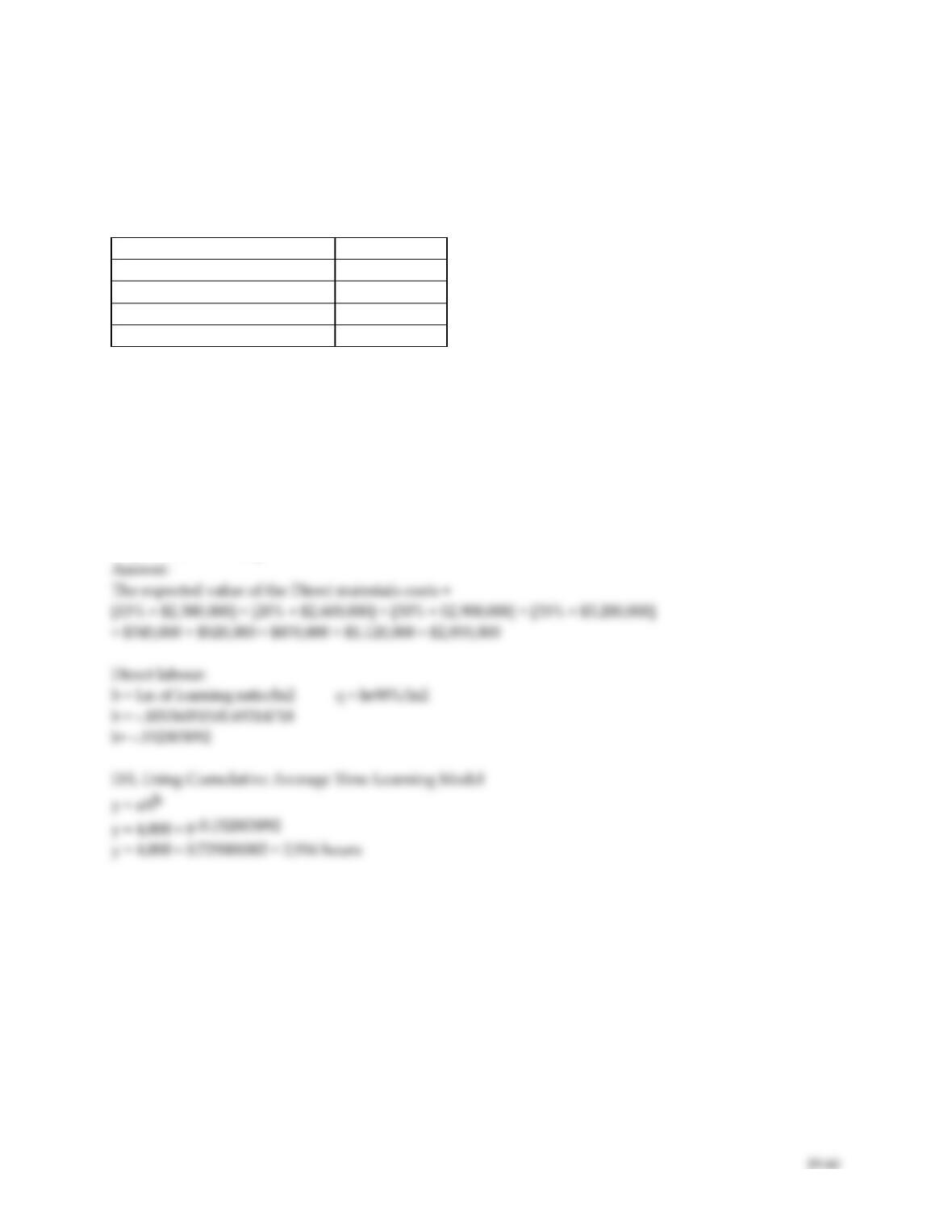
22) A machine has been identified as a bottleneck and the source of the constraint for a manufacturing
company that has multiple products and multiple machines. Discuss ways the company can overcome
the bottleneck.
Cost Accounting: A Managerial Emphasis, 6e
Chapter 19 – Cost Management: Quality, Time, and the Theory of Constraints
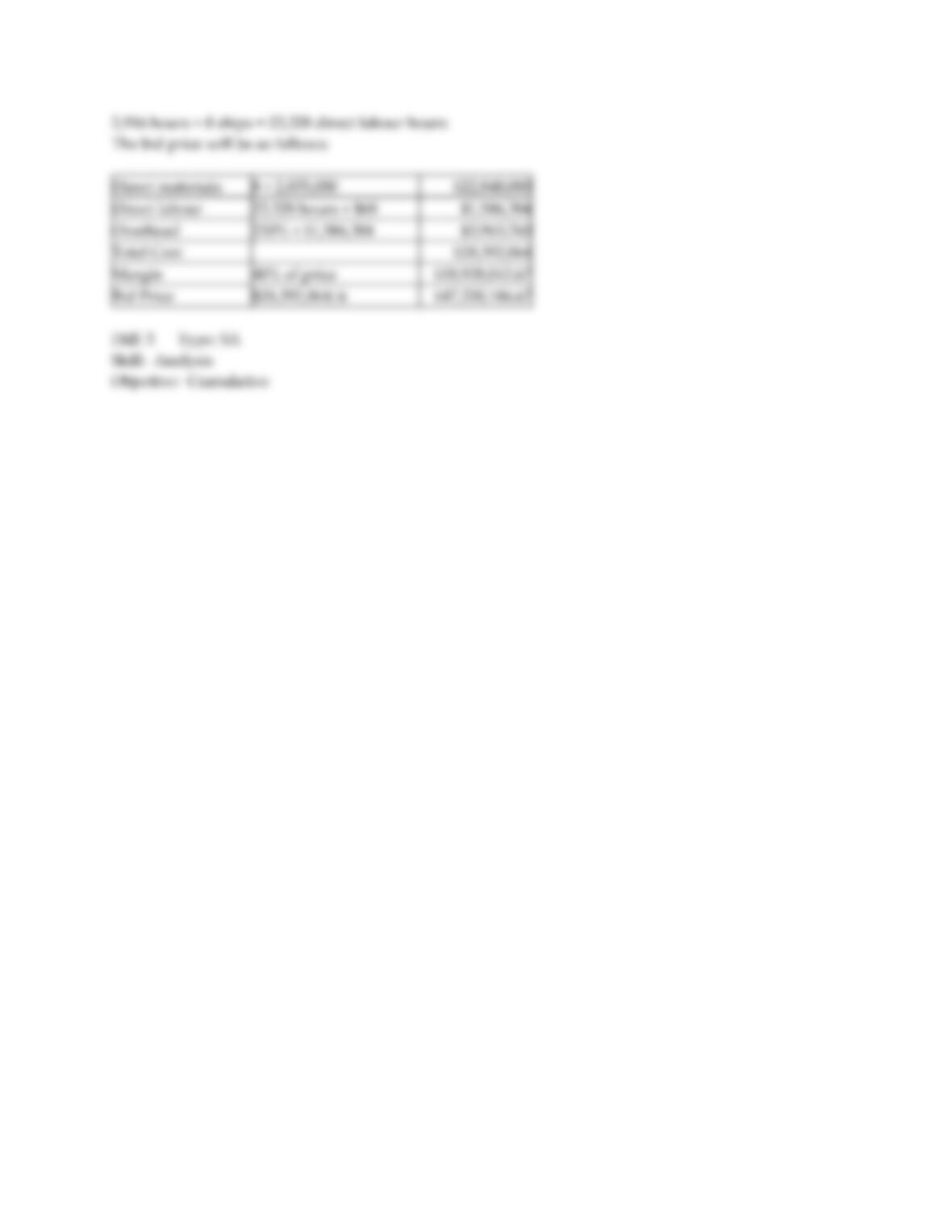
23) Columbus Shipbuilding Ltd. is preparing a bid on a contract to supply 8 small vessels. It is facing two
issues in preparing its estimates. First, due to volatility in the market place there is uncertainty regarding
the cost of direct materials. Second, it recognizes that there will be improvements in labour productivity
during the contract.
Columbus has estimated the following probability distribution for its direct materials costs:
Direct material cost/unit
Probability
$2,300,000
15%
$2,600,000
20%
$2,900,000
30%
$3,200,000
35%
In estimating the direct labour costs, Columbus has predicted a 90% cumulative average time learning
curve. The time required to produce the first vessel is estimated at 4,000 hours. Direct labour costs
average $68 per hour.
Manufacturing overhead is applied at the rate of 250% of direct labour costs. The bid price will be
established to permit a 40% gross margin.
Required:
Prepare the total bid price for the order.
Cost Accounting: A Managerial Emphasis, 6e
Chapter 19 – Cost Management: Quality, Time, and the Theory of Constraints
19–61