Cost Accounting: A Managerial Emphasis, 6e
Chapter 19 – Cost Management: Quality, Time, and the Theory of Constraints
24) The demand for Ballard’s Glass Company‘s products varies, ranging from 10 to 20 windows a day
with an average of 15. John Ballard works eight hours a day, five days a week. Each order is one window,
and each window takes 26 minutes to install. The company plans to add doors to its product line and
anticipates that they will sell an average of 5 doors per day. Each door takes 12 minutes to install.
Ballard is concerned with the increased waiting time if it adds doors. To offset this concern it can hire a
part-time employee. This will decrease window time to 20 minutes and door time to 10 minutes; increase
the costs of windows from $10 to $12 and doors from $6 to $7.50. Since Ballard is giving customers faster
service it will increase its prices from $17 to $20 for windows and from $10 to $12 for doors.
What is the expected daily revenue with and without doors, respectively, assuming average sales units
are used and it hires a part-time employee if doors are sold?
A) $230 and $170
B) $260 and $200
C) $360 and $255
D) $315 and $300
E) $400 and $340
25) The demand for Ballard’s Glass Company‘s products varies, ranging from 10 to 20 windows a day
with an average of 15. John Ballard works eight hours a day, five days a week. Each order is one window,
and each window takes 26 minutes to install. The company plans to add doors to its product line and
anticipates that they will sell an average of 5 doors per day. Each door takes 12 minutes to install.
Ballard is concerned with the increased waiting time if it adds doors. To offset this concern it can hire a
part-time employee. This will decrease windows time to 20 minutes and doors to 10 minutes. However,
this will increase the costs of windows from $10 to $12 and doors from $6 to $7.50. Since he is giving
customers faster service he will increase his prices from $17 to $20 for windows and from $10 to $12 for
doors.
What is the daily contribution margin if he sells both windows and doors and the part–time person is
hired?
A) $185.00
B) $142.50
C) $140.00
D) $97.50
E) $72.00
Cost Accounting: A Managerial Emphasis, 6e
Chapter 19 – Cost Management: Quality, Time, and the Theory of Constraints
26) A company has identified the following data:
order waiting time
8 minutes
order manufacturing lead time
72 minutes
order receipt time
7 minutes
order manufacturing cycle time
72 minutes
What is the order manufacturing time?
A) 9 minutes
B) 15 minutes
C) 55 minutes
D) 64 minutes
E) 79 minutes
27) Quick Shop Printing has two workstations, cutting and pasting. The cutting station is limited by the
speed of operating the cutting machine. Pasting is limited by the speed of the workers. Pasting normally
waits on work from cutting. Each department works an eight–hour day. If cutting begins work two hours
earlier than pasting each day, the two departments generally finish their work at about the same time.
Not only does this eliminate the bottleneck, but it increases finished units produced each day by 80 units.
All units produced can be sold even though the change increases inventory stock by 10 percent from 200
units. The cost of operating the cutting department two more hours each day is $800. The contribution
margin of the finished products is $3 each. Inventory carrying costs are $0.20 per unit per day.
What is the change in the daily contribution margin if the change is made?
A) $(396)
B) $(564)
C) $396
D) $400
E) $475
Cost Accounting: A Managerial Emphasis, 6e
Chapter 19 – Cost Management: Quality, Time, and the Theory of Constraints
Answer the following question(s) using the information below:
The tool crib at a large manufacturing company is responsible for providing tools to the factory workers
on demand. The tool crib has a variable demand. Historically, its demand has ranged from 150 to 250
small tools per day with an average of 200. Diane, the tool crib attendant, works eight hours a day, five
days a week. Each order is for one small tool and each small tool takes Diane 2 minutes to retrieve from
the bins.
28) What is the average waiting time, in minutes?
A) 2
B) 3
C) 5
D) 2.5
E) 7
29) What is the cycle time for an order?
A) 2 minutes per tool
B) 3 minutes per tool
C) 5 minutes per tool
D) 7 minutes per tool
E) 4 minutes per tool
Cost Accounting: A Managerial Emphasis, 6e
Chapter 19 – Cost Management: Quality, Time, and the Theory of Constraints
30) Diane has been asked to consider plans to add the retrieval of larger tooling fixtures to her duties. She
anticipates that there would be an average of 12 tooling fixtures per day requested. Each tooling fixture
would take Diane 4 minutes to retrieve.
What is the average waiting time, in minutes, if Diane continues to be the only worker that would
retrieve the small tools as well as the larger tooling fixtures?
A) 5.0 minutes
B) 10.0 minutes
C) 15.5 minutes
D) 18.5 minutes
E) 31.0 minutes
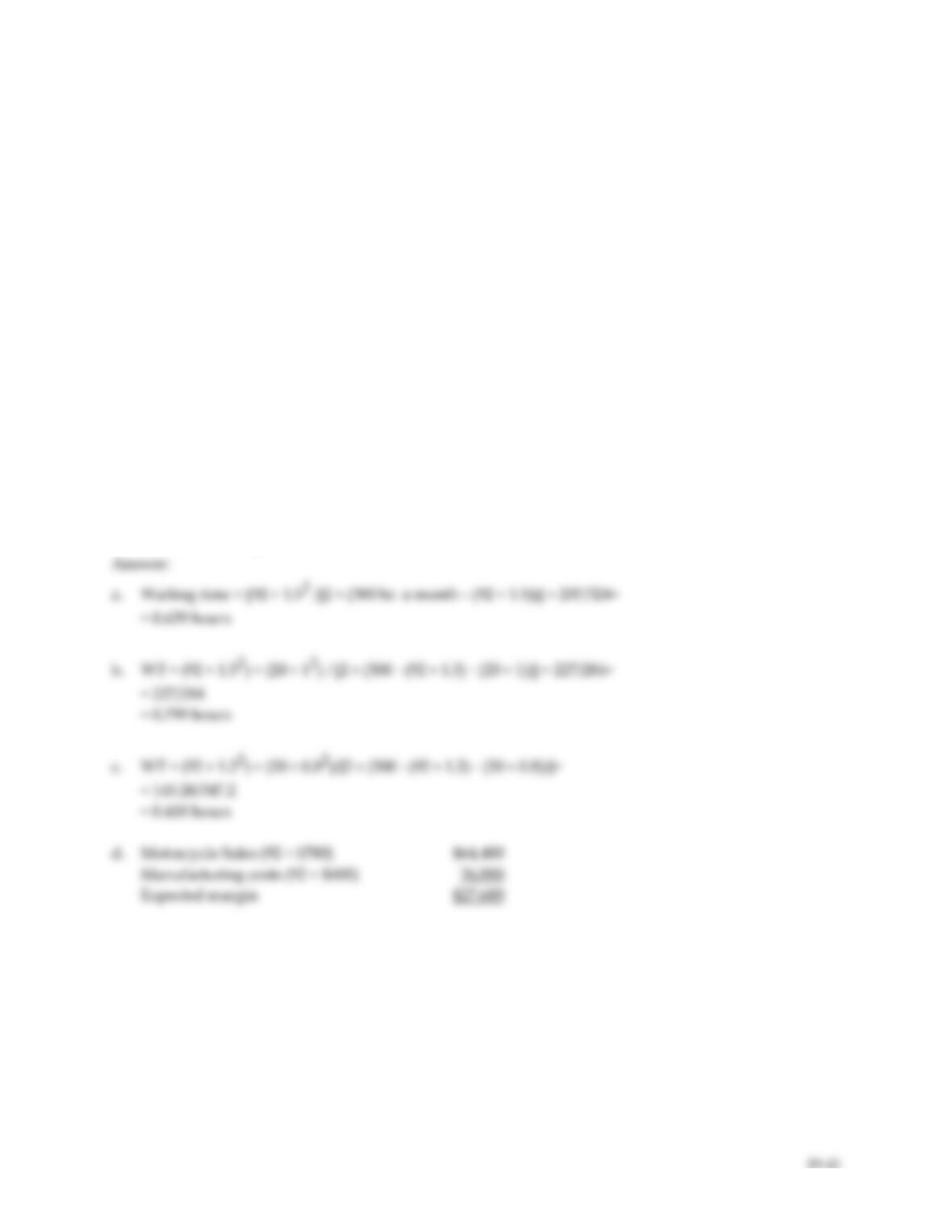
31) Brown Laundry has a variable demand. The daily demand ranges from 100 to 140 customers a day
with an average of 5 items. The average daily demand is 110 customers. The laundry operates 10 hours a
day. Each order takes approximately 5 minutes.
Required:
a. What is the average customer waiting time in minutes?
b. What is the cycle time for an order?
c. The manager has decided that the waiting time is too long and has increased the work day to 11
hours. What is the waiting time now? Will the customers be any happier?
Cost Accounting: A Managerial Emphasis, 6e
Chapter 19 – Cost Management: Quality, Time, and the Theory of Constraints
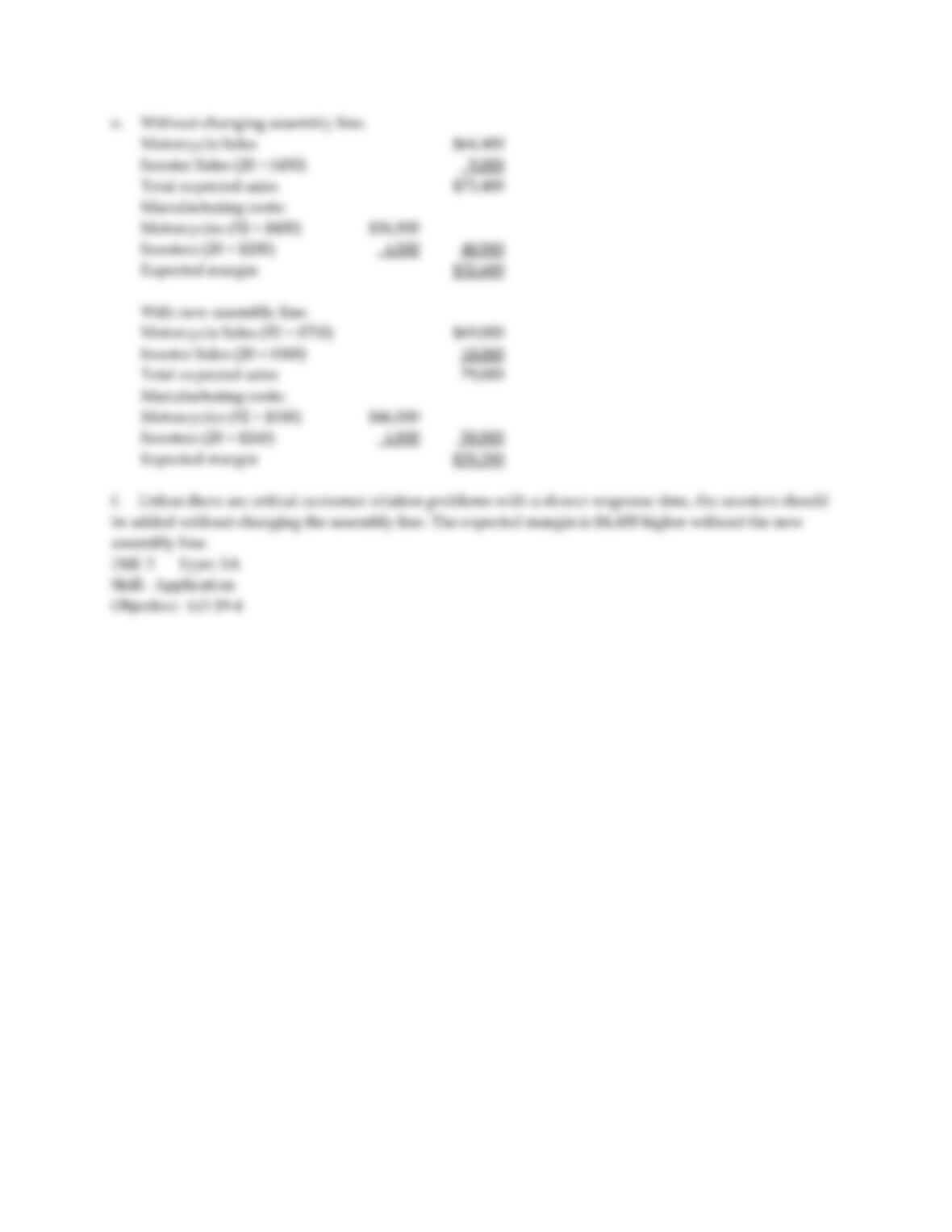
32) Canevil Unlimited makes small motorcycles. The monthly demand ranges from 80 to 100 motorcycles.
The average demand is 92 motorcycles. The plant operates 300 hours a month. Each cycle takes
approximately 1.5 hours.
If the company adds a new line of scooters, initial demand will be 20 per month. Each scooter will take 1
hour to make. To offset approaching production capacity, expanding the assembly line is possible. This
will decrease manufacturing time for all products by 20 percent. However, this will increase the costs of
cycles from $400 to $500 and scooters from $200 to $240. The change will also cause increases in prices
from $700 to $750 for cycles and from $450 to $500 for scooters.
Required:
a. What is the average waiting time for cycles if they are the only item manufactured?
b. What is the average waiting time if both cycles and scooters are produced and the assembly line is
not enlarged?
c. What is the average waiting time if both cycles and scooters are produced and the assembly line is
enlarged?
d. What is the expected monthly margin without scooters if the company sells all 92 cycles it
manufactures?
e. What are the expected monthly contribution margins if scooters are made with the current assembly
line and with the new assembly line? Assume average sales and that sales equal production.
f. What action do you recommend?
Cost Accounting: A Managerial Emphasis, 6e
Chapter 19 – Cost Management: Quality, Time, and the Theory of Constraints
19–46
Cost Accounting: A Managerial Emphasis, 6e
Chapter 19 – Cost Management: Quality, Time, and the Theory of Constraints
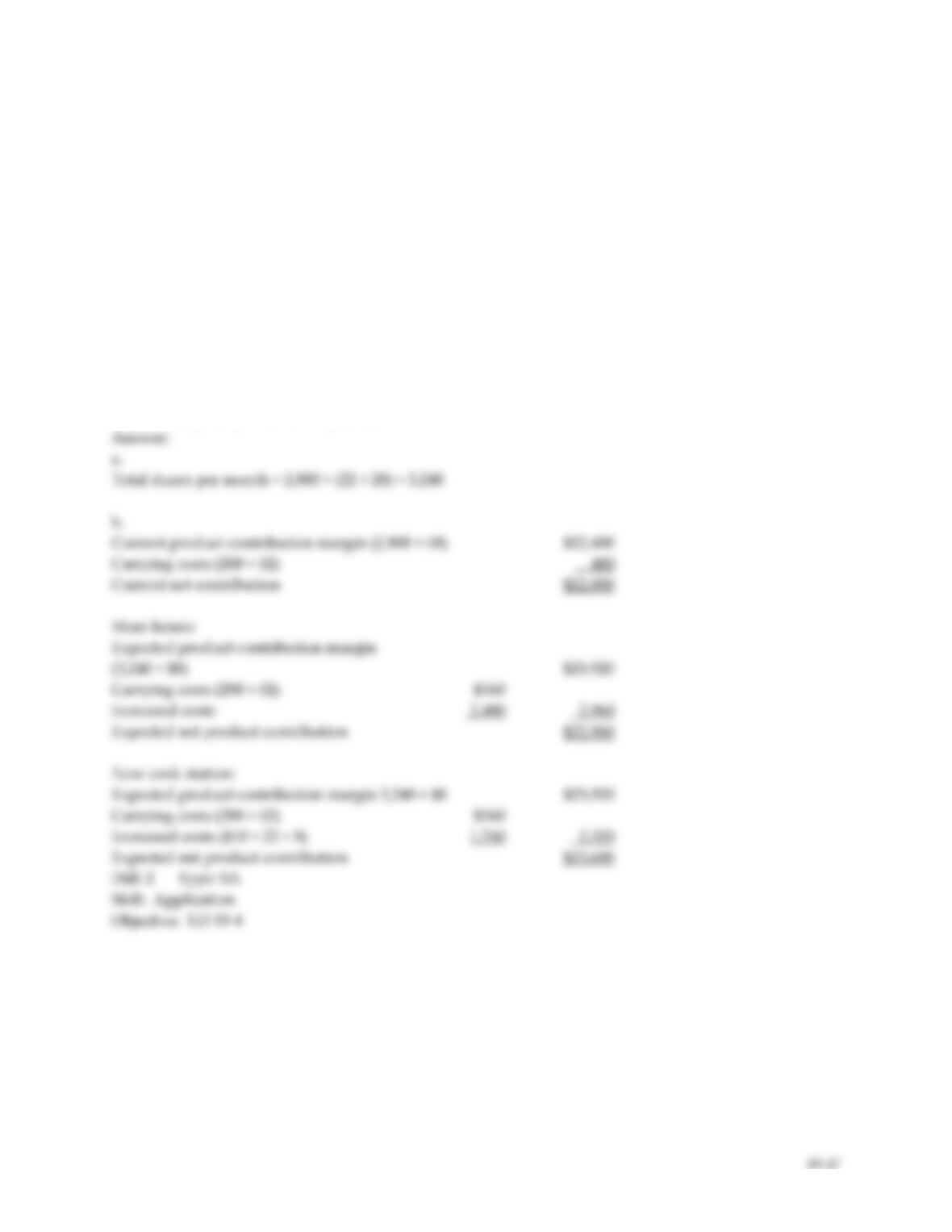
33) Brix, Inc. prepares frozen food for fast-food restaurants. It has two workstations, cooking and
assembly. The cooking station is limited by the cooking time of the food. Assembly is limited by the
speed of the workers. Assembly normally waits on food from cooking. Because the demand has increased
in recent months to 2,800 dozen units, management is considering adding another cook station or else
having the cooks start to work earlier. The monthly cost of operating the cooking station one more hour
each day is $2,400. The cost of adding another cook station would add an average of $10 per hour. The
current operating hours total eight hours a day, 22 days a month. The contribution margin of the finished
products is currently $8 per dozen. Inventory carrying costs average $2.00 per dozen per month. Either
the extra hour or the new cook station would increase production by 20 dozen a day with a long–run
increase of 80 dozen units in finished goods inventory to 280 dozen.
Required:
a. What is the total production per month if the change is made?
b. What is the increase in the expected monthly product contribution for each of the possible changes?
Assume long-run production equals sales.
Cost Accounting: A Managerial Emphasis, 6e
Chapter 19 – Cost Management: Quality, Time, and the Theory of Constraints
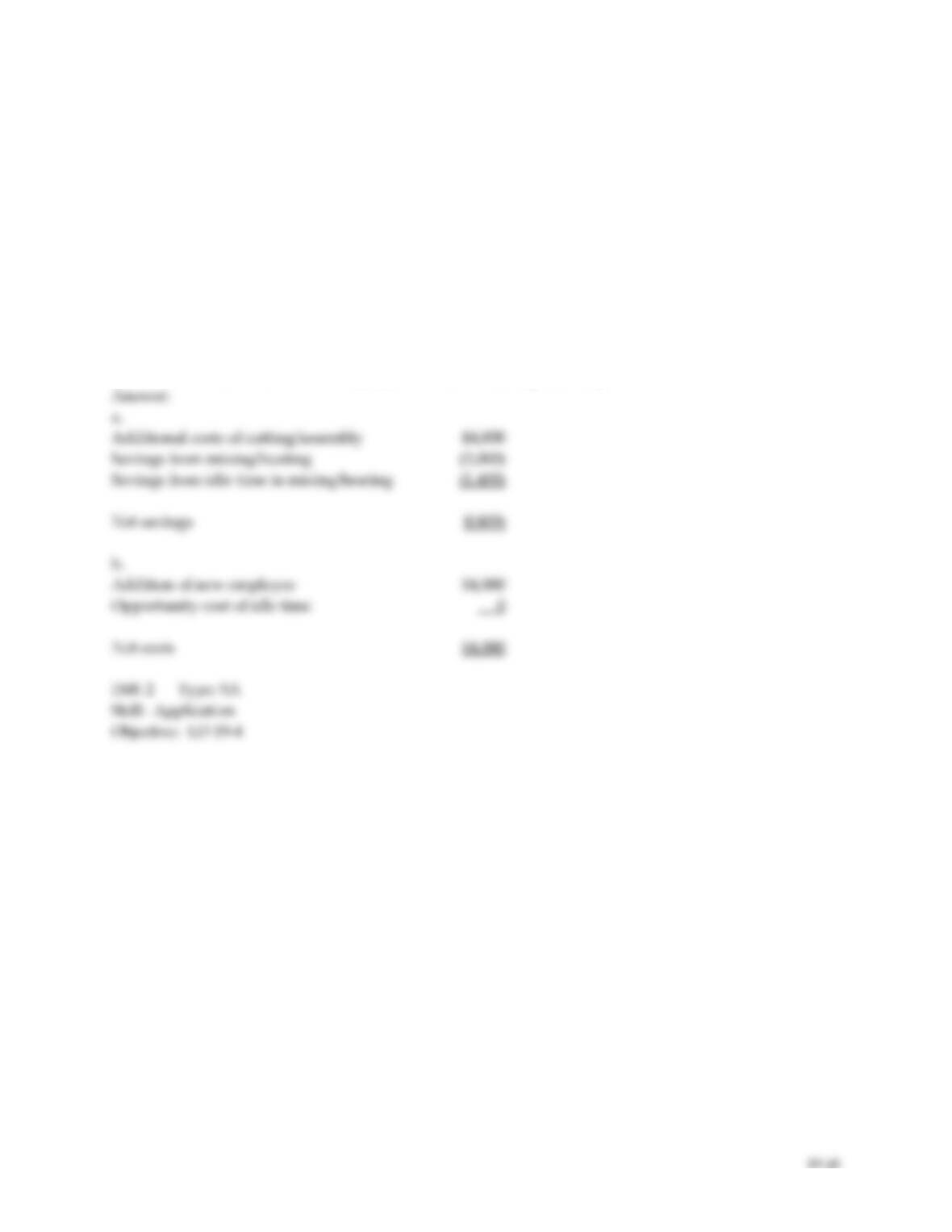
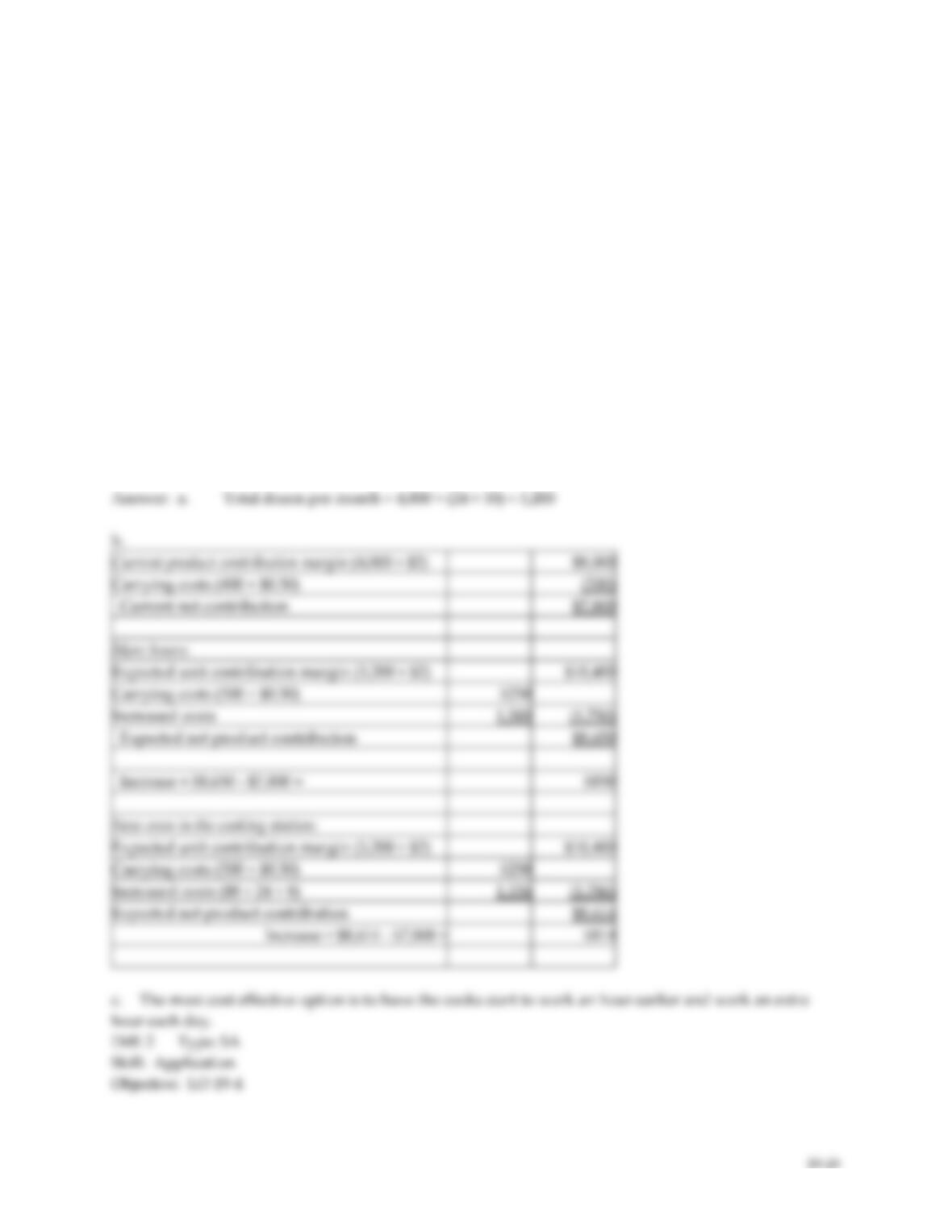
34) Sof-T, Inc. manufactures foam products for upholstery companies. It has two workstations,
mixing/heating and cutting/assembly. The mixing/heating station is limited by the capacity of the
equipment. Cutting/assembly is limited by the speed of the cutting machine workers. Cutting/assembly
normally lags behind mixing/heating. Because the demand has increased in recent months, management
is considering adding another person to cutting/assembly. This would increase the department’s costs by
$4,000 a month. If the person is moved from mixing/heating, that department’s cost would decline by
$3,000. By keeping mixing/heating labourers the same, the department can increase production on-call by
10 percent. Current idle time in mixing/heating averages one-half person a day for a net cost of $1,400 a
month.
Required:
a. What is the net effect of moving the employee from mixing/heating to cutting/assembly?
b. What is the net effect if a new employee is hired for cutting/assembly?
Cost Accounting: A Managerial Emphasis, 6e
Chapter 19 – Cost Management: Quality, Time, and the Theory of Constraints
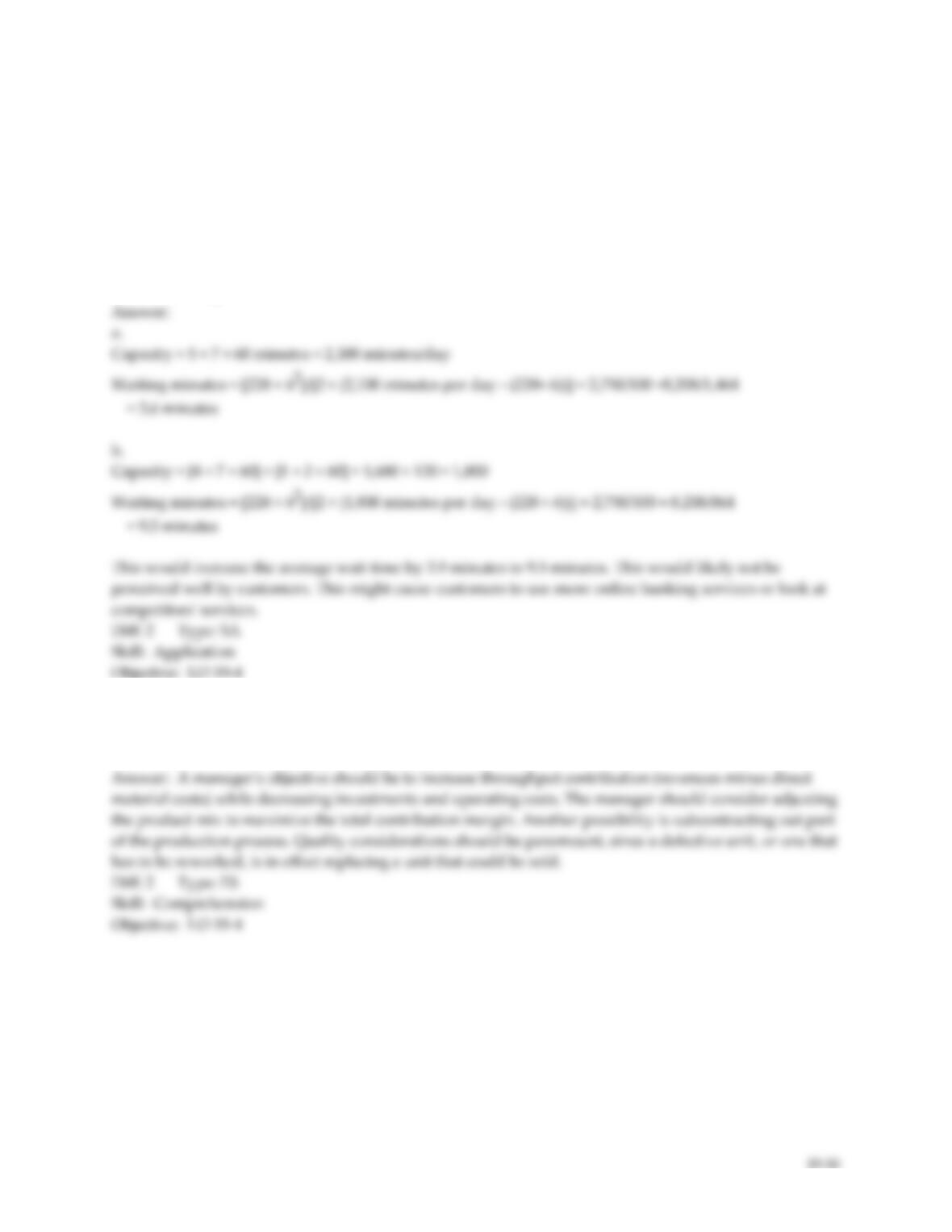
35) Aunt Lydia’s Cookies, Inc., prepares frozen gourmet cookies for shipment to upscale grocery stores as
well as mailing to web and catalog customers. The company has two workstations, cooking and
distribution. The cooking station is limited by the cooking time of the food. Distribution is limited by the
speed of the workers. Distribution normally waits on food from cooking. Because the demand has
increased in recent months to 4,000 dozen cookies, management is considering adding another oven in
the cooking station or else having the cooks start to work earlier. The monthly cost of operating the
cooking station one more hour each day is $1,500. The cost of adding another cooking station would add
an average of $8 per hour. The current operating hours total eight hours a day, 24 days a month. The
contribution margin of the finished products is currently $2 per dozen. Inventory carrying costs average
$0.50 per dozen per month. Either the extra hour or the new cooking station would increase production
by 50 dozen a day, with a long-run increase of 100 dozen units in finished goods inventory to 500 dozen.
Required:
a. What is the total production per month if the change is made?
b. What is the increase in the expected monthly product contribution for each of the possible
changes? Assume long-run production equals sales.
c. What course of action would you recommend?
Cost Accounting: A Managerial Emphasis, 6e
Chapter 19 – Cost Management: Quality, Time, and the Theory of Constraints
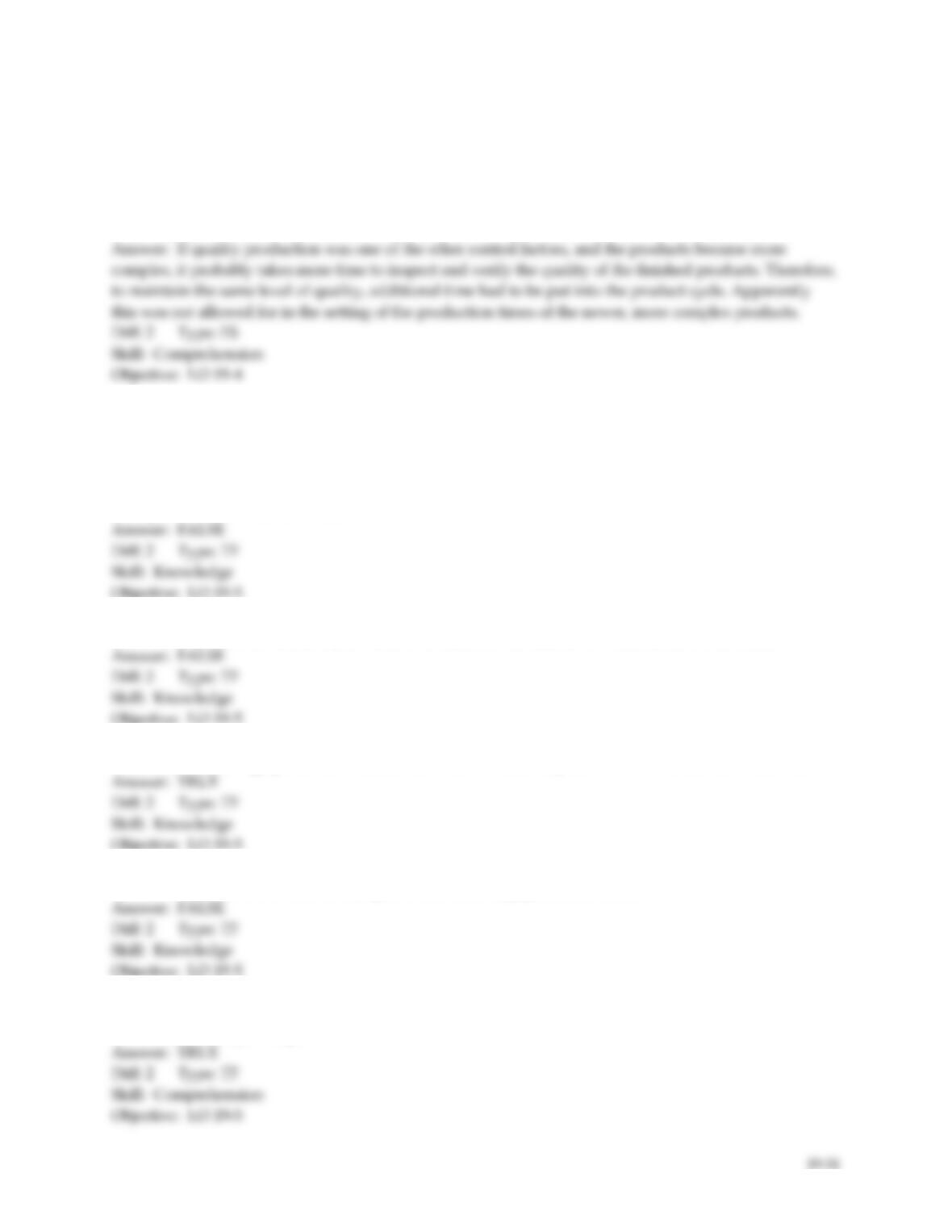
36) Bank of Bowmanville has variable demand for its counter services. The daily demand ranges from 200
to 250 customers a day and the average banking transaction takes 6 minutes. The average daily demand
is 228 customers. The bank currently has 5 staff members serving the counter and operates 7 hours a day.
Required:
a. What is the average customer waiting time in minutes?
b. In an effort to reduce costs, the bank is considering eliminating one of its counter services staff and
having a manager fill in during two hours of the day. What would be the effect of this change on wait
time? What might the customers’ reaction be?
37) The Alpha Beta Corporation experiences numerous instances of constraints hindering the effective
operation of their manufacturing process. Identify the methods that might be used to maximize operating
income, and minimize the effect of the constraints.
Cost Accounting: A Managerial Emphasis, 6e
Chapter 19 – Cost Management: Quality, Time, and the Theory of Constraints
38) Acme Janitor Service has always taken pride in the fact that it had one of the highest customer
response times in the home cleaning service industry. However, as the products manufactured for this
industry have become more complex, the company’s customer response time has declined.
Required:
Why do you think that response time declined if all other quality factors have remained the same?
19.5 Evaluate the strengths and weaknesses of the theory of constraints (TOC) and
activity-based costing (ABC) for managing bottlenecks.
1) The theory of constraints describes methods of reducing bottlenecks by identifying and reducing fixed
costs previously viewed as variable.
2) The theory of constraints analyzes fixed costs and considers short–run costs to be variable costs.
3) In a manufacturing operation, the bottleneck machine sets the pace for all non-bottleneck machines.
4) Producing more non-bottleneck output increases throughput contribution.
5) The objective of the theory of constraints is to increase throughput contribution while decreasing
investments and operating costs.