Chapter 19: Accounting for Postretirement Benefits
75. Joan, Inc. started a pension plan on January 1, 2016. At that date, prior service cost of $1,100,000 was recognized as a
result of prior service credit granted to existing employees. At December 31, 2016, the following information was
available:
Service cost for 2016
$ 90,000
Fair value of plan assets
225,500
Projected benefit obligation
1,278,000
Employer contribution for 2016 (at 12/31)
225,500
Expected asset return rate
7%
Discount rate
8%
Average remaining service life
16 years
Required:
a.
Compute the pension expense for 2016.
b.
Prepare appropriate journal entries for 2016.
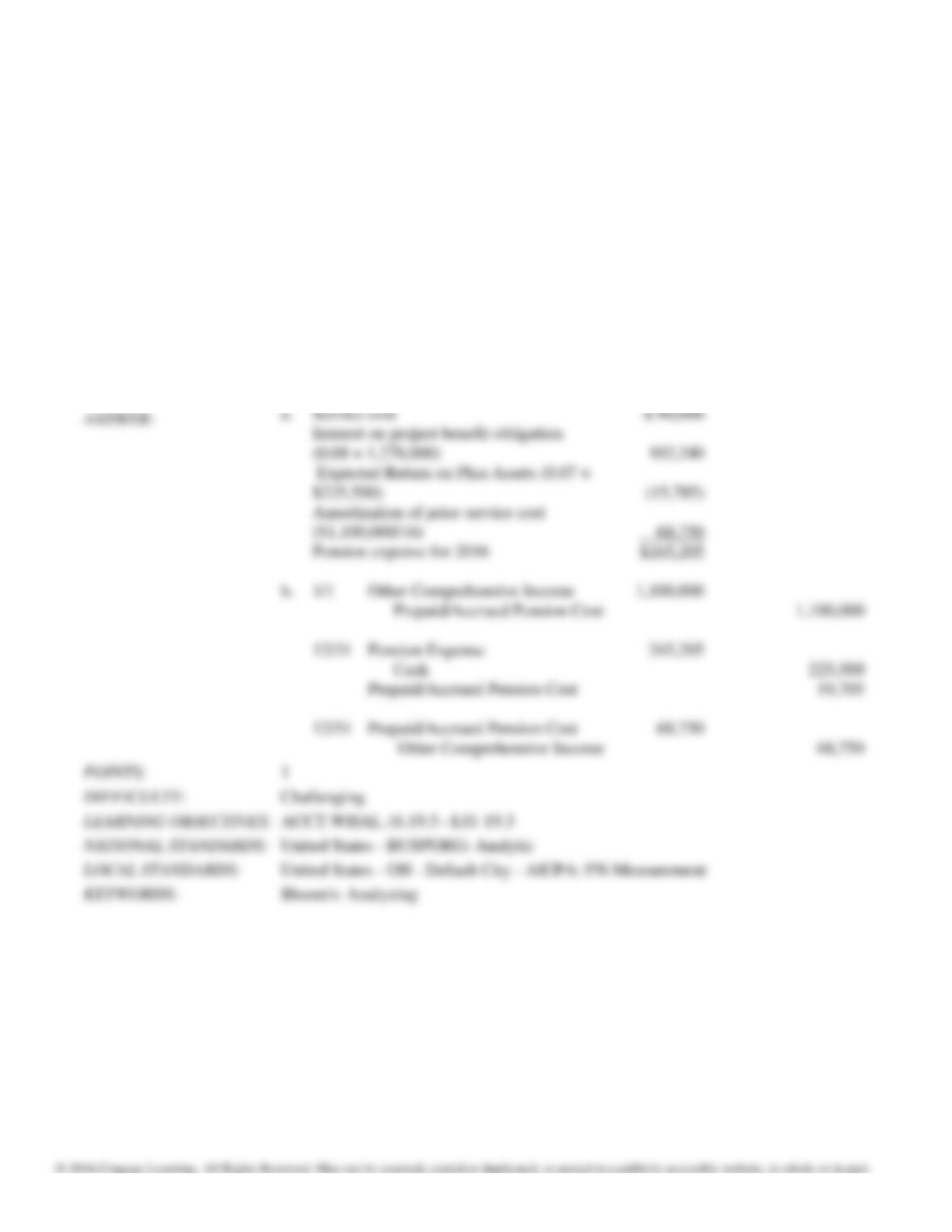
a.
Service cost
Interest on project benefit obligation
(0.08 × 1,278,000)
Pension expense for 2016
b.
1/1
Other Comprehensive Income
Prepaid/Accrued Pension Cost
12/31
Pension Expense
Cash
Prepaid/Accrued Pension Cost
12/31
Prepaid/Accrued Pension Cost
Other Comprehensive Income
1
Challenging
ACCT.WHAL.16.19.3 – LO: 19.3
United States – BUSPORG: Analytic
United States – OH – Default City – AICPA: FN-Measurement
Bloom’s: Analyzing
Chapter 19: Accounting for Postretirement Benefits
Total
2018
76. In 2016, the Ballaster Company decided to amend its defined benefit pension plan. The amendment gave 7 employees
the right to receive future benefits based upon their prior service. Ballaster’s actuary determined that the prior service
cost for this amendment amounts to $550,000. One employee will retire in 1 year, 2 expect to retire in 2 years,1 in
three years, 1 in 4 years, and 2 in five years.
Required:
Using the straight line method
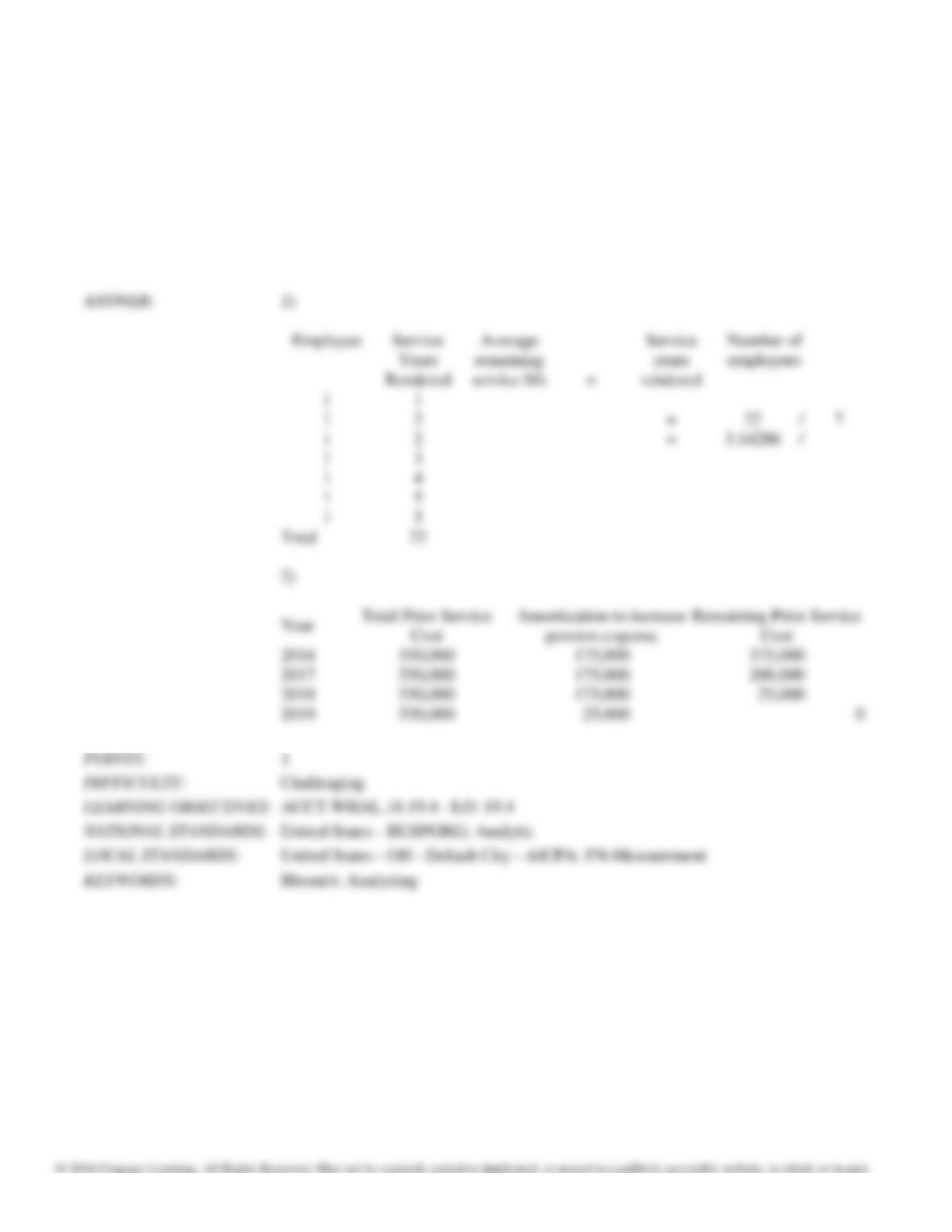
1)compute the remaining service life (round to 5 decimals)
2) prepare an amortization schedule to amortize the prior service cost
ACCT.WHAL.16.19.4 – LO: 19.4
United States – OH – Default City – AICPA: FN-Measurement
Chapter 19: Accounting for Postretirement Benefits
77. In 2016, the Electrician Company decided to amend its defined benefit pension plan. The amendment gave 7
employees the right to receive future benefits based upon their prior service. Electrician’s actuary determined that the
prior service cost for this amendment amounts to $550,000. Employee A will retire in 1 year, employee’s B & C expect
to retire in 2 years, employee D in three years, employee E in 4 years, and employee’s F & G in five years.
Required:
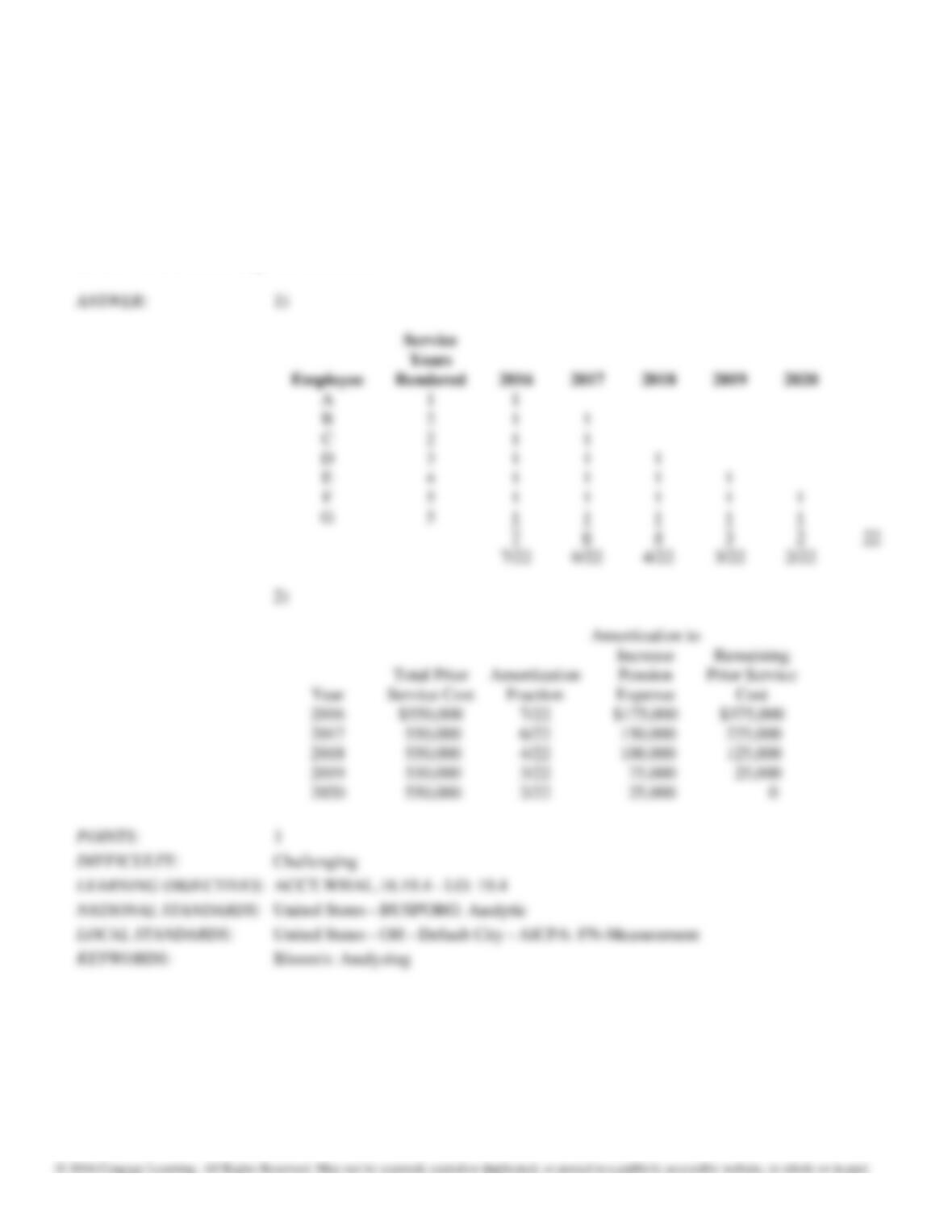
Using the years-of-future service method, prepare the schedules to determine:
1) the amortization fraction for each year
2) the amortization of the prior service cost
Chapter 19: Accounting for Postretirement Benefits
78. Mark, Inc. amended its defined benefit pension plan as of January 1, 2016. Mark received a report from its actuary
stating that at the beginning of 2016 unrecognized prior service cost resulting from the amendment amounted to
$144,000. The company’s work force was composed of twelve people. Four were expected to retire at the end of 2018.
Two were expected to retire at the end of 2020, two more at the end of 2022, and four at the end of 2024.
Required:
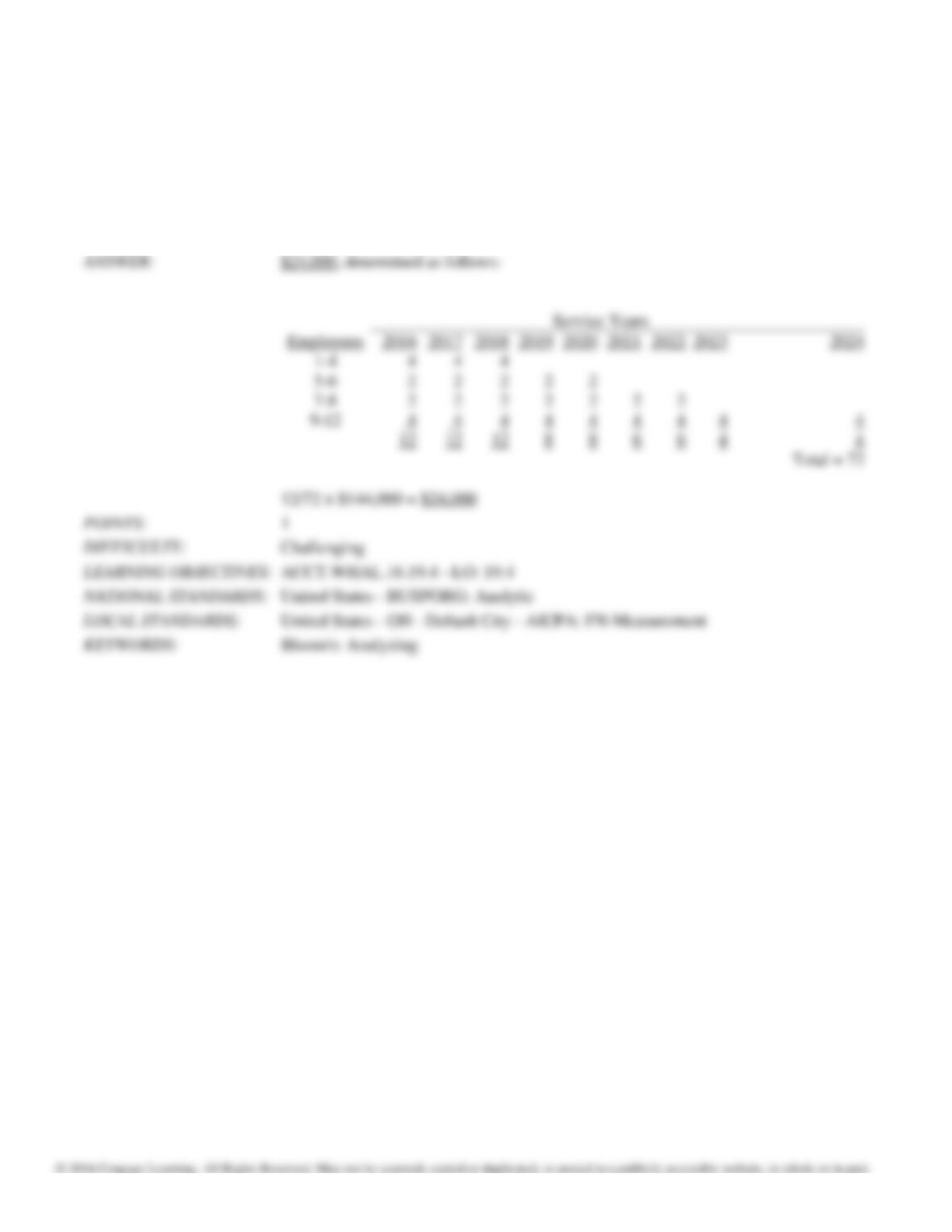
Using the years-of-future-service method, compute the amount of prior service cost to be amortized in the first year.
Chapter 19: Accounting for Postretirement Benefits
79. Martha Co. has a defined benefit pension plan for its employees. The plan was amended at the beginning of 2016
which increased benefits based on services rendered by certain employees in prior periods. The actuary has reported
that unrecognized prior service cost resulting from the amendment is $385,000. Five employees expect to receive the
increased benefits. Shown below is a schedule of the employees and their expected years of future service:
Employee No.
Expected Years of
Future Service
1
5
2
6
3
7
4
8
5
9
Required:
Using the straight-line method:
a.
Compute the average remaining service life.
b.
Determine the amount of unrecognized prior service cost to be included in the 2016
pension expense calculation.
Chapter 19: Accounting for Postretirement Benefits
80. Robin Co. has a defined benefit pension plan that has experienced differences between its expected and actual
projected benefit obligation. Data on the plan as of January 1, 2016, follow:
Unrecognized net gain
$ 98,000
Fair value of plan assets
250,000
Projected benefit obligation
380,000
Unrecognized net gain at January 1, 2016
Corridor (10% × $380,000)
Excess gain
Net gain deducted in pension expense calculation = $60,000/12 years = $5,000
1
Challenging
ACCT.WHAL.16.19.4 – LO: 19.4
United States – BUSPORG: Analytic
United States – OH – Default City – AICPA: FN-Measurement
Bloom’s: Analyzing
There was no difference between the company’s expected and actual return on plan assets during 2016. The average
remaining service life of the company’s employees is 12 years.
Required:
Determine the amount of the net gain or loss to be included in pension expense for 2016 and indicate whether it is an
increase or decrease in the pension expense calculation.
Chapter 19: Accounting for Postretirement Benefits
81. A list of descriptive phrases related to pension plan accounting is shown below:
____
a.
A reconciliation of the beginning and ending balances of the projected benefit
obligation.
____
b.
The amounts and types of securities included in the plan assets.
____
c.
A reconciliation of the beginning and ending balances of the fair value of the plan
assets.
____
d.
The discount rate.
____
e.
The actuarial value of the vested benefits.
____
f.
The funded status of the plan, the amounts not recognized on the balance sheet,
and the amounts recognized on the balance sheet.
____
g.
The expected long-term rate of return on the plan assets.
____
h.
The basis for determining payments to which employees will be entitled during
retirement.
____
i.
The amount of pension expense.
____
j.
The names of employees who are presently receiving pension benefits.
a.
Y
e.
Y
i.
b.
Y
Y
j.
c.
Y
g.
Y
d.
Y
h.
N
ACCT.WHAL.16.19.4 – LO: 19.4
Required:
In the space preceding each phrase, indicate whether the item described must be disclosed per the requirements of
current GAAP regarding an employer’s disclosures about pensions and other postemployment benefits. Use “Y” if the
item is a required disclosure and “N” if it is not a required disclosure.
Chapter 19: Accounting for Postretirement Benefits
82. Marjorie, Inc.’s records contained the following data as of December 31, 2016, on its OPEB plan:
Service cost
$ 250,000
Benefits paid
90,000
Contributions to the plan
50,000
Actual & expected return on plan assets
68,000
Unrecognized prior service cost amortization
36,000
Accumulated postretirement benefit obligation (1/1/2016)
1,200,000
Discount rate
8%
Required:
a.
Compute the OPEB expense for 2016.
b.
Service cost
$250,000
Interest cost ($1,200,000 × 8%)
Return on plan assets
Amortization of unrecognized prior service cost
OPEB expense
$314,000
b.
Post-retirement Benefit Expense
Cash
Accumulated Postretirement Benefit Cost
1
Challenging
ACCT.WHAL.16.19.5 – LO: 19.5
United States – BUSPORG: Analytic
United States – OH – Default City – AICPA: FN-Measurement
Bloom’s: Analyzing
Prepare the journal entry to record the 2016 OPEB expense.
Chapter 19: Accounting for Postretirement Benefits
83. On January 1, 2016, Jackson Hole Company decided to provide a healthcare plan for retired employees. In order for
benefits to be determined for each employee, the company gives credit to the date of hire for each employee. This is a
retroactive benefit. The following information regarding the plan is as follows:
Accumulated postretirement benefit obligation for employees fully
eligible to receive benefits (12/31/16)
$ 50,000
Accumulate postretirement benefit obligation (1/1/16)
150,000
Average remaining service period of active plan participants
(1/1/16)
10 years
Expected return on plan assets
–
Interest rate
12%
Payments to retired employees during 2016
$ 15,000
Prior service cost
25,000
Service Cost
45,000
Service Cost
Interest cost on accumulated postretirement benefit
obligation ($150,000 x .12)
Expected return on plan assets
Amortization of prior service cost ($25,000 / 10)
2,500
OPRB expense
Other Comprehensive Income: Prior Service Cost
Accrued Postretirement Benefit Cost
Postretirement Benefit Expense
Accrued Postretirement Benefit Cost
65,500
Accrued Postretirement Benefit Cost
Cash
15,000
Accrued Postretirement Benefit Cost
Other Comprehensive Income: Prior Service Cost
2,500
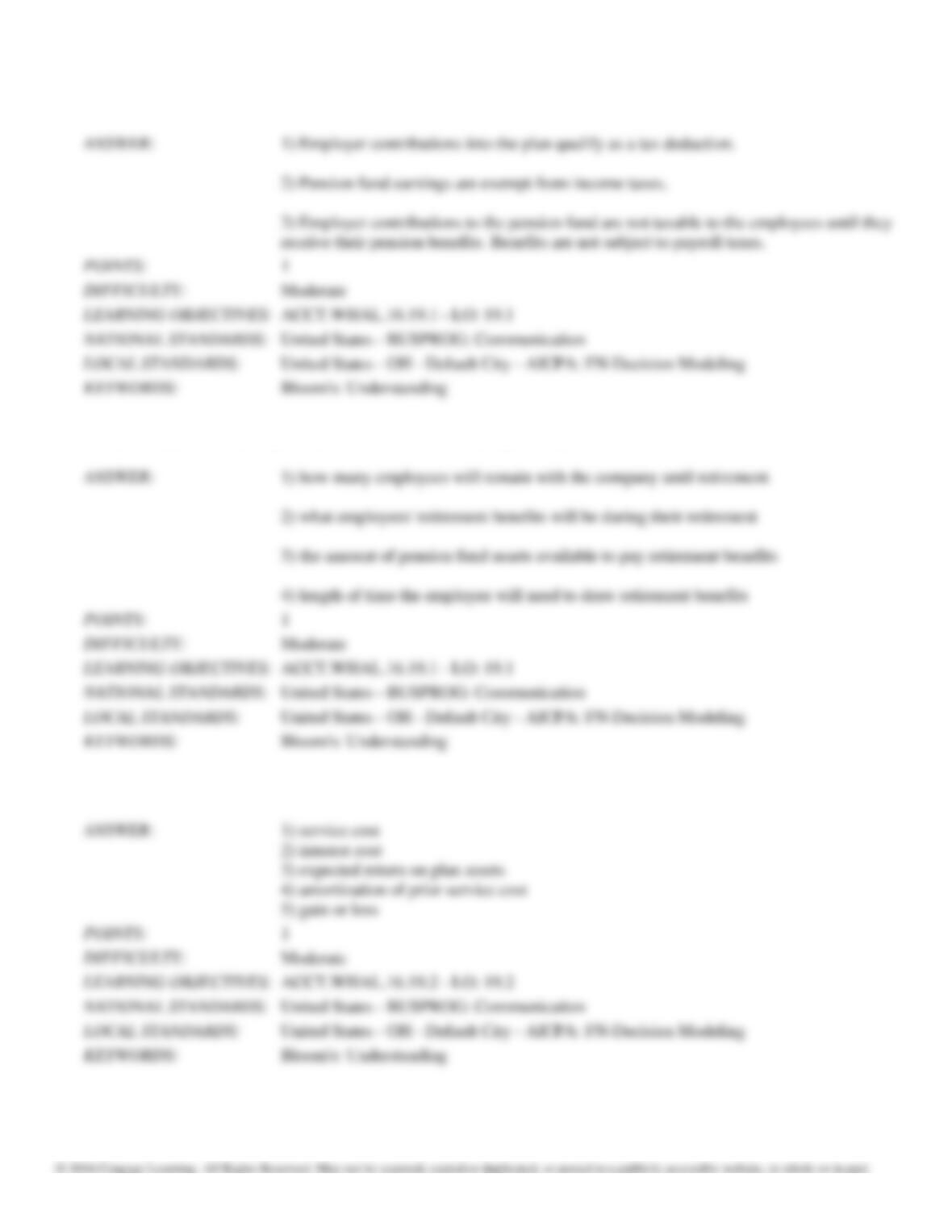
1/1/2016 accumulated postretirement benefit obligation balance
+ Service Cost for 2016
+ Interest Cost for 2016
– Payment of retirement benefits for 2016
( 15,000)
12/31/16 accumulated postretirement benefit obligation balance
1
Challenging
ACCT.WHAL.16.19.5 – LO: 19.5
United States – OH – Default City – AICPA: FN-Measurement
Bloom’s: Analyzing
Required:
1) Compute the OPRB expense for 2016 using the average remaining service life to amortize the prior service cost.
2) Prepare all the required journal entries for 2016 if the plan is not funded.
3) Compute the accumulated postretirement benefit obligation.
Chapter 19: Accounting for Postretirement Benefits
84. What are the advantages of qualified pension plans?
85. What estimates are necessary to account for a defined benefit pension plan?
86. What five components comprise pension expense?
Chapter 19: Accounting for Postretirement Benefits
87. What three methods are available to provide guidance for companies to recognize gains or losses in pension expense?
88. The IASB’s 2011 amendment to IAS 19 removed the smoothing of devices in pension accounting, which means
that companies will have to recognize all changes in their projected benefit obligation and plan assets in the current
period. These changes will be recorded in pension expense or other comprehensive income. With this change pension
expense will have two components. Indicate that those two components are and provide a brief explanation of each.
89. What disclosures are required by GAAP about a company’s defined benefit pension plan?
Chapter 19: Accounting for Postretirement Benefits
90. What four alternative methods for accounting for prior service cost were considered by accounting regulators?
91. What five alternatives were examined by regulators to determine which best met the recognition-measurement criteria
of a liability?
92. Define the following:
expected postretirement benefit obligation (EPBO)
accumulated postretirement benefit obligation (APBO)
Chapter 19: Accounting for Postretirement Benefits
93. What are the three major differences between the accounting for pensions and the accounting for other
Postretirement Benefits (OPRB’s)?
Chapter 19: Accounting for Postretirement Benefits
94. According to GAAP pension expense for a defined benefit pension plan consists of five components.
Required:
List and briefly describe each of the five components of net periodic pension cost that a company must recognize.
Chapter 19: Accounting for Postretirement Benefits
95. The board of directors of the Vermont Company is going to adopt a defined benefit pension plan for the company’s
employees. The board is considering granting pension credit for up to ten (10) years of service rendered prior to the
date that the plan is adopted. The board desires to grant the retroactive credit in order to provide equity to employees
for their previous years of service. The board has hired an actuary to determine the cost of granting the retroactive
credit. The actuary has calculated the cost of the retroactive benefits to be approximately one million dollars. The
board has asked the company’s controller to explain how the cost of the prior service credit would be accounted for in
the financial statements.
Required:
a.
Describe the GAAP that would be required by Vermont Company if prior service credit is
granted to its employees.
b.
Many people have argued that the method adopted by the FASB to account for prior
service costs has several conceptual flaws. Briefly discuss the flaws of the approach
adopted by the FASB for prior service costs.
c.
service costs violates the matching principle. The matching principle is violated
because all the services were performed by the employees in previous periods,
(1)
Recognize the total prior service cost as an expense in the period when it
(2)
Recognize the total prior service cost as a prior period adjustment (i.e., a
(3)
Account for it prospectively. Expense it in current and future periods. No
The textbook discusses three other approaches that might have been used to account for
prior service costs. Describe these three alternative approaches.
Chapter 19: Accounting for Postretirement Benefits
96. Current GAAP requires that a company with a defined benefit pension plan disclose a reconciliation of the beginning
and ending balances of the projected benefit obligation.
Required:
State the items that must be included in this disclosure.
97. One type of post-retirement benefit other than pensions is healthcare benefits.
Required:
Discuss the major differences between postretirement healthcare benefits and pensions.
Chapter 19: Accounting for Postretirement Benefits
98. In addition to providing pensions to their employees, many companies also offer other postemployment benefits.
These are benefits going to former employees after employment but before retirement.
Required:
Describe how the cost of these benefits is to be accounted for under current GAAP.