Exam
Name___________________________________
TRUE/FALSE. Write ‘T’ if the statement is true and ‘F‘ if the statement is false.
1) Firms typically would prefer a positive cash conversion cycle versus a negative cash conversion cycle.
2) Working capital alters a firm’s value by affecting its free cash flow.
3) Working capital management involves the management of all of a firm’s assets and liabilities.
MULTIPLE CHOICE. Choose the one alternative that best completes the statement or answers the question.
4) Which of the following is a firm‘s cash cycle?
A) the average length of time between when a firm originally purchases its inventory and when it receives
the cash back from selling its product
B) the average length of time between when a firm pays cash to purchase its initial inventory and when it
receives cash from the sale of the product produced from that inventory
C) the average length of time between when a firm pays cash to purchase its initial inventory and when it
sells that product
D) the average length of time between when a firm originally purchases its inventory and when it sells the
product produced from that inventory
5) Macrae Products, a manufacturer of building products, buys raw gypsum on credit on May 16. It processes
this gypsum to make dry plaster powder on May 20 and pays cash for the raw gypsum on May 30. On June 7
it sells the dry plaster powder to a chain of hardware stores, and on June 21 receives cash payment for this
sale. What is the length of the cash cycle in this case?
A) 8 days
B) 14 days
C) 22 days
D) 23 days
6) Genovese Fine Foods, a manufacturer of foodstuffs, buys durham wheat flour on credit on June 1. It
processes this flour to make pasta on June 6 and pays cash for the flour on June 15. On June 22 it sells the
pasta to a chain of supermarkets, and on July 3 receives cash payment for this sale. What is the length of the
cash cycle in this case?
A) 8 days
B) 12 days
C) 18 days
D) 28 days
7) Which of the following is a firm‘s operating cycle?
A) the average length of time between when a firm originally purchases its inventory and when it receives
the cash back from selling its product
B) the average length of time between when a firm pays cash to purchase its initial inventory and when it
receives cash from the sale of the product produced from that inventory
C) the average length of time between when a firm originally purchases its inventory and when it sells the
product produced from that inventory
D) the average length of time between when a firm originally purchases its inventory and when it pays
cash for that inventory
8) Jerome Industries has inventory days of 48, accounts receivable days of 21, and accounts payable days of 30.
What is its cash conversion cycle?
A) 39 days
B) 57 days
C) 69 days
D) 72 days
9) Sales 122,800
Cost of Goods Sold 104,380
Accounts Receivable 10,900
Inventory 1,420
Accounts Payable 22,640
Cromwell Incorporated has the information shown above on its annual Income Statement and Balance Sheet
(all numbers shown are in thousands). What is Cromwell’s cash conversion cycle?
A) –41.8 days
B) –36.1 days
C) 24.3 days
D) 111.6 days
10) Which of the following firms would be expected to need the most cash to conduct its daily operations?
A) a retail grocery store that sells on a cash only basis
B) an electronics manufacturer that only assemble its goods once they have been paid for
C) an airline that has many of its fares pre–paid by cash or credit card
D) an aircraft manufacturer with large inventory and long development and sales cycles
11) Net Income 60,000
+ Depreciation +6,000
– Capital Expenditures –7,000
– Increases in Working Capital –2,000
= Free Cash Flow 57,000
Vega Music’s projected net income and free cash flows are given above in thousands of dollars. Vega expects
that their net income and increases in net working capital to increase by 5% per year. If Vega were able to
reduce its annual increase in working capital by 10% without affecting any other part of the business
adversely, what would be the effect of this reduction on Vega’s value, given a cost of capital of 13%?
A) an increase of $500,000
B) an increase of $1,370,000
C) an increase of $2,500,000
D) an increase of $3,800,000
12) Franklin Industries has a current net working capital of $2.5 million. It expects that this will grow at a rate of
3.5% annually forever. If it could slow that growth to 3% per year, how would that affect thevalue of the
firm, given that it has a cost of capital of 11%?
A) a decrease of $2.22 million
B) an increase of $12,500
C) an increase of $0.78 million
D) an increase of $2.08 million
13) The difference between a firm’s operating cycle and its cash cycle is
A) its account receivable days.
B) its accounts payable days.
C) its inventory days.
D) There is no difference between the cash and operating cycles.
14) The cash conversion cycle (CCC) is defined as
A) Inventory Days + Accounts Receivable Days – Accounts Payable Days.
B) Inventory Days – Accounts Receivable Days – Accounts Payable Days.
C) Inventory Days + Accounts Receivable Days + Accounts Payable Days.
D) Inventory Days + Accounts Payable Days – Accounts Receivable Days.
15) Which of the following statements is FALSE?
A) The main components of net working capital are cash, inventory, receivables, and payables.
B) The firm’s cash cycle is the average length of time between when a firm originally purchases its
inventory and when it receives the cash back from selling its product.
C) Working capital includes the cash that is needed to run the firm on a day–to–day basis. It does not
include excess cash, which is cash that is not required to run the business and can be invested at a
market rate.
D) If the firm pays cash for its inventory, the firm’s operating cycle is identical to the firm’s cash cycle
16) Which of the following statements is FALSE?
A) A firm’s cash cycle is the length of time between when the firm pays cash to purchase its initial
inventory and when it receives cash from the sale of the output produced from that inventory.
B) The longer a firm’s cash cycle, the more working capital it has, and the more cash it needs to carry to
conduct its daily operations.
C) Most firms buy their inventory on credit, which increases the amount of time between the cash
investment and the receipt of cash from that investment.
D) Any reduction in working capital requirements generates a positive free cash flow that the firm can
distribute immediately to shareholders.
Use the table for the question(s) below.
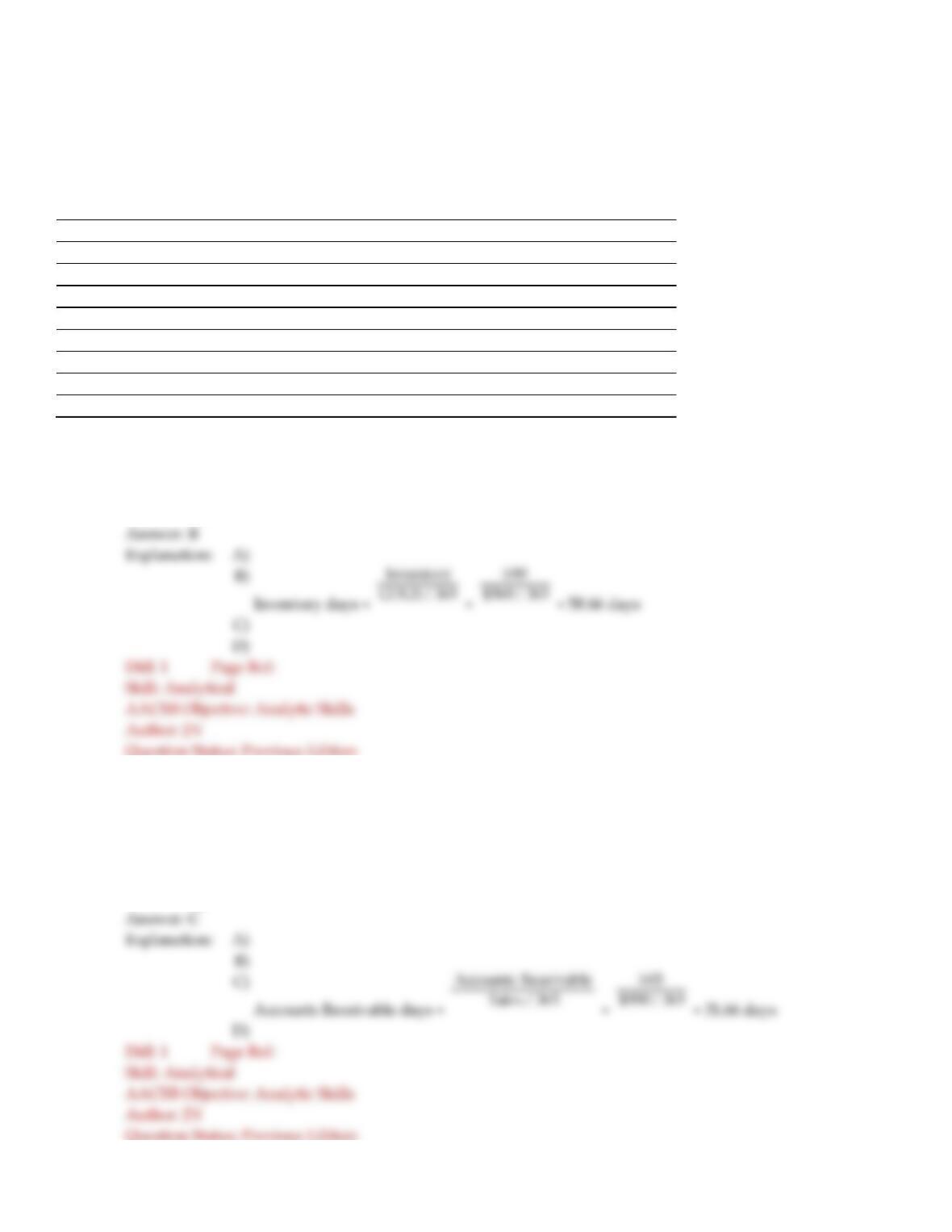
Luther Industries had sales of $980 million and a cost of goods sold of $560 million in 2006.
A simplified balance sheet for the firm appears below:
Luther Industries
Balance Sheet
As of December 31, 2006
(millions of dollars)
Assets
Liabilities and Equity
Cash
25
Accounts payable
60
Accounts receivable
85
Notes payable
425
Inventory
90
Accruals
45
Total current assets
200
Total current liabilities
530
Net plant, property, and equipment
6100
Long term debt
2725
Total assets
6300
Total liabilities
3255
Common equity
3045
Total liabilities and equity
6300
17) Luther’s Inventory days is closest to:
A) 32 days
B) 59 days
C) 39 days
D) 42 days
18) Luther’s Accounts Receivable days is closest to:
A) 42 days
B) 39 days
C) 32 days
D) 59 days
19) Luther’s Accounts Payable days is closest to:
A) 39 days
B) 32 days
C) 59 days
D) 42 days
20) Luther’s cash conversion cycle is closest to:
A) 51 days
B) 66 days
C) 71 days
D) 129 days
21) Which of the following would decrease a firm’s cash conversion cycle?
A) Increase the inventory days
B) Increase the accounts receivable days
C) Increase the accounts payable days
D) Increase the cash days
22) Which of the following would increase a firm’s cash conversion cycle?
A) Increase inventory days
B) Decrease accounts receivable days
C) Decrease accounts payable days
D) Increase cash days
SHORT ANSWER. Write the word or phrase that best completes each statement or answers the question.
23) What is a firm’s operating cycle?
24) What is a firm’s cash cycle?
25) Can a firm’s cash cycle be longer than a firm’s operating cycle?
TRUE/FALSE. Write ‘T’ if the statement is true and ‘F‘ if the statement is false.
26) Collection float is the amount of time it takes for a firm to be able to use funds after a customer has paid for
its goods.
27) Trade credit should always be used when it is offered.
MULTIPLE CHOICE. Choose the one alternative that best completes the statement or answers the question.
28) What is trade credit?
A) the credit that a firm is extends to its customers
B) the amount a firm is owed by its customers who have received goods and services but have not yet
paid for them
C) the percentage discount offered to a customer who opts to pay their account early
D) the amount that a firm owes its suppliers for goods which it has received but for which it has not yet
paid.
29) A firm offers its customers 2/14 net 28. What is the cost of trade credit to a customer who chooses to pay on
day 28?
A) 32.8%
B) 67.3%
C) 69.3%
D) 72.4%
30) What is meant by the term 1.5/14 net 30?
A) If the invoice is paid within 14 days a discount of 1.5 percent can be taken, otherwise the invoice is due
in 30 days.
B) If the invoice is paid within 30 days a discount of 14 percent can be taken, otherwise the invoice is due
14 days after that days.
C) If the invoice is paid within 1.5 days a discount of 14 percent can be taken, otherwise the invoice is due
in 30 days.
D) If the invoice is paid right away, a discount of 14 percent can be taken, otherwise a discount of 1.5
percent can be taken if paid within the next 30 days.
31) A firm offers its customers 3/5 net 25. What is the cost of trade credit to a customer who chooses to pay on
day 25?
A) 32.3%
B) 65.5%
C) 68.4%
D) 74.3%
32) A firm offers its customers 1/10 net 40. What is the cost of trade credit to a customer who chooses to pay on
day 40?
A) 12.8%
B) 13.0%
C) 65.5%
D) 96.0%
33) A firm tries to extend its disbursement float in order to reduce its working capital needs. Which of the
following is a risk that may be associated with this strategy, if it is taken too far?
A) may attract a late fee
B) may be required to pay before delivery for future supplies
C) may jeopardize the entire relationship with the supplier
D) all of the above
34) Which of the following best describes the collection float?
A) how long it takes the firm to receive the check after the customer has mailed it
B) how long it takes the firm to process the check and deposit it in the bank
C) how long it takes before the bank gives the firm credit for the funds
D) how long it takes for a firm to be able to use funds after a customer has paid for its goods
35) Which of the following best describes the availability float?
A) how long it takes the firm to process the check and deposit it in the bank
B) how long it takes before the bank gives the firm credit for the funds
C) how long it takes before payments to suppliers actually result in a cash outflow for the firm
D) how long it takes for a firm to be able to use funds after a customer has paid for its goods
36) Collection float is made up of all of the following EXCEPT:
A) disbursement float.
B) processing float.
C) mail float.
D) availability float.
37) Which of the following statements is FALSE?
A) Under the Modigliani–Miller assumptions of perfect capital markets, the amounts of payables and
receivables are irrelevant.
B) One factor that contributes to the length of a firm’s receivables and payables is the delay between the
time a bill is paid and the cash is actually received.
C) Collection float is the amount of time it takes before payments to suppliers actually result in a cash
outflow for the firm.
D) The credit that the firm is extending to its customer is known as trade credit.
38) Which of the following statements is FALSE?
A) The Check Clearing for the 21st Century Act (Check 21), which became effective on October 28, 2004,
eliminated the disbursement float due to the check–clearing process.
B) Trade credit is, in essence, a loan from the selling firm to its customer.
C) The accounts receivable balance represents the amount that a firm owes its suppliers for goods that it
has received but for which it has not yet paid.
D) Providing financing at below–market rates is an indirect way to lower prices for only certain customers.
39) What is the meaning of the term 2/10 net 30?
A) If the invoice is paid within 10 days a 2% discount can be taken. If the invoice is paid between 11 and
29 days a 1% discount can be taken. After 30 days the full invoice is due.
B) If the invoice is paid within 2 days a 10% discount can be taken, otherwise the full invoice is due in 30
days.
C) If the invoice is paid within 2 days a 10% discount can be taken, otherwise a 2% discount can be taken if
the invoice is paid in 30 days.
D) If the invoice is paid within 10 days a 2% discount can be taken, otherwise the full invoice is due in 30
days.
40) Your firm purchases goods from its supplier on terms of 1/10 net 30. The effective annual cost to your firm
if it chooses not to take advantage of the trade discount offered is closest to:
A) 16.8%
B) 44.6%
C) 20.1%
D) 13.0%
41) Which of the following is NOT an advantage of trade credit versus a standard loan?
A) Trade credit reduces a firm’s collection float.
B) If the buyer defaults, the supplier may be able to seize the inventory as collateral.
C) The supplier may have more information about the credit quality of the customer than a bank.
D) Providing financing at below–market rates is an indirect way to lower prices for only certain customers.
42) Which of the following is a component of disbursement float but not a component of collection float?
A) Availability float
B) Mail float
C) Processing float
D) Check–clearing float
SHORT ANSWER. Write the word or phrase that best completes each statement or answers the question.
43) What is cash discount?
44) What is discount period?
45) What is credit period?
46) What is collection float?
TRUE/FALSE. Write ‘T’ if the statement is true and ‘F‘ if the statement is false.
47) The three steps in establishing a credit policy are establishing credit standards, establishing credit terms, and
establishing a collection policy.
48) A firm that chooses a low–risk, restrictive credit policy will tend to have a larger investment in receivables.
MULTIPLE CHOICE. Choose the one alternative that best completes the statement or answers the question.
49) Which of the following are the “5–C’s of Credit”?
A) Character, Capacity, Compensation, Collateral, Conditions
B) Character, Cash, Credit, Collateral, Collectability
C) Character, Capacity, Capital, Collateral, Conditions
D) Cash, Capacity, Capital, Compensation, Collectability
50) A firm currently sells its product with a 2% discount to customers who pay by cash or credit card when they
purchase one of the firm’s products; otherwise, the full price is due within 30 days. Forty percent of
customers take advantage of the discount. The firm plans to drop the discount so the new terms will simply
be net 30. In doing so it expects to sell 100 fewer units per month and all customers to pay at day 30. The firm
currently sells 1000 units per month at a cost per unit of $45 and a selling price per unit of $80. If the firm’s
required return is 2%, what is the net present value (NPV) of making this change?
A) –$169,860
B) –$122,420
C) $64,490
D) $172,320
51) What should a firm do after establishing a credit policy?
A) Decide what should be done for those customers who do not pay their accounts on time.
B) Monitor its accounts receivable to analyze whether its credit policy is effective.
C) Decide on the length of the period before payment must be made.
D) Determine what percent of monthly sales are collected in the month after that sale.
52) A firm’s credit terms specify “1/10 net 30” and the accounts receivable days outstanding is 32 days. Which of
the following can be concluded on the basis of this information?
A) Most customers pay on time.
B) The average customer pays two days late.
C) All customers have paid within 32 days of purchase.
D) All customers pay late.
53) SwenCorp had sales of $154 million this year and an average accounts receivable of $18 million per day. Its
credit terms specify “2/14 net 40.” On average, how long does it take to collect on its sales?
A) 8.5 days
B) 13 days
C) 28 days
D) 43 days
54) Jen Industries had sales of $32 million this year and an average accounts receivable of $0.8 million per day.
On average, how long does it take to collect on its sales?
A) 9 days
B) 11 days
C) 12 days
D) 19 days
55) Commercial Supply Corp. bills its accounts on terms of 2/10 net 30. The firm’s accounts receivable include
$200,000 that has been outstanding for ten or fewer days, $126,000 outstanding for 11 to 30 days, $98,000
outstanding for 31 to 40 days, $12,000 outstanding for 41 to 50 days, $20,000 outstanding for 51 to 60 days,
and $7000 outstanding for more than 60 days. Is the aging schedule for Commercial Supply Corp. bottom
heavy?
A) No, since 70% of the outstanding sales are on time and the percentage of long term outstanding
payments is low.
B) Yes, since the percentage of payments that are late are greater than the percentage of payments that are
on time.
C) No, since since the percentage of payments that are late are greater than the percentage of payments
that are on time.
D) cannot tell from the information given
56) Customer Amount Owed Age (days)
Abel $10,000 53
Brannick $69,000 12
CLI $45,230 65
Deer $14,800 27
ESR $22,090 39
Flann $14,890 78
Graill $23,180 62
A firm has the accounts on its books shown above. What percentage of debt has been outstanding for over 60
days?
A) 28%
B) 30%
C) 34%
D) 42%
57) Which one of the following is NOT one of the three steps involved in establishing a credit policy?
A) establishing credit payment patterns
B) establishing credit standards
C) establishing a collection policy
D) establishing credit terms