19
Taxation of Business Forms and Their Owners
Solutions to Tax Research Problems
19-25 Family partnerships are attractive because of both tax and non-tax incentives.
However, the Tax Reform Act of 1986 reduced the tax benefits associated with
family partnerships. First, the individual income tax rates were reduced from a
maximum rate of 50 percent to a maximum rate of 28 percent (33% of the
interplay of the phase-out of the lower bracket) beginning in 1988. This reduces
the benefits associated with shifting income from a member of the family in a
higher tax bracket to a member of the family in a lower tax bracket. Second, § l(i)
of TRA 86 requires that the unearned income of dependents under age 14 be taxed
at the higher of their marginal tax rate, or their parents’ marginal tax rate.
The income from a partnership could constitute unearned income, particularly
if the daughter is a limited partner. However, since she is 11 years old, her income
would be taxed at her parents’ rate for only three years. After three years, it would
be taxed at her rate, which would result in tax savings. Family partnerships also
provide an incentive for a family member to enter the family business.
Because family partnerships may transfer income from a member active in the
business to an inactive member, and thereby reduce the tax liability of the family
unit, they are closely scrutinized to ensure that the effect is not merely an
assignment of income, but rather a transfer of a capital interest.
In order to achieve the tax advantages inherent in family partnerships, the
validity of the partnership must be established. In assessing its validity, the IRS
and the courts determine whether the parties actually intend to join together to
carry on a business and to share the profits and losses of this business [Comm. v.
Culbertson 49-1 USTC ¶9112, 10 AFTR2d 6068, 310 F.2d 412 (CA-7, 1962)].
This decision is based on a number of factors. Some of the more important ones
are the capital contributions, rendition of vital services, participation in
management, and control of the assets necessary to the partnership business.
Difficulties often arise with family partnerships where one or more of the
partners is a minor who contributes no services and whose interest was acquired
by gift. Such is the case with B and his daughter. They, therefore, must prove that
the daughter owns a capital interest in a partnership in which capital is a material
income-producing factor [§ 704(e)].
Capital is a material income-producing factor if a substantial part of the gross
income of the business was earned by its use. This determination includes
goodwill [Bateman v. U.S. 74-1 USTC ¶9176, 33 AFTR2d 74-483, 490 F.2d 549
(CA-9 1973)]. Because the business manufactures and sells utility tables, it
probably requires a substantial investment in plant, equipment, and inventory and

should have amassed at least some unrecorded goodwill. Furthermore, net
ordinary income for the proprietorship is relatively small in relation to net assets
(27%) when you consider the fact that no proprietor’s salary is deductible in
arriving at net income. Thus, capital undoubtedly is a material income-producing
factor.
Assuming the above is true, the daughter qualifies as a partner if she owns a
capital interest in the partnership, regardless of whether her interest was acquired
through purchase or gift (Jeremiah
J. O’Connell, Jr. et al, 23 TCM 210, T.C. Memo 1964-38). If she actually owns a
capital interest, the pro rata share of partnership income, after allocation of a
reasonable salary to her father, would be taxable to her. Otherwise, all of the
income is taxable to her father. A capital interest is more than merely sharing in
the profits and losses, however [Reg. § 1.704-l(e)]. It involves an interest in the
net assets of the business which would be distributable to the owners upon
liquidation or withdrawal from the partnership.
Ownership of this interest is a sensitive issue. Because the daughter is a
minor, it is even more difficult to prove that she actually received a partnership
interest that she owns and controls. Unless she is mature enough to manage her
interest and participate in the partnership activities, she will not be considered a
partner. Given her age of 11, it is most unlikely that she satisfies this requirement.
To circumvent this problem, a trust could be established with the daughter as its
sole beneficiary [Theodore D. Stern 15 T.C. 521 (1950)]. The trustee would then
control the partnership interest and ensure that her rights are upheld [Reg. §
1.704-l(e)(2)(viii)].
Although it is possible for her father to serve as trustee, this could jeopardize
the entire tax benefits. He would be serving as a partner in his individual capacity
and also in the capacity of a trustee. This could make it difficult for him to prove
that he, as trustee, acted solely in the interest of the beneficiary. Although this is
not impossible if his rights as owner and as trustee are differentiated, he should be
advised against this dual role.
Engaging someone else as trustee would alleviate some of the problems. The
trustee’s control over the interest for the sole benefit of the beneficiary must still
be established. The trustee’s participation in the management of the partnership
must show that he is independent of the donor (the father) and does not
subordinate the interest of the beneficiary to those of the donor or of the
partnership. The trustee also should be given specific rights to act as a partner. He
should have the power to retain the trust’s share of earnings in the partnership or
invest the distributed amounts elsewhere. He should have the right to liquidate or
sell the trust’s interest. Although such right may be limited by a requirement that
the interest be sold or offered to another family member, it must not prevent the
donee from receiving the fair market value of the interest, including any
unrecorded goodwill.

Rather than structuring the business as a general partnership, however, it may
be more beneficial to establish a limited partnership with the father as a general
partner and the trustee as a limited partner. While such an arrangement is still
subject to the test of whether control, and therefore ownership, of the interest has
been transferred, control is defined differently. Limited partners may not
participate in the management of the business [Reg. § 1.704-l(e)(2)(ix)]. Instead,
control is evidenced by the limited partner’s right to invest distributions elsewhere
and to liquidate or withdraw the interest. Furthermore, the general partner may not
exercise any control that restricts the rights of the limited partner beyond those
that would be experienced by any unrelated limited partner.
Advice to B:
B should establish a limited partnership, with himself as a general partner and the
daughter as a limited partner. (Recall, however, that tax benefits for unearned
income generally will not begin until a later year; that is, the year in which she
becomes 19 years old or 24 if a full time student.) It does not matter how her
capital contribution is achieved as long as it actually occurs and is properly
recorded. Her interest should be held in trust and administered by an independent
third party.
In establishing the partnership, the father must file a gift tax return and pay the
taxes. (Even if no return is required, it is advisable to file a return because it
demonstrates the father’s intent to make the gift.) He also must comply with all
the formalities involved in creating a partnership, including filing the appropriate
papers to change the ownership of the business, creating a partnership bank
account, holding the trust out as a partner to creditors and customers, and filing
partnership returns. Although these formalities alone do not validate the
partnership, noncompliance could be interpreted as evidence of a lack of intent to
carry on the business as a partnership.
As a general partner, B could manage the business. He must, however,
distribute to the trust its pro rata share (based on capital accounts) of net income
after deducting a reasonable amount for salary to the father (and to the daughter—
although not required, it is advisable—if she performs any services). Cash
distributions are not required to the extent assets are used for reasonable business
needs, including daily working capital and the accumulation of capital for planned
expansion. Cash distributed to the trust must be for the daughter‘s use. It cannot,
however, be used to pay for her support [Pflugradt v. U.S., 63-1 USTC ¶9112, 10
AFTR2d 6068, 310 F.2d 412 (Ca-7, 1962)].
There are numerous family partnership cases. One of these, Ginsberg v.
Comm. [74-2 USTC ¶9660, 34 AFTR2d 74-5760, 502 F.2d 965 (CA-6, 1974)] is
a detailed discussion of a family partnership that violates many of the
requirements.
19-26 Background Information. Gain or loss is recognized when assets are exchanged

for stock and securities [§ 1001(a)] unless the transaction qualifies for
nonrecognition of gain or loss under another section [§ 1001(c)]. Section 351
(established by the Revenue Act of 1921) provides that gain or loss is not
recognized in this type of exchange if the transferors control the corporation
immediately after the exchange. Section 368(c) defines such control as owning at
least 80 percent of the voting power and the total number of shares of all
outstanding stock. The exchange continues to qualify under § 351 even if the
transferors receive other property, including money and debt transferred to the
corporation in excess of the basis of all assets transferred [§ 357(c)]. These other
properties are referred to as boot. (See Rev. Rul. 69-359, 1969-1 C.B. 101 for the
inclusion of money in the definition of property.) However, gain must be
recognized to the extent of the market value of boot [§ 351(b)]. But losses are not
recognized under any circumstances when a transferor owns directly or indirectly
a majority of the stock [ §§ 267(a)(l) and 351(b)]. An exchange does not qualify
under § 351 to the extent of (1) services contributed by the transferors; (2) debt
claims against the transferee corporation that do not qualify as securities; or (3)
interest accrued on the corporation’s debt after the transferor’s holding period for
the debt has begun. In contrast, a corporation does not recognize any gain or loss
on a sale or exchange of its own stock (1032).
The basis of the stock and securities received in a § 351 exchange is the basis
of the net assets transferred to the corporation plus any gain recognized on the
transaction that has not been allocated to boot received [§ 358(a)(l)]. The basis of
boot received is its market value [§ 358(a)(2)]. If the transaction does not qualify
under § 351, the basis is the total cost; that is, the market value of the net assets
transferred (1012). Similarly, the transferors’ bases for the assets plus any gain
recognized by them on the transaction pass to the corporation in a § 351 exchange
[§ 362(a)]. Otherwise, the corporation’s basis for each asset is that asset’s market
value.
As in other situations, the holding period “tacks” when capital assets and §
1231 assets are involved in a nontaxable exchange. Thus, the corporation’s
holding period for these assets includes the transferors’ holding period. Similarly,
the transferors’ holding period for the stock and securities received in exchange
for capital assets or § 1231 assets includes the holding period for the assets
transferred [§ 1223(1)]. The holding period for all other assets does not tack and
begins with the date of the transfer. If some assets transferred qualify for the
carryover of holding period and some do not, an allocation is made. The result is
that some stock and securities will be assigned a longer holding period than
others.
The rationale for the nonrecognition and the transfer of basis and holding
period principles of § 351 exchanges is that nothing has occurred except a change
in organizational form. [See Portland Oil Co. v. Comm., 40-1 USTC 1¶9234, 24
AFTR 225, 109 F.2d 479 (CA-1, 1940), aff’g. 38 BTA 757.] In addition,
providing the flexibility of changing an organizational form as the business
changes may enhance economic growth for the country as a whole.

Although the word securities is not defined in § 351, it has been held that §§
354(a)(l) and 361 (a), dealing with corporate reorganizations, are applicable. [See
Lloyd-Smith v. Comm., 1-1 USTC ¶9167, 26 AFTR 189, 116 F.2d 642 (CA-2,
1941) aff’g. 40 BTA 214.] Securities, in this context, are interpreted to exclude
short-term debt. This is based on the argument that when debt will be converted to
cash in the future, the transaction appears to be more like a sale. [See Reg. §
1.368-l(b) and Pinellas Ice & Storage Co. v. Comm., 3 USTC ¶1023, 11 AFTR
1112, 287 U.S. 462 (1933).] Consequently, the continuity-of-interest doctrine has
developed [Reg. § 1.368-l(b)]; this differentiates between a continued interest in a
business and a sale.
Although the general circumstances surrounding the debt are of primary
importance, the length of time has evolved as a key factor in determining whether
debt represents an investment (and thus a continued interest) in the business or is
a cash equivalent. No time period is specified but it is becoming generally
accepted that notes with a term of at least 10 years qualify as securities and those
of five years or less are more likely to be short-term debt and do not qualify under
§ 351. [See, among others, Robert W. Adams, 58 T.C. 41 (1972) and Camp
Wolters Enterprises, Inc., 22 T.C. 737 (1955), aff’d in 56-1 USTC ¶9314; 49
AFTR 283, 230 F.2d 555 (CA-5, 1956).] Loan terms between five and 10 years
fall into an uncertain area and may or may not qualify as securities. [See Boris I.
Bittker and James S. Eustice, Federal Income Taxation of Corporations and
Shareholders (Boston: Warren, Gorham & Lamont), Chapter 3.]
Rulings can be obtained to determine if an exchange will qualify under § 351.
(See Rev. Proc. 81-57, 1981-2 C.B. 674 for a checklist of information that is to be
provided when a ruling is requested.)
E and F Exchange. In the present situation, the exchange qualifies under §
351. E and F meet the control requirement, since they will own all the stock of the
new corporation immediately after the exchange. However, it is quite possible
that E and F will be deemed to have received boot to the extent of debt with three-
year and five-year terms. Assuming the appreciation of $145,000 ($320,000 –
$175,000) applies equally to E and F (i.e., $72,500 each), they may be required to
recognize $40,000 gain each ($20,000 debt due after three years plus $20,000 due
after five years). The remaining gain of $32,500 ($72,500 – $40,000) is not
recognized. Basis in the boot items, three-year and five-year notes, is their market
value of $20,000 each. The basis for the stock and 10-year debt totals $175,000
($175,000 basis of assets transferred + $80,000 gain recognized – $80,000
assigned to the boot) or $87,500 for E and F, individually. The $87,500 is
allocated $72,916.67 to the stock [$100,000 / ($100,000 + $20,000) × $87,500]
and $14,583.33 to the 10-year note for E and for F, individually. The holding
period for the three-year and five-year notes begins with the transaction date.
The holding period for the remaining stock and security depends on the
character of the assets contributed. For example, assume 10 percent of them are
capital assets acquired eight months ago, 30 percent are § 1231 assets acquired

two years ago, and the remaining 60 percent are neither capital nor § 1231 assets.
With this assumption, 10 percent of the stock and security would have a holding
period of eight months, 30 percent would have a holding period of two years, and
60 percent would begin their holding period on the exchange date.
The corporation’s basis to be allocated among the assets is $255,000
($175,000 basis from E and F + $80,000 gain recognized). E and F’s holding
period for all capital and § 1231 assets passes to the corporation because this is, at
least in part, a nontaxable exchange.
19
Taxation of Business Forms and their Owners
Test Bank
True or False
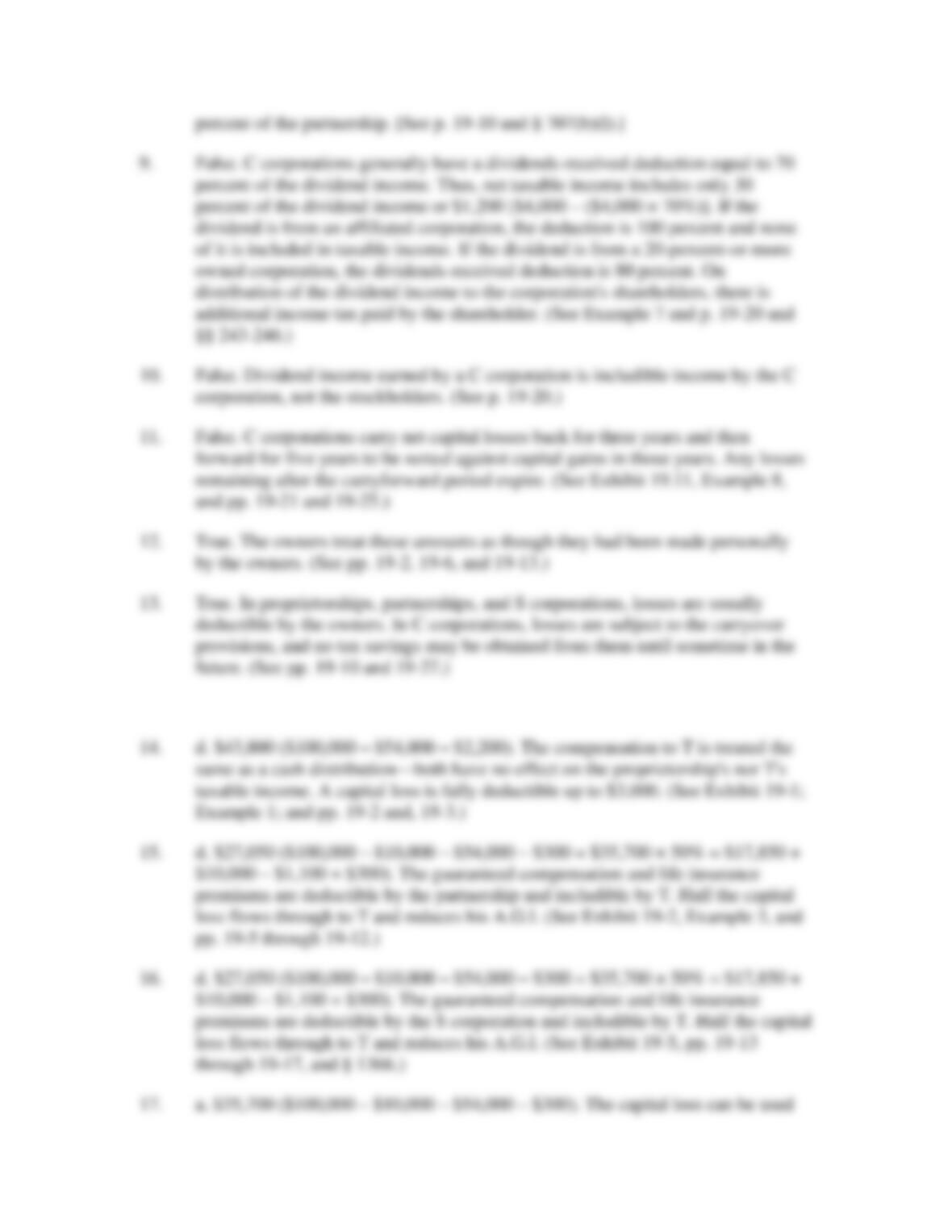
________ 1. Reasonable compensation paid to owners (other than sole proprietors) is
deductible by the business.
________ 2. A partnership has a $7,000 basis for proprietorship land it has just
received in exchange for a 20 percent capital interest. The land had a
$7,000 market value and $8,200 basis to the proprietorship.
________ 3. A disadvantage of the partnership form is that general partners have
unlimited liability for partnership debts.
________ 4. Capital gains of a partnership and an S corporation flow through to
owners to be reported by them on their own tax returns.
________ 5. Reasonable compensation paid to owners (other than proprietors)
qualifies as self-employment income.
________ 6. R is an employee/owner of a C corporation. Q is an employee/owner of
an S corporation. Both R and Q’s salaries are deductible by the
corporations they work for.
________ 7. An accrual basis partnership may deduct interest owed on a note as of
the end of its taxable year, even though it is not paid until May of the
next year. The note is held by a cash basis taxpayer who owns 60 percent
of the business.
________ 8. A partner may recognize a loss on the sale of equipment to a partnership
in which he has a 40 percent interest.
________ 9. A disadvantage of the C corporation is that the full amount of dividends
received by it are subject to triple taxation. For example, a $4,000

dividend received is taxed first to the paying corporation when the
income was earned, second to the receiving corporation, and third to the
shareholders of the receiving corporation when distributed to them.
________ 10. Dividend income earned by a proprietorship, partnership, S corporation,
or C corporation is reported by the owners on their personal tax returns
as dividend income.
________ 11. Individuals and C corporations may reduce income by 100 percent of net
capital losses but not to exceed $3,000 per year.
________ 12. Charitable contributions made by a proprietorship, partnership, or S
corporation are not deductible business expenses.
________ 13. Generally, a newly formed business expecting losses in its first few years
will provide greater tax benefits if organized as a proprietorship,
partnership, or S corporation rather than as a C corporation.
Multiple Choice
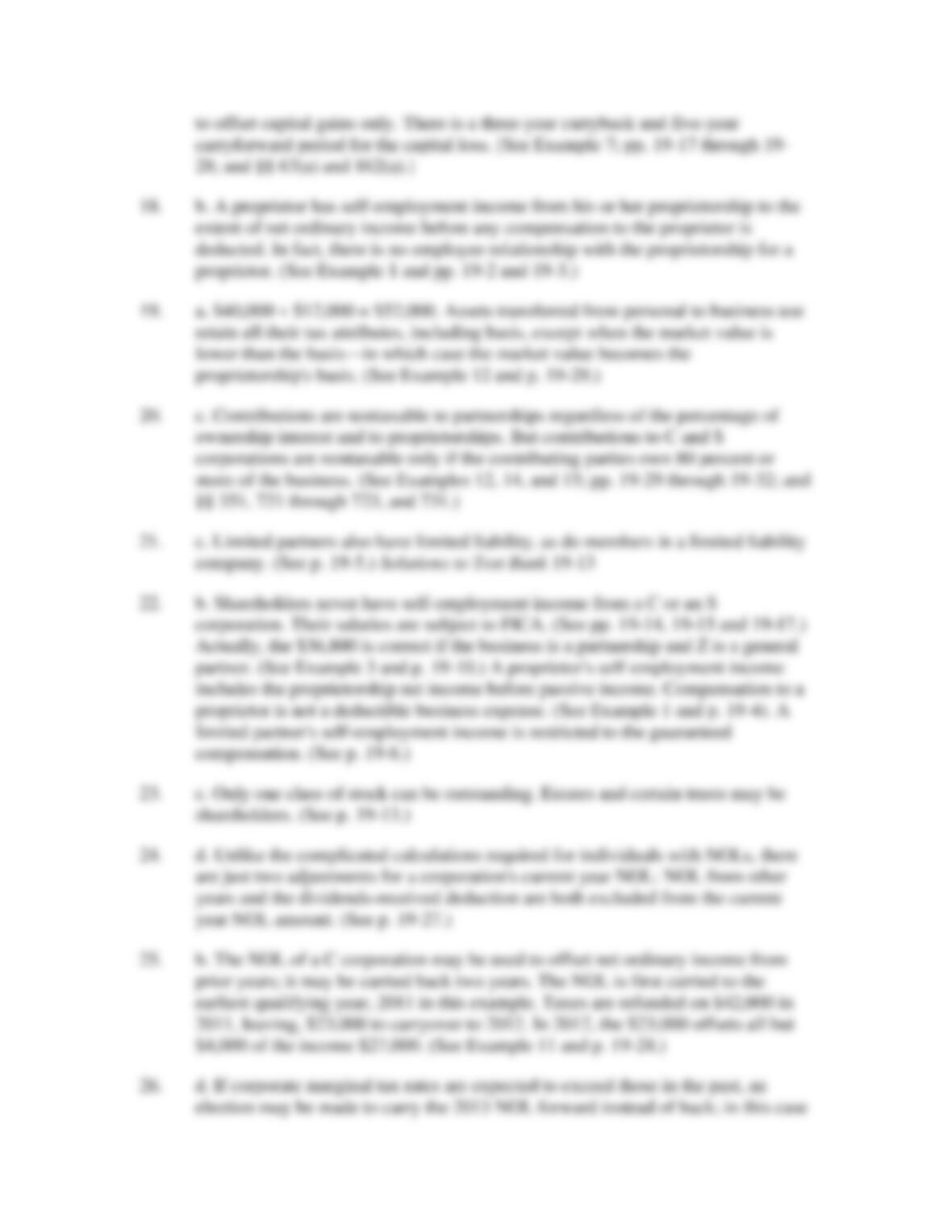
________ 14. The business is a proprietorship owned by T. T is single and has no other
tax information.
Income from services $100,000
Net capital loss 2,200
Guaranteed compensation paid to T 10,000
Life insurance premium for T,
payable to T’s children 300
Other operating expenses 54,000
Ignoring self-employment taxes, T’s A.G.I, is
a. $33,500
b. $33,800
c. $36,000
d. $43,800
________ 15. The business is a partnership and T is a 50 percent owner. T is single and
has no other tax information.
Income from services $100,000

Net capital loss 2,200
Guaranteed compensation paid to T 10,000
Life insurance premium for T,
payable to T’s children 300
Other operating expenses 54,000
Ignoring self-employment taxes, T’s A.G.I, is
a. $21,900
b. $24,400
c. $26,750
d. $27,050
________ 16. The business is an S corporation and T is a 50 percent owner. T is single
and has no other tax information.
Income from services $100,000
Net capital loss 2,200
Guaranteed compensation paid to T 10,000
Life insurance premium for T,
payable to T’s children 300
Other operating expenses 54,000
Ignoring self-employment taxes, T’s A.G.I, is
a. $21,900
b. $24,400
c. $26,750
d. $27,050
________ 17. The business is a C corporation and T is a 50 percent owner. T is single
and has no other tax information.
Income from services $100,000

Net capital loss 2,200
Guaranteed compensation paid to T 10,000
Life insurance premium for T,
payable to T’s children 300
Other operating expenses 54,000
The C corporation’s taxable income is
a. $35,700
b. $33,500
c. $28,500
d. $26,900
________ 18. B, a sole proprietorship, has the following information for the taxable
year:
Net ordinary income before the
item below is considered $30,000
Compensation to B, the proprietor 10,000
B’s self-employment income is
a. $40,000
b. $30,000
c. $20,000
d. $0
________ 19. L operates a proprietorship. During the year, she transferred the
following assets from personal to business use:
Asset Cost Market Value
Car $18,000 $12,000
Land $40,000 $50,000
The proprietorship’s combined or total basis in these assets is

a. $52,000
b. $58,000
c. $62,000
d. $68,000
________ 20. Owners have includible income when appreciated property is contributed
to a business that is
a. A proprietorship
b. AC corporation in exchange for 90 percent of its stock
c. An S corporation in exchange for 60 percent of its stock
d. A partnership in exchange for a 40 percent capital interest
________ 21. In comparing the various business organizational forms discussed in
Chapter 19, which of the following statements is false?
a. Only the C corporation is a taxable entity.
b. The original character of business revenues and expenses flows
through to the owners for all organizational forms except the C
corporation.
c. Only corporate shareholders have limited liability.
d. All owners except proprietors may enter into taxable transactions
with their businesses.
________ 22. A business has the following information:
Net ordinary income before the
items below are considered $ 65,000
Guaranteed compensation to Z (18,000)
Rental income 20,000
Rental expenses (27,000)
Net income $ 40,000
If Z performs services for the business, which of the following
statements is false?

a. Z’s self-employment income is $65,000 if the business is a
proprietorship.
b. Z’s self-employment income is $36,800 if Z is a 40 percent
shareholder of an S corporation.
c. Z’s self-employment income is $18,000 if Z is a limited partner who
receives 40 percent of the profits and losses.
d. Z has no self-employment income if Z is a 40 percent shareholder of
a C corporation.
________ 23. Which of the following properly describes a requirement that a
corporation must meet to elect to be taxed under subchapter S.
a. There can be no more than two classes of stock outstanding.
b. All shareholders must be individuals.
c. The corporation can have no more than 35 eligible shareholders.
d. Both b. and c are correct.
________ 24. Net operating losses (NOLs) of a C corporation may be used to offset net
ordinary income from prior or future years. Adjustments to a C
corporation’s current year NOL include the add back of
a. The charitable contribution deduction
b. NOL from other years
c. Both a. and b.
d. None of the above
________ 25. A corporation’s records show the following:
2009 2010 2011 2012 2013
Net operating gain (loss) $6,000 $16,000 $42,000 $27,000 ($65,000)
Assume the corporation has never had dividend income and its only
NOL occurred in 2012. Using the NOL carryback provisions of the
Code, on what portion of income in 2012 will tax not be refunded?
a. $0
b. $4,000

c. $20,000
d. $27,000
e. None of the above
________ 26. A corporation’s records show the following:
2009 2010 2011 2012 2013
Net operating gain (loss) $6,000 $16,000 $32,000 $27,000 ($65,000)
The corporate marginal tax rates in 2014 (or later years, if applicable)
are expected to exceed those in the past. If the corporation wishes to
maximize its tax savings with the current year’s $65,000 NOL, on what
portion of income in 2012 will tax not be refunded?
a. $0
b. $4,000
c. $16,000
d. $27,000
________ 27. T, a C corporation, receives a dividend of $100 from a 15 percent owned
U.S. corporation and has a dividend-received deduction of
a. $80
b. $70
c. $0
d. $100
________ 28. R, a C corporation, has the following information:
2012 2013
Taxable income before charitable deductions $30,000 $10,000
Charitable contributions 0 3,000
Assume R did not have dividend income, NOL, or capital loss
carrybacks in either year. R’s taxable incomes for 2012 and for 2013,
respectively, are
a. $30,000; $9,000

b. $29,000; $8,000
c. $28,000; $7,000
d. $27,000; $7,000
________ 29. Fringe benefits for a 15 percent owner/employee generally are
deductible by the employer but are excludable income for the employee
when the employer is a
a. Proprietorship, partnership, or S or C corporation
b. Partnership or S or C corporation
c. S or C corporation
d. C corporation
________ 30. T purchased a 60 percent interest in partnership Z for $100,000 on
January 2 of the current year. During the year, the partnership had
ordinary income of $50,000, tax-exempt income of $30,000, and made a
cash distribution to owners of $6,000. T’s basis in his partnership interest
at the end of the year is
a. $100,000
b. $144,400
c. $120,000
d. $194,000
________ 31. Ms. G obtained a 40 percent interest in business H on January 1 of the
current year for $90,000. At the end of the year, H had the following
information:
Balance as of
111 12/31
Net ordinary income $ 80,000
Net capital loss (5,000)
Tax-exempt interest income 30,000
Taxable interest income 3,000
$108,000

Note payable to owner G $12,000 $ 7,000
Note payable to owner C 10,000 12,000
Current payables 4,000 1,000
$26,000 $ 20,000
Cash distributions to owners $ 11,000
If H is a partnership or an S corporation, what is G’s A.G.I., assuming
she has no other income or deductions for the year?
a. $4,400
b. $31,200
c. $32,000
d. $47,600
________ 32. Ms. G obtained a 40 percent interest in business H on January 1 of the
current year for $90,000. At the end of the year, H had the following
information:
Balance as of
111 12/31
Net ordinary income $ 80,000
Net capital loss (5,000)
Tax-exempt interest income 30,000
Taxable interest income 3,000
$108,000
Note payable to owner G $12,000 $ 7,000
Note payable to owner C 10,000 12,000
Current payables 4,000 1,000
$26,000 $ 20,000
Cash distributions to owners $ 11,000
If H is a C corporation, G’s A.G.I, at the end of the year is
a. $4,400
b. $5,600
c. $5,600
d. $4,400
19
Taxation of Business Forms and their Owners
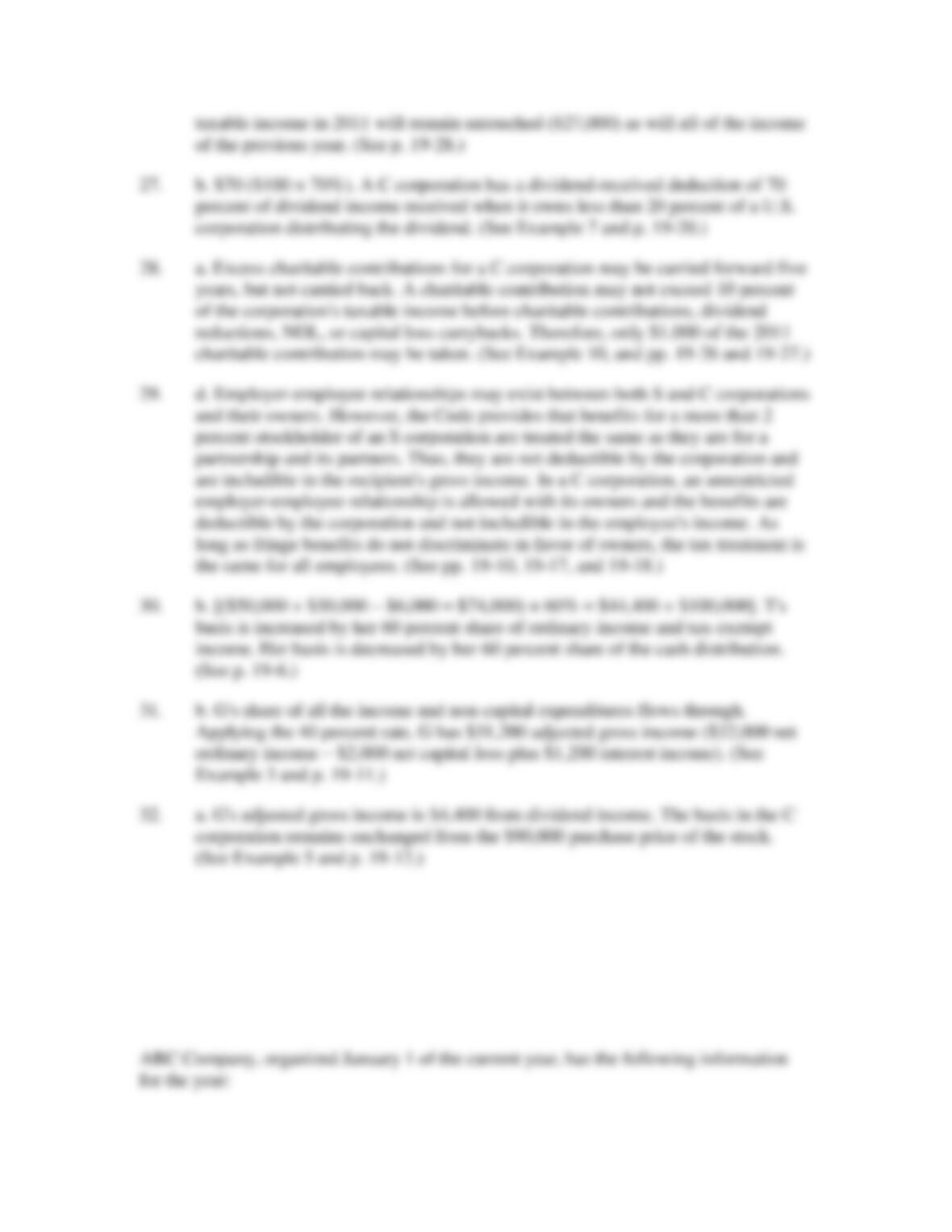
Solutions to Test Bank
True or False
Multiple Choice
19
Taxation of Business Forms and their Owners
Comprehensive Problems
FACTS FOR COMPREHENSIVE PROBLEMS
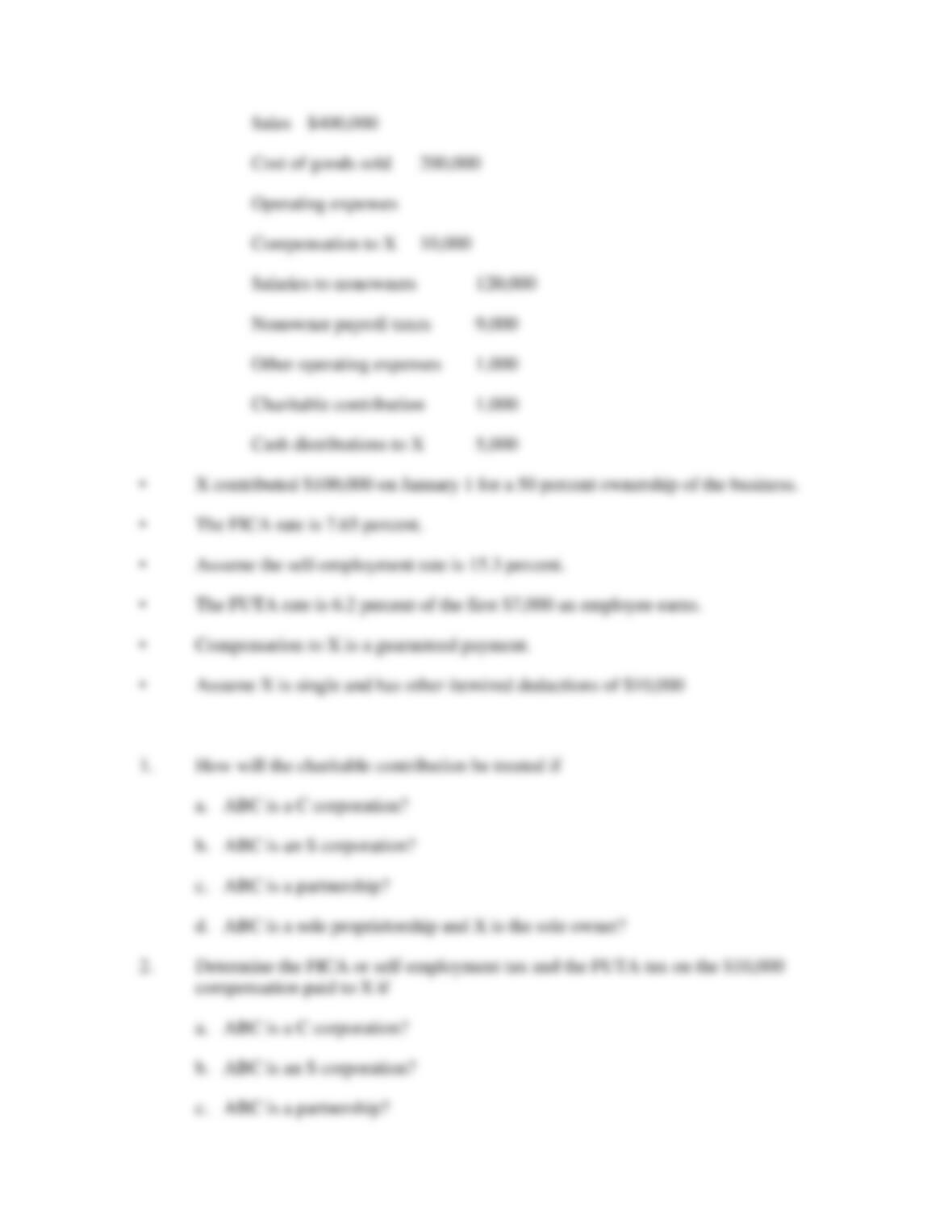
COMPREHENSIVE PROBLEMS
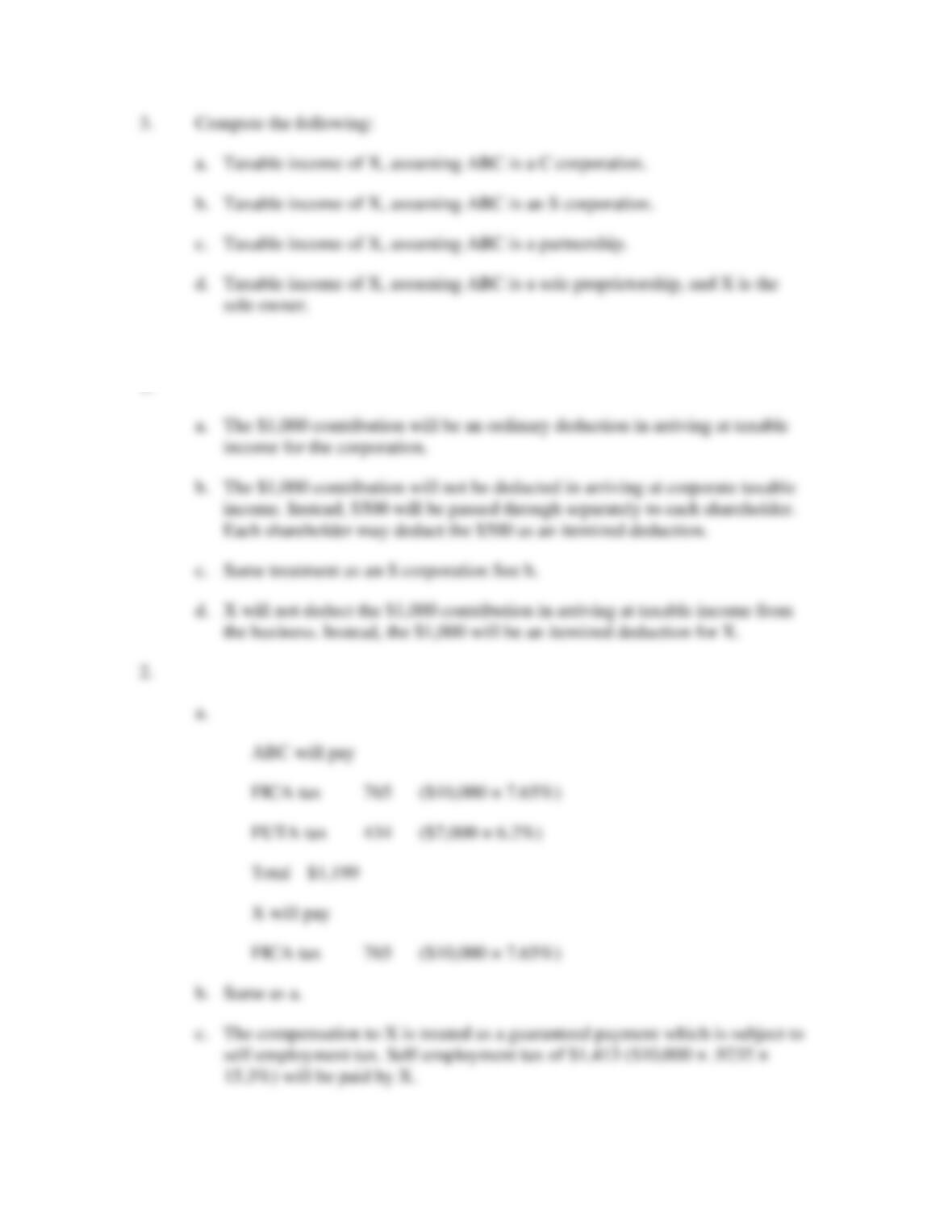
Solutions to Comprehensive Problems