Chapter 19—Black and Scholes and Beyond
MULTIPLE CHOICE
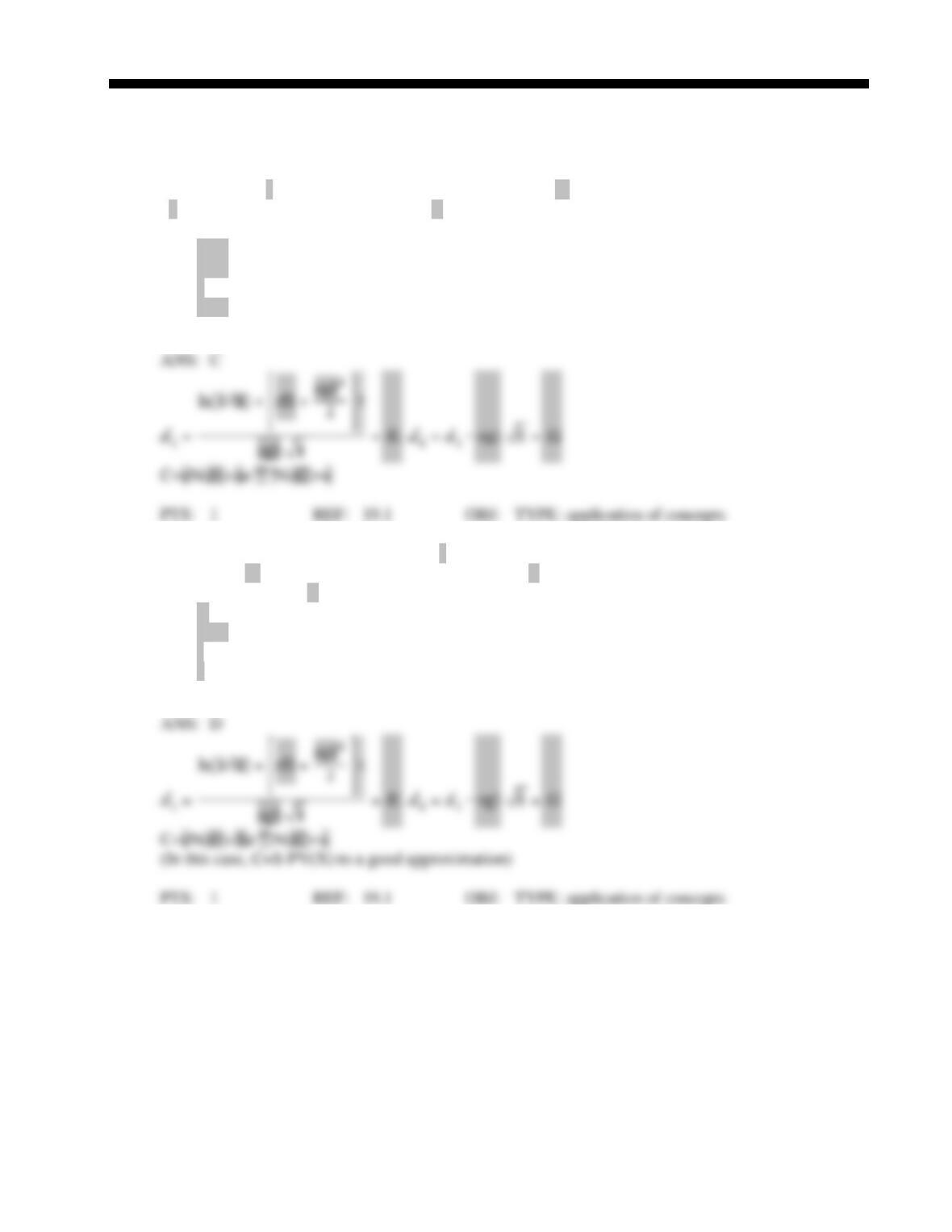
1. You are considering the purchase of a call option on Priceless Packing Inc. Priceless has a current
stock price of $s.00 per share with an annual volatility of sg percent. The exercise price of the option is
$x.00 and the riskless rate of interest is rf percent. If this stock pays no dividends and the option
matures in six months, its value is:
a.
$ans1
b.
$ans2
c.
$c
d.
$ans4
e.
none of the above
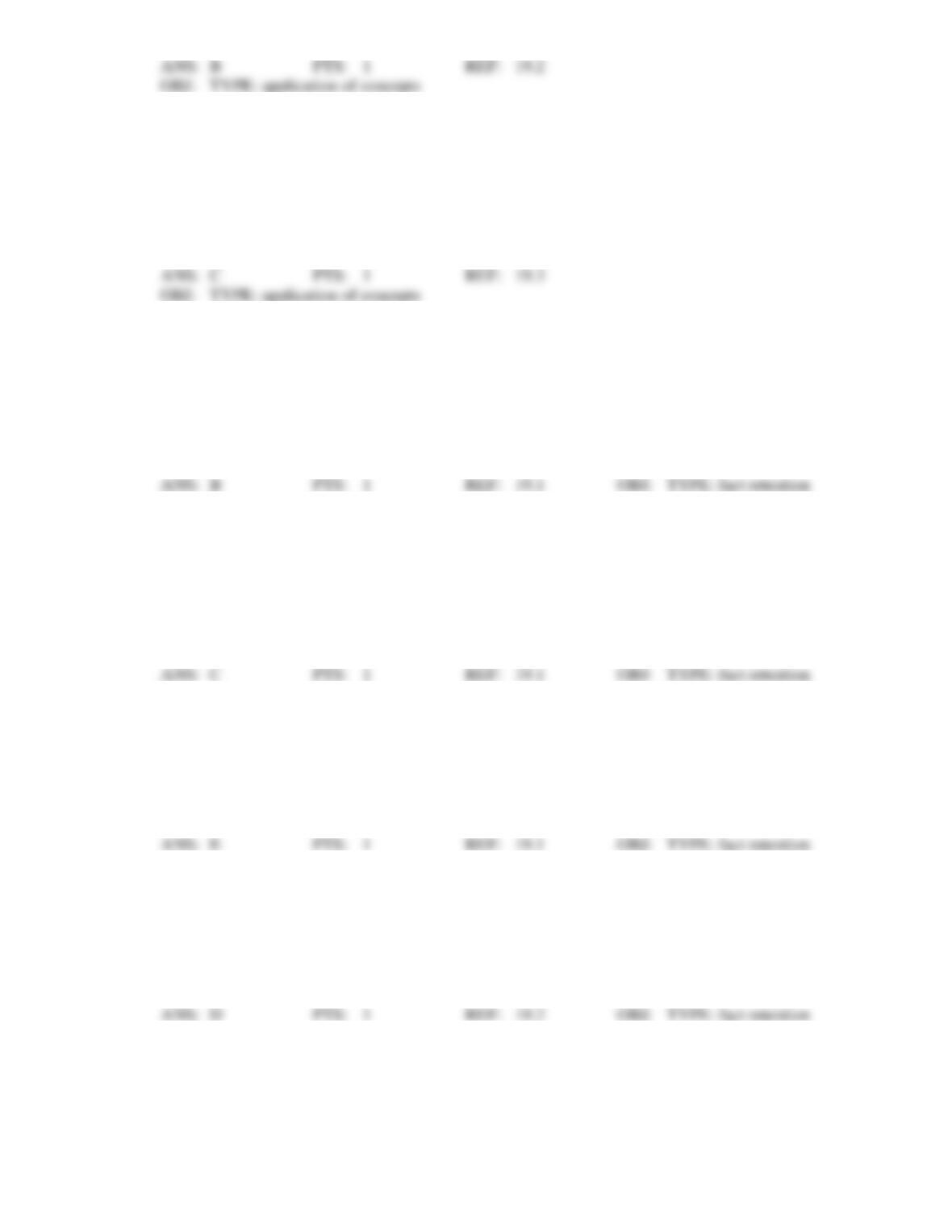
2. Shares of Deepin Damoni are priced at $s.00 per share. The stock pays no dividends and has an annual
volatility of sg percent. The riskless rate of interest is rf percent. Call options on Deepin Damoni with
an exercise price of $X.00 and one year to maturity are worth:
a.
$X.00
b.
$ans2
c.
$s.00
d.
$c
e.
none of the above
3. Blue Skies Inc. has recently issued a convertible bond with a yield to maturity that is less than the
current rate on U.S. Treasury bonds of a similar maturity.
a.
This likely occurred because Blue Skies Inc. stock is known to have a volatility smile.
b.
This likely occurred because convertible bond holders have an implicit investment in the
firm’s equity.
c.
This is not possible. If Blue Skies Inc is a risky company it cannot have a yield below the
comparable US Treasury yield.
d.
This is a classic example of the asset substitution problem.
e.
None of the above.
4. Expected NPV analysis often __________ investment decisions; however, a decision-tree approach
often __________ investment decisions.
a.
overvalues; undervalues
b.
undervalues; correctly values
c.
undervalues; overvalues
d.
correctly values; overvalues
e.
correctly values; undervalues
5. The Black and Scholes model was originally conceived to price an __________ on an underlying stock
that paid no dividends.
a.
American call option
b.
European call option
c.
European put option
d.
American put option
e.
warrants
6. It is not necessary to know what return investors expect on the __________ to determine the price of
an option.
a.
underlying bond
b.
convertible bond
c.
underlying stock
d.
hedge ratio
e.
warrants
7. Pricing an option using Black and Scholes requires an estimate of the __________.
a.
strike price of the option
b.
current market price of underlying stock
c.
time before option expires
d.
annual risk-free interest rate
e.
underlying stock’s volatility
8. Warrants bear a close resemblance to __________.
a.
convertible bonds
b.
equity kickers
c.
put options
d.
call options
e.
none of the above
9. Which of the following factors influence call option values?
a.
stock price
b.
strike price
c.
expiration date
d.
volatility
e.
all of the above
10. An expected NPV calculation undervalues a project because it ignores the project’s __________.
a.
conversion premium
b.
conversion price
c.
conversion ratio
d.
option value
e.
option ratio
11. Managers who receive a great deal of pay in the form of stock options have the incentive not only to
increase the price of the stock, but also to increase its __________.
a.
delta
b.
volatility
c.
dilution
d.
discount
e.
expiration date
12. Which of the following are required inputs for the Black and Scholes formula?
a.
stock price
b.
strike price
c.
risk-free rate
d.
date of expiration
e.
all of the above
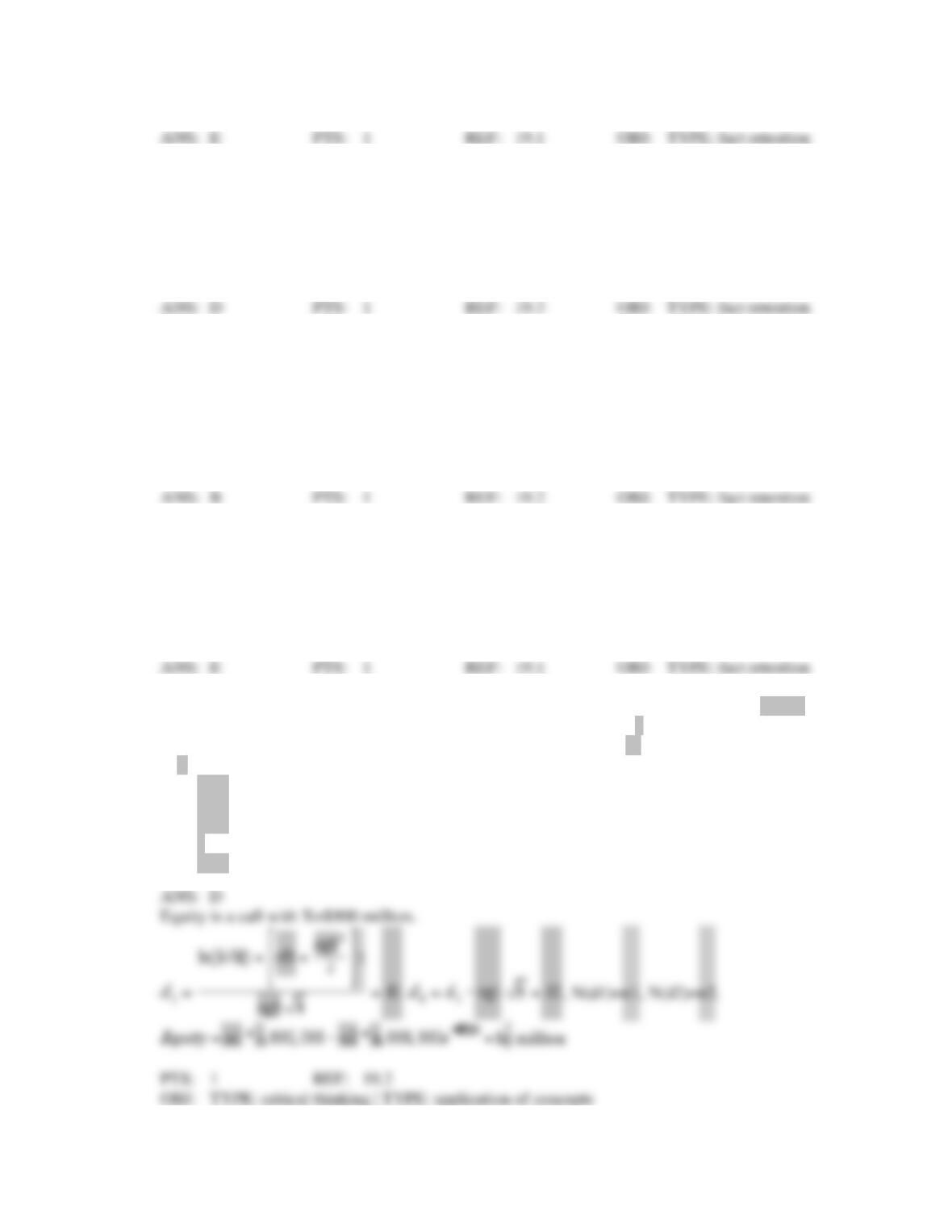
13. A firm has current market value of assets (the sum of debt and equity values) equal to $Assets billion.
The debt is all zero coupon, with maturity five years and face value $x million. The firm will pay no
dividends over the next five years, the volatility of its asset value is sg% per year, and the risk-free rate
is rf% per year, continuously compounded. What is the current value of equity?
a.
$ans1 million
b.
$ans2 million
c.
$ans3million
d.
$c million
e.
$ans5 million
14. A portfolio manager has N shares in stock X. She wishes to use put options on stock X to hedge her
position. The puts under consideration have Black Scholes parameter d1=d1. To have the most fully
hedged position, how many puts should the manager buy (to the nearest 100)?
a.
ans1
b.
ans2
c.
ans3
d.
ans4
e.
ans5
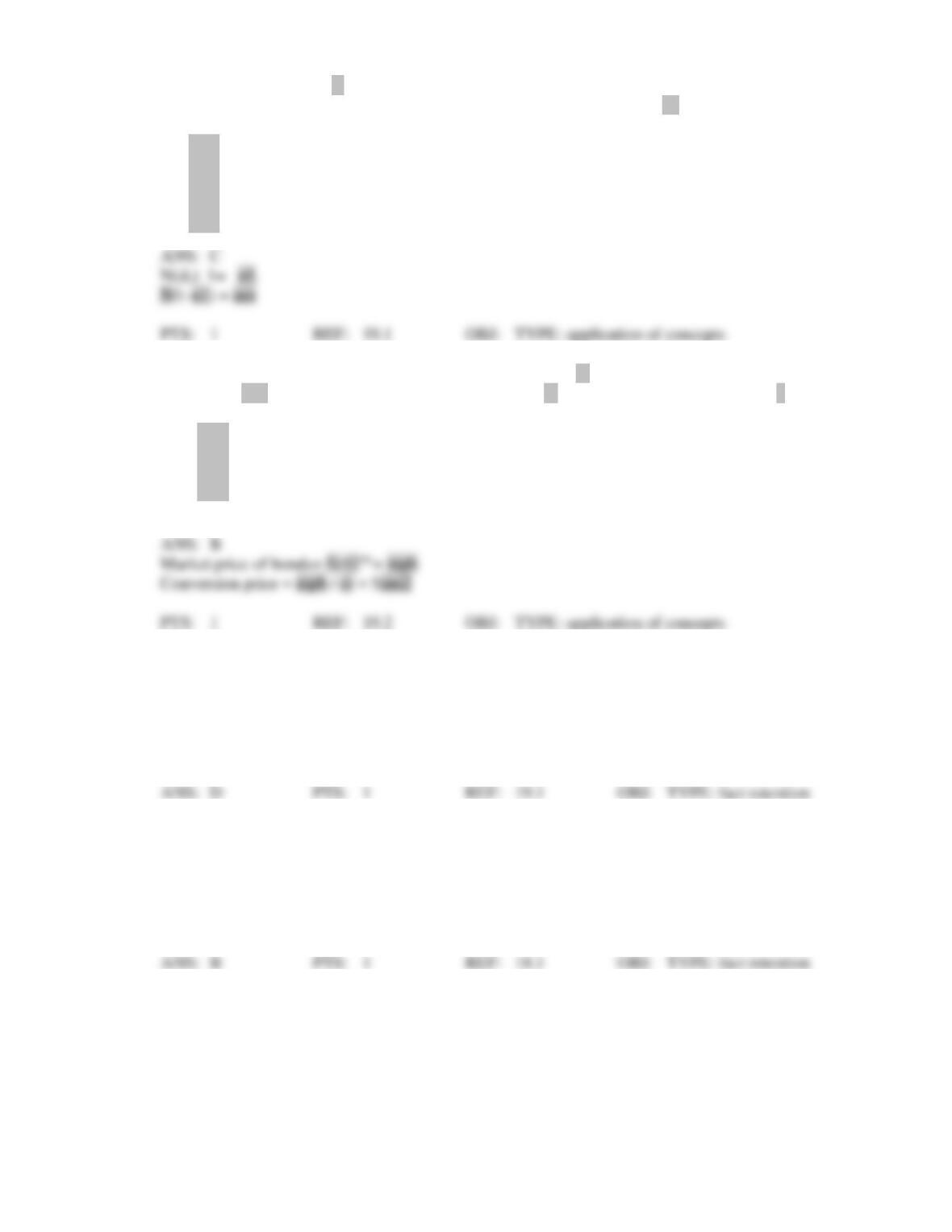
15. Kvicky-Mart Corp. has convertible bonds with Face Value $fv, 40 years to maturity and yield to
maturity of ytm%. The conversion ratio on the bonds is cr, and the current stock price is $p. What is
the conversion price?
a.
$ans1
b.
$ans2
c.
$ans3
d.
$ans4
e.
none of the above
16. Which of the following is not a difference between warrants and call options?
a.
Warrants are issued by firms, call options can be issued by investors
b.
When exercised, warrants increase the number of shares, call options do not
c.
When exercised, warrants increase the cash of the firms; exercised call options do not
necessarily increase the cash flow to the firm
d.
Warrants usually expire within several months, call options often expire years in the future
17. When initially presenting their option pricing formula, Black and Scholes calculated a _______ option
on a ________ stock
a.
American call; dividend-paying stock
b.
European call; non-dividend paying stock
c.
American call; non-dividend paying stock
d.
European call; dividend-paying stock
18. Empirical tests of the Black Scholes option model find
a.
At the money options were priced more precisely than out of the money options
b.
Call options were priced more precisely than put options
c.
Implied volatilities were stable over a variety of strike prices
d.
Put options were priced more precisely than call options
19. Which of the following types of firms would most need to understand how to price real options?
a.
Utilities, due to the volatility of energy costs
b.
Retailers, due to constant expansion of real estate assets
c.
Multi-national banks, due to foreign-exchange exposure
d.
Drug manufactures, due to new drug research exposure
20. When using the Black-Scholes model for stock options, the biggest challenge to analysts is
a.
Estimating the risk-free rate
b.
Estimating the future stock price
c.
Estimating the underlying asset’s volatility
d.
Estimating the firms beta
21. If a firm is expected to pay a dividend, the value of a call option (relative to a non-dividend paying
stock)
a.
Is less because the volatility declines
b.
Is more because the dividend is known
c.
Is more because the dividend is received
d.
Is less because the current stock price overstates the value of the stock to the option holder
22. In general when comparing the values of warrants to call options with identical characteristics, you
would expect
a.
Warrants and call options are equally valued
b.
Warrants are more valuable than call options
c.
Warrants are less valuable than call options
d.
There is no consistent directional difference between warrants and options
MATCHING
Match the following terms with their best descriptions:
a.
not readily observed in the market
b.
value of risk-free debt and put value
c.
measures how much the call price changes as the underlying stock price change
d.
value of risk-free debt minus put value
e.
helps define a lower bound on the market value of a convertible bond
f.
exotic convertible
1. option’s delta
2. volatility
3. value of risky debt
4. conversion value of a bond
5. LYON
SHORT ANSWER
1. You are considering the purchase of a call option on Good Guys Fishing Gear. The stock is currently
priced at $s per share and has an annual volatility of sg percent. You are interested in the options with
a strike price of $x per share. The current riskless rate of interest is rf percent.
a.
What are the fair prices of call options with 3, 6, 9, and 12 months to expiration?
b.
Intuitively describe how option values change with time to expiration.
Time to expiration
Call Value
expiration, the more good things can happen to a call option owner. You should also notice
that the increase in option value occurs at a decreasing rate.
2. Intuitively interpret the Black-Scholes’ call value when the stock price is much larger than the exercise
price.
3.
a.
Interpret a call option’s delta. What is the maximum value delta can attain?
b.
If you are very optimistic about a stock price increasing, explain why you might decide to
invest in an option to provide the maximum return potential.
A call option’s delta explains how call option value changes with changes in the value of the
underlying stock price. The maximum value of delta is one.
4. The following two statements are true. “If you have superior information about a given stock’s upward
potential, a call option purchase is superior to a stock investment. If you purchase an equal number of
options or shares, the investment in shares will provide the greatest benefit if the underlying stock
price increases.” Clarify the distinction.
5. Show how to use put-call parity to derive a Black and Scholes equation for valuing a put option.
6. Intuitively discuss how to calculate a call option’s implied volatility. Suppose we have a reliable
forecast for a stock’s future volatility, and we find that the implied volatility for that stock from the
option’s market is much lower than our forecast. What does this suggest about the call value?
7. The Black-Scholes equation does not include any measure of a stock’s expected return. Does this
imply that option valuation is unrelated to the expected return on the underlying stock?
8. Consider a firm’s equity holders as long a call option on the firm’s underlying assets. Suppose the firm
has outstanding debt due in one year of one billion dollars and an asset value of $900 million. Explain
the incentive problem that can occur if management acts on the shareholders behalf at the expense of
bondholders. Your discussion should be focused on the volatility of the underlying assets of the firm.
9. Explain why convertible bonds that offer bondholders a fixed dollar amount of shares are often called
“death spiral” convertibles.
10. An important theme in this chapter is that “real options are everywhere”. If this is the case, why have
we only witnessed a limited use of option analysis when it comes to corporate finance applications?
11. What is the option’s delta?
12. How does the existence of a relationship between an option’s implied volatility and its strike price
affect option-trading practices?
13. Can you argue that managers would intentionally take more risk to increase a company’s share value?
14. How does one use the Black and Scholes model to value warrants?
15. If the Jackson Corporation has n1 shares outstanding before warrants to purchase n2 more shares are
exercised, what should be the price of the warrants if an identical call option, $C, is valued at $p?
16. Jackson Corporation issued a 20-year convertible zero-coupon bond offering a ytm0%
yield to maturity with a conversion ratio of cr shares of stock for every $pv par value bond.
If the stock is currently selling for $p, what would the market value of this convertible bond be if the
interest rate suddenly jumped, increasing the yield on Jackson’s bonds to ytm1%?
17. What is the major advantage and disadvantage of a death spiral convertible bond?
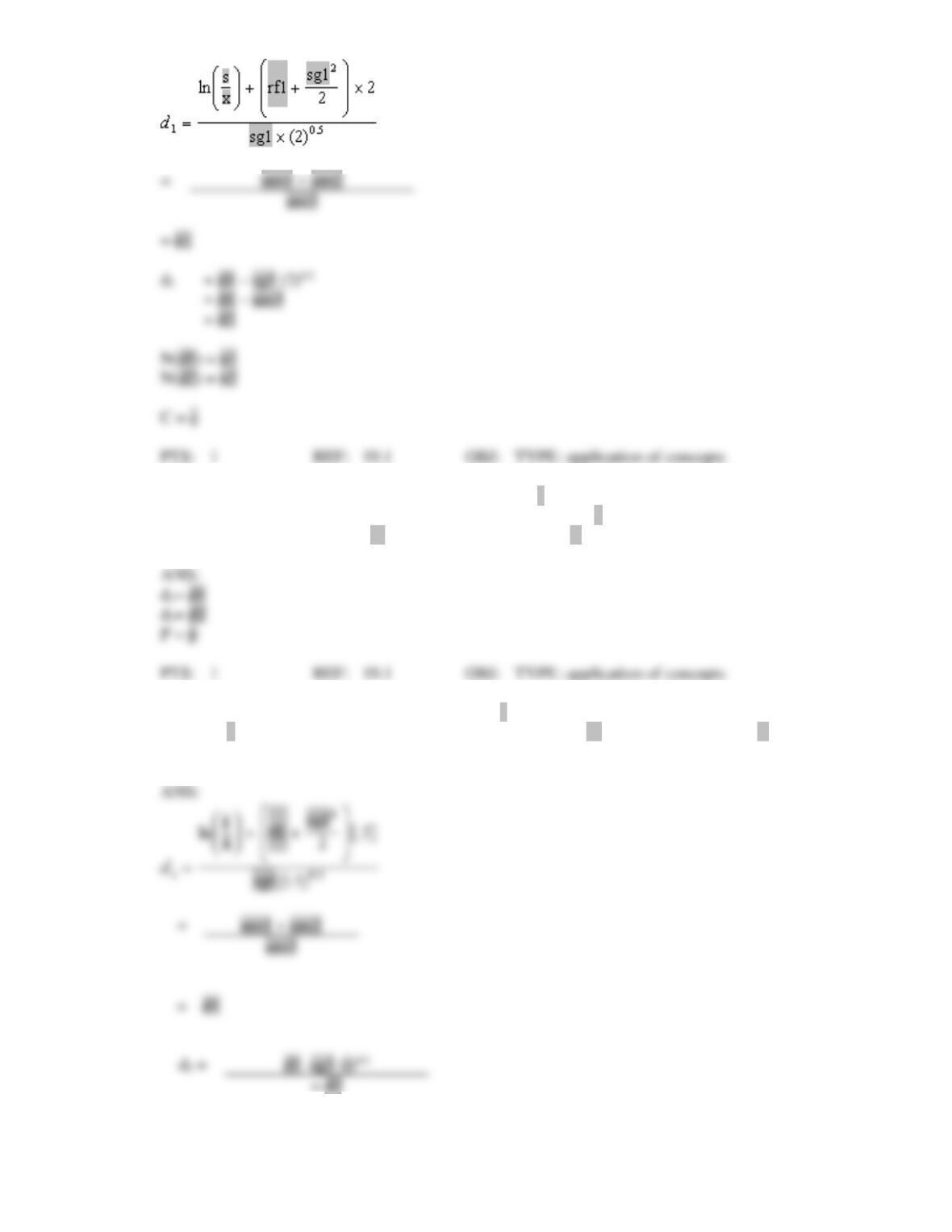
18. The stock of Jefferson Corporation currently sells for $s. A European call option on Jefferson stock
has an expiration date one year in the future and a strike price of $x. The estimate of the annual
standard deviation of Jefferson stock is sg%, and the risk-free rate is rf%. What is the call worth?
19. The stock of Jefferson Corporation currently sells for $s. A European call option on Jefferson stock
has an expiration date two years in the future and a strike price of $x. The estimate of the annual
standard deviation of Jefferson stock is sg%, and the risk-free rate is rf%. What is the call worth?
20. The stock of Jefferson Corporation currently sells for $s. A European put option on Jefferson stock has
an expiration date two years in the future and a strike price of $x. The estimate of the annual standard
deviation of Jefferson stock is sg%, and the risk-free rate is rf%. What is the market value of this put?
21. Albert Corporation stock is currently selling for $s while a call option of Albert stock has an exercise
price of $x. If the annual standard deviation of Albert stock is sg%, the risk-free rate is rf%, and the
option expiration is in six months, what is the call worth?
22. A call option has a strike price of $x, the underlying stock’s price is $s, the risk-free rate is rf%, the
time to expiration is 6 months, and the standard deviation of the stock is sg%. Find the option price
and delta. Explain what the delta means.
23. The Judy Corporation stock sells for $s and has a standard deviation of sg%. Value a call option on
this stock that has 9 months left before expiration and an exercise price of $x. The risk free rate is rf%.
24. Decision trees are sometimes used to calculate the NPV of a real investment with option-like
characteristics. Why does a decision tree give an incorrect answer?
25. A. Your firm is considering a project that will generate net cash flows equal to
X*a-b, where X is the level of an index of local land prices. You can do the project now, in which the
payoff is received immediately, or wait 1 year and decide whether to do the project based on the
change in land values. Assume that the level of the index is currently x0, and will be either xa or xbv
in 1 year. The riskfree rate is rf% per year. Is waiting better than doing the project immediately?
B. What would change in the analysis if one recognized that, for an investment of $x0 in land, one
would receive rents of $rent in addition to the ending value of the land? Should waiting become more
or less attractive (whether or not the decision actually changes)?
26. Suppose gold is currently trading at $s per ounce. The annual volatility of the price of gold is sg%, and
the continuously compounded riskfree rate is rf% per year. If we make an investment of $invest today,
we will have the opportunity to sell some gold jewelry in one year. Each item will use one ounce of
gold and require additional expenses of $adex. We will be able to sell sell items (assume there is no
uncertainty about the demand) for $p1 each next year, and no more after that. If the price of gold next
year is unfavorable, we can choose not to produce the gold, and thereby avoid the gold and additional
expenses. Except for today’s investment, all cash flows occur in one year. Should the investment be
made?
ESSAY
1. Define the volatility smile. How does the volatility smile relate to our trust in the Black-Scholes’
option pricing formula?
2. In general option terminology, discuss what management strategists call a ‘toehold investment.’ This
term is often used to describe investments in emerging markets such as China.
3. How does the Black and Scholes’ approach to valuing options differ from the binomial method?
4. What are the differences between warrants and calls?