
Exam
Name___________________________________
MULTIPLE CHOICE. Choose the one alternative that best completes the statement or answers the question.
1)
Which of the following statements about matter–antimatter engines is not true?
1)
A)
Spacecraft powered by matter–antimatter engines could probably reach speeds of more than
half the speed of light.
B)
One of the major challenges to developing matter–antimatter engines is finding a way to store
antimatter after it is produced.
C)
Matter–antimatter reactions represent the most efficient possible reactions in terms of energy
release.
D)
Matter–antimatter engines would be great in theory, but to date we have no evidence that
antimatter even exists.
2)
Which of the following statements best reflects our current knowledge about the term flife in the
equation
Number of Civilizations =NHP ×flife ×fcivilization ×fnow?
2)
A)
The value of flife is greater than 10.
B)
The value of flife is less than 0.0000001.
C)
The value of flife is either 0 or 1.
D)
The value of flife is equal to 1/2.
E)
The value of flife is between 0 and 1.
3)
Why are fossils of early life on Earth rarer than fossils of plants and animals from the past few
hundred million years?
3)
A)
Early organisms were microscopic and lacked skeletons and other hard structures that are
most likely to be fossilized.
B)
Fossils could not form before there was oxygen in the atmosphere.
C)
Life was far less abundant prior to a few hundred million years ago.
D)
We find fossils in sedimentary layers, and no sediments were deposited until just a few
hundred million years ago.

4)
How does the Kepler mission plan to detect Earth–like planets around other stars?
4)
A)
by observing the slight dip in brightness of the central star as the planet transits
B)
by directly imaging the planet in the infrared
C)
by measuring the Doppler shift in spectral lines as the central star is tugged to and fro by the
planet
D)
by measuring the slight shift in position of the central star as it is tugged to and fro by the
planet
E)
by observing the spectrum of the planet
5)
Which of the following describes a major danger of interstellar travel at near–light speed?
5)
A)
Asteroid fields floating in interstellar space will present a navigational challenge.
B)
Any interstellar journey will take much longer than the lives of the crew members.
C)
Time dilation will slow the heart beats of the crew to a dangerously low rate.
D)
Atoms and ions in interstellar space will hit a fast–moving spacecraft like a flood of
dangerous cosmic rays.
6)
When we analyze whether a world is a possible home to life, the key thing we look for is ________.
6)
A)
evidence of atmospheric oxygen
B)
the past or present existence of liquid water
C)
the presence of organic molecules such as amino acids
D)
surface coloration changes that could indicate vegetative growth
7)
At about what fraction of the speed of light do today’s spacecraft travel?
7)
A)
1/10
B)
1/100
C)
1/1,000
D)
1/10,000
E)
1/2
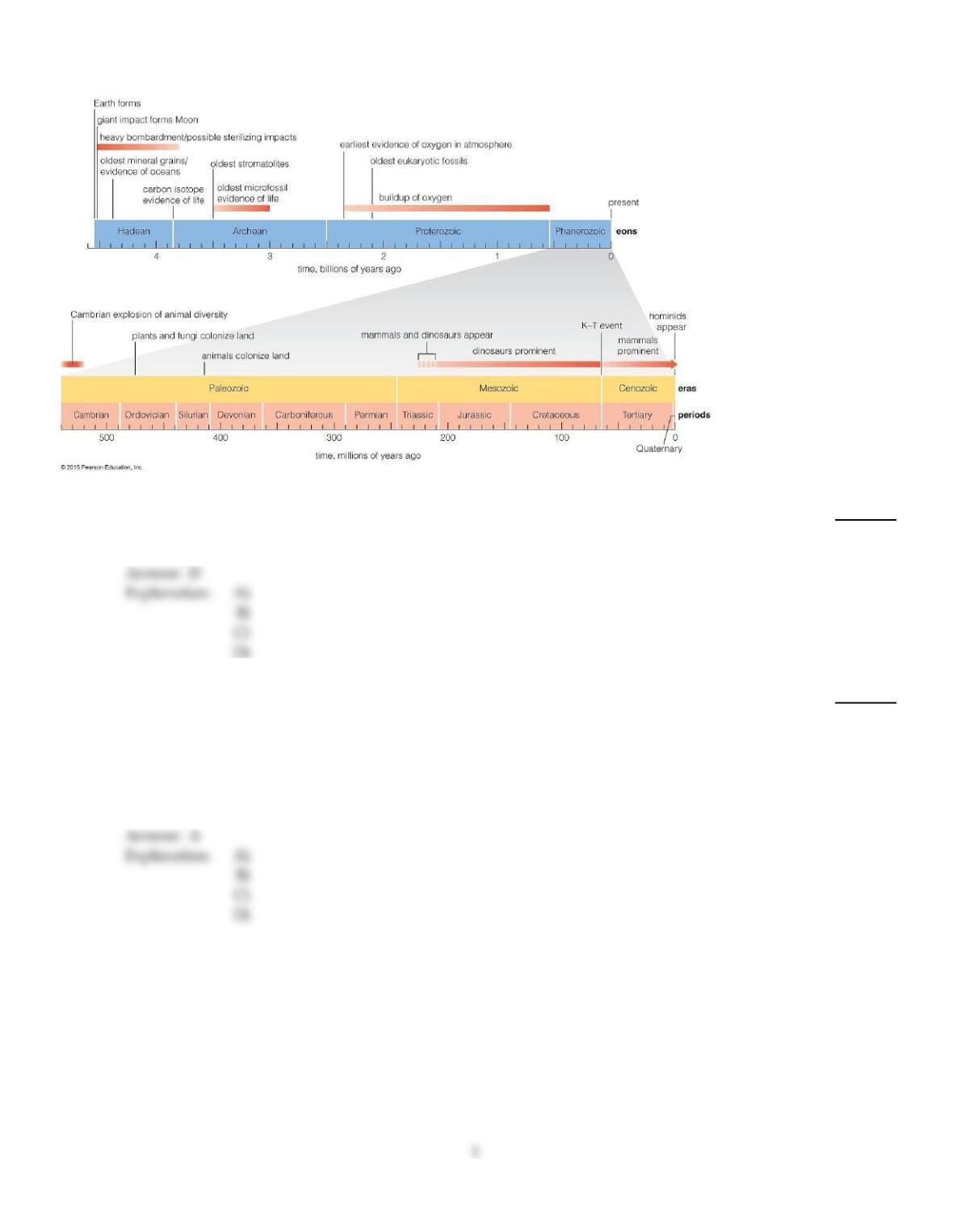
8)
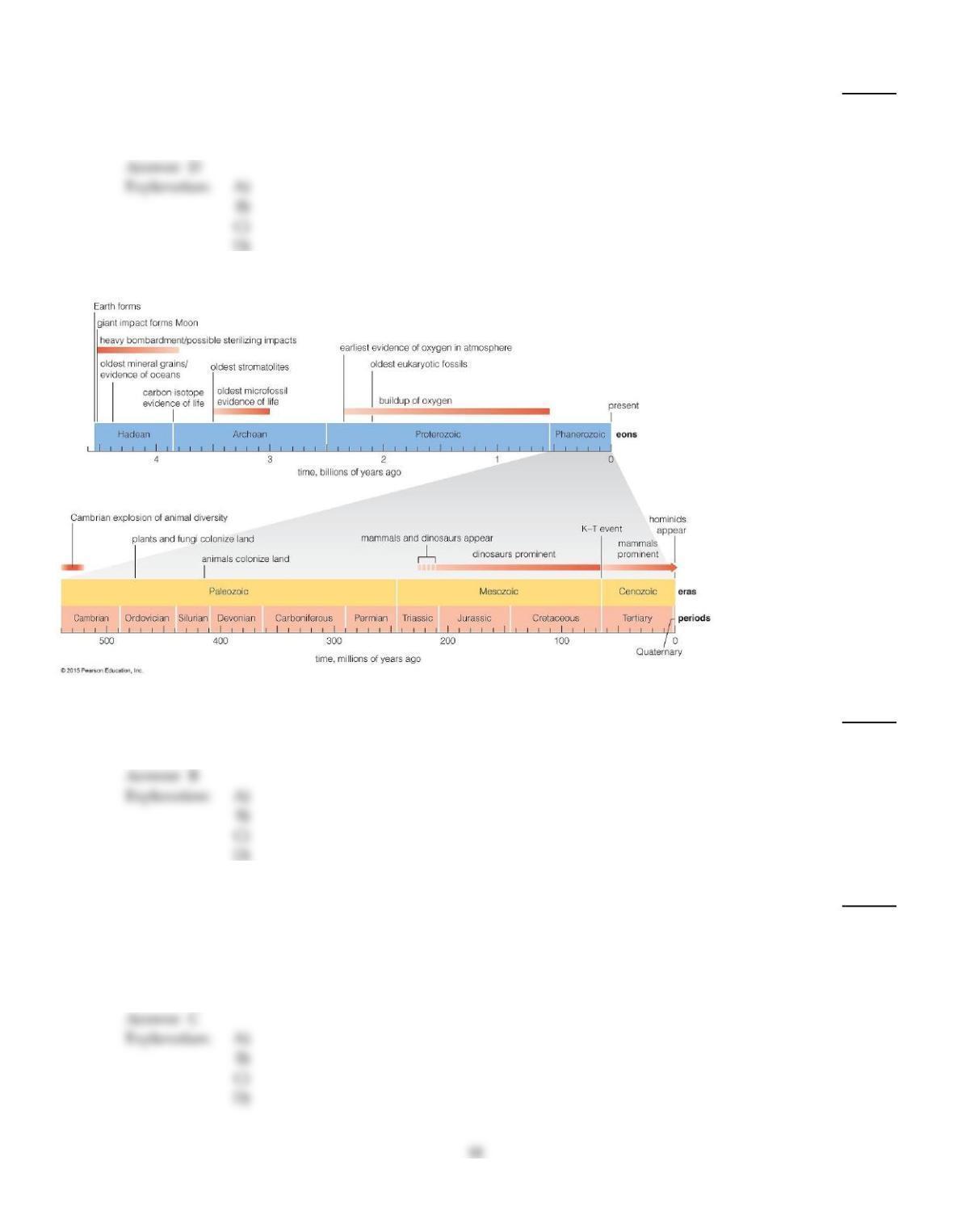
The figure above shows the geological times scale. The Earth’s atmosphere has been oxygen rich for
8)
A)
its entire history.
B)
a few million years.
C)
about 2 billion years.
D)
about 500 million years.
9)
Which of the following best describes how the Drake equation is useful?
9)
A)
It helps us understand what we need to know in order to determine the likelihood of finding
other civilizations.
B)
It allows us to calculate the masses of planets orbiting other stars.
C)
It tells us what wavelengths of light will be most useful to examine in the search for
extraterrestrial intelligence.
D)
It has allowed us to determine the number of civilizations in the Milky Way Galaxy.
A
D

10)
What defines the habitable zone around a star?
10)
A)
the region around a star where liquid water can exist on planetary surfaces
B)
the region around a star where rocky planets can form
C)
the region around a star where humans can survive
D)
the region around a star where its ultraviolet radiation is too weak to destroy biological
organisms on a planetary surface
E)
the region around a star outside of its hot, tenuous corona
11)
In general, how does the size and location of a star’s habitable zone depend on the star’s mass?
11)
A)
The smaller (less massive) the star, the smaller and the closer–in the habitable zone.
B)
The habitable zone is always about the same size, but its location moves inward for smaller
stars.
C)
The smaller (less massive) the star, the larger and the farther–out the habitable zone.
D)
The smaller (less massive) the star, the larger and the closer–in the habitable zone.
12)
Which process(es) lead(s) to the gradual evolution of life via natural selection?
12)
A)
Changes that organisms acquire during their lives are passed on to their offspring.
B)
Organisms tend to produce more offspring than the local environment can support.
C)
Individuals vary in many heritable traits, and some will be better able to compete for
resources at the given time and place in which they live.
D)
A and B
E)
B and C
F)
A, B, and C

13)
In the Drake equation (Number of Civilizations =NHP ×flife ×fciv ×fnow), what do we mean by
fnow?
13)
A)
the fraction of planets in the galaxy on which a civilization could theoretically develop right
now
B)
the fraction of planets with civilizations at the present time (as opposed to only in the past or
future)
C)
the fraction of civilizations in the universe that currently are sending messages to us
D)
the fraction of all species ever to exist that we currently are aware of
14)
Which of the following gases, which we can detect (if present) in infrared spectra, would be a
strong indicator of life on another planet?
14)
A)
methane
B)
sulfuric acid
C)
ozone
D)
water vapor
E)
carbon dioxide
15)
What evidence suggests that life was common on Earth within a billion years of its formation?
15)
A)
Life must have formed early in order to produce the variety of lifeforms seen today.
B)
rocks older than 3.85 billion years with the carbon–12 to carbon–13 ratio typical of living
organisms
C)
3.5 billion year old rock structures formed by microbes called stromatolites
D)
A and C
E)
B and C

16)
Why do some scientists think that Jupiter’s existence may have been critical for life to evolve on
Earth?
16)
A)
It kicked out many comets from the inner solar system through gravitational encounters, thus
ending the heavy bombardment phase of the solar system.
B)
It prevented the Earth from migrating inward and thus ensured a stable climate.
C)
It prevented the Earth from migrating outward and thus ensured a stable climate.
D)
It stabilized the Earth’s axis tilt and thus ensured a stable climate.
E)
Meteorites from Jupiter may have contained the bacteria that started life on Earth.
17)
What are scientists’ best guess(es) for the requirement(s) of life?
17)
A)
energy to fuel the activities of life
B)
a source of materials (nutrients)
C)
liquid water
D)
all of the above
18)
Why do some scientists say that the Moon may have been important for the evolution of life on the
Earth?
18)
A)
It created the ocean tides, and life most likely started in tide pools.
B)
It shielded the Earth during the heavy–bombardment phase of the early solar system.
C)
It stabilized the earth’s axis tilt, preventing large climate changes.
D)
Meteorites from the Moon brought microscopic life to the Earth.
E)
There is no known connection between the Moon and the evolution of life on the Earth.

19)
Which of the following statements about matter–antimatter engines is not true?
19)
A)
Spacecraft powered by matter–antimatter engines could probably reach speeds of 90 percent
of the speed of light.
B)
Matter–antimatter reactions represent the most efficient reactions possible in terms of energy
release.
C)
One of the major challenges to developing matter–antimatter engines is finding a way to store
antimatter after it is produced.
D)
One of the major challenges to developing matter–antimatter engines is finding a way to
produce enough antimatter.
E)
Matter–antimatter engines would be possible in theory, but to date, we have no evidence that
antimatter exists.
20)
Which of the following best explains why an interstellar ramjet could, in theory, achieve
continuous acceleration?
20)
A)
It uses fuel that is more efficient than any other known fuel.
B)
It collects its fuel as it goes, rather than having to carry the weight of fuel along with it.
C)
Its speed always gets faster because time dilation changes the rate at which time flows.
D)
It takes advantage of theoretically possible loopholes in Einstein’s theory of relativity.
E)
It has such a large fuel tank that it will essentially never use up all the fuel it carries.
21)
The Sun’s habitable zone ________.
21)
A)
extends from just beyond the orbit of Mercury to just beyond Earth’s orbit
B)
consists only of Earth, since Earth is the only planet known to be inhabited
C)
extends from the orbit of Earth to the orbit of Jupiter
D)
extends from some place a little beyond the orbit of Venus to some place near the orbit of
Mars

22)
Which of the following is not key evidence in support of the idea that all life today shares a
common ancestor?
22)
A)
All life builds proteins from the same amino acids and uses ATP to store energy in cells.
B)
Mapping of gene sequences shows how life is all related.
C)
All life uses DNA and the same genetic code.
D)
We have identified fossils of the first life forms that ever existed on Earth.
23)
The only place outside of Earth for which there is irrefutable evidence for ancient, microbial life is
23)
A)
Titan.
B)
Europa.
C)
the Moon.
D)
Mars.
E)
None of the above—there is no irrefutable evidence for life beyond Earth.
24)
Which of the following is not considered a potential solution to the question of why we lack any
evidence of a galactic civilization?
24)
A)
There is no galactic civilization because all civilizations destroy themselves before they
achieve the ability to colonize the galaxy.
B)
There is no galactic civilization because we are the first species ever to achieve the ability to
study the universe.
C)
The galactic civilization is deliberately avoiding contact with us.
D)
The galactic civilization probably is undetectable because they operate under different laws of
physics from the ones we know.
25)
Suppose it turns out that one in 1 million stars has a planet that at some point in its history is home
to an advanced civilization. Then the total number of civilizations that have arisen in our galaxy
would be closest to ________.
25)
A)
4,000
B)
400
C)
40
D)
400,000
E)
40,000

26)
At present, what is the primary way that the search for extraterrestrial intelligence (SETI) is carried
out?
26)
A)
by seeking access to the secret records and alien corpses kept at the military’s Area 51 in
Nevada
B)
by analyzing high–resolution images of nearby stars in search of evidence for structures that
could not have developed naturally
C)
by searching for planets around distant stars
D)
by using radio telescopes to search for signals from extraterrestrial civilizations
E)
by using X–ray telescopes to search for exhaust from interstellar spacecraft
27)
Based on DNA studies, it seems that all life on Earth ________.
27)
A)
belongs to one of just two kingdoms: plants and animals
B)
shares a common ancestor
C)
requires oxygen to survive
D)
arose from one of five distinct ancestors that lived about two billion years ago
28)
Why do scientists say that evolution is a “theory”?
28)
A)
because it’s really just a guess about how life developed on Earth
B)
because they are not very confident that it really happened
C)
because it is supported by only a small amount of evidence
D)
because it explains a great deal about life and is supported by an enormous body of evidence
29)
After Mars, the next most likely candidates for life in the solar system are
29)
A)
comets in the Oort cloud.
B)
comets in the Kuiper–belt.
C)
the large moons of the Jovian planets.
D)
the atmospheres of the Jovian planets.
E)
the largest asteroids.

30)
Why are relatively few details known about the life that existed on Earth prior to a few hundred
million years ago?
30)
A)
Older rocks are more rare than younger rocks because of geologic processes like subduction.
B)
Many rocks have been transformed by high heat and pressure, destroying any fossils they
contained.
C)
Nearly all life at that time was microscopic, making it much more difficult to identify.
D)
All of the above
31)
Suppose that Jupiter had never existed, and there was no planet in our solar system between Mars
and Saturn. How would we expect this to have affected Earth?
31)
A)
Earth would have been hit by many more comet impacts.
B)
There would be no water on Earth.
C)
Earth’s orbit would have been unstable, and our planet would have spiraled into the Sun.
D)
There would not have been any effect, since Jupiter is in the outer solar system and Earth is in
the inner solar system.
32)
Which of the following describes a major challenge of interstellar travel at near light speed?
32)
A)
Supernova explosions could destroy spaceships passing nearby.
B)
Atoms and ions in interstellar space will hit the spacecraft like a flood of dangerous cosmic
rays.
C)
Any interstellar journey will take much longer than the lives of the crew members.
D)
Asteroid fields floating in interstellar space will present a severe navigational challenge.
E)
Time dilation will slow the heartbeats of the crew to a dangerously low rate.
33)
Which of the following places is not generally considered a potential home for life in our solar
system?
33)
A)
Europa
B)
Mars
C)
Jupiter’s atmosphere
D)
Titan
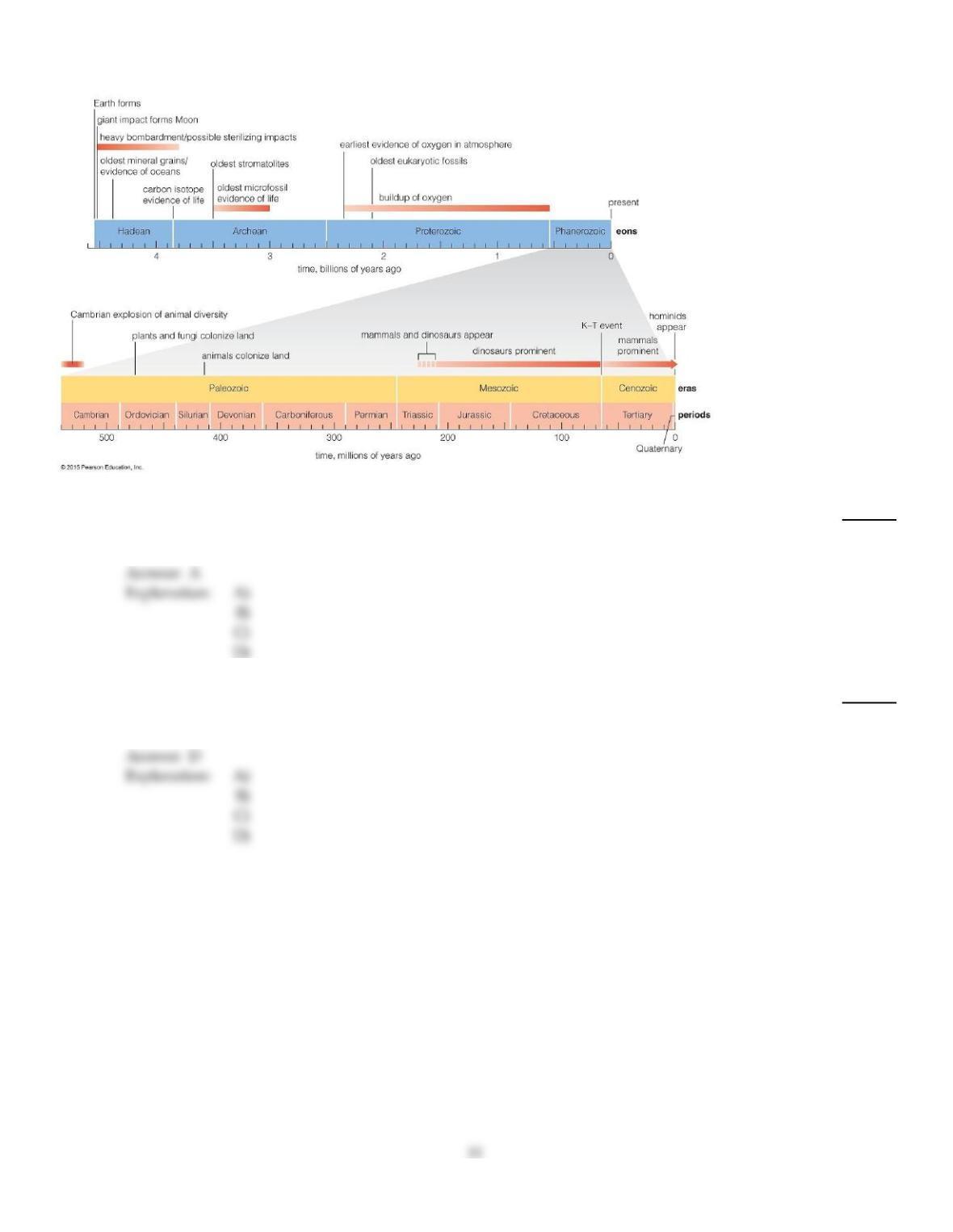
34)
The figure above shows the geological times scale. Humanity’s technological society has existed for
approximately ________ of the Earth’s history.
34)
A)
0.00001 %
B)
0.1 %
C)
20%
D)
10 %
35)
According to fossil evidence, how far back in time did life on Earth exist?
35)
A)
about 545 million years
B)
about 2.0 billion years
C)
about 65 million years
D)
about 3.5 billion years or more

36)
The “rare Earth hypothesis” holds that Earth–like planets will prove to be quite rare. Which of the
following statements best sums up the current status of the debate over this hypothesis?
36)
A)
It is no longer discussed, because as part of its broad cover–up of UFOs, the United States
government has classified all the material relating to this debate as Top Secret.
B)
We do not have enough data to settle the debate, because counterarguments can be made for
each argument suggesting Earth–like planets may be rare.
C)
The debate raged for a while, but is now settled. We are now quite certain that Earth–like
planets are rare.
D)
The debate raged for a while, but is now settled. We are now quite certain that Earth–like
planets are common.
37)
In the Drake equation (Number of Civilizations =NHP ×flife ×fciv ×fnow), we expect the term fciv
to be small if ________.
37)
A)
most civilizations destroy themselves within just a few hundred years of arising
B)
most of the civilizations that have ever existed are still out and about in the galaxy
C)
most habitable planets never actually get life on them
D)
primitive life is common but intelligent life is rare
38)
We are not yet capable of detecting life on planets around other stars. But as our technology
develops, our first real chance of detecting such life will probably come from ________.
38)
A)
examining spectral lines from the atmospheres of distant planets
B)
examining high–resolution images of the planets made by orbiting telescopes
C)
determining the orbital properties of the planets
D)
sending spacecraft to study the planets up close

39)
Which of the following was the most important for maintaining the Earth’s stable climate over the
time it took for large organisms to evolve?
39)
A)
plate tectonics
B)
the Moon
C)
underground sea vents
D)
sustained volcanic activity
E)
the cessation of the heavy bombardment phase
40)
Why do scientists suspect that life first arose near deep–sea volcanic vents or similar environments
with abundant chemical energy?
40)
A)
A deep ocean environment would have protected early organisms from ultraviolet radiation
before the formation of the ozone layer.
B)
All organisms have similar DNA, with further relations having greater differences.
C)
The chemical pathways for extracting energy from chemicals in vents are simpler than
photosynthesis.
D)
A and B
E)
A and C
F)
A, B, and C
F)
41)
At present, what is the primary way that astronomers carry out SETI programs (that is, search for
extraterrestrial intelligence)?
41)
A)
by using X–ray telescopes to search for signals from extraterrestrial civilizations
B)
by searching for planets around distant stars
C)
by analyzing the spectra of extra–solar planets in an attempt to detect oxygen
D)
by using radio telescopes to search for signals from extraterrestrial civilizations
E)
by analyzing high–resolution images of nearby stars in search artificial structures

42)
The analysis of Martian meteorites found on the Earth show that they contain
42)
A)
bacteria with DNA closely related to bacteria on Earth.
B)
only tantalizing hints of possible life.
C)
bacteria with DNA very different from bacteria on Earth.
D)
fossilized remains of multi–cellular insects.
E)
fossilized remains of small, mammal–like creatures.
43)
Which of the following are the best candidates to search for planets that might harbor
extraterrestrial life?
43)
A)
halo stars, because planets can form in isolation from disruptive stellar encounters
B)
solar–mass stars, because they have both a large habitable zone and a long stellar lifetime.
C)
massive stars (greater than twice the mass of the Sun) because they provide more energy to
promote biology
D)
low mass stars (less than one–tenth of the mass of the Sun), because these are the most
common stars in our galaxy
E)
binary stars, because they provide twice as much energy to promote biology
44)
How do scientists study the history of life on Earth?
44)
A)
by using telescopes to look far away, and thus see what life was like in the past
B)
by assuming that life in the past was just like present–day life
C)
by comparing present–day organisms with each other, and assuming past life had mixed
traits of present–day organisms
D)
by studying fossils, the preserved remains of past organisms

45)
Which observation(s) and/or experiment(s) demonstrate ways that the chemical building blocks of
life (amino acids and DNA bases) could have originated on the early Earth?
45)
A)
Experiments have shown that naturally occurring clays can catalyze the formation of RNA
strands.
B)
These complex molecules have been found within meteorites.
C)
Amino acids and DNA bases form from simple chemical reactions in experiments simulating
the early Earth atmosphere.
D)
All of the above
46)
We have sent several spacecraft on trajectories that will ultimately take them into interstellar space
(Pioneer 10 and 11, Voyager 1 and 2, New Horizons). How long will it take these spacecraft to travel as
far as the nearest stars?
46)
A)
never, because they will rust and fall apart
B)
about a thousand years
C)
a few decades
D)
tens of thousands of years
E)
a few hundred years
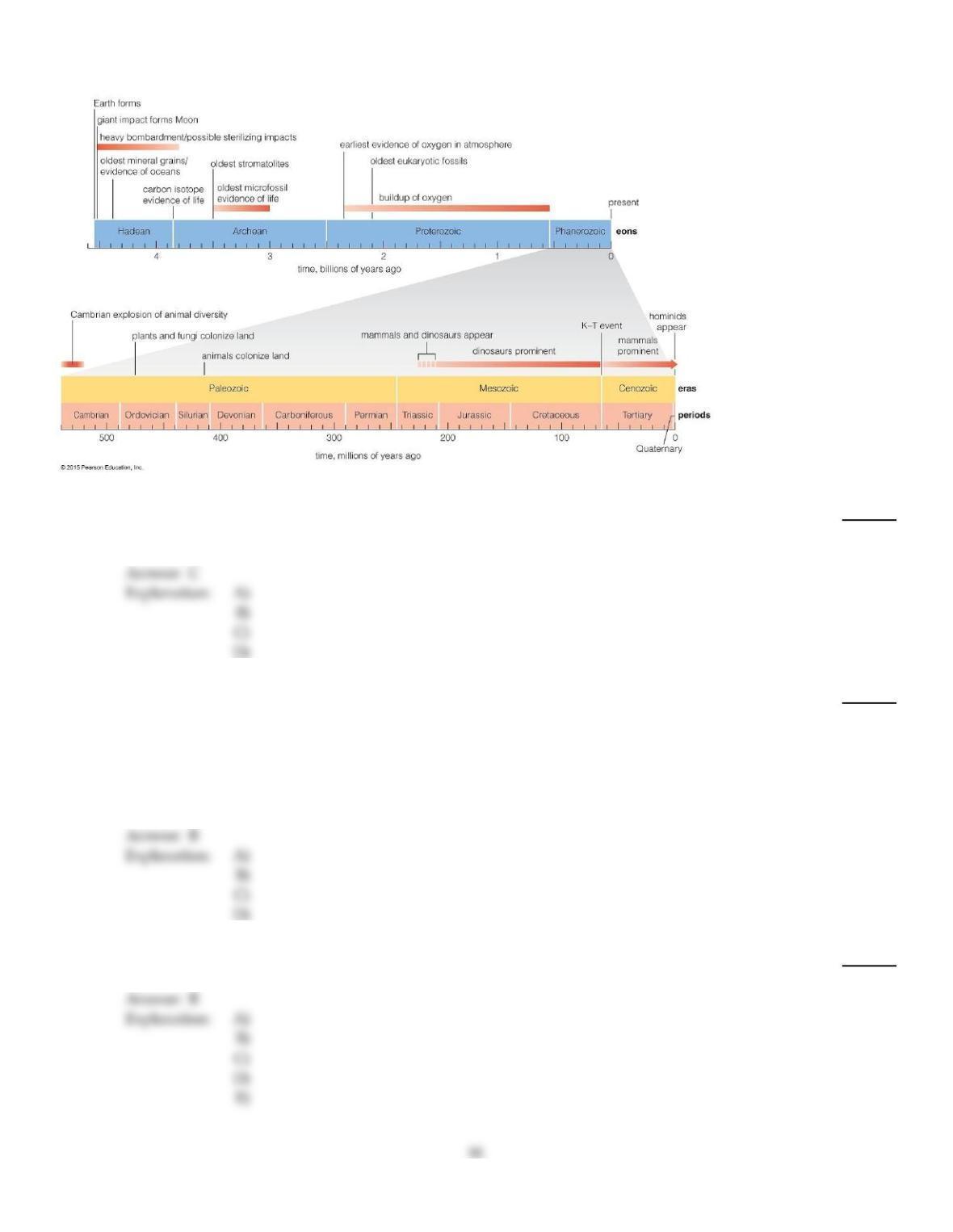
47)
The figure above shows the geological times scale. Humans have existed for approximately
________ of the Earth’s history.
47)
A)
1 %
B)
50%
C)
0.1 %
D)
10 %
48)
Which of the following best describes the predominant scientific view of the origin of life on Earth?
48)
A)
Life arose through a series of extremely unlikely chemical coincidences, making it seem
almost miraculous that life ever came to exist at all.
B)
We may never know precisely how life arose, but current evidence suggests that life probably
can arise naturally under the conditions that prevailed on the early Earth.
C)
Life probably migrated to Earth from some other world.
D)
We can describe with great certainty the precise steps by which life arose on Earth.
Answer:
49)
Where have scientists begun an active search for life beyond the Earth?
49)
A)
Europa
B)
Mars
C)
Venus
D)
Titan
E)
the Moon
Answer:
Answer:
50)
Why don’t we expect to find life on planets orbiting high–mass stars?
50)
A)
The stars are too hot to allow for life.
B)
The high–mass stars emit too much ultraviolet radiation.
C)
Planets cannot have stable orbits around high–mass stars.
D)
The lifetime of a high–mass star is too short.
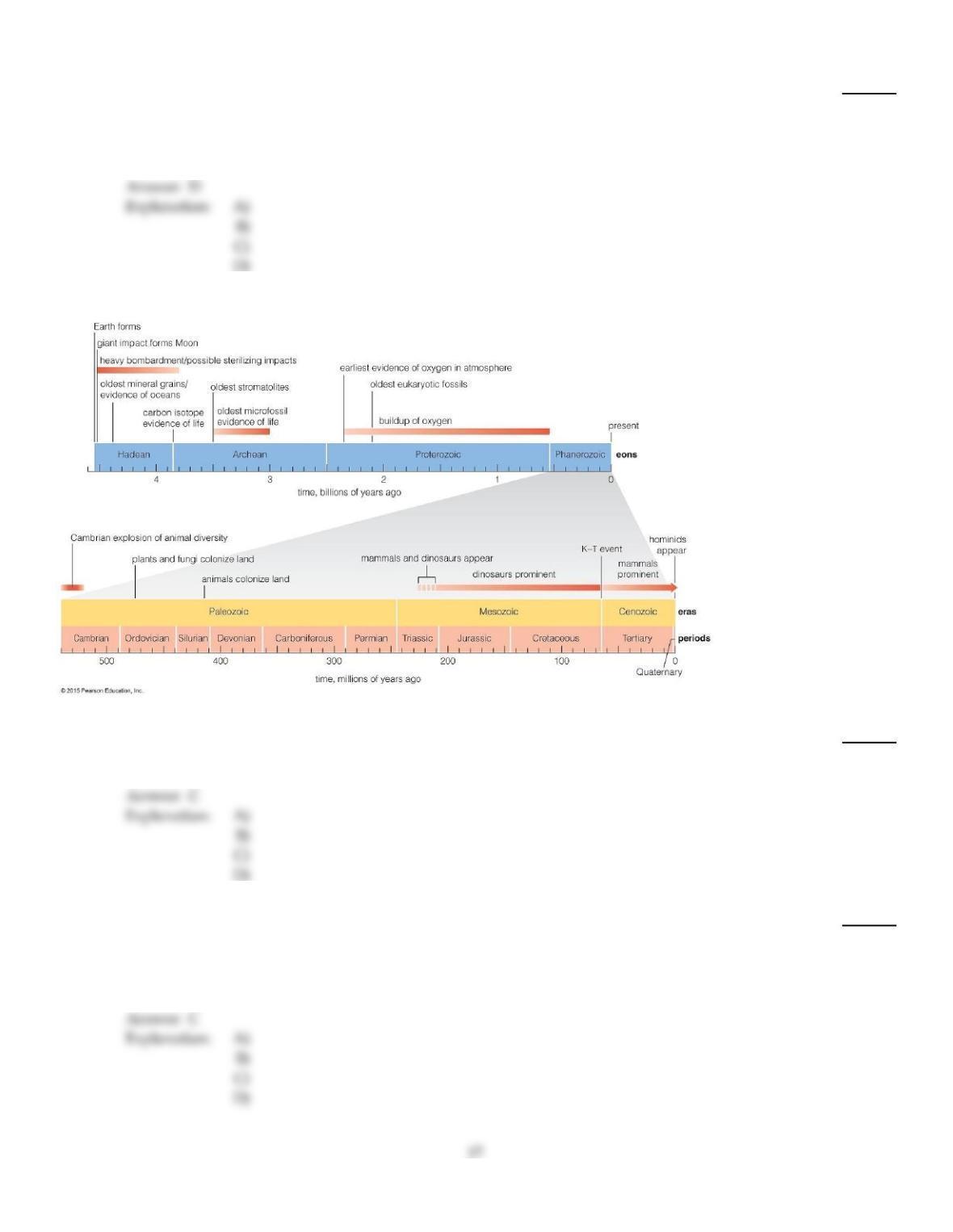
51)
The figure above shows the geological times scale. Animals have been present on land for
approximately ________ of the Earth’s history.
51)
A)
1/2
B)
3/4
C)
1/10
D)
1/5
52)
What is a mutation?
52)
A)
a change in the physical appearance of a living organism
B)
a change in the type of food an organism consumes
C)
a change in a living cell‘s DNA
D)
a change in an organism that turns it into a different species
53)
Looking for an Earth–size planet around a nearby star (besides the Sun) is like looking for a
pinhead located ________.
53)
A)
across the length of a football field
B)
a few hundred kilometers away
C)
across the street
D)
thousands of kilometers away
54)
The figure above shows the geological times scale. Life has existed for ________ of the Earth’s
history.
54)
A)
about 1/4
B)
about 9/10
C)
all
D)
about 1/2
55)
Which of the following is considered by biologists to be a likely place where life might have first
arisen on Earth?
55)
A)
on land surfaces that got moderately heavy rainfall
B)
deep in Earth’s core
C)
in hot water near undersea volcanoes
D)
on meteorites that landed on Earth

56)
In 1974, a radio message was sent out from the Arecibo observatory in Puerto Rico towards a
globular cluster, 21,000 light–years away. Approximately how far has this message gotten as of
today?
56)
A)
It’s just passing stars that are close neighbors to the Sun in the Milky Way.
B)
It’s already arrived at the globular cluster.
C)
It’s just passing through the Oort cloud surrounding our solar system
D)
It’s just beyond the Neptune in our solar system
E)
It’s almost at the center of the Milky Way.
57)
Which of the following best describes what we mean by a habitable world?
57)
A)
a planet or moon with life
B)
a planet or moon that could support life, if any life happened to be on it
C)
a planet or moon that lies within its star’s habitable zone
D)
a planet or moon on which humans could survive if we happened to go there
58)
Which of the following is not a possible solution to the Fermi Paradox?
58)
A)
There is a galactic civilization, but we are currently unable to detect or recognize it.
B)
Given the current age of our galaxy, there has not been enough time for a galactic civilization
to develop.
C)
Of all of the intelligent civilizations in the Milky Way, none has chosen to create a galactic
civilization.
D)
We are the only intelligent civilization to have ever arisen in the Milky Way.
E)
There is a galactic civilization, but it is being actively hidden from us.

59)
If there are other civilizations at present in the Milky Way Galaxy, which statement is almost
undoubtedly true?
59)
A)
For fun, they enjoy “buzzing” to Earth and temporarily abducting people, showing a clear
preference for people located in less–developed rural areas.
B)
They are far more technologically advanced than we are.
C)
They are anatomically much like us, with two arms, two legs, two eyes, and two ears.
D)
They have social structures that are completely different from our own; for example, different
types of “family” units, and so on.
60)
Which of the following best describes natural selection?
60)
A)
It is a guess made by scientists about how life develops, but it has no hard evidence to
support it.
B)
It is the idea that the strong survive and the weak die off.
C)
It is the idea that organisms with genetic traits that improve their ability to reproduce are
more likely to pass those traits on to future generations.
D)
It is the idea that organisms naturally increase in complexity and intelligence with time.
61)
What is the Fermi Paradox?
61)
A)
Interstellar travel is possible yet would take an infinite amount of time because of relativistic
time–dilation.
B)
We would be unable to detect an Earth–like planet even at a distance of a few light years.
C)
The Drake equation predicts that there should be no intelligent life in the Milky Way. Yet, we
exist.
D)
Galactic civilizations, like ours, seem forbidden by the laws of physics.
E)
Reasonable assumptions predict that a galactic civilization should have already arisen in the
Milky Way. Yet, we have absolutely no evidence for it.
62)
How do scientists determine the age of fossils?
62)
A)
They only determine relative ages by assuming that deeper layers of sedimentary rock are
older.
B)
They use radiometric dating to measure the age of the surrounding rocks.
C)
They cannot.

63)
Which of the following is not considered crucial for life to exist on some world?
63)
A)
a source of energy that can be used by life
B)
a source of nutrients
C)
liquid water
D)
an atmosphere
64)
Why is Europa considered a good candidate for the possible existence of life?
64)
A)
It has a thick atmosphere with a surface pressure greater than that on Earth.
B)
The Galileo spacecraft found strange seasonal changes on its surface that look like they could
be due to life.
C)
It is located within our Sun’s habitable zone.
D)
Strong evidence suggests that it has a deep, subsurface ocean of liquid water.
D
65)
Einstein’s theory of relativity tells us that travelers who make a high–speed trip to a distant star and
back will ________.
65)
A)
have more fun than people who stay behind on Earth
B)
never be able to make the trip within their lifetimes
C)
age more than people who stay behind on Earth
D)
age less than people who stay behind on Earth
D
66)
How did oxygen (O2) get into Earth‘s atmosphere?
66)
A)
It was outgassed from volcanoes.
B)
It was released by life through the process of photosynthesis.
C)
It came from chemical reactions with surface rocks.
D)
It was captured from the solar nebula.
B
D

67)
SETI (the Search for Extraterrestrial Intelligence) searches for communications from life in planets
and moons
67)
A)
toward the center of the Milky Way.
B)
around nearby stars.
C)
within the solar system.
D)
in globular clusters.
E)
in other galaxies.
68)
According to current science, why didn‘t oxygen begin to accumulate in the atmosphere for more
than a billion years after life appeared on the Earth?
68)
A)
Oxygen was removed from the atmosphere by chemical reactions with surface rocks as
quickly as it was released by life.
B)
Oxygen was removed from the atmosphere by dissolving in the ocean as quickly as it was
released by life.
C)
Early forms of animal life consumed the oxygen released by plants during the first billion
years of life on Earth.
D)
Early life did not release oxygen, and oxygen releasing organisms didn’t evolve for a billion
years after the earliest life.
69)
What evidence suggests that life arises relatively easily?
69)
A)
Tardigrades, small animals, can survive exposure to the near–vacuum of space.
B)
Life is currently present in extreme environments like deep ocean volcanic vents.
C)
All organisms on Earth use DNA as their genetic material.
D)
Life was present on Earth soon after the end of the heavy bombardment.
70)
Which of the following best describes the current status of the debate over evidence for life in the
Martian meteorite ALH84001?
70)
A)
Most scientists find the evidence intriguing but suspect that it can be explained without
requiring past life on Mars.
B)
Most scientists now agree that the meteorite shows clear evidence of past life on Mars.
C)
Most scientists agree that the evidence would support life if the meteorite truly comes from
Mars, but few scientists accept that the meteorite is from Mars and instead think it is an
ordinary Earth rock.
D)
Most scientists now agree that the meteorite shows no evidence for past life on Mars.
71)
The Voyager I and II spacecraft visited the Jovian planets in the 1980s. When will they reach the
distances of the nearest stars?
71)
A)
in our grandchildren’s lifetime
B)
in our children’s lifetime
C)
thousands of years from now
D)
hundreds of thousands of years from now
E)
in our lifetime
SHORT ANSWER. Write the word or phrase that best completes each statement or answers the question.
72)
Why do we need new forms of technology to make it possible to journey to the nearest
stars within a human lifetime?
72)
73)
Briefly explain the purpose of the equation
Number of Civilizations =NHP ×flife ×fcivilization ×fnow.
73)
74)
Why might the presence of a giant planet be both good and bad for life on a terrestrial
planet in another solar system?
74)
75)
What is the evidence that suggests planetary systems are common in the universe?
75)
76)
If we detected an Earth–like planet in the habitable zone around another star, how might
we learn whether it harbored life?
76)
77)
Briefly summarize current knowledge about the term NHP in the equation
Number of Civilizations =NHP ×flife ×fcivilization ×fnow.
77)

78)
Briefly explain the Fermi Paradox, namely the paradox of the question “Where are the
aliens?”
78)
79)
Briefly explain the meaning of each term in the equation
Number of Civilizations =NHP ×flife ×fcivilization ×fnow.
79)
80)
Briefly summarize current knowledge about the term flife in the equation
Number of Civilizations =NHP ×flife ×fcivilization ×fnow.
80)
81)
The Kepler mission has searched for Earth–like planets by looking for the dip in the
brightness of a star as a (potential) planet transits across it. Why will this technique actually
miss the vast majority of planets around the stars it observes?
81)
TRUE/FALSE. Write ‘T’ if the statement is true and ‘F’ if the statement is false.
82)
The requirement of liquid water is the most severe constraint on the development of life.
82)
83)
The modern–day organisms that seem oldest, in an evolutionary sense, are microbes that
live in the hot water around volcanic vents on the ocean floor.
83)
84)
There is good evidence that life on Earth was thriving prior to 3.85 billion years ago.
84)

85)
One idea for interstellar spacecraft involves harnessing energy from nuclear bombs detonated in
space.
85)
86)
Nearly all of the oxygen in the Earth‘s atmosphere was originally produced by photosynthesis in
the leaves of trees that covered the continents 3.5 billion years ago.
86)
87)
Although antimatter is an interesting theoretical idea, there is no evidence that it actually exists.
87)
88)
The Pioneer and Voyager spacecraft carry a message from Earth, just in case an alien civilization ever
runs across them.
88)
89)
The habitable zone around a star refers to the places where living organisms are found.
89)
90)
If they existed, and if they were watching, a civilization at the center of the Milky Way could have
detected our first TV signals by now.
90)
91)
Relativistic time–dilation means that astronauts aboard a spaceship traveling close to the speed of
light will actually age less than their families left behind on the Earth.
91)
92)
We have already launched spacecraft whose orbits will carry into interstellar space.
92)
93)
We have already launched a spacecraft bound for Alpha Centauri.
93)
ESSAY. Write your answer in the space provided or on a separate sheet of paper.
94)
Generalizing from a Single Example: Many would argue that our concept of life and intelligence is severely limited
by the fact that we have only the “single example” of the Earth. Do you agree with this view (address the
questions of life and intelligence separately)? To what extent do you feel that the search for extraterrestrial life is
biased by the example of life on the Earth? Does the search for extraterrestrial intelligent life suffer more or less
from the same bias?

95)
Evolution as a Scientific Theory: Detractors often dismiss evolution by emphasizing the role randomness plays in
the theory. They argue that a living creature (such as a human being) is about as likely to have evolved by
random chance as a Boeing 747 airplane is of being assembled by a tornado flying through a junkyard. Explain
why this vivid analogy is nevertheless fundamentally flawed by correctly explaining the role that randomness
plays in the theory of evolution.
96)
Science Fiction as a Driver of Science? This chapter, more than any other in the book, involves familiar themes of
science fiction: space travel, extraterrestrial life, extraterrestrial intelligence, and more. Give and discuss two
concepts that started out as science fiction but ended up as science fact. Give and discuss an example of an idea
from science fiction that will likely never be realized as science fact. Do you think that the rise in popularity of
science fiction (Star Trek, Star Wars, and others) has increased or decreased the general public’s understanding of
science? Explain.

Answer Key
Testname: C19
Answer Key
Testname: C19
29
Answer Key
Testname: C19