Chapter 19 – Population Genetics and Human Evolution
True / False
1. The genetic variability of a population is solely dependent on the generation of mutations.
a.
True
b.
False
False
19–1: Natural Selection Drives Evolution
2. Hardy and Weinberg showed that the allele frequencies in a non-evolving population change with successive
generations.
a.
True
b.
False
False
19–2: How Can We Measure Allele Frequencies in Populations?
3. The Hardy-Weinberg law can be used to calculate allele and genotype frequencies without genetic testing.
a.
True
b.
False
19–2: How Can We Measure Allele Frequencies in Populations?
4. Since males have only one X chromosome, the allele frequency of an X-linked trait is equal to the number of males
with the recessive phenotype.
a.
True
b.
False
True
19–3: Using the Hardy–Weinberg Law in Human Genetics
5. Genetic drift is a random process that can change the genetic structure of a population.
a.
True
b.
False
True
6. There is significantly more genetic variation between human populations than within them.
a.
True
b.
False
False
19–6: Genetic Variation in Human Populations
7. Most geneticists would agree that human races are distinct genetic entities.
a.
True
b.
False
False
19–6: Genetic Variation in Human Populations
on genetic variation between populations.
8. According to genetic evidence, the migration of H. sapiens out of Africa replaced other human populations, including
Neanderthals and H. erectus, leading to their extinction.
a.
True
b.
False
True
19–7: The Evolutionary History and Spread of Our Species (Homo sapiens)
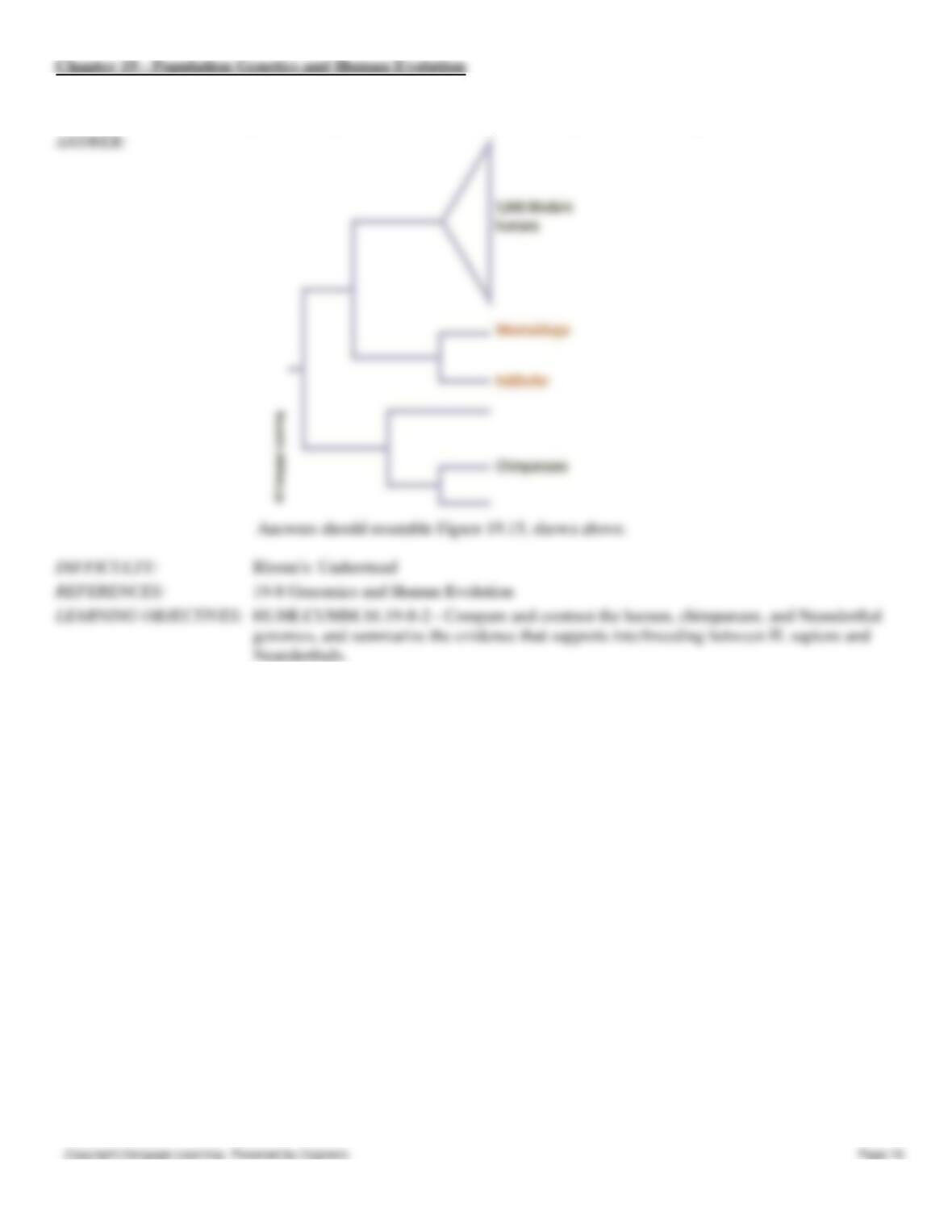
9. All evolutionary ancestors of modern humans have been discovered and identified.
a.
True
b.
False
False
19-8 Genomics and Human Evolution
Denisovans.
10. The availability of genomic data has allowed scientists to construct more accurate phylogenetic trees than those based
on fossil evidence alone.
a.
True
19–4: Measuring Genetic Diversity in Human Populations
Chapter 19 – Population Genetics and Human Evolution
b.
False
True
Bloom’s: Understand
19-8 Genomics and Human Evolution
potential use of genomic techniques to investigate evolutionary relationships.
Multiple Choice
11. A loss of 90% of the population in the Pingelap atoll from a typhoon in 1775 resulted in a high percentage of the
current population being affected by achromatopsia. As a result, all of these affected individuals _____.
a.
have normal vision
b.
are descendants of one of the 20 original survivors
c.
receive genetic testing and genetic counseling
d.
have exceptional hearing
e.
are descendants of the 20 original survivors
b
Bloom’s: Understand
19–1: Natural Selection Drives Evolution
frequencies in a population.
12. The Hardy-Weinberg law is used to calculate allele and genotype frequencies ____.
a.
in small populations
b.
when mating is random
c.
in migrating populations
d.
when some alleles confer an evolutionary advantage over other alleles
e.
the population descends from a single ancestor
b
Bloom’s: Understand
19–2: How Can We Measure Allele Frequencies in Populations?
based, and derive the Hardy-Weinberg equation based on these assumptions.
13. A population that is in genetic equilibrium is said to ____.
a.
have an equal number of homozygotes as heterozygotes for a given trait
b.
deviate from the Hardy-Weinberg law
c.
require genetic testing for estimation of allele frequencies
d.
lose genetic variation with each generation
e.
have an allele or alleles that remain constant generation to generation
e
Bloom’s: Understand
19–2: How Can We Measure Allele Frequencies in Populations?
genetic variation.
14. Albinism is a recessive trait controlled by a single gene. If the frequency of albinos in a population is 0.25, what is the
expected frequency of heterozygotes for this trait?
a.
0.25
b.
0.50
c.
0.75
d.
0.90
e.
1.00
a
Bloom’s: Apply
19–3: Using the Hardy–Weinberg Law in Human Genetics
are carried by heterozygotes.
15. Assume the trait for brown eyes is completely dominant to blue eyes and this trait is controlled by a single gene. If 400
people in a population of 10,000 have blue eyes, how many people would be expected to be heterozygous for this trait?
(Hint: Use the Hardy-Weinberg formula.)
a.
8,000
b.
5,400
c.
3,200
d.
960
e.
320
c
Bloom’s: Apply
19–3: Using the Hardy–Weinberg Law in Human Genetics
are carried by heterozygotes.
16. In a Hardy-Weinberg equilibrium, as the frequencies of homozygous genotypes increase, the frequency of the
heterozygous genotype _____.
a.
doubles
b.
is reduced by a factor of 10
c.
increases linearly
d.
decreases linearly
e.
remains the same
b
Bloom’s: Understand
19–3: Using the Hardy–Weinberg Law in Human Genetics
are carried by heterozygotes.
17. According to the theory of evolution, those best adapted to the environment will _____.
a.
survive and reproduce
b.
not survive
Chapter 19 – Population Genetics and Human Evolution
c.
produce offspring that are genetically identical to the parents
d.
have lower fertility rates
e.
have fewer offspring on average
a
Bloom’s: Understand
19–4: Measuring Genetic Diversity in Human Populations
sickle cell anemia as an example, explain how natural selection affects allele frequencies.
18. A predictable effect of genetic drift in a small population is an increase in _____.
a.
mutations
b.
dominant alleles
c.
recessive alleles
d.
genetic variation
e.
homozygosity
e
Bloom’s: Understand
19–4: Measuring Genetic Diversity in Human Populations
small populations.
19. The relatively high percentage of individuals in West Africa who are heterozygous for the sickle cell trait is an
example of _____.
a.
natural selection
b.
genetic drift
c.
spontaneous mutational spread
d.
heterozygote disadvantage
e.
the founder effect
a
Bloom’s: Remember
19–4: Measuring Genetic Diversity in Human Populations
sickle cell anemia as an example, explain how natural selection affects allele frequencies.
20. The rapid change in G6PD allele frequency and the correlation of this allele with areas of high rates of malaria
suggests that ____ explains this change in G6PD allele frequency.
a.
genetic drift
b.
artificial selection
c.
X-linked inheritance
d.
the founder effect
e.
natural selection
e
Bloom’s: Understand
19–5: Natural Selection Affects the Frequency of Genetic Disorders
21. The genotypic definition of race states that races are populations of the same species in which allele frequencies differ
by ____.
a.
15%–20%
b.
85%
c.
1 in 1000 nucleotides
d.
25%–30%
e.
5%–10%
d
Bloom’s: Understand
19–6: Genetic Variation in Human Populations
race.
22. Humans differ from each other by 1 in 1000 to 1 in 5000 nucleotides, while chimpanzees differ from each other by 1
in 500 nucleotides. This suggests that _____.
a.
humans are a younger species
b.
humans are an older species
c.
humans descended directly from chimpanzees
d.
chimpanzees descended directly from humans
e.
chimpanzees and humans have identical proteomes
a
Bloom’s: Understand
19–6: Genetic Variation in Human Populations
identify individuals and populations.
23. The gradient distributions of alleles across continents reflect _____.
a.
the delineation of new races
b.
genetic drift
c.
human migration patterns
d.
protective alleles
e.
natural selection
c
Bloom’s: Understand
19–6: Genetic Variation in Human Populations
geographic regions gives clues to human migration patterns.
24. The taxonomic category that includes species of apes, humans, and their ancestors is known as ____.
a.
hominids
b.
hominins
c.
hominoids
d.
australopithecines
can be attributed to either a founder effect or to natural selection that favors heterozygotes.
Chapter 19 – Population Genetics and Human Evolution
e.
apes
a
Bloom’s: Understand
19–7: The Evolutionary History and Spread of Our Species (Homo sapiens)
identified chimpanzees as our closest living relative within this group.
25. Of the following hominin species, from which did H. sapiens derive?
a.
H. habilis
b.
H. rudolfensis
c.
H. heidelbergensis
d.
H. ergaster
e.
H. erectus
c
Bloom’s: Remember
19–7: The Evolutionary History and Spread of Our Species (Homo sapiens)
relationships of H. sapiens to other members of this group.
26. According to the _____, modern humans originated in, and migrated out of, East Africa.
a.
haplotype data of mitochondrial DNA sequences
b.
haplotype data of Y chromosome sequences
c.
out–of-Africa model
d.
multiregional model
e.
fossil record
c
Bloom’s: Remember
19–7: The Evolutionary History and Spread of Our Species (Homo sapiens)
modern humans.
27. The phenotypic differences between chimps and humans is best explained by _____.
a.
the high variation in the number of different genes between the two species
b.
the high number of inversion sequences
c.
epistatic changes to genes
d.
patterns of gene expression and regulation
e.
the large amount of “junk DNA” found in chimpanzee genomes
d
Bloom’s: Apply
19-8 Genomics and Human Evolution
Neanderthals.
28. Genomic studies of Neanderthals, modern humans, and chimpanzees have confirmed that ____.
Chapter 19 – Population Genetics and Human Evolution
a.
humans evolved from Denisovans
b.
humans and Neanderthals interbred
c.
humans and Neanderthals are 98.8% genetically identical
d.
humans are direct descendants of Neanderthals
e.
there is a 5% difference in the coding regions of the human genome vs. the chimpanzee genome
b
Bloom’s: Remember
19-8 Genomics and Human Evolution
Neanderthals.
29. The observation that SNPs account for most of the differences in the coding regions between the human and
chimpanzee genomes suggests that ____.
a.
the two genomes are too different to suggest an evolutionary relationship
b.
Neanderthals descended directly from chimpanzees
c.
small changes in amino acid sequences account for big differences in phenotype
d.
most of the differences in phenotype are due to DNA sequence changes
e.
humans descended directly from chimpanzees
c
Bloom’s: Understand
19-8 Genomics and Human Evolution
Neanderthals.
30. Which population has a small percentage of Denisovan genes, thus suggesting interbreeding?
a.
Asians
b.
Melanesians
c.
H. floresiensis
d.
Neanderthals
e.
chimpanzees
b
Bloom’s: Remember
19-8 Genomics and Human Evolution
Denisovans.
Completion
31. The frequency of a certain genotype in a population is called _____________________.
genotype frequency
Bloom’s: Remember
19–2: How Can We Measure Allele Frequencies in Populations?
HUHE.CUMM.16.19-2-1 – Define the terms allele frequency and genotype frequency, and
32. The _____________________ law measures allele and genotype frequencies in a population without the need for
genetic testing.
19–2: How Can We Measure Allele Frequencies in Populations?
33. In the Hardy-Weinberg equation, _____________________ represents the dominant allele, while
_____________________ represents the recessive allele.
p; q
19–2: How Can We Measure Allele Frequencies in Populations?
34. When applying the Hardy-Weinberg law to a gene with dominant and recessive alleles, calculation of the allele
frequencies always begins by writing the frequency of the _____________________ phenotype, then taking the
_____________________ of this to obtain the frequency of the recessive allele.
19–3: Using the Hardy–Weinberg Law in Human Genetics
35. If 0.04% (0.0004) of the people in a population has sickle cell anemia, the percent of heterozygotes in the population
must be _____________________ percent.
19–3: Using the Hardy–Weinberg Law in Human Genetics
36. Hemophilia is an X-linked trait caused by the allele h. About 1 in 10,000 males (0.0001) has hemophilia. The
frequency of the h allele in males is therefore _____________________.
19–3: Using the Hardy–Weinberg Law in Human Genetics
37. In a hypothetical population of 1,000 people, there is a hypothetical trait called pink toe. People who are homozygous
Chapter 19 – Population Genetics and Human Evolution
dominant have red toes, those who are homozygous recessive have white toes, and those who are heterozygous have pink
toes. If 400 people have red toes, the number of people with pink toes is _____________________.
38. The ultimate source of new alleles and genetic variability is _____________________.
39. Because of the _____________________, traits carried by early settlers are found in a large fraction of the descendent
population.
40. In a large population on a Pacific island, a few individuals had a mutation that caused them to have different colored
eyes. After a hurricane, the population was reduced to only a few individuals, but some of those individuals had the rare
eye color mutation. Now, after many generations, almost half of the population on this island has different colored eyes.
This is an example of _____________________.
41. The measure of differential survival and reproductive success is termed _____________________.
42. Heterozygotes for the Tay-Sachs disease allele appear to have greater than normal resistance to
_____________________, which supports the theory that _____________________ explains why this harmful allele
persists in the gene pool.
43. Genomic studies using _____________________ can identify an individual’s ancestral continent.
44. On average, humans differ by _____________________% of their genomic sequences.
45. The idea that H. erectus populations in Africa, the Middle East, and Asia all collectively interbred and evolved into H.
sapiens is called the _____________________ model.
46. The taxonomic category that includes all bipedal primates is called _____________________.
47. Comparative genome studies show that humans and _____________________ shared a common ancestor
approximately 5.4 to 6.3 million years ago.
48. The observation that some modern humans contain Neanderthal DNA suggests _____________________ occurred
between H. sapiens and Neanderthals.
49. Genetic evidence has revealed that H. sapiens diverged from _____________________ 100,000 years ago, while
Neanderthals diverged from this species 300,000 years ago, suggesting that modern humans did not descend directly from
Neanderthals.
50. A(n) _____________________ depicts the evolutionary relationships between related species.
Essay
51. According to the Hardy-Weinberg law, the genotype frequencies of dominant homozygotes, heterozygotes, and
recessive homozygotes are represented by p2, q2, and 2pq, respectively, where p is the frequency of the dominant allele
and q is the frequency of the recessive allele. Explain how this formula was derived.
52. Outline the assumptions made in establishing the Hardy-Weinberg law.
53. One would think that deleterious genes would be eliminated by natural selection, yet we have two human genetic
disorders with a high carrier frequency, sickle-cell anemia and cystic fibrosis. Why has this high frequency for these
conditions remained in the population?
54. Why is it that mutation, acting alone, has little effect on allele frequency, and therefore evolution? What other factors
will magnify the effect?
55. Do you agree with geneticists that there is no genetic basis to divide humans into races? Why or why not?
56. Compare and contrast the out–of-Africa model and multiregional theories of the origin of modern man. Which theory
is supported by the preponderance of genetic evidence? What type of evidence supports the other theory
57. During the eugenics movement of the 1900s, it was believed that individuals affected with certain genetic disorders
should be sterilized to prevent transmitting the gene to future generations. Would such measures be effective? Why or
why not?
58. In the U.S., many states passed laws against miscegenation, or marriage between individuals of different races. What
genetically based arguments would you use in support or opposition to such laws?
59. What is the effect of genetic drift on evolution? How does the founder effect work to cause change in allele
frequency?
60. Diagram the evolutionary relationships between Neanderthals and chimpanzees based on genomic data.