Chapter 19 – The Peripheral Endocrine Glands
resisting stress.
a.
True
b.
False
True
52. Strong circumstantial evidence suggests a link between chronic exposure to psychosocial stressors and development of
pathological conditions such as high blood pressure.
a.
True
b.
False
True
53. Anabolism is the breakdown, or degradation, of large, energy-rich organic molecules within cells.
a.
True
b.
False
False
54. Excess circulating glucose is stored in the liver and muscle as glycogen.
a.
True
b.
False
True
55. The liver plays the primary role in maintaining normal blood glucose levels.
a.
True
b.
False
True
56. Pancreatic somatostatin stimulates digestion in a variety of ways by increasing nutrient breakdown and absorption.
a.
True
b.
False
Chapter 19 – The Peripheral Endocrine Glands
False
57. Blood insulin levels may rise abnormally high in a non-diabetic individual whose alpha cells are under-responsive to
glucose, a condition called reactive hypoglycemia.
a.
True
b.
False
False
58. Glucagon affects many of the same metabolic processes that insulin influences, but in most cases glucagon’s actions
are opposite to those of insulin.
a.
True
b.
False
True
59. A fall in blood fatty acid concentration directly inhibits insulin output and stimulates glucagon output by the liver.
a.
True
b.
False
False
60. The stress hormones, epinephrine and cortisol, both increase blood glucose and blood fatty acids through a variety of
metabolic effects.
a.
True
b.
False
True
61. Osteoporosis occurs with greatest frequency in postmenopausal women because of the associated withdrawal of bone-
preserving estrogen.
a.
True
b.
False
Chapter 19 – The Peripheral Endocrine Glands
True
62. Calcitonin raises plasma Ca2+ concentration and is important for controlling Ca2+ metabolism.
a.
True
b.
False
False
63. Vitamin D is a hormone that increases Ca2+ absorption in the liver.
a.
True
b.
False
False
64. Intracellular phosphate is important in the high-energy phosphate bonds of ATP.
a.
True
b.
False
True
65. Hyperparathyroidism, which is usually caused by a hypersecreting tumor in one of the parathyroid glands, is
characterized by hypocalcemia and hyperphosphatemia.
a.
True
b.
False
False
66. The follicular cells produce two iodine-containing hormones derived from the amino acid __________:
tetraiodothyronine (T4) and __________.
67. About 90% of the secretory product released from the thyroid gland is in the form of __________, yet __________ is
about 10 times more biologically potent.
68. Closely related to thyroid hormone’s metabolic effect is its __________ effect.
69. The most common cause of hyperthyroidism is __________.
70. With __________ caused by thyroid gland failure or lack of __________, a goiter develops because the circulating
level of thyroid hormone is so low.
71. Cortisol is bound mostly to a plasma protein specific for it, which is known as __________.
72. Cortisol exerts __________ and immunosuppressive effects to help hold immune system responses in a check-and-
balance fashion.
73. Adrenal DHEA is overpowered by testicular __________ in males, but is of physiologic significance in females.
74. Excessive adrenal androgen secretion in young boys causes them to prematurely develop male secondary sexual
characteristics, a condition called __________.
75. The adrenal medulla consists of modified postganglionic sympathetic neurons called __________ cells.
76. Epinephrine __________ the overall metabolic rate.
77. The major neural response to a stressful stimulus is generalized activation of the __________ nervous system.
78. The __________ nervous system and the epinephrine secreted at its bidding both inhibit insulin and stimulate
__________.
79. Insulin stimulates __________, the production of glycogen from glucose, in skeletal muscle and the liver.
80. Glucose stimulates insulin secretion by means of a(n) __________ process.
81. The effects of a lack of insulin on protein metabolism result in a net shift toward protein __________.
Chapter 19 – The Peripheral Endocrine Glands
82. Insulin excess can occur in a diabetic patient when too much insulin has been injected for the person’s caloric intake
and exercise level, resulting in __________.
83. Glucagon secretion __________ during the post-absorptive state and __________ during the absorptive state.
84. The stress hormones, __________ and cortisol, both increase blood glucose and blood fatty acids through a variety of
metabolic effects.
85. Recent evidence indicates that the CNS, particularly the __________, directly senses blood-borne nutrients and
hormones associated with nutrient management and uses this information to influence the three main regulators of
__________ homeostasis.
86. Calcium serves as a cofactor in several steps of the cascade of reactions that leads to __________ formation.
87. Regulation of calcium __________ involves the immediate adjustments required to maintain a constant free plasma
Ca2+ concentration on a minute-to-minute basis.
88. Osteoblasts produce two chemical signals that govern osteoclast development and activity in opposite ways: RANK
ligand and __________.
89. __________, the hormone produced by the C cells of the thyroid gland, exerts an influence on plasma Ca2+ levels.
90. Cholecalciferol, or __________, is a steroid-like compound essential for Ca2+ absorption in the __________.
Chapter 19 – The Peripheral Endocrine Glands
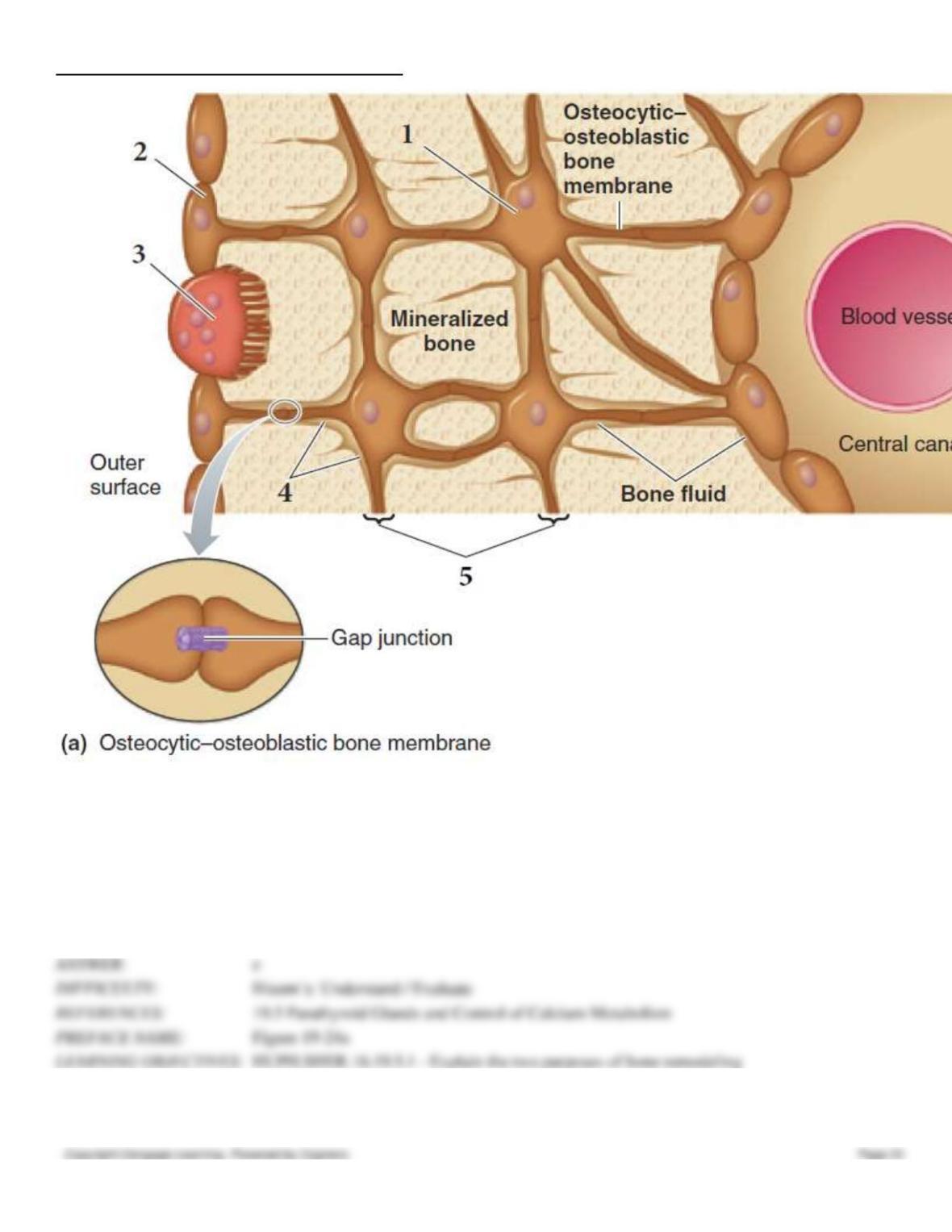
Use the figure above (Figure 19–24a) to answer the corresponding questions.
91. Which number in the figure represents the lamellae?
a.
1
b.
2
c.
3
d.
4
e.
5
92. Which number in the figure represents the canaliculi?
a.
1
Chapter 19 – The Peripheral Endocrine Glands
b.
2
c.
3
d.
4
e.
5
d
93. Which number in the figure represents an osteoclast?
a.
1
b.
2
c.
3
d.
4
e.
5
94. Which number in the figure represents an osteocyte?
a.
1
b.
2
c.
3
d.
4
e.
5
95. Which number in the figure represents an osteoblast?
a.
1
b.
2
c.
3
d.
4
e.
5
b
96. Discuss the relationship between hyperthyroidism and Graves’ disease.
97. Discuss the causes and symptoms of aldosterone hypersecretion.
98. Define stress, and describe factors that elicit a stress response.
99. Describe the role of amylin.
100. Discuss the consequences of vitamin D deficiency.