103. Figure 9-5.
Sully Company provided the following information for last month.
Production in units
3,000
Direct materials cost
$7,000
Direct labor cost
$10,000
Overhead cost
$9,600
Sales commission per unit sold
$ 4
Price per unit sold
$29
Fixed selling and administrative expense
$7,000
There were no beginning and ending inventories.
Refer to Figure 9-5. What is Sully’s cost of goods sold per unit?
104. Figure 9-5.
Sully Company provided the following information for last month.
Production in units
3,000
Direct materials cost
$7,000
Direct labor cost
$10,000
Overhead cost
$9,600
Sales commission per unit sold
$ 4
Price per unit sold
$29
Fixed selling and administrative expense
$7,000
There were no beginning and ending inventories.
Refer to Figure 9-5. What is gross margin for Sully Company last month?
105. Figure 9-5.
Sully Company provided the following information for last month.
Production in units
3,000
Direct materials cost
$7,000
Direct labor cost
$10,000
Overhead cost
$9,600
Sales commission per unit sold
$ 4
Price per unit sold
$29
Fixed selling and administrative expense
$7,000
There were no beginning and ending inventories.
Refer to Figure 9-5. What is operating income for Sully Company for last month?
106. Figure 9-10.
Connor Company produces speaker systems for cars. Estimated sales (in units) in January are 40,000; in
February 37,000; and in March 34,000. Each unit is priced at $60. Connor wants to have 35 percent of the
following month’s sales in ending inventory. That requirement was met on January 1.
Each speaker system requires 3 boxes and 15 yards of wire. Boxes cost $4 each and wire is $0.60 per yard.
Connor wants to have 20 percent of the following month’s production needs in ending raw materials inventory.
On January 1, Connor had 24,000 boxes and 100,000 yards of wire in inventory.
Refer to Figure 9-10. What is Connor’s expected sales revenue for February?
107. Figure 9-10.
Connor Company produces speaker systems for cars. Estimated sales (in units) in January are 40,000; in
February 37,000; and in March 34,000. Each unit is priced at $60. Connor wants to have 35 percent of the
following month’s sales in ending inventory. That requirement was met on January 1.
Each speaker system requires 3 boxes and 15 yards of wire. Boxes cost $4 each and wire is $0.60 per yard.
Connor wants to have 20 percent of the following month’s production needs in ending raw materials inventory.
On January 1, Connor had 24,000 boxes and 100,000 yards of wire in inventory.
Refer to Figure 9-10. How many units does Connor expect to produce in February?
108. Figure 9-10.
Connor Company produces speaker systems for cars. Estimated sales (in units) in January are 40,000; in
February 37,000; and in March 34,000. Each unit is priced at $60. Connor wants to have 35 percent of the
following month’s sales in ending inventory. That requirement was met on January 1.
Each speaker system requires 3 boxes and 15 yards of wire. Boxes cost $4 each and wire is $0.60 per yard.
Connor wants to have 20 percent of the following month’s production needs in ending raw materials inventory.
On January 1, Connor had 24,000 boxes and 100,000 yards of wire in inventory.
Refer to Figure 9-10. How many boxes does Connor expect to purchase in January?
109. Figure 9-11.
Pallen Company estimated sales of 11,000 units at $40 each, unit cost of goods sold of $22, marketing expense
of $65,000 and a 10% commission on each unit sold. Administrative expense is budgeted at $50,000.
Refer to Figure 9-11. What is total selling expense?
110. Figure 9-11.
Pallen Company estimated sales of 11,000 units at $40 each, unit cost of goods sold of $22, marketing expense
of $65,000 and a 10% commission on each unit sold. Administrative expense is budgeted at $50,000.
Refer to Figure 9-11. What is Pallen’s budgeted operating income?
111. Budgets are prepared in which of the following orders?
112. Suppose that a company has the following accounts receivable collection pattern:
Paid in the month of sale
30%
Paid in the month following sale
70%
All sales are on credit. If credit sales for January and February are $200,000 and $100,000 respectively, the cash collection for February is
113. Which of the following statements is true?
114. Figure 9-9.
Yummy Jams Company produces a line of jams. Yummy’s estimated production of jars of jam for the fourth
quarter of the year is as follows:
October
75,000
November
98,000
December
63,000
Each jar requires half a pound of berries. Yummy prefers to buy the freshest berries, so its policy is to have just 3 percent of the following month’s
production needs in ending inventory. On October 1, the company had 1,125 pounds of berries in inventory. Yummy’s pays $0.60 per pound of
berries. It buys all berries on account and typically pays 40 percent of a month’s purchases in that month, and the remaining 60 percent the following
month.
Refer to Figure 9-9. How many pounds of berries will be purchased during the month of November?
115. Figure 9-9.
Yummy Jams Company produces a line of jams. Yummy’s estimated production of jars of jam for the fourth
quarter of the year is as follows:
October
75,000
November
98,000
December
63,000
Each jar requires half a pound of berries. Yummy prefers to buy the freshest berries, so its policy is to have just 3 percent of the following month’s
production needs in ending inventory. On October 1, the company had 1,125 pounds of berries in inventory. Yummy’s pays $0.60 per pound of
berries. It buys all berries on account and typically pays 40 percent of a month’s purchases in that month, and the remaining 60 percent the following
month.
Refer to Figure 9-9. What is the dollar cost of purchases for October?
116. Figure 9-9.
Yummy Jams Company produces a line of jams. Yummy’s estimated production of jars of jam for the fourth
quarter of the year is as follows:
October
75,000
November
98,000
December
63,000
Each jar requires half a pound of berries. Yummy prefers to buy the freshest berries, so its policy is to have just 3 percent of the following month’s
production needs in ending inventory. On October 1, the company had 1,125 pounds of berries in inventory. Yummy’s pays $0.60 per pound of
berries. It buys all berries on account and typically pays 40 percent of a month’s purchases in that month, and the remaining 60 percent the following
month.
Refer to Figure 9-9. How much cash is paid in November for berry purchases (rounded to the nearest dollar)?
117. Bank loan officers would find which of the following budgets to be one of the most important in
determining whether or not to give a company a loan?
118. A company anticipates selling $200,000 of goods, of which $15,000 will probably be uncollectible. Which
of the following statements is true?
119. A company’s planned borrowings and repayments appear on the
120. The planned ending cash balance for the year appears on which of the following statements?
121. Gilbert Company purchased $40,000 of goods in July and expects to purchase $60,000 of goods in August.
Gilbert typically pays for 25 percent of purchases in the month of purchase and 75 percent in the following
month. What are Gilbert Company’s total expected cash disbursements for purchases in the month of August?
122. Which of the following appears on the budgeted balance sheet?
123. Cash budgeting is important to which of the following?
124. Ressen Company finds that typically 30 percent of a month’s sales are for cash. Payments on accounts
receivable are 60 percent in the month of sale and 38 percent in the month following sale. Budgeted sales for
June are $100,000, for July $140,000, and for August $120,000. What are the total cash receipts budgeted for
July?
125. Schrandt Company, an importer and retailer of Polish pottery and kitchenware, prepares a monthly master
budget. Data for the July master budget are given below:
The June 30th balance sheet follows:
Cash
$ 25,000
Accounts payable
$ 45,000
Accounts receivable
110,000
Capital stock
300,000
Inventory
54,000
Retained earnings
94,000
Building and equipment (net)
250,000
Actual sales for June and budgeted sales for July, August, and September are given below:
June
$137,500
July
360,000
August
400,000
September
320,000
Sales are 20 percent for cash and 80 percent on credit. All credit sales are collected in the month following the sale. There are no bad debts.
The gross margin percentage is 40 percent of sales. The desired ending inventory is equal to 25 percent of the following month’s sales. One fourth of
the purchases are paid for in the month of purchase and the others are purchased on account and paid in full the following month.
The monthly cash operating expenses are $43,000, and the monthly depreciation expenses are $7,000.
What is the balance of the accounts receivable at the end of July?
126. June Corporation has the following sales forecasts for the first three months of the current year:
Month
Sales
January
$36,000
February
24,000
March
40,000
75 percent of sales are collected in the month of the sale and the remainder is collected in the following month.
Accounts receivable balance (January 1)
$22,800
Cash balance (January 1)
22,000
Minimum cash balance needed
20,000
What is the cash balance at the end of January, assuming that cash is received only from customers and that $48,000 is paid out during January?
127. Figure 9-6.
Toscano Company makes all its sales on account. Accounts receivable payment experience is as follows:
Percent paid in the month of sale
25%
Percent paid in the month after the sale
64%
Percent paid in the second month after the sale
5%
Toscano provided information on sales as follows:
May
$140,000
June
$115,000
July
$126,000
August (expected)
$132,000
Refer to Figure 9-6. How much of May’s sales are expected to be uncollectible?
128. Figure 9-6.
Toscano Company makes all its sales on account. Accounts receivable payment experience is as follows:
Percent paid in the month of sale
25%
Percent paid in the month after the sale
64%
Percent paid in the second month after the sale
5%
Toscano provided information on sales as follows:
May
$140,000
June
$115,000
July
$126,000
August (expected)
$132,000
Refer to Figure 9-6. How much of June credit sales are expected to be collected in the month of July?
129. Figure 9-6.
Toscano Company makes all its sales on account. Accounts receivable payment experience is as follows:
Percent paid in the month of sale
25%
Percent paid in the month after the sale
64%
Percent paid in the second month after the sale
5%
Toscano provided information on sales as follows:
May
$140,000
June
$115,000
July
$126,000
August (expected)
$132,000
Refer to Figure 9-6. What is budgeted cash to be collected on account for the month of August?
130. Figure 9-7.
Lambert Company purchased $140,000 of goods in September and expects to purchase $130,000 of goods in
October. Lambert typically pays for 20 percent of purchases in the month of purchase and 80 percent in the
following month.
Every month, Lambert must make the following payments:
Rent
$ 5,000
Wages
$14,000
Utilities
$ 3,000
Telephone
$ 400
Loan on equipment
$ 1,200
In mid-October, Lambert expects to buy a new computer for $4,500 using the company credit card. Typically, the credit card bill is paid in full in the
following month. September credit card purchases totaled $6,000.
Refer to Figure 9-7. What is Lambert’s expected cash disbursement in October for purchases of goods?
131. Figure 9-7.
Lambert Company purchased $140,000 of goods in September and expects to purchase $130,000 of goods in
October. Lambert typically pays for 20 percent of purchases in the month of purchase and 80 percent in the
following month.
Every month, Lambert must make the following payments:
Rent
$ 5,000
Wages
$14,000
Utilities
$ 3,000
Telephone
$ 400
Loan on equipment
$ 1,200
In mid-October, Lambert expects to buy a new computer for $4,500 using the company credit card. Typically, the credit card bill is paid in full in the
following month. September credit card purchases totaled $6,000.
Refer to Figure 9-7. What are the total cash disbursements expected by Lambert during the month of October?
132. Figure 9-8.
Cohlmia Company makes all its sales on account. Cohlmia’s accounts receivable payment experience is as
follows:
Percent paid in the month of sale
20%
Percent paid in the month after the sale
75%
Percent paid in the second month after the sale
2%
Cohlmia provided information on sales as follows:
September
$100,000
October
$120,000
November
$200,000
December (expected)
$250,000
Refer to Figure 9-8. What are the expected cash receipts in the month of November?
133. Figure 9-8.
Cohlmia Company makes all its sales on account. Cohlmia’s accounts receivable payment experience is as
follows:
Percent paid in the month of sale
20%
Percent paid in the month after the sale
75%
Percent paid in the second month after the sale
2%
Cohlmia provided information on sales as follows:
September
$100,000
October
$120,000
November
$200,000
December (expected)
$250,000
Refer to Figure 9-8. What are the expected cash receipts in December?
134. The following forecasted sales pertain to Micah Company:
Month
Sales
April
$200,000
May
250,000
June
150,000
July
100,000
Collection pattern:
60% in month of sale
40% in month following the sale
Accounts receivable as of March 31
$35,000
Finished goods inventory as of March 31
4,000 units
The company has a selling price of $10 per unit and expects to maintain ending inventories equal to 20% of the next month’s sales. How many units
are expected to be produced in April?
135. The alignment of managerial and organizational goals is referred to as goal
136. Traditional organization theory uses which of the following to motivate workers?
137. ____ occurs when a manager deliberately underestimates revenues or overestimates costs.
138. Which of the following is true of the master budget?
139. Which of the following is not an advantage of participative budgeting?
140. Which of the following is an advantage of participative budgeting?
141. Which of the following is an example of myopic behavior?
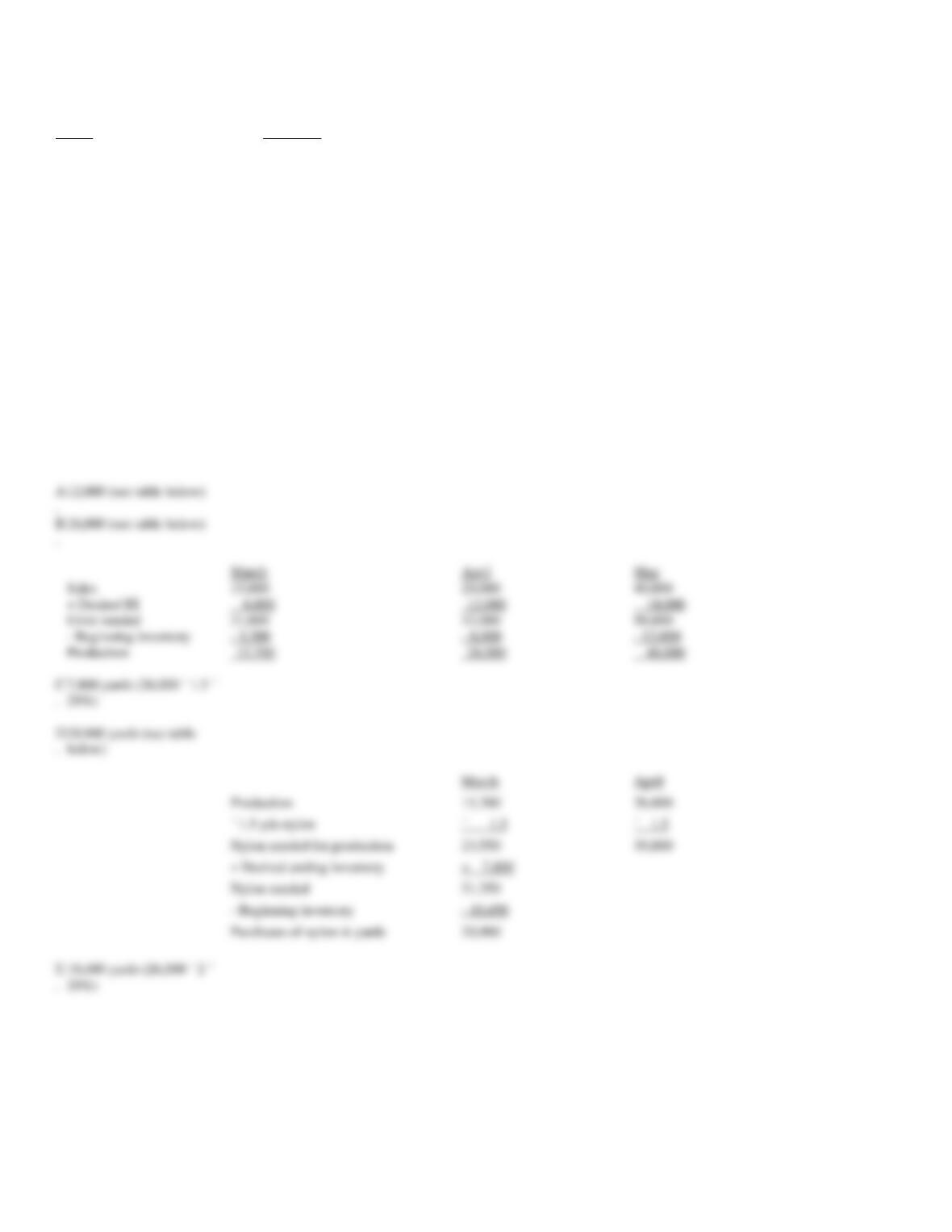
142. Varney Company makes rolling suitcases. Its sales budget for four months is:
Month
Unit Sales
March
15,000
April
20,000
May
40,000
June
60,000
Varney’s policy is that ending inventory of finished suitcases should equal 30 percent of the next month’s sales. Beginning inventory (March 1) is
5,300 suitcases.
Each suitcase required 1.5 yards of ballistic nylon. The ending inventory policy for nylon is that 20 percent of the following month’s production
needs must be on hand. On March 1, Varney had 10,450 yards of nylon in inventory.
A.
What is the desired ending inventory of suitcases for April?
B.
What is the budgeted production of suitcases for April?
C.
What is the desired ending inventory of nylon for March?
D.
What are the budgeted yards of nylon to be purchased in March?
E.
Assuming each suitcase required two yards of ballistic nylon, what is the desired ending inventory of nylon for March?
March
April
May
Sales
15,000
20,000
40,000
+ Desired EI
6,000
12,000
18,000
Units needed
21,000
32,000
58,000
– Beginning inventory
– 5,300
– 6,000
– 12,000
Production
15,700
26,000
46,000
143. Borland Company makes backpacks. Its production budget for two months is:
Month
Budgeted production in units
June
35,000
July
50,000
Borland uses two types of labor to make the backpacks: cutting labor and sewing labor. Each backpack requires six minutes, on average, of cutting
labor. Each backpack requires twenty-four minutes of sewing labor.
Borland has fixed overhead of $4,400 per month and variable overhead of $3 per direct labor hour.
A.
How many hours of cutting labor are budgeted for July?
B.
How many hours of sewing labor are budgeted for July?
C.
What is the total amount of budgeted direct labor hours for July?
D.
What is the budgeted total overhead for the month of July?
144. Abrams Bottling Company sells fruit-flavored colas. Estimated sales in cartons for May, June, and July are
1,000, 3,000 and 5,000 respectively. The price is forecast at $5 per carton. Abrams requires that finished goods
ending inventory be 20 percent of the next month’s sales. Inventory was 500 units on May 1. Each carton
requires 12 oz of fruit syrup and 130 oz of carbonated water. Materials ending inventory is 10 percent of the
next month’s production needs. May 1 inventory met that requirement.
A.
Budgeted revenue for May is $__________________.
B.
Budgeted revenue for July is $__________________.
C.
Production in May is __________________ cartons.
D.
Production in June is __________________ cartons.
E.
Purchases of syrup in May is __________________ ounces.
F.
Purchases of carbonated water in May is __________________ ounces.
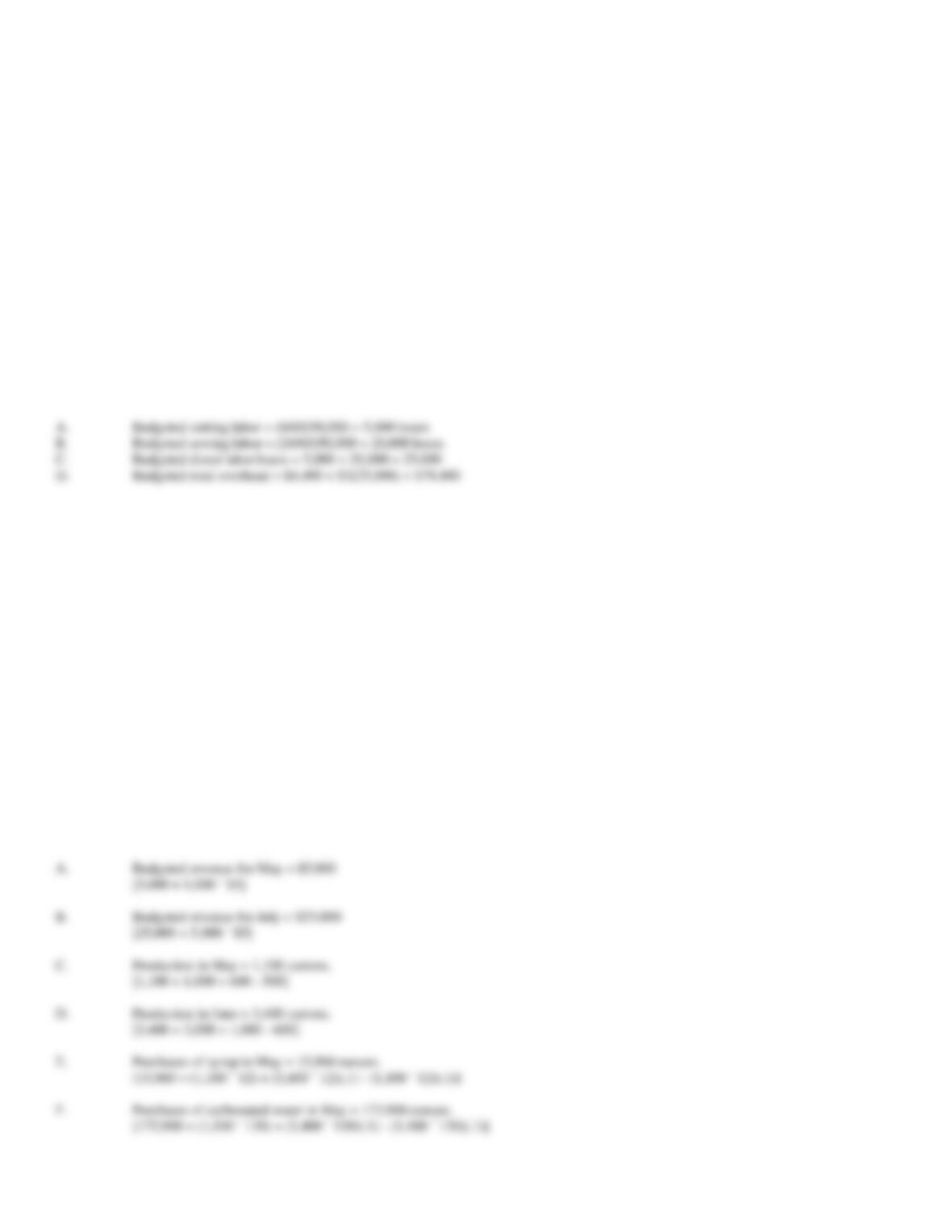
Budgeted revenue for May = $5,000
[5,000 = 1,000 ´ $5]
B.
Budgeted revenue for July = $25,000
[25,000 = 5,000 ´ $5]
C.
Production in May = 1,100 cartons.
[1,100 = 1,000 + 600 – 500]
D.
Production in June = 3,400 cartons.
[3,400 = 3,000 + 1,000 – 600]
Purchases of syrup in May = 15,960 ounces.
F.
Purchases of carbonated water in May = 172,900 ounces.
A.
Budgeted cutting labor = (6/60)50,000 = 5,000 hours
B.
Budgeted sewing labor = (24/60)50,000 = 20,000 hours
C.
Budgeted direct labor hours = 5,000 + 20,000 = 25,000
D.
Budgeted total overhead = $4,400 + $3(25,000) = $79,400
145. Karam Inc. has compiled the following data in order to put together their first quarter operating budget for
2011:
January
February
March
April
Sales (units)
35,000
31,000
38,000
29,000
Additional information:
Karam sells each unit for $95.
Company policy is to have 30 percent of next month’s sales (in units) in ending finished goods inventory. This policy was met in December.
Company policy is to have 40 percent of next month’s production needs in ending raw materials inventory. The production needs for April is
95,500. This policy was met in December.
It takes three pounds of material to produce each unit and the cost is $2.75/pound.
Required:
A. Prepare a sales budget for the January, February and March and for the first quarter in total.
B. Prepare a production budget for January, February and March and for the first quarter in total.
C. Prepare a direct materials purchases budget for January, February and March and for the first quarter in total.
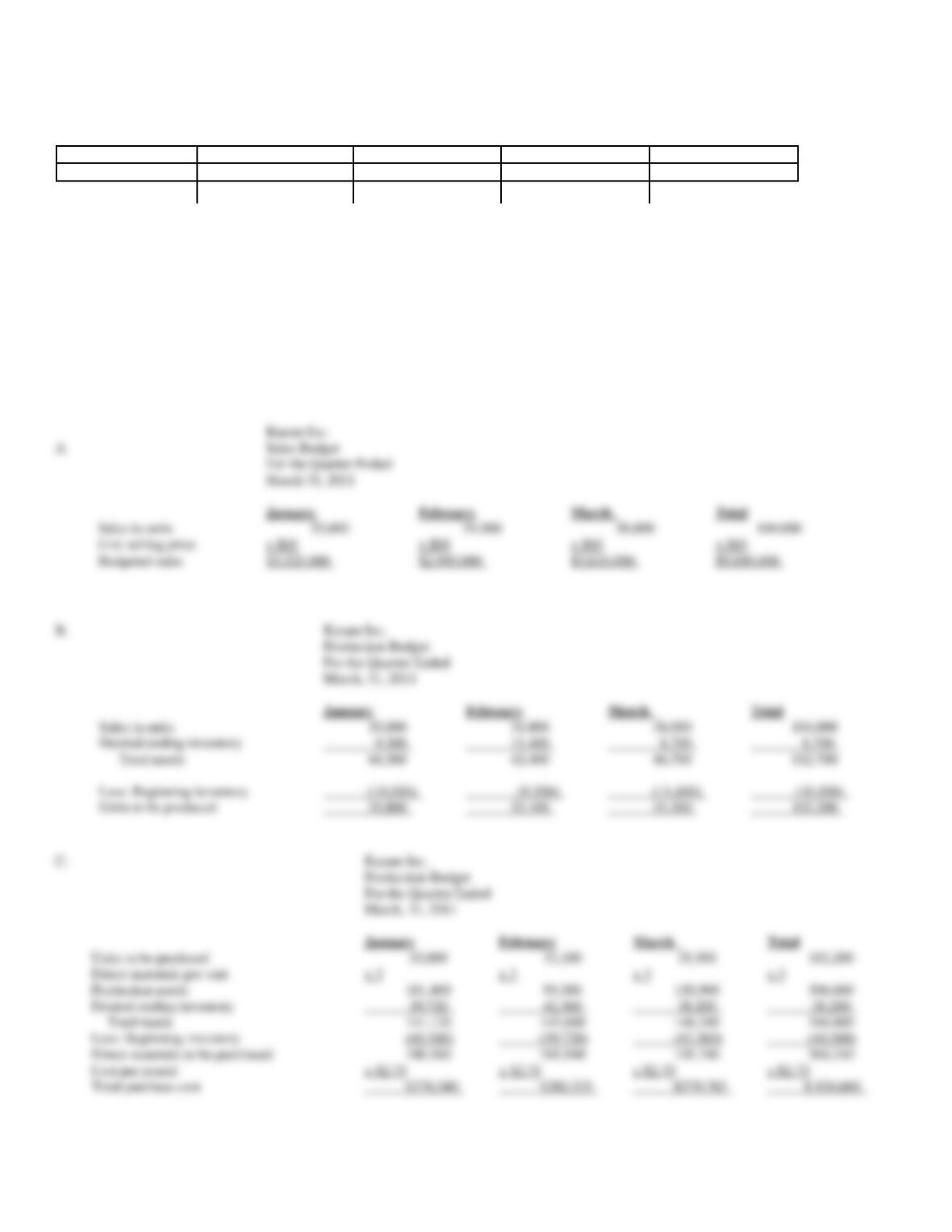
Karam Inc.
A
Sales Budget
Unit selling price
x $95
x $95
x $95
x $95
Budgeted sales
$3,325,000
$2,945,000
$3,610,000
$9,880,000
Karam Inc.
Sales in units
35,000
31,000
38,000
104,000
Total needs
44,300
42,400
46,700
112,700
Less: Beginning inventory
(10,500)
(9,300)
(11,400)
(10,500)
Karam Inc.
Production Budget
Direct materials per unit
x 3
x 3
x 3
x 3
Production needs
101,400
99,300
105,900
306,600
Desired ending inventory
39,720
42,360
38,200
38,200
Total needs
141,120
141,660
144,100
344,800
Direct materials to be purchased
100,560
101,940
101,740
304,240
146. Boyle Company has put together the following data in order to complete their operating budget for the
second quarter in 2011:
April
May
June
July
Sales (units)
73,200
68,900
65,400
67,300
Additional information:
Company policy requires 60 percent of next month’s sales (in units) be in ending inventory. This policy was met in March.
It takes 2.5 hours of direct labor to produce one unit.
The average wage cost is $14.
Variable overhead rate is $6 per direct labor hour and fixed overhead is $15,000 per month.
Required:
A. Prepare a production budget for April, May, June and the quarter in total.
B. Prepare a direct labor budget for April, May, June and the quarter in total.
C. Prepare an overhead budget for April, May, June and the quarter in total.
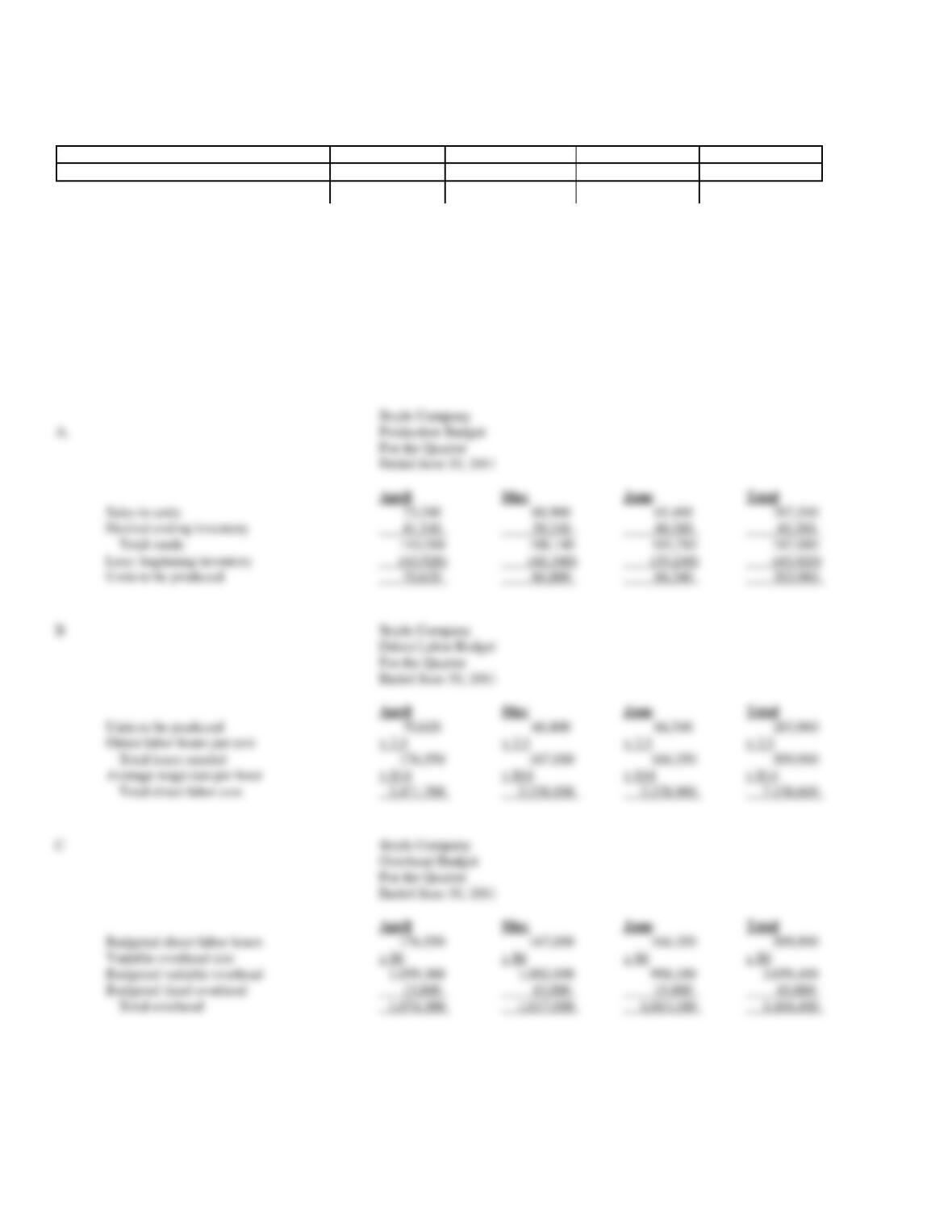
Boyle Company
Production Budget
Sales in units
73,200
68,900
65,400
207,500
Total needs
114,540
108,140
105,780
247,880
Less: beginning inventory
(43,920)
(41,340)
(39,240)
(43,920)
Units to be produced
70,620
66,800
66,540
203,960
B
Boyle Company
Units to be produced
70,620
66,800
66,540
203,960
Total hours needed
176,550
167,000
166,350
509,900
Average wage rate per hour
x $14
x $14
x $14
x $14
Total direct labor cost
2,471,700
2,338,000
2,328,900
7,138,600
C
Boyle Company
Overhead Budget
Budgeted direct labor hours
176,550
167,000
166,350
509,900
Budgeted variable overhead
1,059,300
1,002,000
998,100
3,059,400
Budgeted fixed overhead
15,000
15,000
15,000
45,000
Total overhead
1,074,300
1,017,000
1,013,100
3,104,400
147. Jones Corporation has the following budgeted sales for the selected four-month period:
Month
Unit Sales
July
20,000
August
35,000
September
25,000
October
30,000
Sales price per unit is $180
Plans are to have an inventory of finished product equal to 20 percent of the unit sales for the next month. There was 4,000 units in
beginning inventory on July 1st.
Three pounds of materials are required for each unit produced. Each pound of material costs $20. Inventory levels for materials
equal 30 percent of the needs for the next month.
Desired ending inventory for September is 25,200 pounds of material. Beginning inventory for July was 20,700 pounds of material.
Each unit requires .6 hours of direct labor and the average wage rate is $16 per hour.
Variable overhead rate is $3.50 per direct labor hour. There is also fixed overhead of $22,000 per month.
The company pays a 3% commission on sales
Company has fixed selling and administrative expenses as follows:
Rent $6,000/month
Utilities 1,200/month
Advertising 400/month
Office Salaries 35,000/month
Required:
A.
Prepare a sales budget for July, August, and September and in total for the quarter.
B.
Prepare production budgets for July, August, and September and in total for the quarter.
C.
Prepare a direct materials purchases budget in pounds and dollars for July, August, and September and in total for the quarter.
D.
Prepare a direct labor budget in hours and total cost for July, August and September and in total for the quarter.
E.
Prepare an overhead budget for July, August and September and in total for the quarter.
F.
Prepare a selling and administrative expenses budget for July, August and September and in total for the quarter.
G.
Prepare an ending finished goods inventory budget for the quarter (Hint: you have already calculated the desired ending finished
goods inventory amount and assume a stable per unit rate)
H.
Prepare a cost of goods sold budget for the quarter
I.
Prepare a budged income statement for the quarter-the company falls into the 35 percent tax bracket for income taxes.
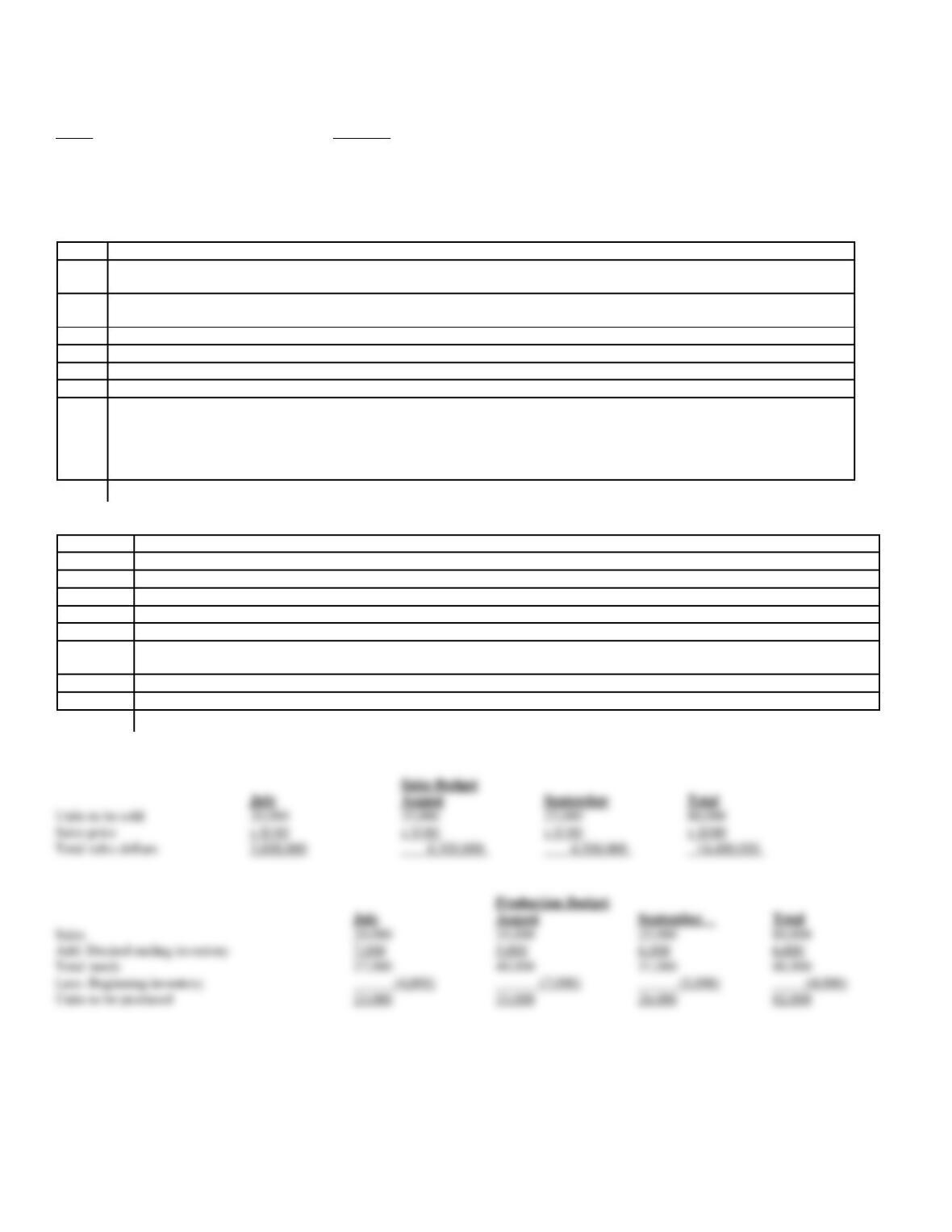
Units to be sold
20,000
35,000
25,000
80,000
Sales price
x $180
x $180
x $180
x $180
Total sales dollars
3,600,000
6,300,000
4,500,000
14,400,000
Sales
20,000
35,000
25,000
80,000
Add: Desired ending inventory
7,000
5,000
6,000
6,000
Total needs
27,000
40,000
31,000
86,000
Less: Beginning inventory
(4,000)
(7,000)
(5,000)
(4,000)
Units to be produced
23,000
33,000
26,000
82,000