Chapter 19: Capital Investment
109. Under the current tax law, an asset that is classified as 7-year property and has a cost of $400,000 would result in a
depreciation deduction in Year 3 of
a. $97,920.
b. $69,960.
c. $66,667.
d. $57,140.
110. Under the current tax law, an asset that is classified as 5-year property and has a cost of $200,000 would result in a
depreciation deduction in Year 2 of
a. $40,000.
b. $50,000.
c. $64,000.
d. $38,400.
111. Information about a project Dalwhinnie Company is considering is as follows:
Investment
$1,500,000
Revenues
$700,000
Variable costs
$140,000
Fixed out-of–pocket costs
$80,000
Cost of capital
12%
Tax rate
40%
The property is considered 5-year property for tax purposes. The company plans to use MACRS and dispose of the
property at the end of the sixth year. No salvage value is expected. Assume all cash flows occur at the end of the
year. Round amounts to dollars.
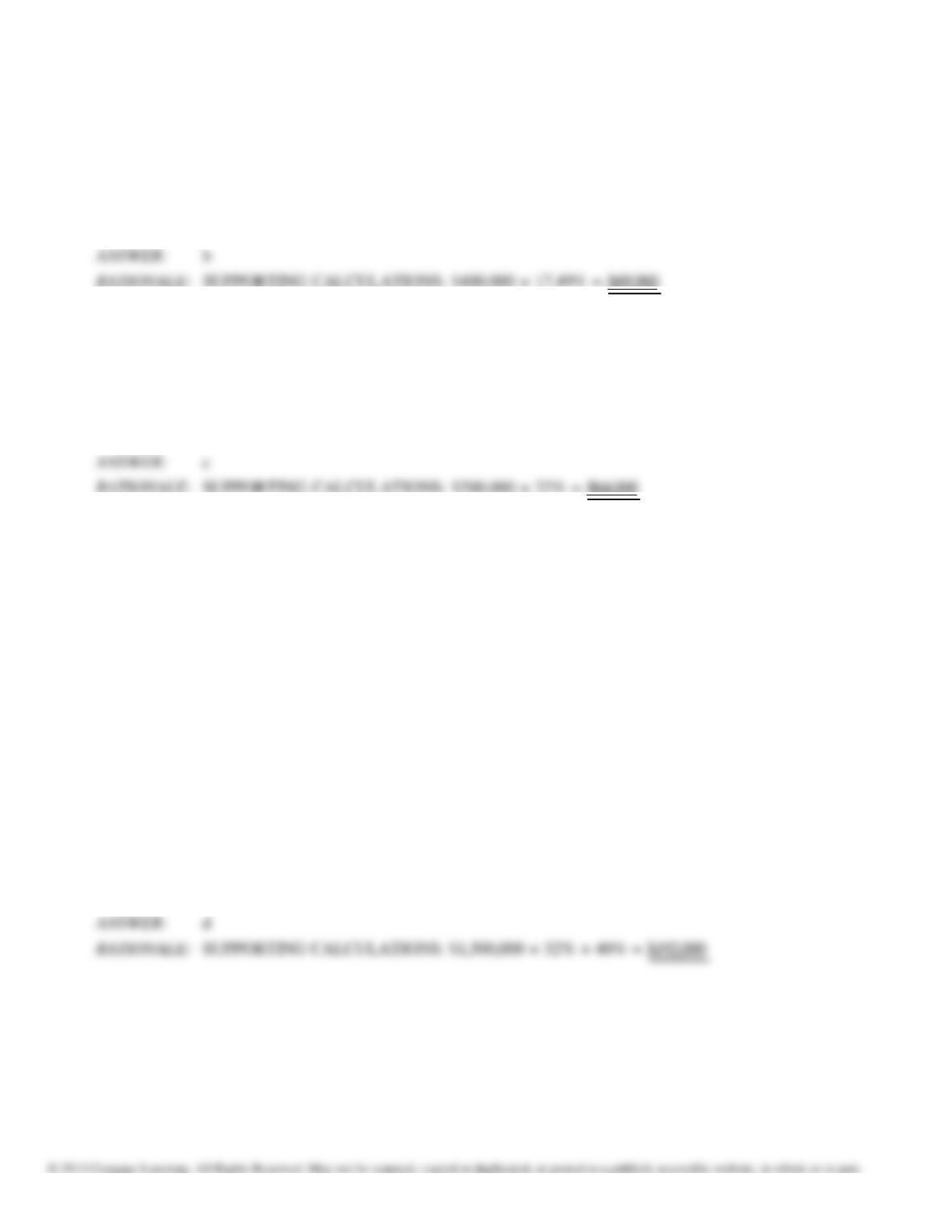
The tax savings from depreciation in Year 2 would be
a. $80,000.
b. $284,000.
c. $217,800.
d. $192,000.
Chapter 19: Capital Investment
112. Bellamy Company is considering the purchase of a computerized manufacturing system. The after–tax cash
benefits/savings associated with the system are as follows:
Decreased waste
$300,000
Increased quality
400,000
Decrease in operating costs
600,000
Increase in on–time deliveries
200,000
The system will cost $9,000,000 and will last ten years. The company’s cost of capital is 12 percent.
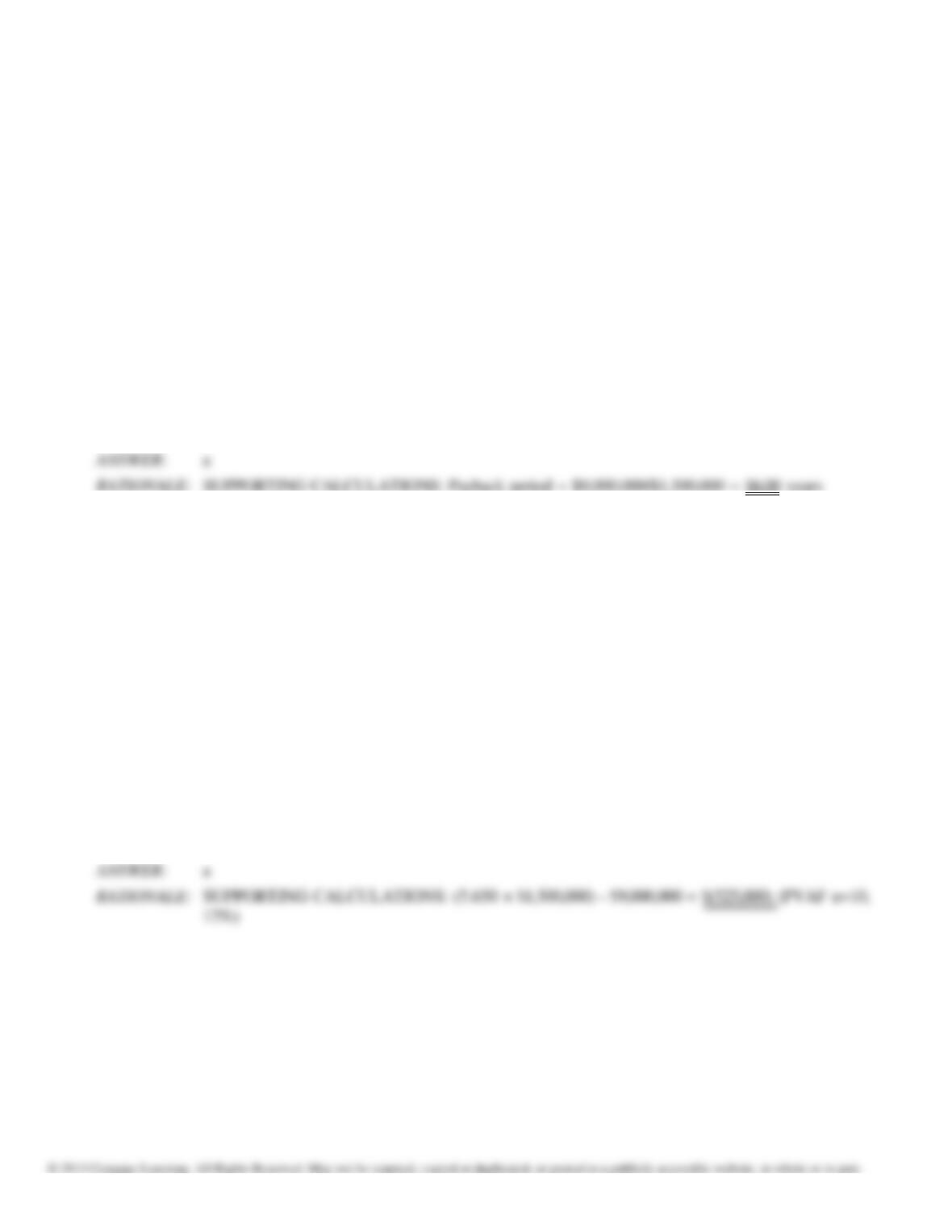
What is the payback period for the computerized manufacturing system?
a. 6.00 years
b. 10.00 years
c. 11.25 years
d. 15.00 years
113. Bellamy Company is considering the purchase of a computerized manufacturing system. The after–tax cash
benefits/savings associated with the system are as follows:
Decreased waste
$300,000
Increased quality
400,000
Decrease in operating costs
600,000
Increase in on–time deliveries
200,000
The system will cost $9,000,000 and will last ten years. The company’s cost of capital is 12 percent.
What is the NPV for the computerized manufacturing system?
a. ($525,000)
b. ($5,610,000)
c. $8,475,000
d. $9,000,000
Chapter 19: Capital Investment
114. Bellamy Company is considering the purchase of a computerized manufacturing system. The after–tax cash
benefits/savings associated with the system are as follows:
Decreased waste
$300,000
Increased quality
400,000
Decrease in operating costs
600,000
Increase in on–time deliveries
200,000
The system will cost $9,000,000 and will last ten years. The company’s cost of capital is 12 percent.
Which of the following best describes the IRR for this project?
a. between 14 and 16%
b. between 12 and 14%
c. between 10 and 12%
d. between 8 and 10%
115. A postaudit compares
a. estimated benefits and costs with budgeted benefits and costs.
b. estimated benefits with estimated costs.
c. actual benefits with actual costs.
d. actual benefits and costs with estimated benefits and costs.
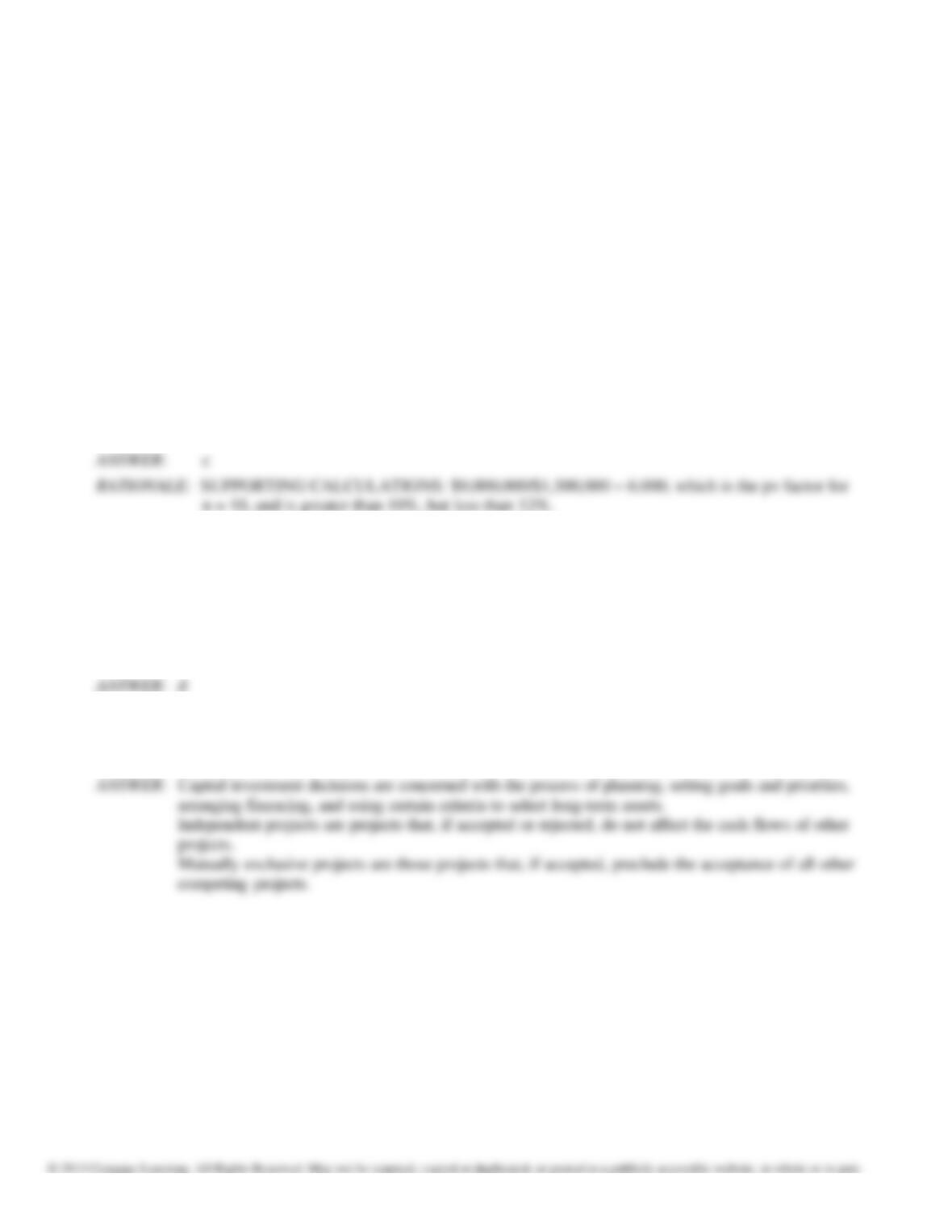
116. Explain what a capital investment decision is. In your answer, distinguish between independent and mutually
exclusive capital investment decisions.
Chapter 19: Capital Investment
117. A capital investment project requires an investment of $450,000. It has an expected life of six years with an annual
cash flow of $90,000 received at the end of each year. The company uses the straight-line method of depreciation
with no mid-year convention. Ignore income taxes.
Required:
a. Compute payback for the project.
b. Compute the net present value of the project using a 12 percent discount rate.
c. Would you recommend this project be accepted? Why or why not?
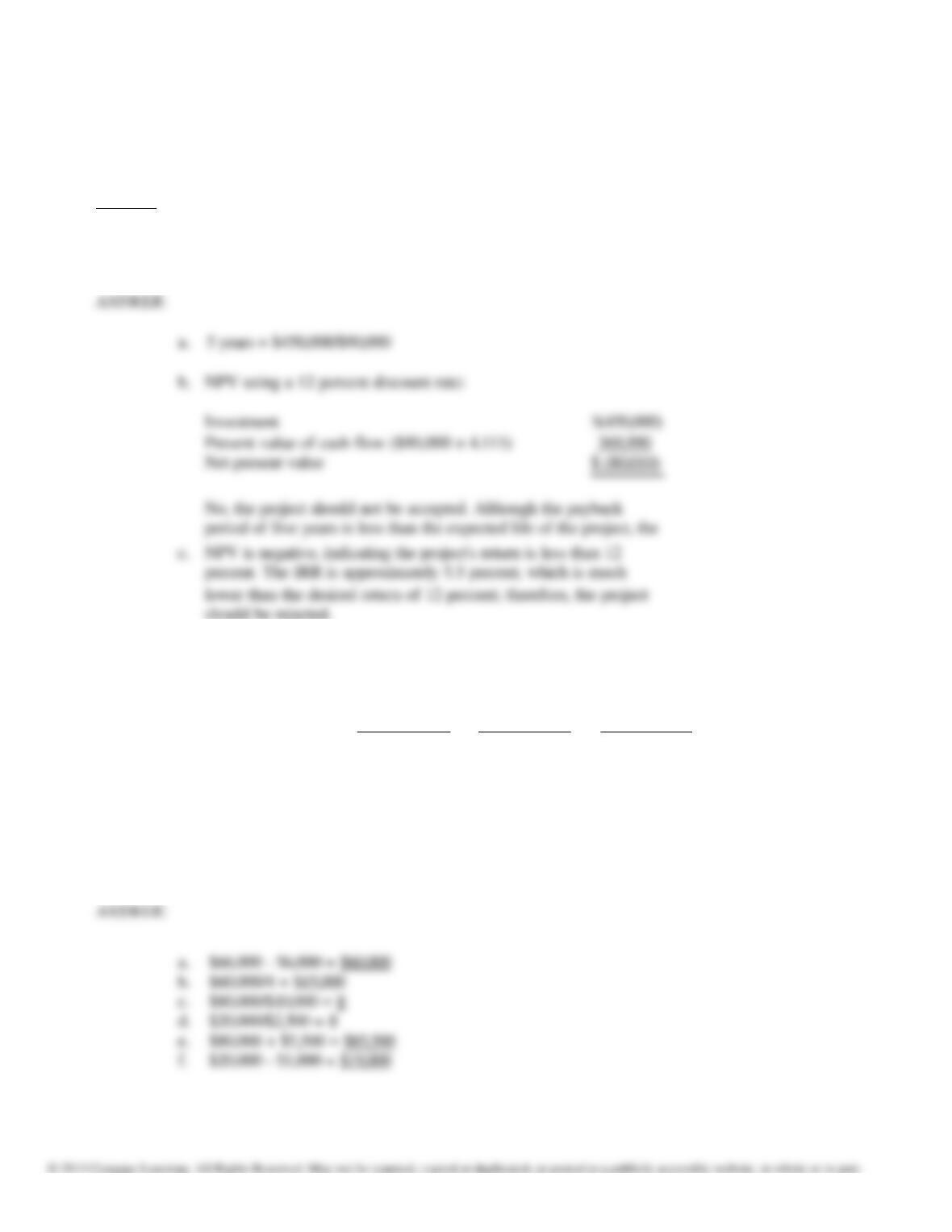
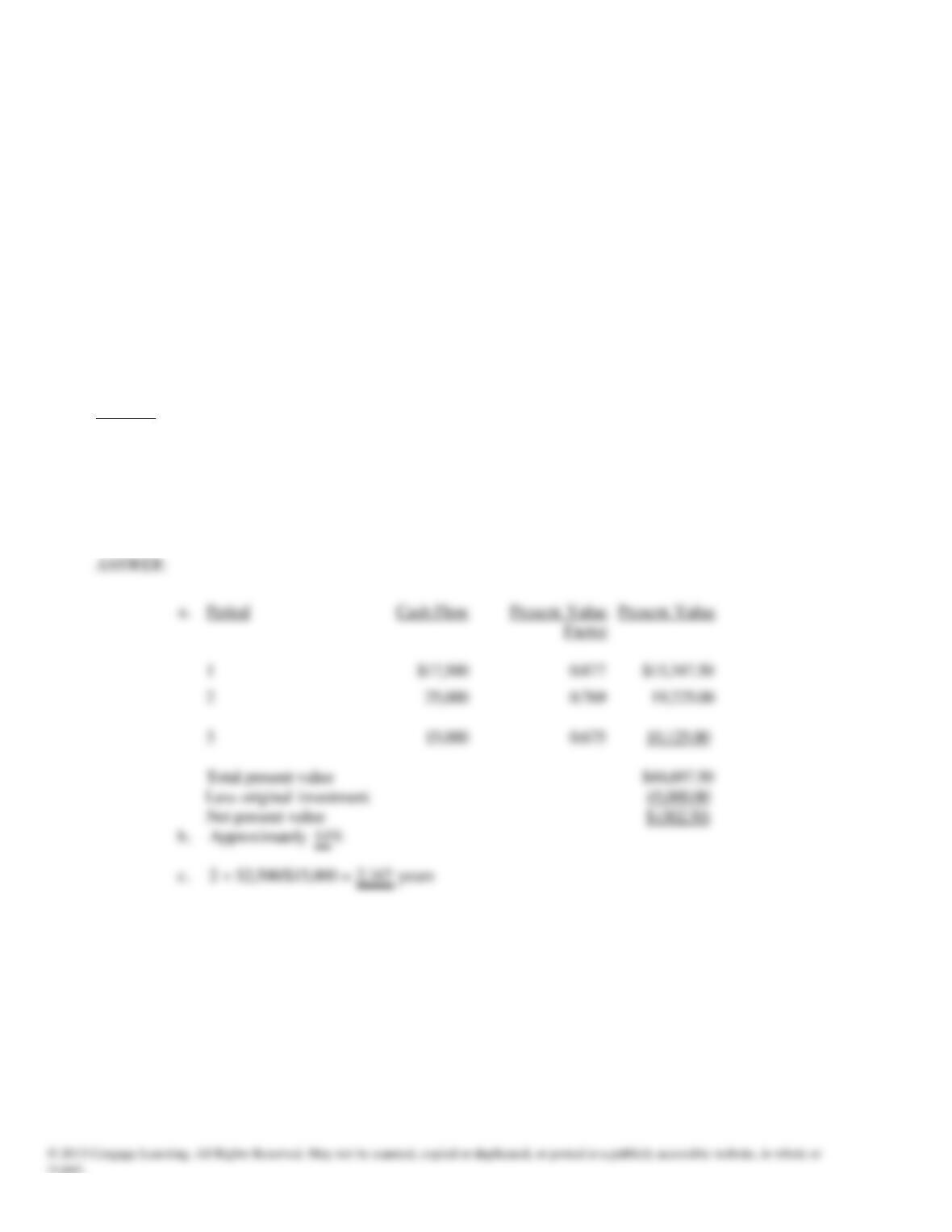
118. Fill in the lettered blanks in the following table:
Investment A
Investment B
Investment C
Amount of investment
$80,000
(a)
$20,000
Economic life in years
10
5
8
Annual cash flow
$10,000
(b)
$ 2,500
Payback period in years
(c)
4
(d)
Present value of cash flows
(e)
$66,000
(f)
Net present value
$ 5,500
$ 6,000
($1,000)
Chapter 19: Capital Investment
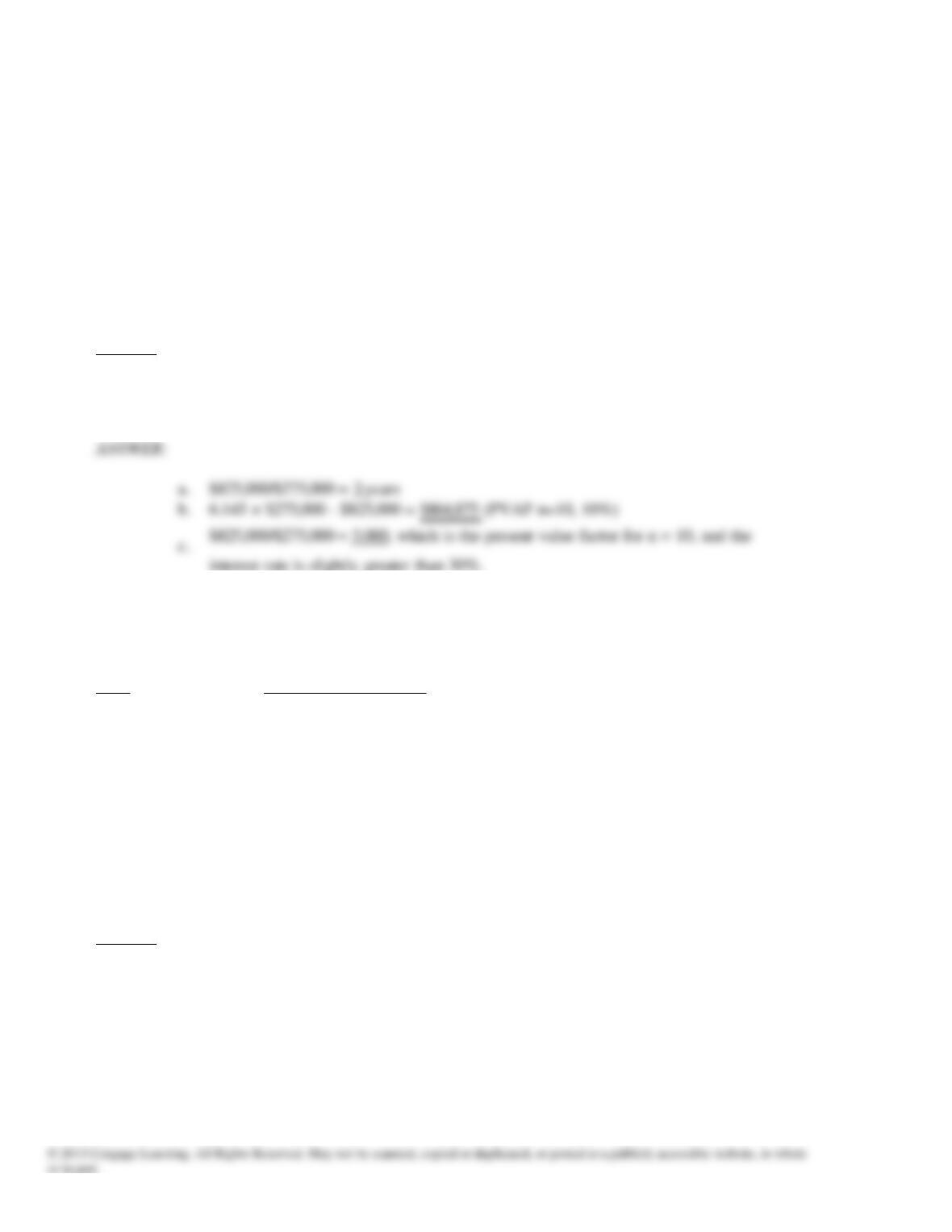
119. Absentia Company is evaluating a capital expenditure proposal that has the following predicted cash flows:
Original investment $45,000
Cash flow:
Year 1
$17,500
Year 2
25,000
Year 3
15,000
Salvage value
–0-
Discount rate
Required:
14%
Determine the following values:
a. Net present value of the investment
b. Proposal‘s internal rate of return
c. Payback period
Chapter 19: Capital Investment
120. Wastenot Production Company is considering the purchase of a flexible manufacturing system. The
after-tax cash benefits/savings associated with the system are as follows:
Decreased waste
$ 82,500
Increased quality
110,000
Decrease in operating costs
68,750
Increase in on–time deliveries
13,750
The system will cost $825,000 and will last ten years.
The company’s cost of capital is 10 percent.
Required:
a. What is the payback period for the flexible manufacturing system?
b. What is the NPV for the flexible manufacturing system?
c. What is the IRR for the flexible manufacturing system?
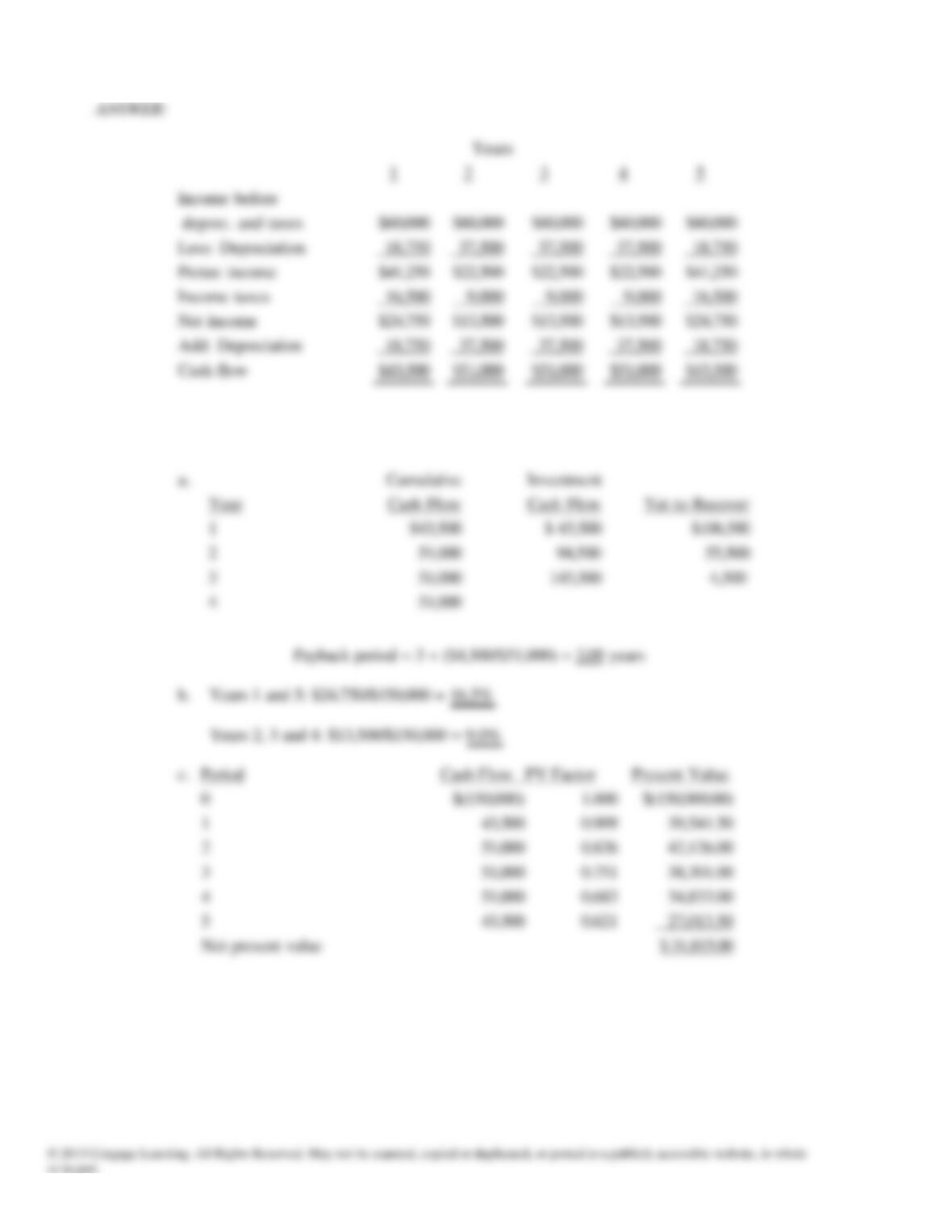
121. Bertram Corporation is considering an investment in equipment for $150,000.
Data related to the investment are as follows:
Income before
Year Depreciation and Taxes
1 $60,000
2 60,000
3 60,000
4 60,000
5 60,000
Cost of capital is 10 percent.
Bertram uses the straight-line method of depreciation with mid-year convention for tax purposes. In
addition, its tax rate is 40 percent and the depreciable life of the equipment is four years with no salvage
value. The equipment is sold at the end of the fifth year.
Required:
Determine the following amounts using after-tax cash flows:
a. Payback period
b. Accounting rate of return on original investments for each year
c. Net present value
Chapter 19: Capital Investment
Chapter 19: Capital Investment
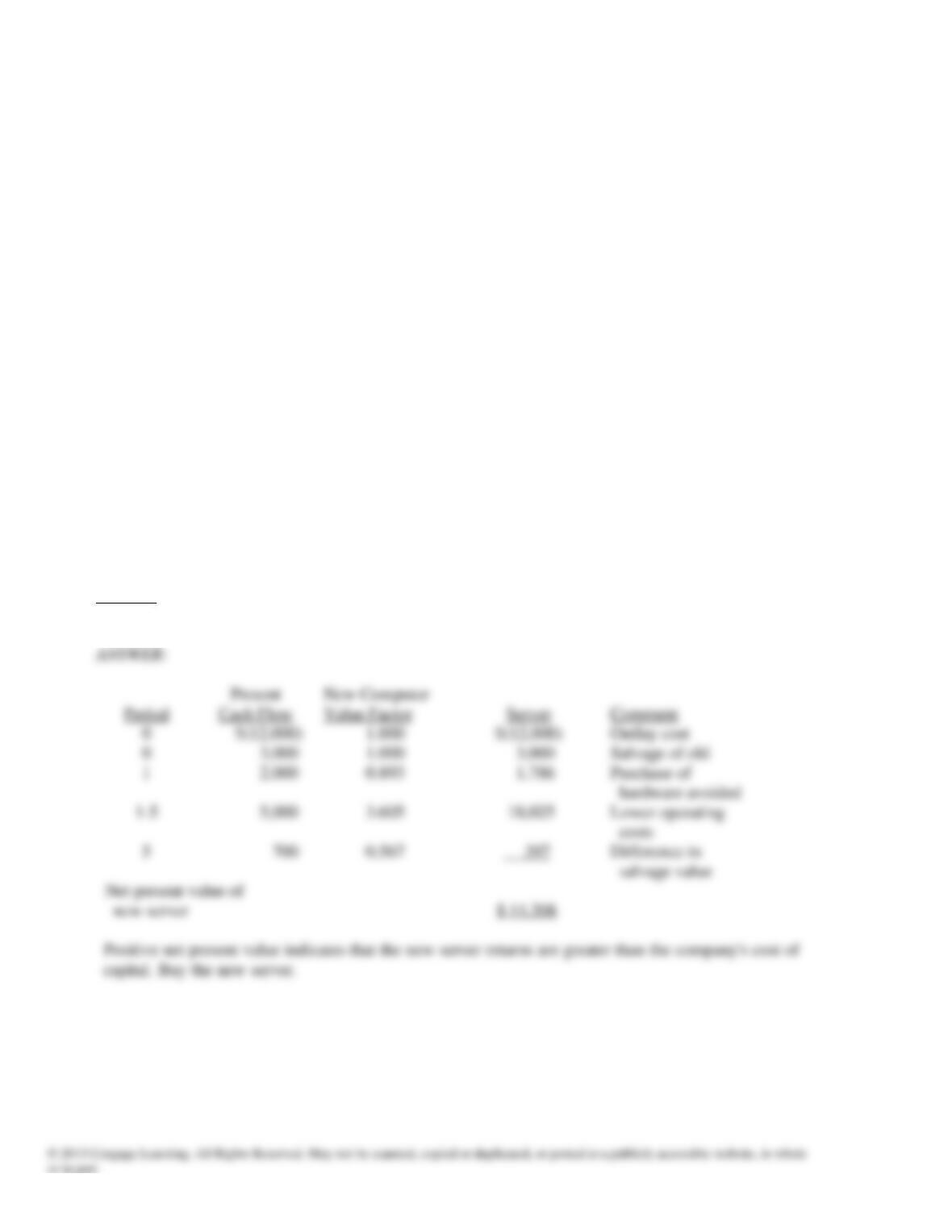
122. Missoula Office Services is considering the purchase of a new server to replace the one in operation.
Data on the new server are as follows:
Cost
$12,000
Salvage value at the end of five years
$1,000
Useful life, in years
5
Annual operating cost
$4,000
If the existing server is kept and used, it would require the purchase of additional hardware a year from
now
costing $2,000. After the use of the server for five years, the salvage value would be $300. Additional
information on the existing system is as follows:
Additional years of use
5
Annual operating costs
$9,000
Remaining book value
$12,000
Current salvage value
$3,000
Cost of capital
12%
The company uses the straight–line method of depreciation with no mid-year convention.
Required:
Should the new server be purchased? Why or why not?
Chapter 19: Capital Investment
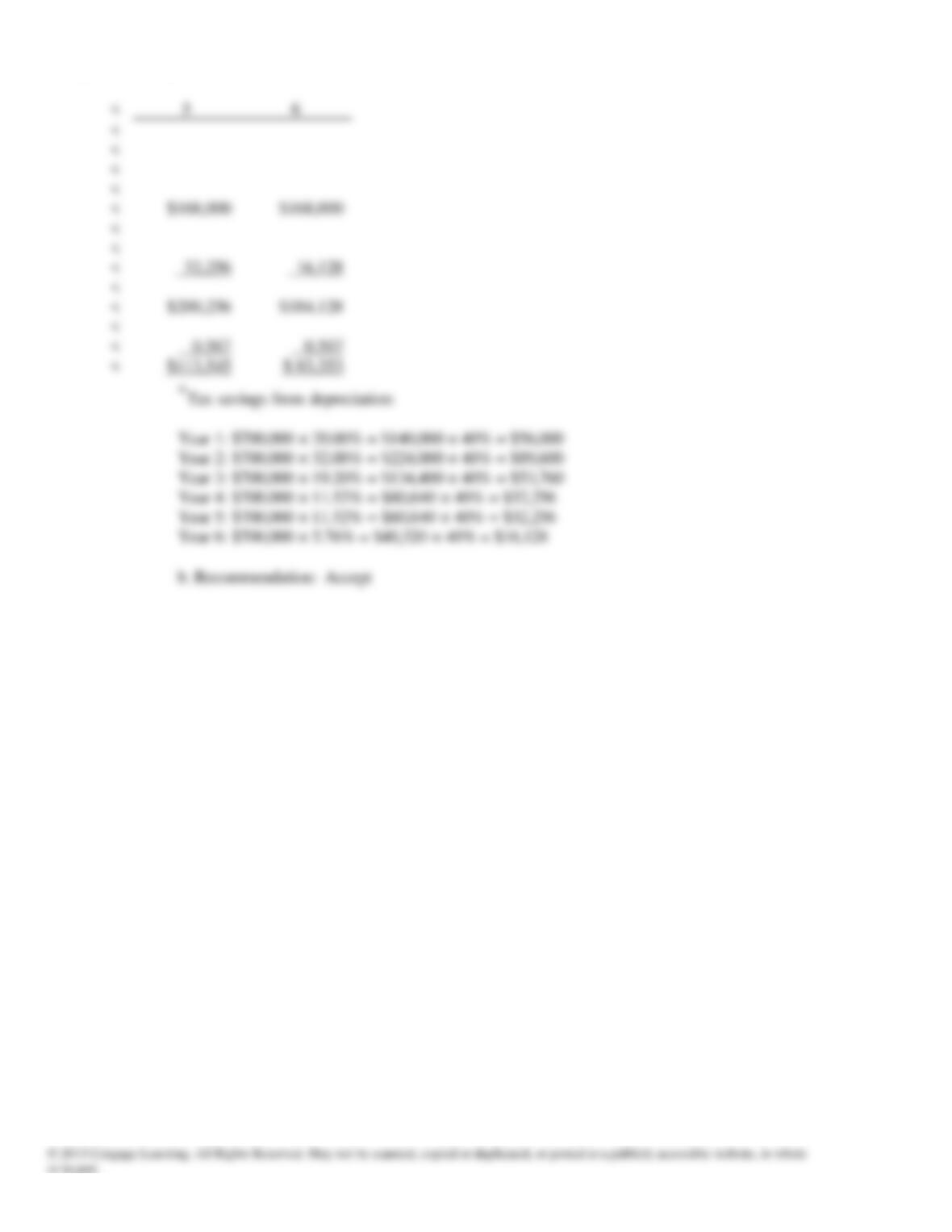
123. Santander Company is considering a project that requires an investment of $700,000. The project is
expected to generate an annual cash flow of $280,000 for six years. The cash flow would be received at
the end of each year.
The asset is considered 5-year property for depreciation purposes and would be disposed of at the end
of the sixth year, at which time it is expected to have no salvage value. The company plans to use
MACRS.
Assume the cost of capital is 12 percent and the income tax rate is 40 percent.
Required:
a. Determine the net present value of the asset. (Round amounts to dollars.)
b. State your recommendation to the management of the company.
Chapter 19: Capital Investment
Chapter 19: Capital Investment
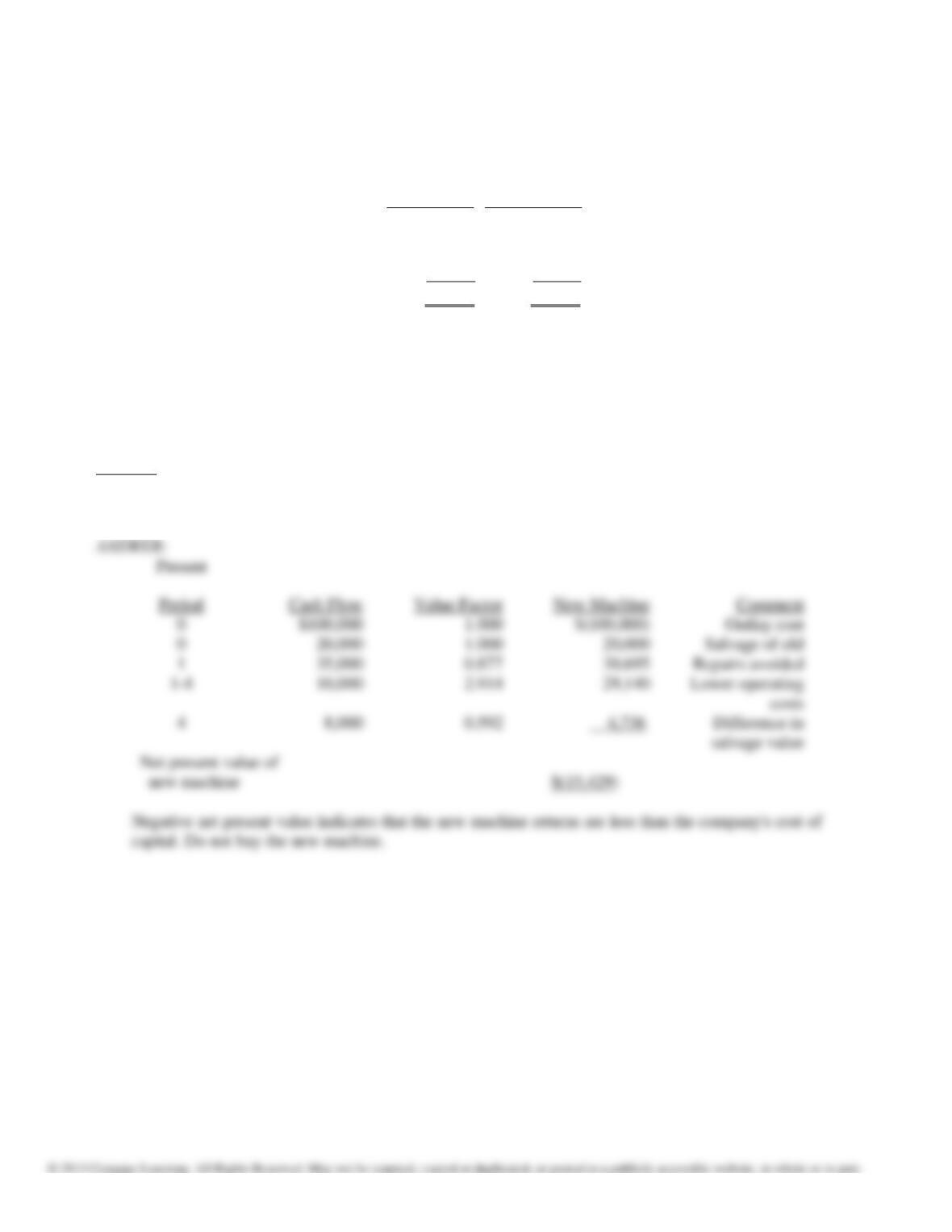
124. Marion Dexter Company is evaluating a proposal to purchase a new machine that would cost $100,000 and
have a salvage value of $10,000 in four years. It would provide annual operating cash savings of $10,000, as
follows:
Old Machine
New Machine
Salaries
$40,000
$36,000
Supplies
7,000
5,000
Maintenance
9,000
5,000
Total
$56,000
$46,000
If the new machine is purchased, the old machine will be sold for its current salvage value of $20,000. If the
new machine is not purchased, the old machine will be disposed of in four years at a predicted salvage value of
$2,000. The old machine’s present book value is $40,000. If kept, in one year the old machine will require
repairs predicted to cost $35,000.
Marion Dexter’s cost of capital is 14 percent.
Required:
Should the new machine be purchased? Why or why not?
Chapter 19: Capital Investment
125. Local Construction Company is considering the purchase of a bulldozer for $280,000. The expected life is four
years. The company is comparing the depreciation tax shield using MACRS versus the straight-line method. If
MACRS is used, the MACRS life is three years with a depreciation rate of 200 percent annually. Regardless of
the method of depreciation used, the mid-year convention will be observed. The company’s tax rate is 40
percent. The straight-line method assumes mid-year convention, and the cost of capital is 14 percent.
Required: (Round all calculations to the nearest dollar.)
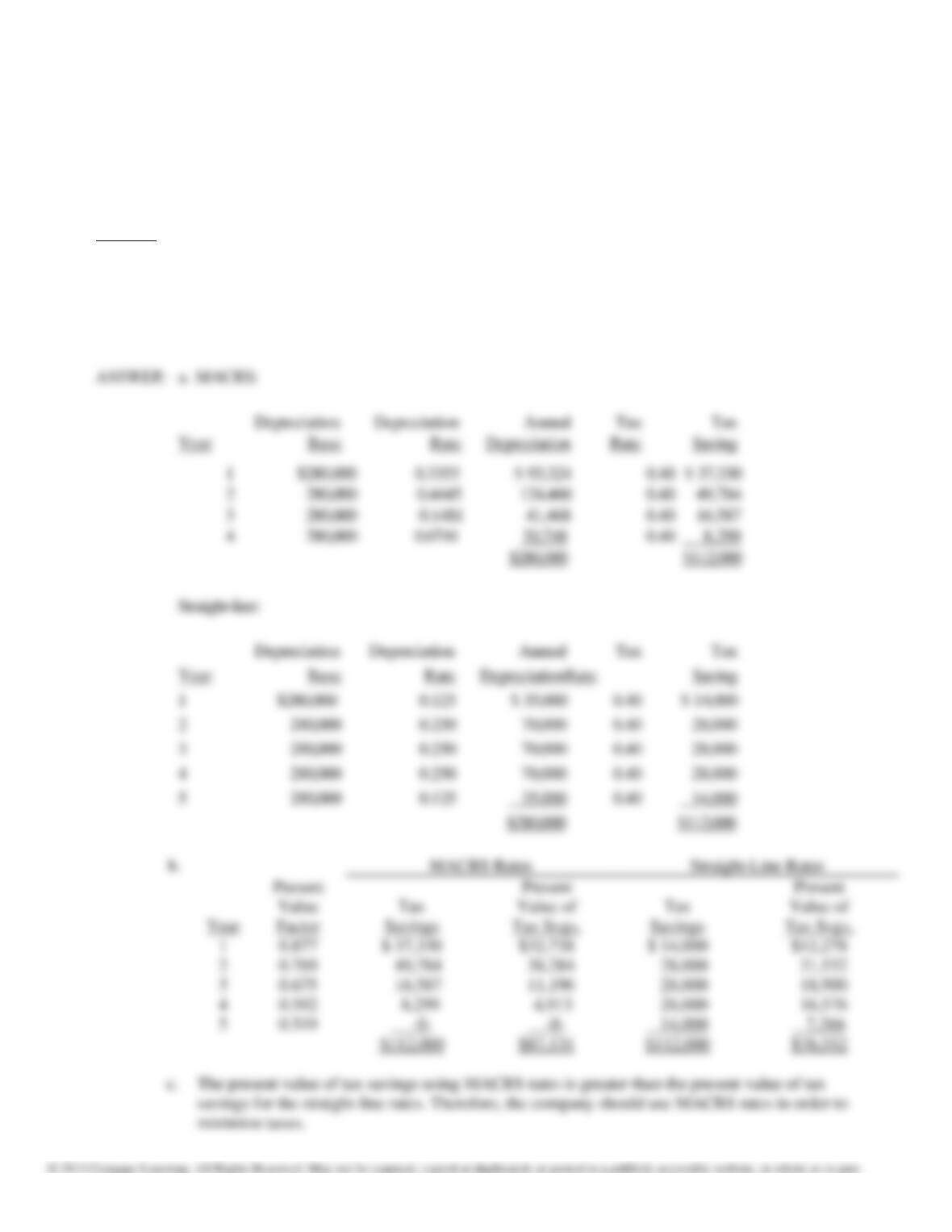
a. Calculate the tax savings from depreciation for each year using both the MACRS and
straight- line methods.
b. Calculate the present value of the tax savings for both depreciation methods.
c. Which method should be used to minimize the firm‘s tax liability? Why?
Chapter 19: Capital Investment
126. What are the differences that affect capital investment decisions regarding advanced technology and environmental
considerations?