380)
If the supply of a good is perfectly inelastic, the price elasticity of supply will equal
380)
A)
zero.
B)
positive infinity.
C)
one.
D)
none of the above.
381)
The longer the time frame involved, the more likely it is that the demand will be relatively
381)
A)
flat.
B)
steep.
C)
elastic.
D)
inelastic.
C
382)
When the consumer spends a large portion of her income on a good, demand will be
382)
A)
elastic.
B)
unit–elastic.
C)
inelastic.
D)
elastic, unit–elastic or inelastic depending upon supply.
A
383)
If a seller lowers the price of a product when demand is price inelastic, the seller can expect
revenues to
383)
A)
stay the same.
B)
rise.
C)
fall.
D)
either rise or fall, but it is impossible to determine which.
C
384)
If demand is elastic and the price of a product decreases by 10 percent, then
384)
A)
the change in quantity demanded is greater than 10 percent.
B)
the change in quantity demanded is less than 10 percent.
C)
the decrease in quantity demanded is greater than 0 percent.
D)
the change in quantity demanded is equal to 10 percent.
A
A
385)
A positive cross price elasticity of demand between two goods suggests that the goods are
385)
A)
complements.
B)
substitutes.
C)
not related.
D)
both of unitary elasticity.
386)
When very few substitutes for a good exist, demand will be
386)
A)
perfectly elastic.
B)
unit–elastic.
C)
inelastic.
D)
elastic.
387)
A decrease in total revenue will result if
387)
A)
demand is inelastic and price increases.
B)
demand is unitary elastic and price decreases.
C)
demand is elastic and price decreases.
D)
demand is inelastic and price decreases.
Pounds of Artisan Jars of
Period Income/Week Bread Sold Jam Sold
1 $250 210
2 $500 5 8
388)
Use the above table. The income elasticity of artisan bread is
388)
A)
0.012.
B)
8.330.
C)
0.780.
D)
1.285.
389)
If a good has an absolute price elasticity of 1, the demand for the good is
389)
A)
unit elastic.
B)
inelastic.
C)
perfectly elastic.
D)
elastic.
390)
A measure of the responsiveness of the demand for one good to the percentage change in the price
of another good is
390)
A)
price elasticity of supply.
B)
income elasticity.
C)
price elasticity of demand.
D)
cross price elasticity of demand.
391)
If the absolute value of the price elasticity of demand for a product is greater than 1, then
391)
A)
demand is unit–elastic.
B)
demand is elastic.
C)
quantity demanded is not very sensitive to price changes.
D)
demand is inelastic.
392)
Inelastic demand implies
392)
A)
that a one percent increase in price results in a larger than one percent decrease in quantity
demanded.
B)
that a one percent cut in price results in a larger than one percent increase in quantity
demanded.
C)
that a one percent decrease or increase in price induces no change in total revenue.
D)
that a one percent increase in price results in a smaller than one percent decrease in quantity
demanded.
ESSAY. Write your answer in the space provided or on a separate sheet of paper.
393)
Graphically, what is the main difference between the measure of income elasticity of demand as opposed to the
measure of price elasticity of demand?
394)
“The income elasticity of a good is positive if a consumer increases the total spending on that good as a result of
an increase in its market price.” Do you agree or disagree? Why?
395)
“The price elasticity of demand for a particular good is smaller in the long run because consumers adapt to
higher prices over time.” Do you agree or disagree? Explain.
396)
“Unit elasticity of demand can be found everywhere along a straight–line demand curve with a slope of –1.” Do
you agree or disagree? Explain.
397)
What would you expect the cross price elasticity of iPods and online music downloads? Explain your answer.
398)
Why is elasticity of demand greater for goods that are a large share of a consumer’s budget?
399)
Why can cross price elasticity of demand be positive or negative, unlike the price elasticity of demand with
respect to the item’s own price?
400)
“The slope of the demand curve gives the elasticity of demand.” Do you agree or disagree? Why?
401)
Price elasticity of demand is measured using percentage changes. Why?
402)
Which has a more elastic demand: hamburger or beef?
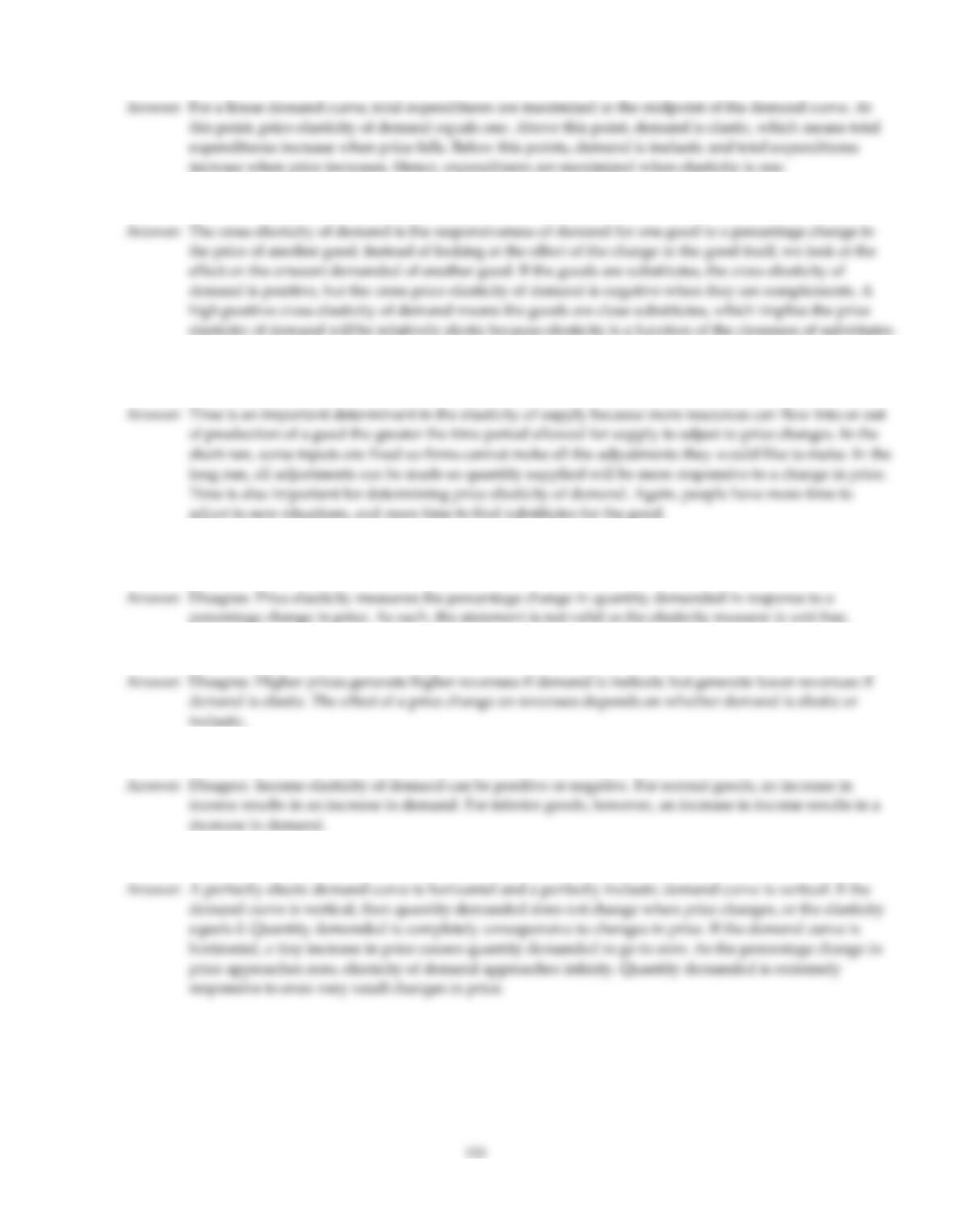
403)
For a linear demand curve, where is the amount of total expenditures on a good maximized?
404)
How does the cross elasticity of demand differ from the price elasticity of demand? How are they related?
405)
Why is time such an important determinant in the elasticity of supply? Is time also important in determining
price elasticity of demand? Explain.
406)
“Price elasticity measures how many more units of a good that consumers will buy given a decrease in price.”
Do you agree or disagree? Explain.
407)
“Higher prices always yield higher revenues.” Do you agree or disagree? Why?
408)
“Income elasticity of demand is always positive.” Do you agree or disagree? Explain.
409)
What does a perfectly elastic demand curve look like? A perfectly inelastic demand curve? Explain.
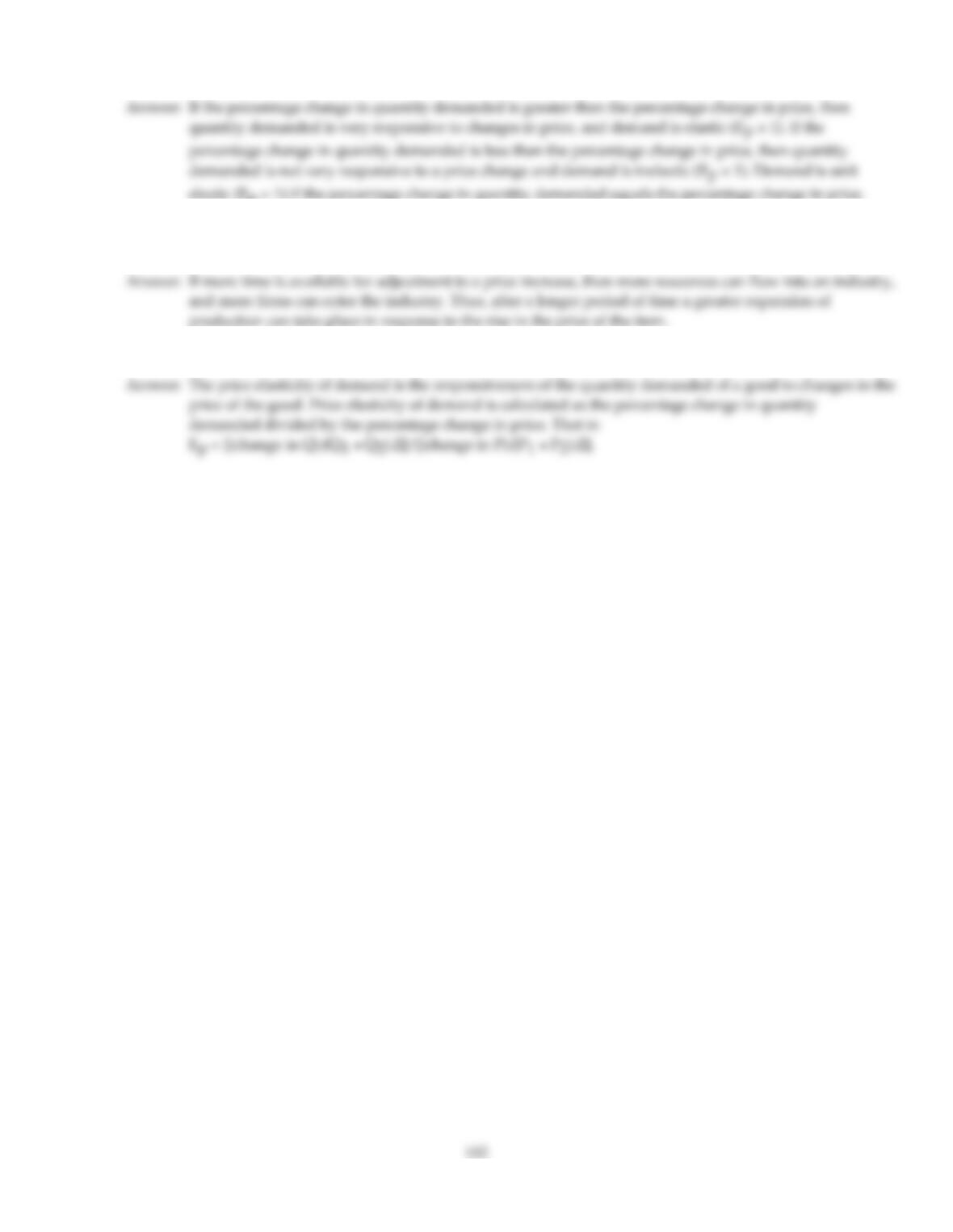
410)
Explain the three possible ranges for price elasticity of demand.
411)
Why is the price elasticity of supply greater if there is more time for adjustment to an increase in the price of an
item?
412)
What is the price elasticity of demand? How is the price elasticity of demand calculated?
Answer Key
Testname: C19
Answer Key
Testname: C19
Answer Key
Testname: C19
Answer Key
Testname: C19
106
Answer Key
Testname: C19
Answer Key
Testname: C19
Answer Key
Testname: C19
Answer Key
Testname: C19
110
Answer Key
Testname: C19
112