242)
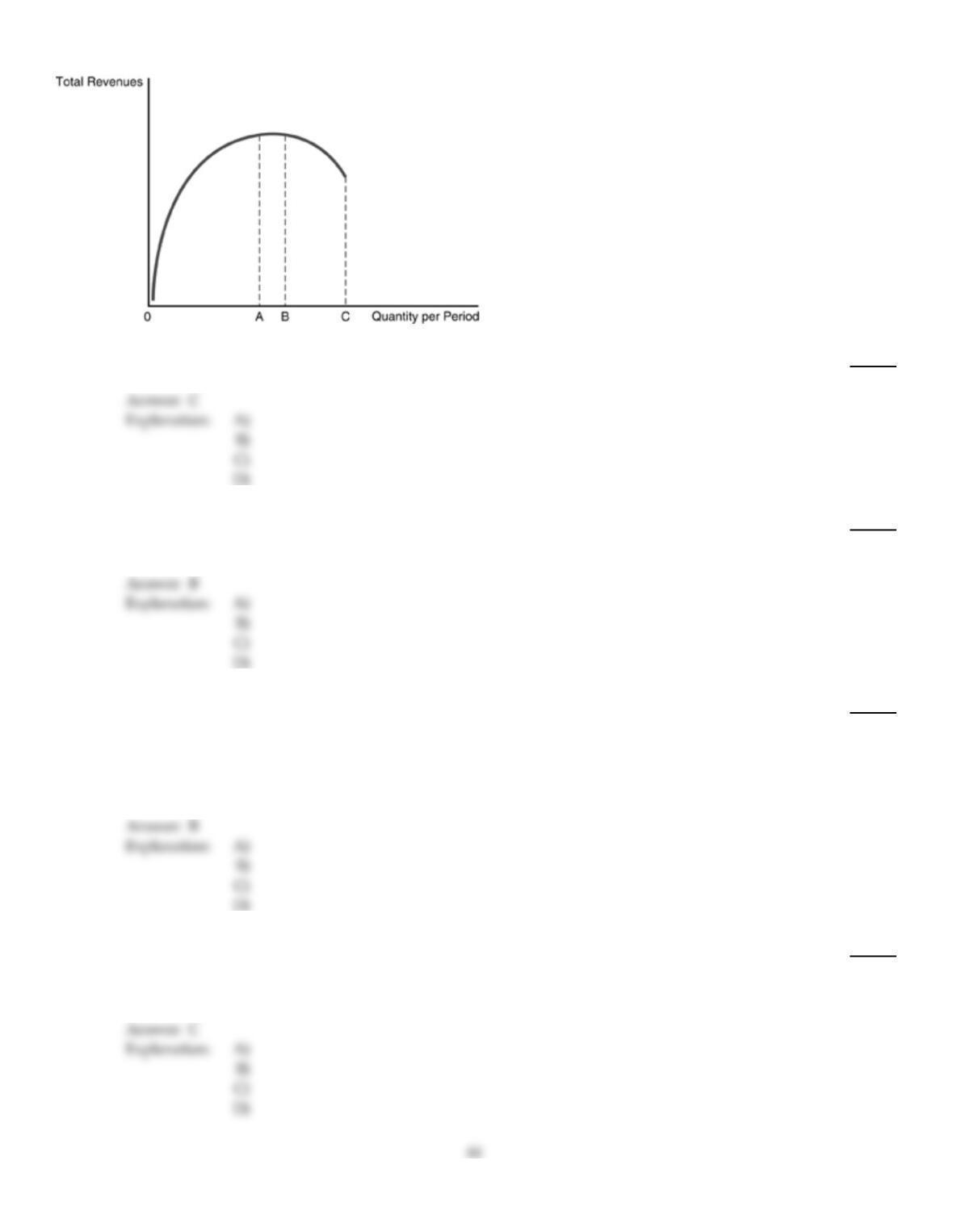
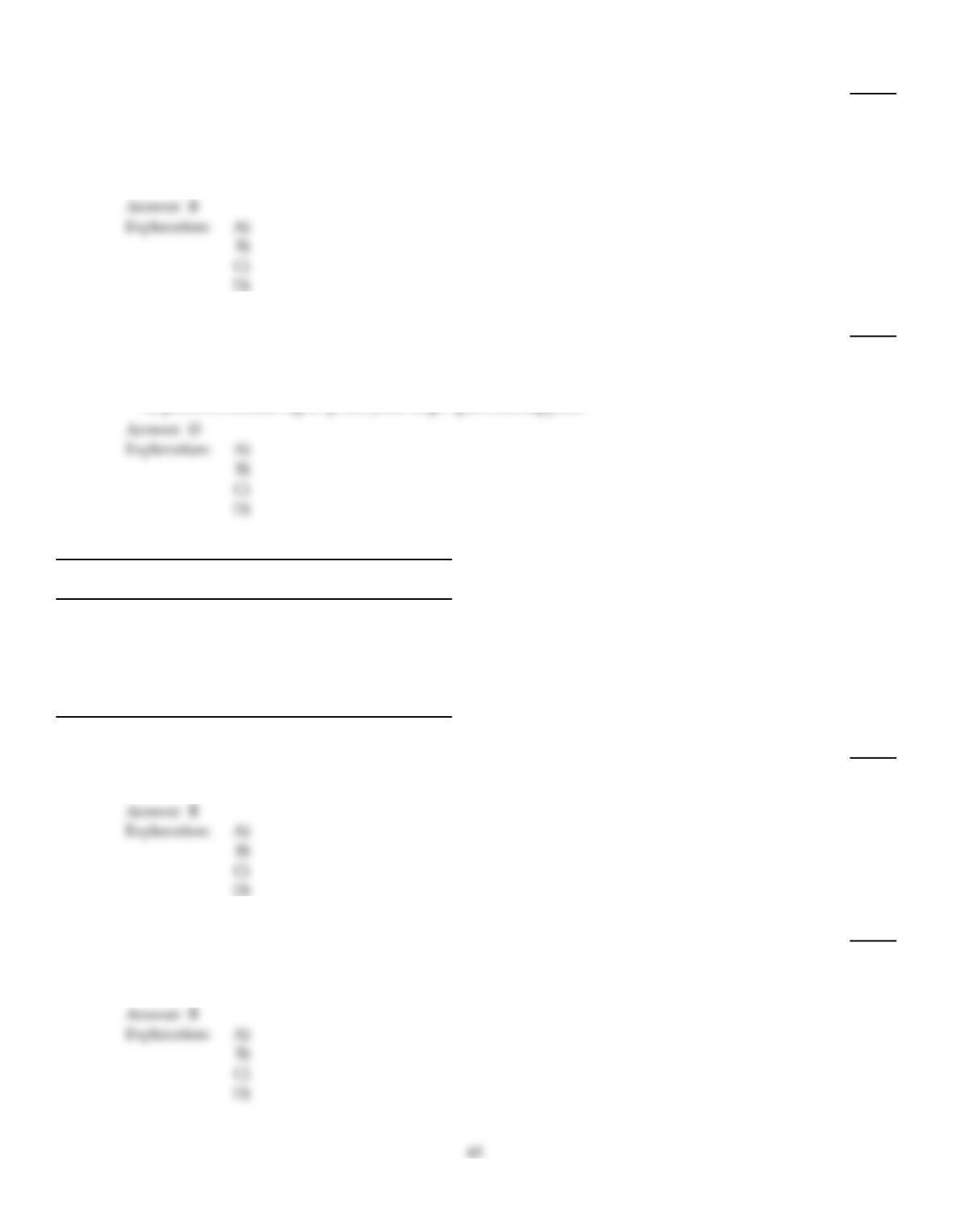
Refer to the above figure. Demand will be unit–elastic when quantity is between
242)
A)
0 and B.
B)
B and C.
C)
A and B.
D)
0 and A.
243)
The slope of the perfectly inelastic demand curve is ________, the slope of the perfectly elastic
demand curve is ________.
243)
A)
one, one
B)
undefined, zero
C)
zero, undefined
D)
one, zero
244)
In which of the following situations is the absolute price elasticity of demand for an item most
likely to exceed a value of 1?
244)
A)
when there are very few close substitutes for the item
B)
when there is considerable time to adjust to a change in the price of the item
C)
when the item‘s share of expenses in consumers’ budgets is very small
D)
when there are very few producers of the item
245)
When the price of sausages is $2.00 per pound, consumers buy 50 pounds of hamburger. When the
price of sausages rises to $3.00 per pound, 60 pounds of hamburger are purchased. The cross price
elasticity of demand between sausages and hamburger is approximately equal to
245)
A)
+2.20.
B)
–0.45.
C)
+0.45.
D)
+0.04.
Month PXQXPYQYPZQZ
Jan $10 100 $20 50 $25 200
Feb 10 90 18 60 25 225
Mar 10 70 15 90 25 275
Apr 12 50 15 100 25 290
May 15 25 15 120 25 320
246)
In the above table, the cross price elasticity of demand (using averages) for Z with good X, when PX
increases from $12 to $15, is approximately equal to
246)
A)
+0.44.
B)
–0.44.
C)
+1.03
D)
+2.26.
247)
If the price of oil goes up by 50% and the quantity demanded goes down by 25%, the absolute value
of the price elasticity of demand is
247)
A)
0.25.
B)
0.75.
C)
0.50.
D)
1.00.
248)
If the absolute price elasticity of demand for a product is greater than 1, then
248)
A)
the absolute price elasticity of demand is elastic and consumers are relatively insensitive to
price changes.
B)
the absolute price elasticity of demand is inelastic and consumers are relatively insensitive to
price changes.
C)
the absolute price elasticity of demand is elastic and consumers are relatively sensitive to
price changes.
D)
the absolute price elasticity of demand is inelastic and consumers are relatively sensitive to
price changes.
249)
If the quantity supplied stays the same no matter what the price is, then supply is
249)
A)
unit elastic.
B)
perfectly inelastic.
C)
perfectly elastic.
D)
undefined.
250)
Julie always purchases the soda with the lowest price. For Julie, the cross price elasticity of demand
for brand X and brand Y will be
250)
A)
equal to 0.
B)
negative.
C)
positive.
D)
impossible to determine without more information.
251)
The result of the calculation of the price elasticity of demand is
251)
A)
always negative.
B)
always positive.
C)
always greater than one.
D)
sometimes positive, sometimes negative.
A
252)
If a 1 percent increase in price causes a 2 percent increase in quantity supplied, then supply is
252)
A)
elastic.
B)
infinite.
C)
inelastic.
D)
unit elastic.
A
253)
For an addictive drug such as heroin, if the price of heroin increases, then
253)
A)
the quantity demanded will decrease by a relatively small amount.
B)
the quantity demanded will actually increase.
C)
the quantity demanded never changes.
D)
the quantity demanded will decrease by a relatively large amount.
A
254)
When the Gizmo Company could sell a gizmo for $10, it produced 2,500 per month. More recently,
the price of a gizmo has fallen to $9 and so Gizmo is only producing 2,000 units per month. What is
the price elasticity of supply for gizmos?
254)
A)
0.47
B)
2.11
C)
–2.11
D)
–0.47
B
C
255)
The difference between price elasticity of demand and income elasticity of demand is that
255)
A)
income elasticity measures the responsiveness of income to changes in supply while price
elasticity of demand measures the responsiveness of demand to a change in price.
B)
income elasticity of demand examines how an individual’s income changes when prices
change and the price elasticity of demand examines how quantity demand changes when
price changes.
C)
income elasticity refers to a horizontal shift of the demand curve while price elasticity of
demand refers to a movement along the demand curve.
D)
income elasticity refers to the movement along the demand curve while price elasticity refers
to a horizontal shift of the demand curve.
256)
The price elasticity of supply is 0.6. This means that
256)
A)
a 10 percent increase in quantity will occur when price increases by 6 percent.
B)
a 50 percent increase in quantity will occur when price increases by 30 percent.
C)
a $10 increase in price would increase quantity supplied by 60.
D)
a 150 percent increase in price would increase quantity supplied by 90 percent.
257)
Other things being equal, demand is more elastic the
257)
A)
larger the percentage of a total budget that a family spends on the good.
B)
more unique the good is.
C)
less expensive the good.
D)
shorter the time period for adjustment.
258)
When demand is perfectly inelastic, an increase in price will
258)
A)
increase total revenue.
B)
leave total revenue unchanged.
C)
either increase total revenue or decrease total revenue, but it is impossible to tell which.
D)
decrease total revenue.
259)
Robert must always have cream in his coffee. For Robert, the cross price elasticity of demand for
coffee and cream is
259)
A)
equal to 0.
B)
negative.
C)
positive.
D)
impossible to determine without more information.
260)
Usually, price elasticities of supply are
260)
A)
ordinarily a negative number based on the law of supply.
B)
an inverse relationship between price and quantity supplied.
C)
considered short–run adjustments due to supply constraints.
D)
positive, because higher prices yield larger quantities supplied.
Price Quantity Demanded
Per Unit Per Week
$5.5 20
$6.0 18
$6.5 16
$7.0 14
$7.5 12
$8.0 10
261)
According to the above table, what is the absolute price elasticity of demand if price falls from $8.00
to $7.50?
261)
A)
1.21
B)
2.82
C)
1.80
D)
4.00
262)
Six months ago, the price of gasoline was $2.20 per gallon. Now, the price is $2.40 per gallon. In
response to this price increase, the number of gallons of gasoline purchased has declined by 2
percent. Based on this information, what is the absolute price elasticity of demand for gasoline?
262)
A)
0.10
B)
0.23
C)
1.20
D)
4.35
263)
When the price of a video rental was $2.00, ticket sales at the local movie theatre averaged 180
admissions per night. Then the video store reduced the price of a video rental to $1, and the theatre
manager reported that ticket sales had fallen to 126 per night. What is the approximate value of the
cross price elasticity of demand between video rentals and theatre tickets?
263)
A)
–0.53
B)
+0.53
C)
+0.30
D)
+1.67
264)
The paintings of a world famous artist Vincent Van Gogh have a price elasticity of supply
264)
A)
equal to 2.0.
B)
approaching infinity.
C)
equal to 1.0.
D)
close to 0.0.
265)
If the absolute price elasticity of demand of a good is 1.46, then the total revenues will increase if its
market price
265)
A)
stays the same.
B)
increases.
C)
decreases.
D)
changes, but we can’t tell without more information if the price increases or decreases.
266)
Which of the following statements is FALSE?
266)
A)
A perfectly inelastic supply curve is a vertical line.
B)
A horizontal supply curve is possible.
C)
Time is an important consideration in determining supply elasticity.
D)
Price elasticity of supply can never equal 1.
267)
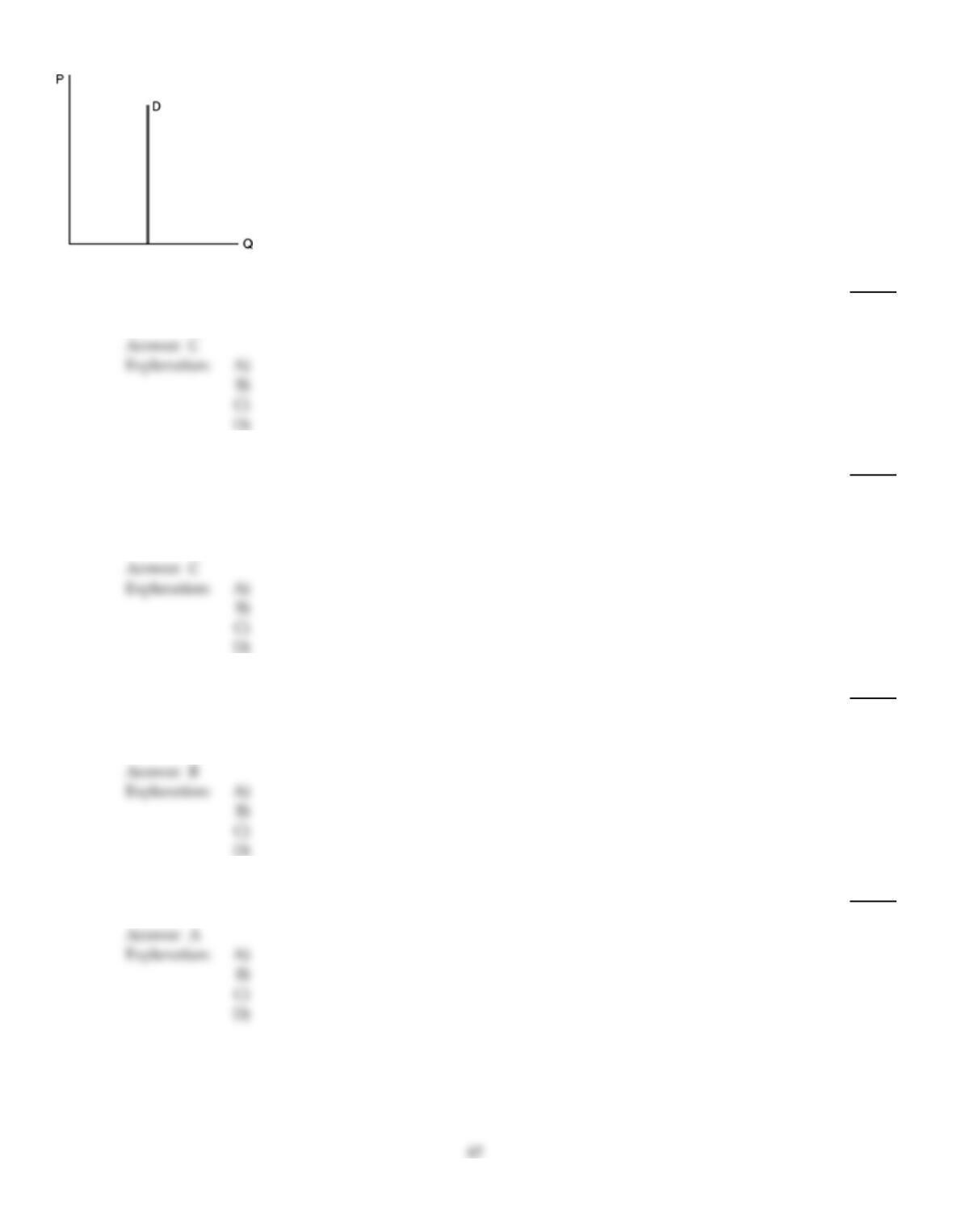
Refer to the above figure. Demand is
267)
A)
perfectly elastic.
B)
unitary elastic.
C)
perfectly inelastic.
D)
undetermined without more information.
268)
A value of the absolute price elasticity of demand equal to 0.5 indicates that
268)
A)
a 1% increase in price leads to a 5% decrease in quantity demanded.
B)
a 2% decrease in price leads to a 25% increase in quantity demanded.
C)
a 1% increase in price leads to a 0.5% decrease in quantity demanded.
D)
a 0.5% decrease in price leads to a 1% increase in quantity demanded.
269)
Suppose that when the price of good X changes, the quantity of good Y demanded remains the
same. The cross price elasticity of demand is
269)
A)
positive.
B)
zero.
C)
negative.
D)
either positive or negative.
270)
The word best associated with price elasticity of demand is
270)
A)
relative.
B)
total.
C)
cumulative.
D)
absolute.
271)
A university raises annual tuition by 10 percent. No other events have occurred, and the
university’s revenues have increased. It must be TRUE that
271)
A)
there was no associated change in quantity demanded.
B)
the associated change in quantity demanded was equal to 10 percent.
C)
the associated change in quantity demanded was greater than 10 percent.
D)
the associated change in quantity demanded was smaller than 10 percent.
272)
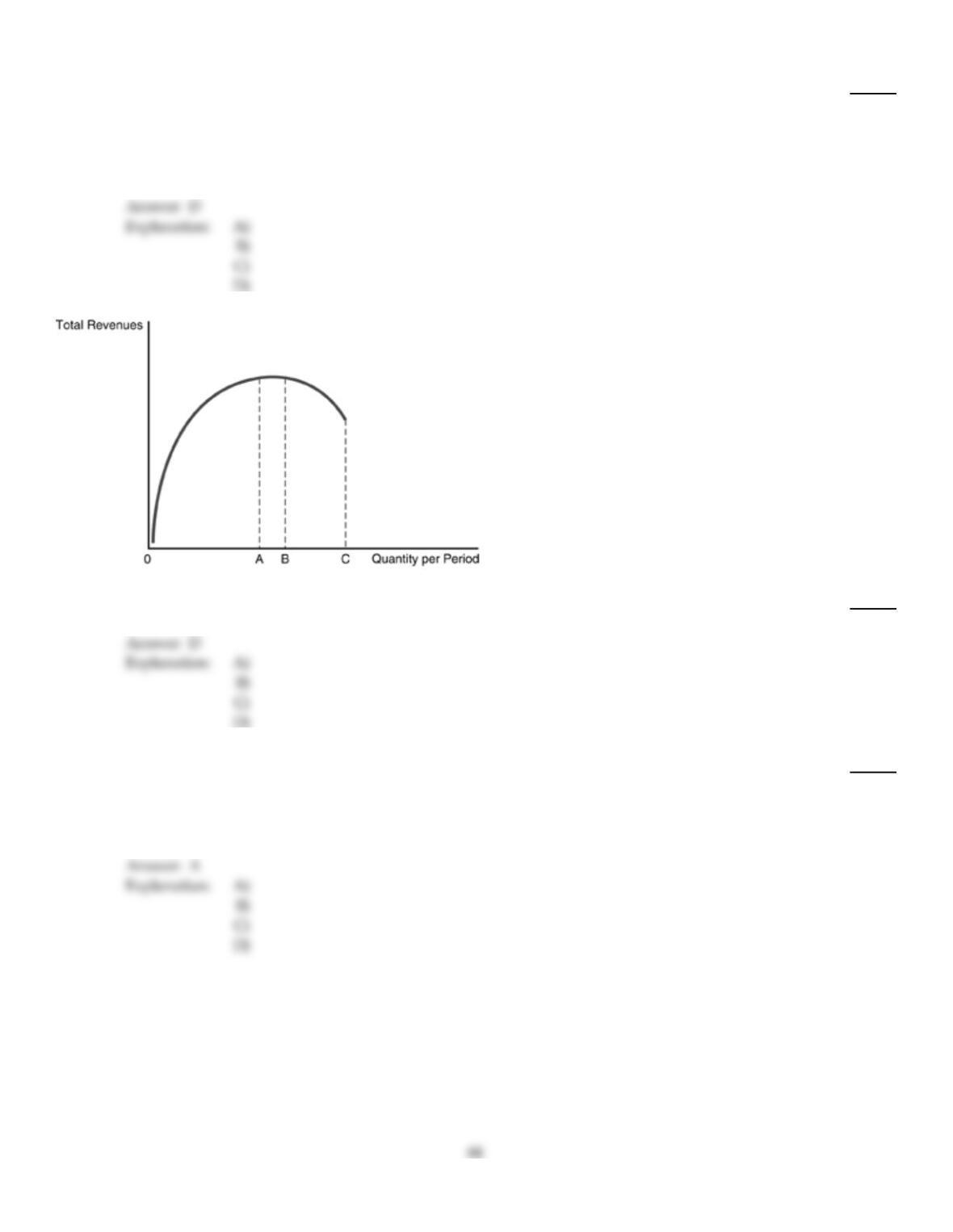
Refer to the above figure. Demand will be elastic when quantity is between
272)
A)
B and C.
B)
0 and B.
C)
A and B.
D)
0 and A.
273)
The longer the time period that suppliers have to adjust to price changes, the
273)
A)
greater will be the price elasticity of supply.
B)
lower will be the price elasticity of demand.
C)
lower will be the price elasticity of supply.
D)
greater will be the price elasticity of demand.
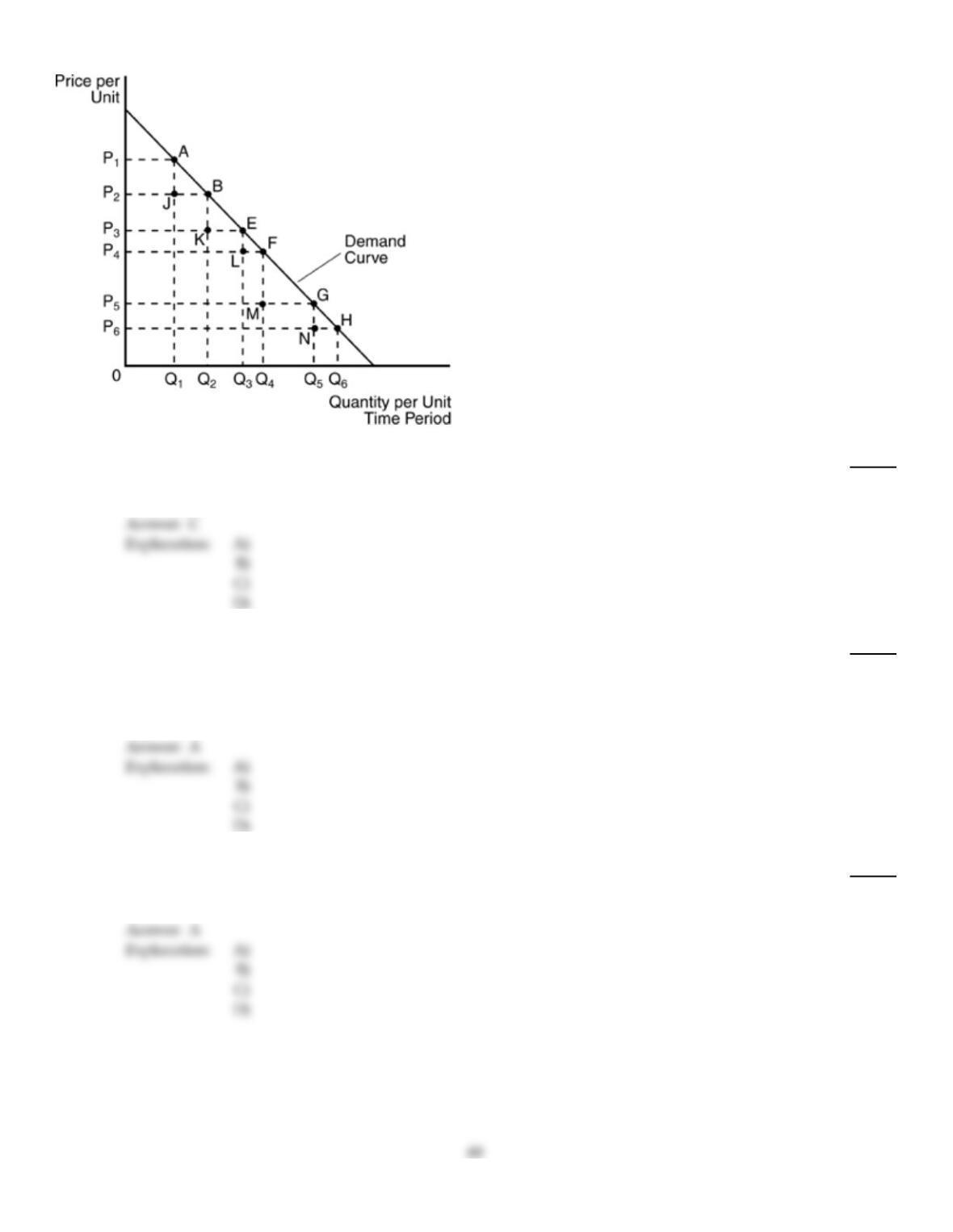
274)
In the above figure, over the price range P5P6, demand is
274)
A)
perfectly inelastic.
B)
elastic.
C)
inelastic.
D)
unit elastic.
275)
If demand is unit–elastic throughout the demand curve, then total revenues are
275)
A)
the same for any price the firm charges.
B)
lower the higher the price.
C)
greater the higher the price.
D)
maximized at the midpoint of the demand curve.
276)
Price elasticities are calculated for four goods, and the values are: 4.5; 3.7; 1.0; 0.2. Which price
elasticity is most elastic?
276)
A)
4.5
B)
1.0
C)
3.7
D)
0.2
277)
The price elasticity of supply is higher when
277)
A)
producers have more time to adjust to price changes.
B)
the number of buyers in the market decreases.
C)
the product in question is an inferior good.
D)
the number of buyers in the market increases.
Price Quantity Demanded
Per Unit Per Week
$10.00 25
9.50 30
9.00 35
8.50 40
8.00 45
7.50 50
7.00 55
6.50 60
6.00 65
5.50 70
5.00 75
278)
Refer to the above table. For which prices is demand inelastic?
278)
A)
in a range of prices below $6.00
B)
in a range of prices between $5 and $1
C)
in a range of prices above $6.00
D)
in a range of prices above $9.00
279)
When the price of cable modems decreased from $100 to $85, the number of cable modems
produced fell from 1,000 per week to 850 per week. Using this information, we know the supply of
cable modems is
279)
A)
inelastic.
B)
elastic.
C)
perfectly inelastic.
D)
unit elastic.
280)
An absolute price elasticity of demand equal to 0.4 indicates that a
280)
A)
1 percent increase in price leads to a 4 percent decrease in quantity demanded.
B)
0.4 percent decrease in price leads to a 1 percent increase in quantity demanded.
C)
4 percent increase in price leads to a 10 percent decrease in quantity demanded.
D)
10 percent decrease in price leads to a 4 percent increase in quantity demanded.
281)
When demand is perfectly inelastic, the demand curve is
281)
A)
downward sloping.
B)
upward sloping.
C)
horizontal.
D)
vertical.
282)
Which of the following is NOT a determinant of the price elasticity of demand?
282)
A)
the cost to produce the product
B)
the time the consumer has to adjust to the price change
C)
the share of the budget spent on the item
D)
the availability of potential substitutes
Price Quantity Demanded
Per Unit Per Week
$10.00 25
9.50 30
9.00 35
8.50 40
8.00 45
7.50 50
7.00 55
6.50 60
6.00 65
5.50 70
5.00 75
283)
Refer to the above table. What is the absolute price elasticity of demand when a price rises from $9
to $9.50?
283)
A)
2.57
B)
0.35
C)
0.55
D)
2.85
284)
The quantity of raspberries sold at a local store increases from 100 pints to 1,500 pints when the
price is reduced from $4.00 to $1.00. In this situation, the absolute price elasticity of demand for
raspberries is approximately
284)
A)
4.3.
B)
1.46.
C)
6.7.
D)
0.69.
285)
If the absolute price elasticity of demand for good Y is 0.5, when there is a 20 percent increase in
price, we can conclude that quantity demanded
285)
A)
has fallen by 10 percent.
B)
has fallen by 4 percent.
C)
has fallen by 1 percent.
D)
has fallen by 100 percent.
286)
If the price of apples went up by 25 percent, which of the following values of the cross price
elasticity for oranges would be most reasonable to anticipate?
286)
A)
–2.5
B)
0.0
C)
1.2
D)
–1.0
287)
Which of the following would most likely exhibit the highest price elasticity of demand?
287)
A)
salt
B)
one particular brand of toothpaste
C)
motor oil
D)
gasoline
288)
If demand is inelastic and the price of a product decreases by 10 percent, then
288)
A)
the change in quantity demanded is greater than 10 percent.
B)
the change in quantity demanded is equal to 10 percent.
C)
the decrease in quantity demanded is greater than 0 percent.
D)
the change in quantity demanded is less than 10 percent.
289)
Generally, expenses on toothpaste are a small part of a consumer’s budget, so the demand for
toothpaste is more likely to be
289)
A)
perfectly elastic.
B)
elastic.
C)
inelastic.
D)
unit elastic.
290)
A 2 percent increase in the price of neckties leads to a 5 percent decrease in the quantity demanded
of neckties. The absolute price elasticity of demand is
290)
A)
0.4.
B)
2.5.
C)
1.
D)
0.2.
291)
Which of the following is NOT characteristic of a good with elastic demand?
291)
A)
Total revenue decreases if price is increased.
B)
Buyers are relatively sensitive to price changes.
C)
The percentage change in quantity demanded is greater than the percentage change in price.
D)
The absolute price elasticity of demand is less than 1.
292)
If a good has an absolute price elasticity of 2, the demand for the good is
292)
A)
unit elastic.
B)
inelastic.
C)
perfectly elastic.
D)
elastic.
293)
The demand for diet soft drinks (as a group) is relatively inelastic because
293)
A)
there are few substitutes.
B)
the purchase of a soft drink represents a large portion of a person’s budget.
C)
there are many of them on the market.
D)
none of the above.
A
294)
Chad’s income went from $1000 per week to $1500 per week. As a result he increased his
consumption of steak from 1 pound a week to 3 pounds a week. Based on his consumption
patterns, the income elasticity of steak for Chad is
294)
A)
–1.50.
B)
–.50.
C)
2.50.
D)
.50.
C
D
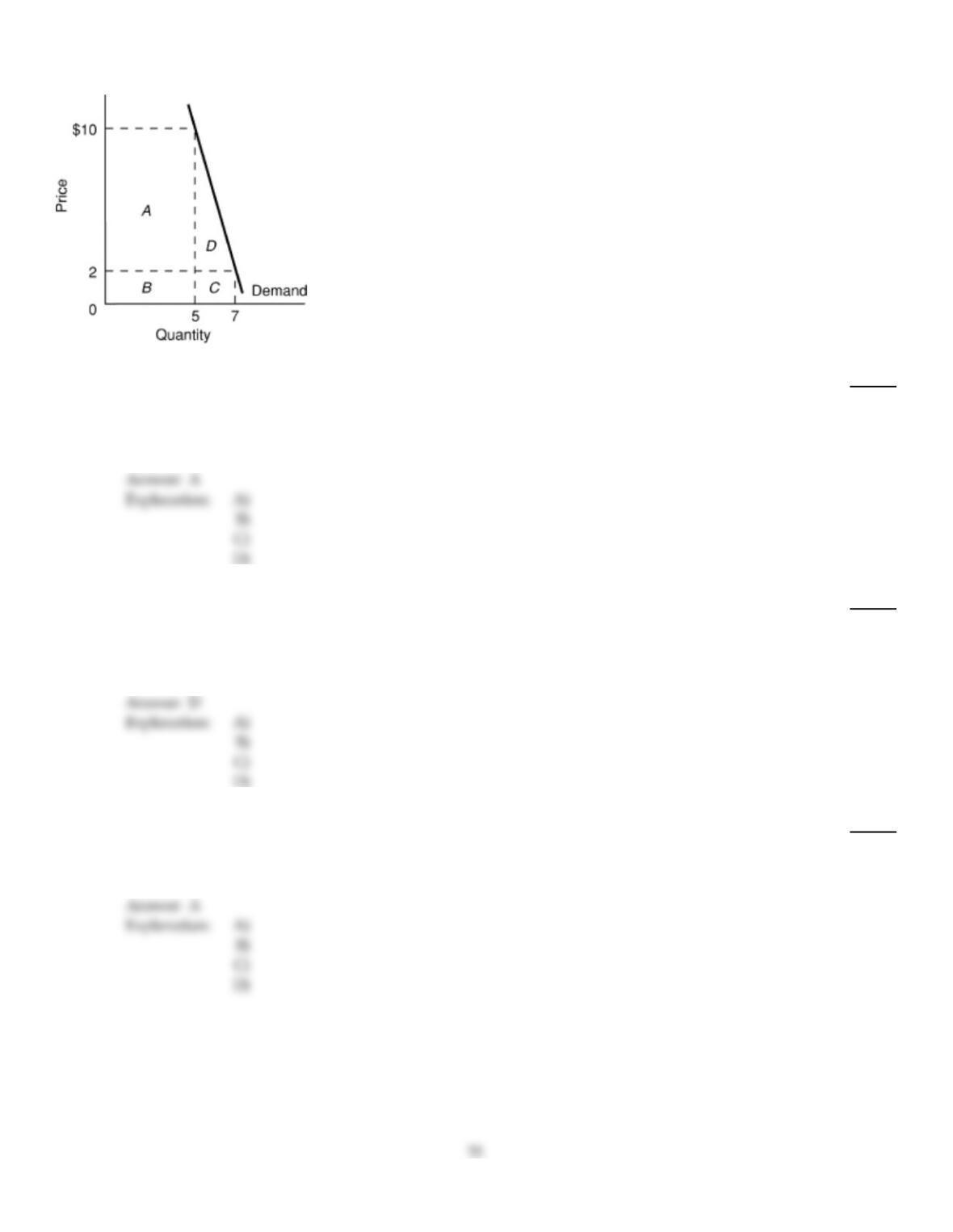
295)
Use the above figure. When the price increases from $2 to $10, total revenue
295)
A)
increases from areas B + C to areas A + B and demand is inelastic.
B)
increases from areas B + C to areas A + D and demand is elastic.
C)
increases from areas A + B to areas B + C and demand is inelastic.
D)
increases from areas C + D to areas B + A and demand is elastic.
296)
The most important determinant of price elasticity of supply is
296)
A)
the price of the good.
B)
the number of close substitutes there are for the good.
C)
the importance of the good in the budgets of consumers.
D)
the time period firms have to adjust to the new price.
297)
A demand relationship in which a given percentage change in price will result in a larger
percentage change in quantity demanded is
297)
A)
elastic.
B)
unit–elastic.
C)
inelastic.
D)
consistent with zero elasticity.
Price Quantity Demanded
Per Unit Per Week
$10.00 25
9.50 30
9.00 35
8.50 40
8.00 45
7.50 50
7.00 55
6.50 60
6.00 65
5.50 70
5.00 75
298)
Refer to the above table. What is the absolute price elasticity of demand when a price rises from $8
to $8.50?
298)
A)
0.515
B)
5.15
C)
1.94
D)
0.194
299)
The more sensitive people are to a change in price, the
299)
A)
smaller the price elasticity of demand.
B)
closer the price elasticity of demand is to one.
C)
greater a change in price must be to induce a certain change in quantity demanded.
D)
greater is the price elasticity of demand.
300)
After full adjustment to a price change has occurred, the absolute price elasticity of demand for an
item is equal to 1. In the short run, the absolute price elasticity of demand for the item was probably
300)
A)
greater than 0.
B)
less than 0.
C)
greater than 1.
D)
less than 1.
301)
When many substitutes exist for a good, demand will be
301)
A)
inelastic.
B)
perfectly unit–elastic.
C)
elastic.
D)
unit–elastic.
302)
Suppose that the absolute price elasticity of demand for hamburger is 1.15 and that the absolute
price elasticity of demand for steak is 2.4. Then the absolute price elasticity of demand for beef will
be
302)
A)
between 1.15 and 2.4.
B)
less than 1.15.
C)
equal to 1.15.
D)
more than 2.4.
303)
Over the inelastic range of a demand curve, there is
303)
A)
a positive relationship between a given percentage change in price and a change in total
revenues.
B)
no relationship between changes in price and changes in total revenues.
C)
an increase in total revenues regardless of an increase or decrease in price.
D)
a negative relationship between a given percentage change in price and a change in total
revenues.
304)
For which of the following purchases would the absolute price elasticity of demand be smallest?
304)
A)
a cell phone
B)
a sports car
C)
utilities
D)
chewing gum
305)
When the consumer spends over 50% of her income on a good, demand will be
305)
A)
elastic.
B)
unit–elastic.
C)
inelastic.
D)
elastic, unit–elastic or inelastic depending upon supply.
Price Quantity Demanded
Per Unit Per Week
$10.00 25
9.50 30
9.00 35
8.50 40
8.00 45
7.50 50
7.00 55
6.50 60
6.00 65
5.50 70
5.00 75
306)
Refer to the above table. For which prices is demand elastic?
306)
A)
in a range of prices above $9.00
B)
in a range of prices between $5 and $10
C)
in a range of prices above $6.50
D)
in a range of prices below $6.50
307)
The price elasticity of demand along a linear demand curve is
307)
A)
constant.
B)
infinite.
C)
more elastic at higher prices than at low prices.
D)
one.
C
308)
When there are very few substitutes for a good, the demand for the good will tend to be
308)
A)
perfectly elastic.
B)
elastic.
C)
inelastic.
D)
unitary.
C
C
309)
When the consumer spends a small portion of his income on a good, demand will be
309)
A)
elastic.
B)
unit–elastic.
C)
inelastic.
D)
elastic, unit–elastic or inelastic depending upon supply.
310)
The longer any price change lasts over time, the
310)
A)
the more quickly quantity demanded will return to its original level.
B)
the longer the short–run equilibrium will continue to be the short–run equilibrium.
C)
more quantity demanded will change.
D)
more difficult it is to alter quantity demanded.
311)
Suppose that the value of the long–run absolute elasticity of demand for a good is 1.2. Then, we
know the short–run absolute price elasticity of demand will be
311)
A)
less than 1.2.
B)
greater than 1.2.
C)
elastic.
D)
inelastic.
312)
If the quantity supplied of candy increases by 10% when the price of candy increases by 20%, which
of the following is TRUE?
312)
A)
Supply for candy is inelastic, and price elasticity of supply = 0.5.
B)
Supply for candy is inelastic, and price elasticity of supply = 2.0.
C)
Supply for candy is elastic, and price elasticity of supply = 0.5.
D)
Supply for candy is elastic, and price elasticity of supply = 2.0.
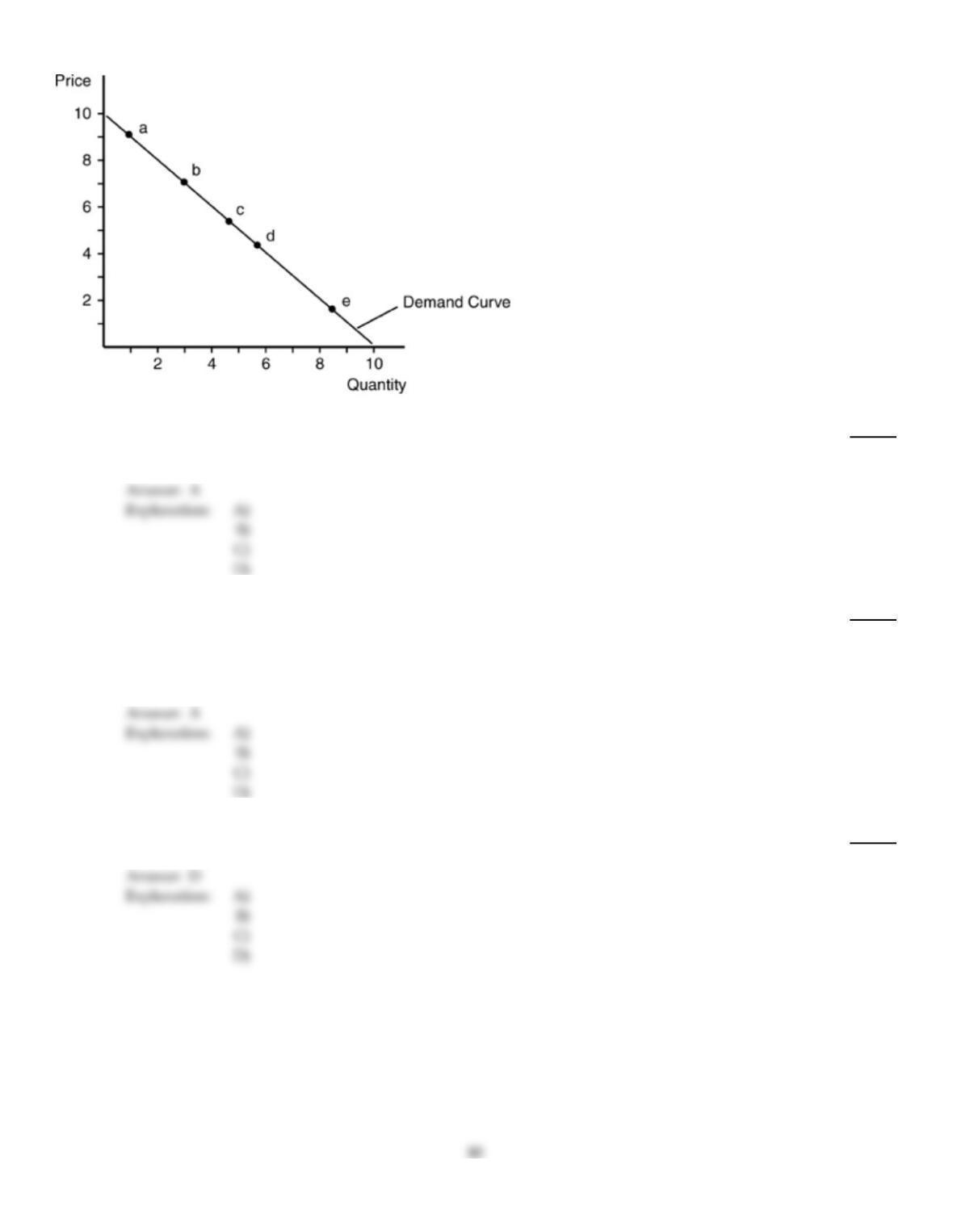
313)
In the above figure, the range of unit elasticity occurs
313)
A)
between point c and point d.
B)
on the vertical axis.
C)
on the horizontal axis.
D)
below point e.
314)
The income elasticity of demand is
314)
A)
the percentage change in demand divided by the percentage change in income.
B)
the change in quantity demanded divided by the change in price.
C)
the change in income divided by the percentage change in price.
D)
the percentage change in income divided by the percentage change in quantity demanded.
315)
Two items which have a negative cross price elasticity of demand are referred to as
315)
A)
inferior goods.
B)
luxury goods.
C)
substitutes.
D)
complements.