37
5) The rate of a nuclear reaction can be changed by
A) adding a catalyst.
B) increasing the volume.
C) increasing the temperature.
D) None of these
6) Beta decay of 60Co produces a beta particle and
A) 56Mn.
B) 59Co.
C) 60Fe.
D) 60Ni.
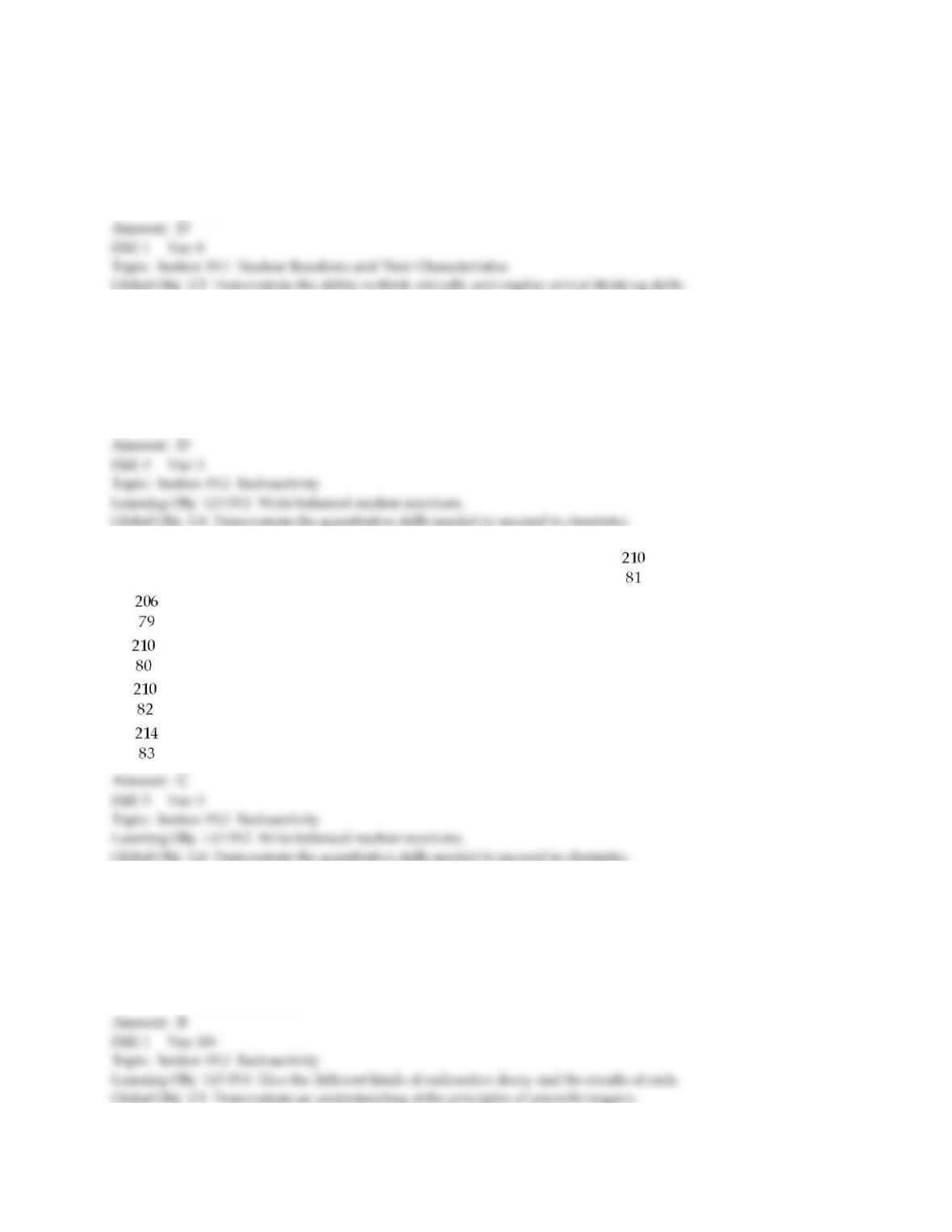
7) In addition to a beta particle, what is the other product of beta decay of Tl?
A) Au
B) Hg
C) Pb
D) Bi
8) When a substance decays by alpha radiation, the mass number of the nucleus ________ and the atomic
number ________.
A) increases by 4, increases by 2
B) reduces by 4, reduces by 2
C) increases by 1, increases by 4
D) reduces by 3, reduces by 1
9) When a substance decays by beta emission, the mass number of the nucleus ________ and the atomic
number ________.
A) decreases by 2, remains the same
B) increases by 2, remains the same
C) remains the same, decreases by 1
D) remains the same, increases by 1
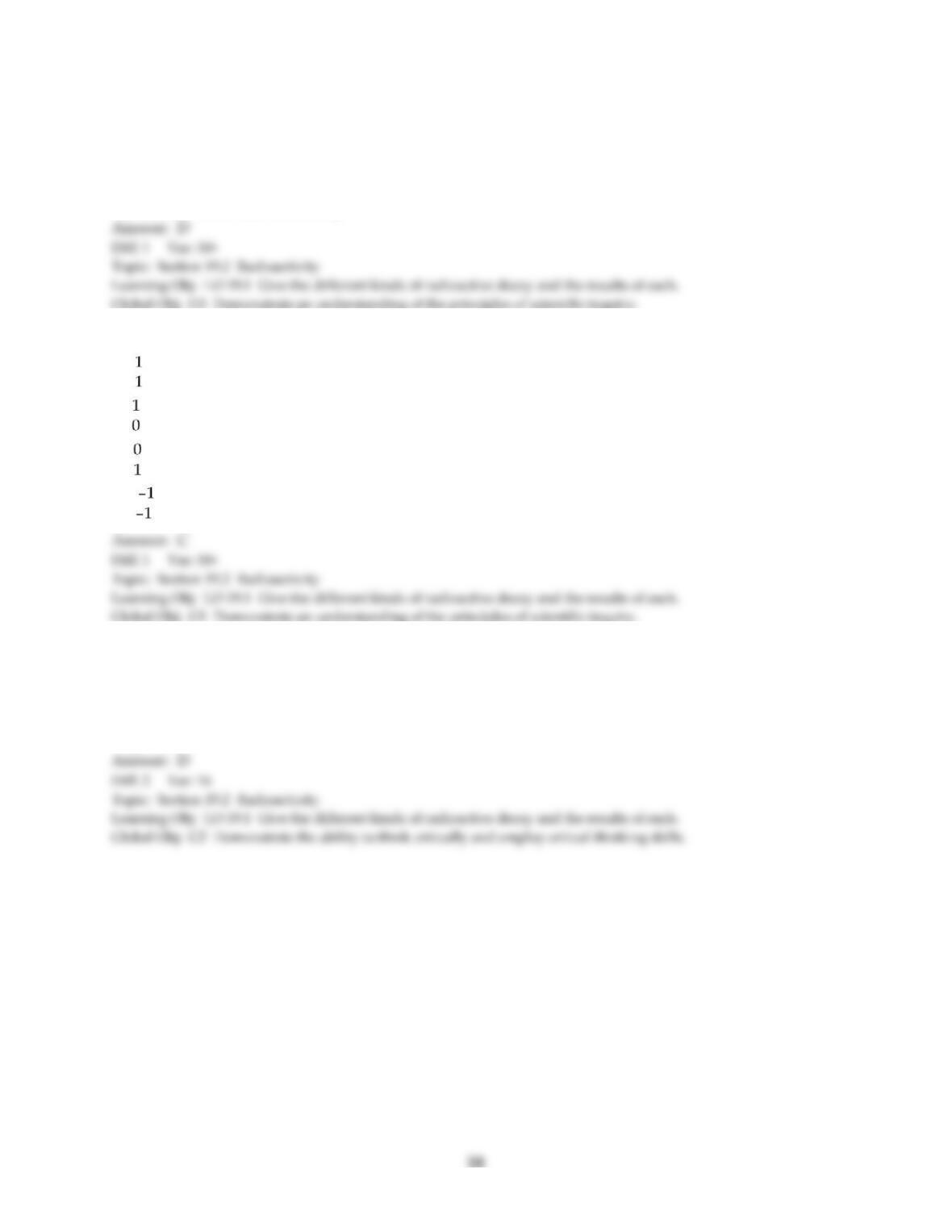
10) A positron is
A) n.
B) p.
C) e.
D) e.
11) Which one of the following processes does not result in transmutation to another element?
A) alpha emission
B) positron decay
C) electron capture
D) gamma emission
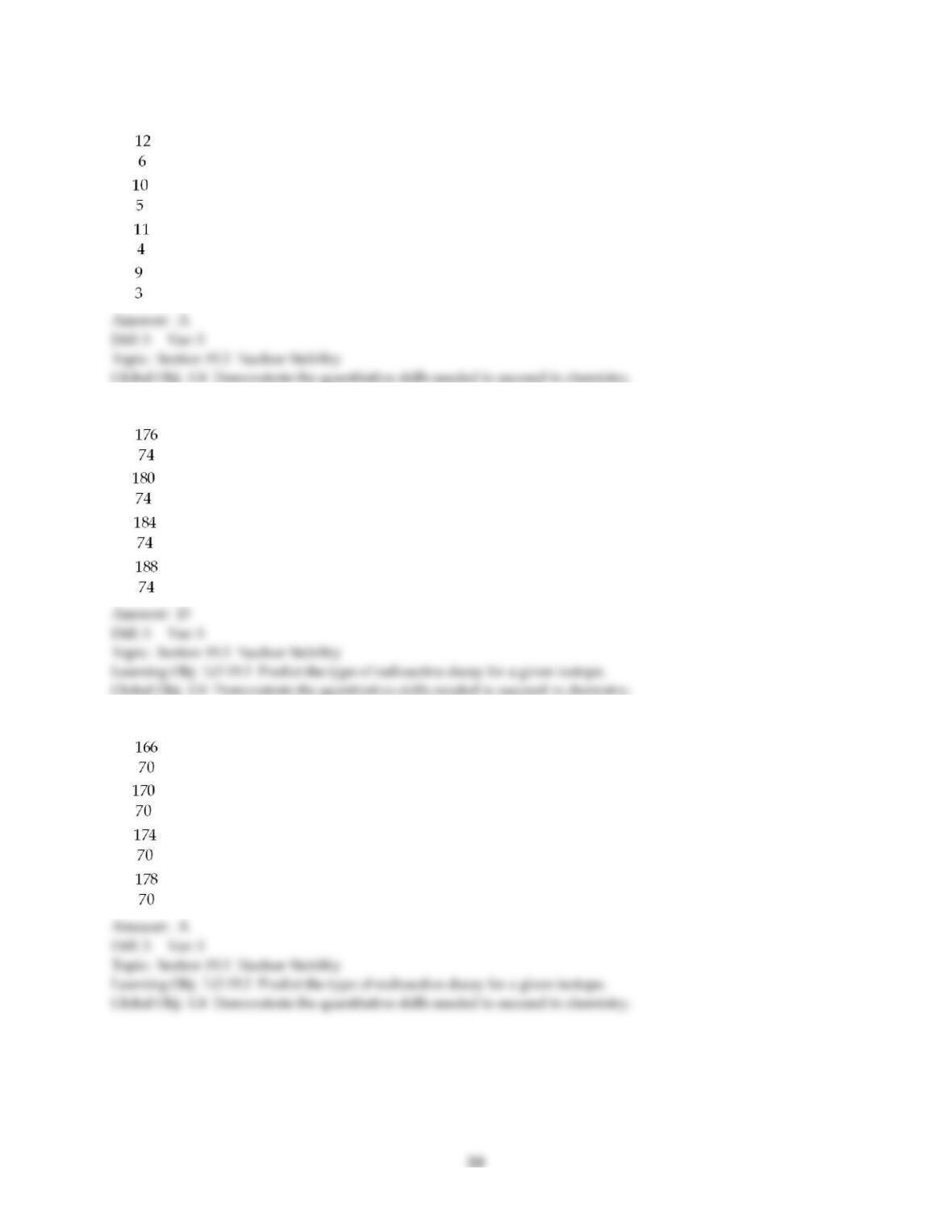
12) Which of the following elements would be expected to be particularly stable?
A) C
B) B
C) Be
D) Li
13) Which of the following nuclides is most likely to undergo beta decay?
A) W
B) W
C) W
D) W
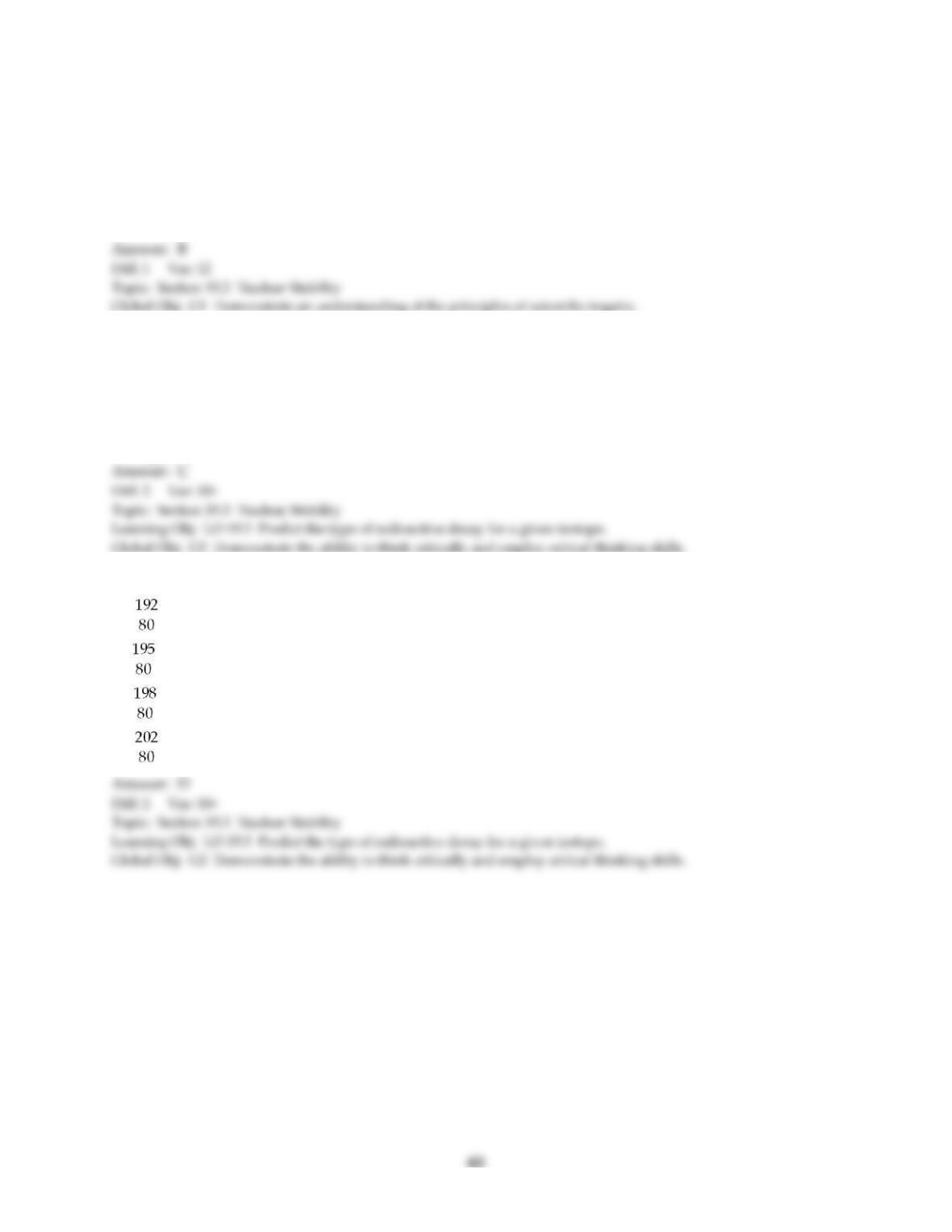
14) Which nuclide below is most likely to decay by electron capture?
A) Yb
B) Yb
C) Yb
D) Yb
15) When more than 3000 known nuclides are plotted on a neutron/proton grid, they make up a group
called
A) the “island of stability.”
B) the “band of nuclear stability.”
C) the “sea of instability.”
D) none of these
16) Which is the only element that contains more protons than neutrons in its most abundant stable
isotope?
A) lithium
B) nitrogen
C) hydrogen
D) copper
17) Which of the following nuclides is most likely to undergo beta decay?
A) Hg
B) Hg
C) Hg
D) Hg
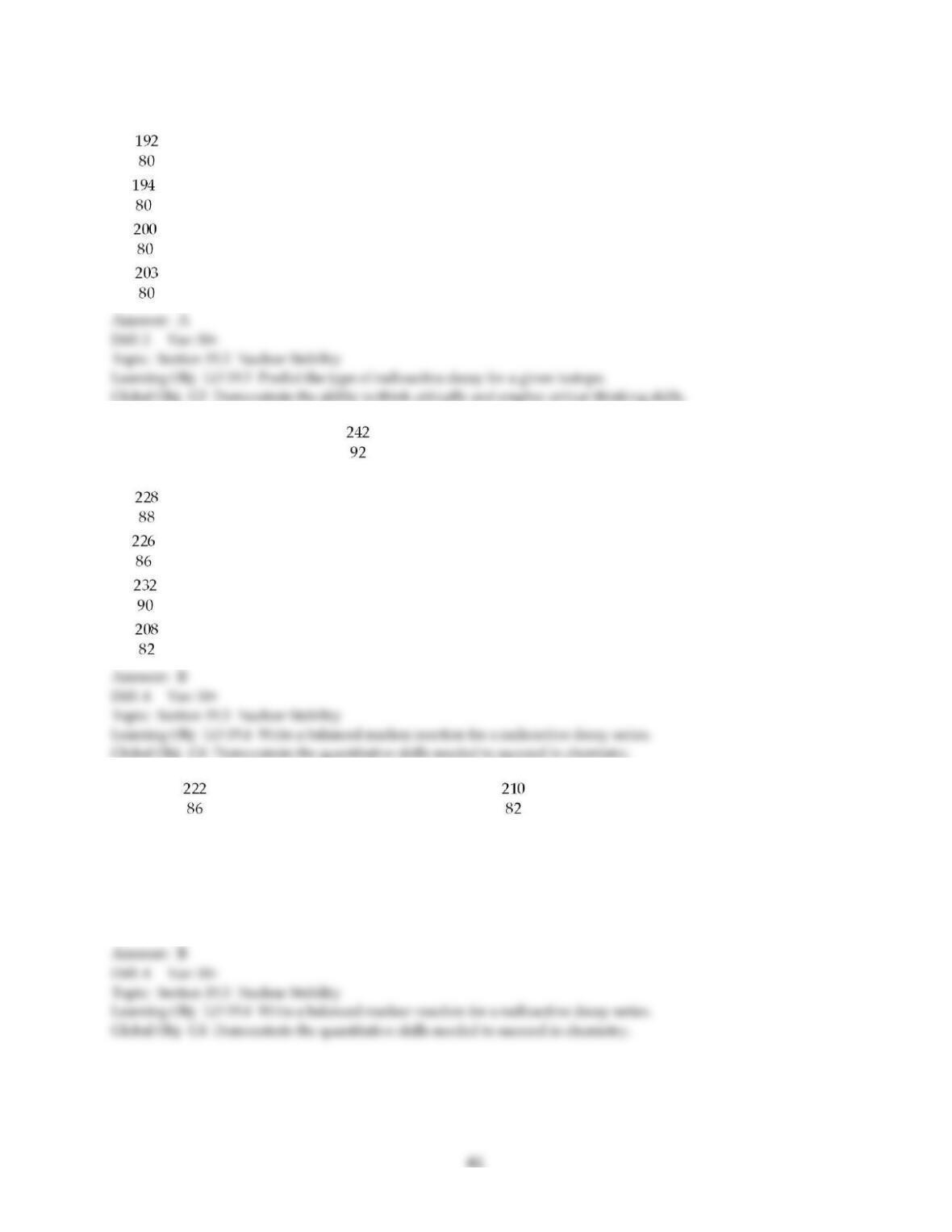
18) Which of the following nuclides is most likely to decay by electron capture?
A) Hg
B) Hg
C) Hg
D) Hg
19) What nuclide is formed when U undergoes a portion of the decay series: alpha, beta, beta, alpha,
alpha, alpha.
A) Ra
B) Rn
C) Th
D) Pb
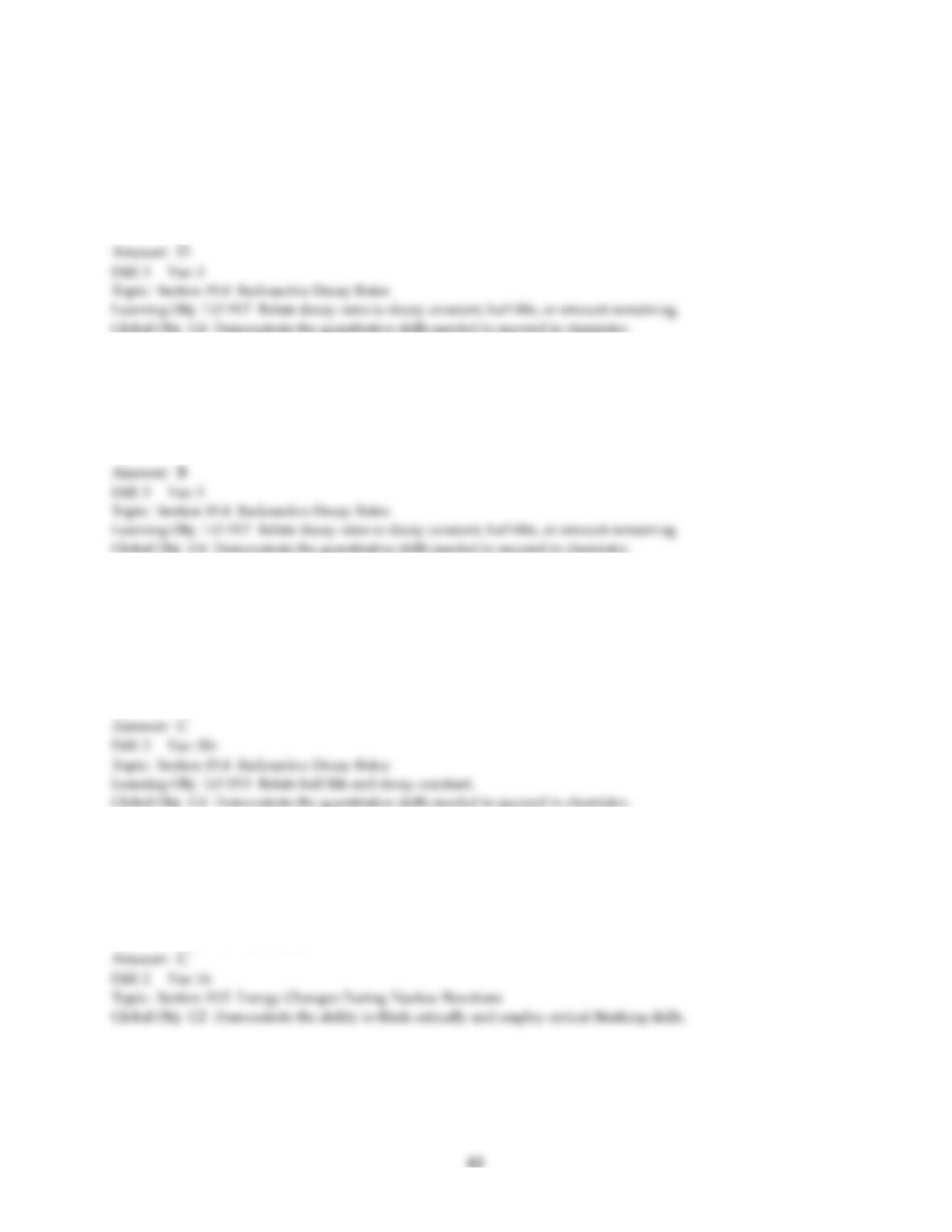
20) When Rn decays in a 5-step series the product is Pb. How many alpha and beta particles are
emitted in the decay series?
A) 1 α, 3 β–
B) 3 α, 2 β–
C) 1 α, 1 β–
D) 3 α, 4 β–
21) Neptunium-239 has a half-life of 2.35 days. How many days must elapse for a sample of 239Np to
decay to 3.00% of its original quantity?
A) 0.0841 days
B) 0.967 days
C) 1.03 days
D) 11.9 days
22) What percentage of a radioactive substance remains after 6.00 half-lives have elapsed?
A) 0.781%
B) 1.56%
C) 3.12%
D) 6.25%
23) The decay constant, k, is given for each of the beta emitters below. Which one has the shortest half
life?
A) 115In, 4.29 × 10⁻⁹ s-1
B) 131I, 9.94 × 10⁻⁷ s-1
C) 217At, 21.4 s-1
D) 42K, 1.55 × 10⁻⁵
s-1
24) Which of the following isotopes is the most stable?
A) 6He, 4.89 MeV/nucleon
B) 20Ne, 8.03 MeV/nucleon
C) 94Zr, 8.67 MeV/nucleon
D) 240Pu, 7.26 MeV/nucleon
25) Which of the following isotopes is the least stable?
A) 7Be, 5.37 MeV/nucleon
B) 23Na, 8.11 MeV/nucleon
C) 94Zr, 8.67 MeV/nucleon
D) 240Pu, 7.26 MeV/nucleon
26) What is the binding energy (kJ/mol) for an element that has a mass defect of 3.33 × 10⁻²⁶ g? Remember
that the unit for a joule is kg m-2 s-2.
A) 6.02 × 10³ kJ/mole
B) 6.02 × 10¹² kJ/mole
C) 1.80 × 10⁹ kJ/mole
D) 5.41 × 10¹⁴ kJ/mole
27) Relative to the amount of energy released in a typical chemical reaction, the amount of energy
released in a typical fission reaction is about
A) the same.
B) 1/2 times greater.
C) 108 times greater
D) 107
times greater
28) What mass percent of 235U (the fissionable isotope) is used in the fuel in nuclear power plants?
A) 3%
B) 14%
C) 30%
D) 85%
44
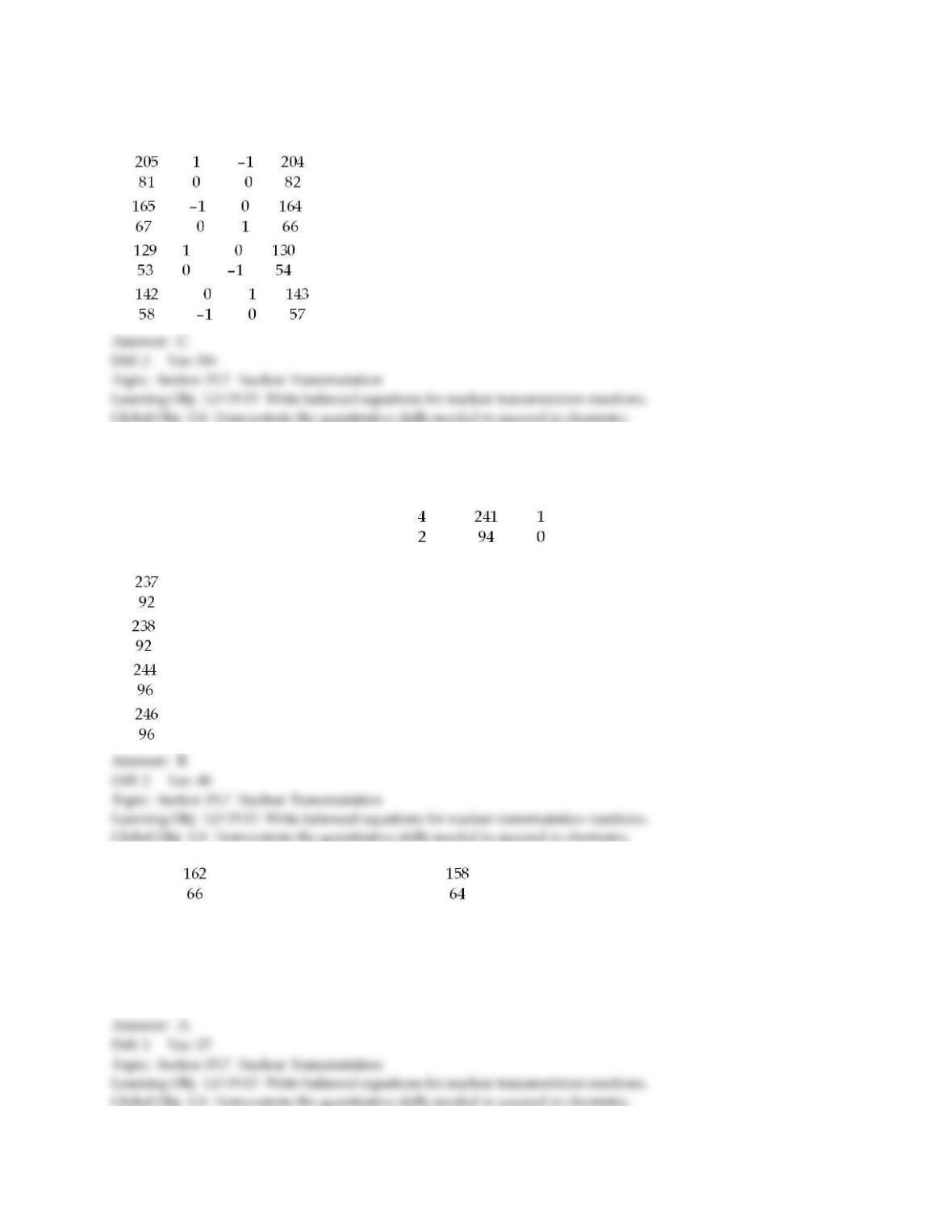
29) Which of the following reactions correctly shows the transmutation of an element by neutron
absorption followed by beta emission?
A) Tl + n → e + Pb
B) Tl + e → n + Dy
C) I + n → e + Xe
D) Ce + e → n + La
30) The nuclear transmutation reaction that leads to the synthesis of plutonium-241 is shown below. What
is the identity of the α-particle bombardment target in this reaction?
? + He → Pu + n
A) U
B) U
C) Cm
D) Cm
31) When Dy is formed by bombardment of Gd, what particle(s) was (were) used for the
bombardment?
A) one α
B) three β–
C) four neutrons
D) three protons
32) What is the abbreviation used for the curie, a unit used in the measurement of nuclear disintegrations
per unit time?
A) Cm
B) Cb
C) Ci
D) Ce
33) Which of the following isotopes is not used for medical purposes?
A) 18F
B) 12C
C) 32P
D) 99mTc
34) What type of shielding can be used to protect against gamma rays?
A) paper
B) lead
C) heavy clothing
D) No shielding is effective against gamma rays.
35) Which is more dangerous in terms of short-lived exposure to radiation? One mole of
A) 83Sr, β–, t1/2 = 1.35 days.
B) 90Sr, β–, t1/2 = 28.5 years.
C) 80Sr, β–, t1/2 = 1.77 hours.
D) 94Sr, β–, t1/2 = 74 seconds.
46
36) Which type of radiation source would pose the greatest health risk when used internally for a medical
procedure?
A) an alpha emitter, t1/2 = 6 hours
B) a beta emitter, t1/2 = 5 hours
C) a beta emitter, t1/2 = 15 days
D) a gamma emitter, t1/2 = 4 hours
37) Carbon-14, which is present in all living tissue, radioactively decays via a first–order process. A one–
gram sample of wood taken from a living tree gives a rate for carbon-14 decay of 13.6 counts per minute.
If the half-life for carbon-14 is 5715 years, how old is a wood sample that gives a rate for carbon-14 decay
of 7.9 counts per minute?
A) 2.2 × 10³ yr
B) 3.1 × 10³ yr
C) 4.5 × 10³ yr
D) 1.4 × 10⁴ yr
19.3 Short Answer Questions
1) The number of protons, neutrons, and total nucleons in Ru are ________, ________, and ________,
respectively.
2) The missing reactant in the nuclear reaction ? → N + e is ________.
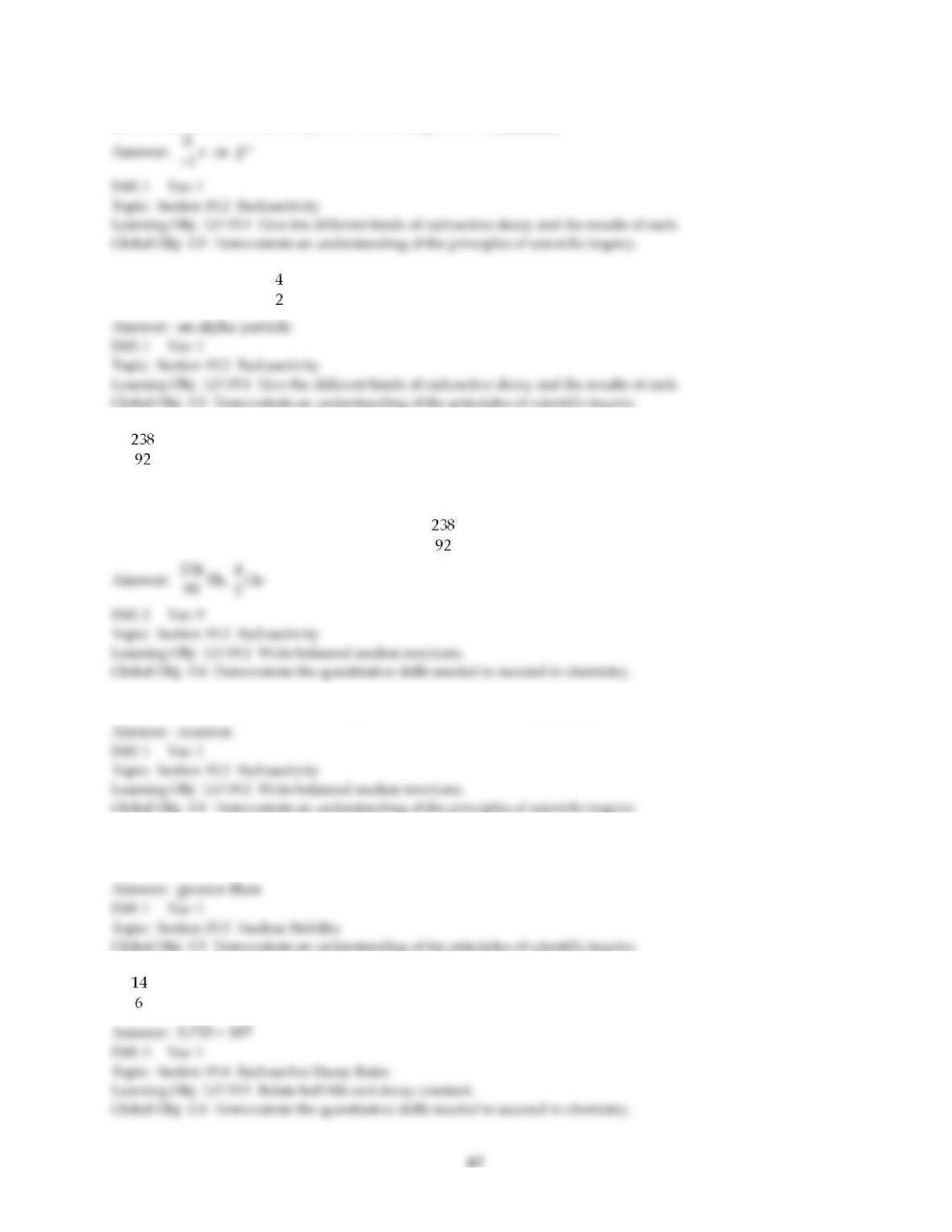
3) In a nuclear reaction, the symbol for a beta particle is ________.
4) In a nuclear reaction He is the symbol for ________.
5) U undergoes alpha decay producing one alpha particle and a single nuclide. To balance the
equation ________ and ________ must be added to the right side of the equation below.
U → ? + ?
6) In an electron capture reaction a proton is converted into a ________.
7) Nuclei that are in the band of stability have a neutron/proton ratio ________ (equal to, greater than, less
than) 1:1.
8) C has a decay constant, k = 1.209 × 10⁻⁴ yr-1 and a half-life of ________ years.

48
9) The loss in mass that occurs when protons and neutrons combine to form a nucleus is called the
________ of the nucleus, and the corresponding energy released during the formation of that nucleus is
the ________ that holds the nucleus together.
10) The mass of a helium-4 nucleus is ________ (greater than, less than, the same as) the sum of the
masses of two protons plus two neutrons.
11) Helium-3, an electron, a neutron, and a proton have masses of 3.016029 amu, 5.486 × 10⁻⁴ amu,
1.00866 amu, and 1.00728 amu, respectively. The mass defect for the formation of helium–3 is ________
amu or ________ g/mol.
12) The mass defect for the formation of lithium-6 is 0.0343 g/mol. The binding energy for lithium-6 nuclei
is ________ kJ/mol.
13) The binding energy for lithium-7 nuclei is 3.79 × 10¹² J/mol. The binding energy per nucleon for
lithium-7 nuclei is ________ MeV/nucleon.
14) The mass defect for the chemical reaction shown below is ________ g.
2 F → F2 E = -159 kJ/mol
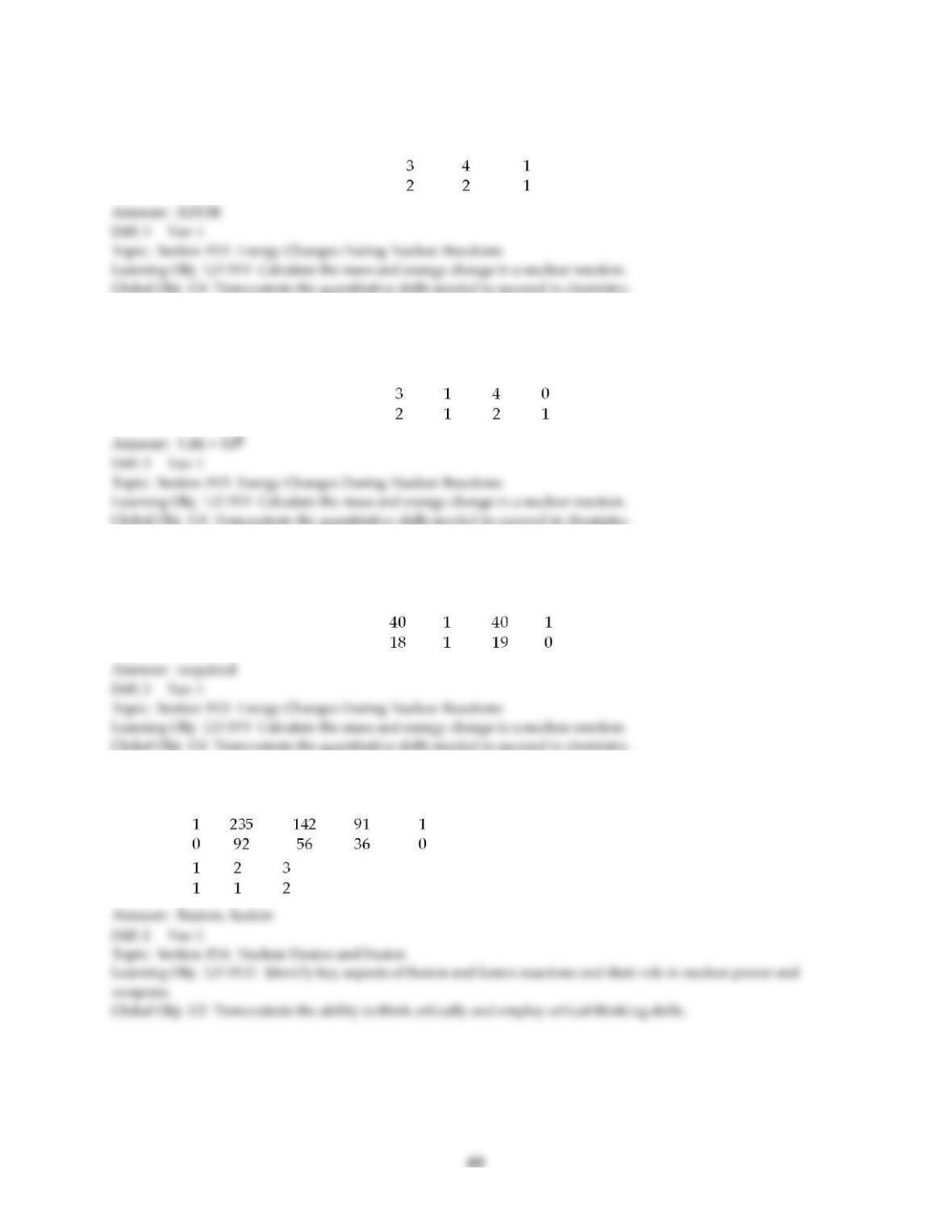
15) The mass change for the reaction shown below is ________ amu. The atomic masses are 3He (3.0160),
4He (4.0026), 1H (1.0078).
2 He → He + 2 H
16) The reaction below releases ________ kJ/mol. The atomic masses are 3He (3.0160), 1H (1.0078), 4He
(4.0026), 0e (0.0005486).
He + H → He + e
17) Energy is ________ (released, required) in the transmutation reaction shown below. The atomic
masses are 40Ar (39.9624), 1H (1.0078), 40K (39.9640), 1n (1.0087).
Ar + H → Kr + n
18) The two reactions shown below are classified as (1) nuclear ________ and (2) nuclear ________.
(1) n + U → Ba + Kr + 3 n
(2) H + H → He
50
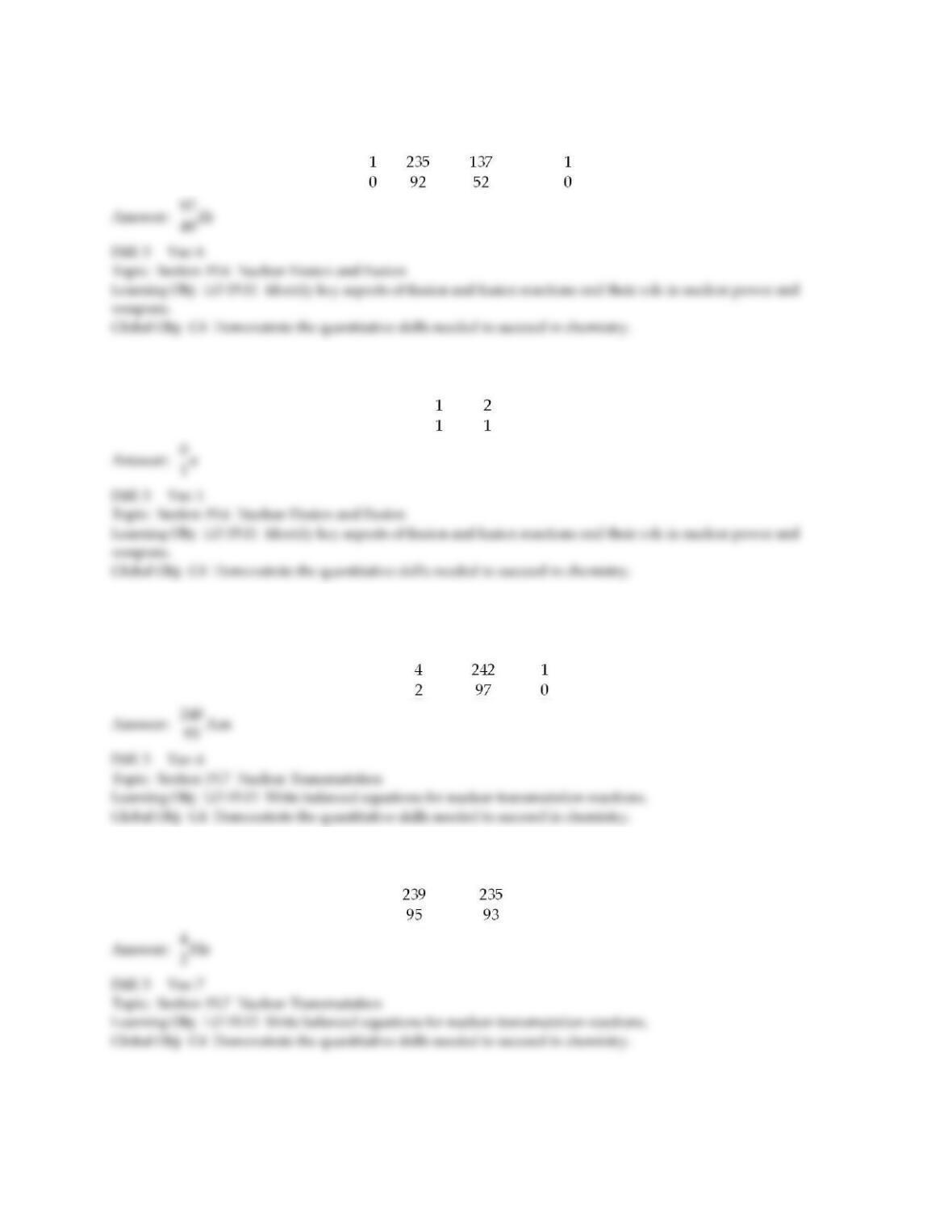
19) What is needed to balance the nuclear fission reaction below?
n + U → Te + ? + 2 n
20) What is needed to balance the nuclear fusion reaction below?
2 H → H + ?
21) In the transmutation reaction that results in the formation of berkelium-243, shown below, the
nucleus that is bombarded by alpha particles is ________.
? + He → Bk + 2 n
22) What is needed to balance the nuclear transmutation reaction below?
Am → Np + ?
23) Units used for measuring radiation include the becquerel, the curie, the gray, and the sievert, which
have the abbreviations ________, ________, ________, and ________, respectively.
24) Among the types of radiation, α, β, γ, and X, the one that requires the least amount of protective
clothing is ________ radiation.
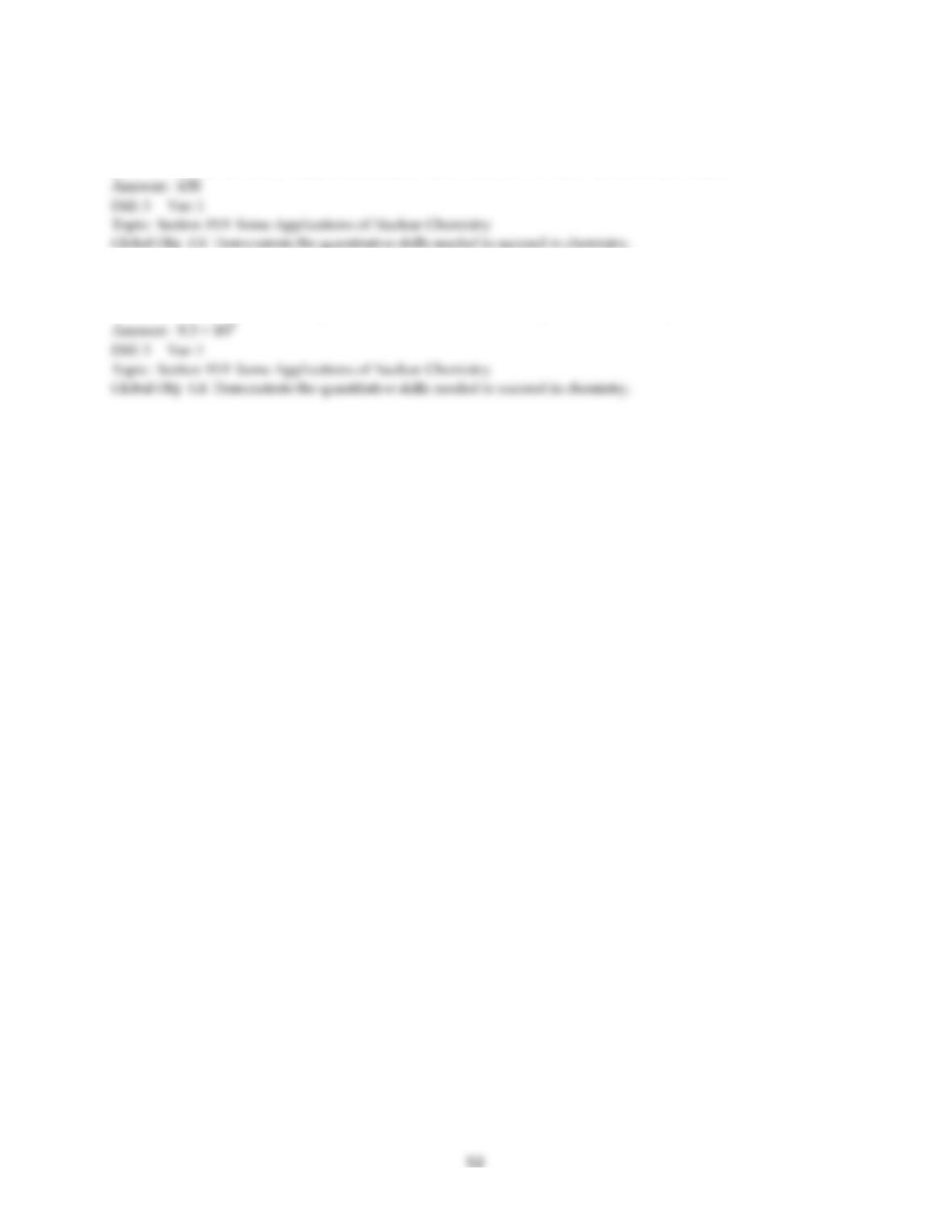
25) Radiocarbon dating involves the unbalanced equation shown below. Needed to balance this equation
is ________. This is an example of ________ decay.
C → N + ?
26) Carbon-14 has a half-life of 5715 years. Currently living organisms decay at a rate of 15.3
disintegrations/ min per gram of carbon. If an archeological artifact has a carbon-14 decay rate of 12.0
disintegrations/ min per gram of carbon, the approximate age of the artifact is ________ years old.
27) Human bones found on the west coast of the United States were thought to be remains of a prospector
who lived in the 19th century. The bones were subjected to carbon-14 dating. Carbon-14 has a half-life of
5715 years. Living organisms decay at a rate of 15.30 disintegrations per minute per gram of carbon. The
bones had a carbon-14 decay rate of 4.660 disintegrations per minute per gram of carbon. To one
significant figure the age of the bones is ________ years old, so the person ________ (did, did not) live in
the 19th century.
28) An average person receives 40 mrem of radiation from medical procedures annually. If a dose as low
as 25 rem can lead to a decrease in white blood cell count, what is the maximum number of medical
procedures that involve radiation allowable before white blood cell count decrease occurs?
29) 201Tl is used in myocardial perfusion imaging. It undergoes beta decay with a half-life of 73 hours
generating 80 keV X-rays. A typical dose is 2.5 mCi which is equal to ________ Bq.