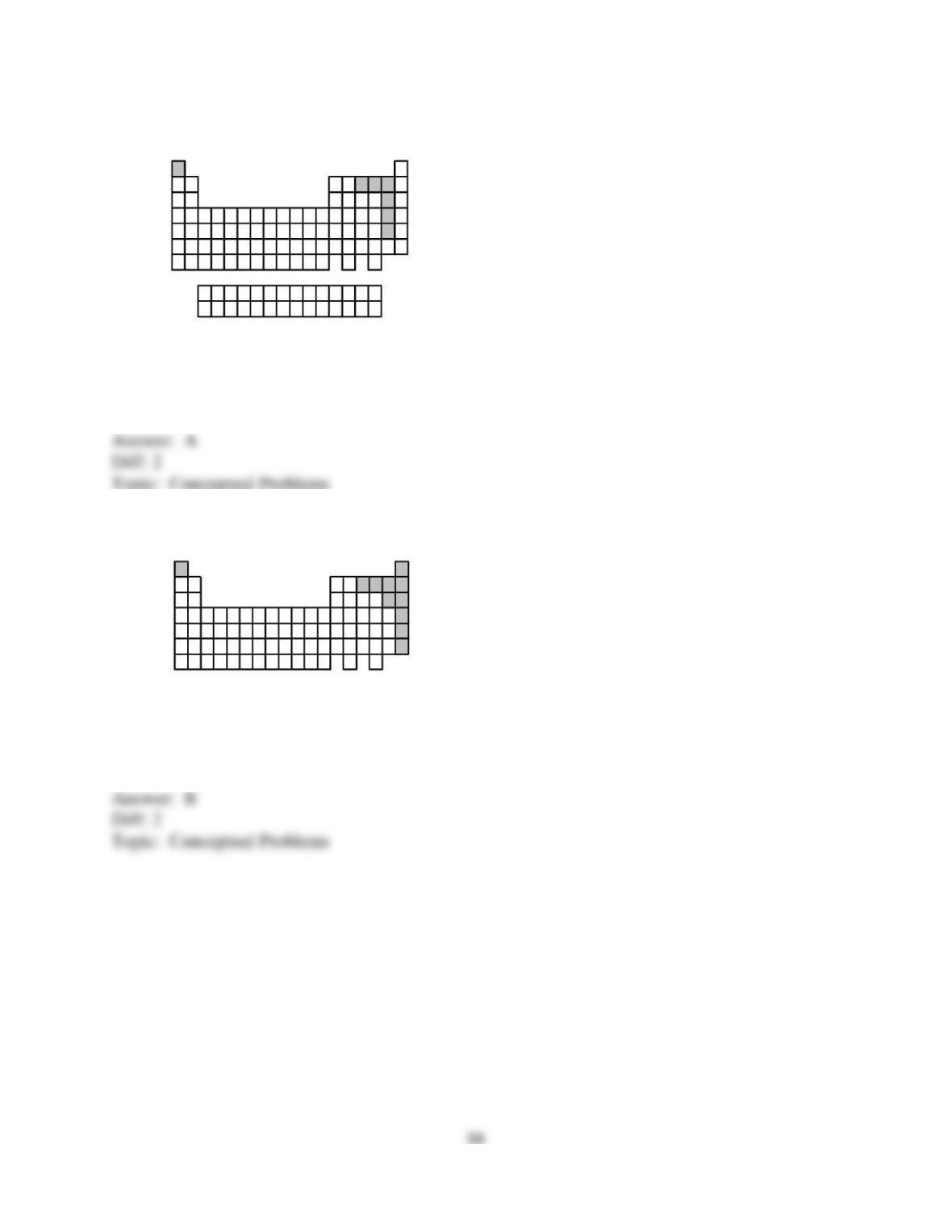
133) At 25°C the elements indicated by the shaded area in the following periodic table are all
A) diatomic molecules.
B) gases.
C) liquids.
D) solids.
134) At 25°C the elements indicated by the shaded area in the following periodic table are all
A) diatomic molecules.
B) gases.
C) liquids.
D) solids.
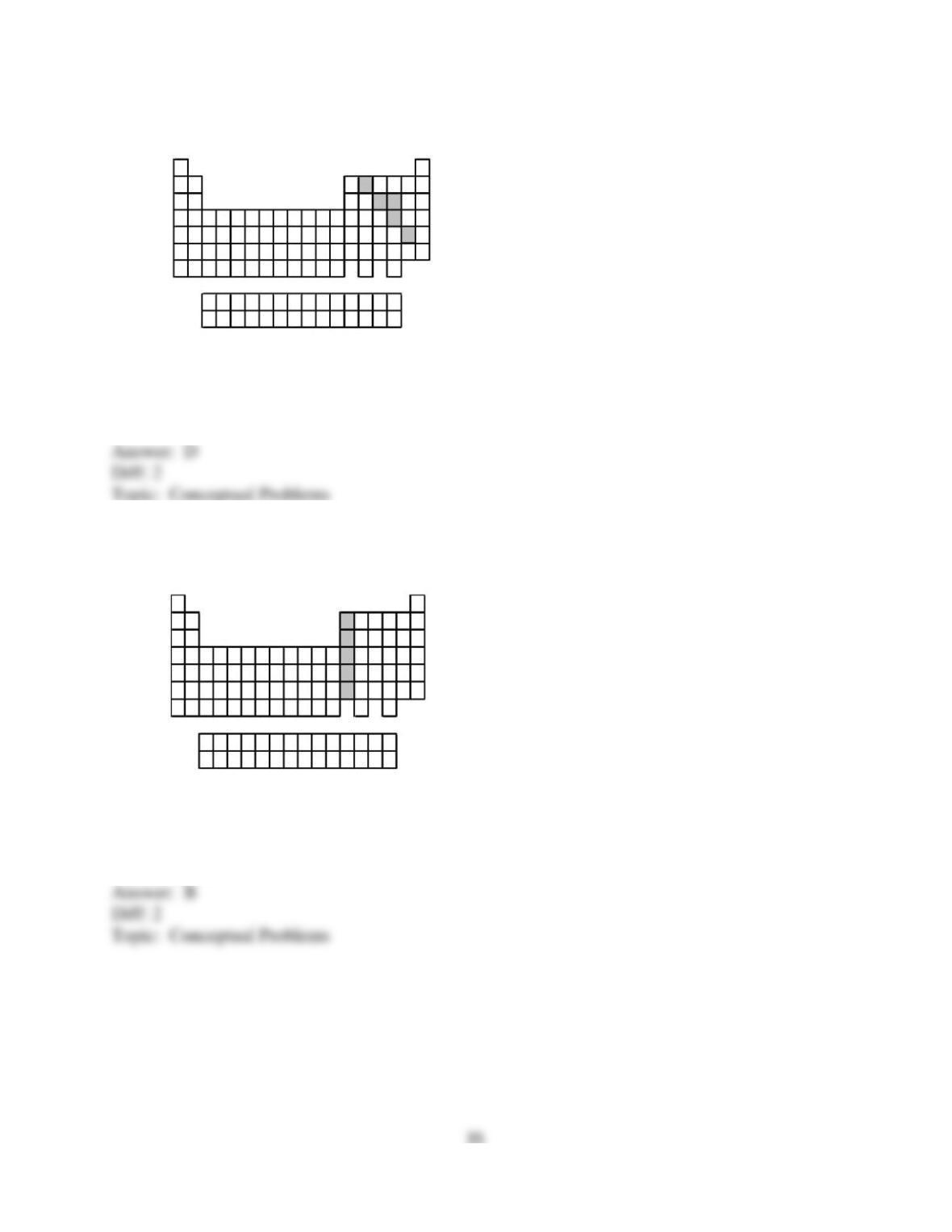
135) At 25°C the elements indicated by the shaded area in the following periodic table are all
A) diatomic molecules.
B) gases.
C) liquids.
D) nonmetals that are solids.
136) What is the name for the group of elements indicated by the shaded portion of the periodic
table?
A) alkaline earth metals
B) group 3A elements
C) halogens
D) noble gases
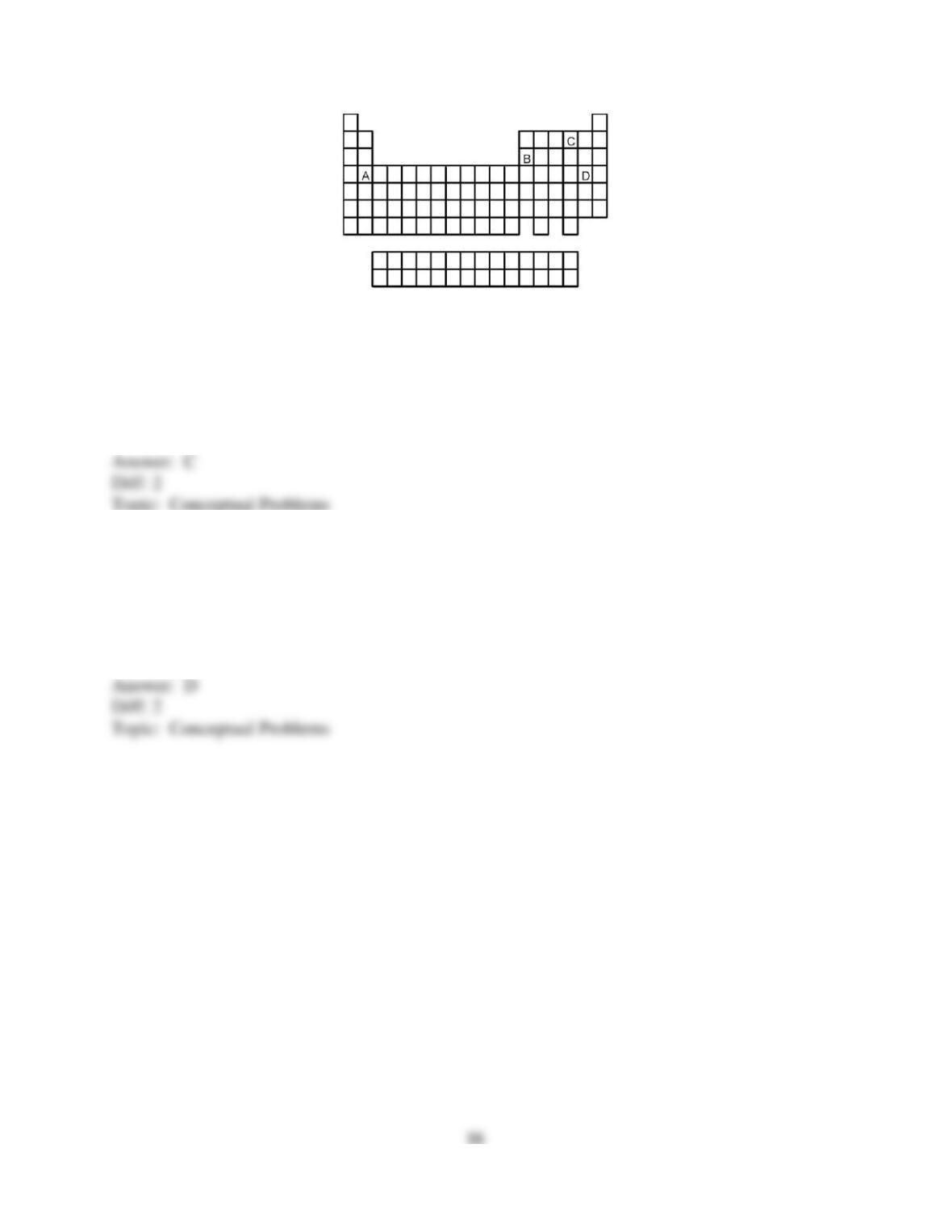
137) What is the likely formula for the binary compound formed from the elements represented
by letters B and D on the periodic table above?
A) BD
B) B3D
C) BD3
D) B2D3
138) What is the likely formula for the binary compound formed from the elements represented
by letters B and C on the periodic table above?
A) BC
B) B3C
C) BC3
D) B2C3
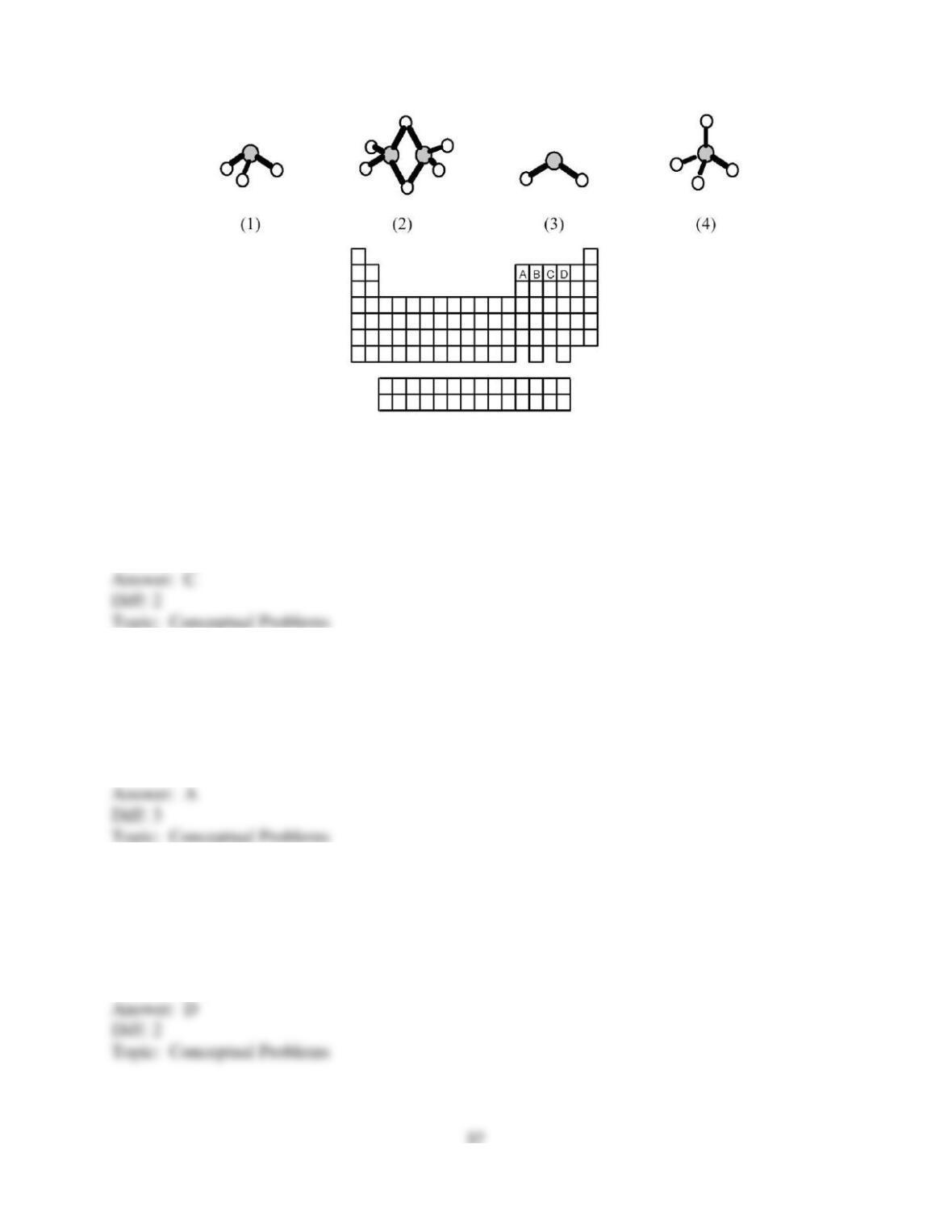
139) Which element indicated on the above periodic table forms a binary hydride with molecular
structure (1) shown above?
A) element A
B) element B
C) element C
D) element D
140) Which element indicated on the above periodic table forms a binary hydride with molecular
structure (2) shown above?
A) element A
B) element B
C) element C
D) element D
141) Which element indicated on the above periodic tableforms a binary hydride with molecular
structure (3) shown above?
A) element A
B) element B
C) element C
D) element D
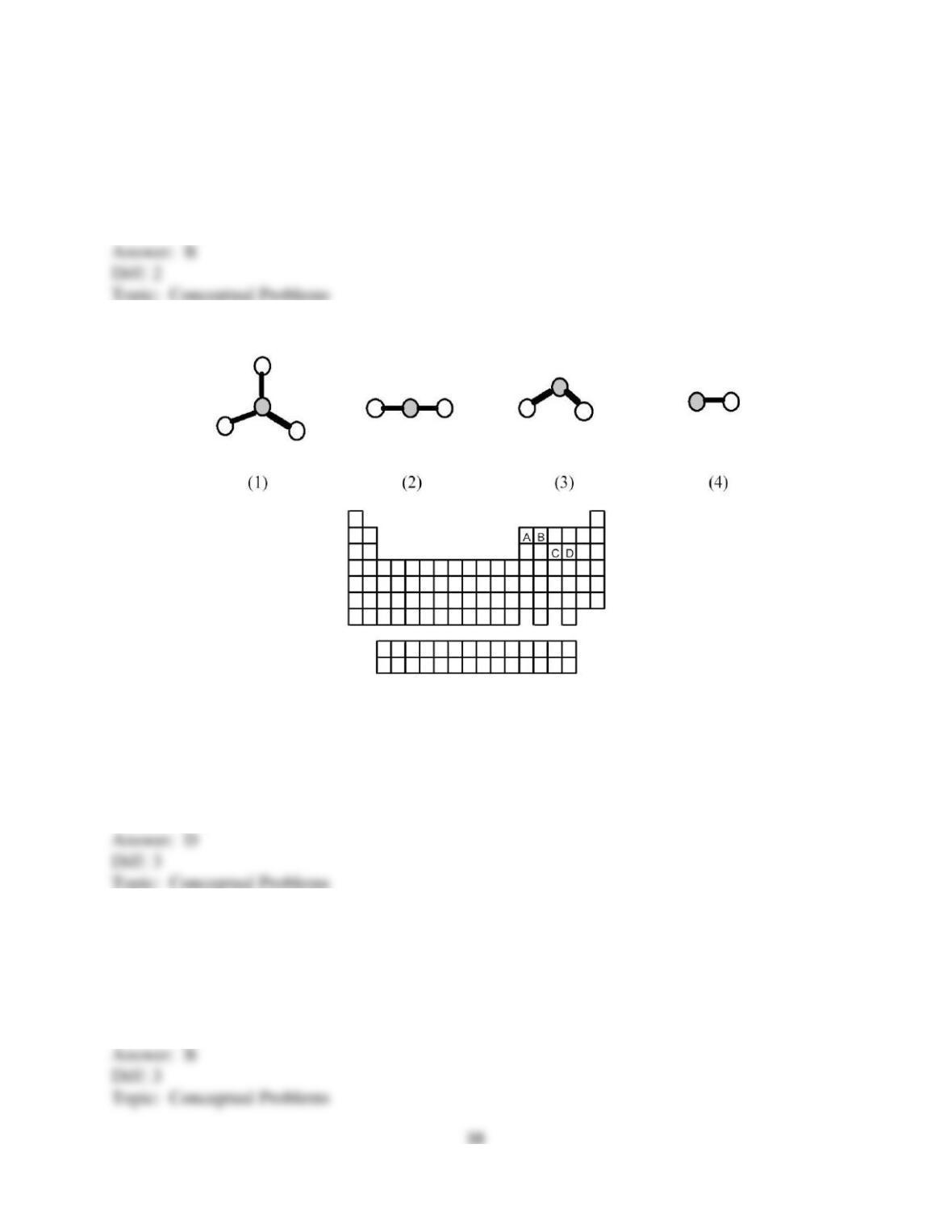
142) Which element indicated on the above periodic table forms a binary hydride with molecular
structure (4) shown above?
A) element A
B) element B
C) element C
D) element D
143) Which element indicated on the above periodic table forms a binary oxide with molecular
structure (1) shown above?
A) element A
B) element B
C) element C
D) element D
144) Which element indicated on the above periodic table forms a binary oxide with molecular
structure (2) shown above?
A) element A
B) element B
C) element C
D) element D
145) Which element indicated on the above periodic table forms a binary oxide with molecular
structure (3) shown above?
A) element A
B) element B
C) element C
D) element D
146) Which element indicated on the above periodic table forms a binary oxide with molecular
structure (4) shown above?
A) element A
B) element B
C) element C
D) element D
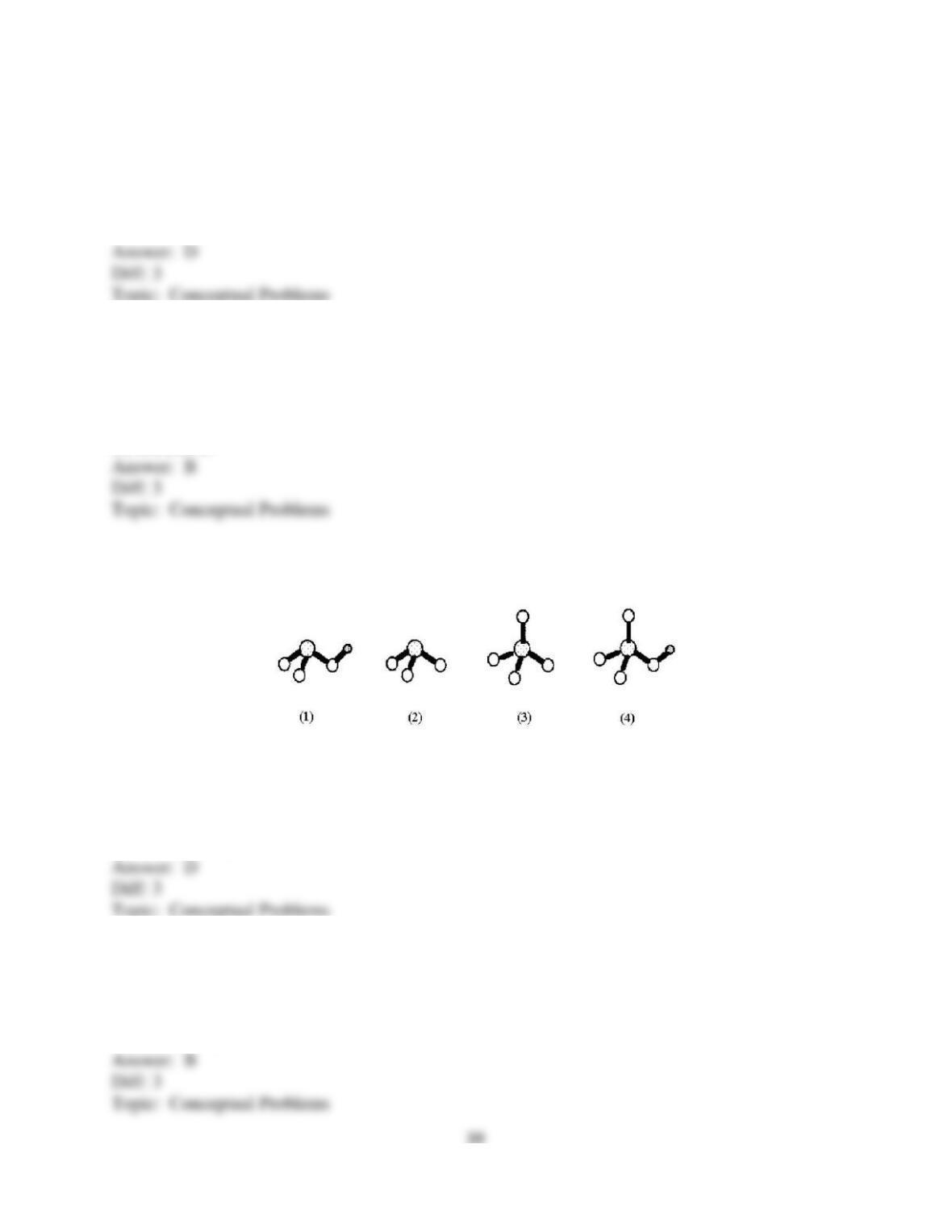
Shown below are four oxoanions of sulfur. Small gray spheres represent hydrogen, unshaded
spheres represent oxygen, and dotted spheres represent sulfur.
147) Which oxoanion is the strongest acid?
A) oxoanion (1)
B) oxoanion (2)
C) oxoanion (3)
D) oxoanion (4)
148) Which oxoanion is the strongest base?
A) oxoanion (1)
B) oxoanion (2)
C) oxoanion (3)
D) oxoanion (4)
149) Which oxoanion is the weakest base?
A) oxoanion (1)
B) oxoanion (2)
C) oxoanion (3)
D) oxoanion (4)
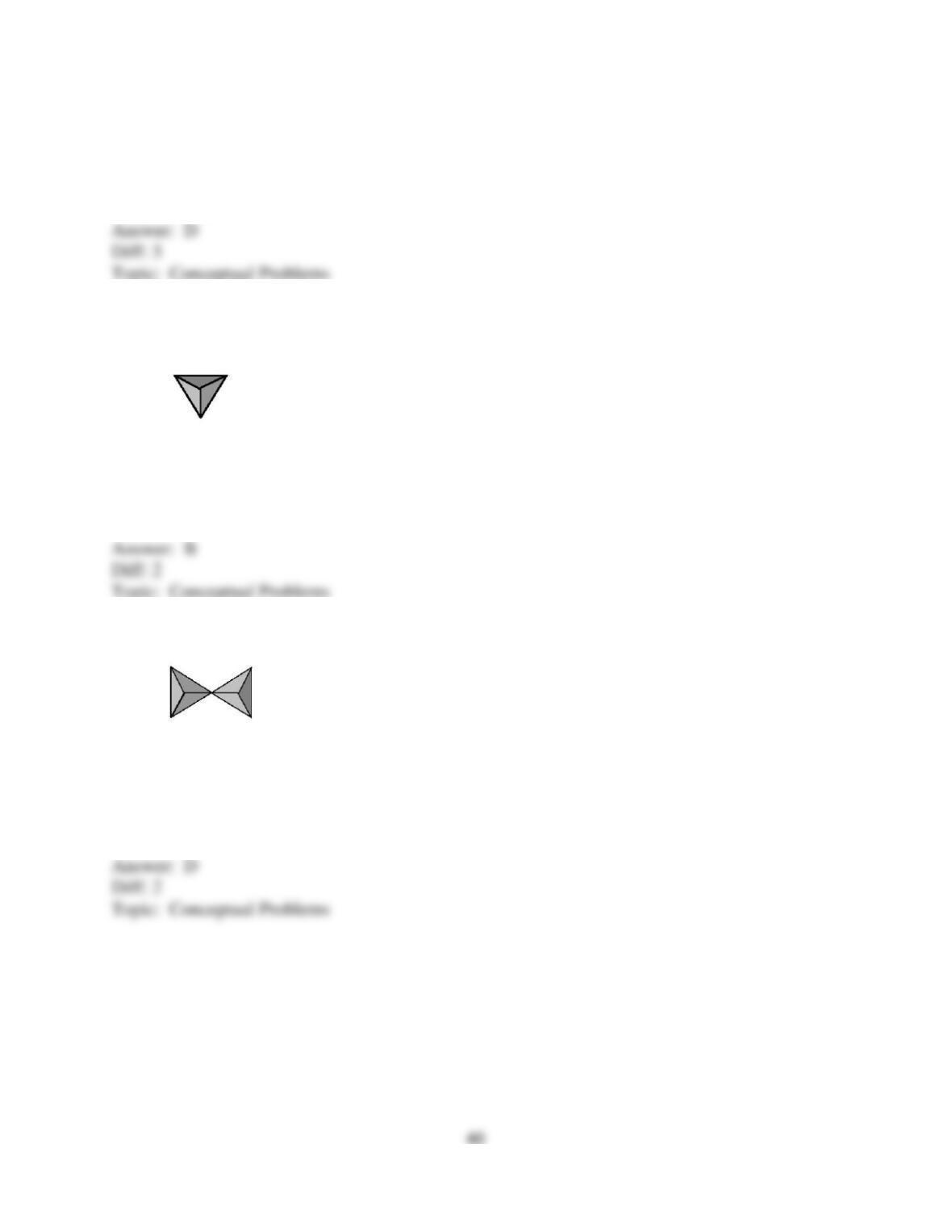
150) The silicate ion shown in the picture below combines with zirconium to form the mineral
zircon. What is the formula and charge of the silicate ion?
A) SiO32-
B) SiO44-
C) Si4O104-
D) Si4O116-
151) What is the formula and charge of the silicate anion represented by the picture below?
A) SiO32-
B) SiO44-
C) Si2O63-
D) Si2O76-
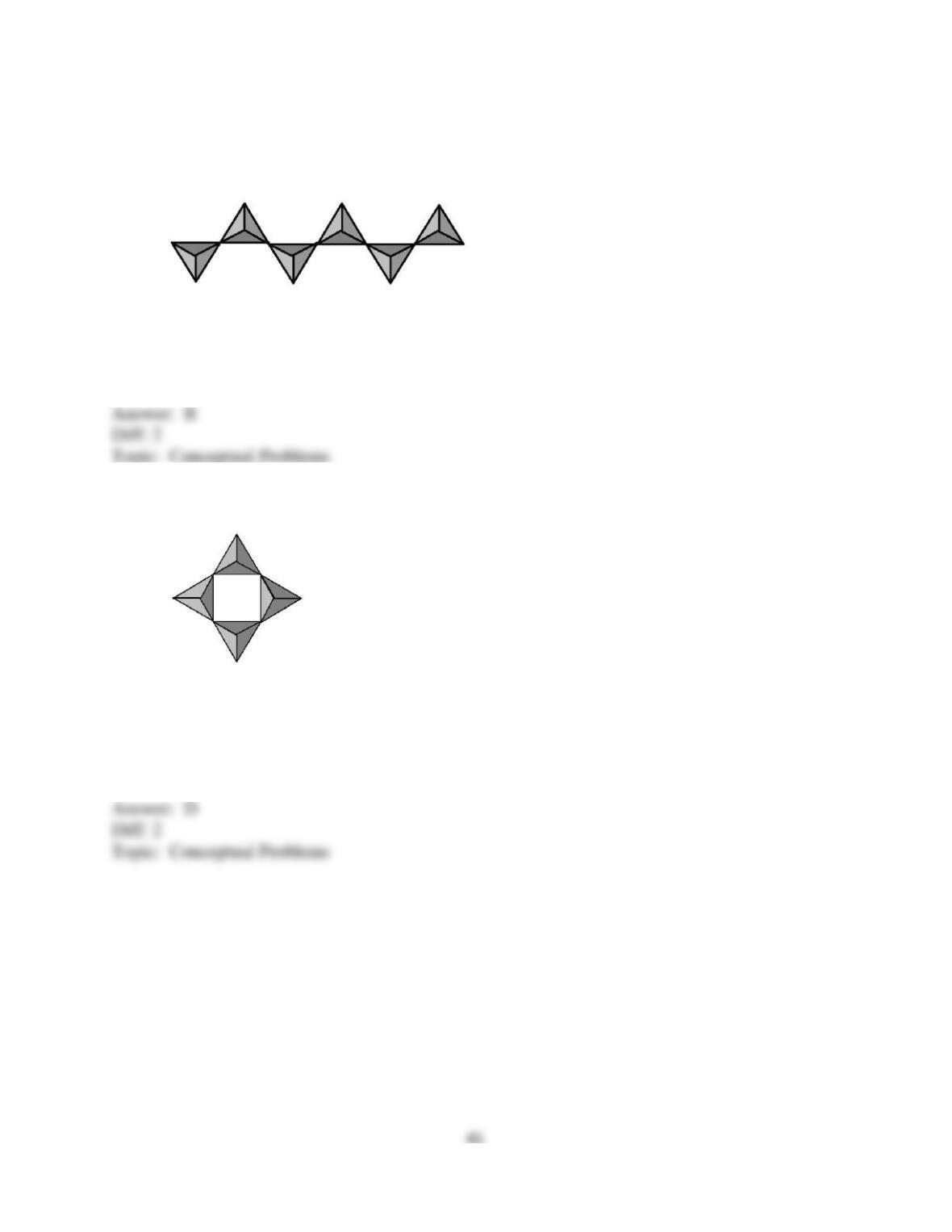
152) The infinitely extended silicate ion shown in the picture below combines with calcium and
magnesium to form the mineral diopside. What is the formula and charge of the repeating unit of
the silicate ion?
A) SiO32-
B) Si2O64-
C) Si3O108-
D) Si6O2424-
153) What is the formula and charge of the silicate anion represented by the picture below?
A) SiO22-
B) SiO32-
C) SiO44-
D) Si4O128-
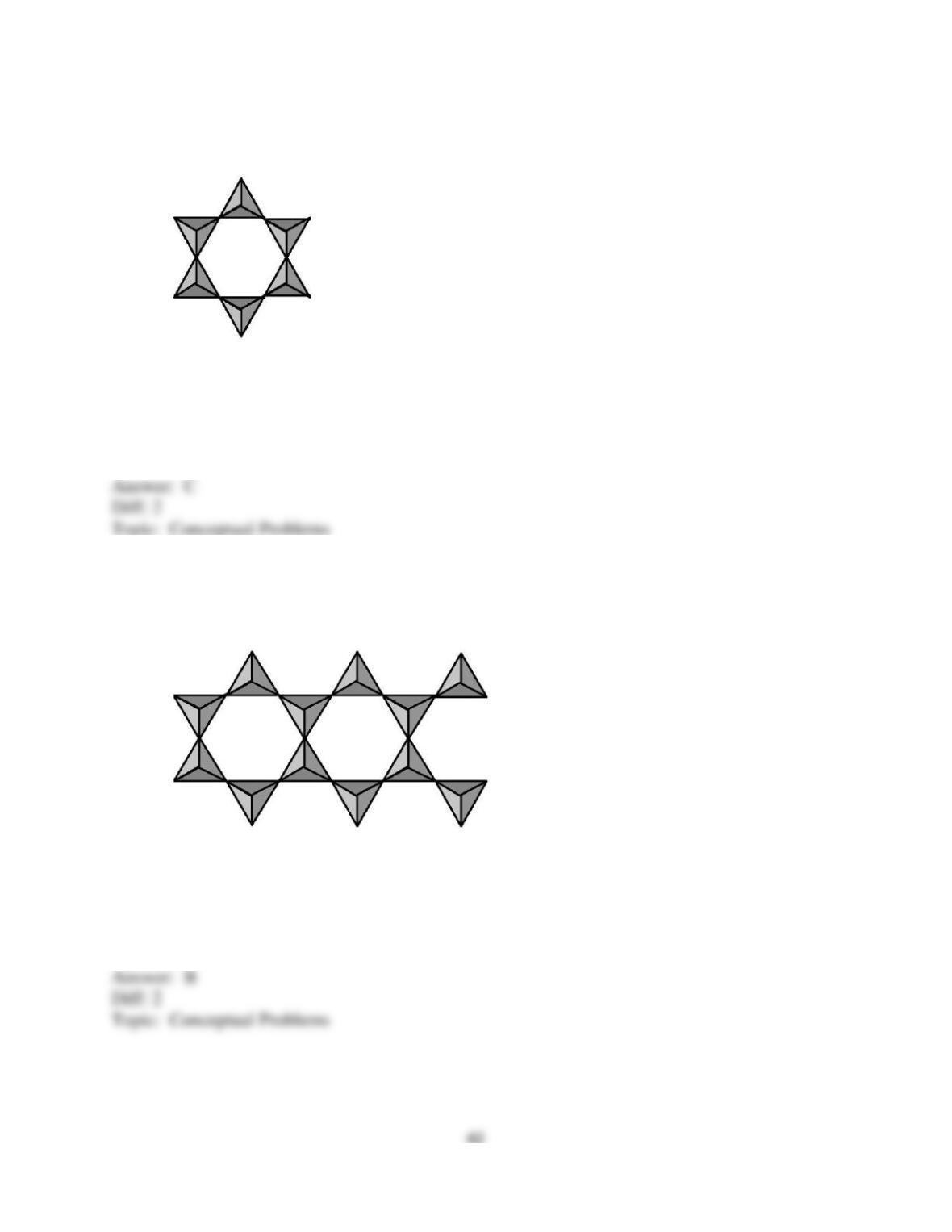
154) The silicate ion shown in the picture below combines with beryllium and aluminum to form
the mineral beryl. What is the formula and charge of the silicate ion?
A) Si6O612+
B) Si6O122-
C) Si6O1812-
D) Si6O2424-
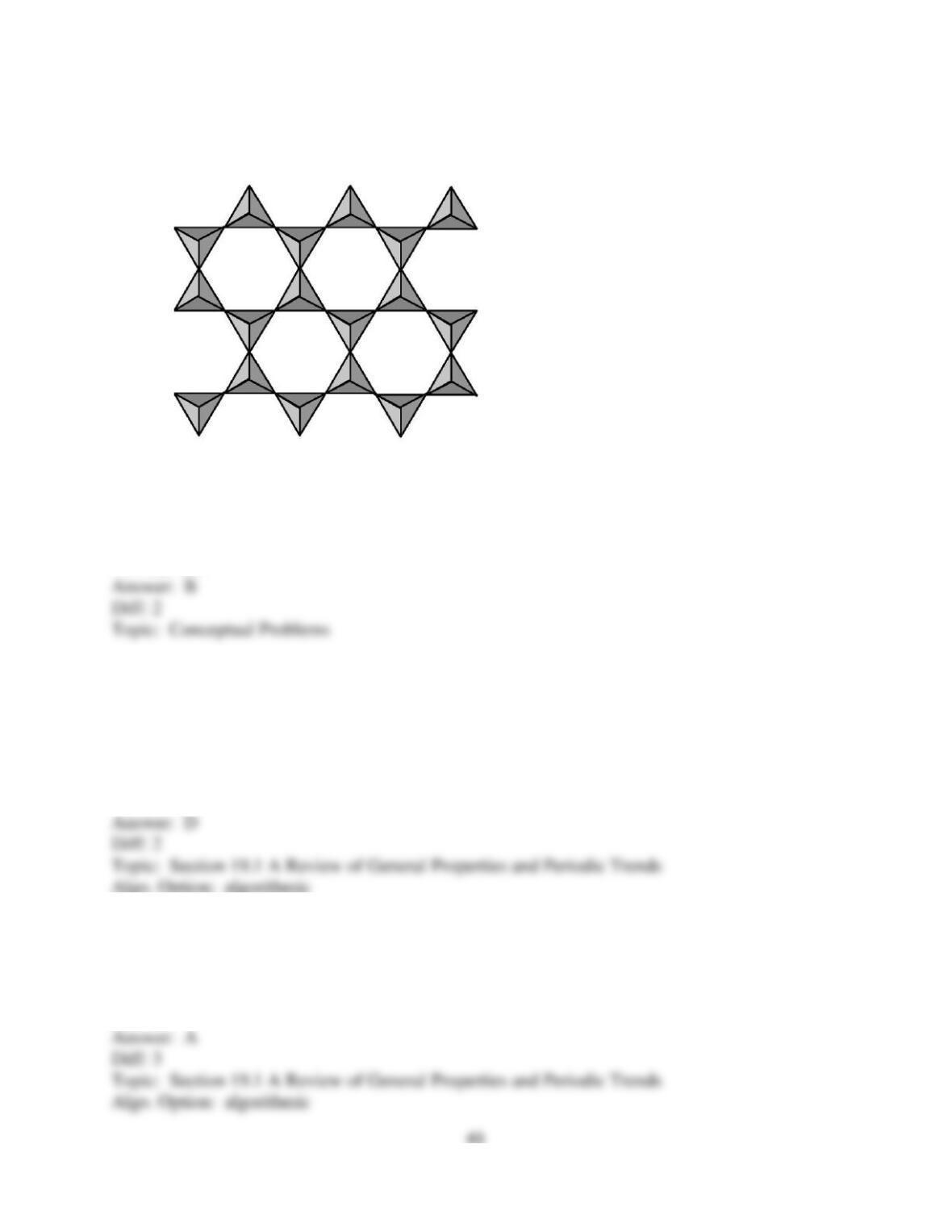
155) The double-stranded silicate ion shown in the picture below combines with calcium and
magnesium to form the mineral tremolite, which is a form of asbestos. What is the formula and
charge of the repeating unit of the silicate ion?
A) SiO32-
B) Si4O116-
C) Si6O1710-
D) Si12O3012-
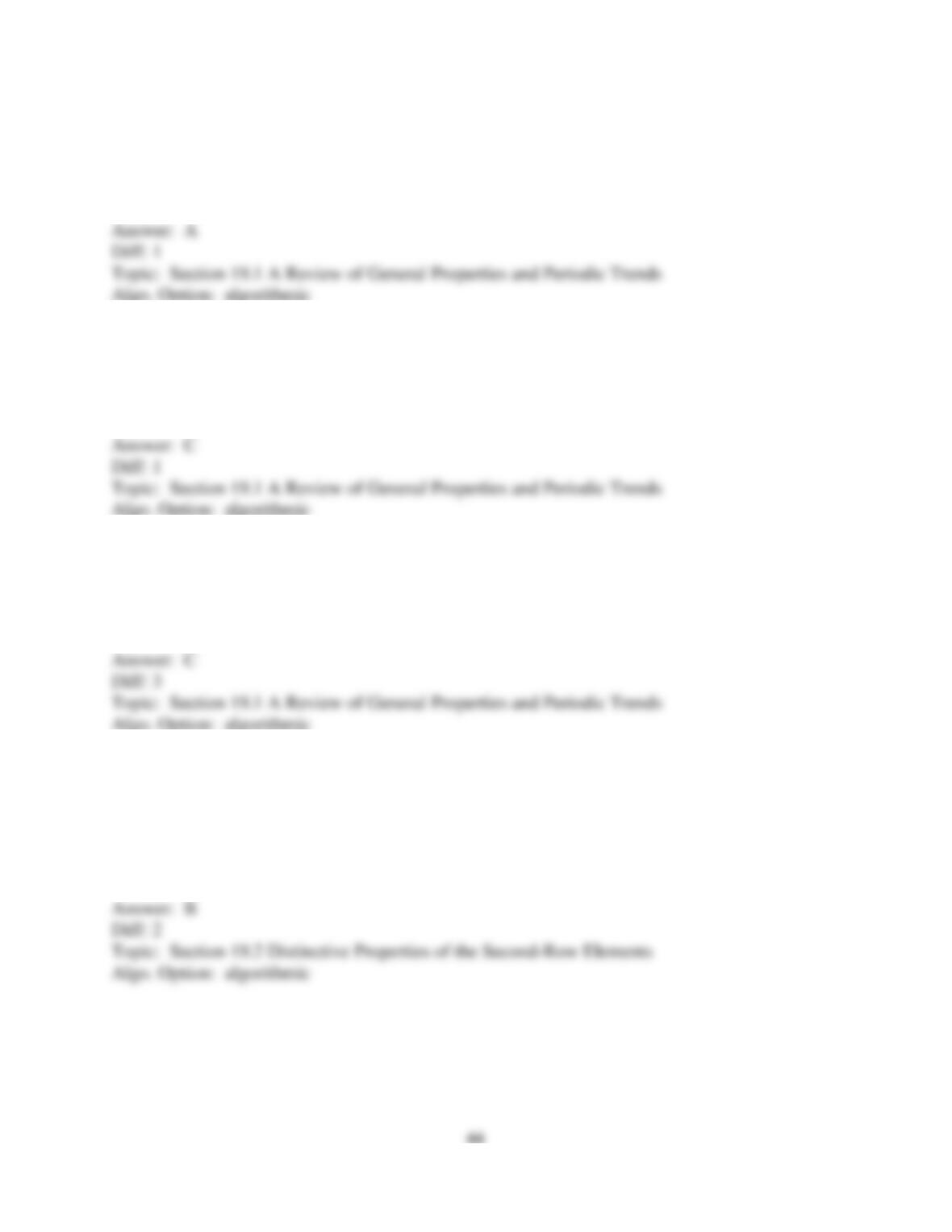
156) The two-dimensional layer silicate ion shown in the picture below combines with
magnesium and hydroxide ions to form talc. What is the formula and charge of the repeating unit
of the silicate ion?
A) SiO32-
B) Si4O104-
C) Si6O156-
D) Si18O5028-
19.2 Algorithmic Questions
1) What is the most metallic element of group 3A?
A) Al
B) Ga
C) In
D) Tl
2) Which of the following elements forms the most ionic binary hydride?
A) K
B) Mg
C) S
D) Cl
3) Which of the following elements exhibits the most metallic character?
A) In
B) Sn
C) Sb
D) Te
4) Which one of the following is not a main group element?
A) Rb
B) Sr
C) U
D) Pb
5) Which one of the following elements forms the most acidic binary oxide?
A) Cs
B) Sn
C) Se
D) Te
6) Which one of the following compounds that contains a Group 6A element is least likely to
exist?
A) OF2
B) OF6
C) SF4
D) SF6
7) Which one of the following compounds exhibits the strongest hydrogen bonding between its
molecules?
A) CH3OH
B) CH3F
C) CH3Cl
D) CH3Br
8) Which one of the following elements can form more than four chemical bonds with other
elements?
A) C
B) N
C) O
D) As
19.3 Short Answer Questions
1) Main-group elements are those elements in groups ________ through ________ of the
periodic table.
2) The number of metallic elements in period 3 of the periodic table is ________.
3) Elements in period 2 of the periodic table differ markedly from the heavier elements in the
same group due to their especially small ________ and high ________.
4) Elements in group 3A of the periodic table have the valence electron configuration ________.
5) The B–H–B bond in B2H6 is a three-________, two-________ bond.
6) The number of nonmetals in group 4A of the periodic table is ________.
7) The formula of aluminum carbide is ________.
8) The charge , n, on the cyclic anion Si6O18n that is found in the mineral beryl is ________.
9) Aqua regia may be prepared by mixing ________ and ________.
10) The most acidic oxides of the group 5A elements are oxides of the element ________.
11) The oxidation numbers of nitrogen in NH4NO3 are ________ and ________.