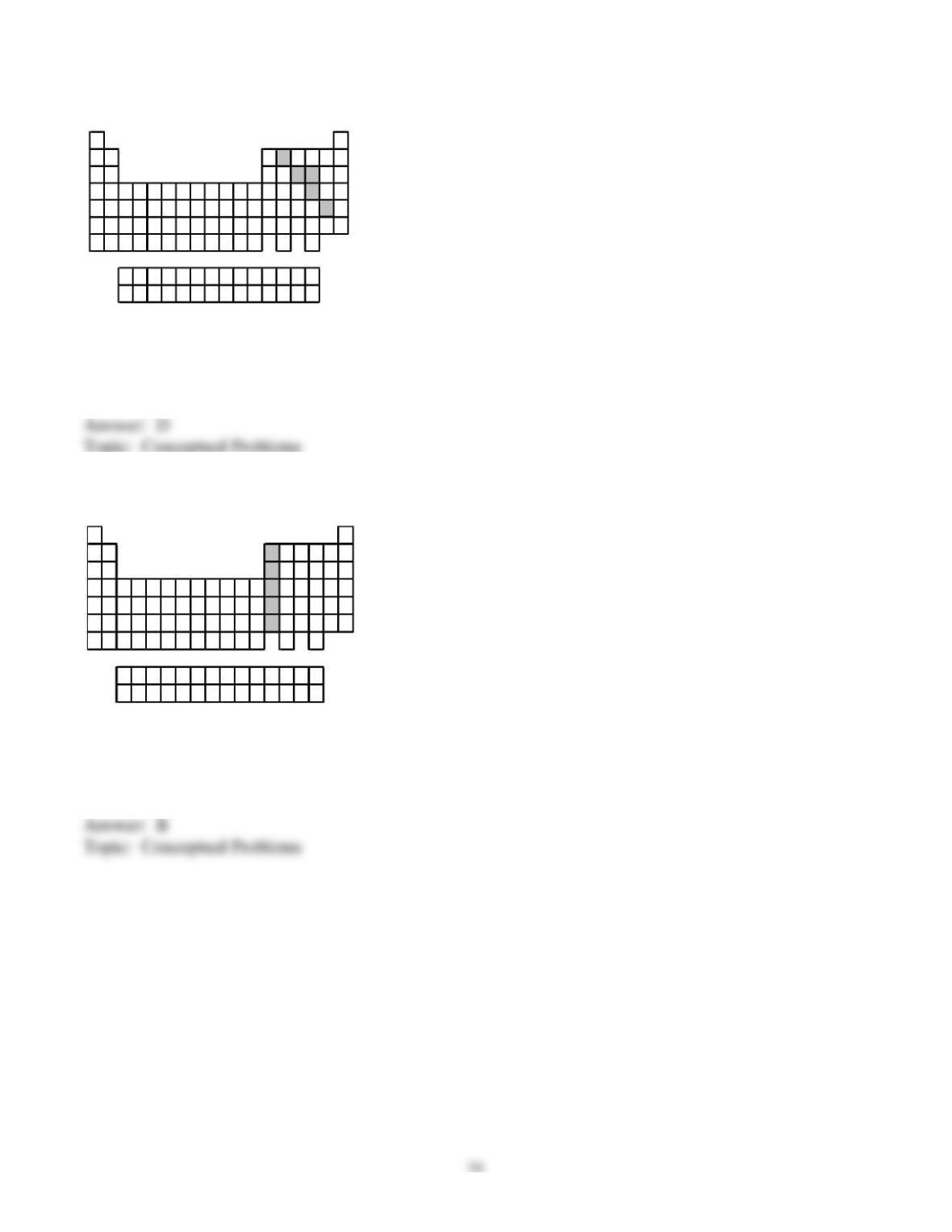
148) At 25°C the elements indicated by the shaded area in the following periodic table are all
A) diatomic molecules.
B) gases.
C) liquids.
D) nonmetals that are solids.
149) What is the name for the group of elements indicated by the shaded portion of the periodic table?
A) alkaline earth metals
B) group 3A elements
C) halogens
D) noble gases
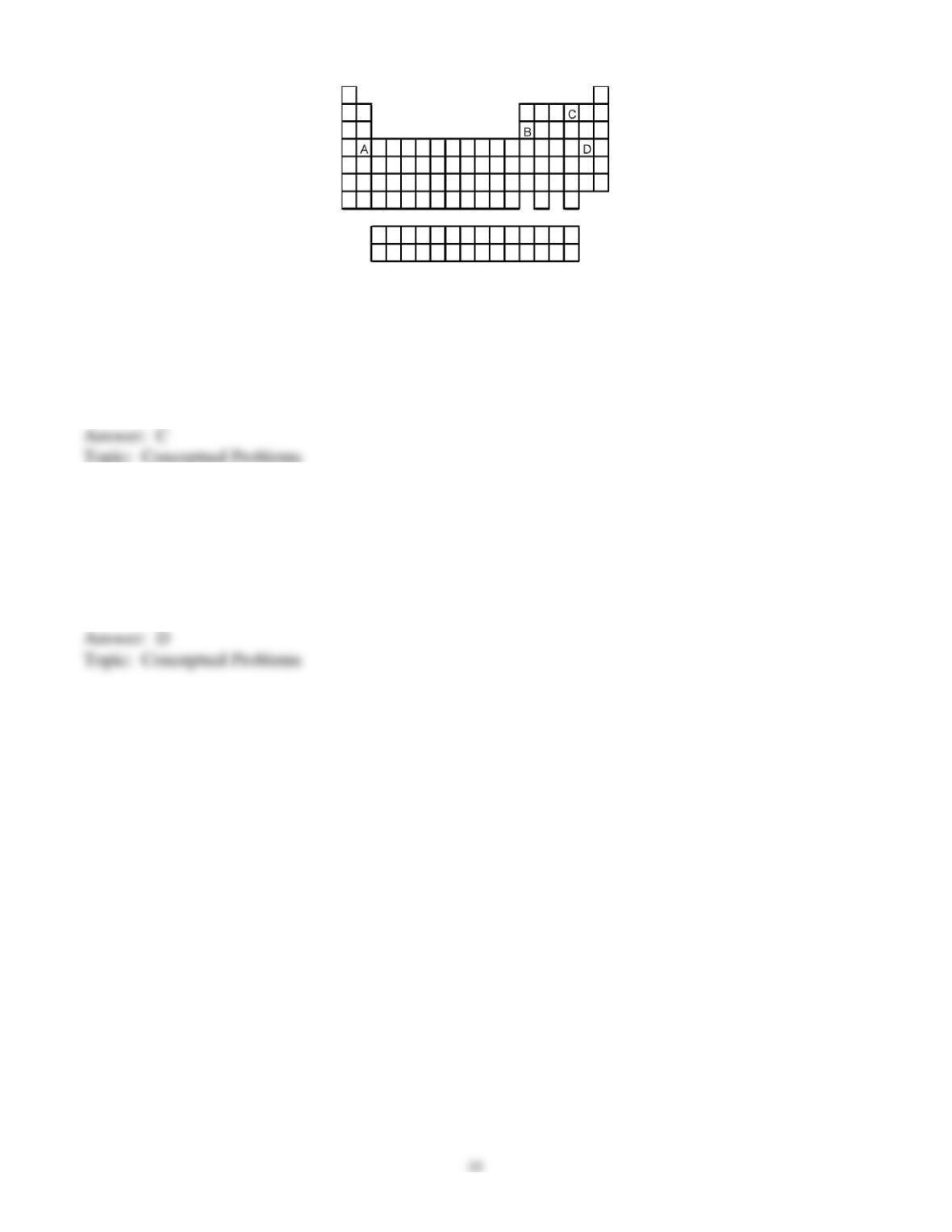
150) What is the likely formula for the binary compound formed from the elements represented by
letters B and D on the periodic table above?
A) BD
B) B3D
C) BD3
D) B2D3
151) What is the likely formula for the binary compound formed from the elements represented by
letters B and C on the periodic table above?
A) BC
B) B3C
C) BC3
D) B2C3
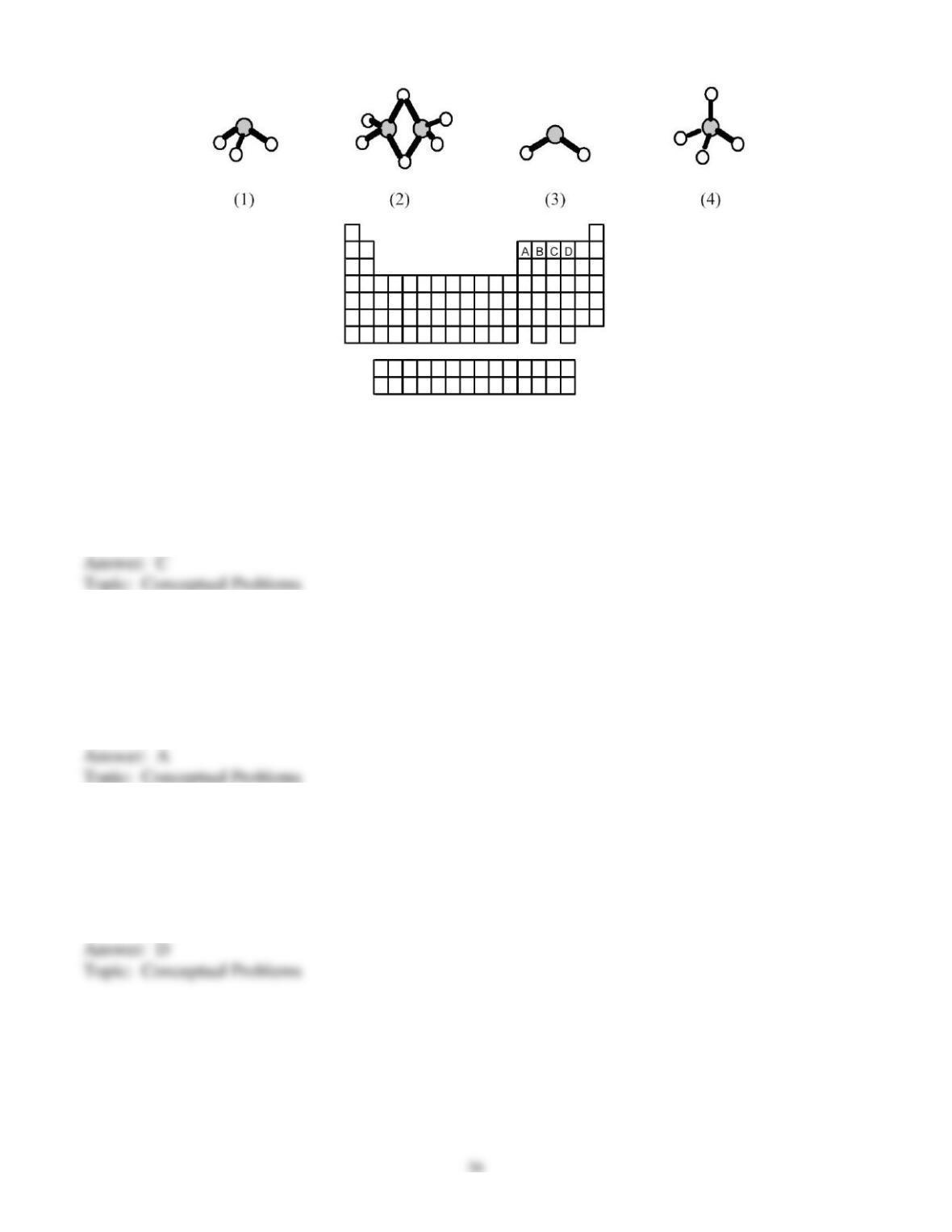
152) Which element indicated on the above periodic table forms a binary hydride with molecular
structure (1) shown above?
A) element A
B) element B
C) element C
D) element D
153) Which element indicated on the above periodic table forms a binary hydride with molecular
structure (2) shown above?
A) element A
B) element B
C) element C
D) element D
154) Which element indicated on the above periodic tableforms a binary hydride with molecular
structure (3) shown above?
A) element A
B) element B
C) element C
D) element D
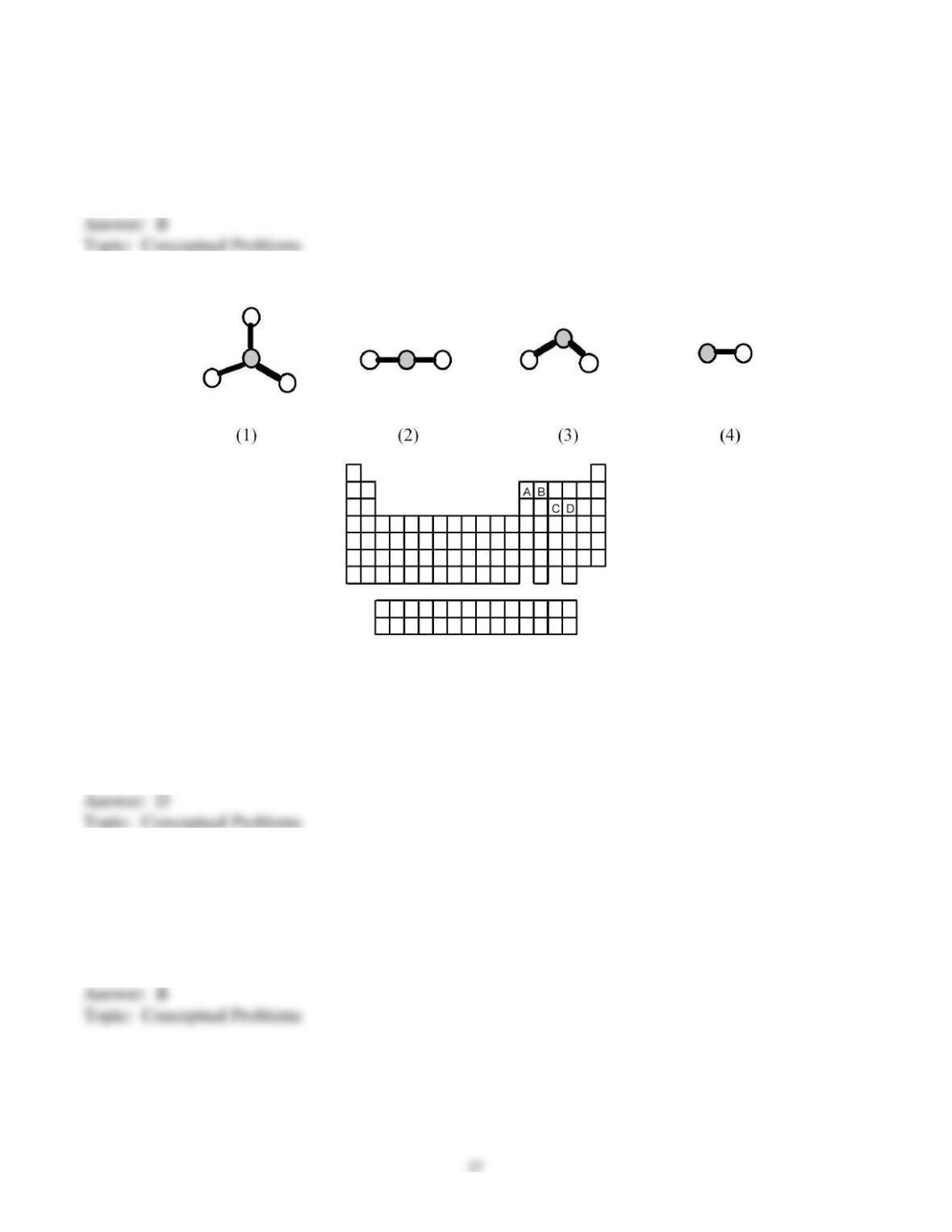
155) Which element indicated on the above periodic table forms a binary hydride with molecular
structure (4) shown above?
A) element A
B) element B
C) element C
D) element D
156) Which element indicated on the above periodic table forms a binary oxide with molecular structure
(1) shown above?
A) element A
B) element B
C) element C
D) element D
157) Which element indicated on the above periodic table forms a binary oxide with molecular structure
(2) shown above?
A) element A
B) element B
C) element C
D) element D
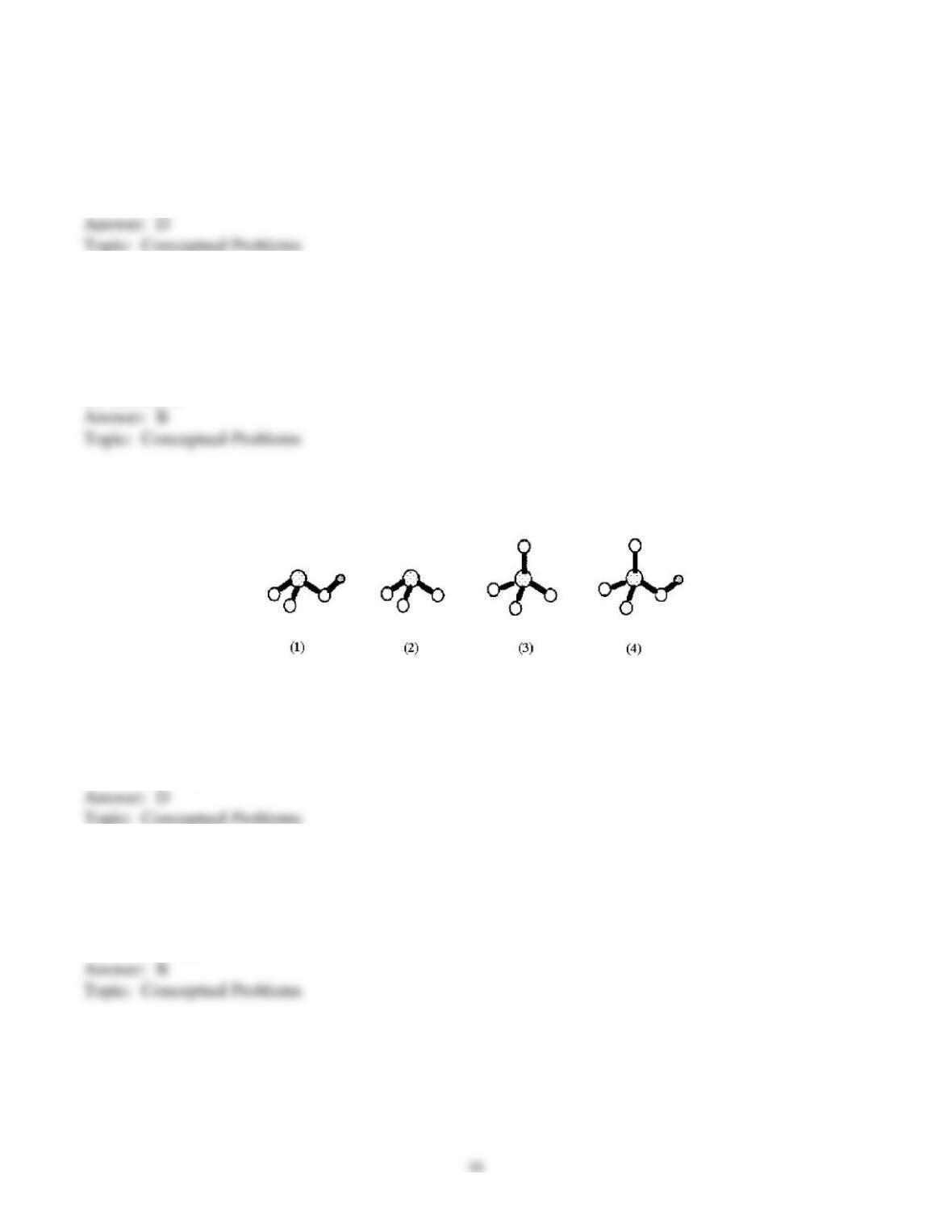
158) Which element indicated on the above periodic table forms a binary oxide with molecular structure
(3) shown above?
A) element A
B) element B
C) element C
D) element D
159) Which element indicated on the above periodic table forms a binary oxide with molecular structure
(4) shown above?
A) element A
B) element B
C) element C
D) element D
Shown below are four oxoanions of sulfur. Small gray spheres represent hydrogen, unshaded spheres
represent oxygen, and dotted spheres represent sulfur.
160) Which oxoanion is the strongest acid?
A) oxoanion (1)
B) oxoanion (2)
C) oxoanion (3)
D) oxoanion (4)
161) Which oxoanion is the strongest base?
A) oxoanion (1)
B) oxoanion (2)
C) oxoanion (3)
D) oxoanion (4)
162) Which oxoanion is the weakest base?
A) oxoanion (1)
B) oxoanion (2)
C) oxoanion (3)
D) oxoanion (4)
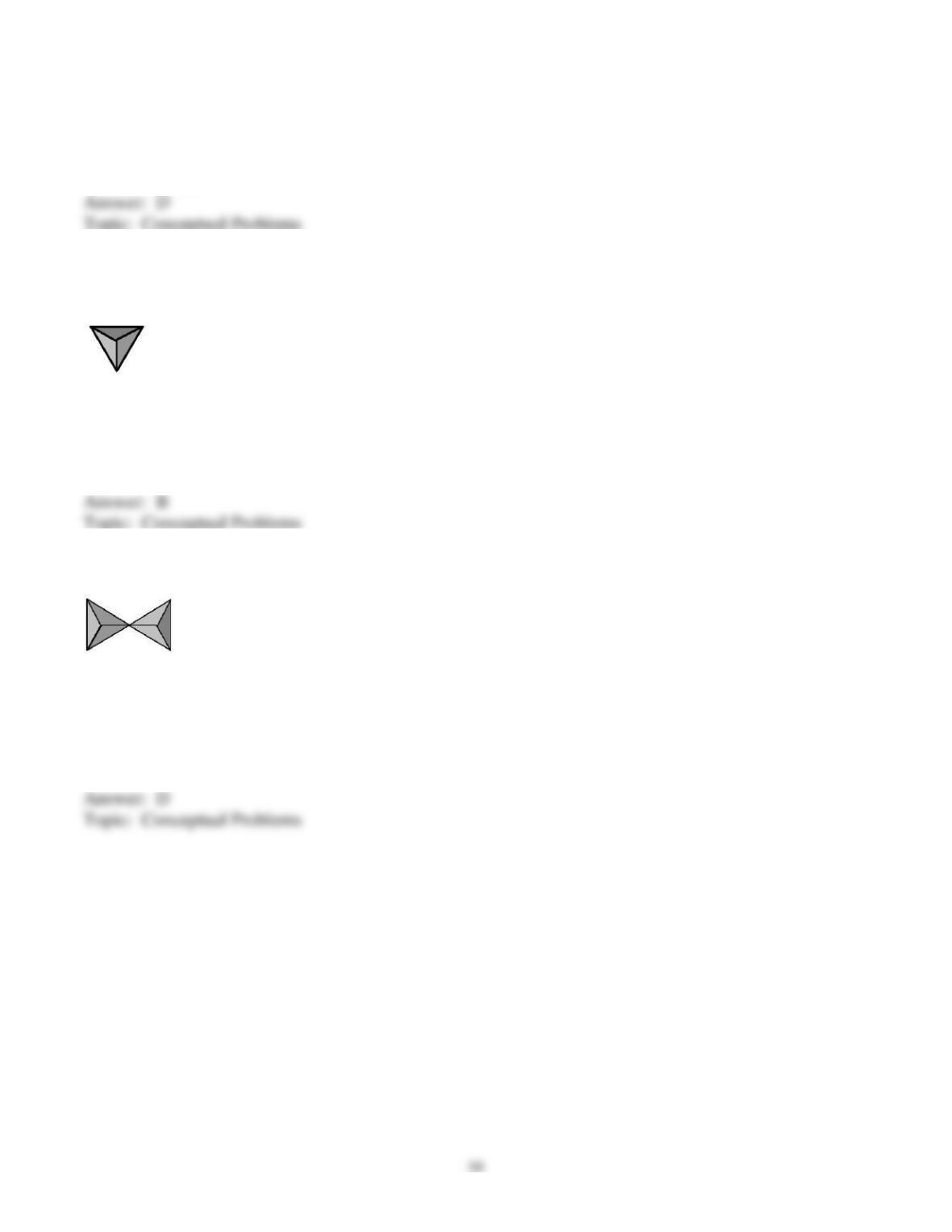
163) The silicate ion shown in the picture below combines with zirconium to form the mineral zircon.
What is the formula and charge of the silicate ion?
A) SiO32-
B) SiO44-
C) Si4O104-
D) Si4O116-
164) What is the formula and charge of the silicate anion represented by the picture below?
A) SiO32-
B) SiO44-
C) Si2O63-
D) Si2O76-
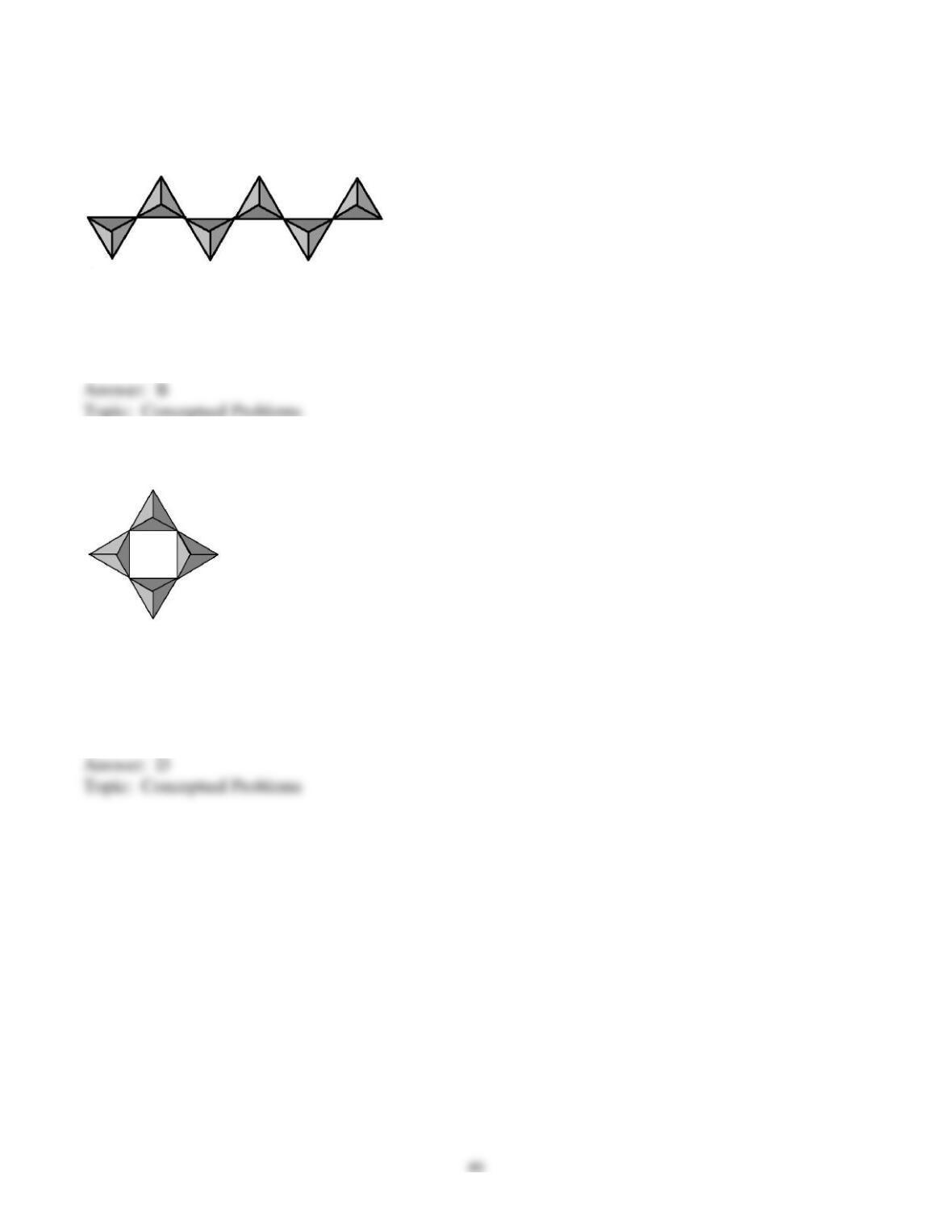
165) The infinitely extended silicate ion shown in the picture below combines with calcium and
magnesium to form the mineral diopside. What is the formula and charge of the repeating unit of the
silicate ion?
A) SiO32-
B) Si2O64-
C) Si3O108-
D) Si6O2424-
166) What is the formula and charge of the silicate anion represented by the picture below?
A) SiO22-
B) SiO32-
C) SiO44-
D) Si4O128-
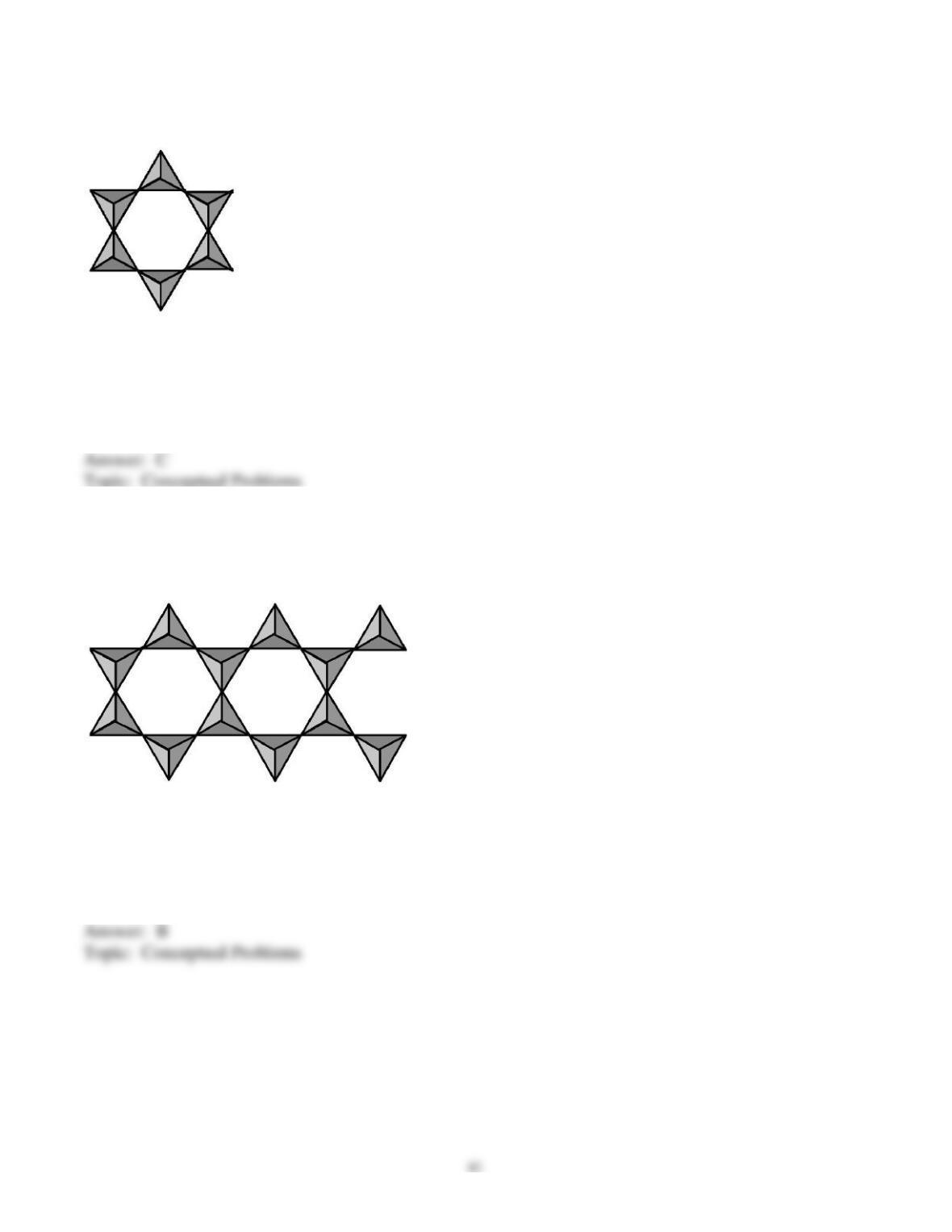
167) The silicate ion shown in the picture below combines with beryllium and aluminum to form the
mineral beryl. What is the formula and charge of the silicate ion?
A) Si6O612+
B) Si6O122-
C) Si6O1812-
D) Si6O2424-
168) The double-stranded silicate ion shown in the picture below combines with calcium and
magnesium to form the mineral tremolite, which is a form of asbestos. What is the formula and charge
of the repeating unit of the silicate ion?
A) SiO32-
B) Si4O116-
C) Si6O1710-
D) Si12O3012-
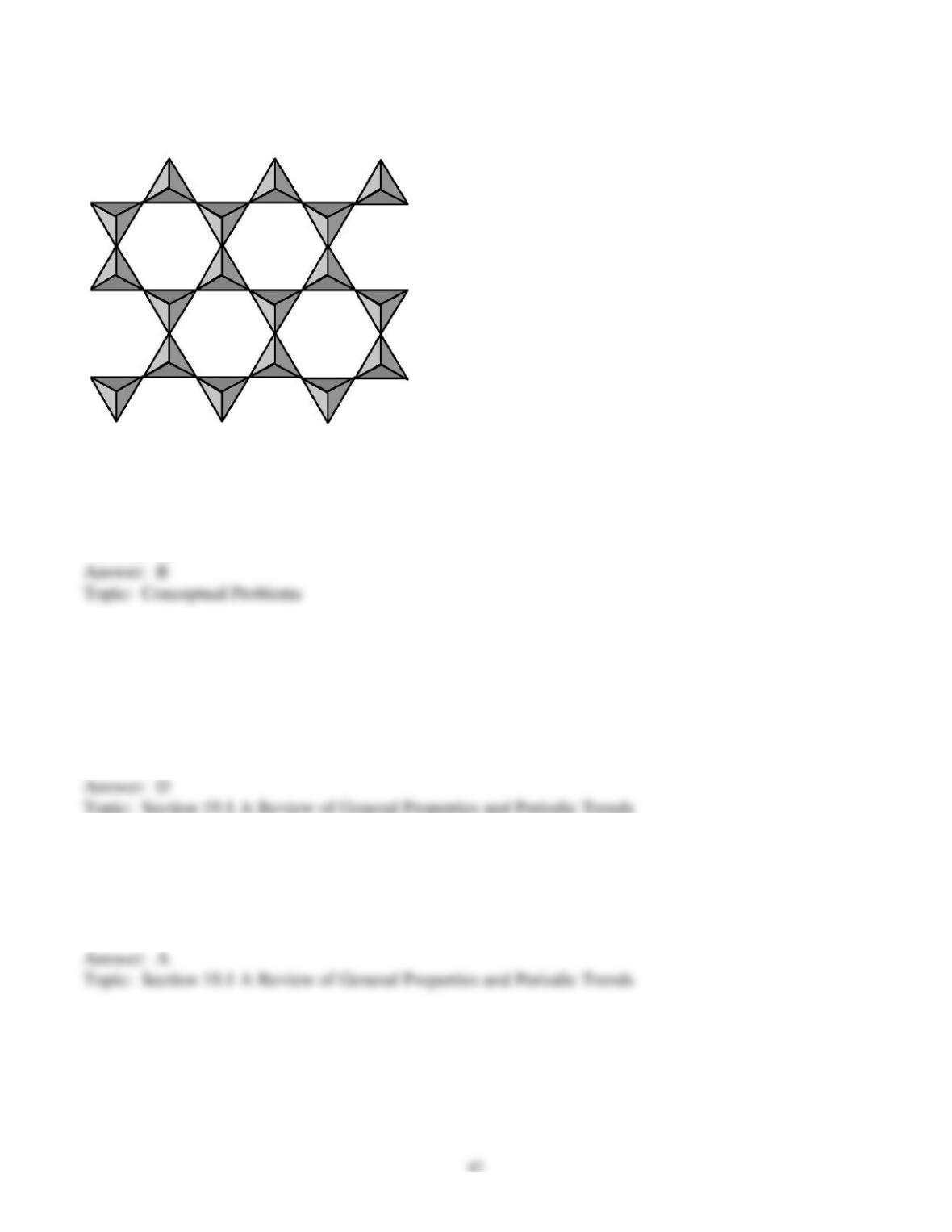
169) The two-dimensional layer silicate ion shown in the picture below combines with magnesium and
hydroxide ions to form talc. What is the formula and charge of the repeating unit of the silicate ion?
A) SiO32-
B) Si4O104-
C) Si6O156-
D) Si18O5028-
19.2 Algorithmic Questions
1) What is the most metallic element of group 3A?
A) Al
B) Ga
C) In
D) Tl
2) Which of the following elements forms the most ionic binary hydride?
A) K
B) Mg
C) S
D) Cl
3) Which of the following elements exhibits the most metallic character?
A) In
B) Sn
C) Sb
D) Te
4) Which one of the following is not a main group element?
A) Rb
B) Sr
C) U
D) Pb
5) Which one of the following elements forms the most acidic binary oxide?
A) Cs
B) Sn
C) Se
D) Te
6) Which one of the following compounds that contains a Group 6A element is least likely to exist?
A) OF2
B) OF6
C) SF4
D) SF6
7) Which one of the following compounds exhibits the strongest hydrogen bonding between its
molecules?
A) CH3OH
B) CH3F
C) CH3Cl
D) CH3Br
8) Which one of the following elements can form more than four chemical bonds with other elements?
A) C
B) N
C) O
D) As
19.3 Short Answer Questions
1) Main-group elements are those elements in groups ________ through ________ of the periodic table.
2) The number of metallic elements in period 3 of the periodic table is ________.
3) Elements in period 2 of the periodic table differ markedly from the heavier elements in the same
group due to their especially small ________ and high ________.
4) Elements in group 3A of the periodic table have the valence electron configuration ________.
5) The B–H–B bond in B2H6 is a three-________, two-________ bond.
6) In the mixed aluminum-boron hydride AlBH6, the number of hydrogen involved in 2c-2e bonds is
________, and the number of hydrogen involved in 3c-2e bonds is ________.
7) The number of nonmetals in group 4A of the periodic table is ________.
8) Carbon combines with some metals and semimetals to form carbides. What is the formula of
aluminum carbide?
9) The percentage of carbon in the endohedral fullerene complexes KrC60 and XeC60 is ________%C
and ________%C, respectively.
10) The fullerene C60 is an ________ (allotrope, isotope, isomer) of carbon.
11) When a person exhales through a straw into water, the water will have a(n) ________ (acidic, basic,
neutral) pH due to the reaction ________.
12) The charge, n, on the cyclic anion Si6O18n that is found in the mineral beryl is ________.
13) The ratio of oxygen atoms to silicon atoms in orthosilicate, single-strand silicates, double-strand
silicates, and cyclic silicates is ________, ________, ________, and ________, respectively.
14) Wollastonite, CaSiO3, is an example of a(n) ________ (orthosilicate, single-strand silicate, double-
strand silicate, and cyclic silicate).
15) Diopside, CaMgSi2O6, is an example of a(n) ________ (orthosilicate, single-strand silicate, double-
strand silicate, and cyclic silicate).
16) The most acidic oxides of the group 5A elements are oxides of the element ________.
17) The oxidation numbers of nitrogen in NH4NO3 are ________ and ________.
18) In the reaction below, ________ is the oxidizing agent and ________ is the reducing agent.
N2H4(l) + N2O4(l) → 3 N2(g) + 4 H2O(g)
19) When P4O10 is dissolved in water, the water will have a(n) ________ (acidic, basic, neutral) pH due
to the reaction ________.
20) Why is H3PO4 a weak triprotic acid whereas H3PO3 is a weak diprotic acid?
21) Ring strain the cause of high molecular reactivity that occurs when the angles in a ring of atoms are
not close to “normal” bond angles (90° when the bonds are formed by atoms using pure p-orbitals,
109.5° using sp3 hybrid orbitals, 120° using sp2 orbitals, etc.). The angles in white phosphorus, P4,
measure ________, and P4 ________ (is, is not) expected to exhibit ring strain and be very reactive.
22) Adenosine triphosphate (ATP) plays an important role in energy transfer within cells. ATP can be
considered to be an ester of triphosphoric acid, which is formed by the combination of three phosphoric
acid molecules with the elimination of two water molecules. What is the formula of triphosphoric acid?
23) The highest and lowest oxidation states exhibited by Group 6A elements are ________ and
________.
24) The most stable allotrope of sulfur is S8. What are the approximate bond angles in S8?
25) Disproportionation is a reaction in which a reactant is both oxidized and reduced in the same
reaction. In the disproportionation reaction below, the oxidation number of chlorine in Cl2, ClO–, and
Cl– is ________, ________, and ________, respectively.
Cl2(g) + 2 OH–(aq) → ClO–(aq) + Cl–(aq) + H2O(l)