161)
The value of the absolute price elasticity of demand for good X is 4. The absolute price elasticity for
good Y is 1. Which good’s quantity demanded is more responsive to a change in price?
161)
A)
Good X
B)
Good Y
C)
They are equally responsive.
D)
Not enough information is given.
162)
If price decreases by 10 percent and quantity demanded increases by 30 percent, the price elasticity
of demand will be
162)
A)
3.
B)
30.
C)
300.
D)
0.333.
163)
If the demand curve for a product is horizontal, then
163)
A)
the price elasticity of the product approaches zero.
B)
the demand for the product is perfectly elastic.
C)
only a certain amount of the product will be consumed regardless of price.
D)
the demand for the product is perfectly inelastic.
164)
If the price of good X increases by 1 percent, then the quantity supplied increases by more than 1
percent. This means
164)
A)
the good has good substitutes.
B)
supply is unit–elastic.
C)
supply is inelastic.
D)
supply is elastic.
165)
A local transit authority charges $1 for a bus ride. An economics study suggests that in the price
range from $0.50 to $1.50, the elasticity of demand for bus trips is 1.1. To increase its revenue, the
transit authority should
165)
A)
lower the fare.
B)
charge $1.10.
C)
leave the fare as it is.
D)
raise the fare.
166)
The income elasticity of demand for all goods taken together must be
166)
A)
between 0 and 1.
B)
–1.
C)
+1.
D)
zero.
167)
Generally, expenses on a sport utility vehicle are a large part of a consumer‘s budget, so the
demand for sport utility vehicles is more likely to be
167)
A)
perfectly elastic.
B)
unit elastic.
C)
inelastic.
D)
elastic.
168)
A firm could lower prices and still increase revenue if
168)
A)
elasticity of demand is equal to unity.
B)
demand is inelastic.
C)
demand is elastic.
D)
elasticity of demand is equal to zero.
169)
In an extreme hypothetical instance in which the price change of a good elicited no change in
quantity demanded, we would say that the item is
169)
A)
unitary elastic.
B)
infinitely elastic.
C)
perfectly inelastic.
D)
perfectly elastic.
170)
If the absolute price elasticity of demand is 0.2, a 10 percent increase in the price will cause
170)
A)
the quantity demanded to decrease by 20 percent.
B)
the quantity demanded to decrease by 5 percent.
C)
the quantity demanded to decrease by 0.2 percent.
D)
the quantity demanded to decrease by 2 percent.
Price Quantity Demanded
Per Unit Per Week
$10.00 25
9.50 30
9.00 35
8.50 40
8.00 45
7.50 50
7.00 55
6.50 60
6.00 65
5.50 70
5.00 75
171)
Refer to the above table. What is the absolute price elasticity of demand if a price falls from $7 to
$6.50?
171)
A)
0.92
B)
1.08
C)
0.85
D)
1.17
172)
Suppose two goods are perfect substitutes. The price elasticity of demand of one of the goods is
172)
A)
0.
B)
infinity.
C)
1.
D)
1000.
173)
The range to the left of the midpoint on a linear demand curve is
173)
A)
elastic.
B)
infinite.
C)
inelastic.
D)
one.
174)
When the absolute percentage change in quantity demanded is just equal to the percentage change
in price, demand is
174)
A)
perfectly inelastic.
B)
elastic.
C)
unit–elastic.
D)
relatively inelastic.
175)
Which of the following is a determinant of the price elasticity of demand for a product?
I. The existence of substitute goods
II. The percentage of a consumer’s total budget devoted to purchases of that commodity
175)
A)
I only
B)
II only
C)
both I and II
D)
neither I nor II
176)
Suppose the absolute price elasticity of demand for newsletter subscriptions is 1.3. In order to
increase the total revenues from subscriptions, the publishers should
176)
A)
sell the newsletters on the inelastic portion of its demand curve.
B)
keep the price the same.
C)
reduce the price of the newsletters.
D)
increase the price of the newsletters.
177)
Suppose that the amount of computer printers demanded increases by 20 percent when the price of
personal computers falls by 10 percent. The cross price elasticity of demand between computer
printers and personal computers is
177)
A)
–2.0.
B)
0.5.
C)
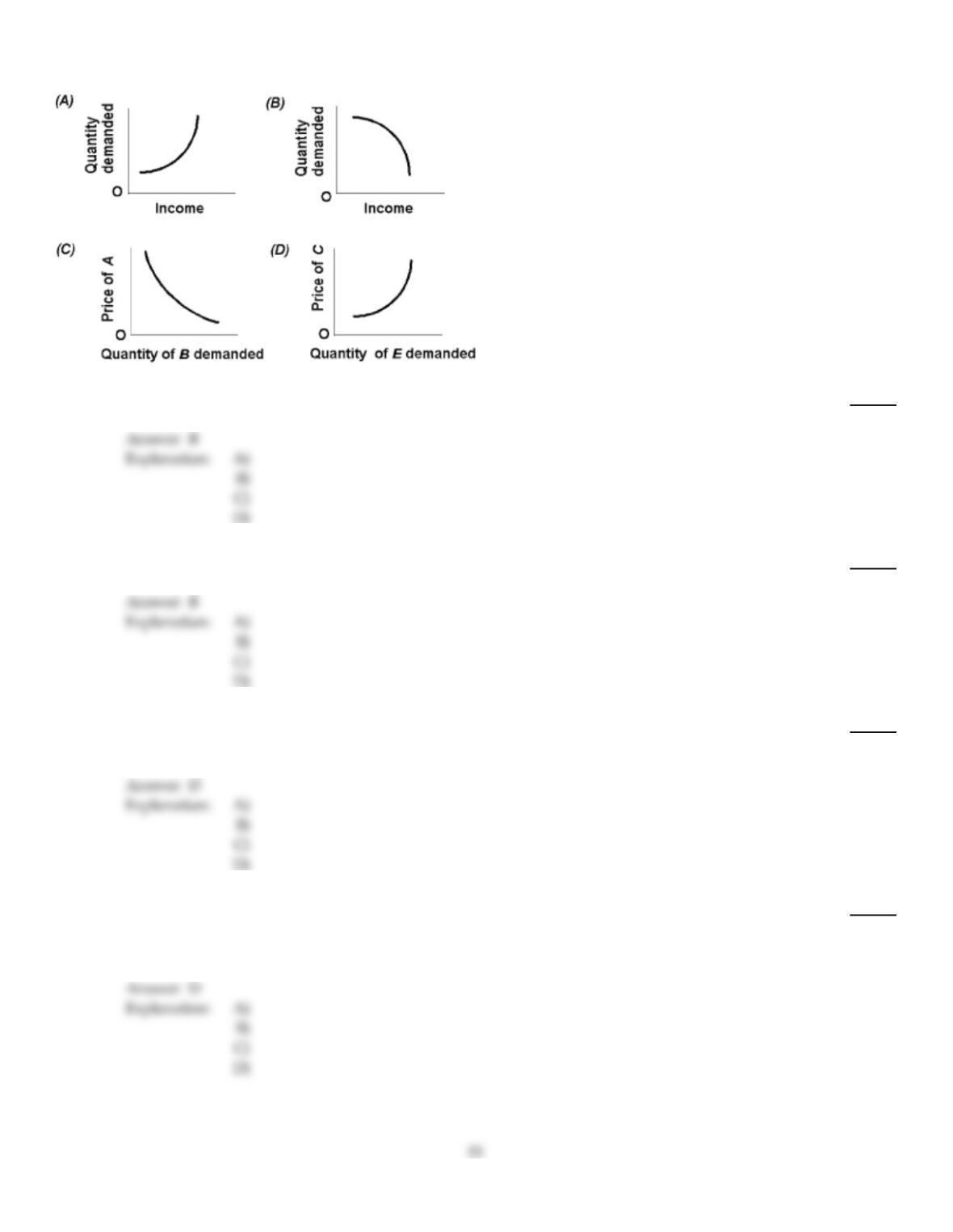
–0.5.
D)
2.0.
178)
An 18 percent increase in the price of small cars results in a 10 percent expansion in the quantity
supplied. The supply elasticity in this range equals ________.
178)
A)
7/10
B)
9/5
C)
4/10
D)
5/9
179)
The most important determinant of the elasticity of supply is
179)
A)
the proportion of the good in the budget of consumers.
B)
whether the good is a durable good or a nondurable good.
C)
the price of the good.
D)
the time period firms have to adjust to the new price.
180)
The cross price elasticity of demand is measured by the
180)
A)
percentage change in the price of one good divided by the percentage change in the demand
for another good.
B)
percentage change in the price of one good divided by the percentage change in price of
another good.
C)
percentage change in the quantity demanded of one good divided by the percentage change
in quantity demanded of another good.
D)
percentage change in the demand for one good divided by the percentage change in price of
another good.
181)
A good’s price elasticity of demand can be calculated by using the formula of
181)
A)
absolute change in quantity demanded divided by absolute change in price.
B)
percentage change in price divided by percentage change in quantity demanded.
C)
percentage change in price divided by percentage change in income.
D)
percentage change in quantity demanded divided by percentage change in price.
182)
If goods X and Y are complements, then the cross price elasticity of demand will be
182)
A)
positive.
B)
greater than zero but less than 1.
C)
elastic.
D)
negative.
183)
Suppose the demand for rental apartments decreased substantially. We would expect to observe
183)
A)
no change in rent and a sharp reduction in quantity supplied in the short run, and an even
larger decrease in quantity supplied in the long run.
B)
a small decrease in quantity supplied and significantly lower rents in the short run, and
quantity supplied to decrease much more in the long run.
C)
a large decrease in quantity supplied in the short run, followed by a counter–reaction and an
increase in quantity supplied in the long run.
D)
a large decrease in quantity supplied in the short run and the long run, but much larger
reductions in rent in the long run.
184)
A demand relationship in which the quantity demanded changes exactly in proportion to the
change in price is
184)
A)
elastic.
B)
unit–elastic.
C)
inelastic.
D)
consistent with zero elasticity.
185)
Suppose that when the price of root beer rises 10%, the quantity of pizza demanded falls 5%. This
would mean that pizza and root beer are
185)
A)
complements, with a cross price elasticity of –2.0.
B)
substitutes, with a cross price elasticity of 0.5.
C)
complements, with a cross price elasticity of –0.5.
D)
substitutes, with a cross price elasticity of –2.0.
186)
We generally expect the price elasticity of supply to be
186)
A)
positive.
B)
zero.
C)
between –1 and +1.
D)
negative.
187)
If a price decrease of a product significantly raises its revenues, then the absolute price elasticity of
demand for that product must be
187)
A)
an example of unit elasticity.
B)
less than one.
C)
equal to one.
D)
greater than one.
188)
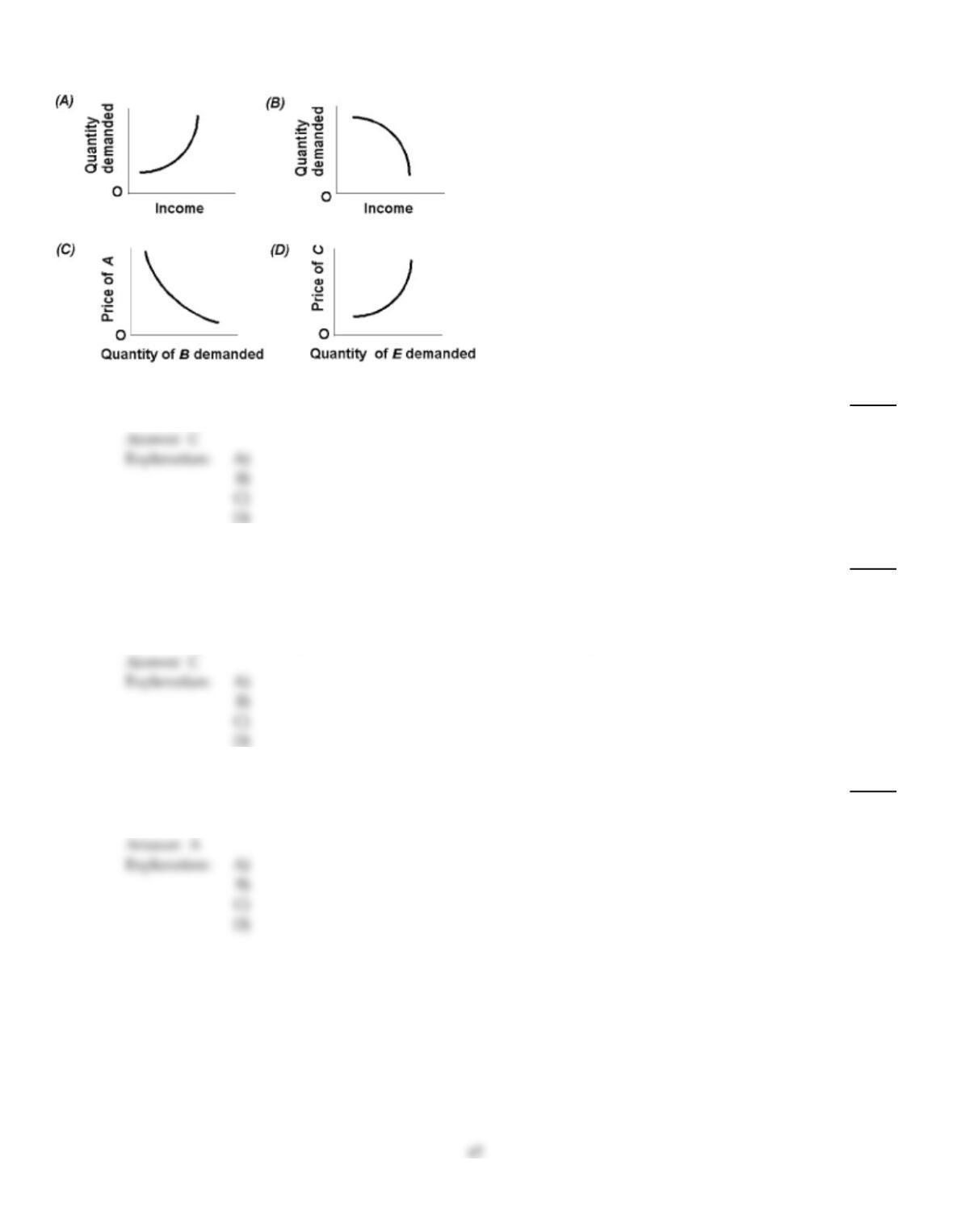
Use the above figure. Which graph depicts complementary goods?
188)
A)
A
B)
B
C)
C
D)
D
189)
The less sensitive quantity demanded is to a change in price, the
189)
A)
closer the absolute price elasticity of demand is to one.
B)
greater the absolute price elasticity of demand.
C)
smaller the absolute price elasticity of demand.
D)
smaller a change in price must be to induce a certain change in quantity demanded.
190)
If the price of hamburger meat increases by 20 percent and the quantity supplied by meat packing
companies increases by 30 percent, what is the price elasticity of supply?
190)
A)
1.50
B)
0.67
C)
1.65
D)
1.20
191)
Suppose that the income elasticity of demand for peanut butter is 0.75. Which of the following is
TRUE?
191)
A)
Peanut butter is an inferior good, because income elasticity is positive.
B)
Peanut butter is an inferior good, because income elasticity is less than 1.
C)
Peanut butter is a normal good, because income elasticity is positive.
D)
Peanut butter is a normal good, because income elasticity is less than 1.
192)
If the demand curve for a product is vertical, then
192)
A)
its price elasticity of demand is equal to zero.
B)
consumers may purchase all they want to at the established market price.
C)
consumers are highly responsive to price changes.
D)
the demand for the good is perfectly elastic.
193)
For most items, we find the price elasticity of supply will be
193)
A)
invisible.
B)
negative.
C)
inverse.
D)
positive.
194)
If the slope of a demand curve is constant, then we know that
194)
A)
elasticity of demand is also elastic everywhere.
B)
elasticity of demand varies along the demand curve.
C)
elasticity of demand is inelastic everywhere.
D)
elasticity of demand is constant and elastic.
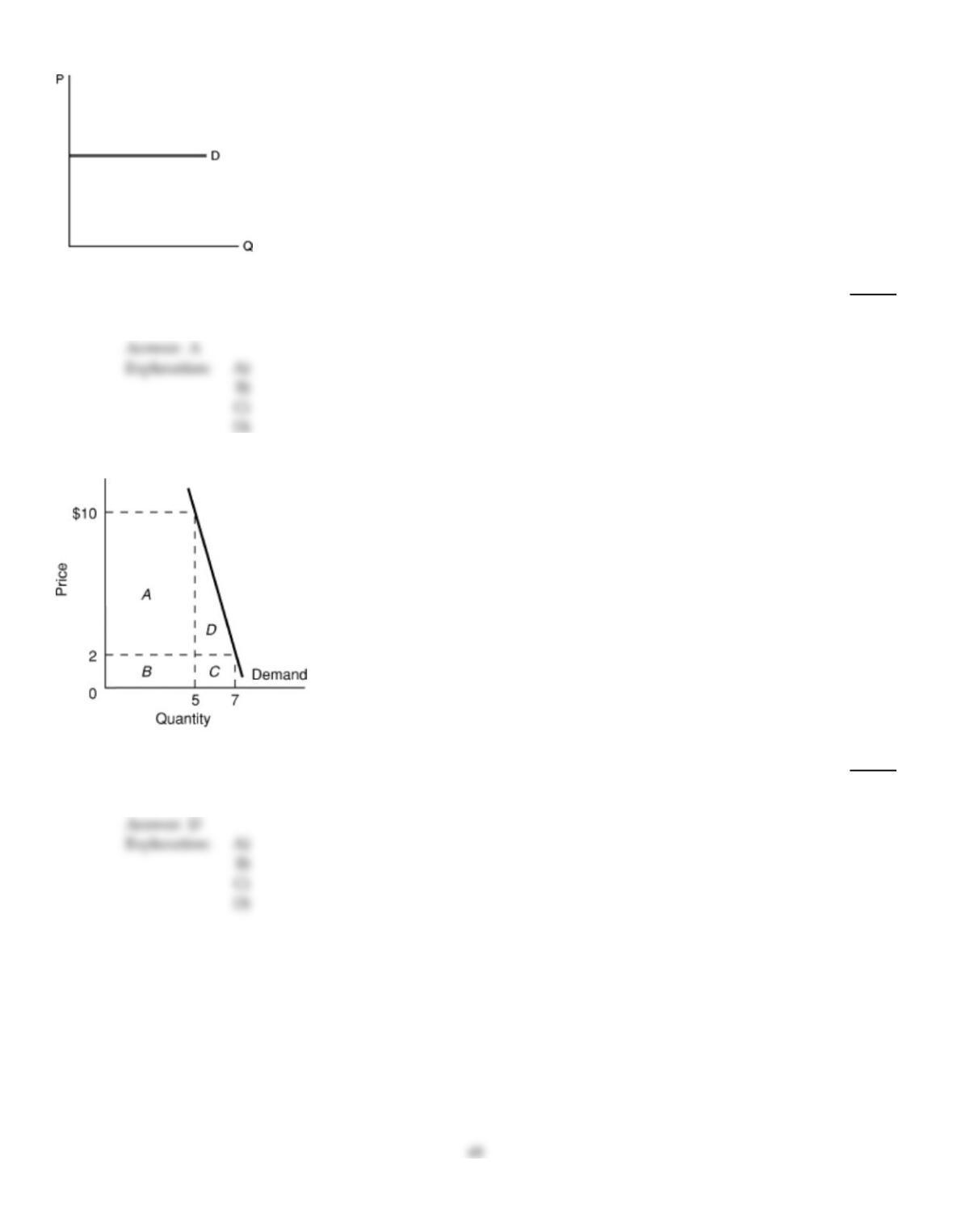
195)
Refer to the above figure. Demand is
195)
A)
perfectly elastic.
B)
unitary elastic.
C)
perfectly inelastic.
D)
undetermined without more information.
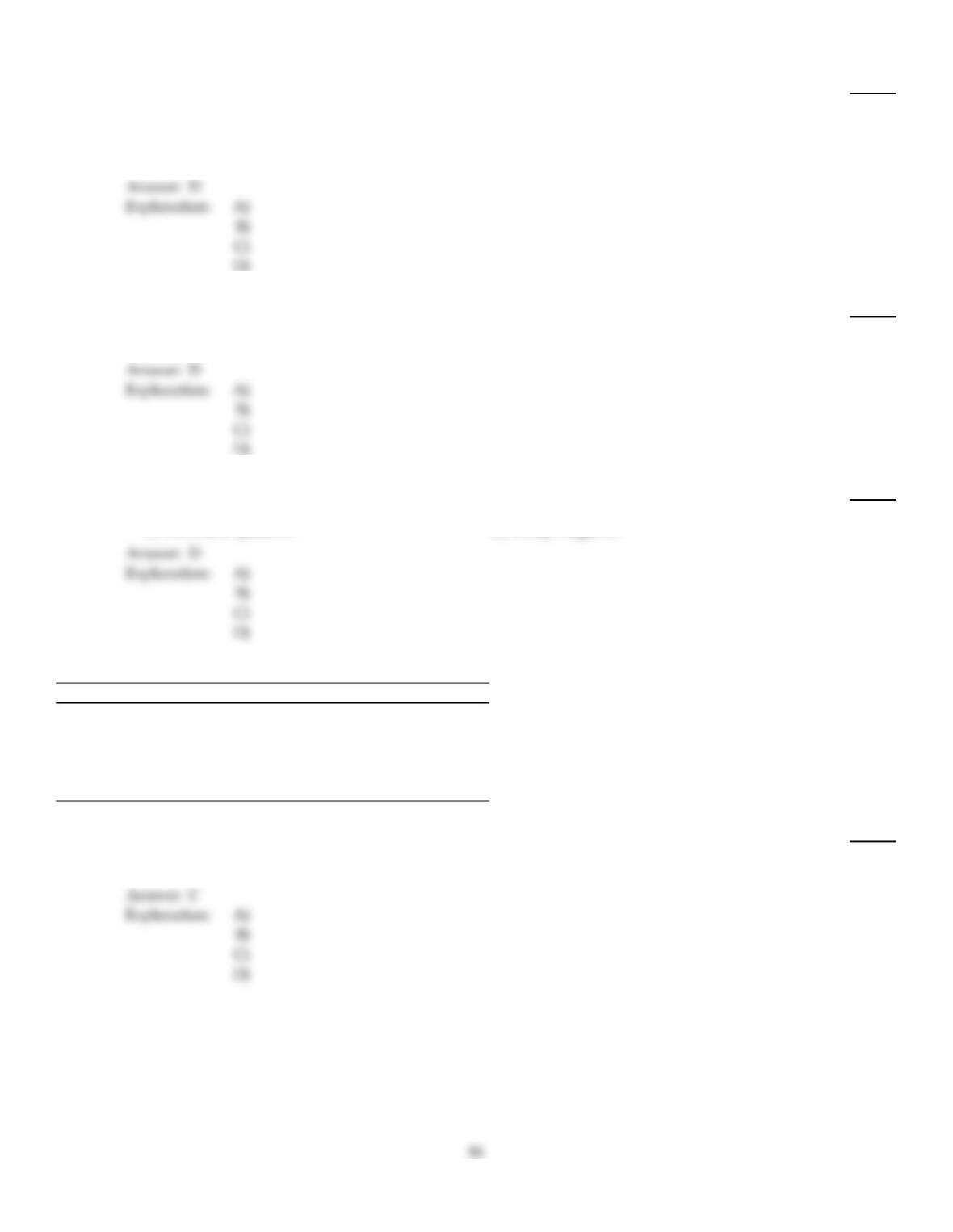
196)
Use the above figure. When the price increases from $2 to $10, the absolute price elasticity of
demand is
196)
A)
1.50.
B)
1.00.
C)
0.67.
D)
0.25.
197)
The price elasticity of demand measures
197)
A)
the change in price due to a change in demand.
B)
the change in quantity demanded due to a change in price of a substitute good.
C)
the responsiveness of price to a change in competition.
D)
the responsiveness of quantity demanded to a change in price.
198)
A product that has an elastic demand curve has all of the following characteristics EXCEPT
198)
A)
it is a large part of a consumer’s income.
B)
a consumer can wait to buy the product.
C)
it has many substitutes.
D)
it has few or no substitutes.
199)
The price elasticity of demand is
199)
A)
always positive.
B)
constant along the demand curve.
C)
sometimes positive.
D)
always negative.
Px Qx Py Qy Pz Qz
$10 100 $20 50 $25 200
10 90 18 60 25 225
10 70 15 90 25 275
12 50 15 100 25 290
15 25 15 120 25 320
200)
Refer to the above table. Suppose the price of X increases from $10 to $12. What is the cross price
elasticity of demand between X and Y?
200)
A)
+0.545
B)
+1.833
C)
+0.579
D)
–1.833
201)
Suppose that the demand for pizza is inelastic. If a pizzeria decided to lower the price of pizza,
total revenue would
201)
A)
increase.
B)
decrease.
C)
be maximized.
D)
stay the same.
202)
The price elasticity of demand is the
202)
A)
change in quantity demanded divided by the change in price.
B)
percentage change in quantity demanded divided by the percentage change in price.
C)
change in price divided by the change in quantity demanded.
D)
percentage change in price divided by the percentage change in quantity demanded.
203)
The range to the right of the midpoint on a linear demand curve is
203)
A)
elastic.
B)
inelastic.
C)
infinite.
D)
one.
204)
If demand is unit elastic, then
204)
A)
a two percent increase in price leads to a two percent decrease in quantity demanded.
B)
the unit change in quantity demanded equals the unit change in price.
C)
a ten percent increase in price leads to a one percent decrease in quantity demanded.
D)
an increase in price of any amount leads to quantity demanded falling to zero.
205)
If price elasticity of supply is less than 1
205)
A)
supply is elastic.
B)
demand is inelastic.
C)
demand is elastic.
D)
supply is inelastic.
206)
If demand is perfectly elastic everywhere along the demand curve, then
206)
A)
the demand curve is horizontal.
B)
people must be irrational.
C)
the demand curve is vertical.
D)
the demand curve is a rectangular hyperbola.
207)
Supply will become more elastic when
207)
A)
a time period lengthens.
B)
the good is important to consumers.
C)
there are good substitutes for the goods.
D)
the time period shortens.
208)
When the absolute price elasticity of demand equals 0.67, demand is
208)
A)
elastic.
B)
unit–elastic.
C)
inelastic.
D)
undetermined without more information.
209)
When price is $5 per unit, quantity demanded is 12 units. When price is $6 per unit, quantity
demanded is 8 units. The value of the absolute price elasticity of demand is approximately
209)
A)
4.00.
B)
1.82.
C)
2.20.
D)
0.36.
210)
Elastic demand implies
210)
A)
that a one percent decrease or increase in price induces no change in total revenue.
B)
that a one percent increase in price results in a smaller than one percent decrease in quantity
demanded.
C)
that a one percent increase in price results in a larger than one percent decrease in quantity
demanded.
D)
that a one percent cut in price results in a larger than one percent increase in quantity
demanded.
211)
Use the above figure. Which graph depicts an inferior good?
211)
A)
A
B)
B
C)
C
D)
D
212)
If the prices of computer tablets rise, we would expect the number of tablet covers purchased to
212)
A)
be equal to ten.
B)
decrease.
C)
be equal to one.
D)
increase.
213)
At a price of $10, quantity demanded is 30 units. When the price rises to $11, quantity demanded is
24 units. What is the absolute price elasticity of demand?
213)
A)
6.0
B)
0.5
C)
0.43
D)
2.33
214)
Whenever the absolute value of the price elasticity of demand is greater than 1, but less than
infinite
214)
A)
demand is perfectly elastic.
B)
demand is unit elastic.
C)
demand is inelastic.
D)
demand is elastic.
Px Qx Py Qy Pz Qz
$10 100 $20 50 $25 200
10 90 18 60 25 225
10 70 15 90 25 275
12 50 15 100 25 290
15 25 15 120 25 320
215)
Refer to the above table. Suppose the price of X increases from $10 to $12. What is the cross price
elasticity of demand between X and Z?
215)
A)
–0.292
B)
–7.06
C)
+0.292
D)
+7.06
216)
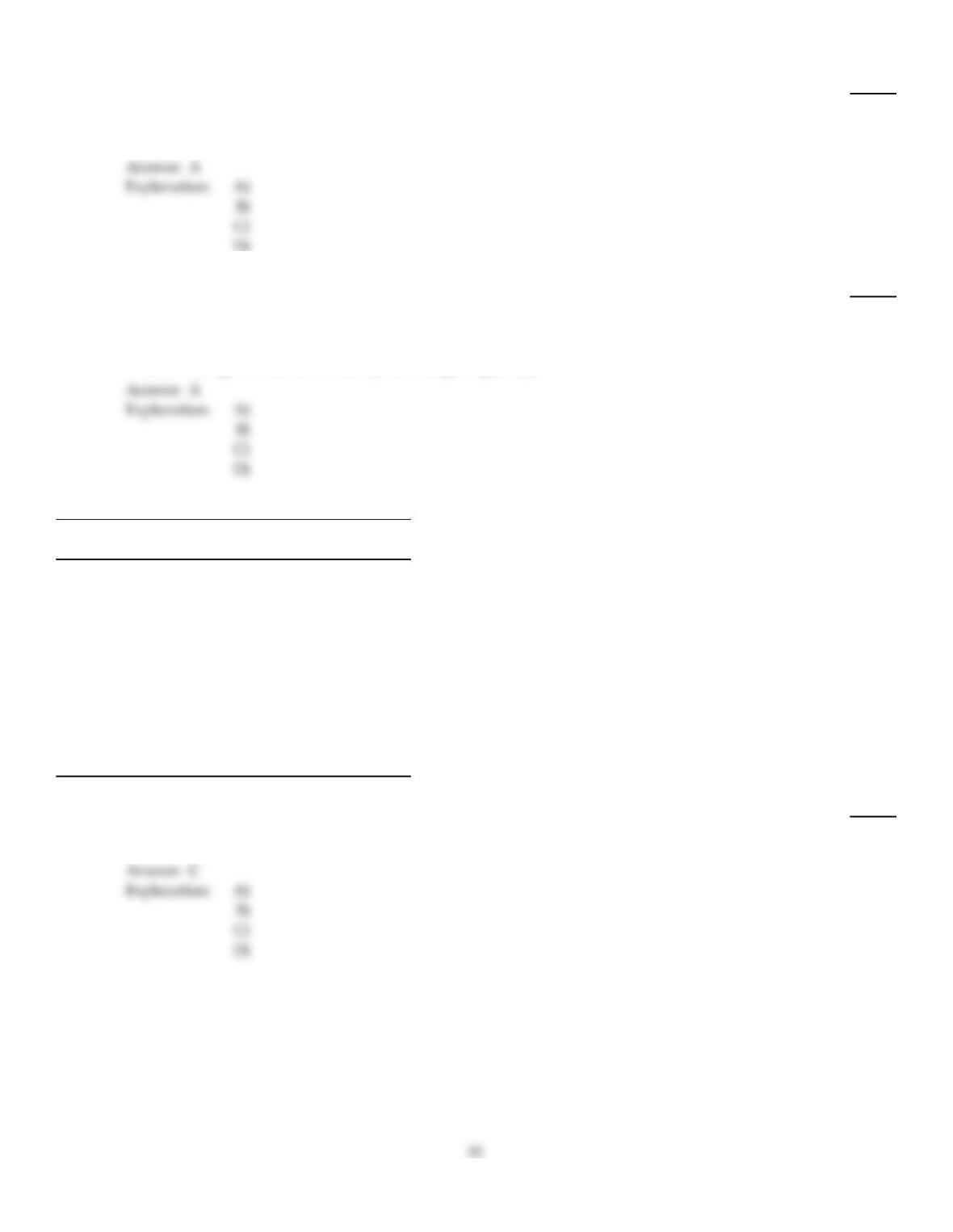
Refer to the above figure. The supply curve is
216)
A)
perfectly elastic.
B)
elastic at high prices and inelastic at low prices.
C)
perfectly inelastic.
D)
unitary for all prices.
C
217)
If the price of a good increases and the total revenue also increases, the good has a(n)
217)
A)
inelastic demand.
B)
unit elastic demand.
C)
perfectly elastic demand.
D)
elastic demand.
A
C
218)
Owners of a coffee shop finds that they can sell 150 donuts a day when the price of a donut is $1.20.
When they price donuts at $1, they sell 170 donuts. The absolute value of the price elasticity of
demand for donuts is
218)
A)
0.69.
B)
1.45.
C)
infinity.
D)
1.00.
219)
Income elasticity of demand is defined as
219)
A)
the percentage change in demand divided by the percentage change in income.
B)
the change in income multiplied by the change in quantity.
C)
the change in price divided by the change in income.
D)
the change in income divided by the change in quantity.
Price Quantity Demanded
Per Unit Per Week
$10.00 25
9.50 30
9.00 35
8.50 40
8.00 45
7.50 50
7.00 55
6.50 60
6.00 65
5.50 70
5.00 75
220)
Refer to the above table. What is the absolute price elasticity of demand when price changes from
$5.50 to $5.00?
220)
A)
1.38
B)
5.0
C)
0.72
D)
0.79
221)
The actual value of the price elasticity of demand is always
221)
A)
positive because of the law of demand.
B)
positive because of diminishing marginal utility.
C)
negative because percentages can only be negative.
D)
negative because of the law of demand.
Pounds of Artisan Jars of
Period Income/Week Bread Sold Jam Sold
1 $250 210
2 $500 5 8
222)
Use the above table. Based on the information in the table, artisan bread is a(n)
222)
A)
negative good.
B)
necessary good.
C)
inferior good.
D)
normal good.
223)
A supply curve that is parallel to the price axis is
223)
A)
perfectly inelastic.
B)
relatively inelastic.
C)
unitary elastic.
D)
perfectly elastic.
224)
When total revenue and price are inversely related, demand is
224)
A)
unit–elastic.
B)
inelastic.
C)
elastic.
D)
not related.
225)
When demand is unit elastic, a 10 percent change in the price of the good
225)
A)
will cause a change in quantity demanded equal to 10 percent.
B)
will cause a change in quantity demanded greater than 10 percent.
C)
will not cause any change in quantity demanded.
D)
will cause a change in quantity demanded of less than 10 percent.
226)
The supply curve for housing in the very short run is likely to be
226)
A)
unit–elastic elastic.
B)
very inelastic.
C)
perfectly elastic.
D)
very elastic.
B
Month PXQXPYQYPZQZ
Jan $10 100 $20 50 $25 200
Feb 10 90 18 60 25 225
Mar 10 70 15 90 25 275
Apr 12 50 15 100 25 290
May 15 25 15 120 25 320
227)
In the above table, the cross price elasticity of demand for good X with good Y when PY falls from
$20 to $18 is
227)
A)
–2.
B)
+1.
C)
–1.
D)
0.
B
228)
Other things being equal, the longer a price change persists
228)
A)
the greater is the elasticity of demand.
B)
the less chance a consumer will be able to adjust.
C)
the more the consumer will be willing to pay.
D)
the less is the elasticity of demand.
A
A
229)
If the price of gasoline increases from $2.50 per gallon to $3.00 per gallon and the quantity
demanded goes down from 120 million gallons per week to 115 million gallons per week, the
absolute value of price elasticity of demand in that price range is approximately
229)
A)
2.34.
B)
0.93.
C)
0.23.
D)
4.35.
230)
The absolute price elasticity of demand for good X is 1.2 when price is measured in dollars. If price
were measured in cents, the price elasticity elasticity of demand would equal
230)
A)
1200.
B)
0.012.
C)
12.
D)
1.2.
231)
Moving downward on a downward sloping linear demand curve, the absolute value of the price
elasticity of demand
231)
A)
may either increase or decrease.
B)
is constant.
C)
increases continuously.
D)
decreases continuously.
232)
Suppose that the demand for men’s ties is price inelastic for the range of prices between $10 and
$12. If Joe raises the price of the ties in his shop from $10 to $12, what will happen to Joe’s total
revenues?
232)
A)
Total revenues will decrease.
B)
Total revenues will increase.
C)
Total revenues will have no relationship to the quantity of ties demanded.
D)
Total revenues will not change.
233)
The price elasticity of supply measures
233)
A)
the change in supply due to a change in input prices.
B)
the responsiveness of quantity supplied to a change in price.
C)
the responsiveness of quantity demanded to a change in price.
D)
the change in price due to a change in quantity supplied.
234)
The percentage change in the demand for one good divided by the percentage change in the price
of a related good is the
234)
A)
price elasticity of demand.
B)
income elasticity.
C)
price elasticity of supply.
D)
cross price elasticity of demand.
235)
When demand is unit elastic, a change in price will cause
235)
A)
a change in total revenue in the opposite direction.
B)
no change in total revenue.
C)
a change in total revenue in the same direction.
D)
a change in total revenue in either direction depending on whether the price is increasing or
decreasing.
236)
If the price elasticity of demand for good A is –1, then a 1% increase in
236)
A)
consumer income will result in a 1% decrease in the demand for good A.
B)
the market price of good A will result in a 1% increase in the quantity demanded of good A.
C)
the market price of good A will result in a 1% decrease in the quantity demanded of good A.
D)
consumer income will result in a 1% increase in the demand for good A.
237)
If the calculated price elasticity of demand between two points is –4, demand is
237)
A)
unit–elastic.
B)
inelastic.
C)
elastic.
D)
unresponsive to price.
238)
Total revenue is
238)
A)
price × quantity.
B)
change in price × quantity.
C)
change in price × change in quantity.
D)
price × change in quantity.
239)
A value of the absolute price elasticity of demand equal to 0.25 indicates that
239)
A)
a 5% decrease in price leads to a 2% increase in quantity demanded.
B)
a 0.25% decrease in price leads to a 1% increase in quantity.
C)
a 1% decrease in price leads to a 2.5% increase in quantity demanded.
D)
a 2% decrease in price leads to a 25% increase in quantity demanded.
240)
The price elasticity of demand can be computed as
240)
A)
change in price/change in quantity demanded.
B)
change in quantity demanded/change in price.
C)
percentage change in quantity demanded/percentage change in price.
D)
change in total utility/change in quantity.
241)
The formal definition of price elasticity of demand is
241)
A)
quantity demanded divided by price.
B)
quantity demanded multiplied by price and divided by 100.
C)
percentage change in quantity demanded divided by percentage change in price.
D)
change in quantity demanded divided by change in price.