A) the amount of sample that undergoes 1 disintegration per second.
B) the amount of sample that undergoes 3.7 × 10¹⁰ disintegrations per second.
C) the amount of tissue damage done by radiation.
D) equal to 0.01 J of energy absorbed per kilogram of tissue.
74) A curie is
A) the amount of sample that undergoes 1 disintegration per second.
B) the amount of sample that undergoes 3.7 × 10¹⁰ disintegrations per second.
C) the amount of tissue damage done by radiation.
D) equal to 0.01 J of energy absorbed per kilogram of tissue.
75) A rad is
A) the amount of sample that undergoes 1 disintegration per second.
B) the amount of sample that undergoes 3.7 × 10¹⁰ disintegrations per second.
C) the amount of tissue damage done by radiation.
D) equal to 0.01 J of energy absorbed per kilogram of tissue.
76) Which unit of radiation describes the amount of radiation emitted by a radioactive substance?
A) becquerel
B) gray
C) rad
D) rem
77) Which unit of radiation describes the amount of energy absorbed by a kilogram of tissue exposed to a
radiation source?
A) becquerel
B) curie
C) rad
D) rem
78) Which unit of radiation is frequently used in medicine to describe the amount of tissue damage
caused by a radioactive substance?
A) becquerel
B) curie
C) rad
D) rem
79) The effects of ionizing radiation depend on
A) length of exposure to radiation.
B) location of source (internal or external).
C) type and energy of radiation.
D) All of these
80) Ionizing radiation having the lowest energy is exhibited by
A) α particles.
B) β particles.
C) γ rays.
D) X-rays.
23
81) Which type of radiation is not used for medical applications?
A) alpha emission
B) beta emission
C) gamma radiation
D) positron emission
82) A few sheets of ordinary paper can form an effective shield against what type of radiation?
A) alpha particles
B) cosmic rays
C) gamma rays
D) neutrons
83) A small block of wood or heavy clothing can form an effective shield against what type of radiation?
A) beta particles
B) cosmic rays
C) gamma rays
D) neutrons
84) Most of the radiation to which people are exposed comes from
A) atmospheric testing of nuclear weapons.
B) emissions from nuclear power plants.
C) medical procedures.
D) natural sources.
85) Radiation is dangerous to organisms because
A) all radionuclides are poisonous.
B) it causes electrolysis of water in the cells.
C) it causes nuclear reactions in the cells.
D) it ionizes molecules in the cells.
86) Carbon-14, which is present in all living tissue, radioactively decays via a first-order process. A one-
gram sample of wood taken from a living tree gives a rate for carbon-14 decay of 13.6 counts per minute.
If the half-life for carbon-14 is 5715 years, how old is a wood sample that gives a rate for carbon-14 decay
of 3.9 counts per minute?
A) 4.6 × 10³ yr
B) 6.6 × 10³ yr
C) 1.0 × 10⁴ yr
D) 2.9 × 10⁴ yr
87) An archeological artifact was subjected to radiocarbon dating. The artifact showed a carbon-14 decay
rate of 13.8 disintegrations/min per gram of carbon. Carbon-14 has a half-life of 5715 years, and currently
living organisms decay at the rate of 15.3 disintegrations/min per gram of carbon. What is the
approximate age of the artifact?
A) 257 years old
B) 371 years old
C) 591 years old
D) 851 years old
88) The ratio of 238U to 206Pb is used to date old mineral samples. Each 1.000 g of 238U that decays
eventually produces 0.866 g of 206Pb. If the half-life of 238U is 4.468 × 10⁹ years, what is the age of a
mineral that has a 238U/206Pb mass ratio of 2.00?
A) 2.94 × 10⁹ years
B) 3.60 × 10⁹ years
C) 3.87 × 10⁹ years
D) 4.47 × 10⁹ years
89) If a log contains 60.0% of the 14C present in a living tree, how long has the log been dead? The half–
life of 14C is 5730 years.
A) 2290 years
B) 3430 years
C) 4220 years
D) 7560 years
90) The practical limit for 14C dating occurs when its activity falls to 0.20% of its original value due to
interference in detectors by natural background radiation. If the half-life is 5715 years, what is the
maximum age of a sample that can be dated by 14C without interference?
A) 1.3 × 10⁴ years
B) 2.9 × 10⁴ years
C) 5.1 × 10⁴ years
D) 2.9 × 10⁶ years
91) If the age of the Earth is 4.5 billion years and the half-life of 40K is 1.26 billion years, what percent of
the Earth’s original amount of 40K remains today?
A) 4.2%
B) 8.4%
C) 12%
D) 16%
92) Radium occurs only in uranium ores, typically with an observed Ra/U ratio of 1mg/3kg. Uranium ores
normally contain only about 200 ppm of U. How many kilograms of uranium ore must be processed to
obtain 1 mg of radium?
A) 1700 kg ore
B) 15,000 kg ore
C) 6.0 × 10⁸ kg ore
D) None of these
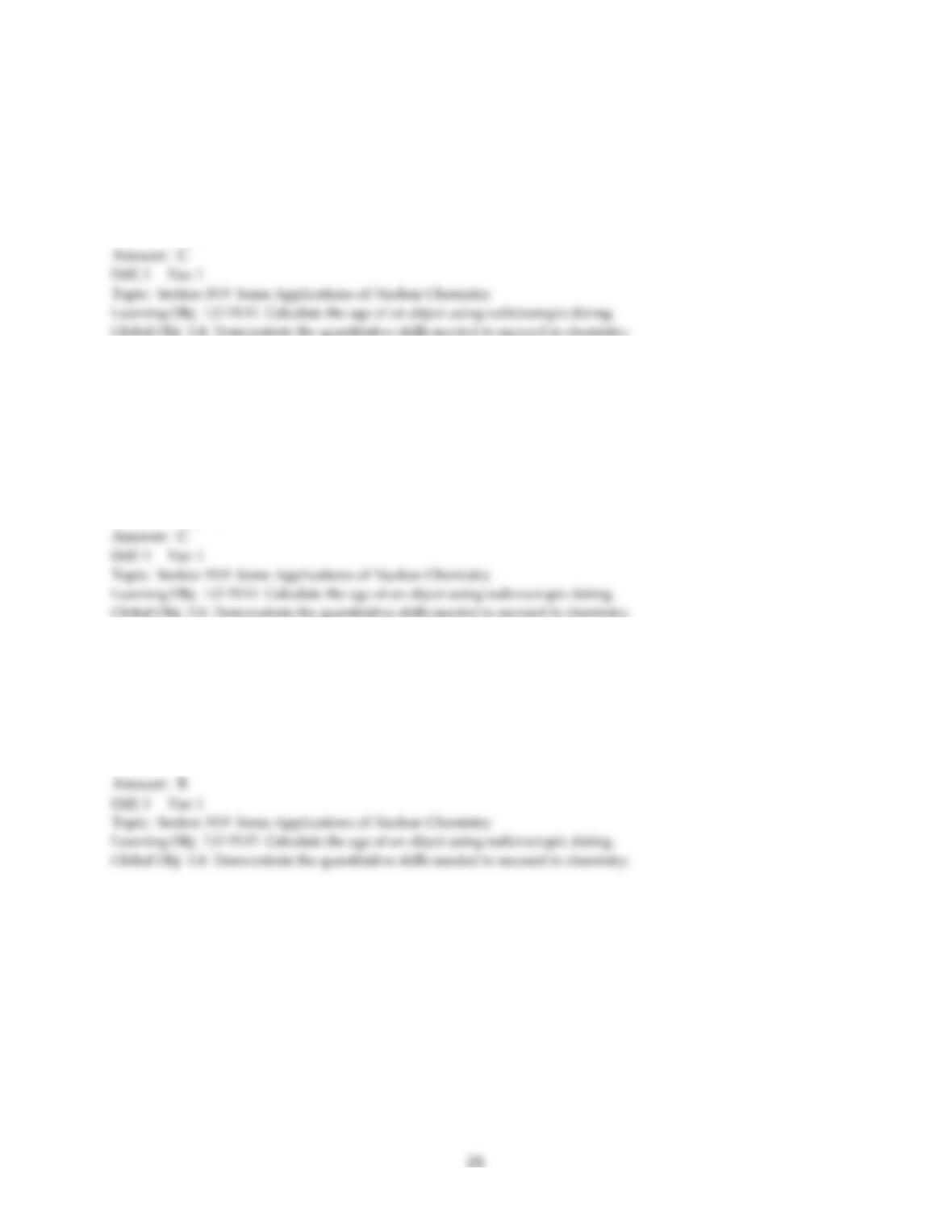
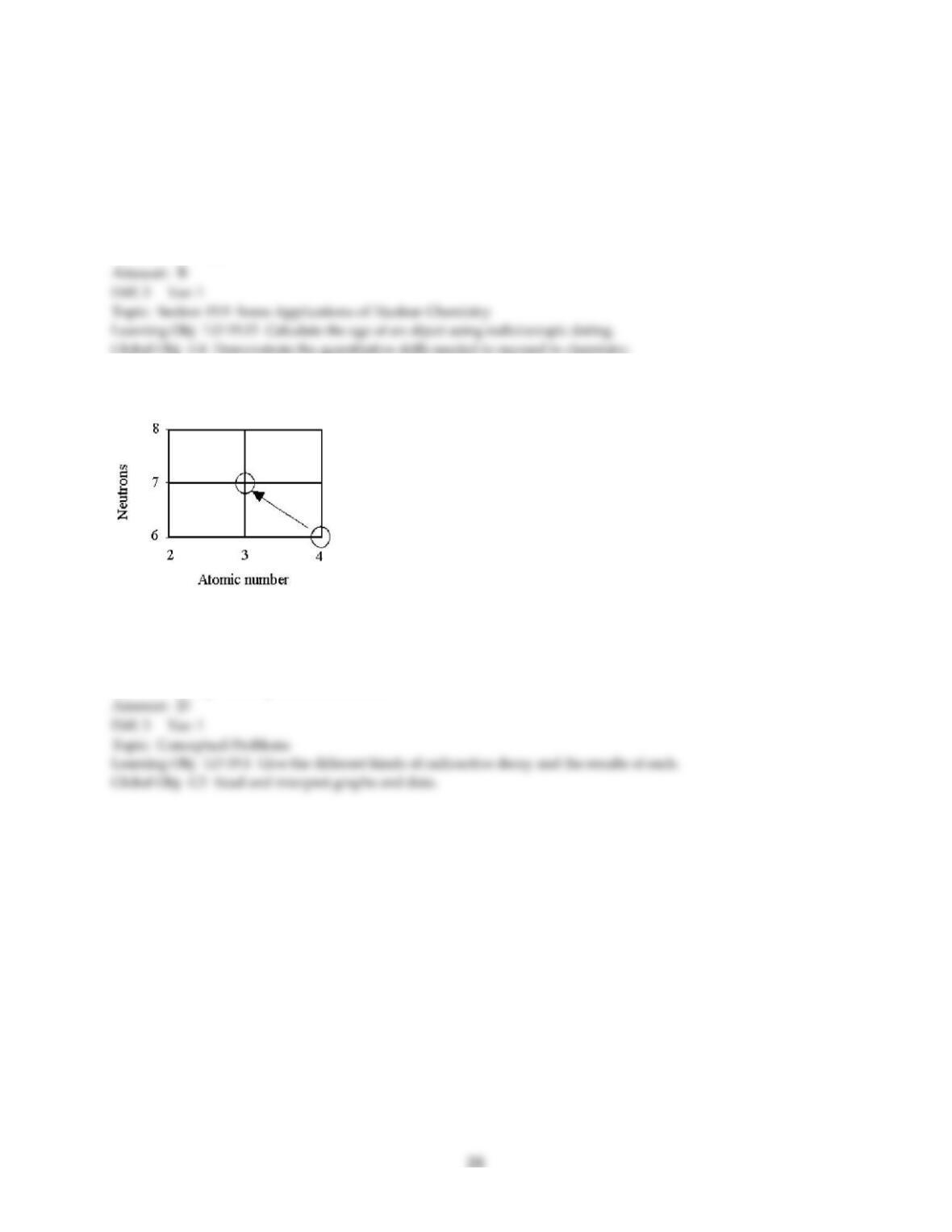
93) Tell the type of decay process occurring in the following nuclear reaction.
A) α emission
B) β emission
C) γ emission
D) electron capture or positron emission
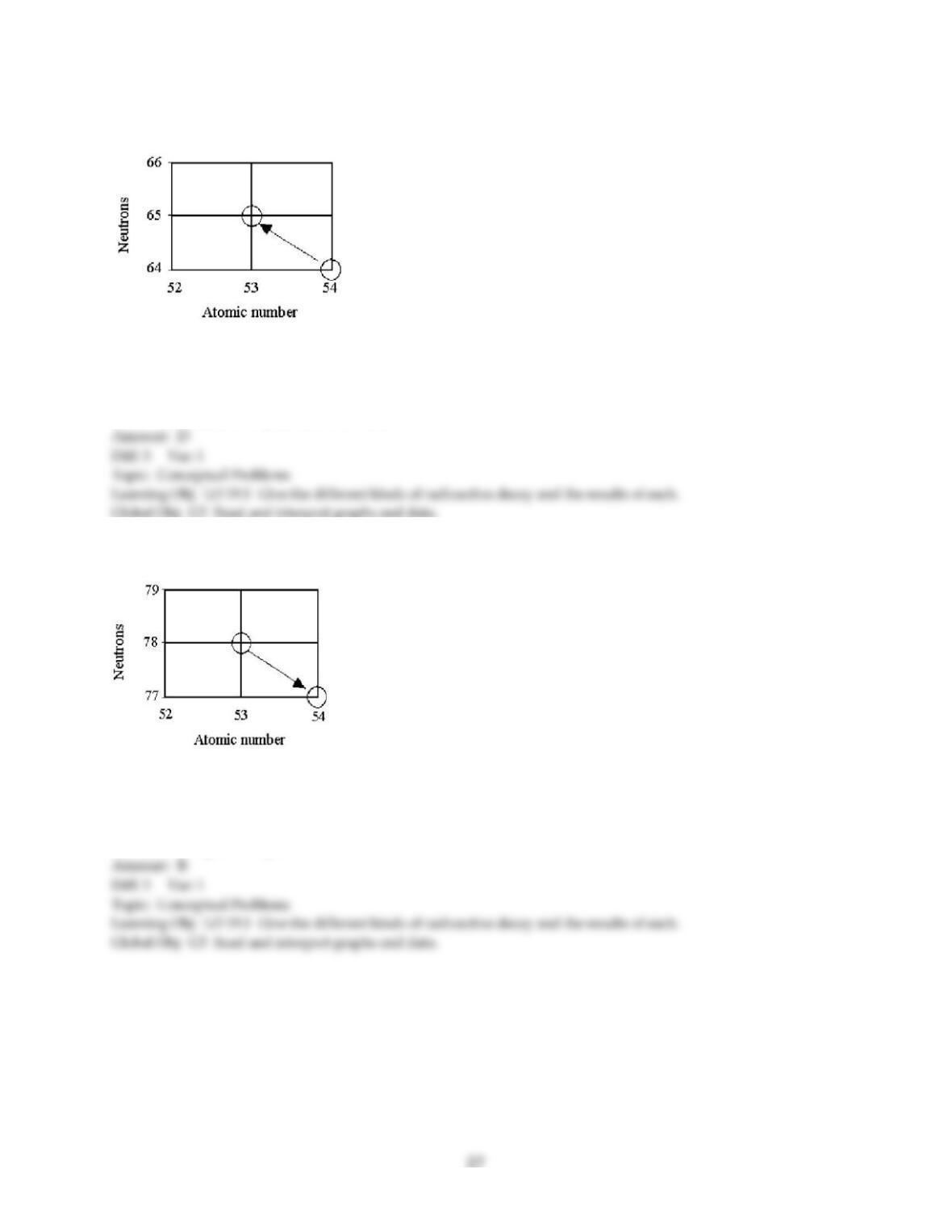
94) Tell the type of decay process occurring in the following nuclear reaction.
A) α emission
B) β emission
C) γ emission
D) electron capture or positron emission
95) Tell the type of decay process occurring in the following nuclear reaction.
A) α emission
B) β emission
C) γ emission
D) electron capture or positron emission
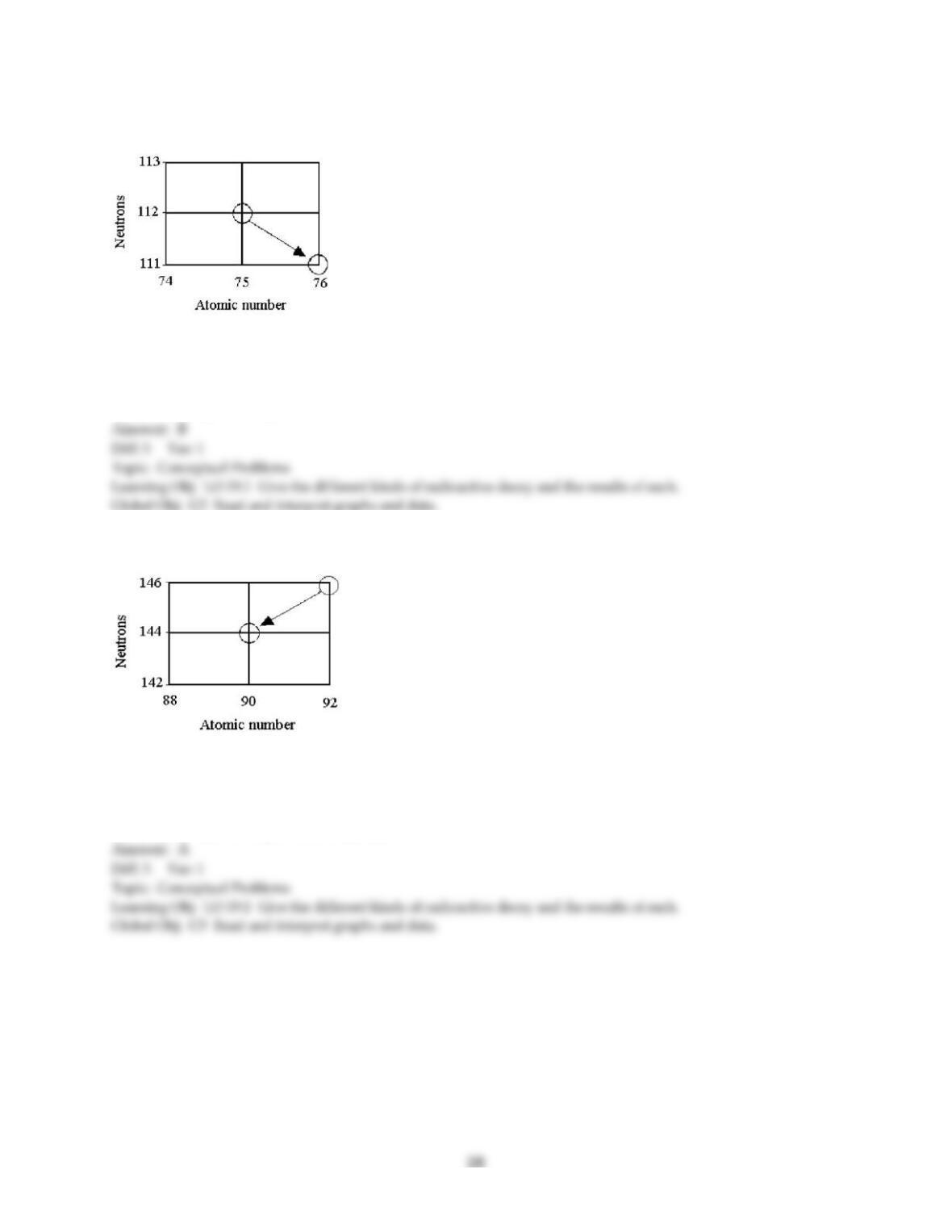
96) Tell the type of decay process occurring in the following nuclear reaction.
A) α emission
B) β emission
C) γ emission
D) electron capture or positron emission
97) Tell the type of decay process occurring in the following nuclear reaction.
A) α emission
B) β emission
C) γ emission
D) electron capture or positron emission
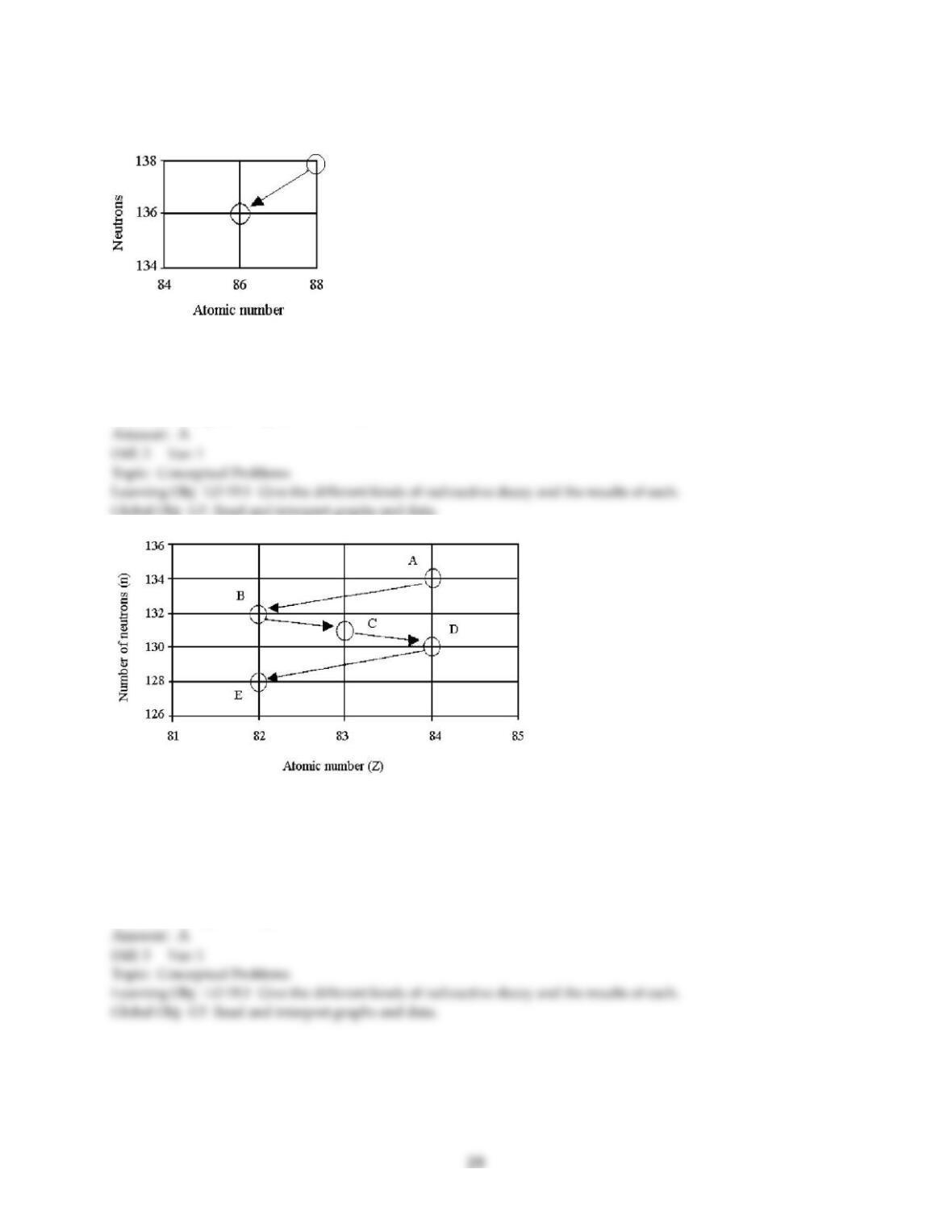
98) Tell the type of decay process occurring in the following nuclear reaction.
A) α emission
B) β emission
C) γ emission
D) electron capture or positron emission
99) What kind of decay process is occurring in the decay of isotope A to isotope B in the figure shown
above?
A) α emission
B) β emission
C) γ emission
D) electron capture or positron emission
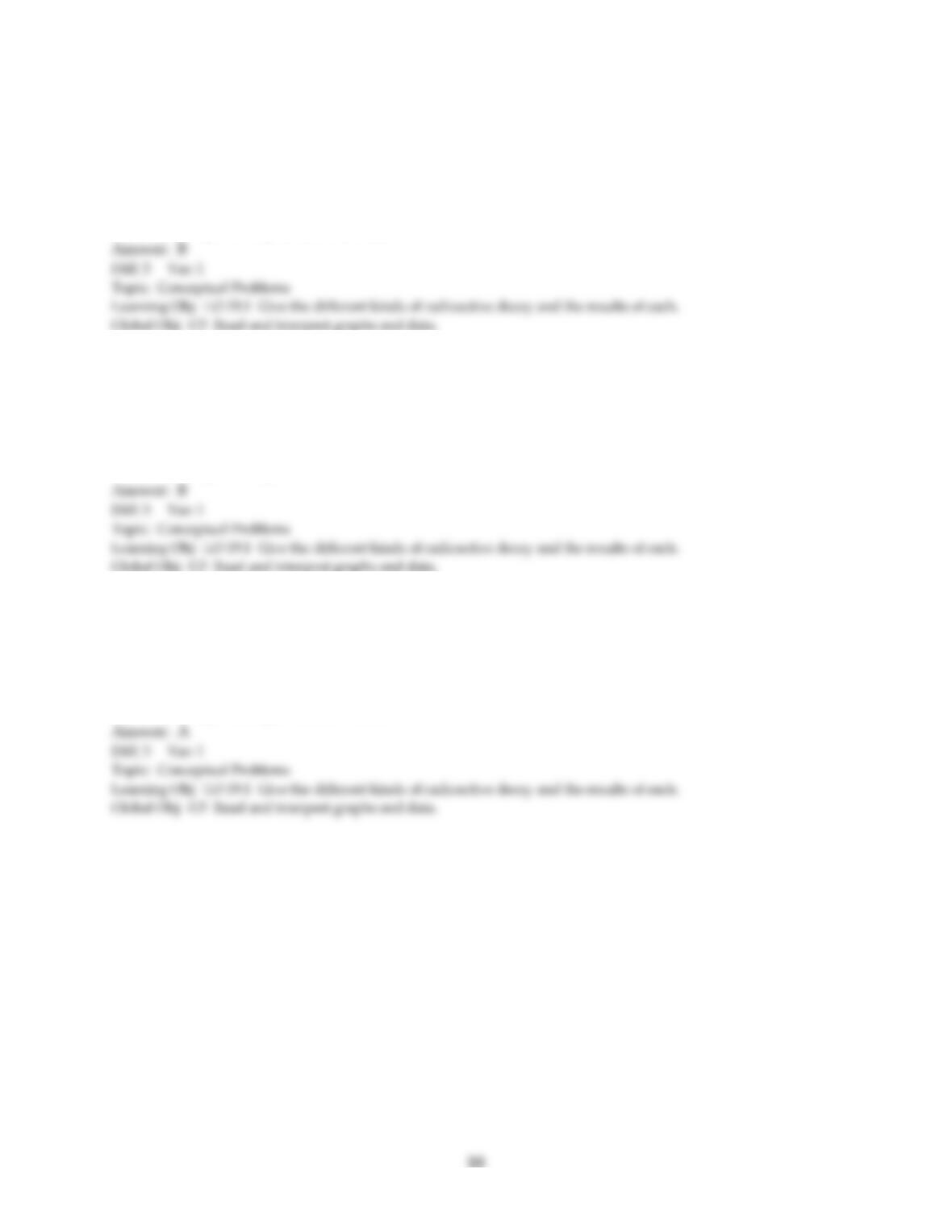
100) What kind of decay process is occurring in the decay of isotope B to isotope C in the figure shown
above?
A) α emission
B) β emission
C) γ emission
D) electron capture or positron emission
101) What kind of decay process is occurring in the decay of isotope C to isotope D in the figure shown
above?
A) α emission
B) β emission
C) γ emission
D) electron capture or positron emission
102) What kind of decay process is occurring in the decay of isotope D to isotope E in the figure shown
above?
A) α emission
B) β emission
C) γ emission
D) electron capture or positron emission
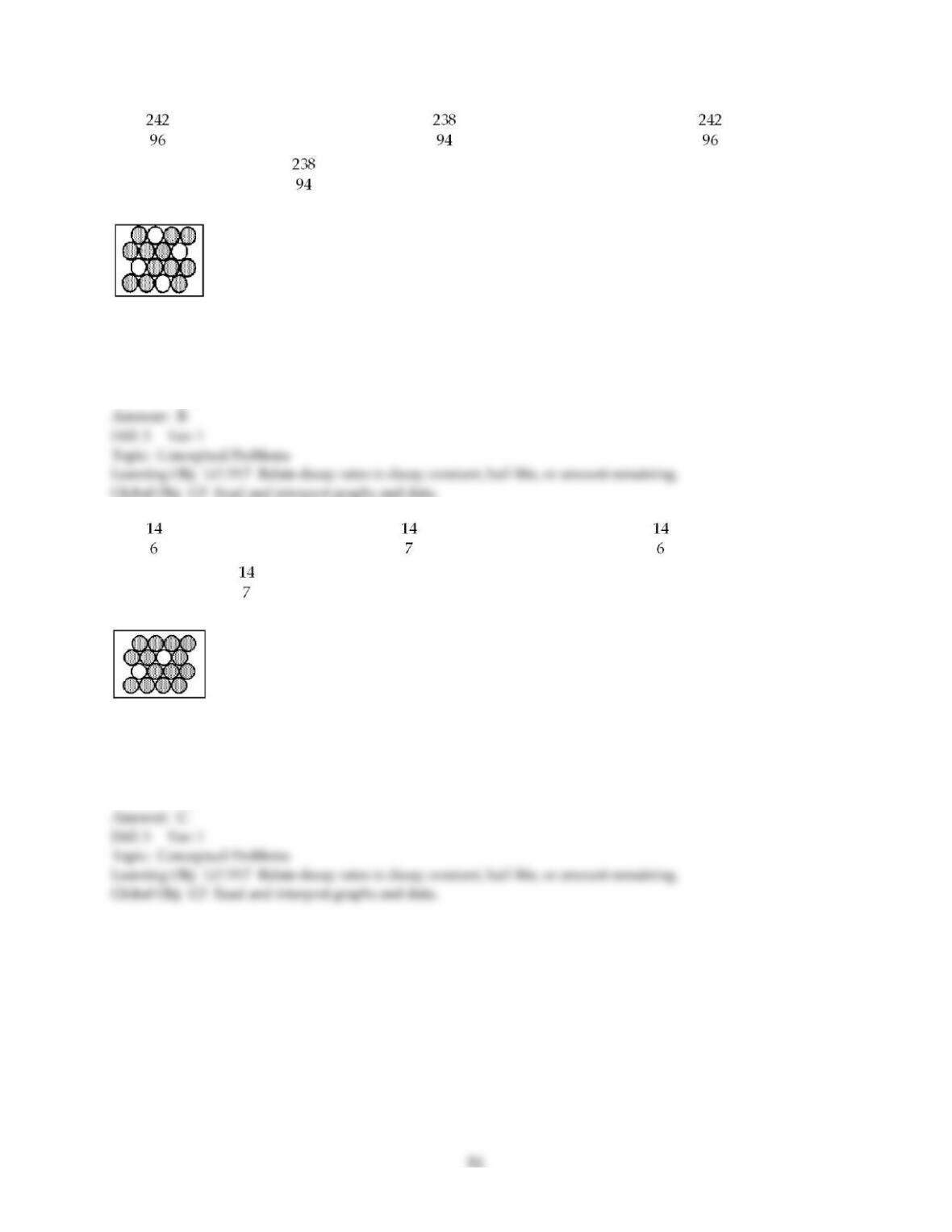
103) Cm decays by alpha emission to give Pu. If unshaded spheres represent Cm atoms and
shaded spheres represent Pu atoms, how many half-lives have passed in the following example?
A) 1 half-life
B) 2 half-lives
C) 3 half-lives
D) 4 half-lives
104) C decays by beta emission to give N. If unshaded spheres represent C atoms and shaded
spheres represent N atoms, how many half-lives have passed in the following example?
A) 1 half-life
B) 2 half-lives
C) 3 half-lives
D) 4 half-lives
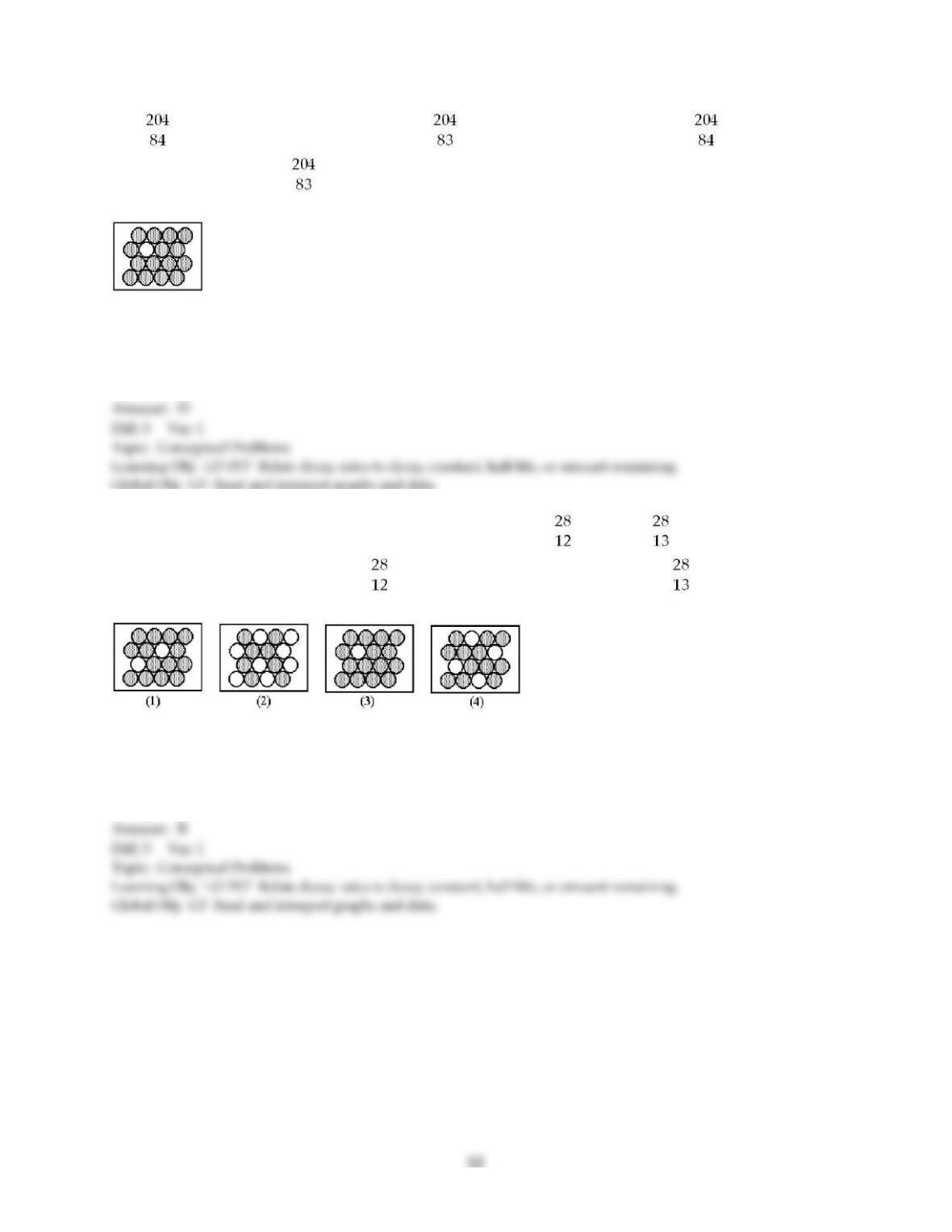
105) Po decays by electron capture to give Bi. If unshaded spheres represent Po atoms and
shaded spheres represent Bi atoms, how many half-lives have passed in the following example?
A) 1 half-life
B) 2 half-lives
C) 3 half-lives
D) 4 half-lives
106) Which of the following figures represents the beta decay of Mg to give Al after one half-life has
passed? Unshaded spheres represent Mg atoms and shaded spheres represent Al atoms.
A) figure (1)
B) figure (2)
C) figure (3)
D) figure (4)
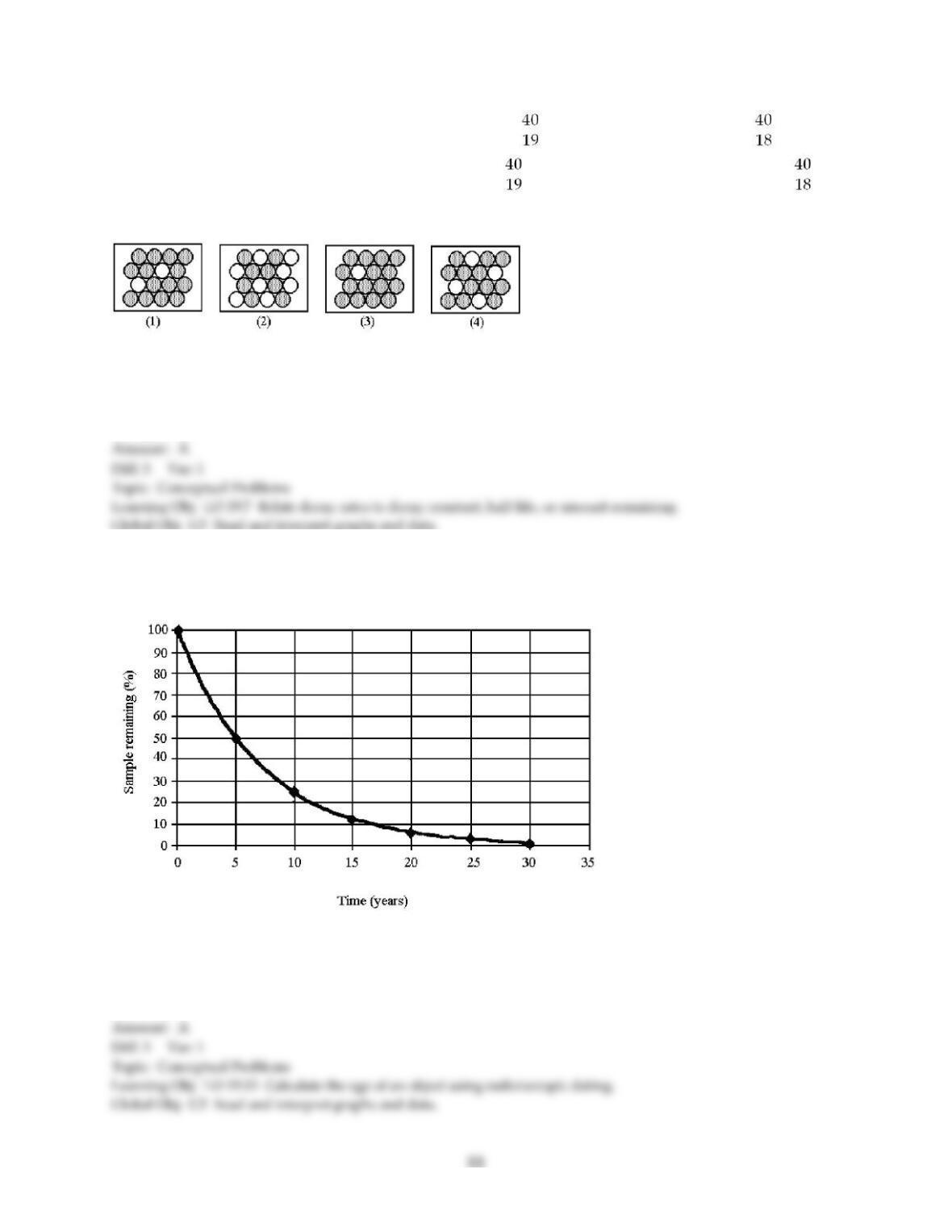
107) Which of the following figures represents the decay of K by positron emission to give Ar after
three half-lives has passed? Unshaded spheres represent K atoms and shaded spheres represent Ar
atoms.
A) figure (1)
B) figure (2)
C) figure (3)
D) figure (4)
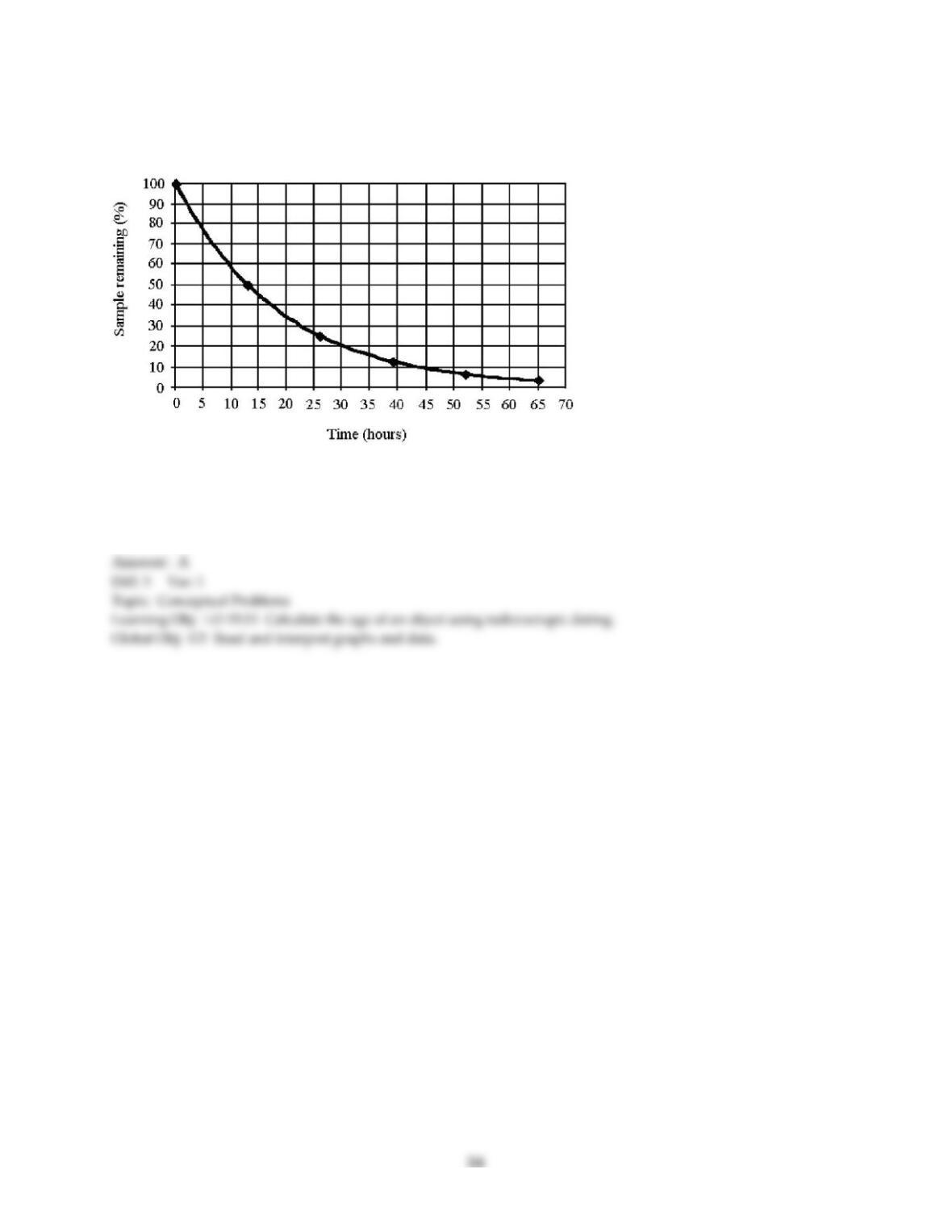
108) The decay curve shown below approximates the decay of cobalt-60. What is the approximate half-life
of cobalt-60?
A) 5 years
B) 12.5 years
C) 15 years
D) 17.5 years
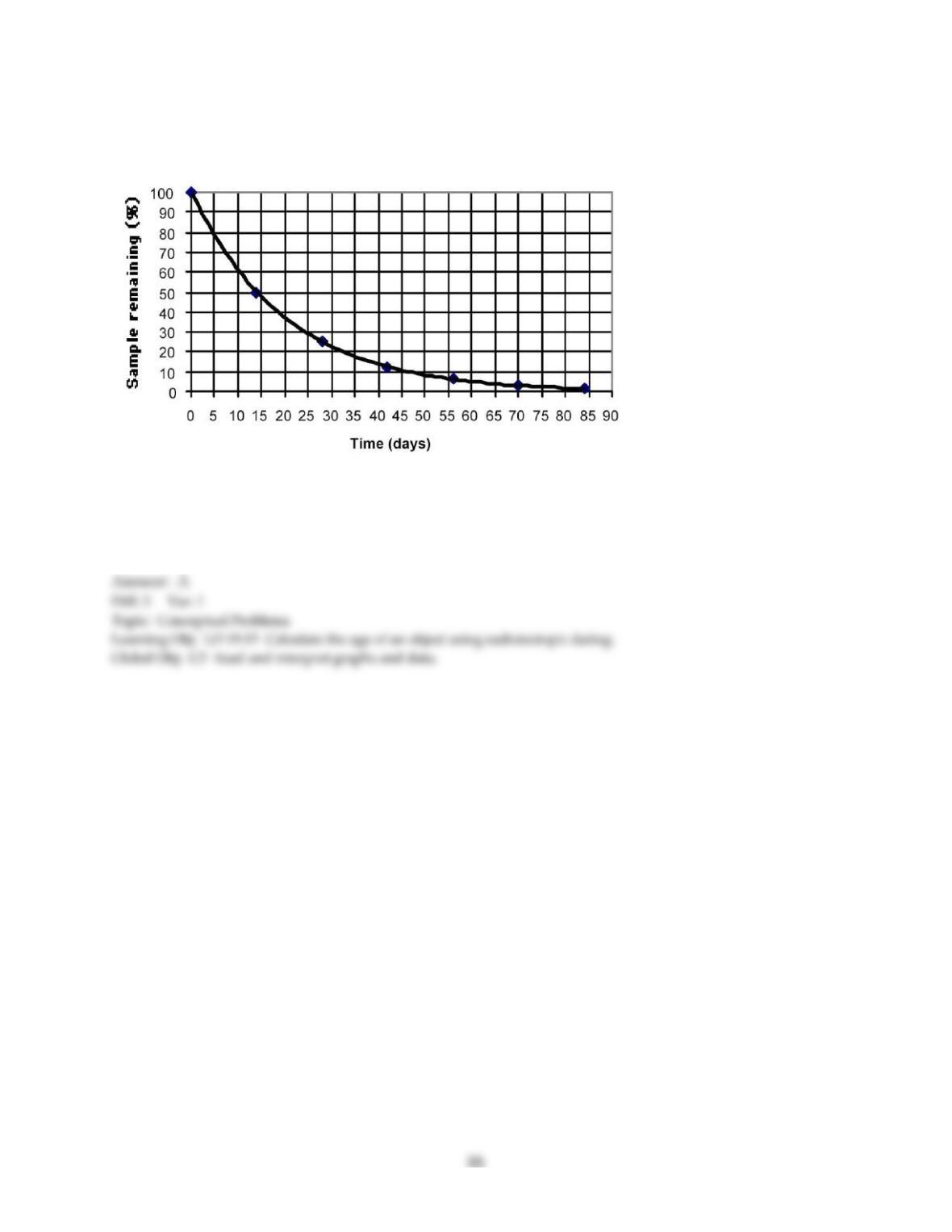
109) The decay curve shown below approximates the decay of iodine-123. What is the approximate half–
life of iodine-123?
A) 13 hours
B) 26 hours
C) 32.5 hours
D) 35 hours
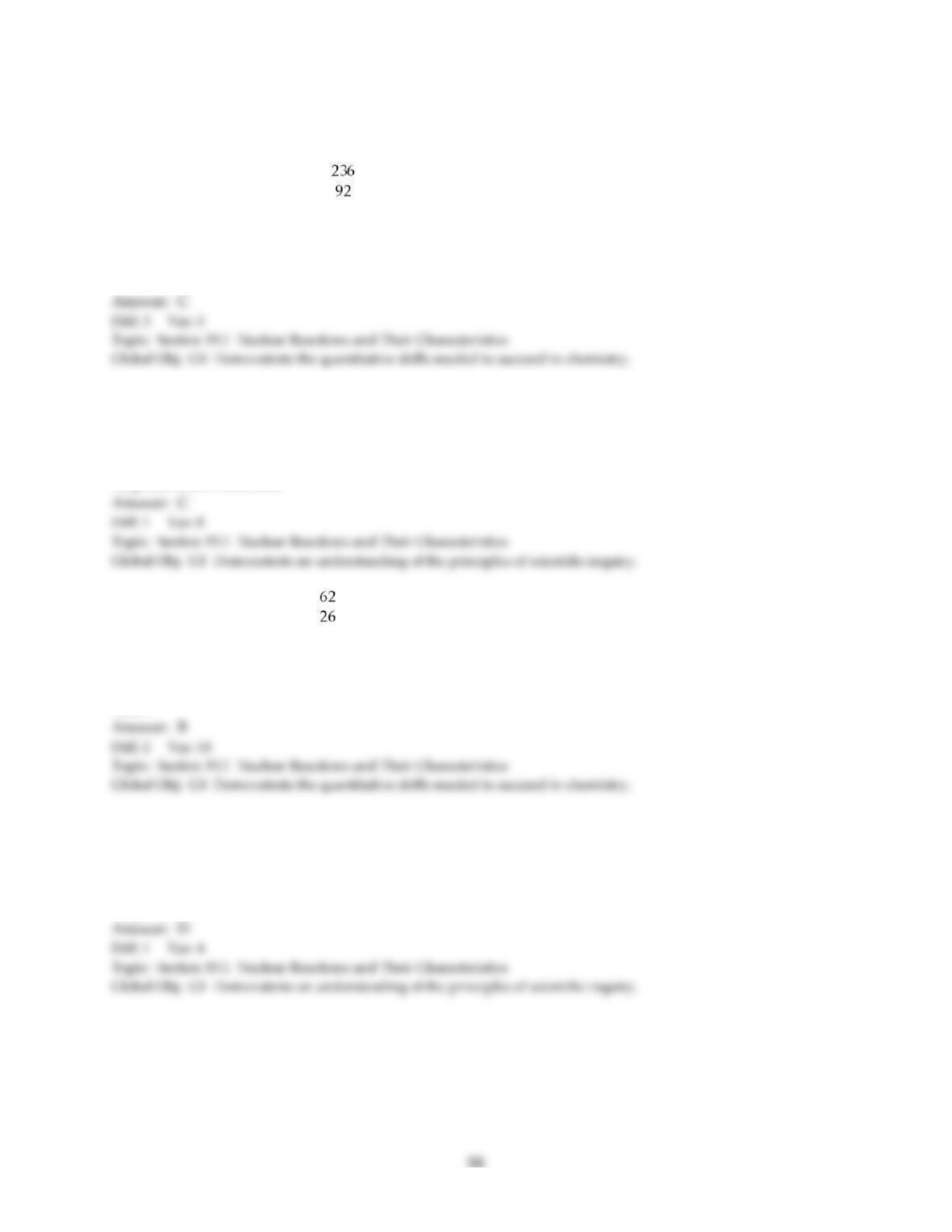
110) The decay curve shown below approximates the decay of phosphorus-32. What is the approximate
half-life of phosphorus-32?
A) 14 days
B) 27 days
C) 35 days
D) 37.5 days
19.2 Algorithmic Questions
1) The number of nucleons in a U2+
nucleus is
A) 92.
B) 144.
C) 236.
D) 328.
2) The term “nucleons” refers to the number of ________ in the atom.
A) neutrons and electrons
B) electrons
C) protons and neutrons
D) protons and electrons
3) The number of neutrons in Fe2+ is
A) 26.
B) 36.
C) 60.
D) 62.
4) “Isotopes” are atoms with the same number of ________ but different number of ________.
A) electrons, neutrons
B) neutrons, protons
C) protons, electrons
D) protons, neutrons