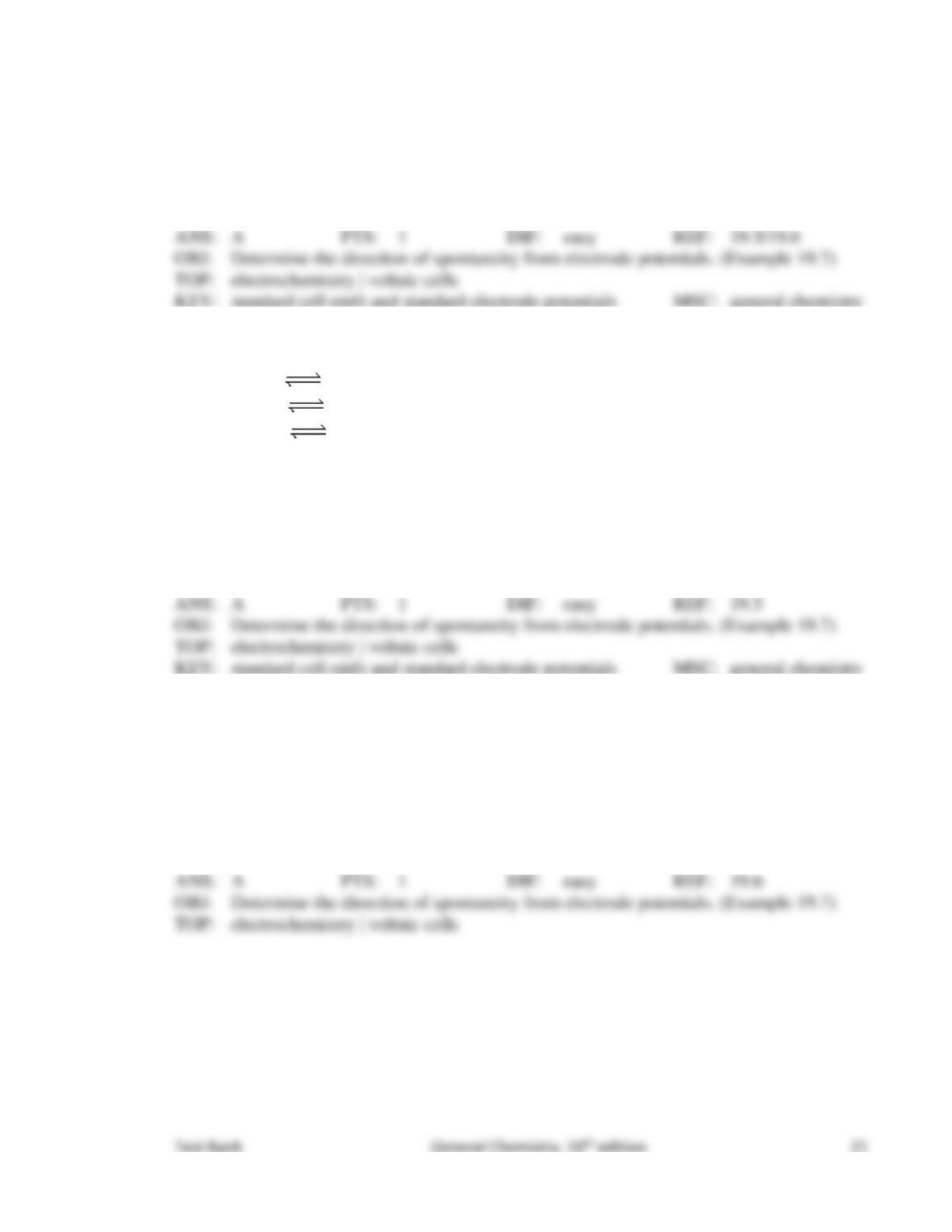
Which of the following reactions will proceed spontaneously from left to right under
standard-state conditions?
A)
Mg(s) + 2Cu2+(aq) → Mg2+(aq) + 2Cu+(aq)
B)
V2+(aq) + 2Cu+(aq) → V(s) + 2Cu2+(aq)
C)
Mg2+(aq) + 2Cu+(aq) → 2Cu2+(aq) + Mg(s)
D)
Mg2+(aq) + V(s) → V2+(aq) + Mg(s)
E)
2Cu2+(aq) + 2Cu+(aq) → Mg2+(aq) + Mg(s)
59. Consider the following standard reduction potentials:
2H+(aq) + 2e– H2(g); E° = 0.00 V
Sn2+(aq) + 2e– Sn(s); E° = –0.15 V
Cd2+(aq) + 2e– Cd(s); E° = –0.40 V
Which pair of substances will react spontaneously under standard-state conditions?
A)
Cd with H+
B)
Cd with Sn
C)
Sn2+ with Cd2+
D)
Sn with Cd2+
E)
Sn2+ with H+
60. For a certain oxidation–reduction reaction, E°cell is positive. This means that
A)
G° is negative and K is greater than 1.
B)
G° is positive and K is less than 1.
C)
G° is positive and K is greater than 1.
D)
G° is negative and K is less than 1.
E)
G° is zero and K is greater than 1.
Test Bank General Chemistry, 10th edition 22
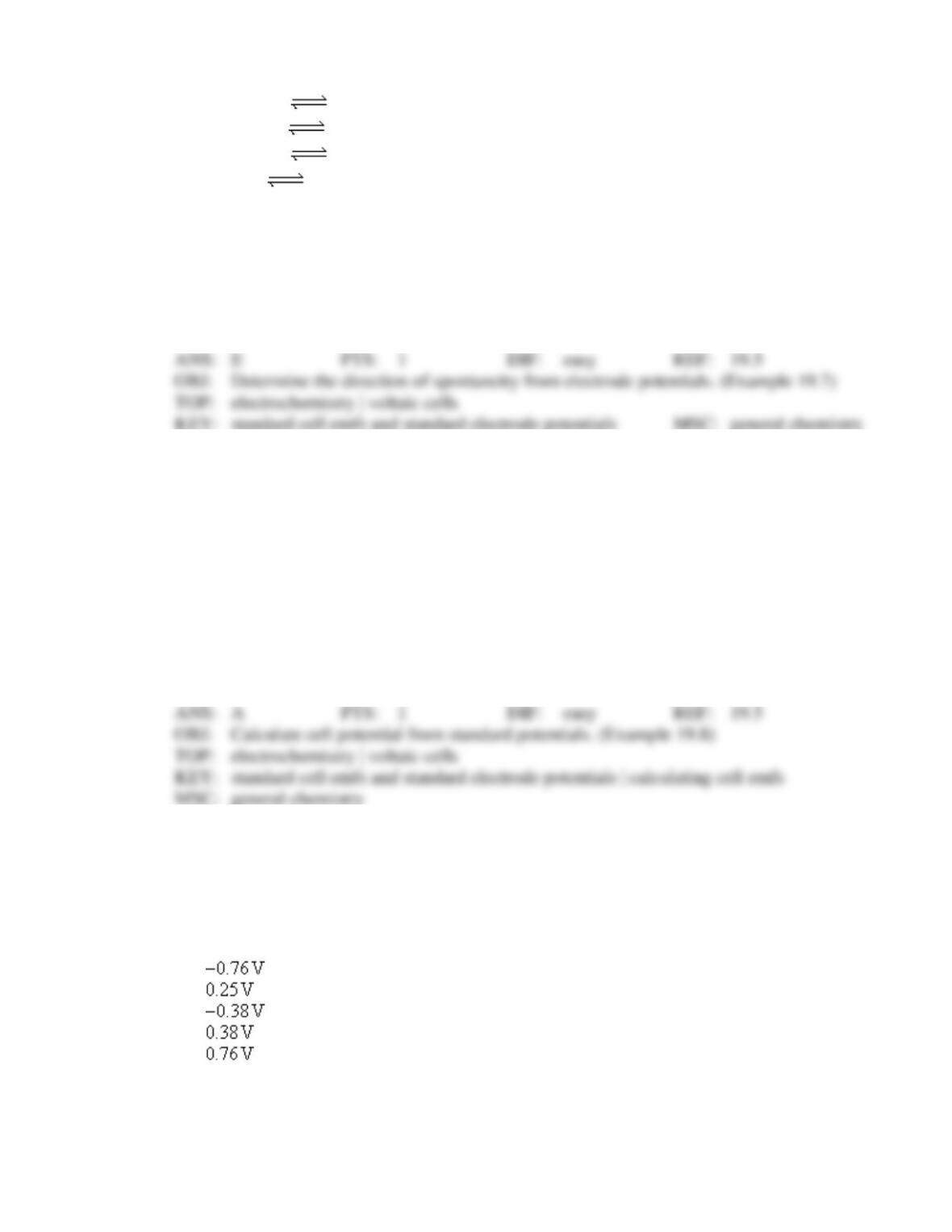
61. Consider the following reduction potentials:
Cd2+(aq) + 2e– Cd(s); E° = –0.40 V
Pb2+(aq) + 2e– Pb(s); E° = –0.13 V
Cu2+(aq) + 2e– Cu(s); E° = 0.34 V
Br2(l) + 2e– 2Br–(aq); E° = 1.07 V
Under standard-state conditions, which of the following reactions is spontaneous?
A)
Cd2+(aq) + Pb(s) → Cd(s) + Pb2+(aq)
B)
Pb2+(aq) + Cu(s) → Pb(s) + Cu2+(aq)
C)
2Br–(aq) + Pb2+(aq) → Br2(l) + Pb(s)
D)
2Br–(aq) + Cu2+(aq) → Br2(l) + Cu(s)
E)
Cu2+(aq) + Cd(s) → Cu(s) + Cd2+(aq)
62. Consider the following cell reaction:
2Ag+(aq) + H2(g) → 2H+(aq) + 2Ag(s); E°cell = 0.80 V
Under standard-state conditions, what is E° for the following half-reaction?
Ag+(aq) + 2e– → Ag(s)
A)
0.80 V
B)
–0.40 V
C)
0.40 V
D)
–0.80 V
E)
1.10 V
63. Consider the following cell reaction:
Zn(s) + 2H+(aq) → Zn2+(aq) + H2(g); Ecell = 0.76V
Under standard-state conditions, what is E° for the following half-reaction?
Zn2+(aq) + 2e− → Zn(s)
A)
B)
C)
D)
E)
Test Bank General Chemistry, 10th edition 23
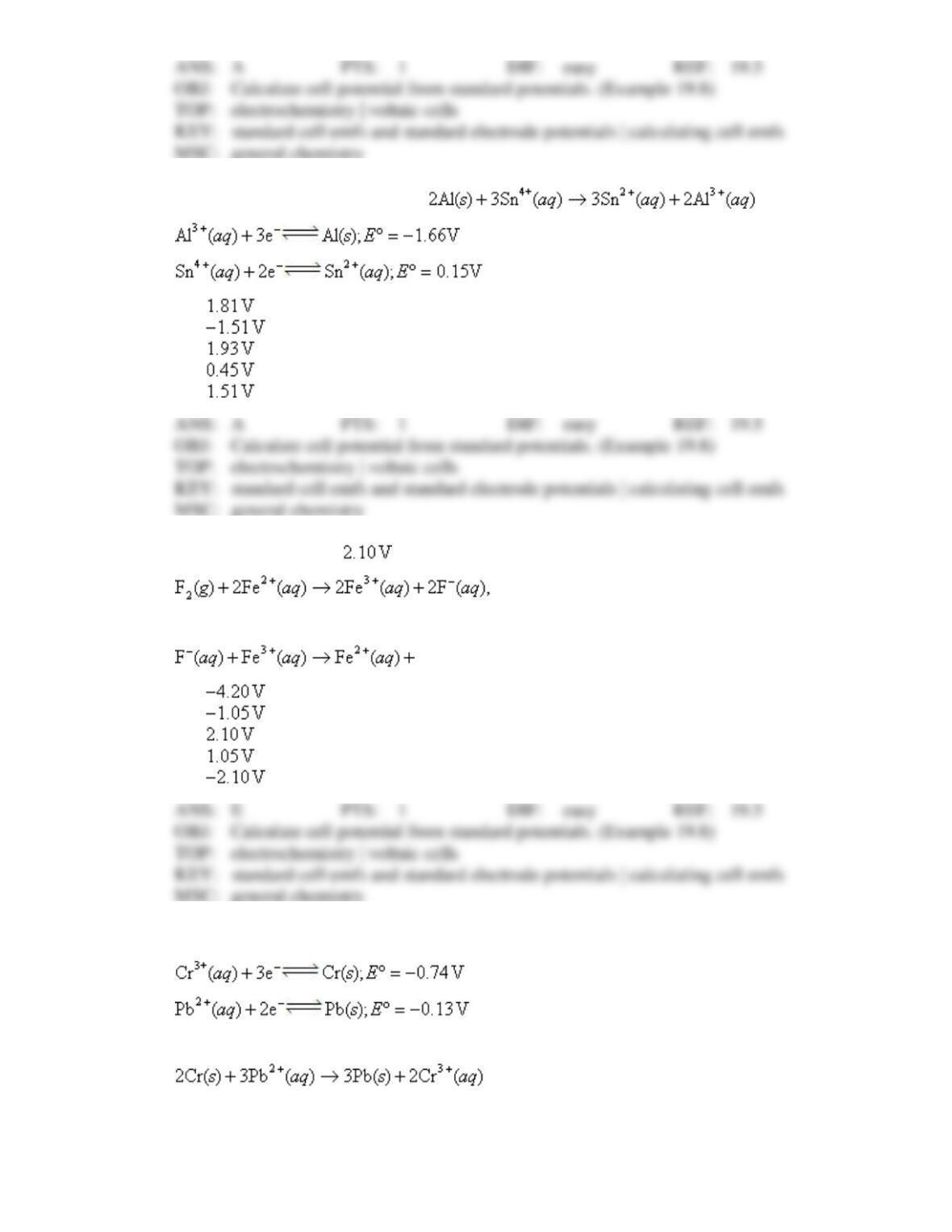
64. What is E°cell for the cell reaction ?
A)
B)
C)
D)
E)
65. If the value of E°cell is for the reaction
what is the value of E°cell for
½ F2(g) ?
A)
B)
C)
D)
E)
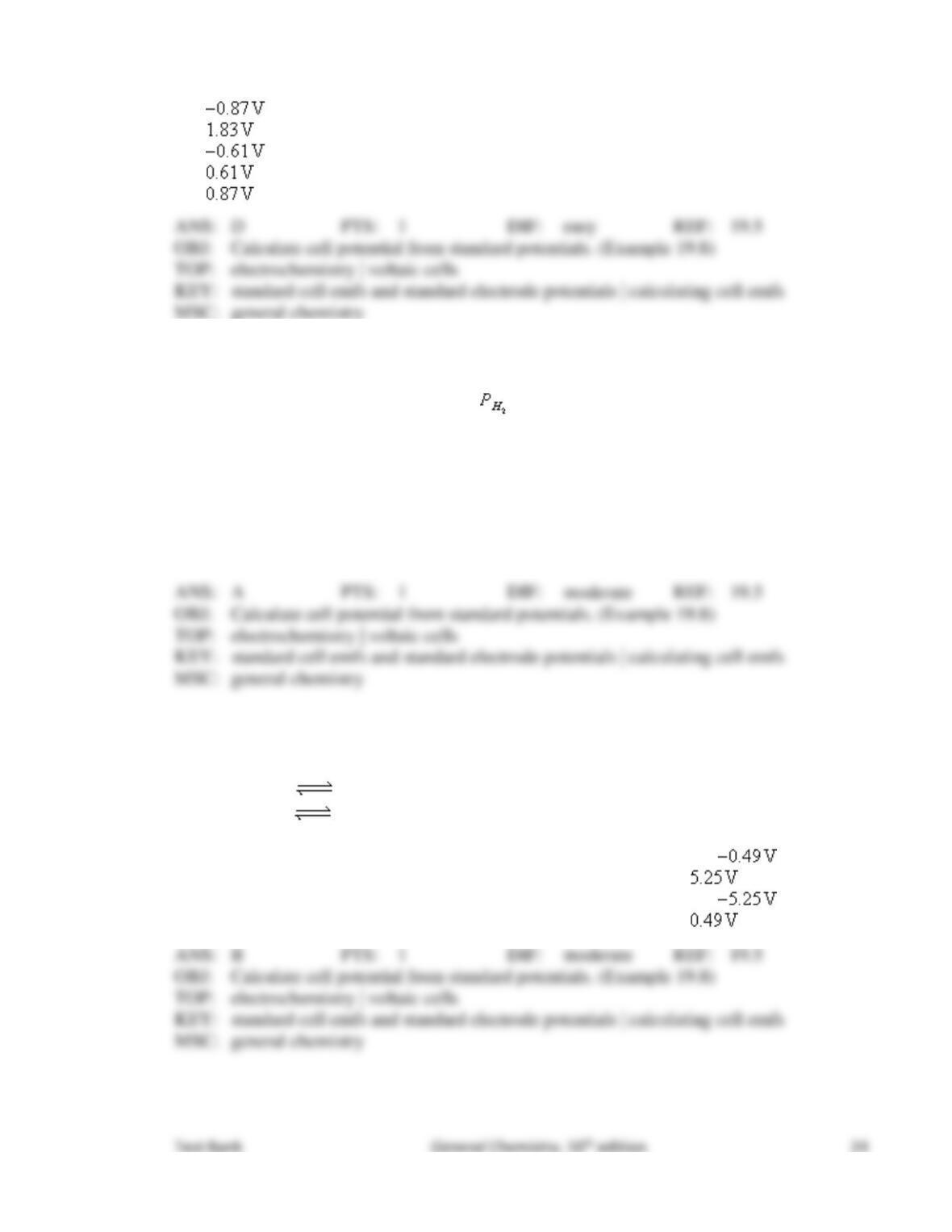
66. Given:
What is the standard cell potential for the following reaction?
A)
B)
C)
D)
E)
67. A voltaic cell is made by placing an iron electrode in a compartment in which the Fe2+
concentration is 2.0 10–5 M and by placing a Pt electrode in the other compartment, in
which the H+ concentration is 3.4 M and = 1.00 atm. The Fe2+/Fe half-cell reduction
potential is –0.41 V, and the H+/H2 half-cell reduction potential is 0.00 V. What is the value
of E° for this cell, and which electrode is the anode?
A)
0.41 V, Fe
B)
0.90 V, Pt
C)
–0.41 V, Pt
D)
–0.41 V, Fe
E)
0.41 V, Pt
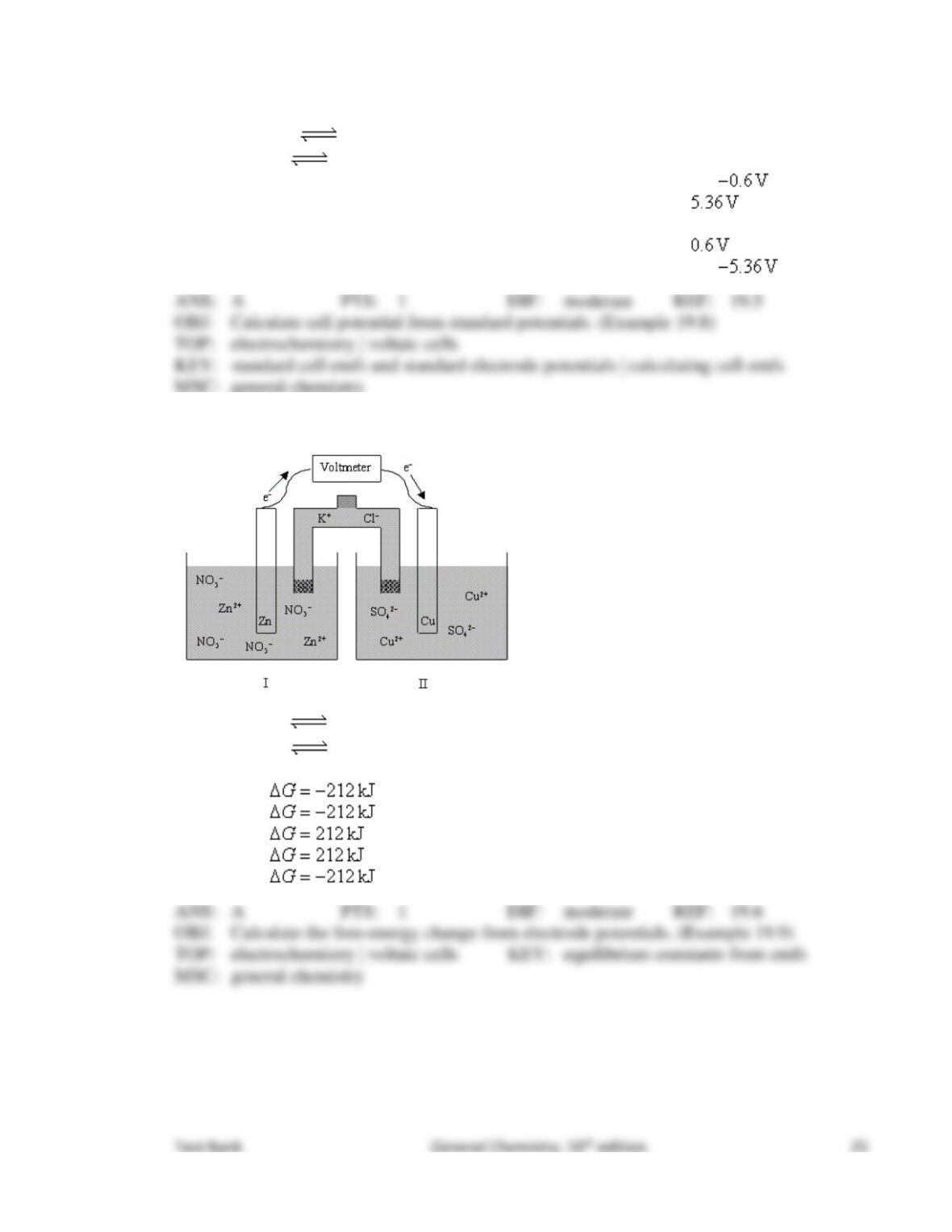
68. Which of the following statements is true concerning the electrochemical cell depicted
below?
Cu | Cu2+(aq) || Zn2+(aq) | Zn
Cu2+(aq) + 2e− Cu(s); E° = –2.38 V
Zn2+(aq) + 2e− Zn(s); E° = –2.87 V
A)
The cell is at equilibrium.
B)
The cell reaction is nonspontaneous with a standard cell potential of .
C)
The cell reaction is spontaneous with a standard cell potential of .
D)
The cell reaction is nonspontaneous with a standard cell potential of .
E)
The cell reaction is spontaneous with a standard cell potential of .
69. Which of the following statements is true concerning the hypthetical electrochemical cell
depicted below? (M1 and M2 are differing metals)
M1 | M12+(aq) || M2+(aq) | M2
M12+(aq) + 2e− M1(s); E° = –2.38 V
M22+(aq) + e− M2(s); E° = –2.98 V
A)
The cell reaction is nonspontaneous with a standard cell potential of .
B)
The cell reaction is spontaneous with a standard cell potential of .
C)
The cell is at equilibrium.
D)
The cell reaction is spontaneous with a standard cell potential of .
E)
The cell reaction is nonspontaneous with a standard cell potential of .
70. If the cell is initially at standard-state conditions, which of the following statements is true?
Zn2+(aq) + 2e– Zn(s); E° = –0.76 V
Cu2+(aq) + 2e– Cu(s); E° = 0.34 V
A)
Initially , and it will become more positive with time.
B)
Initially , and it will not change with time.
C)
Initially , and it will become more negative with time.
D)
Initially , and it will become more positive with time.
E)
Initially , and it will become more negative with time.
Test Bank General Chemistry, 10th edition 26
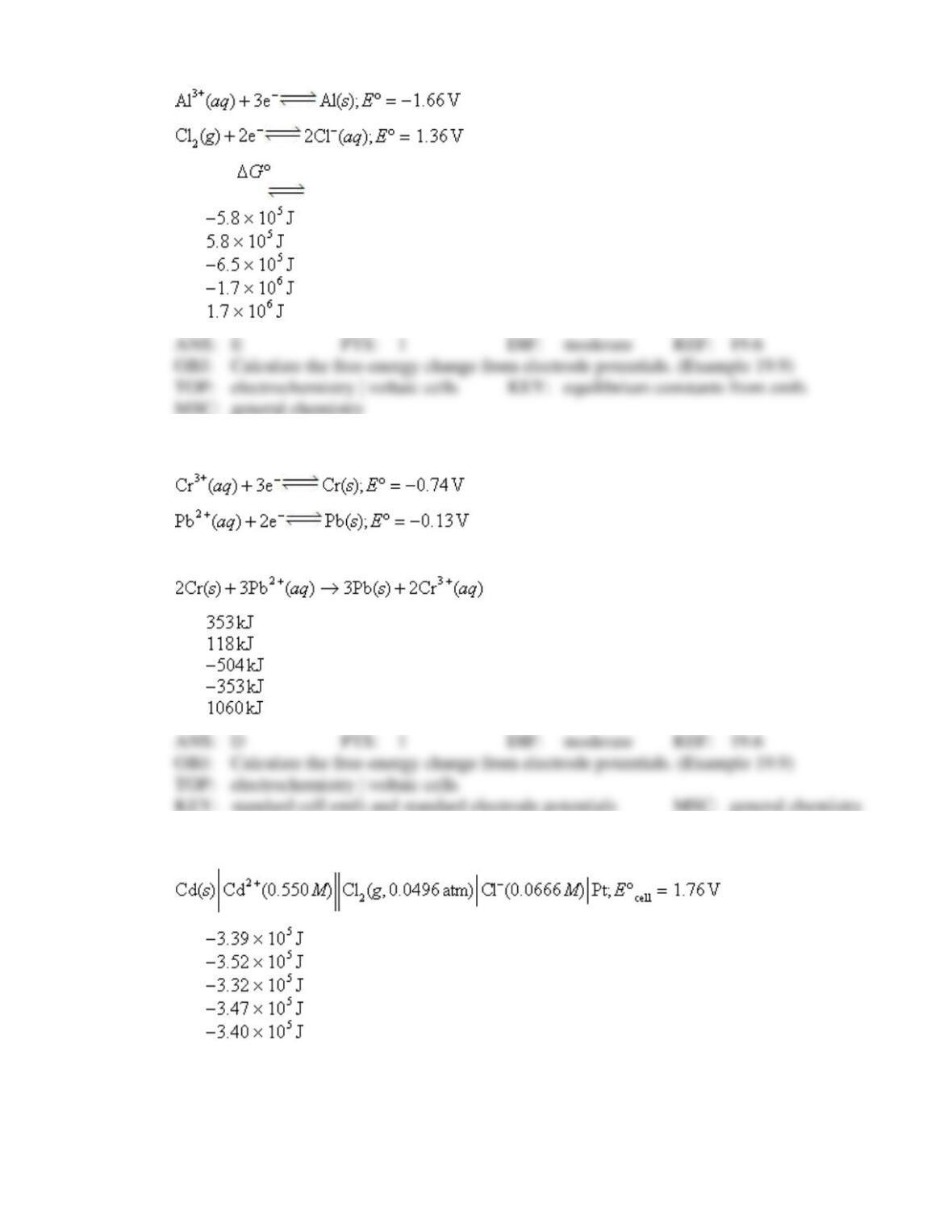
71. Given:
What is for the following cell reaction?
2AlCl3(aq) 2Al(s) + 3Cl2(g)
A)
B)
C)
D)
E)
72. Given:
What is the standard Gibbs free-energy change for the following reaction?
A)
B)
C)
D)
E)
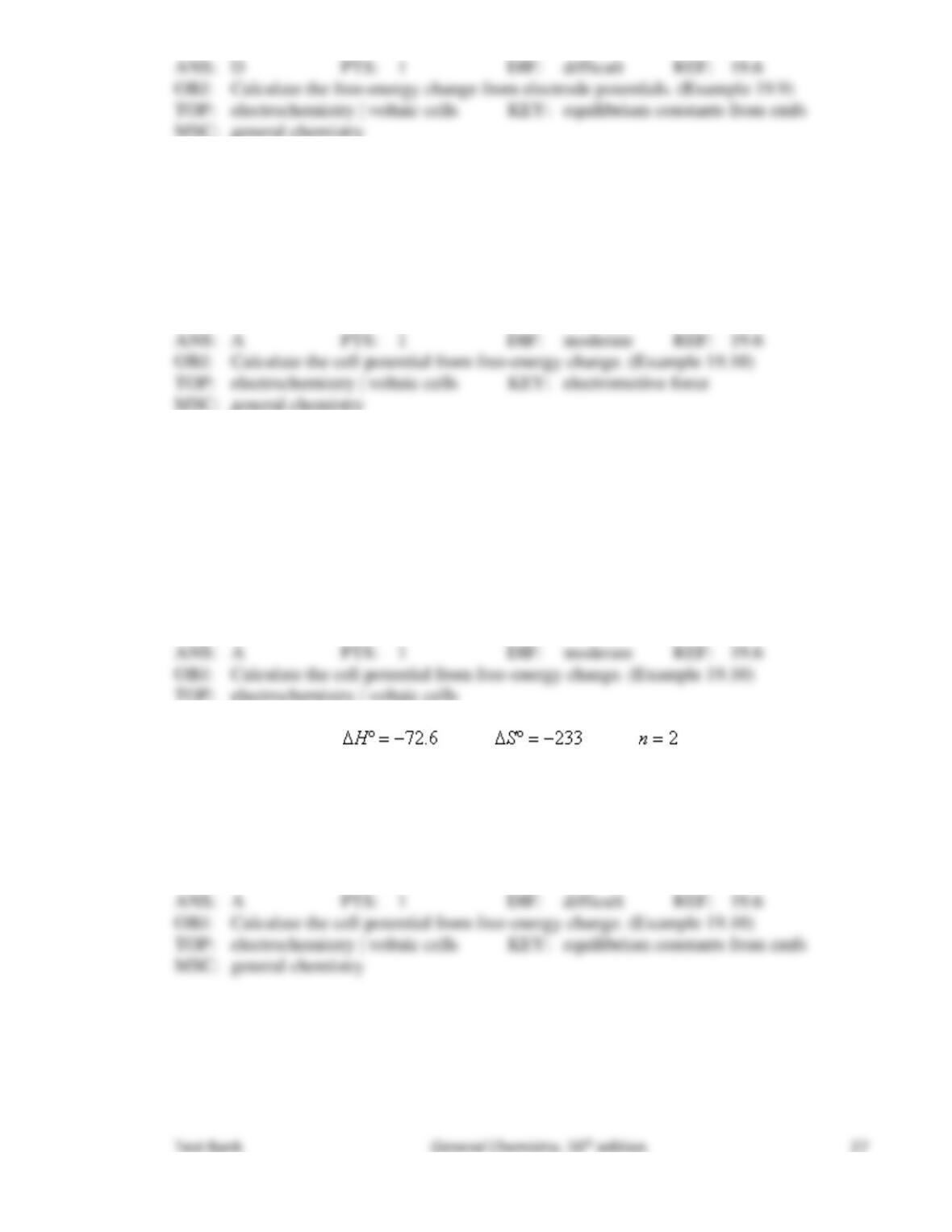
73. Calculate the maximum electrical work obtainable at 25oC from the following voltaic cell.
A)
B)
C)
D)
E)
74. For a reaction in a voltaic cell, both H° and S° are positive. Which of the following
statements is true?
A)
E°cell will increase with an increase in temperature.
B)
E°cell will not change when the temperature increases.
C)
E°cell will decrease with an increase in temperature.
D)
G° > 0 for all temperatures.
E)
None of the above statements is true.
75. If Ecell for a certain reaction is –1.68 V (n = 1), and S is 31.1 J/(Kmol), what is H in
units of J/mol at 25C?
A)
1.71 105
J/mol
B)
−1.53 105
J/mol
C)
1.63 105
J/mol
D)
−4.82 104
J/mol
E)
1.53 105
J/mol
76. For a certain reaction, kJ and J/K. If , calculate E°cell for the
reaction at 25°C.
A)
0.0164 V
B)
0.0961 V
C)
0.346 V
D)
0.736 V
E)
0.0654 V
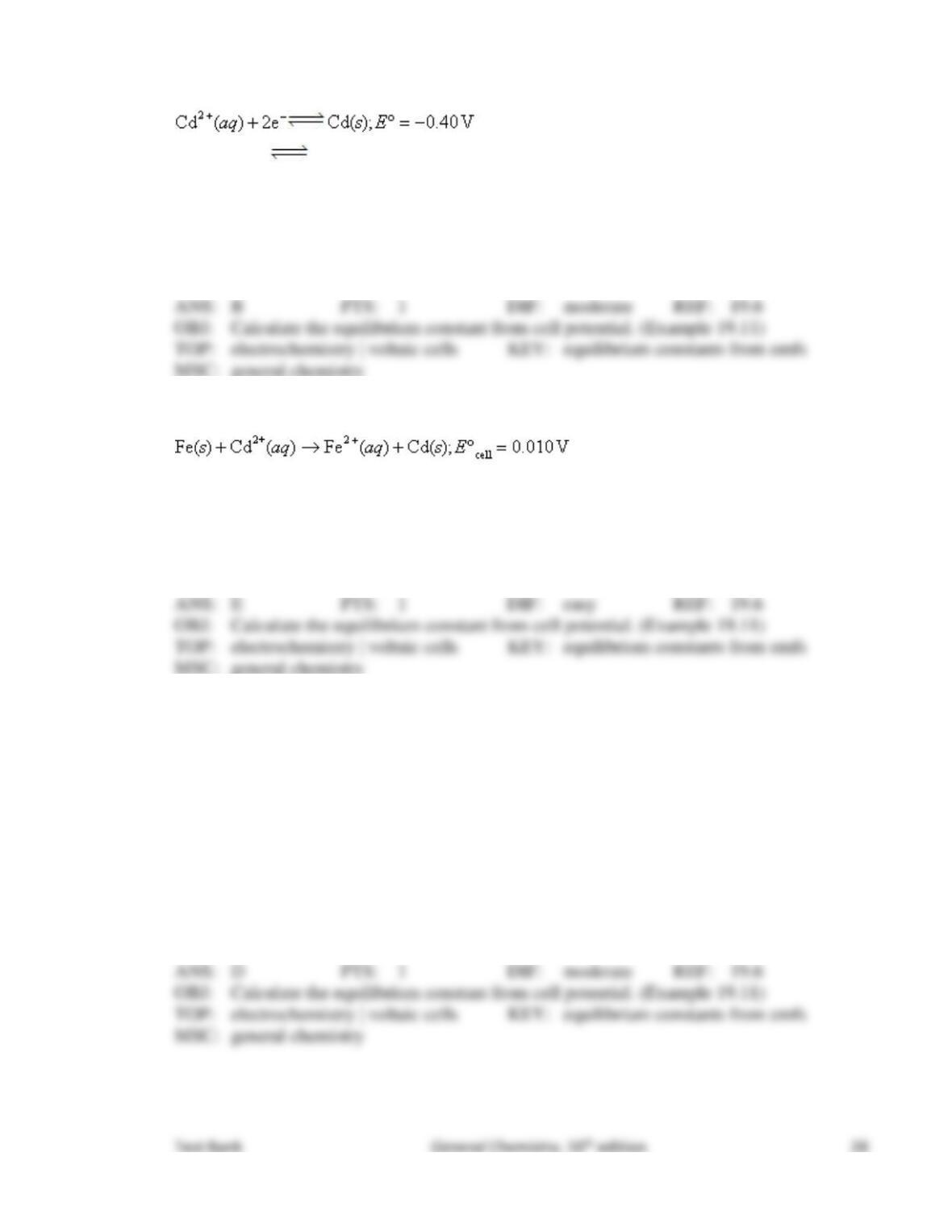
77. What is the logarithm of the equilibrium constant, log K, at 25°C of the voltaic cell
constructed from the following two half-reactions?
Ag+(aq) + e–Ag(s); E° = 0.80 V
A)
6.7
B)
40.6
C)
20.3
D)
13.5
E)
67.6
78. What is the equilibrium constant (K) at 25°C for the following cell reaction?
A)
0.010
B)
1.5
C)
0.25
D)
1.0
E)
2.2
79. Calculate the solubility product of silver iodide at 25°C given the following data:
E°(V)
AgI(s) + e– → Ag(s) + I–
–0.15
I2(s) + 2e– → 2I–
+0.54
Ag+ + e– → Ag(s)
+0.80
A)
2 10–12
B)
3 10–3
C)
2 10–24
D)
9 10–17
E)
2 10–4
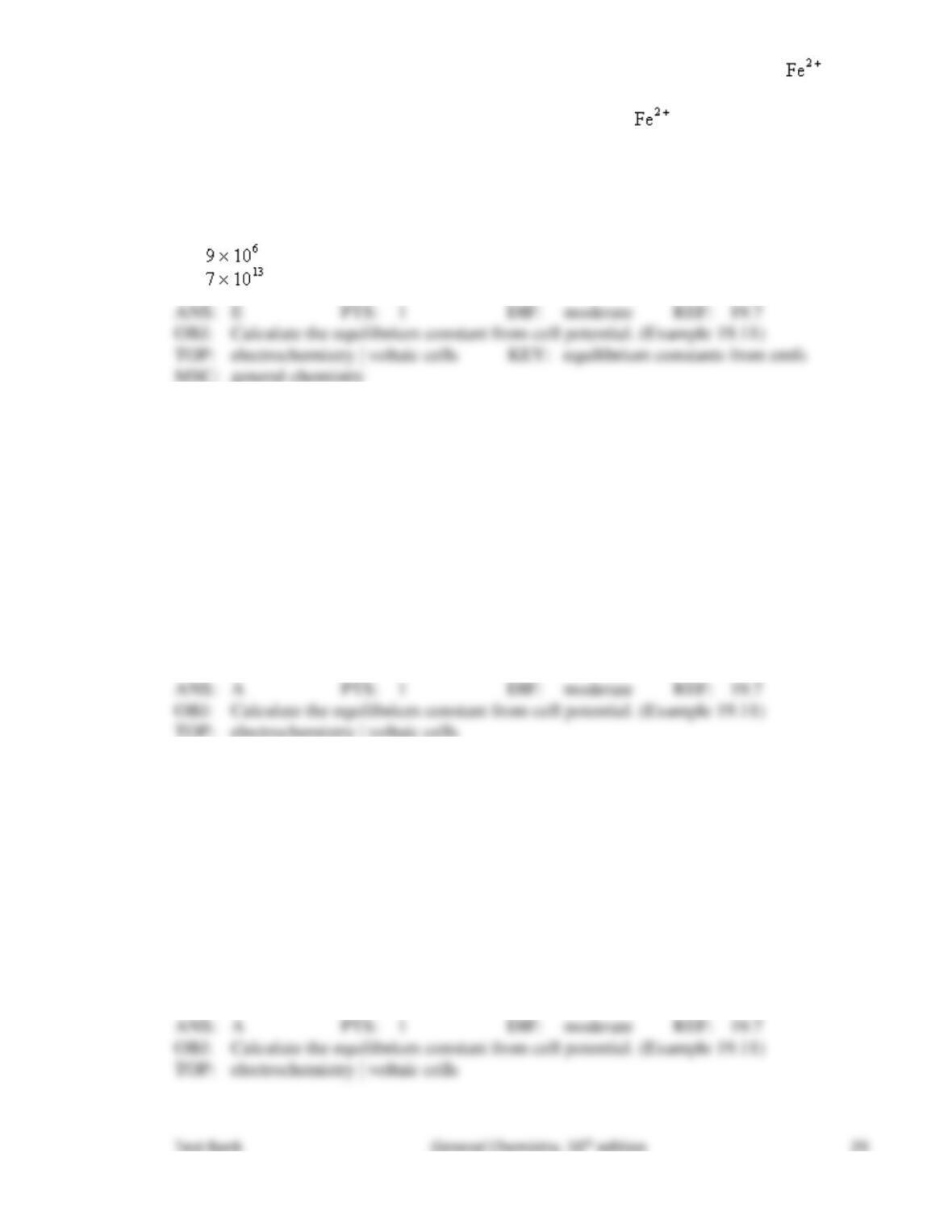
80. A voltaic cell is made by placing an iron electrode in a compartment in which the
concentration is 2.0 10–5 M and by placing a Pt electrode in the other compartment, in
which the H+ concentration is 3.4 M and PH2 = 1.00 atm. The /Fe half-cell reduction
potential is –0.41 V, and the H+/H2 half-cell reduction potential is 0.00 V. What is the
equilibrium constant at 25°C for the spontaneous cell reaction?
A)
4 104
B)
5 1020
C)
5 1022
D)
E)
81. The cell potential of the following cell is determined using an unspecified concentration of
acid. What is [H+] given that the measured cell potential is –0.366 V and the anode
reduction potential (E) is 0.222 V at 25C?
Ag(s) | AgCl(s) | Cl−(1.0 M) || H+(aq, ? M) | H2(g, 1.0 atm) | Pt(s)
A)
3.7 10−3
M
B)
1.2 10−10
M
C)
4.9 10−5
M
D)
1.4 10−5
M
E)
6.1 10−2
M
82. The cell potential of the following cell is determined using an unspecified concentration of
acid. What is the pH of the acid solution given that the measured cell potential is –0.562 V
and the anode reduction potential (E) is 0.222 V at 25C?
Ag(s) | AgCl(s) | Cl−(1.0 M) || H+(aq, ? M) | H2(g, 1.0 atm) | Pt(s)
A)
5.74
B)
13.2
C)
6.24
D)
11.5
E)
1.26
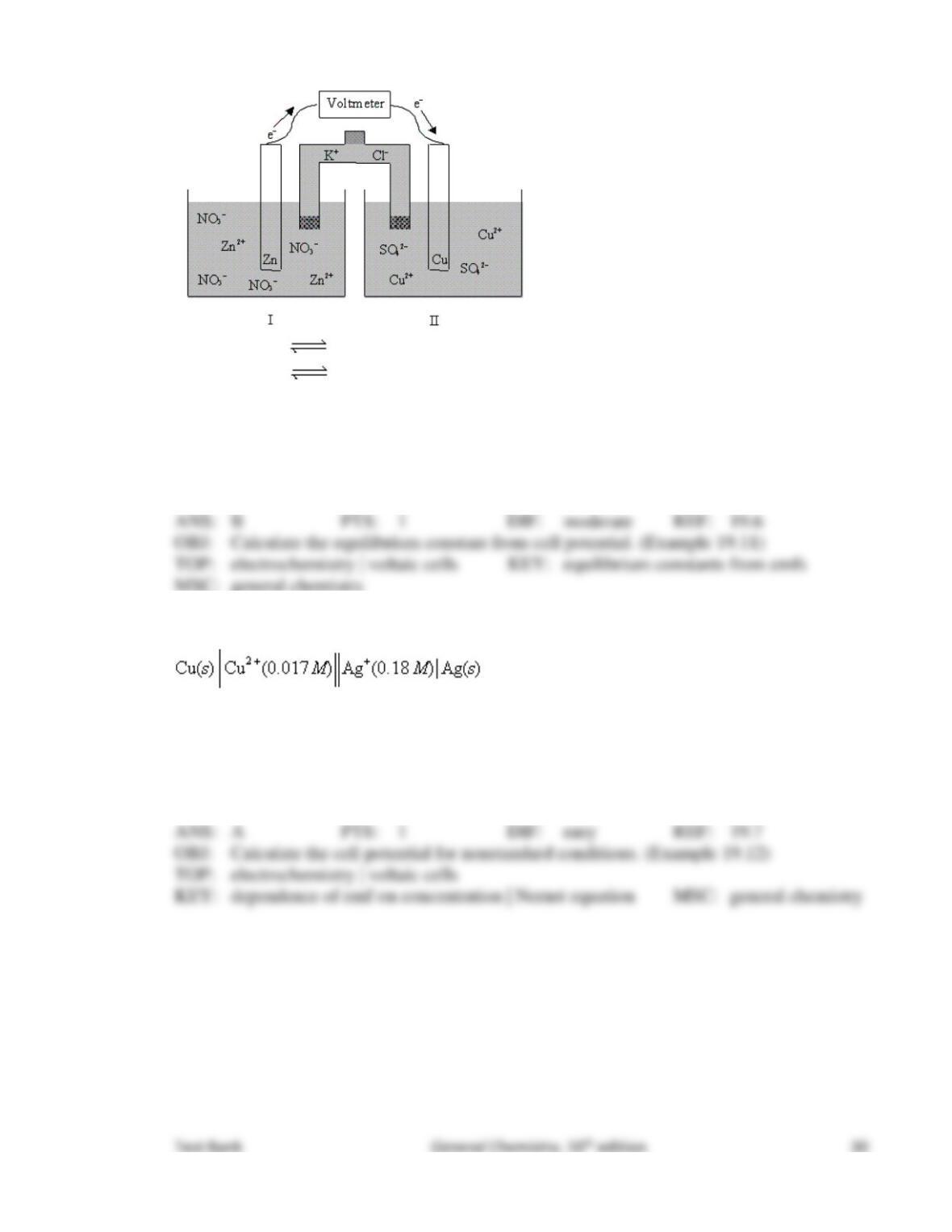
83. If the cell is initially at standard-state conditions, which of the following statements is true?
Zn2+(aq) + 2e– Zn(s); E° = –0.76 V
Cu2+(aq) + 2e– Cu(s); E° = 0.34 V
A)
Initially Kc = 2 10–37, and it decreases with time.
B)
Initially Kc = 2 1037, and it does not change with time.
C)
Initially Kc = 2 1037, and it decreases with time.
D)
Initially Kc = 2 1037, and it increases with time.
E)
Initially Kc = 2 10–37, and it increases with time.
84. What is E of the following cell reaction at 25°C? E°cell = 0.460 V.
A)
0.468 V
B)
0.282 V
C)
0.460 V
D)
0.490 V
E)
0.479 V
Test Bank General Chemistry, 10th edition 31
85. For the cell reaction
l)
the standard cell potential is 1.34 V. To determine the cell potential at nonstandard
conditions, what is the value that should be used for n in the Nernst equation?
A)
8
B)
10
C)
5
D)
2
E)
6
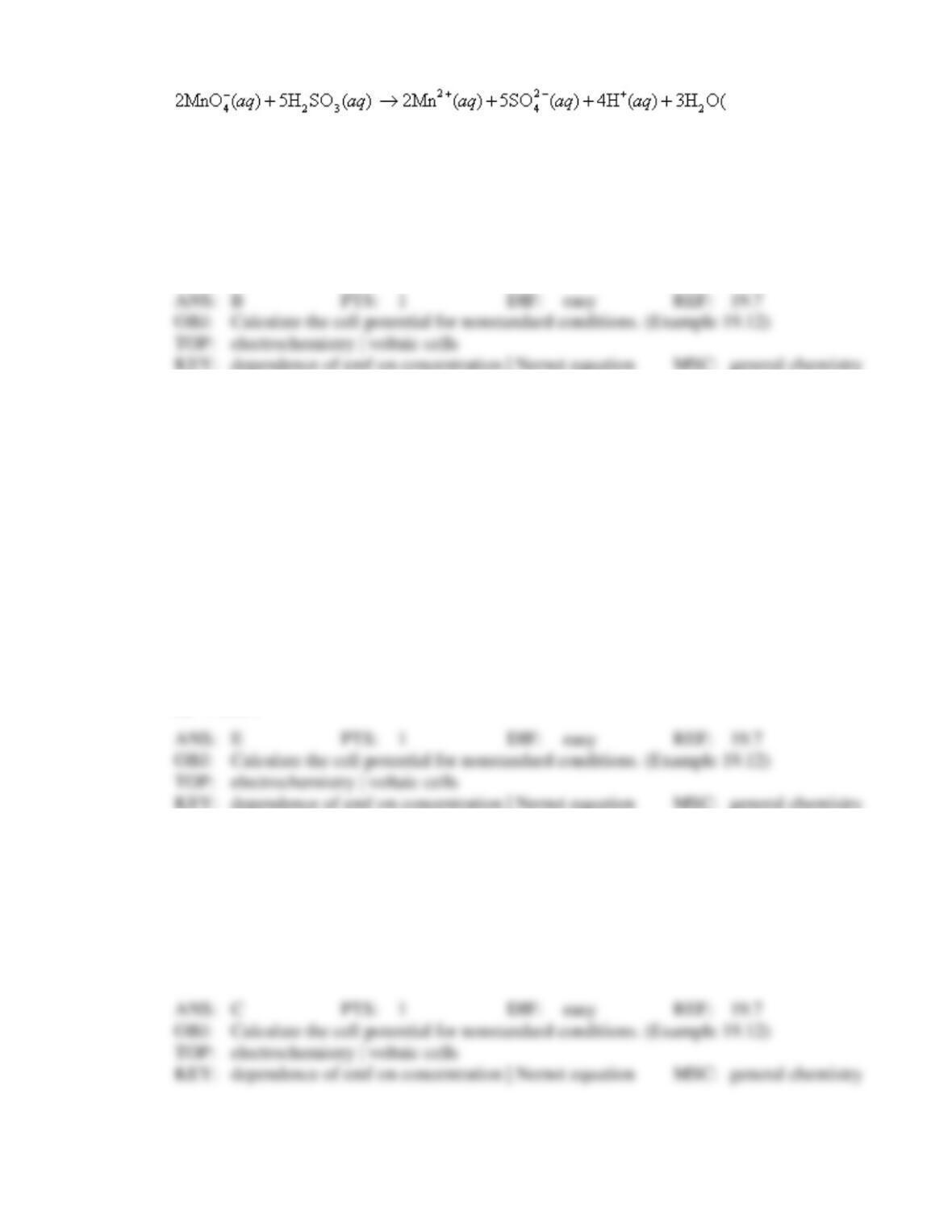
86. For the cell reaction
2MnO4–(aq) + 5H2SO3(aq) → 2Mn2+(aq) + 5SO42–(aq) + 4H+(aq) + 3H2O(l)
the standard cell potential is 1.34 V. Which change(s) will result in an increase in the cell
potential?
1.
increasing the permanganate-ion concentration
2.
decreasing the pH
3.
increasing the sulfurous acid concentration
A)
1 only
B)
2 only
C)
3 only
D)
1 and 2
E)
1 and 3
KEY: dependence of emf on concentration | Nernst equation MSC: general chemistry
87. What is the copper(II)-ion concentration at 25°C in the cell Zn(s) | Zn2+(1.0 M) || Cu2+(aq) |
Cu(s) if the measured cell potential is 1.01 V? The standard cell potential is 1.10 V.
A)
0.030 M
B)
0.99 M
C)
0.00091 M
D)
1.0 M
E)
0.99 M
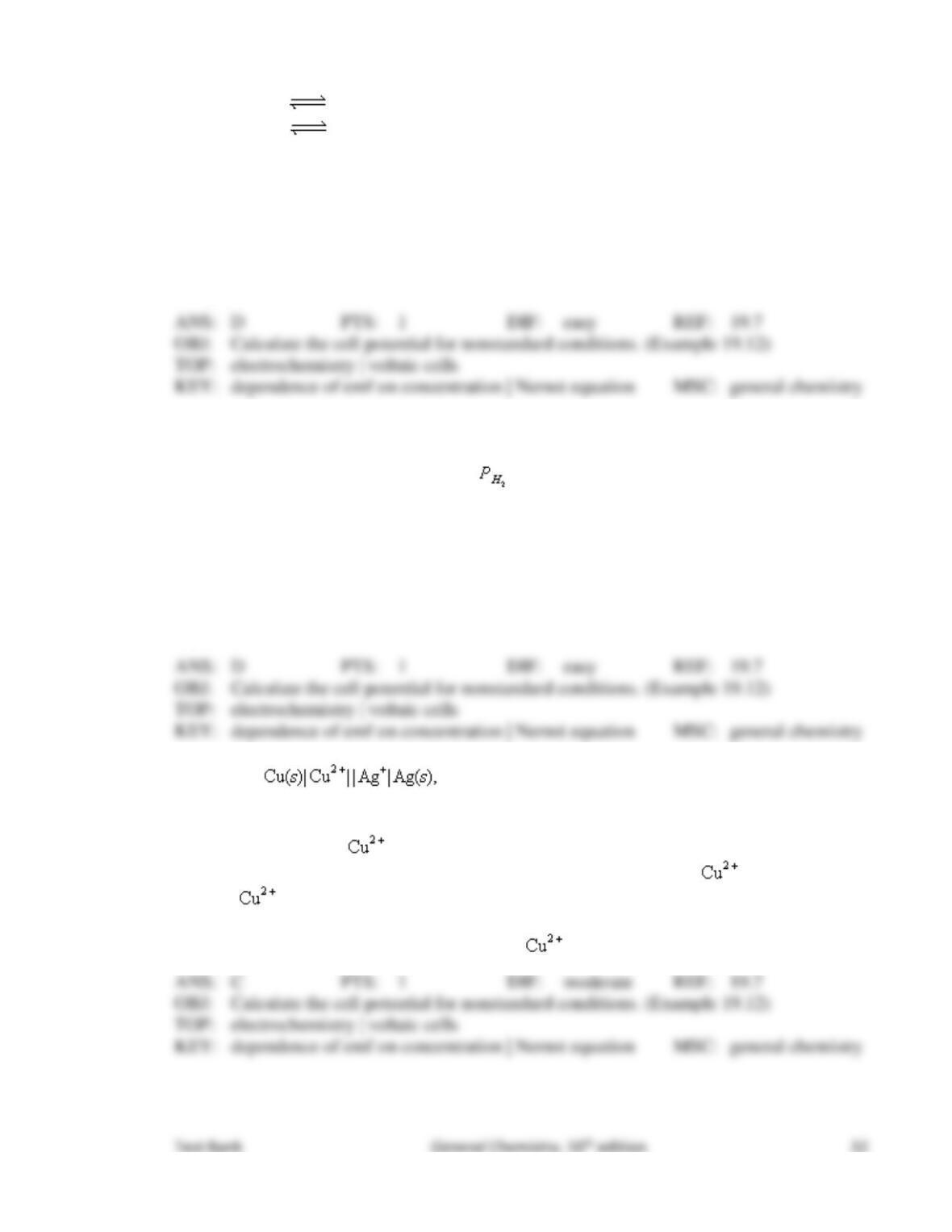
88. Given:
Zn2+(aq) + 2e– Zn(s); E° = –0.76 V
Cu2+(aq) + 2e– Cu(s); E° = 0.34 V
What is the cell potential of the following electrochemical cell at 25°C?
Zn(s) | Zn2+(1.0 M) || Cu2+(0.0010 M) | Cu(s)
A)
between 0.34 and 0.76 V
B)
less than 0.42 V
C)
between 0.00 and 0.76 V
D)
between 0.76 and 1.10 V
E)
greater than 1.10 V
89. A voltaic cell is made by placing an iron electrode in a compartment in which the Fe2+
concentration is 2.0 10–5 M and by placing a Pt electrode in the other compartment, in
which the H+ concentration is 3.4 M and = 1.00 atm. The Fe2+/Fe half-cell reduction
potential is –0.41 V, and the H+/H2 half-cell reduction potential is 0.00 V. What is E for the
cell at equilibrium?
A)
–0.41 V
B)
0.41 V
C)
0.69 V
D)
0.00 V
E)
0.28 V
90. For the cell the standard cell potential is 0.46 V. A cell using these
reagents was made, and the observed potential was 0.31 V at 25oC. What is a possible
explanation for the observed voltage?
A)
The volume of the solution was larger than the volume of the Ag+ solution.
B)
The volume of the Ag+ solution was larger than the volume of the solution.
C)
The concentration was larger than the Ag+ concentration.
D)
The Ag electrode was twice as large as the Cu electrode.
E)
The Ag+ concentration was larger than the concentration.