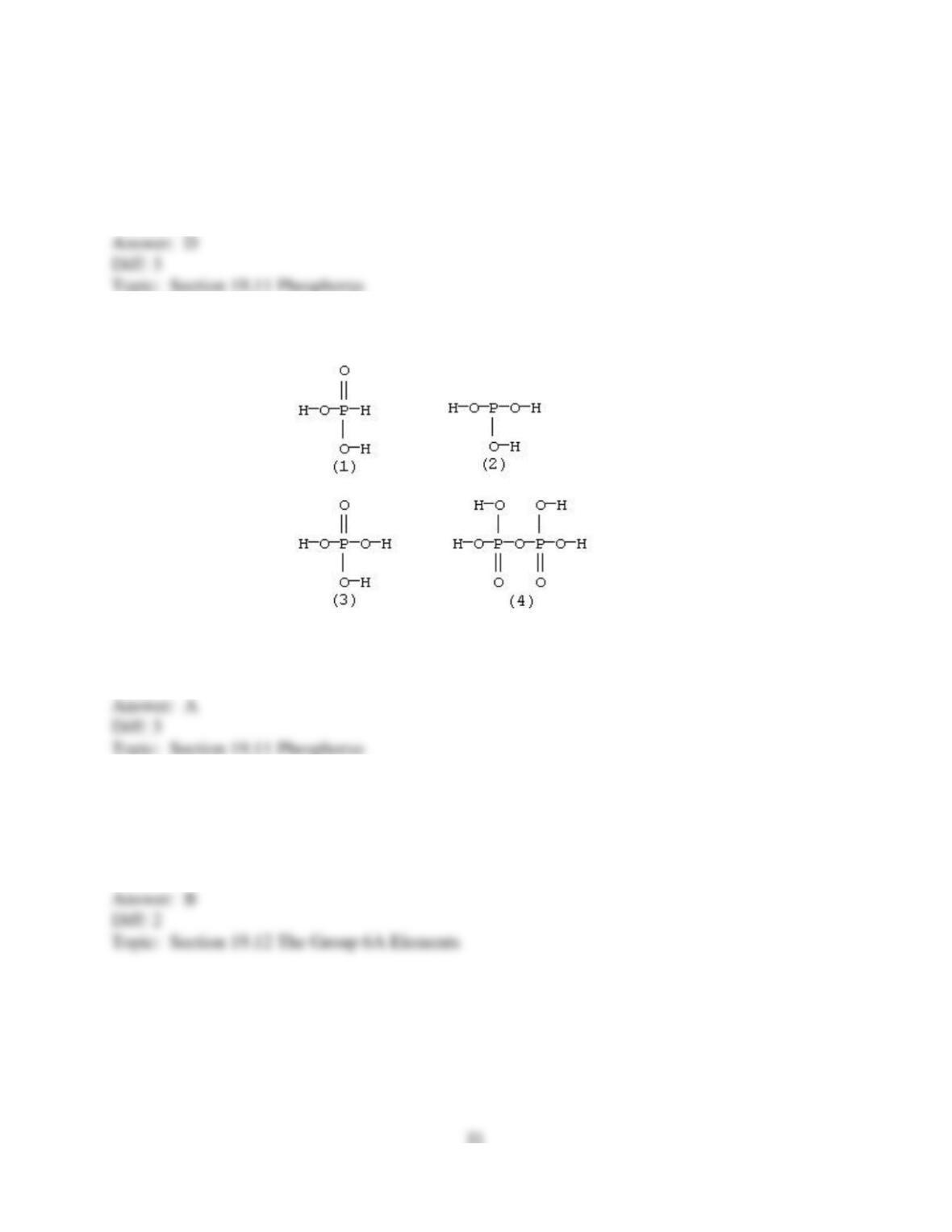
90) What is the most acidic oxide of phosphorus?
A) PO2
B) PO3
C) P4O6
D) P4O10
91) What is the molecular structure of phosphorous acid?
A) 1
B) 2
C) 3
D) 4
92) Which group 6A element has the most negative electron affinity?
A) O
B) S
C) Se
D) Te
93) Which group 6A element is naturally radioactive?
A) S
B) Se
C) Te
D) Po
94) What statement is not characteristic about group 6A elements?
A) Oxygen, sulfur, and selenium are typical nonmetals while tellurium is a semi-metal.
B) Oxygen is a powerful oxidizing agent but H2Se and H2Te are good reducing agents.
C) S, Se, and Te are much less electronegative than oxygen and commonly have positive
oxidation states.
D) The favored oxidation state of Te and Po is +2.
95) Which element of group 6A has the highest melting point?
A) S
B) Se
C) Te
D) Po
96) Which element of group 6A has the highest boiling point?
A) S
B) Se
C) Te
D) Po
97) Which elements of group 6A are oxidizing agents and which are reducing agents?
A) O and S are oxidizing agents while Se and Te are reducing agents.
B) O and Se are oxidizing agents while S and Te are reducing agents.
C) O and S are reducing agents while Se and Te are oxidizing agents.
D) O and Se are reducing agents while S and Te are reducing agents.
98) What is the chemical formula of “fool’s gold”?
A) cinnabar, HgS
B) galena, PbS
C) gypsum, CaSO4↔2H2O
D) pyrite, FeS2
99) What is the structure of rhombic sulfur?
A) crown shaped S8 molecules
B) discrete S atoms
C) discrete S2 molecules
D) polymeric Sn chains
100) What are appropriate methods for the generation of H2S?
Reaction 1: FeS(s) + 2 H+(aq) → H2S(g) + Fe2+(aq)
Reaction 2: CH3C(CS)NH2(aq) + H2O(l) + heat → CH3(CO)NH2(aq) + H2S(aq)
Reaction 3: 3 S(g) + 2 H2O(g) → SO2(g) + 2 H2S(g)
Reaction 4: 2 SO2(g) + 2 H2O(g) → 2 H2S(g) + 3 O2(g)
A) Reactions 1 and 2
B) Reactions 1 and 3
C) Reactions 2 and 3
D) Reactions 2 and 4
101) Describe the color changes when sulfur (melting point 113°C, boiling point 445°C) is
heated from 25°C to 500°C? It turns from a yellow solid to a
A) dark reddish brown liquid and then boils.
B) reddish brown solid and then into reddish brown liquid and then boils.
C) straw colored liquid which turns dark reddish brown and then it boils.
D) yellow liquid and then it boils.
102) The increased viscosity of molten sulfur at 160-195°C is due to the
A) melting of S8 to give discrete S8 units.
B) merging of the S8 rings to give interlocking S8 rings.
C) opening of the S8 rings to give smaller S units.
D) opening of the S8 rings which then polymerize into long chains.
103) What statement is not representative of the chemistry of H2S?
A) It has a linear geometry.
B) It is an extremely toxic substance.
C) It is a weak diprotic acid.
D) It is a weak reducing agent.
104) What is a convenient synthetic method for the preparation of SO2?
A) 2 SO3(g) + heat → 2 SO2(g) + O2(g)
B) S8(s) + 8 O2(g) + heat → 8 SO2(g)
C) H2SO3(aq) ⇌ H2O(l) + SO2(aq)
D) FeSO3(s) + heat → FeO(s) + SO2(g)
105) What is the anhydride of sulfuric acid?
A) SO2
B) SO3
C) S2O3
D) S2O5
106) What is the name of the commercial process for the preparation of sulfuric acid?
A) Contact process
B) Haber process
C) Mond process
D) Ostwald process
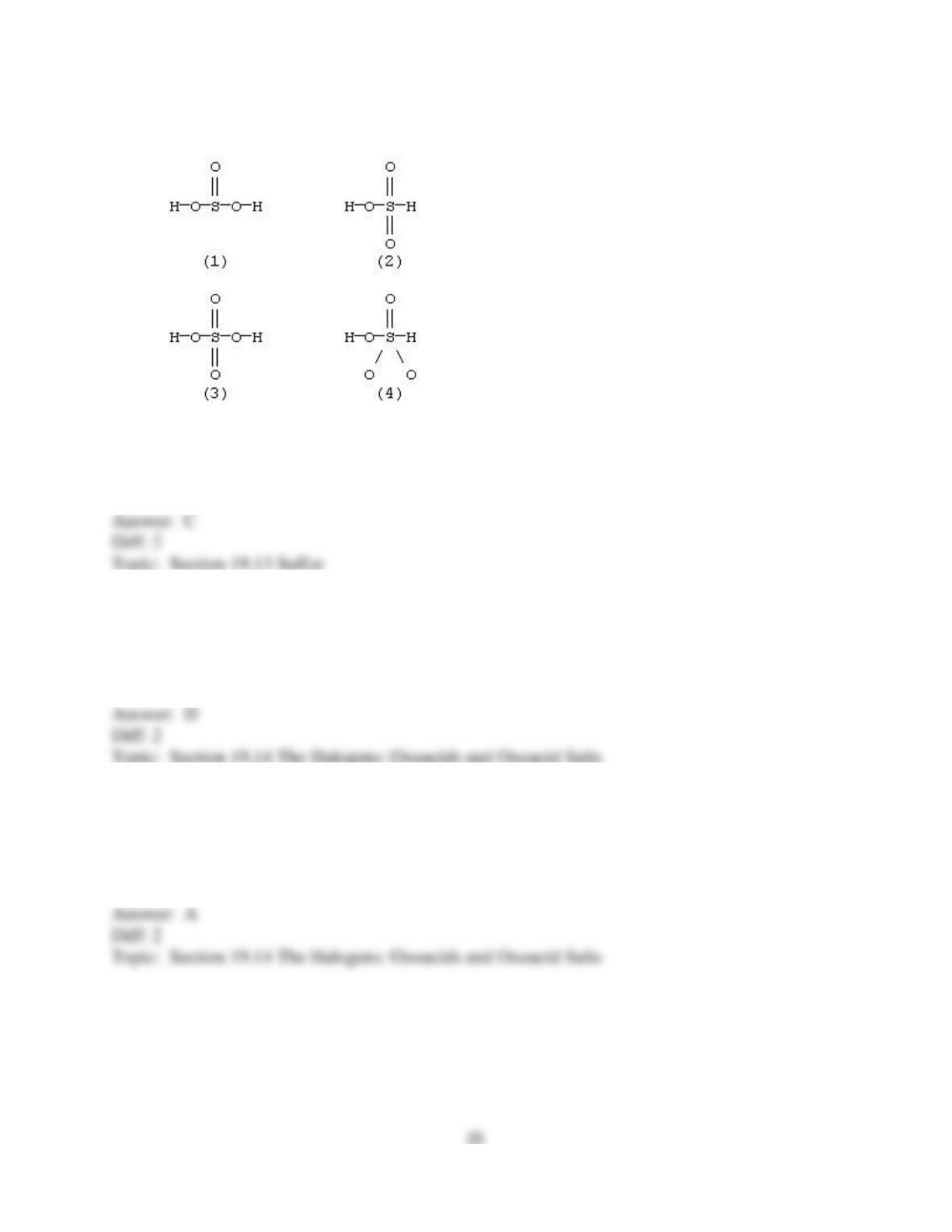
107) What is the structure of sulfuric acid?
A) 1
B) 2
C) 3
D) 4
108) Which of the halogens forms more than one perhalic acid?
A) F
B) Cl
C) Br
D) I
109) A 0.01 M aqueous solution of which of the following is the most basic?
A) NaClO
B) NaClO2
C) NaClO3
D) NaClO4
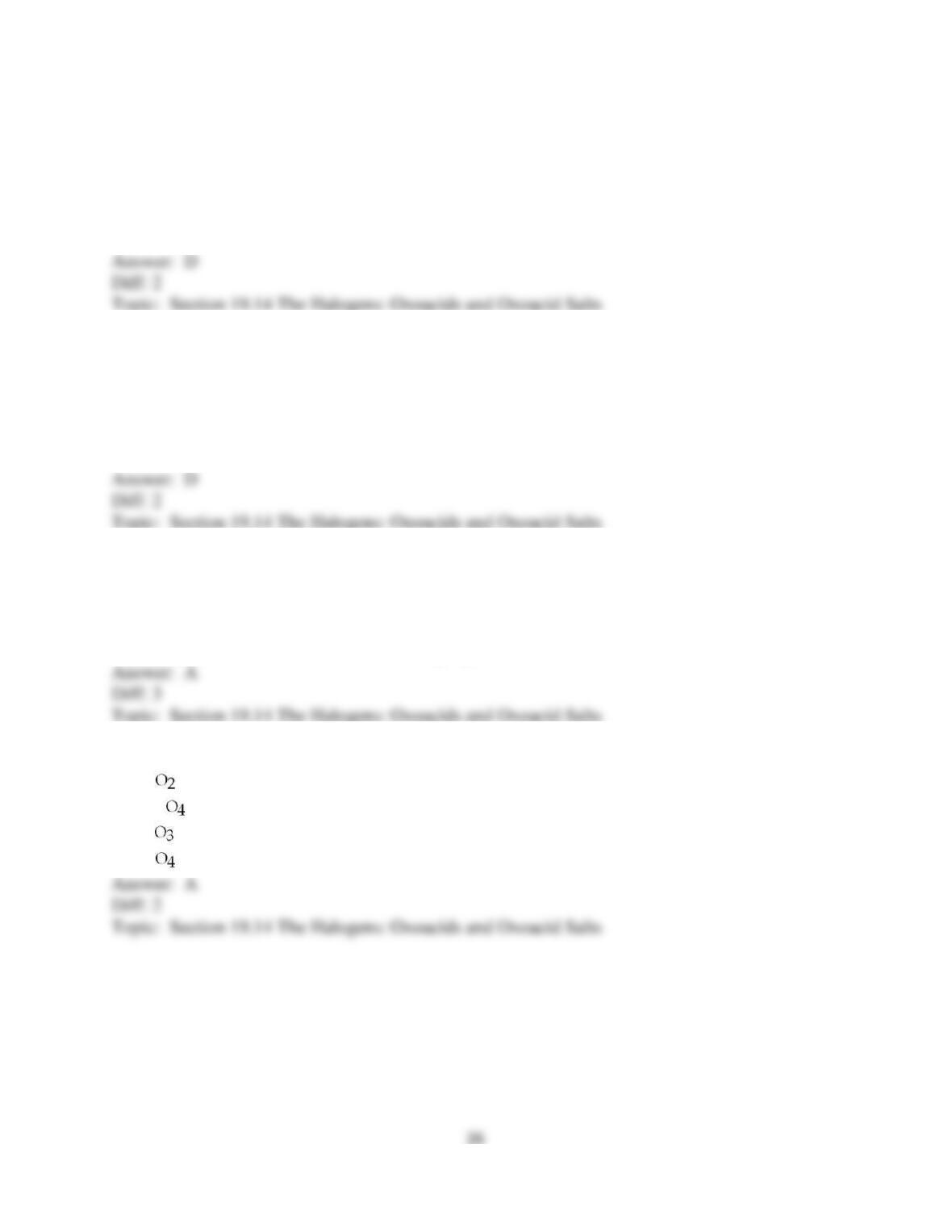
110) Using principles discussed in chapters 15 and 19, determine which of the following is the
strongest acid.
A) HClO
B) HClO2
C) HClO3
D) HClO4
111) What are the products of the reaction of chlorine gas with hot aqueous sodium hydroxide?
A) Cl– and H2O
B) ClO3– and H2O
C) Cl– and ClO3–
D) Cl–, ClO3– and H2O
112) How would one synthesize a perchlorate salt?
A) Electrolytic oxidation of a solution of chorate salt.
B) Electrolytic oxidation of a solution of chorite salt.
C) Electrolytic oxidation of a solution of hypochlorite salt.
D) Oxidation of a solution of chlorate salt by a perbromate salt.
113) Which of the following is not expected to be stable?
A) HI
B) HCl
C) HI
D) HI
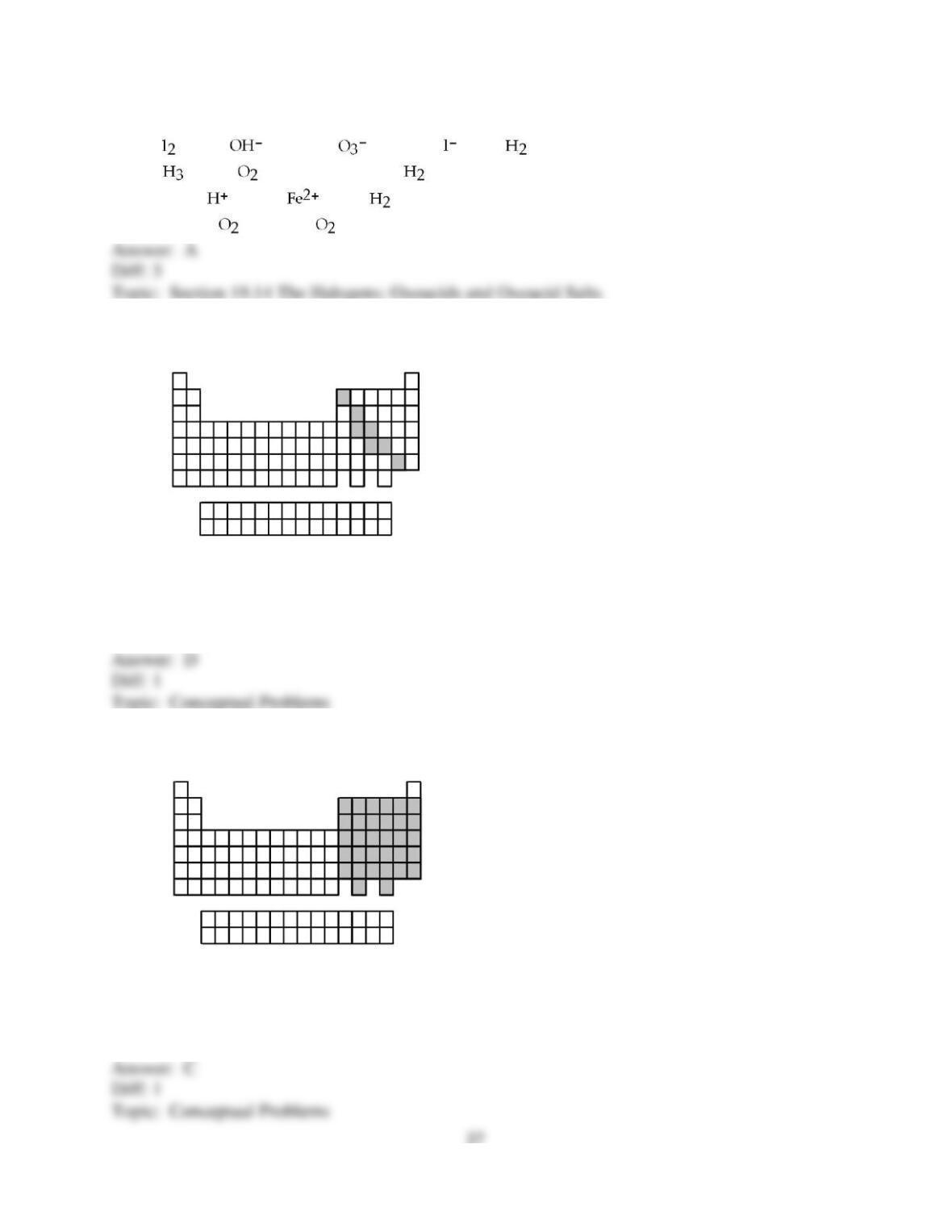
114) Which of the following is a disproportionation reaction?
A) 3 C (g) + 6 (aq) → Cl (aq) + 5 C (aq) 3 O(l)
B) 4 N (g) + 5 (g) → 4 NO(g) + 6 O(l)
C) Fe(s) + 2 (aq) → (aq) + (g)
D) 2 NO(g) + (g) → 2 N (g)
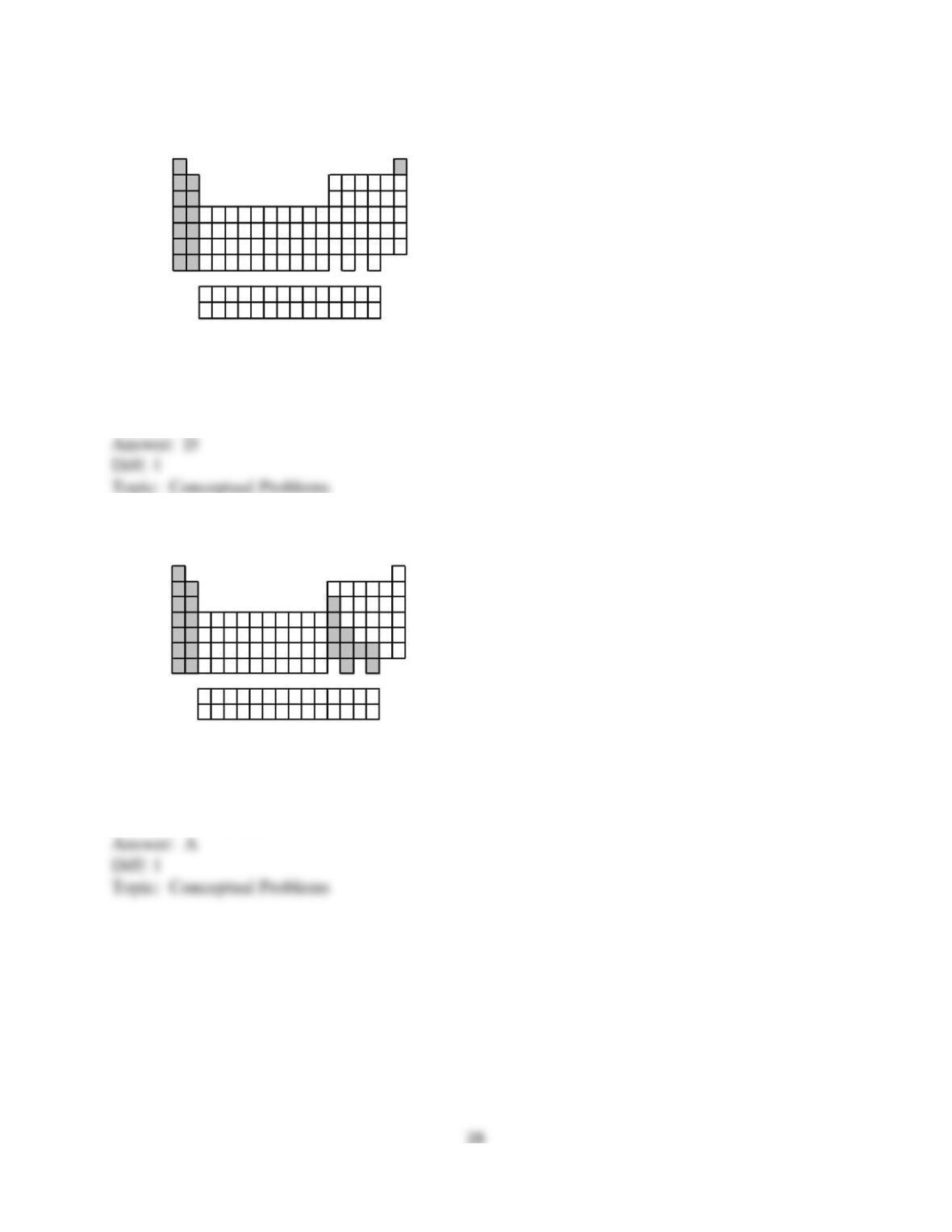
115) The elements indicated by the shaded area in the following periodic table are all
A) gases.
B) metals.
C) nonmetals.
D) semimetals.
116) The elements indicated by the shaded area in the following periodic table are all
A) metals.
B) nonmetals.
C) p-block elements.
D) s-block elements.
117) The elements indicated by the shaded area in the following periodic table are all
A) metals.
B) nonmetals.
C) p-block elements.
D) s-block elements.
118) The elements indicated by the shaded area in the following periodic table are all
A) main-group elements.
B) p-block elements.
C) s-block elements.
D) transition elements.
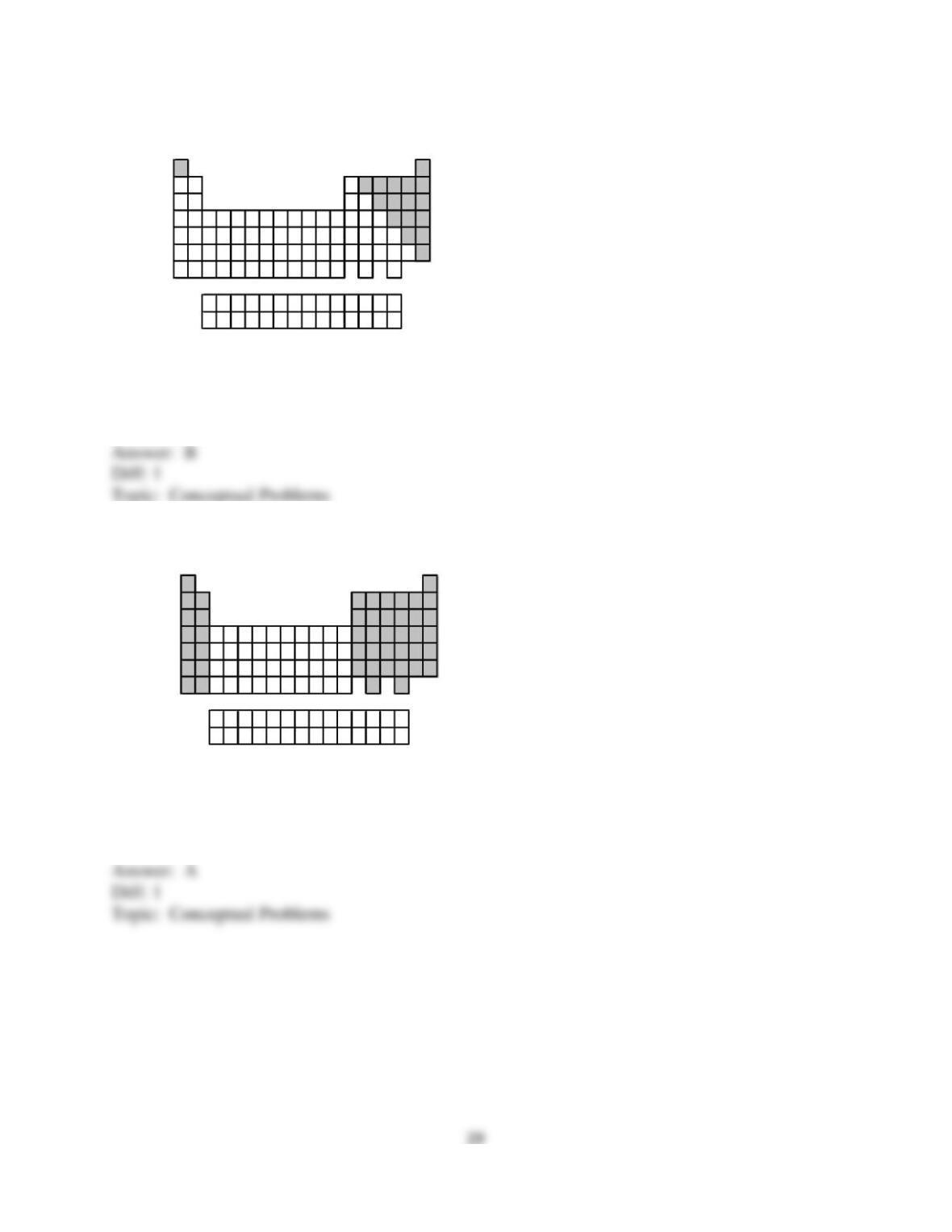
119) The elements indicated by the shaded area in the following periodic table are all
A) main-group metals.
B) nonmetals.
C) p-block elements.
D) semimetals.
120) The elements indicated by the shaded area in the following periodic table are all
A) main-group elements.
B) main-group metals.
C) nonmetals.
D) semimetals.
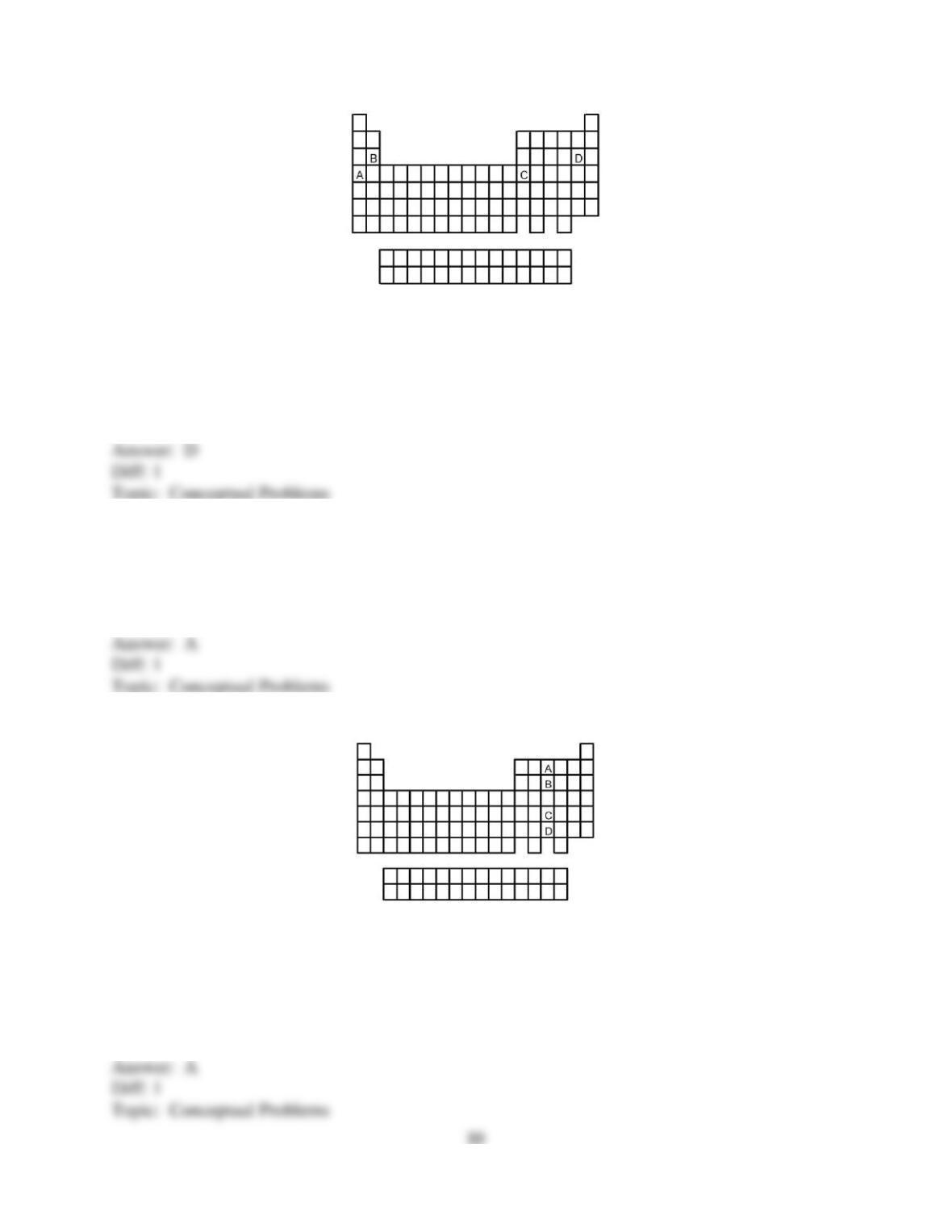
121) Which of the elements indicated on the above periodic table has the highest ionization
energy?
A) element A
B) element B
C) element C
D) element D
122) Which of the elements indicated on the above periodic table is least electronegative?
A) element A
B) element B
C) element C
D) element D
123) Which of the elements indicated on the above periodic table is the group 5A element with
the smallest atomic radius?
A) element A
B) element B
C) element C
D) element D
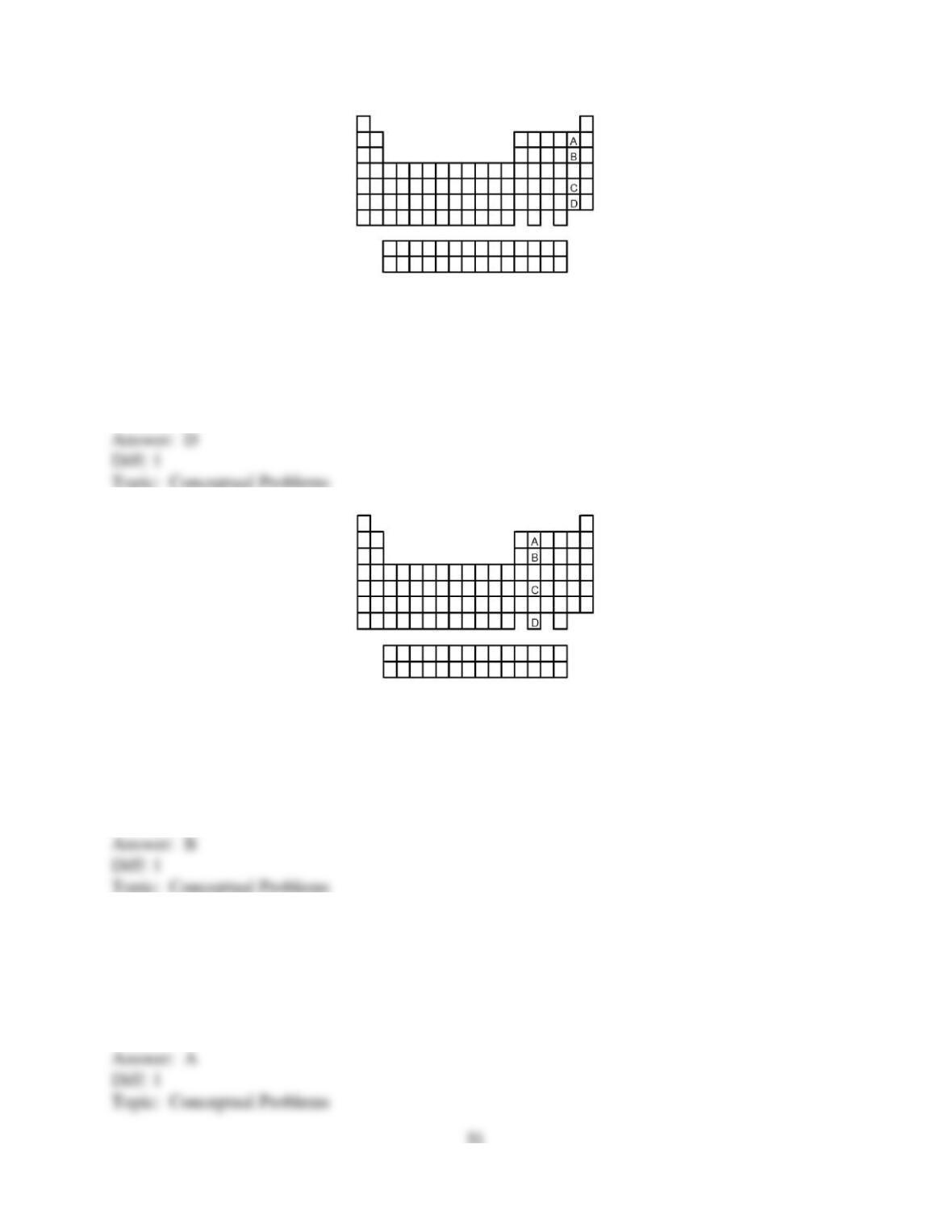
124) Which of the elements indicated on the above periodic table is the group 7A element with
the largest atomic radius?
A) element A
B) element B
C) element C
D) element D
125) Which of the elements indicated on the above periodic table is a group 4A element that is a
semiconductor?
A) element A
B) element B
C) element C
D) element D
126) Which of the elements indicated on the above periodic table is a group 4A element that
forms the strongest π bonds?
A) element A
B) element B
C) element C
D) element D
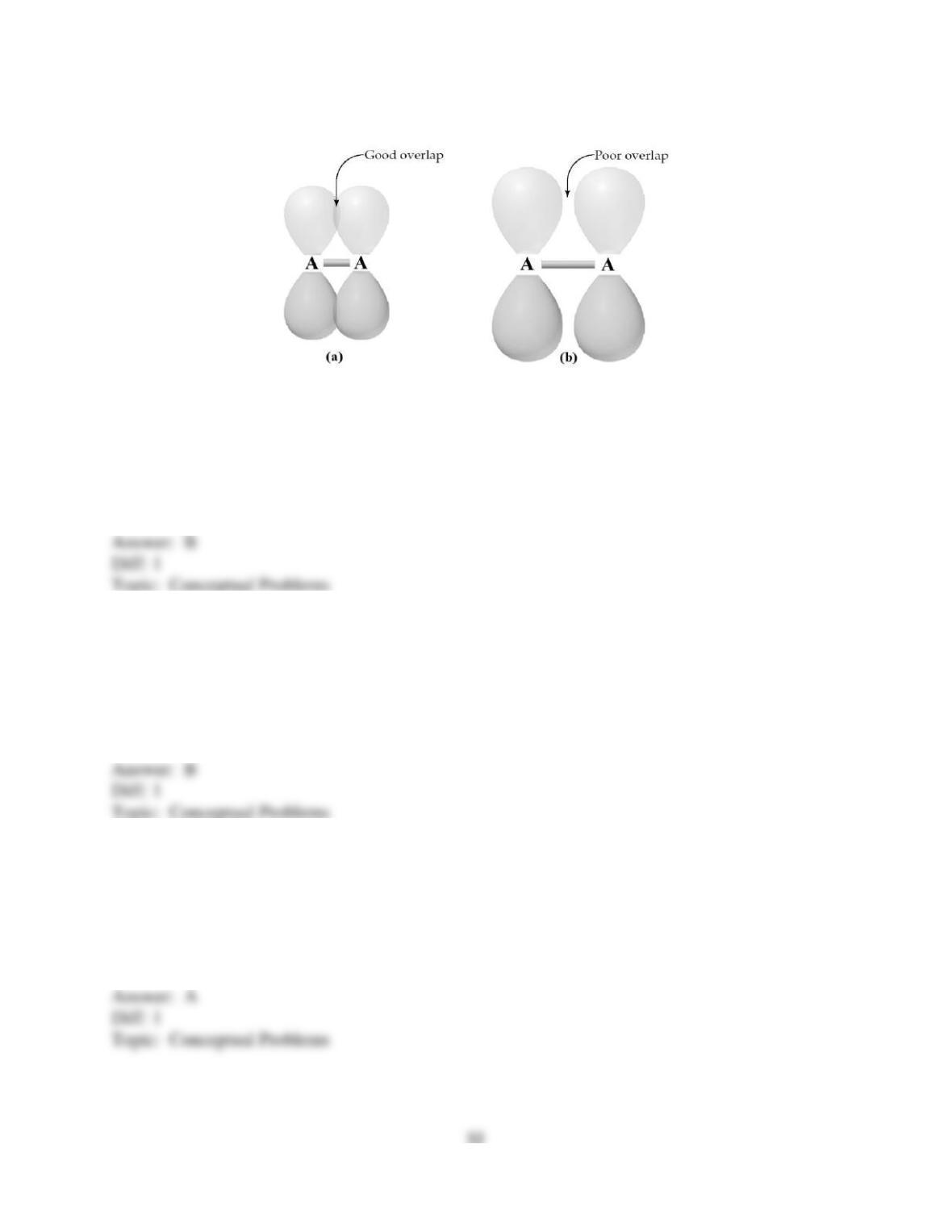
127) Which of these molecules is most likely to contain good π overlap of p orbitals, as shown in
figure (a), rather than poor π overlap of p orbitals, as shown in figure (b)?
A) Cl2
B) O2
C) P4
D) S8
128) Which of these molecules is most likely to contain good π overlap of p orbitals, as shown in
figure (a), rather than poor π overlap of p orbitals, as shown in figure (b)?
A) Cl2
B) N2
C) P4
D) S8
129) Which of these molecules is most likely to contain good π overlap of p orbitals, as shown in
figure (a), rather than poor π overlap of p orbitals, as shown in figure (b)?
A) CO2
B) SiO2
C) GeO2
D) SnO2
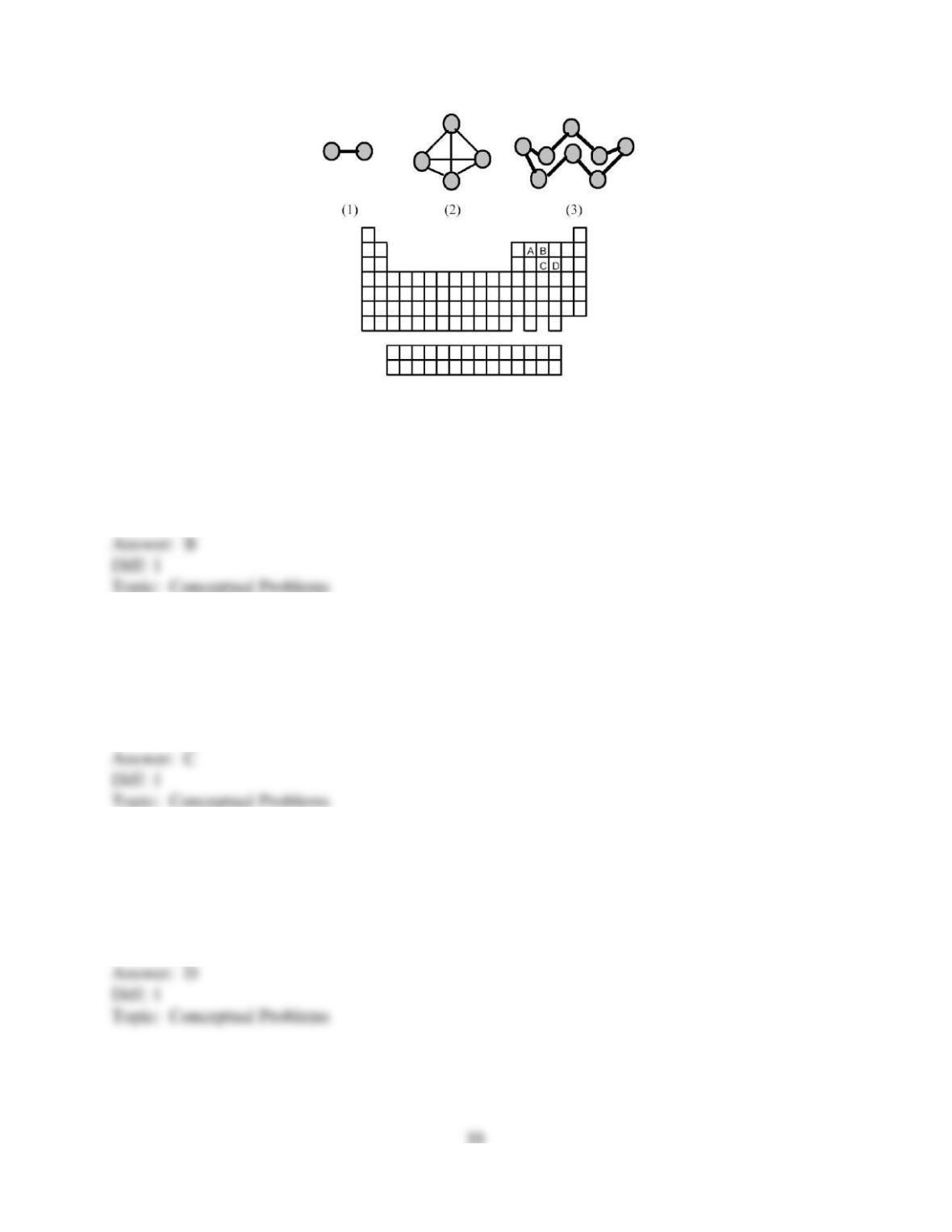
130) Which of the elements indicated on the above periodic table has a common allotrope stable
at 25°C having molecular structure (1)?
A) element A
B) element B
C) element C
D) element D
131) Which of the elements indicated on the above periodic table forms a common allotrope
having molecular structure (2)?
A) element A
B) element B
C) element C
D) element D
132) Which of the elements indicated on the above periodic table forms a common allotrope
having molecular structure (3)?
A) element A
B) element B
C) element C
D) element D