72)
If the price of a good increases and the total revenue also increases, the good has a(n)
72)
A)
perfectly elastic demand.
B)
inelastic demand.
C)
unit elastic demand.
D)
elastic demand.
73)
A supply curve that is parallel to the quantity axis is
73)
A)
relatively inelastic.
B)
unitary elastic.
C)
perfectly elastic.
D)
perfectly inelastic.
C
74)
Supply will become more elastic when
74)
A)
there are good substitutes for the goods.
B)
the time period shortens.
C)
the good is important to consumers.
D)
a time period lengthens.
D
75)
When two goods are substitutes,
75)
A)
cross price elasticity of demand will be positive.
B)
cross price elasticity of demand will be negative.
C)
cross price elasticity of demand will be 0.
D)
the demands for both goods will be inelastic.
A
76)
If personal computer prices rise by 1 percent, we would expect the number of color printers
purchased to
76)
A)
decrease.
B)
be equal to ten.
C)
increase.
D)
be equal to one.
A
B
77)
We say that a good has elastic demand whenever the absolute value of the price elasticity of
demand is greater than 1. A 1 percent change in price therefore causes
77)
A)
a change that cannot be determined based on 1 percent.
B)
a greater than 1 percent change in quantity demanded.
C)
a change of less than 1 percent in the quantity demanded.
D)
exactly a 1 percent change in the quantity demanded.
78)
If demand is inelastic and the price of a product decreases by 10 percent, then
78)
A)
the change in quantity demanded is equal to 10 percent.
B)
the change in quantity demanded is greater than 10 percent.
C)
the decrease in quantity demanded is greater than 0 percent.
D)
the change in quantity demanded is less than 10 percent.
79)
Moving upward along a downward sloping straight–line demand curve, as the price of the product
goes up,
79)
A)
the price elasticity of demand goes from negative to positive.
B)
the price elasticity of demand goes from being inelastic to being elastic.
C)
the price elasticity of demand does not change.
D)
the price elasticity of demand goes from being elastic to being inelastic.
80)
Suppose the demand for frozen yogurt cones increases from 400 to 425 cones a day when the price
is reduced from $1.50 to $1.25. In this situation, the elasticity of demand, calculated using the
average method, is
80)
A)
3.
B)
1.33.
C)
1.
D)
0.33.
81)
The price elasticity of supply is higher when
81)
A)
the number of buyers in the market decreases.
B)
the product in question is an inferior good.
C)
producers have more time to adjust to price changes.
D)
the number of buyers in the market increases.
82)
Suppose that the cross price elasticity of demand between bagels and cream cheese is –1.45. This
indicates that the two goods are
82)
A)
complements.
B)
substitutes.
C)
both inferior.
D)
completely unrelated in the minds of consumers.
83)
If the absolute price elasticity of demand for good Y is 0.75, when there is a 30 percent increase in
price, we can conclude that quantity demanded
83)
A)
has fallen by 22.5 percent.
B)
has fallen by 40.0 percent.
C)
has fallen by 10.4 percent.
D)
has fallen by 35.0 percent.
84)
When the price of chicken is $2.00 per pound, consumers buy 50 pounds of hamburger. When the
price of chicken rises to $3.00 per pound, 60 pounds of hamburger are purchased. The cross price
elasticity of demand between chicken and hamburger is approximately equal to
84)
A)
–0.45.
B)
+0.04.
C)
+2.20.
D)
+0.45.
85)
A perfectly elastic demand curve is
85)
A)
a rectangular hyperbola.
B)
vertical.
C)
a downward sloping straight line.
D)
horizontal.
86)
Color television prices rise by 10 percent, and in response the quantity of those TVs supplied
increases by 6 percent. The supply elasticity for color television sets in that price range is
86)
A)
–1.66.
B)
0.6.
C)
1.66.
D)
6.0.
87)
Which of the following is NOT characteristic of a good with elastic demand?
87)
A)
The percentage change in quantity demanded is greater than the percentage change in price.
B)
Total revenue decreases if price is increased.
C)
The absolute price elasticity of demand is less than 1.
D)
Buyers are relatively sensitive to price changes.
88)
Other things being equal, the longer a price change persists,
88)
A)
the greater is the elasticity of demand.
B)
the less is the elasticity of demand.
C)
the more the consumer will be willing to pay.
D)
the less chance a consumer will be able to adjust.
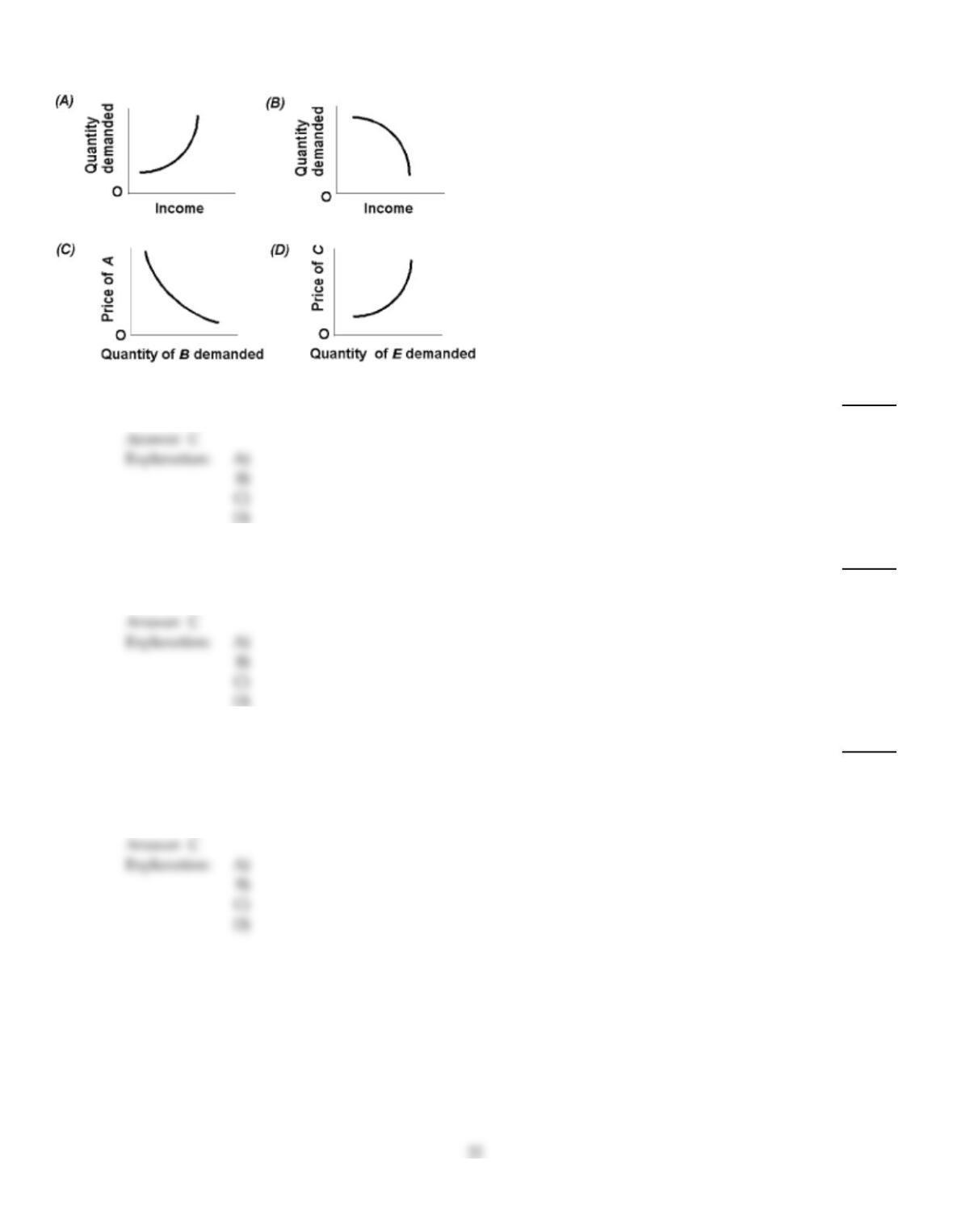
89)
Use the above figure. Which graph depicts a normal good?
89)
A)
D
B)
B
C)
A
D)
C
90)
The supply curve for housing in the very short run is likely to be
90)
A)
very elastic.
B)
unit–elastic elastic.
C)
very inelastic.
D)
perfectly elastic.
91)
When demand is perfectly inelastic, an increase in price will
91)
A)
either increase total revenue or decrease total revenue, but it is impossible to tell which.
B)
leave total revenue unchanged.
C)
increase total revenue.
D)
decrease total revenue.
Price Quantity Demanded
Per Unit Per Week
$10.00 25
9.50 30
9.00 35
8.50 40
8.00 45
7.50 50
7.00 55
6.50 60
6.00 65
5.50 70
5.00 75
92)
Refer to the above table. At a price below $5, the absolute price elasticity of demand is
92)
A)
between 0.8 and 1.0.
B)
1.0.
C)
greater than 1.
D)
below 1.
93)
Refer to the above table. For which prices is demand unit–elastic?
93)
A)
In a range of prices between $6 and $6.50
B)
In a range of prices below $6.50
C)
In a range of prices above $6.50
D)
In a range of prices between $5 and $10
94)
If demand is perfectly elastic everywhere along the demand curve, then
94)
A)
the demand curve is horizontal.
B)
the demand curve is vertical.
C)
the demand curve is a rectangular hyperbola.
D)
people must be irrational.
95)
The price elasticity of demand is a measure of
95)
A)
the horizontal shift in the demand curve when the price of a good changes.
B)
the demand for a product holding prices constant.
C)
the responsiveness of the quantity demanded of a good to a changes in the price of the good.
D)
the quantity demanded of a good at a given price.
Month PXQXPYQYPZQZ
Jan $10 100 $20 50 $25 200
Feb 10 90 18 60 25 225
Mar 10 70 15 90 25 275
Apr 12 50 15 100 25 290
May 15 25 15 120 25 320
96)
In the above table, the cross price elasticity of demand for good X with good Y when PY falls from
$20 to $18 is
96)
A)
0.
B)
–1.
C)
–2.
D)
+1.
97)
The most important determinant of the elasticity of supply is
97)
A)
the time period firms have to adjust to the new price.
B)
the proportion of the good in the budget of consumers.
C)
the price of the good.
D)
whether the good is a durable good or a nondurable good.
98)
A value of the absolute price elasticity of demand equal to 0.6 indicates that
98)
A)
a 0.6 percent increase in price leads to a 1 percent decrease in quantity demanded.
B)
a 6 percent increase in price leads to a 10 percent decrease in quantity demanded.
C)
a 1 percent increase in price leads to a 6 percent decrease in quantity demanded.
D)
a 10 percent increase in price leads to a 6 percent decrease in quantity demanded.
Price Quantity Demanded
Per Unit Per Week
$5.5 20
$6.0 18
$6.5 16
$7.0 14
$7.5 12
$8.0 10
99)
According to the above table, what is the absolute price elasticity of demand if price falls from $8.00
to $7.50?
99)
A)
4.00
B)
1.21
C)
1.80
D)
2.82
100)
For most goods and services the income elasticity of demand is
100)
A)
positive.
B)
inverse.
C)
negative.
D)
invisible.
SHORT ANSWER. Write the word or phrase that best completes each statement or answers the question.
101)
Price elasticity of demand is measured using percentage changes. Why?
101)
102)
Explain the three possible ranges for price elasticity of demand.
102)
103)
What does a perfectly elastic demand curve look like? A perfectly inelastic demand curve?
Explain.
103)
104)
“Price elasticity measures how many more units of a good that consumers will buy given a
decrease in price.” Do you agree or disagree? Explain.
104)
105)
Why can cross price elasticity of demand be positive or negative, unlike the price elasticity
of demand with respect to the item‘s own price?
105)
106)
How does the cross elasticity of demand differ from the price elasticity of demand? How
are they related?
106)
107)
What is the price elasticity of demand? How is the price elasticity of demand calculated?
107)
108)
“Unit elasticity of demand can be found everywhere along a straight–line demand curve
with a slope of –1.” Do you agree or disagree? Explain.
108)
109)
Why is elasticity of demand greater for goods that are a large share of a consumer’s
budget?
109)
110)
“Income elasticity of demand is always positive.” Do you agree or disagree? Explain.
110)
111)
Why is the price elasticity of supply greater if there is more time for adjustment to an
increase in the price of an item?
111)
112)
“The price elasticity of demand for a particular good is smaller in the long run because
consumers adapt to higher prices over time.” Do you agree or disagree? Explain.
112)
113)
Which has a more elastic demand: hamburger or beef?
113)
114)
Explain why an increase in price can raise total revenues if the price elasticity of demand is
inelastic.
114)
115)
For a linear demand curve, where is the amount of total expenditures on a good
maximized?
115)
116)
Graphically, what is the main difference between the measure of income elasticity of
demand as opposed to the measure of price elasticity of demand?
116)
117)
“The slope of the demand curve gives the elasticity of demand.” Do you agree or disagree?
Why?
117)
118)
“Higher prices always yield higher revenues.” Do you agree or disagree? Why?
118)
119)
What would you expect the cross price elasticity of iPods and online music downloads?
Explain your answer.
119)
120)
Why is time such an important determinant in the elasticity of supply? Is time also
important in determining price elasticity of demand? Explain.
120)
121)
“The income elasticity of a good is positive if a consumer increases the total spending on
that good as a result of an increase in its market price.” Do you agree or disagree? Why?
121)
Answer Key
Testname: C19
Answer Key
Testname: C19
Answer Key
Testname: C19
32
Answer Key
Testname: C19
33