
60) Define transmutation.
A) the transformation of one element into another
B) the loss of neutrons from an atom
C) the loss of electrons from an atom
D) the loss of protons from an atom
E) the gain of neutrons to an atom
61) Identify the lowest natural radiation.
A) cosmic radiation from outer space
B) terrestrial radiation
C) natural radionuclides in the body
D) a five-hour jet airplane ride
E) radon gas
62) Identify the highest natural radiation.
A) cosmic radiation from outer space
B) terrestrial radiation
C) natural radionuclides in the body
D) a five-hour jet airplane ride
E) radon gas
63) Identify the part of the body that can be studied with radiotracers.
A) spleen
B) brain
C) heart
D) tumors
E) all of the above
64) Identify the common radiotracers used in the diagnosis of medical problems
A) fluorine-18
B) iodine-131
C) thallium-201
D) iron-59
E) all of the above

Algorithmic Questions
1) Identify the radioactive green light that glows in the dark.
A) phenol red
B) radioactivity
C) phosphorescence
D) desensitivity
E) argon
2) Which particle has the highest penetrating power?
A) alpha particle
B) proton particle
C) gamma particle
D) positron capture
E) electron emission
3) Which particle has the lowest penetrating power?
A) alpha particle
B) neutron particle
C) gamma particle
D) positron capture
E) electron emission
4) Describe what changes occur during alpha decay.
A) The mass number and atomic number decreases.
B) The mass number and atomic number increases.
C) The mass number increases and the atomic number decreases.
D) The mass number is unchanged and the atomic number increases.
E) The mass number and atomic number do not change.
5) Describe what changes occur during beta decay.
A) The mass number and atomic number decreases.
B) The mass number and atomic number increases.
C) The mass number increases and the atomic number is unchanged.
D) The mass number is unchanged and the atomic number increases.
E) The mass number and atomic number do not change.

6) Describe what changes occur during gamma ray emission.
A) The mass number and atomic number decreases.
B) The mass number and atomic number increases.
C) The mass number is unchanged and the atomic number decreases.
D) The mass number increases and the atomic number decreases.
E) The mass number and atomic number do not change.
7) Describe what changes occur during positron emission.
A) The mass number and atomic number decreases.
B) The mass number and atomic number increases.
C) The mass number is unchanged and the atomic number decreases.
D) The mass number decreases and the atomic number is unchanged.
E) The mass number and atomic number do not change.
8) Describe what changes occur during electron capture.
A) The mass number and atomic number decreases.
B) The mass number and atomic number increases.
C) The mass number is unchanged and the atomic number decreases.
D) The mass number decreases and the atomic number is unchanged.
E) The mass number and atomic number do not change.
9) Determine the identity of the daughter nuclide from the alpha decay of Po.
A) Rn
B) Pb
C) Ra
D) Hg
E) At

10) Determine the identity of the daughter nuclide from the alpha decay of Th.
A) U
B) Pa
C) Ra
D) Ac
E) Th
11) Determine the identity of the daughter nuclide from the beta decay of C.
A) N
B) Be
C) N
D) C
E) B

12) Determine the identity of the daughter nuclide from the beta decay of P.
A) P
B) S
C) S
D) Si
E) Al
13) Determine the identity of the daughter nuclide from the positron emission of F.
A) Na
B) F
C) N
D) O
E) Ne

14) Determine the identity of the daughter nuclide from the positron emission of Ge.
A) Ga
B) As
C) Zn
D) As
E) Ga
15) Determine the identity of the daughter nuclide from the electron capture by Cl.
A) Ar
B) K
C) S
D) P
E) Ar

16) Determine the identity of the daughter nuclide from the electron capture by Be.
A) C
B) He
C) B
D) Li
E) B
17) Identify the missing particle in the following nuclear equation:
H + H → He + ? + g
A) n
B) n
C) H
D) n
E) g
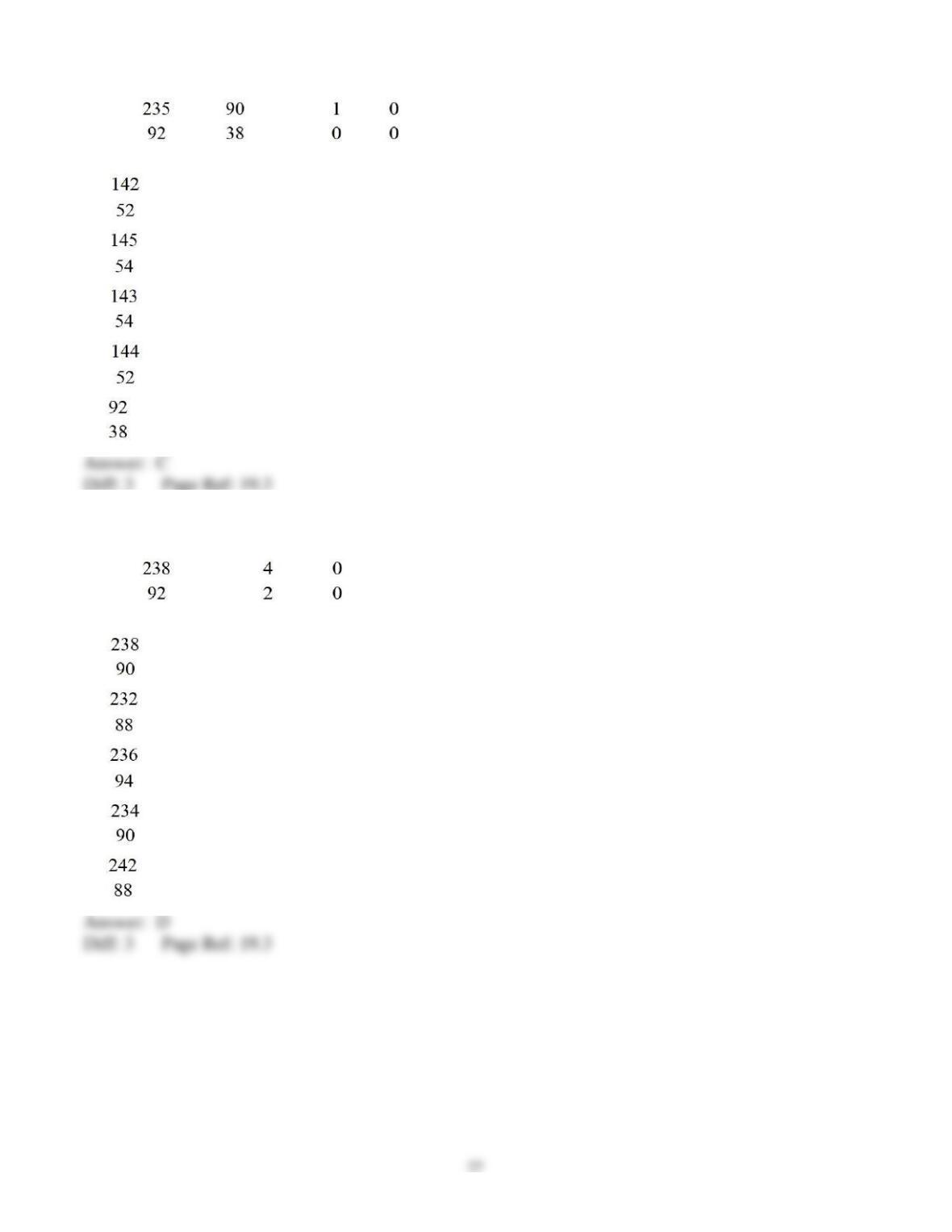
18) Identify the missing particle in the following nuclear equation:
U → Sr + ? + 2 n + 4 g
A) Te
B) Xe
C) Xe
D) Te
E) Sr
19) Identify the missing particle in the following nuclear equation:
U → ? + He + 2 g
A) Th
B) Ra
C) Pu
D) Th
E) Ra

20) Beta decay of 60Co produces a beta particle and
A) 56Mn.
B) 59Co.
C) 60Fe.
D) 60Ni.
21) In addition to a beta particle, what is the other product of beta decay of Pb?
A) Hg
B) Tl
C) Bi
D) Po
22) The number of nucleons in a Co nucleus is
A) 27.
B) 33.
C) 60.
D) 87.
23) Which of the following elements would be expected to be particularly stable?
A) C
B) B
C) Be
D) Li

24) Which of the following nuclides is most likely to undergo beta decay?
A) Pt
B) Pt
C) Pt
D) Pt
25) Which nuclide below is most likely to decay by electron capture?
A) Re
B) Re
C) Re
D) Re
26) Above what atomic number are there no stable isotopes of any element?
A) 20
B) 92
C) 83
D) 70
E) 89
27) Stable isotopes, with low atomic numbers, have a N/Z ratio of 1. What does that imply?
A) The number of neutrons equals the number of protons.
B) The number of neutrons equals the number of electrons plus protons.
C) The number of protons equals the number of electrons plus neutrons.
D) The atomic number equals the atomic mass.
E) The number of protons equals the number of electrons plus neutrons.

28) Atoms with Z > ________ are radioactive and decay in one or more steps involving mostly alpha
and beta decay.
A) 60
B) 110
C) 83
D) 160
E) 50
29) Neptunium-239 has a half-life of 2.35 days. How many days must elapse for a sample of 239Np to
decay to 0.100% of its original quantity?
A) 0.0427 days
B) 1.491 days
C) 2.04 days
D) 23.4 days
30) What percentage of a radioactive substance remains after 7.00 half-lives have elapsed?
A) 0.391%
B) 0.78%
C) 1.56%
D) 3.12%
31) The half-life of cobalt-60 is 5.20 yr. How many milligrams of a 2.000-mg sample remains after 6.55
years?
A) 0.837
B) 3.23 × 10⁻¹⁵
C) 4.779
D) 1.588
E) 1.163
32) Strontium-90 is a byproduct in nuclear reactors fueled by the radioisotope uranium-235. The half-
life of strontium-90 is 28.8 yr. What percentage of a strontium-90 sample remains after 75.0 yr?
A) 68.1
B) 16.5
C) 7.40
D) 38.4
E) 2.60

33) Determine the half-life of a nuclide that loses 38.0% of its mass in 407 hours.
A) 204 hours
B) 568 hour
C) 586 hours
D) 281 hours
E) 291 hours
34) Carbon-11 is used in medical imaging. The half-life of this radioisotope is 20.4 min. What
percentage of a sample remains after 60.0 min?
A) 71.2
B) 5.28
C) 13.0
D) 34.0
E) 2.94
35) A rock contains 0.313 mg of lead-206 for each milligram of uranium-238. The half-life for the decay
of uranium-238 to lead-206 is 4.5 × 10⁹ yr. The rock was formed ________ yr ago.
A) 1.41 × 10⁹
B) 1.08 × 10⁹
C) 1.39 × 10⁹
D) 2.00 × 10⁹
E) 1.56 × 10⁹
36) Potassium-40 decays to argon-40 with a half-life of 1.27 × 10⁹ yr. The age of a mineral sample that
has a mass ratio of 40Ar to 40K of 0.812 is ________ yr.
A) 1.56 × 10⁹
B) 1.02 × 10⁹
C) 1.47 × 10⁹
D) 7.55 × 10⁸
E) 1.09 × 10⁹
37) If we start with 1.000 g of strontium-90, 0.908 g will remain after 4.00 yr. This means that the half-
life of strontium-90 is ________ yr.
A) 3.05
B) 4.40
C) 28.8
D) 3.63
E) 41.6

38) If we start with 1.000 g of cobalt-60, 0.675 g will remain after 3.00 yr. This means that the half-life
of cobalt-60 is ________ yr.
A) 3.08
B) 4.44
C) 2.03
D) 5.30
E) 7.65
39) A freshly prepared sample of curium-243 undergoes 3312 disintegrations per second. After 6.00 yr,
the activity of the sample declines to 2755 disintegrations per second. The half-life of curium-243 is
________ yr.
A) 4.99
B) 32.6
C) 7.21
D) 0.765
E) 22.6
40) The radioactive decay of ________ is the single greatest source of human exposure to radiation.
A) radon
B) uranium
C) ozone
D) hydrogen
E) thorium
41) Give the maximum age that can be estimated from radiocarbon dating.
A) 100,000 years.
B) 1,000,000 years
C) 50,000 years.
D) 5,000 years.
E) 30,000 years

42) Complete the following equation of nuclear fusion.
H + H → He + ______
A) H
B) g
C) n
D) H
E) n
43) Complete the following equation of transmutation.
N + He → O + ______
A) e
B) γ
C) n
D) H
E) n

44) Complete the following equation of transmutation.
Al + He → P + ______
A) H
B) γ
C) e
D) H
E) n
45) Complete the following equation of nuclear transmutation.
U + C → Cf + 6 ______
A) H
B) g
C) e
D) e
E) n
46) Identify the following diagnostic procedure that gives the lowest dose of radiation.
A) dental x-ray — panoramic
B) upper gastrointestinal tract x-ray
C) chest x-ray
D) mammogram
E) x-ray after barium enema

47) Identify the following diagnostic procedure that gives the highest dose of radiation.
A) dental x-ray — two bitewings
B) upper gastrointestinal tract x-ray
C) chest x-ray
D) mammogram
E) thallium heart scan
48) Identify the symptom that is not from radiation exposure.
A) measles
B) increased cancer risk
C) death
D) genetic effects
E) weaker immune systems

Matching Questions
Match the following.
A) He
B) g
C) e
D) p
E) e
F) n
1) positron
Diff: 1 Page Ref: 19.3
2) gamma ray
Diff: 1 Page Ref: 19.3
3) alpha particle
Diff: 1 Page Ref: 19.3
4) beta particle
Diff: 1 Page Ref: 19.3
5) proton
Diff: 1 Page Ref: 19.3
6) neutron
Diff: 1 Page Ref: 19.3
7) electron
Diff: 1 Page Ref: 19.3
Short Answer Questions
1) Define radioactivity.
2) Why is an alpha emitter much more harmful if is ingested than when applied to the skin?
3) Describe what is meant by the term “valley of stability”?
4) Explain the concept of “magic numbers”.
5) How does a dosimeter measure exposure to radioactivity?
6) Define chain reaction in terms of the fission of uranium nucleus.
7) List two problems associated with nuclear power.
8) What is the “mass defect”?