68. Ewing Company sells household furniture. Customers who purchase furniture on the
installment basis make payments in equal monthly installments over a two-year period,
with no down payment required. Ewing’s gross profit on installment sales equals 40% of
the selling price of the furniture.
For financial accounting purposes, sales revenue is recognized at the time the sale is
made. For income tax purposes, however, the installment method is used. There are no
other book and income tax accounting differences, and Ewing’s income tax rate is 30%.
If Ewing’s December 31, 2018, balance sheet includes a deferred tax liability of $900,000
arising from the difference between book and tax treatment of the installment sales, it
should also include installment accounts receivable of
a. $7,500,000.
b. $3,000,000.
c. $2,250,000.
d. $675,000.
69. Ferguson Company has the following cumulative taxable temporary differences:
12/31/19 12/31/18
$3,600,000 $2,560,000
The tax rate enacted for 2019 is 40%, while the tax rate enacted for future years is 30%.
Taxable income for 2019 is $6,400,000 and there are no permanent differences.
Ferguson’s pretax financial income for 2019 is
a. $10,000,000.
b. $7,440,000.
c. $5,360,000.
d. $2,800,000.
70. What is the amount of the deferred tax liability at the end of 2018?
a. $84,000
b. $72,000
c. $30,000
d. $0
Test Bank for Intermediate Accounting, Sixteenth Edition
19 – 22
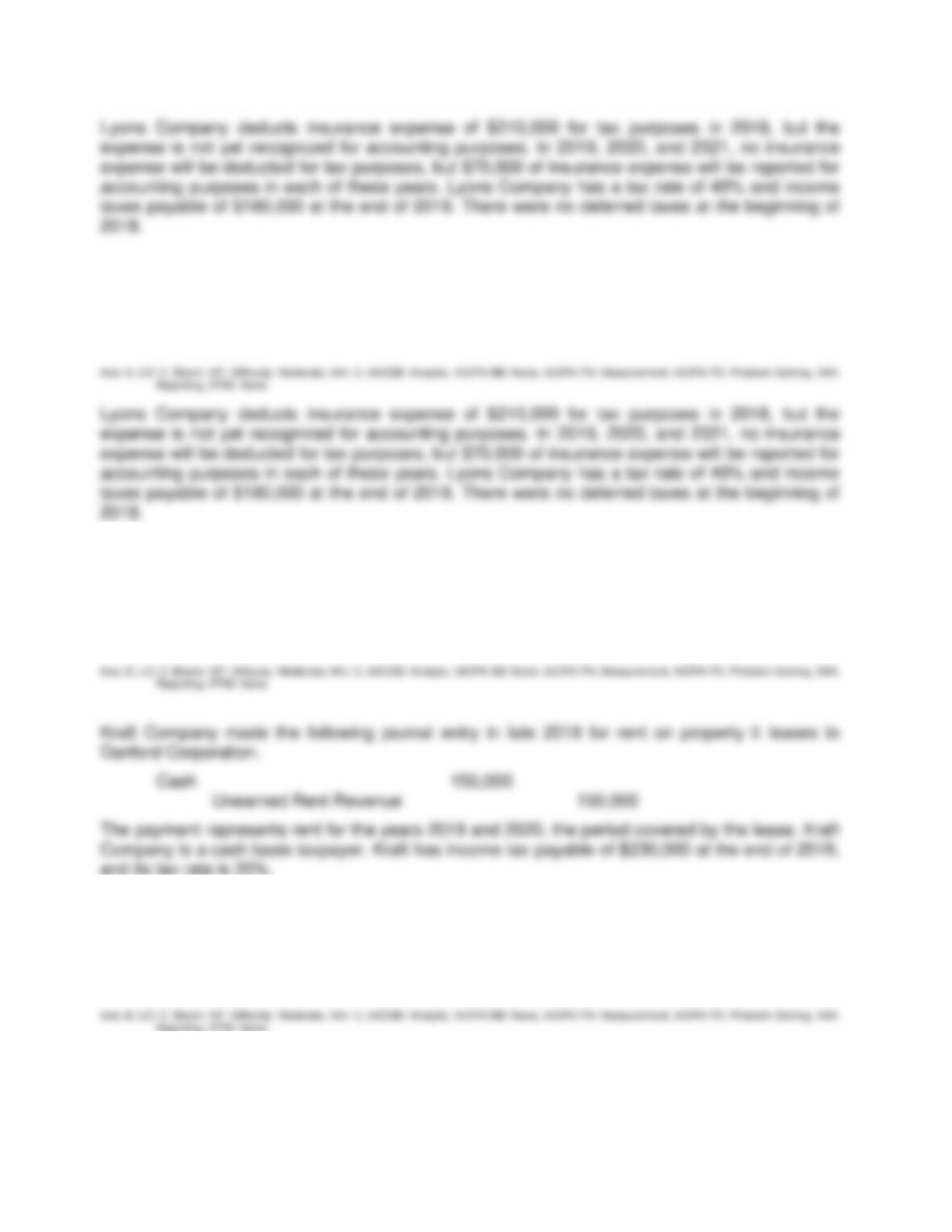
71.What is the amount of income tax expense for 2018?
a. $264,000
b. $252,000
c. $210,000
d. $180,000
72. Assuming that income taxes payable for 2019 is $240,000, the income tax expense for
2019 would be what amount?
a. $324,000
b. $268,000
c. $240,000
d. $212,000
73. What amount of income tax expense should Kraft Company report at the end of 2018?
a. $132,500
b. $177,500
c. $203,750
d. $282,500
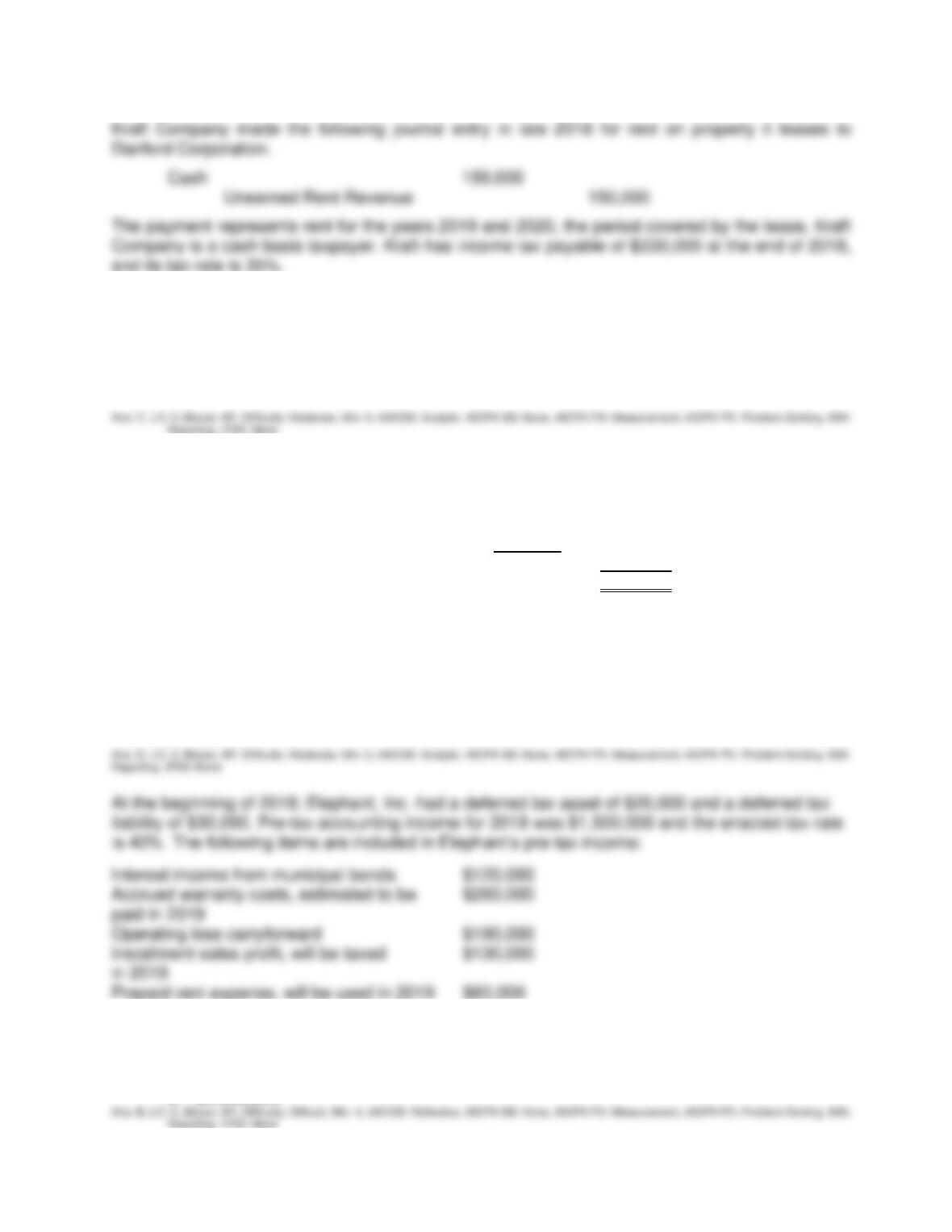
74. Assuming the income taxes payable at the end of 2019 is $255,000, what amount of
income tax expense would Kraft Company record for 2019?
a. $202,500
b. $228,750
c. $281,250
d. $307,500
75. The following information is available for Kessler Company after its first year of
operations:
Income before taxes $250,000
Federal income tax payable $104,000
Deferred income tax (4,000)
Income tax expense 100,000
Net income $150,000
Kessler estimates its annual warranty expense as a percentage of sales. The amount
charged to warranty expense on its books was $95,000. Assuming a 40% income tax rate,
what amount was actually paid this year for warranty claims?
a. $105,000
b. $100,000
c. $95,000
d. $85,000
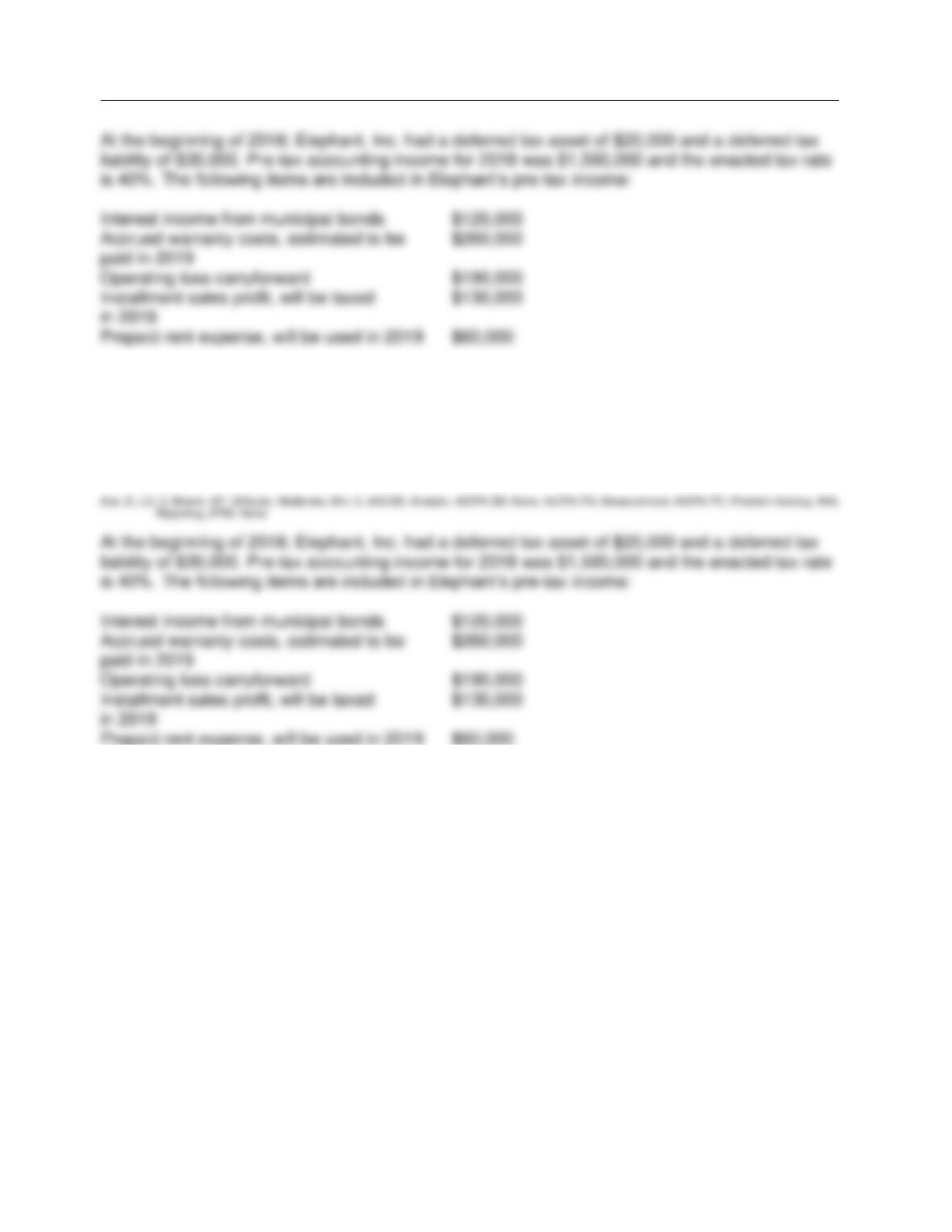
76. What is Elephant, Inc.’s taxable income for 2018?
a. $1,500,000
b. $1,260,000
c. $1,740,000
d. $2,260,000
Test Bank for Intermediate Accounting, Sixteenth Edition
19 – 24
77. Which of the following is required to adjust Elephant, Inc.’s deferred tax asset to its correct
balance at December 31, 2018?
a. A credit of $104,000
b. A credit of $76,000
c. A debit of $76,000
d. A debit of $84,000
78. The ending balance in Elephant, Inc.’s deferred tax liability at December 31, 2018 is
a. $46,000
b. $76,000
c. $52,000
d. $156,000
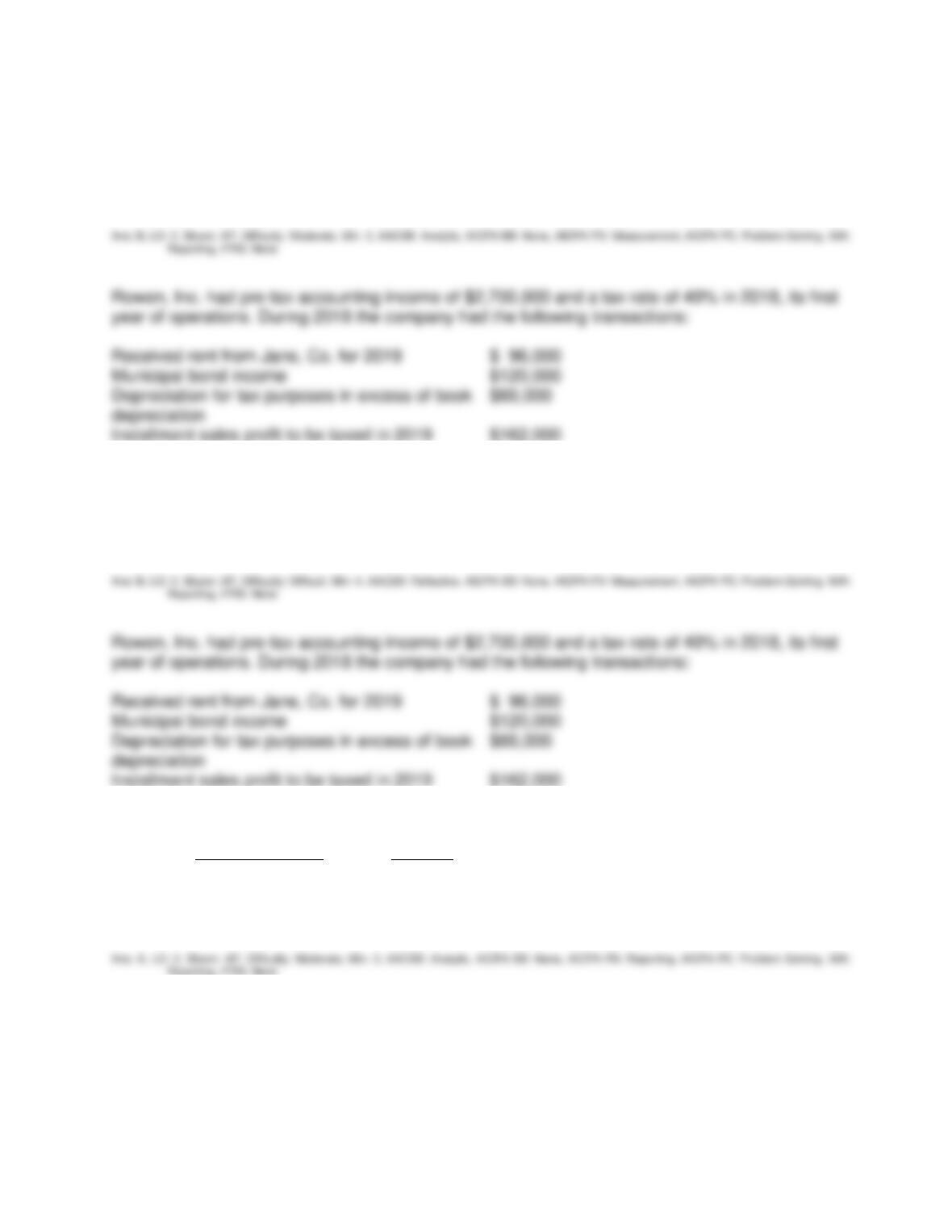
79. For 2018, what is the amount of income taxes payable for Rowen, Inc?
a. $904,800
b. $981,600
c. $1,029,600
d. $1,159,200
80. At the end of 2018, which of the following deferred tax accounts and balances exist at
December 31, 2018?
Account _ Balance
a. Deferred tax asset $38,400
b. Deferred tax liability $38,400
c. Deferred tax asset $62,400
d. Deferred tax liability $62,400

Test Bank for Intermediate Accounting, Sixteenth Edition
19 – 26
81. Based on the following information, compute 2018 taxable income for South Co. assuming
that its pre-tax accounting income for the year ended December 31, 2018 is $460,000.
Future taxable
Temporary difference (deductible) amount
Installment sales
$384,000
Depreciation
$120,000
Unearned rent
($400,000)
a. $564,000
b. $356,000
c. $964,000
d. $444,000
82.Fleming Company has the following cumulative taxable temporary differences:
12/31/18 12/31/17
$1,600,000 $2,250,000
The tax rate enacted for 2018 is 40%, while the tax rate enacted for future years is 30%.
Taxable income for 2018 is $4,000,000 and there are no permanent differences.
Fleming’s pretax financial income for 2018 is:
a. $2,400,000
b. $3,350,000
c. $4,325,000
d. $5,600,000
83. Larsen Corporation reported $200,000 in revenues in its 2018 financial statements, of
which $66,000 will not be included in the tax return until 2019. The enacted tax rate is
40% for 2018 and 35% for 2019. What amount should Larsen report for deferred income
tax liability in its balance sheet at December 31, 2018?
a. $23,100
b. $26,400
c. $29,400
d. $33,600
84. Duncan Inc. uses the accrual method of accounting for financial reporting purposes and
appropriately uses the installment method of accounting for income tax purposes. Profits
of $1,200,000 recognized for books in 2017 will be collected in the following years:
Collection of Profits
2018 $200,000
2019 $400,000
2020 $600,000
The enacted tax rates are: 40% for 2017, 35% for 2018, and 30% for 2019 and 2020.
Taxable income is expected in all future years. What amount should be included in the
December 31, 2017, balance sheet for the deferred tax liability related to the above
temporary difference?
a. $ 70,000
b. $300,000
c. $370,000
d. $480,000
85. At December 31, 2017 Raymond Corporation reported a deferred tax liability of $240,000
which was attributable to a taxable temporary difference of $800,000. The temporary
difference is scheduled to reverse in 2021. During 2018, a new tax law increased the
corporate tax rate from 30% to 40%. Raymond should record this change by debiting
a. Retained Earnings for $80,000.
b. Retained Earnings for $24,000.
c. Income Tax Expense for $24,000.
d. Income Tax Expense for $80,000.
86. Palmer Co. had a deferred tax liability balance due to a temporary difference at the
beginning of 2017 related to $1,500,000 of excess depreciation. In December of 2017, a
new income tax act is signed into law that lowers the corporate rate from 40% to 35%,
effective January 1, 2019. If taxable amounts related to the temporary difference are
scheduled to be reversed by $750,000 for both 2018 and 2019, Palmer should increase or
decrease deferred tax liability by what amount?
a. Decrease by $75,000
b. Decrease by $37,500
c. Increase by $37,500
d. Increase by $75,000
Test Bank for Intermediate Accounting, Sixteenth Edition
19 – 28
87. A reconciliation of Gentry Company’s pretax accounting income with its taxable income for
2018, its first year of operations, is as follows:
Pretax accounting income $4,500,000
Excess tax depreciation (225,000)
Taxable income $4,275,000
The excess tax depreciation will result in equal net taxable amounts in each of the next
three years. Enacted tax rates are 40% in 2018, 35% in 2019 and 2020, and 30% in 2021.
The total deferred tax liability to be reported on Gentry’s balance sheet at December 31,
2018, is
a. $90,000.
b. $75,000.
c. $78,750.
d. $67,500.
88. Khan, Inc. reports a taxable and financial loss of $2,250,000 for 2019. Its pretax financial
income for the last two years was as follows:
2017 $900,000
2018 1,200,000
The amount that Khan, Inc. reports as a net loss for financial reporting purposes in 2019,
assuming that it uses the carryback provisions, and that the tax rate is 30% for all periods
affected, is
a. $2,250,000 loss.
b. $ -0-.
c. $675,000 loss.
d. $1,575,000 loss.
89. Assuming that Wilcox elects to use the carryback provision, what income (loss) is reported
in 2018? (Assume that any deferred tax asset recognized is more likely than not to be
realized.)
a. $(2,700,000)
b. $ -0-
c. $(2,610,000)
d. $(1,650,000)
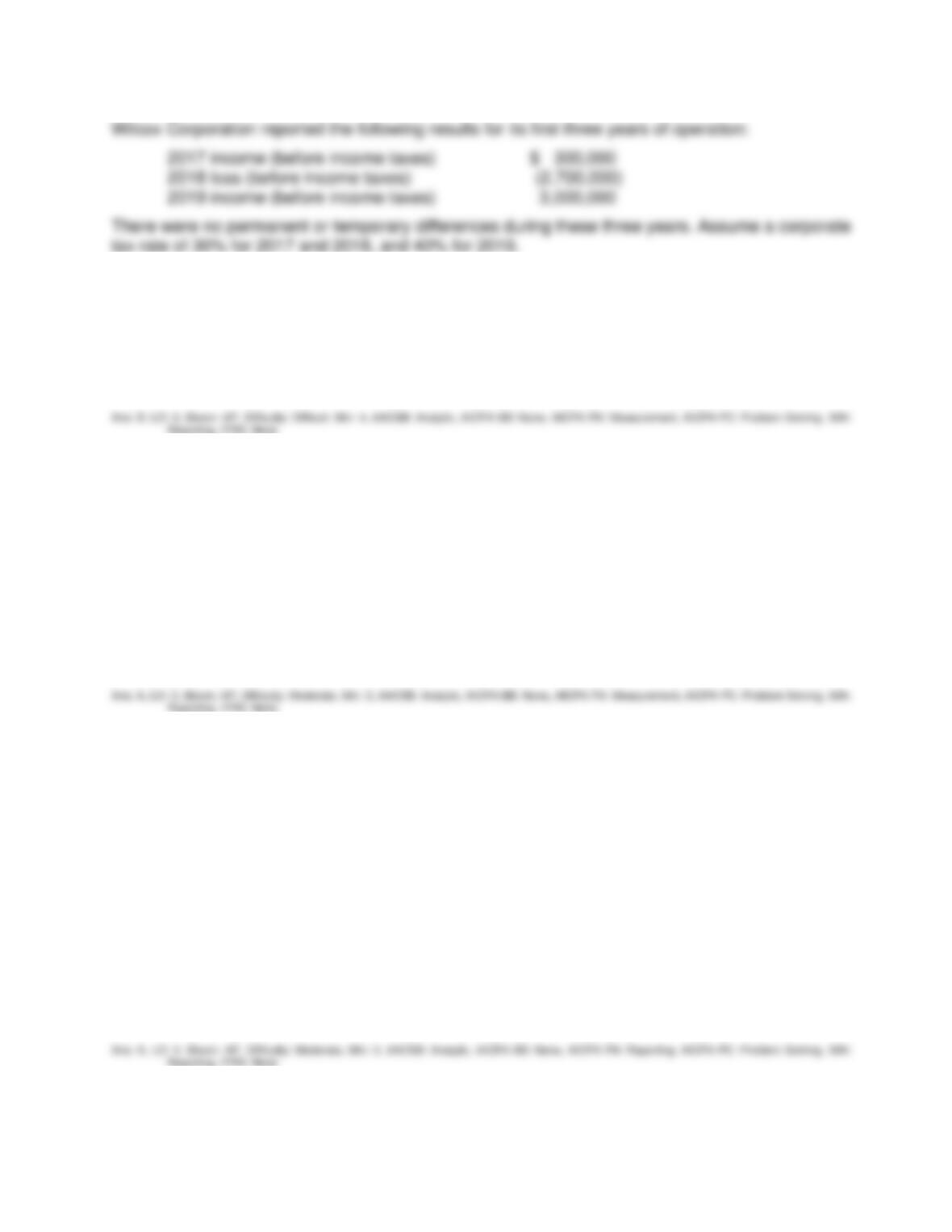
90. Assuming that Wilcox elects to use the carryforward provision and not the carryback
provision, what income (loss) is reported in 2018?
a. $(2,700,000)
b. $(1,620,000)
c. $ -0-
d. $(2,610,000)
91. Rodd Co. reports a taxable and pretax financial loss of $900,000 for 2018. Rodd’s taxable
and pretax financial income and tax rates for the last two years were:
2016 $900,000 30%
2017 900,000 35%
The amount that Rodd should report as an income tax refund receivable in 2018,
assuming that it uses the carryback provisions and that the tax rate is 40% in 2018, is
a. $270,000.
b. $315,000.
c. $360,000.
d. $405,000.
92. Nickerson Corporation began operations in 2016. There have been no permanent or
temporary differences to account for since the inception of the business. The following
data are available:
Year
2016
2017
2018
2019
Enacted Tax Rate
45%
40%
35%
30%
Taxable Income
$2,000,000
2,400,000
Taxes Paid
$900,000
960,000
In 2018, Nickerson had an operating loss of $2,480,000. What amount of income tax
benefits should be reported on the 2018 income statement due to this loss assuming that
it uses the carryback provision?
a. $1,092,000
b. $996,000
c. $992,000
d. $744,000
Test Bank for Intermediate Accounting, Sixteenth Edition
19 – 30
93. Assuming that C.J. Company opts to carryback its 2018 NOL, what is the amount of
income taxes payable at December 31, 2019?
a. $272,000
b. $672,000
c. $492,000
d. $432,000
94. Assuming that C.J. Company opts only to carryforward its 2018 NOL, what is the amount
of deferred tax asset or liability that C.J. Company would report on its December 31, 2018
balance sheet?
Amount _ Deferred tax asset or liability
a. $300,000 Deferred tax liability
b. $350,000 Deferred tax liability
c. $400,000 Deferred tax asset
d. $300,000 Deferred tax asset
Multiple Choice Answers—Computational
Item
Ans.
Item
Ans.
Item
Ans.
Item
Ans.
Item
Ans.
Item
Ans.
Item
Ans.

MULTIPLE CHOICE—CPA Adapted
95. Munoz Corp.’s books showed pretax financial income of $3,600,000 for the year ended
December 31, 2018. In the computation of federal income taxes, the following data were
considered:
Gain on an involuntary conversion $1,560,000
(Munoz has elected to replace the property within the statutory
period using total proceeds.)
Depreciation deducted for tax purposes in excess of depreciation
deducted for book purposes 240,000
Federal estimated tax payments, 2018 300,000
Enacted federal tax rate, 2018 30%
What amount should Munoz report as its current federal income tax liability on its
December 31, 2018 balance sheet?
a. $240,000
b. $312,000
c. $540,000
d. $612,000
96. Haag Corp.’s 2018 income statement showed pretax accounting income of $2,500,000.
To compute the federal income tax liability, the following 2018 data are provided:
Income from exempt municipal bonds $ 100,000
Depreciation deducted for tax purposes in excess of depreciation
deducted for financial statement purposes 200,000
Estimated federal income tax payments made 500,000
Enacted corporate income tax rate 30%
What amount of current federal income tax liability should be included in Hagg’s
December 31, 2018 balance sheet?
a. $160,000
b. $220,000
c. $250,000
d. $660,000
97. On January 1, 2018, Gore, Inc. purchased a machine for $2,250,000 which will be
depreciated $225,000 per year for financial statement reporting purposes. For income tax
reporting, Gore elected to expense $250,000 and to use straight-line depreciation which
will allow a cost recovery deduction of $200,000 for 2018. Assume a present and future
enacted income tax rate of 30%. What amount should be added to Gore’s deferred
income tax liability for this temporary difference at December 31, 2018?
a. $135,000
b. $75,000
c. $67,500
d. $60,000

Test Bank for Intermediate Accounting, Sixteenth Edition
19 – 32
98. On January 1, 2018, Piper Corp. purchased 40% of the voting common stock of Betz, Inc.
and appropriately accounts for its investment by the equity method. During 2018, Betz
reported earnings of $1,200,000 and paid dividends of $400,000. Piper assumes that all of
Betz’s undistributed earnings will be distributed as dividends in future periods when the
enacted tax rate will be 30%. Ignore the dividend-received deduction. Piper’s current
enacted income tax rate is 25%. The increase in Piper’s deferred income tax liability for
this temporary difference is
a. $240,000.
b. $200,000.
c. $144,000.
d. $ 96,000.
99. Foltz Corp.’s 2018 income statement had pretax financial income of $500,000 in its first
year of operations. Foltz uses an accelerated cost recovery method on its tax return and
straight-line depreciation for financial reporting. The differences between the book and tax
deductions for depreciation over the five-year life of the assets acquired in 2018, and the
enacted tax rates for 2018 to 2022 are as follows:
Book Over (Under) Tax Tax Rates
2018 $(100,000) 35%
2019 (130,000) 30%
2020 (30,000) 30%
2021 120,000 30%
2022 140,000 30%
There are no other temporary differences. In Foltz’s December 31, 2018 balance sheet, the
noncurrent deferred income tax liability and the income taxes currently payable should be
Noncurrent Deferred Income Taxes
Income Tax Liability Currently Payable
a. $78,000 $100,000
b. $78,000 $140,000
c. $30,000 $120,000
d. $30,000 $140,000
100. Didde Corp. prepared the following reconciliation of income per books with income per tax
return for the year ended December 31, 2018:
Book income before income taxes $2,700,000
Add temporary difference
Construction contract revenue which will reverse in 2019 240,000
Deduct temporary difference
Depreciation expense which will reverse in equal amounts
in each of the next four years (960,000)
Taxable income $1,980,000
Didde’s effective income tax rate is 34% for 2018. What amount should Didde report in its
2018 income statement as the current provision for income taxes?
a. $ 81,600
b. $673,200
c. $918,000
d. $999,600
101. In its 2018 income statement, Cohen Corp. reported depreciation of $3,700,000 and interest
revenue on municipal obligations of $700,000. Cohen reported depreciation of $5,500,000
on its 2018 income tax return. The difference in depreciation is the only temporary
difference, and it will reverse equally over the next three years. Cohen’s enacted income tax
rates are 35% for 2018, 30% for 2019, and 25% for 2020 and 2021. What amount should be
included in the deferred income tax liability in Hertz‘s December 31, 2018 balance sheet?
a. $480,000
b. $620,000
c. $750,000
d. $875,000
102. Dunn, Inc. uses the accrual method of accounting for financial reporting purposes and
appropriately uses the installment method of accounting for income tax purposes.
Installment income of $3,000,000 will be collected in the following years when the enacted
tax rates are:
Collection of Income Enacted Tax Rates
2017 $300,000 35%
2018 600,000 30%
2019 900,000 30%
2020 1,200,000 25%
The installment income is Dunn‘s only temporary difference. What amount should be
included in the deferred income tax liability in Dunn’s December 31, 2018 balance sheet?
a. $750,000
b. $855,000
c. $945,000
d. $1,050,000
Test Bank for Intermediate Accounting, Sixteenth Edition
19 – 34
103. For calendar year 2018, Kane Corp. reported depreciation of $1,600,000 in its income
statement. On its 2018 income tax return, Kane reported depreciation of $2,400,000.
Kane’s income statement also included $300,000 accrued warranty expense that will be
deducted for tax purposes when paid. Kane’s enacted tax rates are 30% for 2018 and
2019, and 24% for 2020 and 2021. The depreciation difference and warranty expense will
reverse over the next three years as follows:
Depreciation Difference Warranty Expense
2019 $320,000 $ 60,000
2020 280,000 100,000
2021 200,000 140,000
$800,000 $300,000
These were Kane’s only temporary differences. In Kane’s 2018 income statement, the
deferred portion of its provision for income taxes should be
a. $267,600.
b. $150,000.
c. $135,600.
d. $146,400.
104. Wright Co., organized on January 2, 2018, had pretax accounting income of $960,000 and
taxable income of $3,120,000 for the year ended December 31, 2018. The only temporary
difference is accrued product warranty costs which are expected to be paid as follows:
2019 $720,000
2020 360,000
2021 360,000
2022 720,000
The enacted income tax rates are 35% for 2018, 30% for 2019 through 2021, and 25% for
2022. If Wright expects taxable income in future years, the deferred tax asset in Wright’s
December 31, 2018 balance sheet should be
a. $432,000.
b. $504,000.
c. $612,000.
d. $756,000.
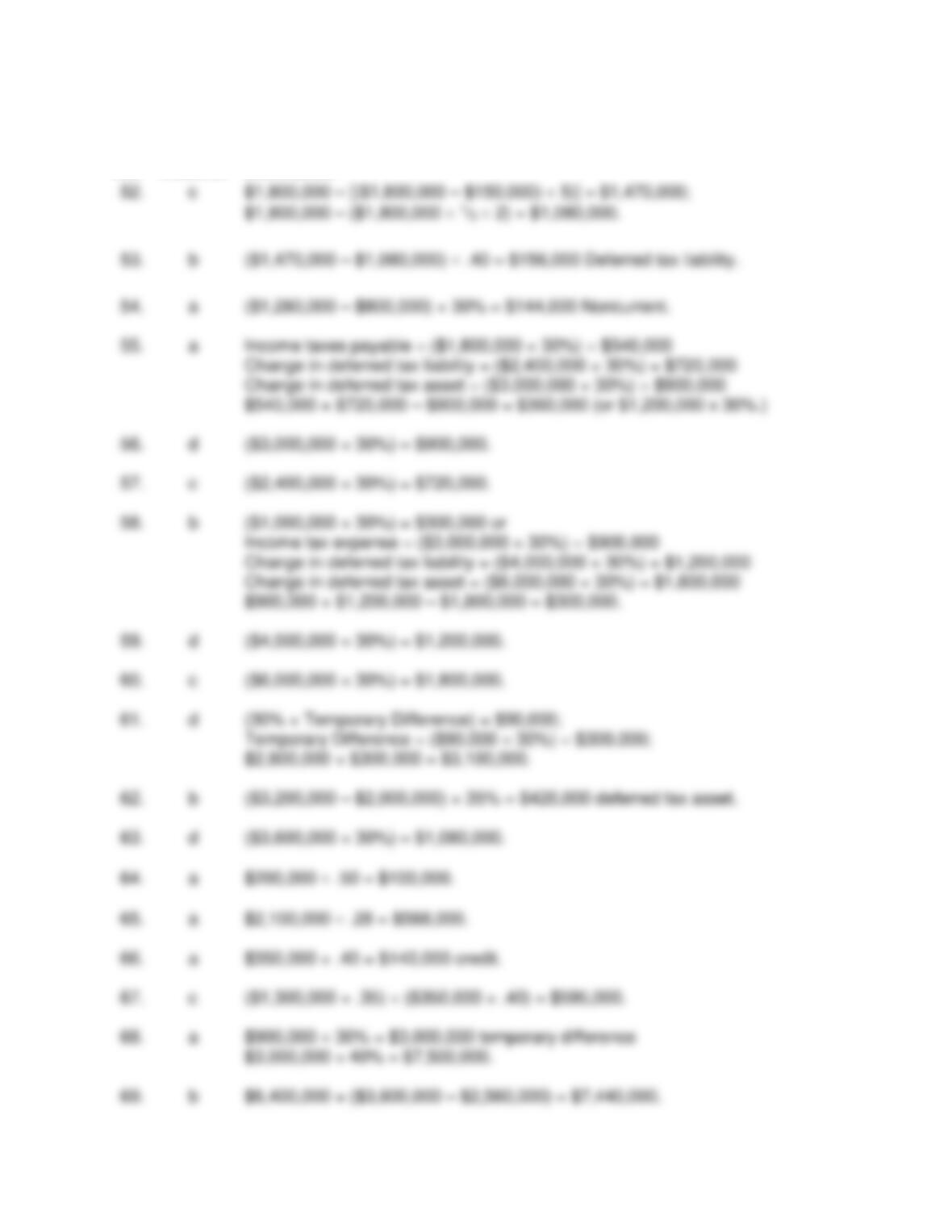
Multiple Choice Answers—CPA Adapted
Item
Ans.
Item
Ans.
Item
Ans.
Item
Ans.
Item
Ans.
DERIVATIONS — Computational
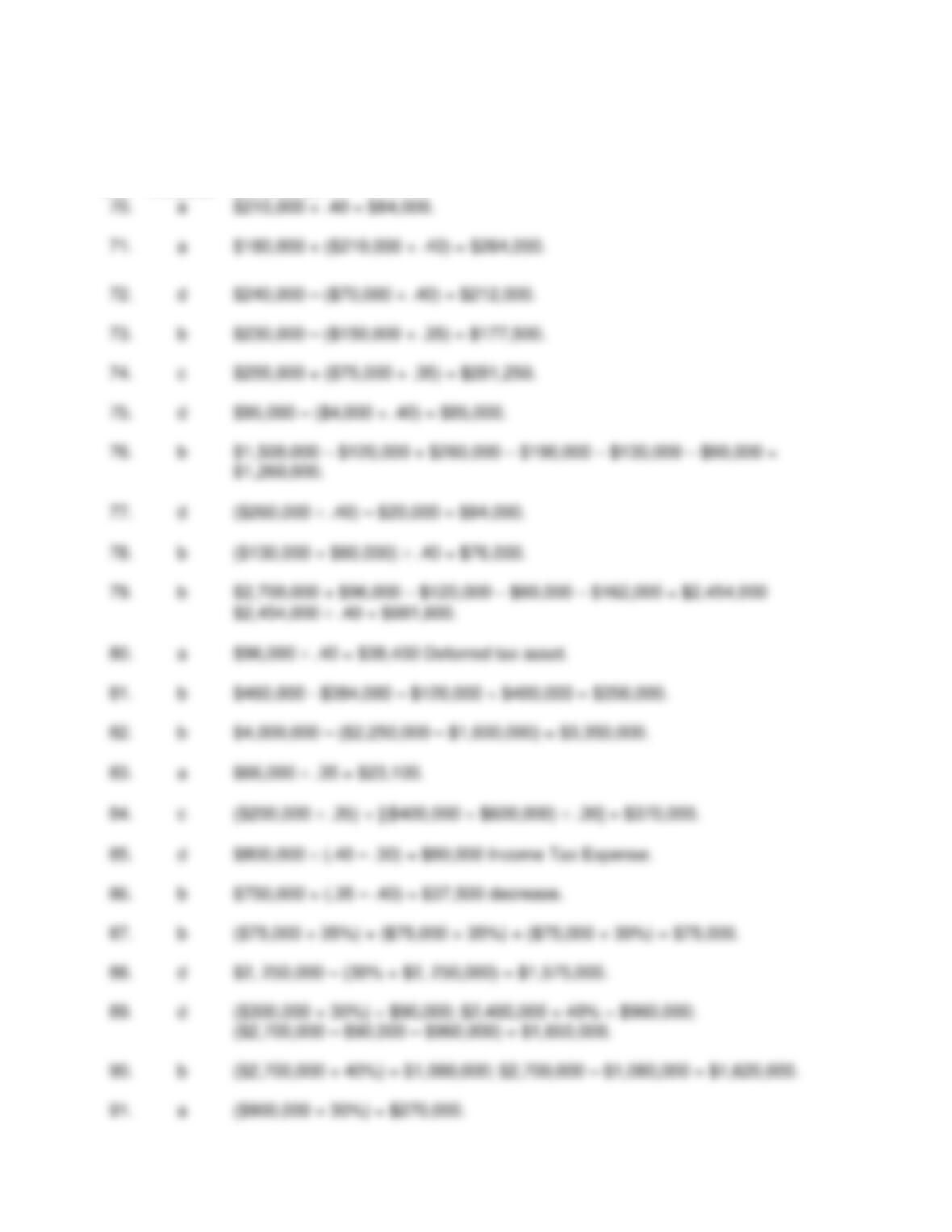
No. Answer Derivation
Test Bank for Intermediate Accounting, Sixteenth Edition
19 – 36
DERIVATIONS — Computational (cont.)
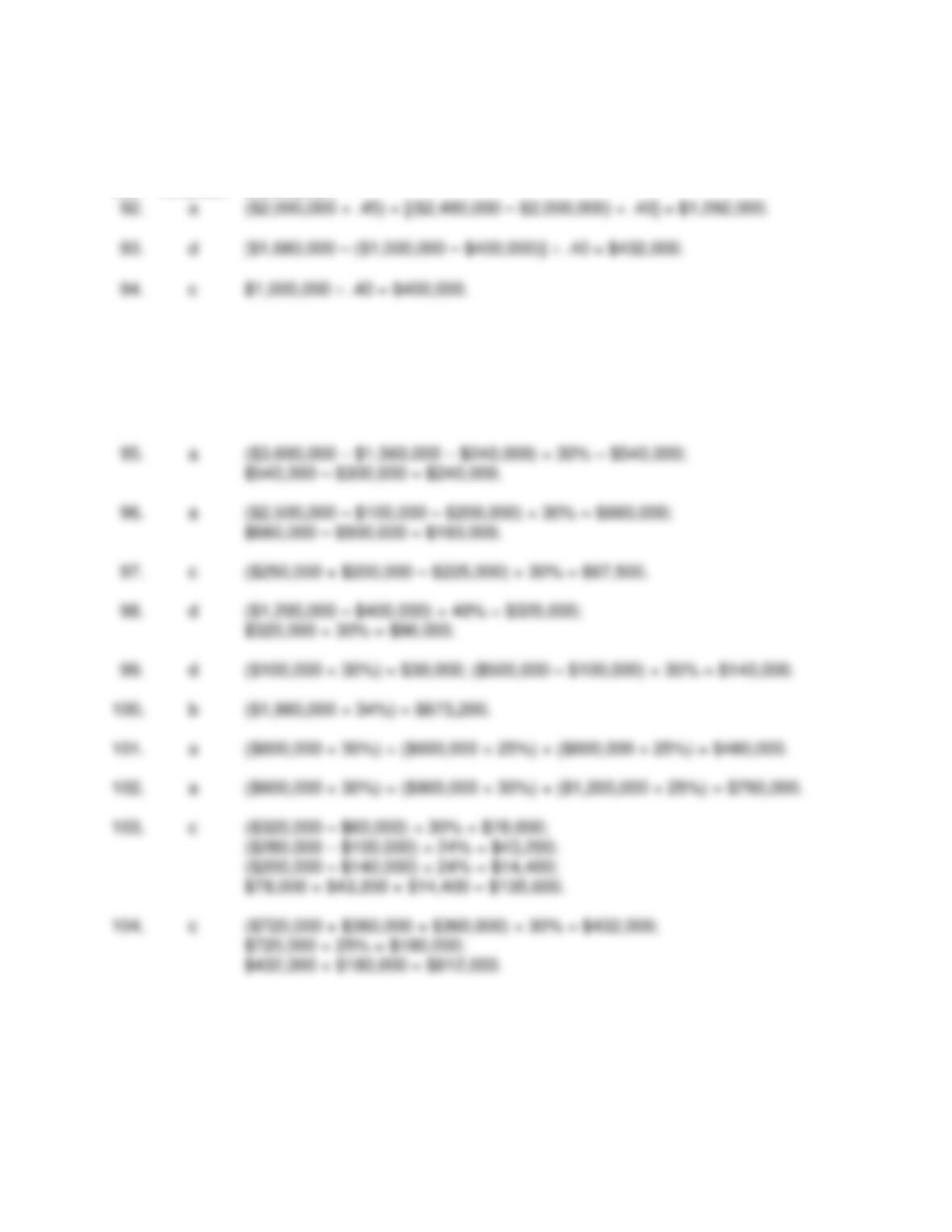
No. Answer Derivation
DERIVATIONS — Computational (cont.)
No. Answer Derivation
DERIVATIONS — CPA Adapted
No. Answer Derivation