1
Chemistry, 7e (McMurry/Fay)
Chapter 19 Nuclear Chemistry
19.1 Multiple-Choice Questions
1) Which statement about nuclear reactions is true?
A) New elements are never produced in a nuclear reaction.
B) Nuclear reactions involve valence electrons.
C) The rate of a nuclear reaction is affected by catalysts.
D) Tremendous amounts of energy are involved in nuclear reactions.
2) The number of nucleons in an atom or ion is the same as the
A) atomic number.
B) charge on the atom or ion.
C) mass number.
D) none of these
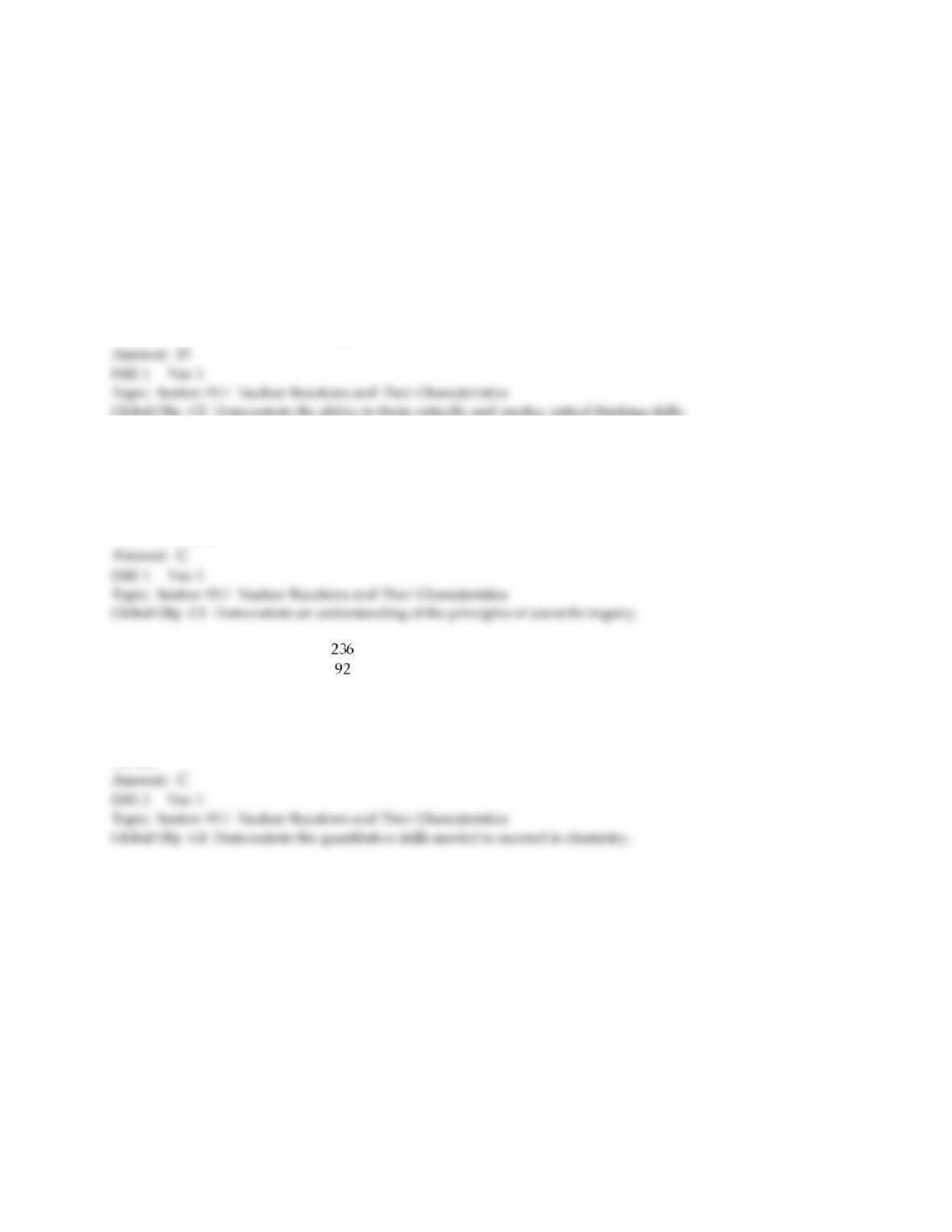
3) The number of nucleons in a U2+ nucleus is
A) 92.
B) 144.
C) 236.
D) 328.
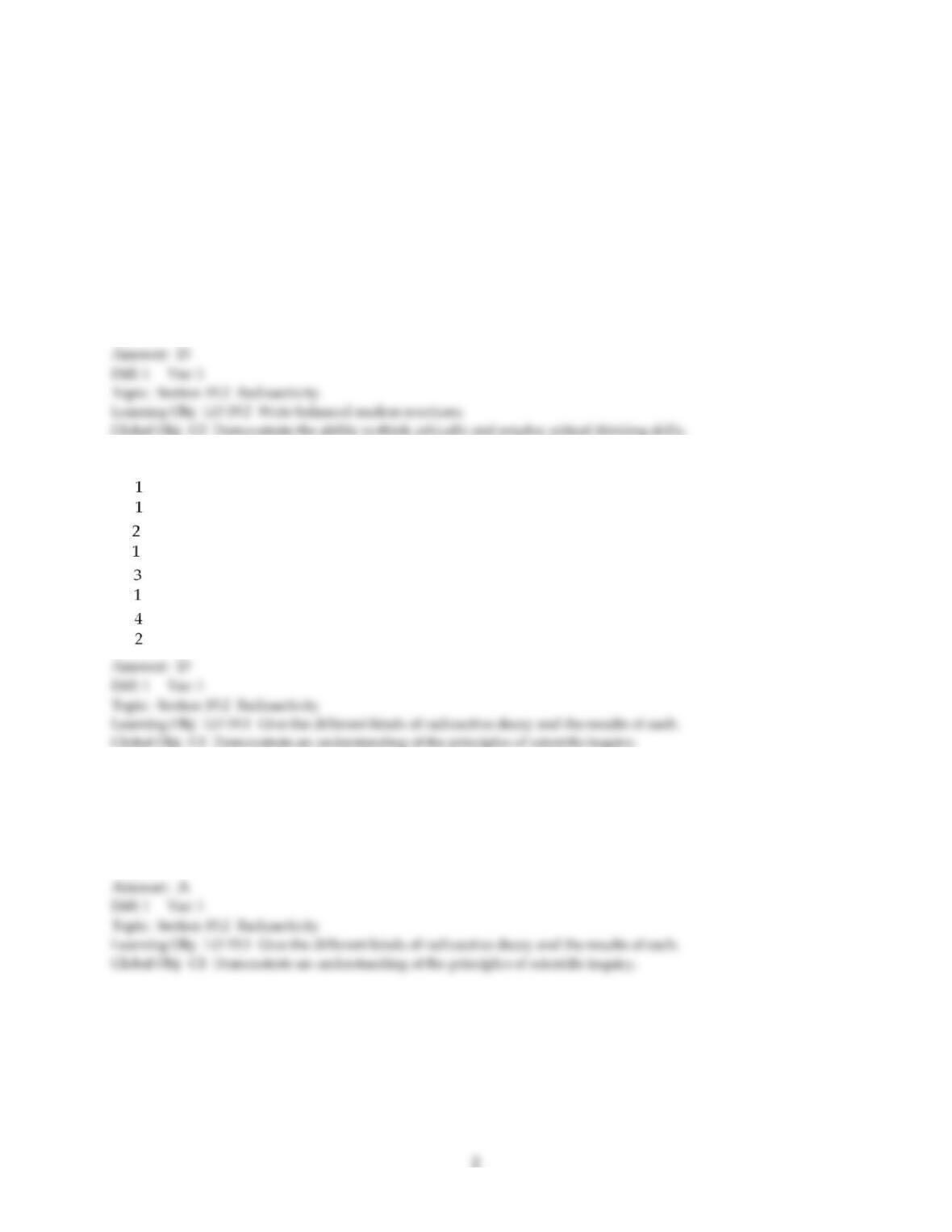
4) Which of the following statements is not correct when balancing a nuclear equation?
I. The mass numbers must be conserved on both sides of the reaction arrow.
II. The ionic charges must be conserved on both sides of the reaction arrow.
III. The atomic numbers must be conserved on both sides of the reaction arrow.
IV. The elements must be the same on both sides of the reaction arrow.
A) II only
B) II and III
C) I and III
D) II and IV
5) An alpha particle is
A) H+.
B) H+.
C) H+.
D) He2+.
6) The nuclear decay process that involves the particle having the greatest mass is ________ emission.
A) alpha
B) beta
C) gamma
D) positron
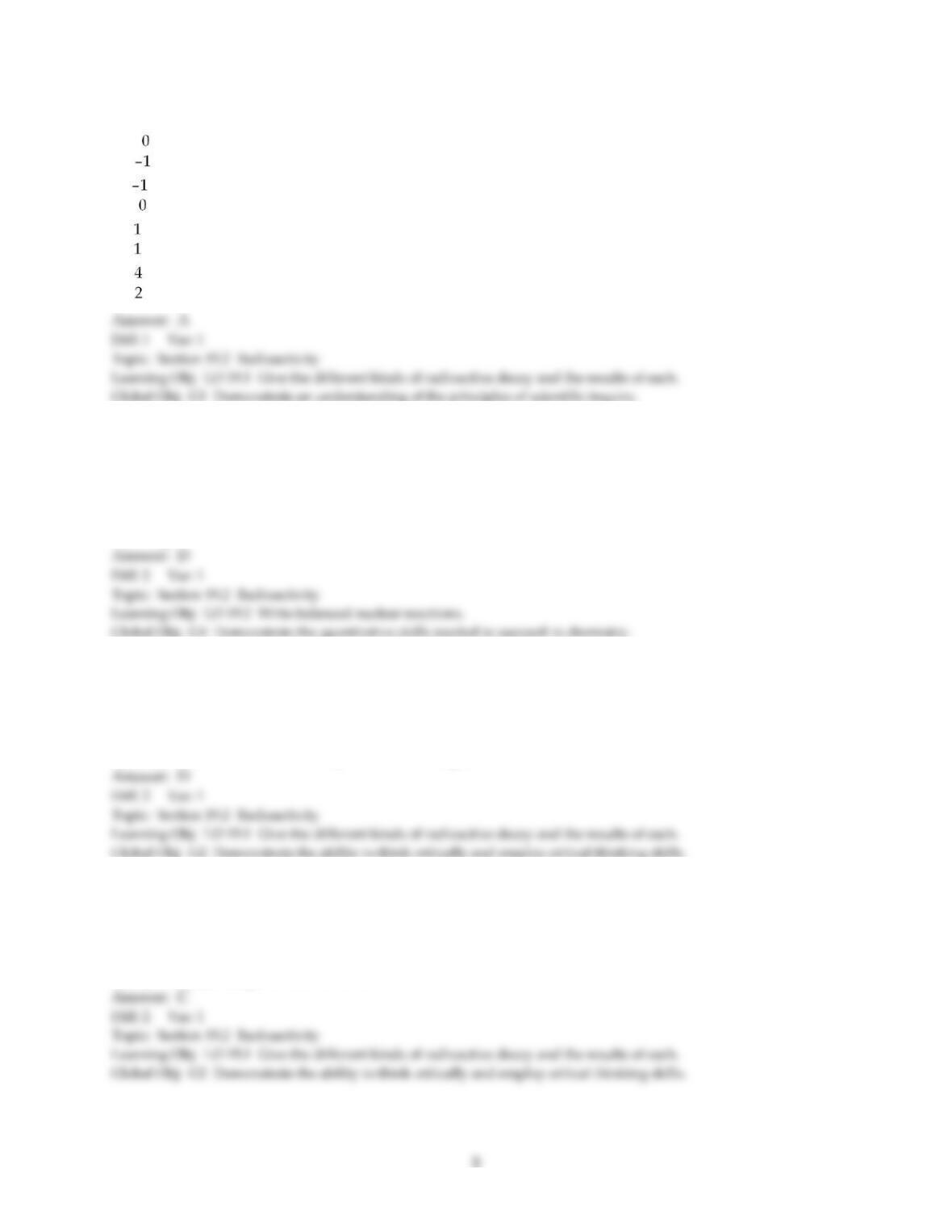
7) A beta particle is
A) e.
B) e.
C) p.
D) He.
8) Beta decay of 24Na produces a beta particle and
A) 20F.
B) 23Na.
C) 24Ne.
D) 24Mg.
9) Which of the following statements about gamma radiation is false?
A) It almost always accompanies alpha or beta emission.
B) It is a mechanism to release excess energy in the nucleus.
C) Gamma rays are high energy photons.
D) The mass number decreases by one with each gamma emitted.
10) Gamma radiation can be described as
A) a helium nucleus.
B) a negatively charged free electron.
C) high energy electromagnetic radiation.
D) a positively charged free electron.
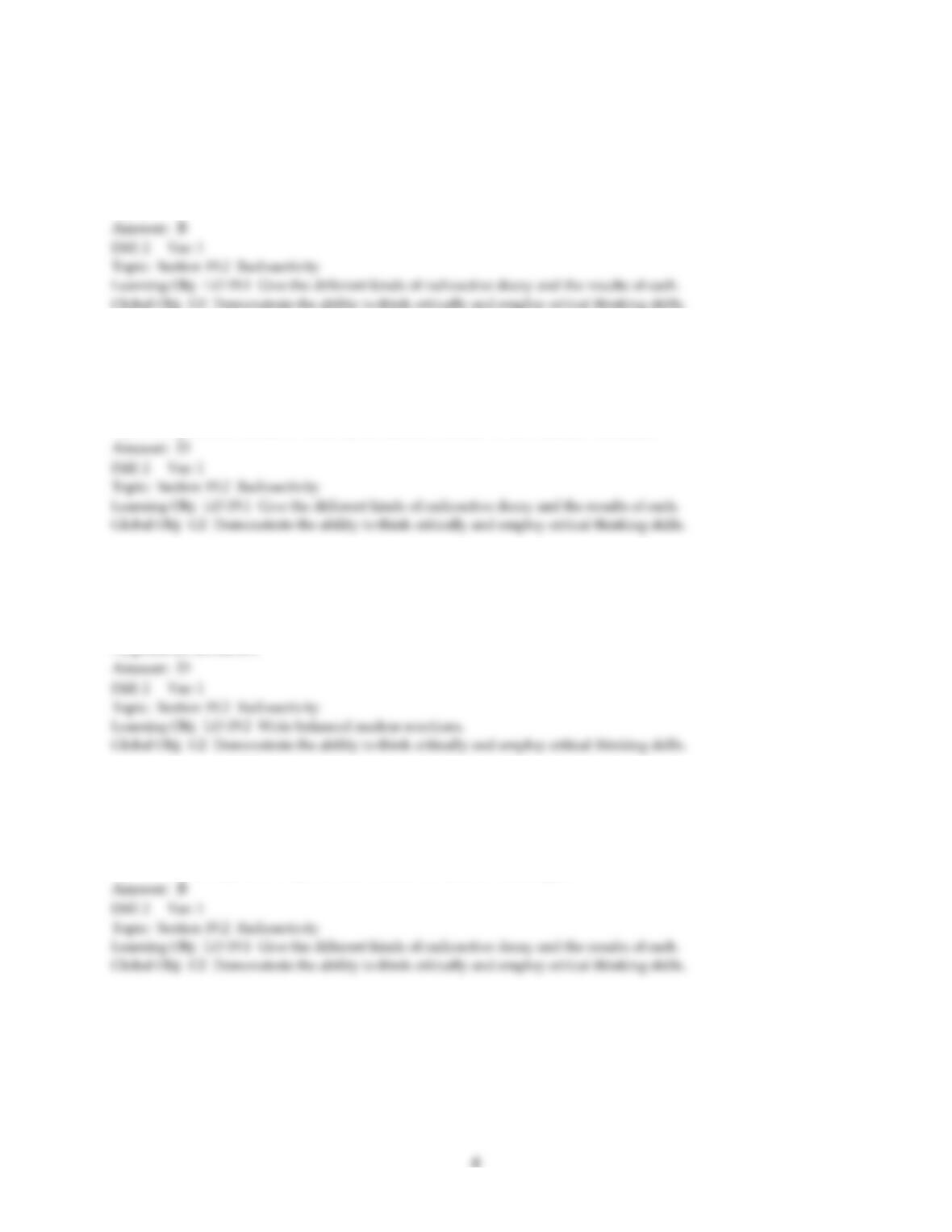
11) Positron emission changes the atomic number of an element by
A) –2.
B) –1.
C) +1.
D) +2.
12) Which of the following statements about positrons is false?
A) The positron has same mass as an electron.
B) A positron is ejected from the nucleus during the conversion of a proton into a neutron.
C) A positron is a positive electron.
D) When positron emission occurs, the atomic number of the nucleus increases.
13) The nuclear transformation potassium-40 argon-40 + ? is classified as
A) alpha emission.
B) beta emission.
C) electron capture.
D) positron emission.
14) Which of the following statements about electron capture is false?
A) The electron is used to convert a proton to a neutron.
B) The electron involved is most likely an outer shell valence electron.
C) In electron capture decay, the atomic number decreases by one.
D) In electron capture decay, the mass number remains unchanged.
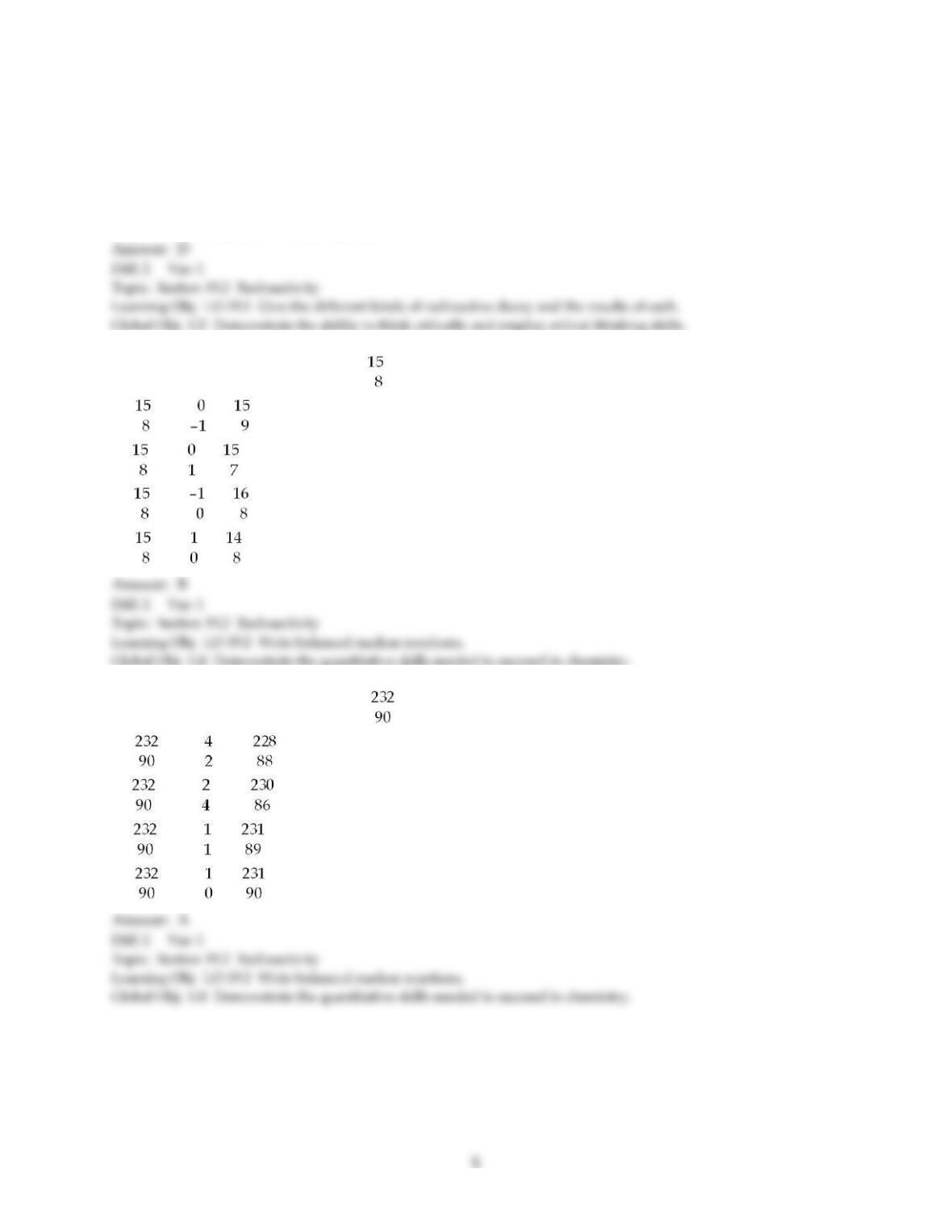
15) Which of the following decay processes give a product nuclide whose atomic number is one less than
the starting nuclide?
A) alpha decay
B) beta decay and positron decay
C) gamma decay and beta decay
D) positron decay and electron capture
16) Which reaction below represents O decay by positron emission?
A) O → e + Ra
B) O → e + N
C) O → e + O
D) O → e + O
17) Which reaction below represents Th decay by alpha emission?
A) Th → He + Ra
B) Th → He + Ra
C) Th → p + Ac
D) Th → n + Th

18) Which reaction below represents Ti decay by electron capture?
A) Ti + e → Ti
B) Ti + e → Ti
C) Ti + e → Ti
D) Ti + e → Sc
19) In addition to a beta particle, what is the other product of beta decay of I?
A) Sb
B) Te
C) Xe
D) Cs
20) Tritium, H, is formed in the upper atmosphere when N captures a neutron and then decays.
What is the other product of this reaction?
A) C
B) C
C) B
D) B
21) As the atomic number of the elements increases, the ratio of neutrons to protons in stable nuclei
A) decreases.
B) stays the same.
C) increases.
D) is unrelated to stability.
22) Which one of the following statements about isotopes is false?
A) The ratio of neutrons to protons is about 1:1 for elements lighter than Ca.
B) The ratio of neutrons to protons is > 1:1 for elements heavier than Ca.
C) Nonradioactive isotopes generally have an odd number of neutrons.
D) All isotopes beyond 209Bi are radioactive.
23) Which one of the following combinations of neutrons/protons results in the lowest number of
nonradioactive (stable) isotopes?
A) even number protons/even number neutrons
B) even number protons/odd number neutrons
C) odd number protons/even number neutrons
D) odd number protons/odd number neutrons
24) Which of the following elements would you expect to have the largest number of stable isotopes?
Element number:
A) 48
B) 49
C) 50
D) 51
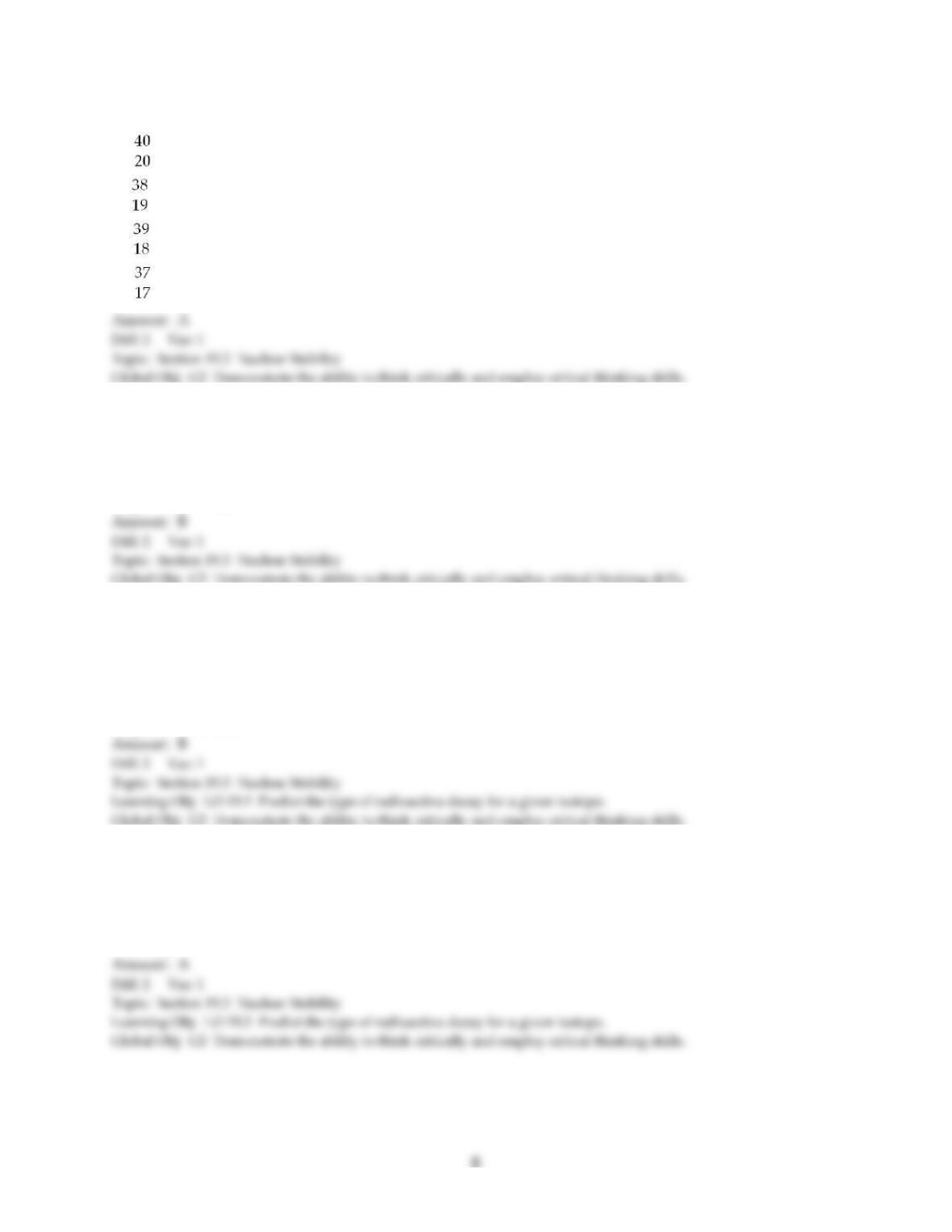
25) Which of the following elements would be expected to be particularly stable?
A) Ca
B) K
C) Ar
D) Cl
26) Which process decreases the neutron/proton ratio?
A) alpha emission
B) beta emission
C) electron capture
D) positron emission
27) A radioisotope has a neutron/proton ratio which is too low. Which of the following processes will not
occur for such a nucleus?
A) alpha emission
B) beta emission
C) electron capture
D) positron emission
28) A radioisotope which is neutron poor and very heavy is most likely to decay by
A) alpha emission, electron capture, or positron emission.
B) only alpha emission.
C) only electron capture.
D) only positron emission.
29) Which of the following statements regarding nuclear stability is true?
A) A stable element always has an equal number of protons and neutrons.
B) The most abundant isotope of an element always has an equal number of protons and neutrons.
C) Very few elements have at least one radioactive isotope.
D) Hydrogen is the only element whose most abundant isotope contains more protons than neutrons.
30) Which of the following processes will decrease the neutron/ proton ratio?
A) positron emission
B) electron capture
C) beta emission
D) alpha emission
31) Iodine-123, used in thyroid therapy, has a half-life of 13.27 hours. How many half-lives are required
for a 160 mg sample of iodine-123 to decay to 5.0 mg?
A) 0.031
B) 1.0
C) 5.0
D) 32
32) Neptunium-239 has a half-life of 2.35 days. How many days must elapse for a sample of 239Np to
decay to 1.00% of its original quantity?
A) 0.0640 days
B) 0.736 days
C) 1.36 days
D) 15.6 days
33) If a sample of 233Pa takes 62.7 days to decrease to 20.0% of its original mass, what is its half-life?
A) 0.0370 days
B) 27.0 days
C) 157 days
D) 195 days
34) What percentage of a radioactive substance remains after 6.00 half–lives have elapsed?
A) 0.78%
B) 1.56%
C) 3.31%
D) 6.25%
35) Fluorine-18 is a radioisotope widely used in positron emission tomography to investigate brain
activity. The half-life is 109.8 minutes. How long will it take for 2.75 μg of 18F to decay to 500 ng?
A) 0.288 min
B) 270 min
C) 871 min
D) 2.06 × 10³ min
36) Fluorine-18 is an isotope used in Positron Emission Tomography (PET) to scan the brain. If a
researcher has 1.50 μg of 18F, how long before it decays to 1.0 ng? The half-life of 18F is 109.8 minutes.
A) 5.2 × 10⁻² hr
B) 4.6 × 10⁻² hr
C) 19 hr
D) 51 hr
37) What is the decay constant for a radioactive isotope which decreases to 34% of its original value in
2.48 hours?
A) 0.137 hr-1
B) 0.168 hr-1
C) 0.435 hr-1
D) 2.30 hr-1
38) An experiment with 55Co takes 47.5 hours. At the end of the experiment, 1.90 ng of 55Co remains. If
the half life is 18.0 hours, how many ng of 55Co were originally present?
A) 2.47 ng
B) 3.05 ng
C) 3.28 ng
D) 11.8 ng
39) A researcher needs 5.00 mg of 128Ba for an experiment. If the half-life of 128Ba is 2.43 days, how
many milligrams of 128BaCl2 must she order from the manufacturer if it takes 4.50 days to ship the
material from the manufacturer to the university? (Assume the molar mass of 128Ba is 128 g/mol.)
A) 11.6 mg
B) 18.0 mg
C) 21.5 mg
D) 44.9 mg
40) Mass defect is the mass lost when
A) an atom is formed from individual protons, neutrons, and electrons.
B) a nucleus is formed from individual protons and neutrons.
C) electrons are removed from an atom.
D) electrons are added to an atom.
41) The sum of the masses of the protons and neutrons in a given nucleus minus the mass of that nucleus
is always
A) negative.
B) positive.
C) temperature dependent.
D) zero.
42) The binding energy is defined as
A) the amount of energy absorbed when electrons are added to an ion.
B) the amount of energy absorbed when protons and neutrons form a nucleus.
C) the amount of energy released when electrons are removed from the atom.
D) the amount of energy required to break apart a nucleus into individual protons and neutrons.
43) A binding energy curve is a plot of binding energy per nucleon versus atomic number. In what region
of the binding energy curve are the most stable elements found?
A) in the lower left region (low atomic mass)
B) in the central top region (moderate atomic mass)
C) in the lower right region (heavy atomic mass)
D) binding energy is not dependent on atomic mass
44) The total binding energies for 3He, 4He, and 6He are 7.72 MeV, 28.29 MeV, and 29.26 MeV
respectively. Arrange the 3 isotopes in increasing order of binding energy per nucleon.
A) 3He < 4He < 6He
B) 6He < 4He < 3He
C) 4He < 3He < 6He
D) 3He < 6He < 4He
45) Calculate the mass defect for the formation of phosphorus-31. The mass of a phosphorus-31 nucleus is
30.973765 amu. The masses of a proton and a neutron are 1.00728 and 1.00866 amu, respectively.
A) 0.13015 amu
B) 0.15404 amu
C) 0.27261 amu
D) 0.27399 amu
46) If the mass of one neutron is 1.00866 amu, the mass of one proton is 1.00728 amu, and the mass of 14C
nucleus is 13.99995 amu, calculate the binding energy for the 14C nucleus.
A) 9.92 × 10⁹ kJ/mol
B) 1.02 × 10¹⁰ kJ/mol
C) 5.54 × 10¹¹ kJ/mol
D) 5.95 × 10¹¹ kJ/mol
47) If the mass of one neutron is 1.00866 amu, the mass of one proton is 1.00728 amu, and the mass of 12C
nucleus is 11.99671 amu, calculate the binding energy for the 12C nucleus.
A) 8.90 × 10⁹ kJ/mol
B) 8.90 × 10¹² kJ/mol
C) 1.10 × 10¹⁵ kJ/mol
D) 1.10 × 10¹⁸ kJ/mol
48) How much energy is released for alpha decay of 236U? The masses of 4He, 232Th, and 236U are
4.002604, 232.038124, and 236.045637 amu, respectively.
A) 1.473 × 10⁸ kJ/mol
B) 4.418 × 10⁸ kJ/mol
C) 4.909 × 10⁸ kJ/mol
D) 7.209 × 10⁸ kJ/mol
49) What is the mass change in grams for the reaction 2 NO2(g) → N2O4(g)? The enthalpy for the reaction
is -57.2 kJ.
A) -6.36 × 10⁻¹³ g
B) -6.36 × 10⁻¹⁰ g
C) -1.91 × 10⁻⁷ g
D) -1.91 × 10⁻⁴ g
50) Choose the words that best complete the following sentence.
The ________ the binding energy, the ________ stable the nucleus.
A) larger, less
B) larger, more
C) smaller, less
D) smaller, more
51) Which does not apply to a nuclear fusion reaction?
A) Atoms of one element cannot be converted to atoms of another element.
B) Energy is conserved.
C) Matter is conserved.
D) None of these apply to a nuclear fusion reaction.
52) Which of the following is not an advantage of fusion reactions over fission reactions for power
generation?
A) cheap and plentiful fuel
B) ease of reaction initiation
C) Fusion products are non-polluting.
D) Fusion products are nonradioactive.
53) Breaking a chemical bond requires approximately 102 kJ/mol of energy. What is closest to the order of
magnitude of the energy required to split a nucleus in to its individual protons and neutrons?
A) 103 kJ/mol
B) 104 kJ/mol
C) 108 kJ/mol
D) 1010 kJ/mol
54) Which reaction is expected to release the greatest amount of energy?
A) 2 H → H2
B) H + H →He
C) n + U → Te + Zr + 2 1n
D) n + U → Ba + Kr + 3 n
55) Elements with ________ atomic mass are best possible candidates for a fusion reaction.
A) very low
B) moderate
C) moderate to heavy
D) very heavy
56) Elements with ________ atomic mass are best possible candidates for a fission reaction.
A) very low
B) moderate
C) moderate to heavy
D) very heavy
57) Four heavy elements (A, B, C, and D) will fission when bombarded by neutrons. In addition to
fissioning into two smaller elements, A also gives off a beta particle, B gives off gamma rays, C gives off
neutrons, and D gives off alpha particles. Which element would make a possible fuel for a nuclear
reactor?
A) element A
B) element B
C) element C
D) element D
58) What does the term “critical mass” mean? It is the
A) amount of fissionable material which will self-sustain a nuclear chain reaction.
B) difference between mass of individual protons and neutrons and the mass of the nucleus.
C) energy which holds the nucleus together.
D) mass of fuel in a nuclear reactor core.
59) In fusion reactions to make superheavy elements, energy is required to bring the two nuclei together
and to form additional mass. How much energy must be converted into mass for the alpha bombardment
of 253Es to form 257Md? (The isotopic masses are 253Es = 253.08294 amu, 4He = 4.00260 amu, 257Md =
257.09558 amu.)
A) 3.01 × 10⁶ kJ/mol
B) 9.04 × 10⁸ kJ/mol
C) 3.59 × 10¹¹ kJ/mol
D) 7.21 × 10¹¹ kJ/mol
60) Nitrogen-14 (14.003074 amu) is synthesized in the sun by fusion of 13C (13.003355 amu) and 1H
(1.007825 amu). How much energy is released in this nuclear reaction?
A) 2.432 × 10⁶ kJ/mol
B) 7.295 × 10⁸ kJ/mol
C) 9.141 × 10¹⁰ kJ/mol
D) 1.807 × 10¹¹ kJ/mol
61) Oxygen-16 (15.994915 amu) is synthesized in the sun by fusion of 12C (12.000000 amu) and 4He
(4.00260 amu). How much energy is released in this nuclear reaction?
A) 2.48 × 10³ kJ/mol
B) 2.30 × 10⁶ kJ/mol
C) 6.92 × 10⁸ kJ/mol
D) 7.20 × 10¹¹ kJ/mol
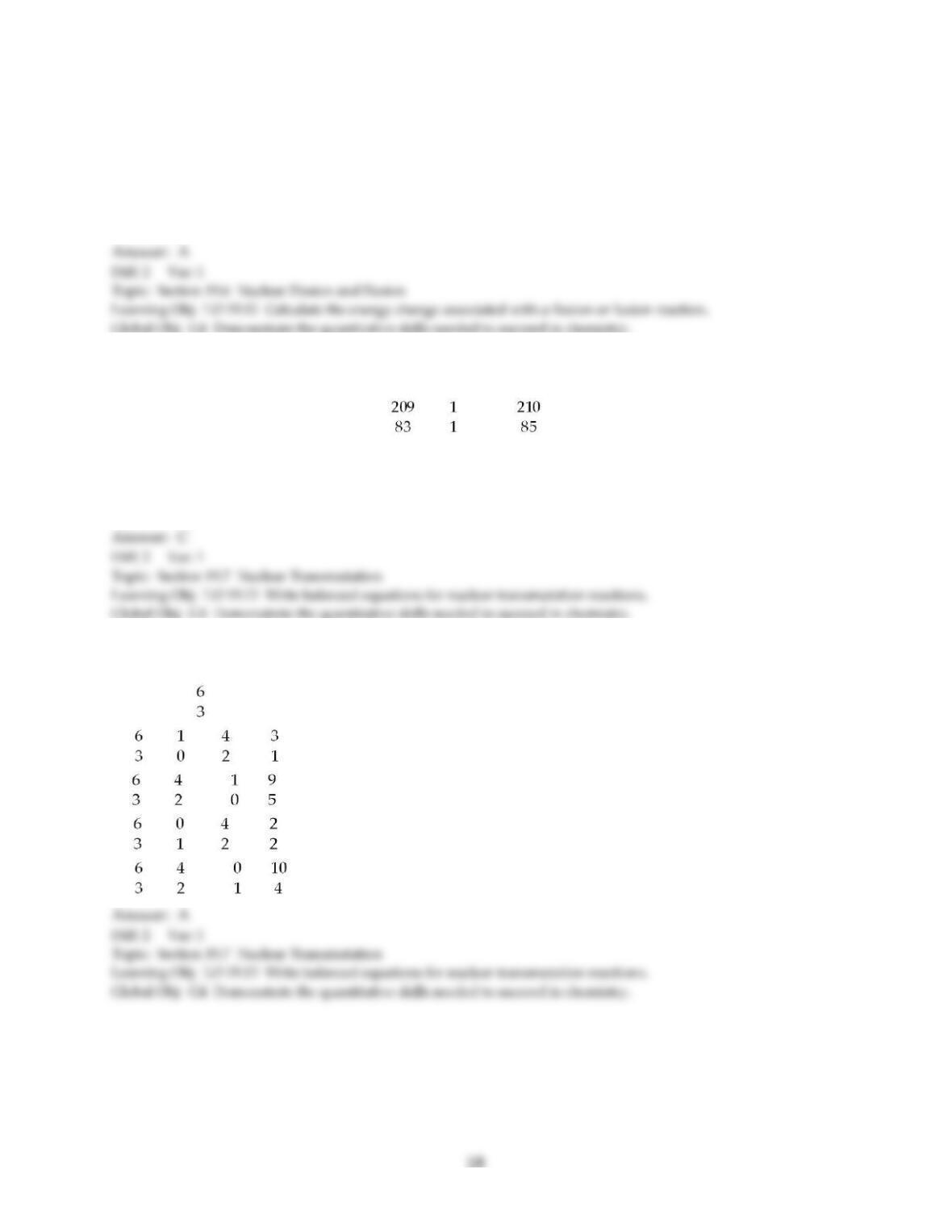
62) The masses of 4He, 6Li, and 10B are 4.0015, 6.0135, and 10.0102 amu respectively. The fission of a
boron-10 nucleus into He-4 and Li-6 would
A) absorb energy.
B) evolve energy.
C) result in no energy change.
D) Need more information
63) What is the missing product of the nuclear reaction?
Bi + p → ? + Po
A) α
B) β+
C) β–
D) n
64) A shorthand way of writing transmutation equations is to show the bombarding particle and the
subsequent emitted particle in parentheses. Which of the following equations shows the balanced nuclear
reaction for Li (n, α)?
A) Li + n → He + H
B) Li + He → n + B
C) Li + n → He + He
D) Li + He → n + Be

19
65) A shorthand way of writing transmutation equations is to show the bombarding particle and the
subsequent emitted particle in parentheses. Which particle is produced by Li (p, α)?
A) H
B) He
C) Be
D) He
66) The first transuranium element was synthesized by bombarding U with neutrons. After capturing
one neutron, the resulting nuclide was unstable and decayed by beta emission. What was the product of
these two nuclear reactions?
A) Np
B) Pa
C) Th
D) U
67) An element, X is formed by bombardment of uranium-238 atoms with a beta particle. How
many neutrons are produced by this reaction?
A) 3
B) 2
C) 1
D) 0
68) Radiation is detected by its ________ properties.

20
A) gravitational
B) ionizing
C) kinetic
D) thermal
69) Which one of the following instruments would be the least suitable for detecting particles given off in
radioactive decay?
A) electron microsope
B) Geiger counter
C) photographic film
D) scintillation counter
70) Which one of the following is most penetrating?
A) alpha particles
B) beta particles
C) gamma rays
D) positrons
71) Which ionizing radiation has the greatest energy?
A) α
B) β
C) γ
D) χ
72) A becquerel is
A) the amount of sample that undergoes 1 disintegration per second.
B) the amount of sample that undergoes 3.7 × 10¹⁰ disintegrations per second.
C) the amount of tissue damage done by radiation.
D) equal to 0.01 J of energy absorbed per kilogram of tissue.
73) A sievert is