Chapter 19 – Budgets
TRUE/FALSE
1. ‘Budgetary slack’ can be referred to as dysfunctional behaviour where managers deliberately
understate or overstate elements of a budget such as sales or costs in order to achieve budget.
2. Formulating guidelines for overall activity levels and policies on performance criteria, and
communicating this information to the preparers of budgets, are all part of the budget process.
3. Participative budgeting is where an entity is structured into strategic business units and the
performance of these units is measured in terms of accounting results.
4. A situation where the involvement of lower-level managers in the budget process is merely
‘window dressing’, that is, they appear to be involved but in fact are not, is referred to as
‘pseudoparticipation’.
5. Responsibility accounting is where an entity is structured into strategic business units and the
performance of these units is measured in terms of accounting results.
6. For control and planning purposes, an annual budget is normally broken down into quarterly,
monthly and weekly periods, which are dependent on the needs of the organisation and the state of
the economy.
7. A production budget is prepared on the basis of determining the production level needed to satisfy
sales demand and ensure that the inventory levels are sufficient for the period. Therefore
production is equal to sales plus closing inventory less opening inventory.
8. 16 000 units of Product A are produced in the period. This requires two units of material X for
production. If closing inventory of material X is 4000 units and opening inventory is 6000 units,
then 32 000 units of material X was purchased in the period.

MULTIPLE CHOICE
1. Which of the following is not a reason for implementing a budget?
A.
For planning purposes.
B.
As a form of communication.
C.
To assist in preparing a balance sheet.
D.
For coordinating functions.
2. A detailed plan that describes the use of financial and operating resources over a specific period of
time in the future is a(n):
A.
business plan.
B.
budget.
C.
statement of comprehensive income
D.
balance sheet.
3. Well-designed budgets:
A.
lead to desired changes in behaviour and minimise any undesired behaviour that results
from the measurement process.
B.
will ensure greater profitability.
C.
are static.
D.
will achieve all of the above.=
4. Positive behaviour flows when :
A.
there is no budget to worry about.
B.
the goals of the entity and individual are aligned in the budget.
C.
the budget is obviously unachievable, but presents a tremendous challenge.
D.
budgets contain a maximum of slack.
5. Which of the following information is not required for preparation of a budget?
A.
Credit sales
B.
Materials purchased
C.
Costs of labour
D.
The location of the company’s headquarters

6. The best way to achieve more accurate and achievable budgets is to:
A.
have the budget committee monitor actual results on a frequent basis so that quick punitive
action can be taken when actual results do not comply with budgeted expectations.
B.
have the budget prepared by top executives only.
C.
have all employees participate in the preparation of the budget.
D.
let it be known that budget variances will not be tolerated.
7. Which of the following people are not involved in preparing a budget?
A.
The board of directors
B.
Shareholders
C.
Sales directors
D.
Production managers
8. Responsibility accounting reports are used:
A.
to determine which manager should be blamed if actual results do not comply with
budgeted expectations.
B.
to evaluate a department manager’s effectiveness in generating revenues or controlling
expenses.
C.
to determine if the actual cost of the product is in line with costs of competitors.
D.
only when actual results are below budgeted expectations.
9. Which of the following is not an element of a sound budgeting culture?
A.
Must expend all the budget before year end.
B.
Regular budgets.
C.
Responsibility accounting.
D.
Continuous review of budgets.
10. Budgets are developed in RKH Corporation by soliciting input from responsible employees once a
year. This technique is best described as:
A.
perpetual budgeting.
B.
participative budgeting.
C.
responsibility accounting.
D.
committee budgeting.
11. Which of the following describes responsibility accounting?
A.
It assigns departmental performance goals to department managers.
B.
It requires performance evaluation based on factors a manager can control.
C.
It periodically produces reports that assist in evaluating managers’ performance.
D.
All of the above.

12. Four months into the new budget it is learned that there will be a major increase in the cost of raw
materials. The most appropriate action is to:
A.
leave the master budget intact.
B.
revise the master budget to incorporate the cost increase in raw materials.
C.
hold the purchasing department responsible for not anticipating the cost increase.
D.
No action is necessary.
13. The master budget normally consists of a budgeted:
A.
statement of comprehensive income and statement of cash flows.
B.
statement of cash flows and balance sheet.
C.
balance sheet, statement of comprehensive income and statement of cash flows.
D.
balance sheet and statement of comprehensive income.
14. The first step in the master budgeting process is to prepare:
A.
the sales budget.
B.
the production budget.
C.
a cash budget.
D.
a pro forma balance sheet.
15. A cash budget is one in which:
A.
credit sales and cash sales are recorded.
B.
cash sales and cash expenses are recorded.
C.
cash sales and all expenses are recorded.
D.
credit sales and all expenses are recorded.
16. A collection of individual functional budgets is known as a:
A.
pro forma financial statement.
B.
flexible budget.
C.
static budget.
D.
master budget.
Use the information below to answer questions 17, 18 and 19.
RTU Ltd sells goods to customers on cash and credit terms. If customers purchase goods on credit,
they are allowed exactly one month to pay. RTU Ltd’s customers purchased goods worth $5000 in
July, with $2050 being cash sales. Goods worth $2600 were sold by RTU Ltd in August, and they
received 90% of this amount in cash. A further $4500 of goods was sold, all on credit, by RTU Ltd
in September.

17. All credit customers paid the amounts owing by the due date. How much credit sales did RTU Ltd
have for July?
A.
$2050
B.
$5000
C.
$2950
D.
$6540
18. How much total cash did RTU receive in August?
A.
$5450
B.
$2600
C.
$2050
D.
$5290
19. All customers took the maximum allowed time to pay. All credit customers paid the amounts
owing by the due date. How much cash did RTU receive in September?
A.
$260
B.
$2340
C.
$4500
D.
$4760
20. The Bowden Company has furnished the following information:
Forecast sales for 1st quarter
$200 000
Forecast sales for 2nd quarter
250 000
Cash sales = 10% of total sales
Collection schedule:
In quarter sold
75%
In next quarter
25%
What are Bowden Company’s forecast total cash collections for the second quarter?
A.
$212 500
B.
$237 500
C.
$238 750
D.
$250 000
21. Hamilton Manufacturing Company has furnished the following information:
Purchases during 1st quarter all on account
$18 000
Cash payments for materials during 1st quarter
22 000
Accounts Payable balance at the end of 1st quarter
6000
Note: The Accounts Payable account is used only for direct materials.
What was the balance in Hamilton’s Accounts Payable account at the beginning of the 1st quarter?
A.
$2000
B.
$10 000
C.
$22 000
D.
$28 000
22. A typical non-cash expense would be:
A.
depreciation expense.
B.
payment of wages accrued in a prior month.
C.
payment of materials purchased in a prior month.
D.
All of the above are cash expenses.
23. Which of the following information is not shown by a cash budget?
A.
Cash inflow.
B.
When cash is likely to be received.
C.
When cash will be deposited into banks.
D.
Cash outflow.
24. The production budget is equal to:
A.
expected sales in units plus beginning inventory minus desired ending inventory.
B.
beginning inventory plus net purchases minus ending inventory.
C.
net purchases plus desired ending inventory.
D.
expected sales in units plus desired ending inventory minus beginning inventory.
25. Bowden Company forecasts sales for the third quarter at 10,000 units. The desired ending
inventory for the second quarter is 2000 units and for the third quarter 3000 units. How many units
must be produced in the third quarter?
A.
9000 units
B.
11 000 units
C.
12 000 units
D.
13 000 units
26. Hamilton has budgeted total manufacturing overhead costs for the year as $125 000, based on
20 000 direct labour hours. The ratio of variable manufacturing overhead costs to fixed
manufacturing overhead costs is 2:1. In a given month, 2000 direct labour hours are budgeted for
production. How much overhead is budgeted?
A.
$6250
B.
$12 500

C.
$18 750
D.
$25 000
27. The Marginal Manufacturing Company manufactures one product. Sales and production details are
as follows:
Estimated sales of Zebras
9000
Unit selling price
$50
Materials used in manufacture of Zebras:
Material
Units required
Opening inventory
Closing inventory
A
2 units
4000 units
6000 units
What are the estimated sales revenue of Zebras and the number of units of A that are purchased in
the current month?
A.
$900 000 and 16 000 units.
B.
$450 000 and 20 000 units.
C.
$450 000 and 18 000 units.
D.
$450 000 and 16 000 units
28. The Marginal Manufacturing Company manufactures a product called Saver. Each unit of Saver
requires 10 kilos of a material called Lostit. The budget calls for production of 7500 units of Saver
for the month of July. The ending inventory of Lostit is forecast at 3500 kilos for the month of July
and 4000 kilos for the month of June. If the cost of Lostit is $2 per kilo, what is the cost of
purchases in monetary terms during the month of July?
A.
$15 000
B.
$75 000
C.
$149 000
D.
$151 000
29. The Sutcliff Manufacturing Company manufactures a product called Zyklon. Each unit of Zyklon
requires 2 kg of Zinses. The budget calls for production of 8000 units of Zyklon during the third
quarter. The ending inventory of Zinses is forecasted at 3000 kg for the second quarter and 2000
kg for the third quarter. How many kilograms of Zinses must be purchased during the third
quarter?
A.
8000 kg
B.
14 000 kg
C.
15 000 kg
D.
16 000 kg

30. The direct materials budget:
A.
identifies the quantity of direct materials that will be used to meet production needs during
the specified time period.
B.
identifies the quantity of direct materials that must be purchased to meet production needs
during the specified time period.
C.
uses this formula: beginning inventory plus net purchases minus ending inventory.
D.
is equal to direct materials needed for production plus beginning inventory minus desired
ending inventory.
31. A typical production budget consists of:
A.
a direct materials budget, a direct labour budget, and a manufacturing overhead budget.
B.
a direct materials budget, a direct labour budget, manufacturing overhead budget, and an
administrative expense budget.
C.
a direct materials budget and a direct labour budget.
D.
a manufacturing overhead budget.
32. The production of each TV set requires 1.5 direct labour hours. The average cost of each direct
labour hour is $10.50. If scheduled production for May is 2000 TVs, what will be the total
budgeted cost of direct labour?
A.
$3000
B.
$21 000
C.
$31 500
D.
None of the above are correct.
33. Each of Pallet, Inc.’s production workers can produce four wooden pallets per hour. During the
month of June, Pallets, Inc. has forecast sales of 100 000 pallets. The beginning inventory was
10 000 pallets, and desired ending inventory is 25 000 pallets. How many hours of direct labour
must be budgeted to meet production needs?
A.
25 000
B.
21 250
C.
33 750
D.
28 750
34. In preparing the sales budget, the preparer should consider:
I.
expected demand for the firm’s products.
II.
current production capacity.
III.
planned staffing levels.
A.
I only
B.
I and II only
C.
II and III only
D.
I, II and III
SHORT ANSWER
1. Why do entities budget?
2. What are the typical types of budgets of a manufacturing company?
3. What is a sales budget, and how is it generated?
4. What is the manufacturing company’s production budget, and how is it generated?
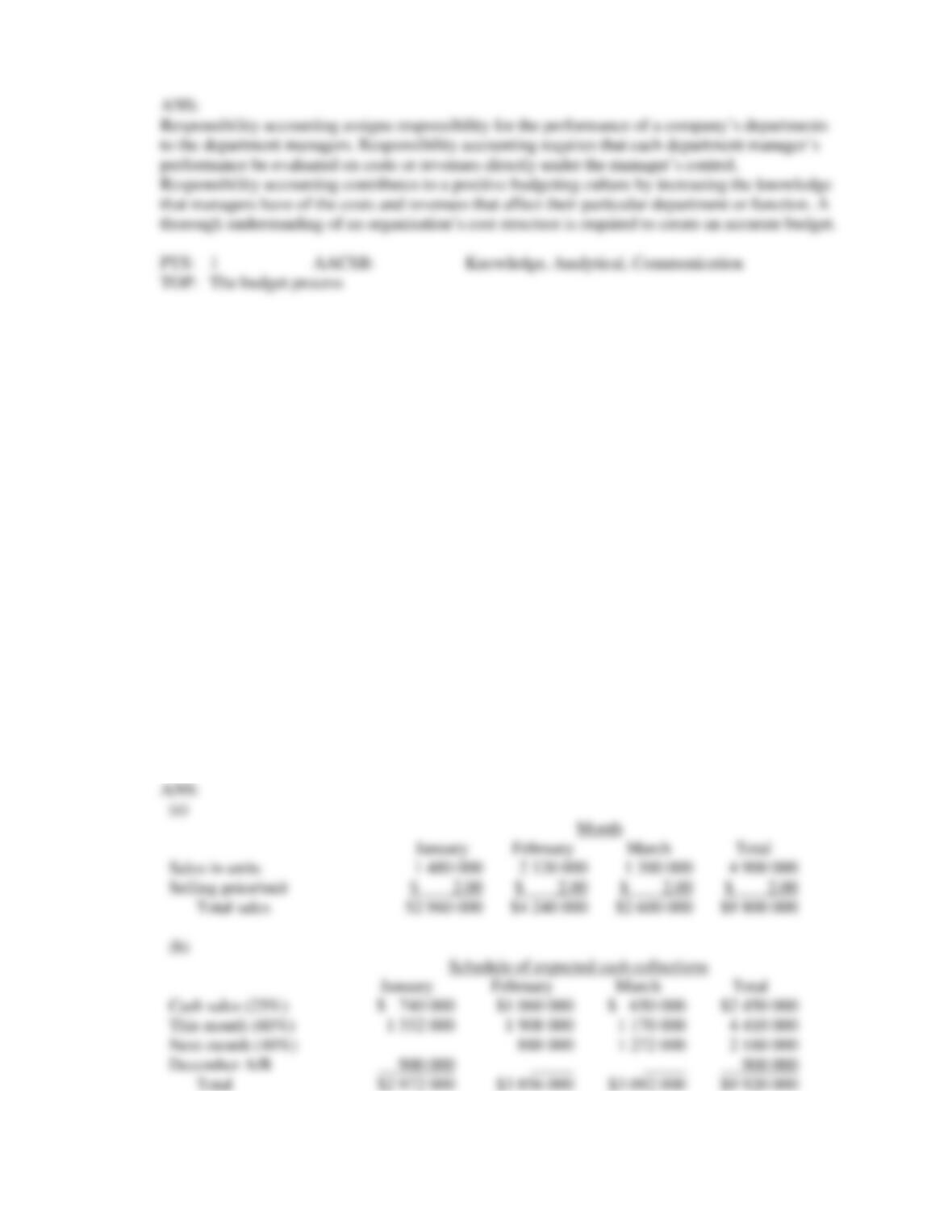
5. What is ‘responsibility accounting’ and how does it contribute to positive budgeting culture?
PROBLEM
1. Southern Mills is a textile manufacturing company in eastern Tennessee. Every year the company
prepares a complete set of budgets. The budgeting process begins with information supplied by the
Sales and Marketing department.
The balance in Accounts Receivable at the beginning of the year was $900 000. The marketing
department has predicted unit sales to be as follows:
January
1 480 000 sq. yds.
February
2 120 000 sq. yds.
March
1 300 000 sq. yds.
Selling price for the fabric is $2.00 per square yard. Cash sales account for 25% of sales.
Collections on account (non-cash sales charged to accounts receivable) are received 60% in the
month of the sale and 40% in the following month.
Required:
(a)
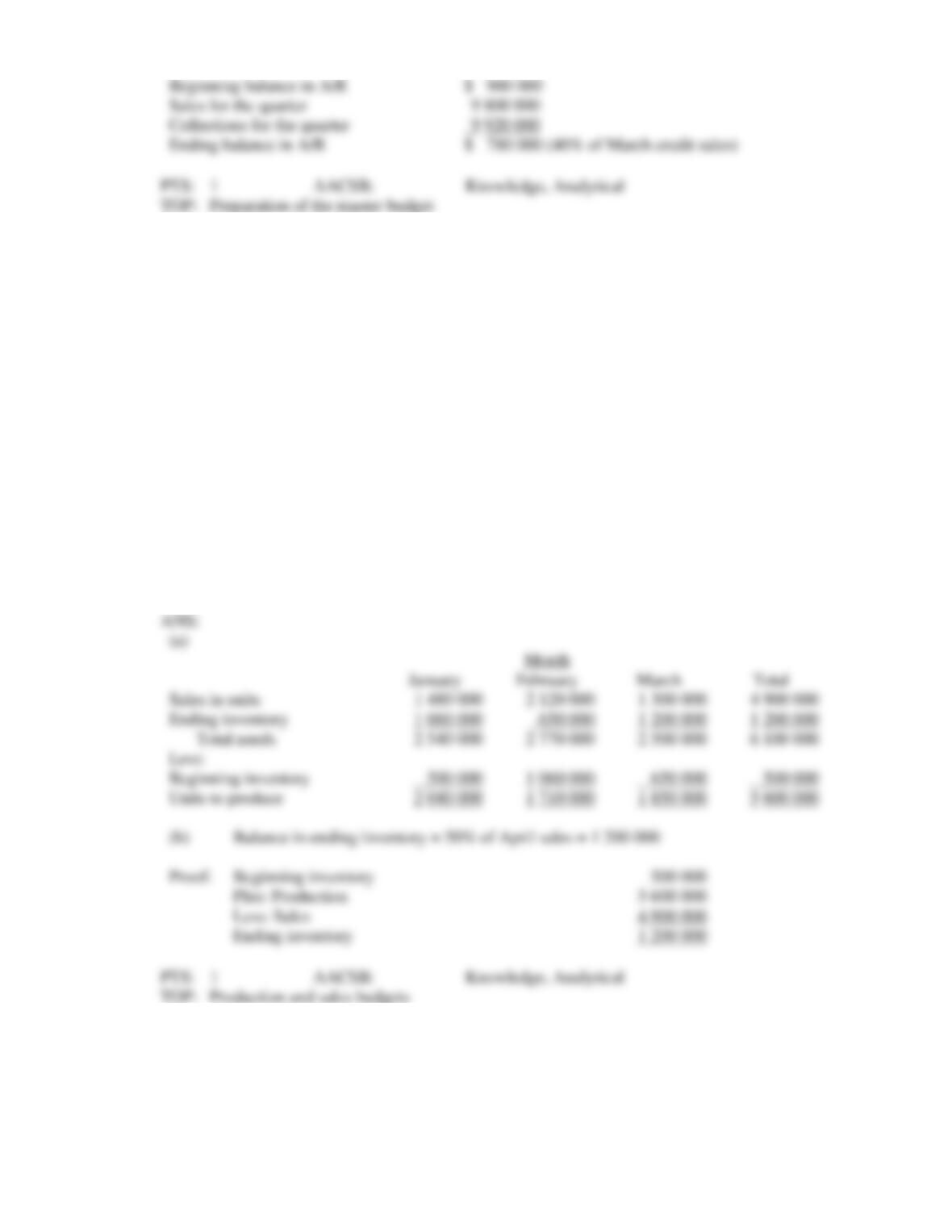
Prepare a Sales budget for Southern Mills for the first three months of the year. (Show
totals for the quarter.)
(b)
Prepare a Schedule of Expected Cash Collections for the first three months.
(c)
Calculate the balance in Accounts Receivable as of the end of March.
(a)
Sales in units
Selling price/unit
(b)
Cash sales (25%)
This month (60%)
Next month (40%)
December A/R
(c)
Beginning balance in A/R
$ 900 000
Sales for the quarter
9 800 000
Collections for the quarter
9 920 000
Ending balance in A/R
$ 780 000 (40% of March credit sales)
2. Southern Mills is a textile manufacturing company in eastern Tennessee. Every year the company
prepares a complete set of budgets. The budgeting process begins with information supplied by the
Sales and Marketing department.
The balance in inventory at the beginning of the year was 500 000 square yards of fabric. The
company plans to have inventory at the end of the month equal to 50% of the following month’s
sales. The marketing department has predicted unit sales (in square yards of fabric) to be as
follows:
January
1 480 000 sq. yds.
February
2 120 000 sq. yds.
March
1 300 000 sq. yds.
April
2 400 000 sq. yds.
Required:
(a)
Prepare a Production budget for Southern Mills for the first three months of the year.
(Show totals for the quarter.)
(b)
Calculate the balance in inventory as of the end of March.
(a)
Sales in units
Ending inventory
Less:
Beginning inventory
Units to produce
(b)
Balance in ending inventory = 50% of April sales = 1 200 000
Proof:
Beginning inventory
Plus: Production
Less: Sales
Ending inventory
3. Southern Mills is a textile manufacturing company in eastern Tennessee. Every year the company
prepares a complete set of budgets. The budgeting process begins with information supplied by the
Sales and Marketing department.
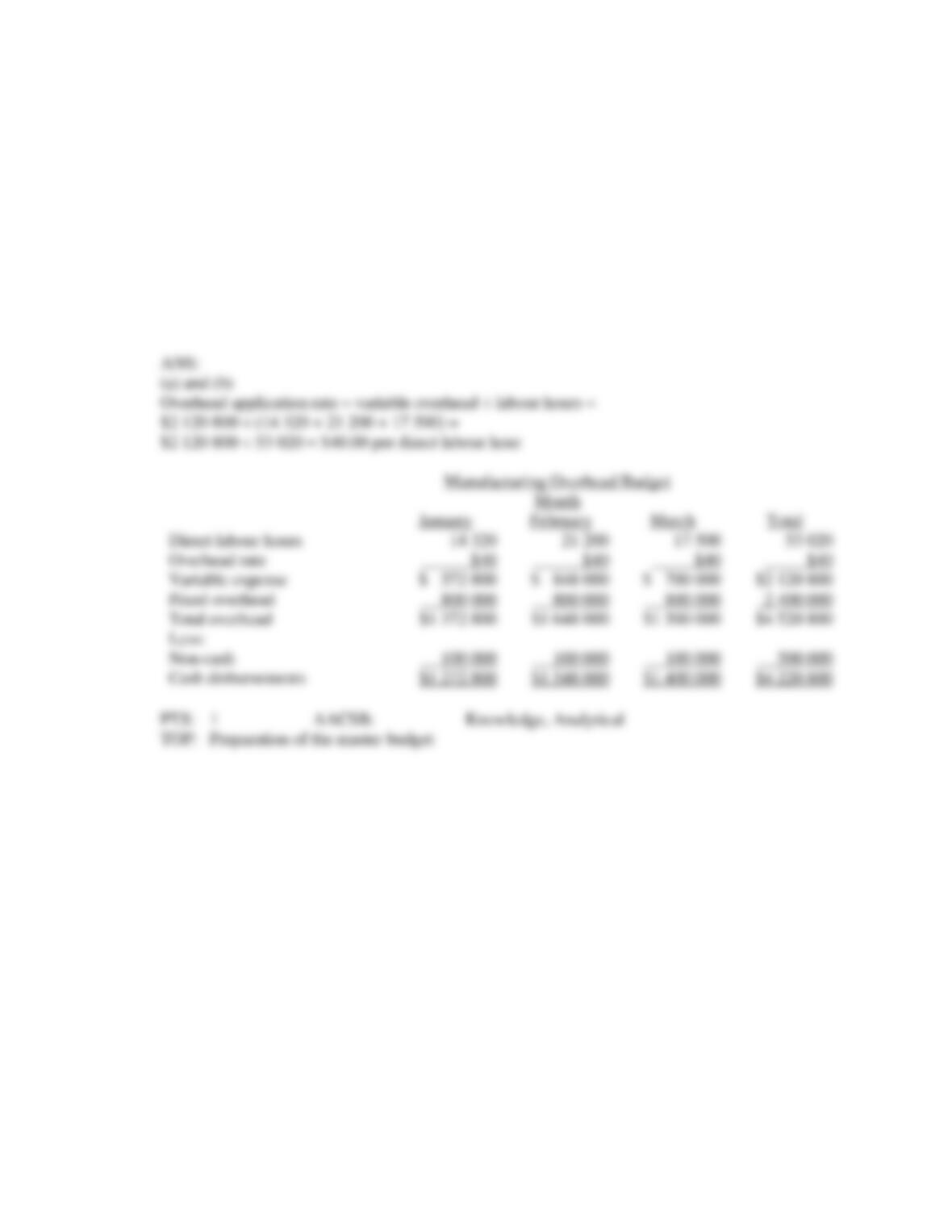
Variable manufacturing costs, for which direct labour hours is the cost driver, are expected to be
$2 120 800. Fixed manufacturing overhead is expected to be $2 400 000 for the quarter. The fixed
expenses include monthly depreciation expense of $100 000.
Budgeted direct labour hours are as follows:
January
14 320 hours
February
21 200 hours
March
17 500 hours
Required:
(a)
Prepare an overhead budget for each month in the first quarter and for the total quarter.
(b)
Prepare a schedule of cash disbursements for manufacturing overhead.
Variable expense
Total overhead
Cash disbursements
CASE
1. Mr Sparks is the CEO of a large manufacturing company. He believes strongly that he is the
keeper of all the knowledge of what is best for the company. Mr Sparks has traditionally prepared
all of the budget estimates himself and then communicated the results to his department managers.
In the past several years, however, he has begun to notice that the department managers rarely
manage to stay within their budgets and have many excuses for their failures. Mr Sparks has also
noticed an increase in his employee turnover, particularly at the managerial level.
Required:
(a)
Explain what is meant by the term ‘participative budgeting’ and how the term relates to the
current situation.
(b)
How would you recommend that Mr Sparks change the budgeting procedures to gain more
support from the department managers?
(c)
How does participative budgeting contribute to a positive budgeting culture?