
ch19 Key
1. The transfer price should be chosen so that each division manager, when striving to maximize his or her own
division’s profits, makes the decision that maximizes the company’s profit.
2. A transfer price represents the amount charged when one division sells goods or services to another division
of the same company.
3. In a decentralized organization, the managers of profit centers and investment centers have little autonomy in
deciding whether to accept or reject orders and whether to buy from inside the organization or from outside.
4. The transfer price charged when one division of an organization sells goods or services to another division
affects the total profit of the overall organization, assuming a transfer is made.

5. The transfer pricing policy of a company can affect the incentives of autonomous division managers as they
decide whether to make the transfer.
6. The goal in setting transfer prices is to establish incentives for autonomous division managers to make
decisions that support the goals of the division.
7. Under imperfect competition, where the external market price depends on the production decisions of the
producer, the opportunity cost incurred buy the company as a result of internal transfers depends on the quantity
sold internally.
8. A general rule that will ensure goal congruence is to set the transfer price equal to the sum of the additional
outlay cost per unit incurred because goods are transferred and the opportunity cost per unit to the organization
because of the transfer.

9. When there is excess production capacity, there is no opportunity cost to the company and the transfer price
under the general rule is only the outlay cost.
10. Every unit transferred to another company division results in one less unit sold in the external market when
there is no excess production capacity.
11. Full-cost-based transfer prices lead the buying division to view costs that are non-unit–level costs for the
company as a whole as unit–level costs to the buying division which can lead to faulty decision making.
12. Basing transfer prices on artificially low distress market prices could lead the producing division to sell or
close the productive resources devoted to producing the product for transfer.

13. Transfer prices based upon variable costs are very useful for performance evaluations because such prices
will always result in profit for the selling division.
14. A common approach is to set the transfer price equal to the price in the external market and when there is no
excess production capacity and perfect competition prevails, the general transfer pricing rule and the external
price yield the same transfer price.
15. Use of negotiation to arrive at a transfer price can lead to divisiveness and competition between
participating division managers.
16. In situations when the producing division has excess capacity or the external market is imperfectly
competitive, the general rule and the external market price will yield the same transfer price.

17. Some US presidential candidates believe that the US could collect billions per year in additional taxes if
transfer pricing was calculated according to US tax laws.
18. Because tax rates vary among countries, companies have incentives to set transfer prices that will increase
revenues (and profits) in low-tax countries and increase costs (thereby reducing profits) in high–tax countries.
19. ABC Company has two divisions in different foreign countries, X and Y. If X imposes an import duty on
goods transferred in from Y, the company has an incentive to set a relatively low transfer price on the
transferred goods which will minimize the duty to be paid and maximize overall company profit.
20. External segment reporting accepts the use of negotiated transfer prices.
21. In general, a product cost will be the highest price used as a transfer price, and the market price will be the
lowest price used as a transfer price
22. In an international environment, setting a transfer price below product cost may result in accusations of
“dumping” product
23. Goal Congruence is a critical factor in setting transfer prices
24. The market price may be an inappropriate transfer price if
25. Kim Bauer, a division of Waterfun Inc, produces swim suits from material it purchases from the Fabric
Division. An appropriate transfer price for the material may be
26. When setting transfer prices, company officials need to consider
27. What is not an adjustment to market price that might be made during internal transfer price negotiation?
28. Which of the following are drawbacks related to negotiated transfer prices?
29. Which of the following is not a cost-based transfer price?
30. Transfer pricing is appropriate when
31. ___is one that would leave the selling division no worse off if there were an internal transaction.
32. ___is one that would leave the purchasing division no worse off if there were an internal transaction.
33. ___is the most appropriate method of transfer pricing when there is a perfectly competitive outside market
for the product being considered for an internal transfer.
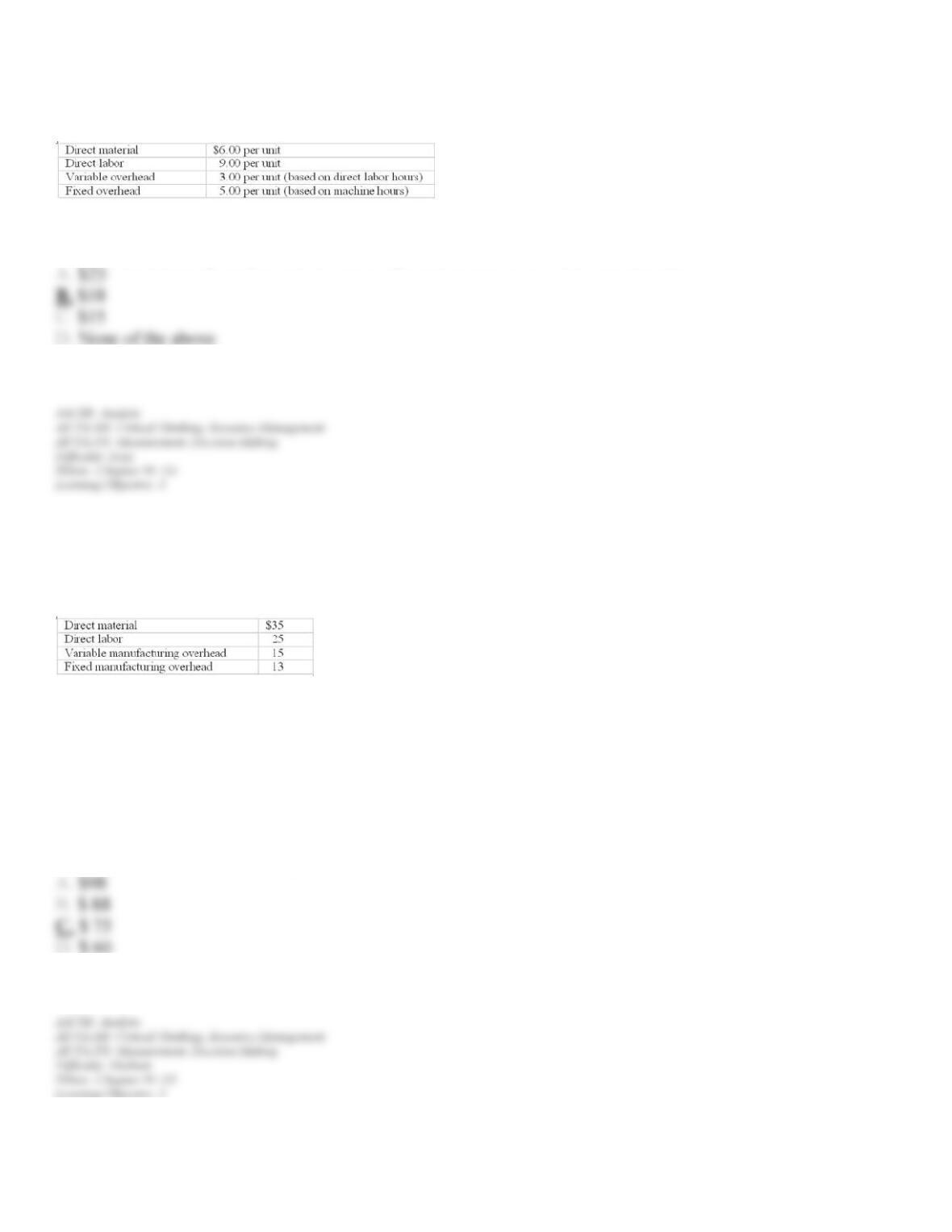
34. Ponderosa Inc. has two divisions, X and Y. Division X sells a component to Division Y. There is no
external market for Division X’s component. X’s standard costs are as follows:
What is the transfer price per unit for the component based on standard variable cost?
Use the following to answer questions 35-36:
Simmons Company’s records show the following costs for Division X‘s output:
The units typically are transferred from Division X to Division Y, although they may be sold externally at $98
per unit.. Beginning and ending inventories are equal to zero.
Hilton – Chapter 19
35. What would be the transfer price if variable cost is used?
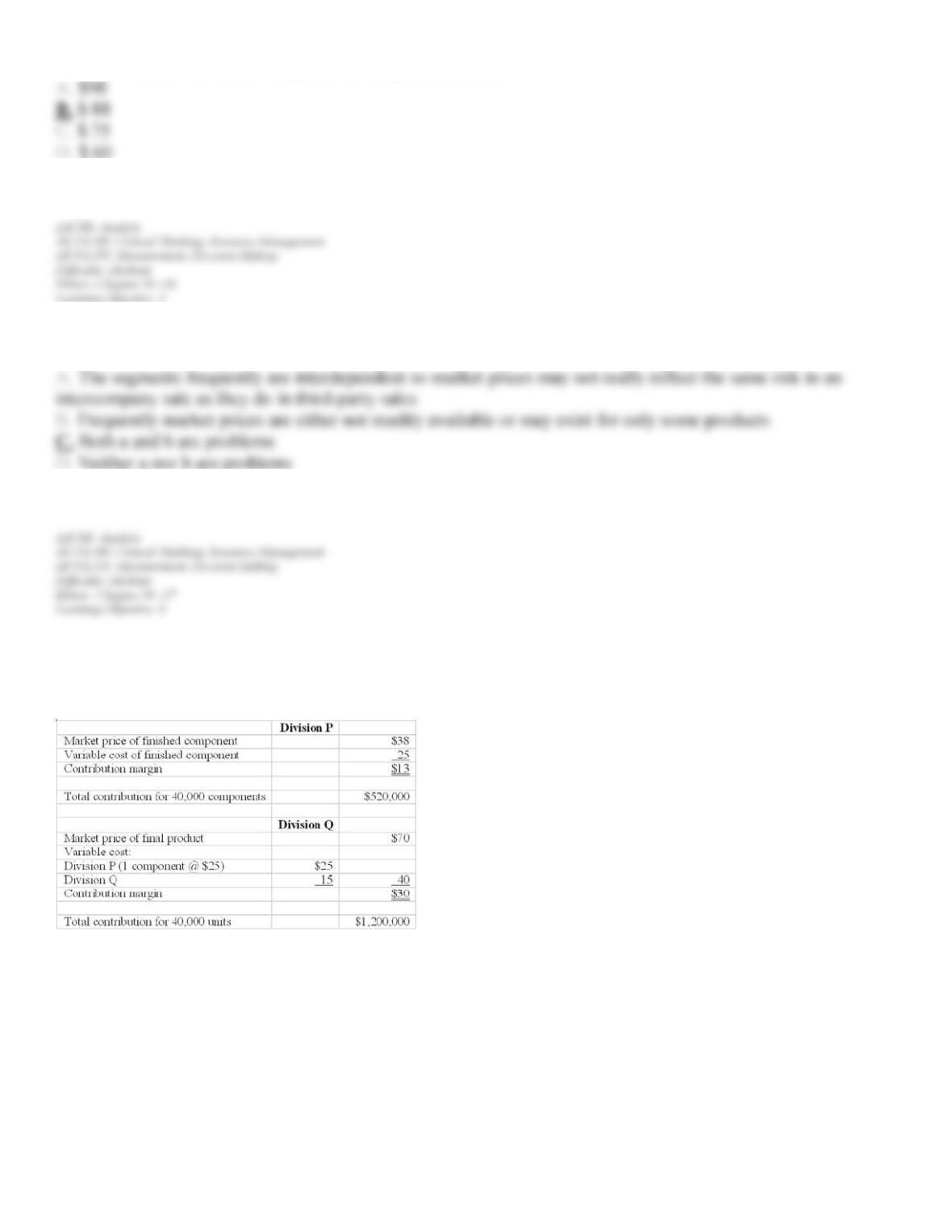
36. What would be the transfer price if absorption cost is used?
37. What are the problems related to market–based transfer prices for external segment reporting?
Use the following to answer questions 38-42:
Vallarta Inc. has two divisions, P and Q, with the following information:
The variable cost of Division Q will be incurred regardless of where it purchases the components, internally or
externally.
Hilton – Chapter 19
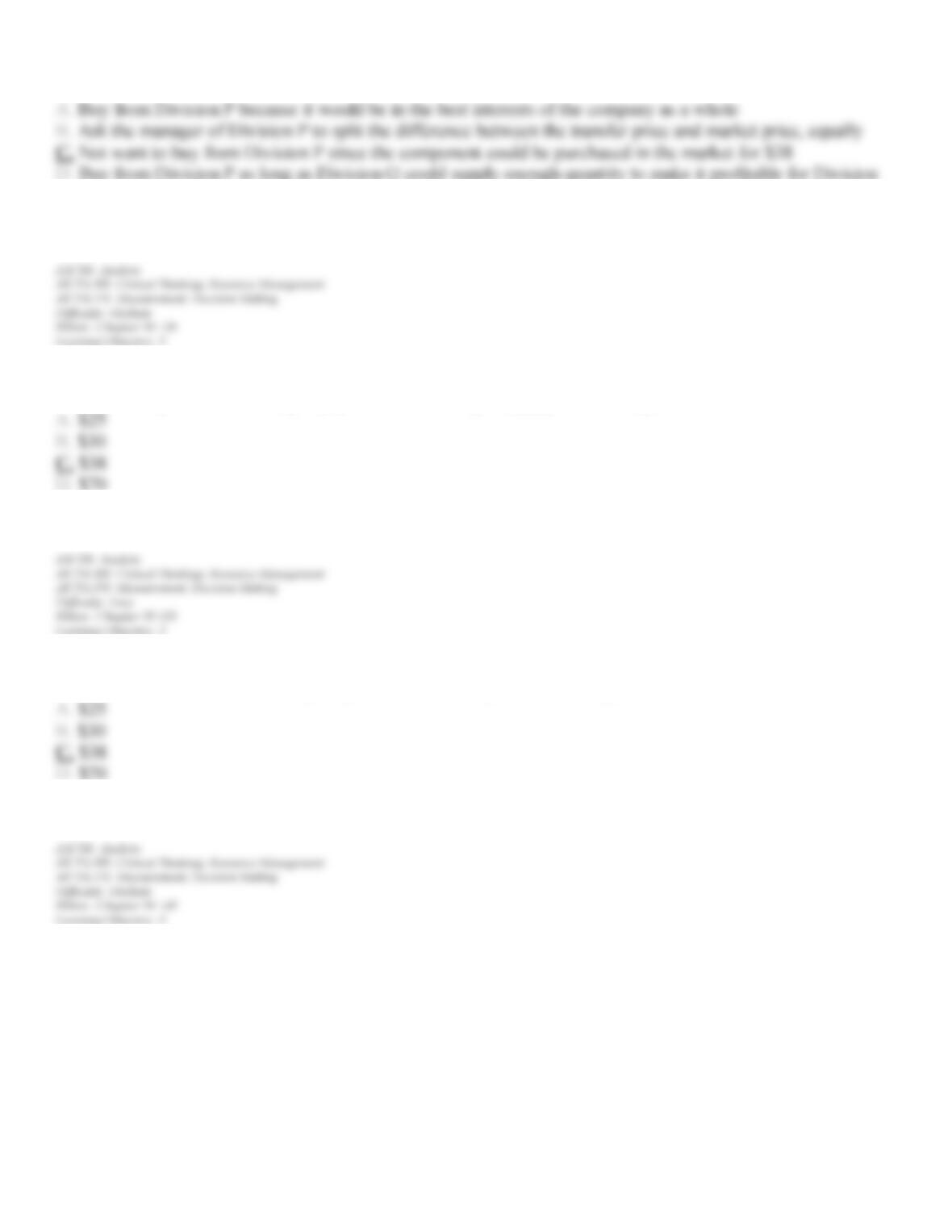
38. If Division P wants to transfer the component to Division Q at a $45 transfer price, the manager of Division
Q would
Q
39. Division Q would be willing to pay Division P as high as ____ for the component?
40. If Division P has no excess capacity; the best transfer price under the general rule would be
41. If Division P has no excess capacity; the lowest transfer price Division P would be willing to accept would
be
42. If Division P has excess capacity, ____ is the lowest transfer price it would be willing to accept from
Division Q.
Use the following to answer questions 43-44:
Madison Co. has two divisions: Chocolate and Mocha. The Chocolate Division produces the chocolate to be
used in Mocha Instant produced by the Mocha Division. Mocha Instant sells for $2.00 a cup. Chocolate
Division‘s costs are $1.50 per cup. Mocha Instant requires ¼ cup of Chocolate powder and additional $1.20 per
cup for additional materials, labor and variable overhead.
Hilton – Chapter 19
43. What is Chocolate Division’s operating income per cup assuming a transfer price of $2.25 per pound?
44. What is the Mocha Division’s operating income for 4 cups of Mocha Instant, assuming the transfer price of
the ingredient is set at $2.25 per cup.
Use the following to answer questions 45-47:
Hilton – Chapter 19
45. Which of the following is the transfer price that will avoid transfer pricing problems?
46. What is the transfer price based on variable cost plus a 25 percent markup?
47. What is the transfer price based on absorption cost plus a 30 percent markup?
48. Which of the following is an environmental factor affecting performance evaluation (and business) in a
multinational firm?
Use the following to answer questions 49-51:
Fjord Inc. has several plants located around the world. The plant in Norway manufacturers a component that is
used in a product manufactured by one of the U.S. plants. The Norway plant has excess capacity. The current
tax rate in Norway is 40%, while the U.S. corporate tax rate is 30%.
Hilton – Chapter 19
49. What is the minimum transfer price the Norway plant would accept?
50. What is the maximum transfer price the U.S. plant would pay?
51. What is the transfer price that would be the best for Fjord Inc.
52. A transfer price set as 135 percent of absorption costs is an example of a
53. A company with divisions both domestic and international would not consider which of the following when
determining transfer prices?
54. Mason Company wants to maximize the cash it recovers from its division in Norway. The country places
restrictions on the amount of funds that can be transferred outside its borders. Several plans have been
considered but which one, if implemented, will achieve Mason’s goal?
55. Dual transfer prices are useful because
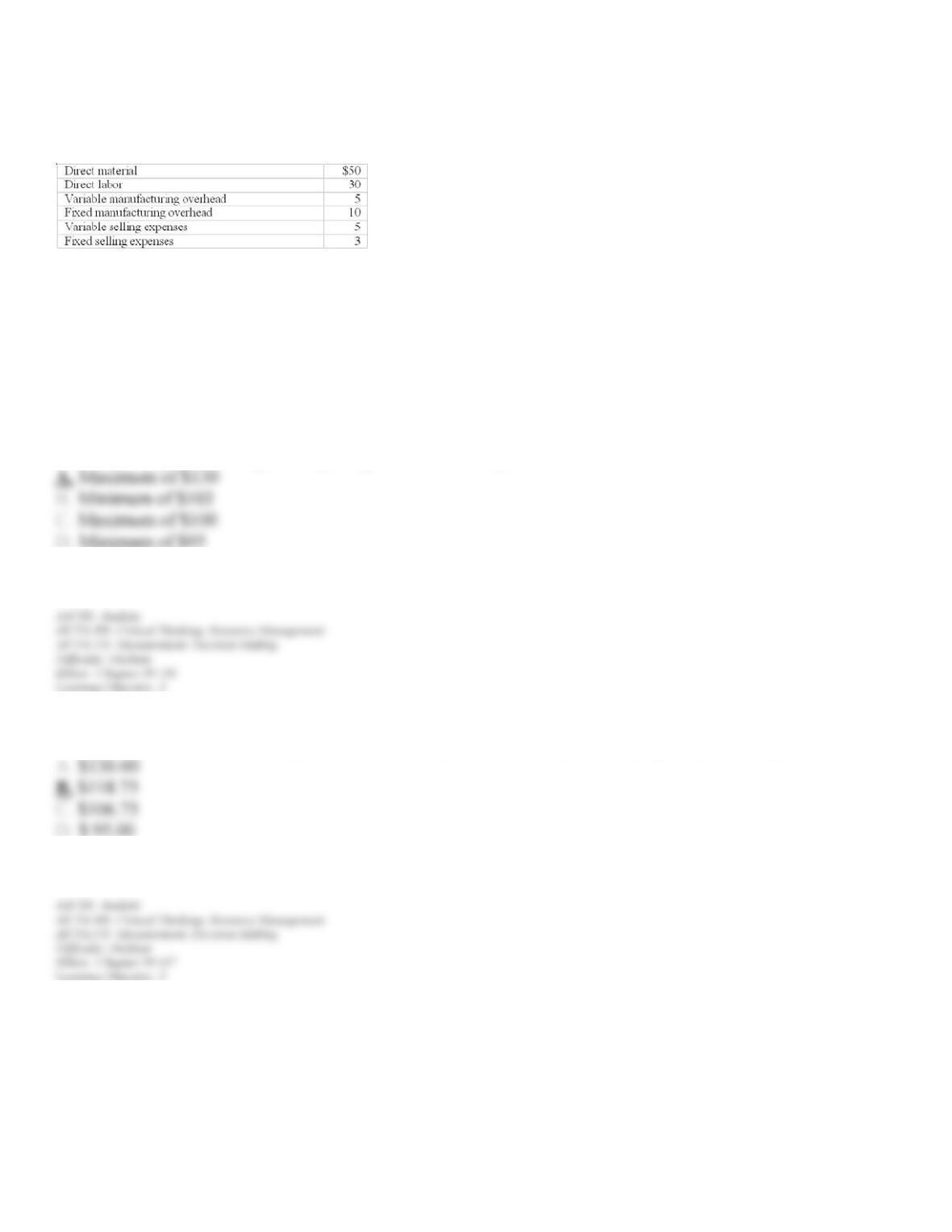
Use the following to answer questions 56-58:
The Furniture Express has two divisions: cutting and assembly and finishing. The company makes quality
furniture. The costs for its completed tables are:
While the tables usually are transferred to assembly and finishing, there is a market for the
unassembled-unfinished tables where they sell for $130 for a complete set of parts for a table. The company
expects a 25 percent markup as its minimum profit level.
Hilton – Chapter 19
56. If the company uses negotiated pricing to set a transfer price, it should be a
57. What would be the transfer price is Furniture Express uses absorption costing and the markup?
58. What is the transfer price for Furniture Express using variable cost without a markup?
59. Which of the following statements about transfer pricing is true?
60. Which of the following statements about transfer pricing is false?