Exam
Name___________________________________
MULTIPLE CHOICE. Choose the one alternative that best completes the statement or answers the question.
1)
Consider the following data:
Price of A Quantity Demanded of A
$5 6
$4 10
The absolute value of the price elasticity of demand for product A is
1)
A)
1.80.
B)
0.56.
C)
2.25.
D)
0.44.
2)
If the cross price elasticity of demand between two goods is negative, then the two goods are
2)
A)
complements.
B)
substitutes.
C)
unrelated.
D)
independent.
3)
If the price of wireless phone service decreases and the demand for wired phone services decreases,
then wired and wireless phone services are
3)
A)
elastic goods.
B)
complements.
C)
substitutes.
D)
inferior goods.
4)
A 3 percent increase in the price of cotton leads to a 6 percent decrease in the quantity demanded of
cotton. The absolute price elasticity of demand is
4)
A)
2.
B)
0.33.
C)
3.
D)
0.5.
5)
If a good has an absolute price elasticity of 0, the demand for the good is
5)
A)
unit elastic.
B)
inelastic.
C)
perfectly inelastic.
D)
elastic.
6)
Income elasticity of demand reflects
6)
A)
the responsiveness of the quantity demanded to changes in income, adjusting its relative price
so real income does not change.
B)
the change in total quantity demanded divided by the total change in income.
C)
the responsiveness of demand to changes in income.
D)
the responsiveness of income of producers to a change in quantity sold of the good.
7)
A 2 percent rise in the price of a good leads to a 10 percent decrease in quantity demanded. The
absolute price elasticity of demand is
7)
A)
0.1.
B)
1.0.
C)
10.
D)
5.
8)
A measure of the responsiveness of demand to changes in income, all other things being constant,
is
8)
A)
price income elasticity of demand.
B)
cross price elasticity of demand.
C)
income elasticity of demand.
D)
price elasticity of demand.
9)
Absolute price elasticities are calculated for four commodities, and the values are: 0.009; 1.0; 3.3;
and 4.1. Which indicates the most price–responsive situation?
9)
A)
1.0
B)
0.009
C)
3.3
D)
4.1
10)
The price elasticity of demand is a measure of
10)
A)
the quantity demanded of a good at a given price.
B)
the demand for a product holding prices constant.
C)
the horizontal shift in the demand curve when the price of a good changes.
D)
the responsiveness of the quantity demanded of a good to a changes in the price of the good.
11)
If demand for Rolls Royce automobiles rises in an area where incomes have increased, this tells us
that a Rolls Royce is
11)
A)
a normal good.
B)
a complementary good.
C)
an inferior good.
D)
a substitute good.
12)
If the price elasticity of demand for apples is greater than 1, an increase in apple prices will
12)
A)
lower total revenue.
B)
not affect total revenue.
C)
raise total revenue.
D)
either raise or lower total revenue, but it is impossible to determine which.
13)
A vertical supply curve may be described as being
13)
A)
relatively inelastic.
B)
perfectly elastic.
C)
perfectly inelastic.
D)
relatively elastic.
14)
A 10 percent increase in the price of tablets leads to a 10 percent decrease in the quantity demanded
of tablets. The absolute price elasticity of demand for tablets is
14)
A)
0.3.
B)
1.
C)
3.
D)
10.
15)
The price elasticity of supply is
15)
A)
positive.
B)
unknown, depending on other factors.
C)
negative.
D)
zero.
16)
Suppose that the absolute price elasticity for cookies equals 0.9. We could then say that the demand
for cookies is
16)
A)
inelastic.
B)
perfectly elastic.
C)
unit–elastic.
D)
elastic.
17)
Suppose that the cross price elasticity of demand between goods A and B equals 1.5. Which of the
following is TRUE?
17)
A)
A and B are substitutes because the cross price elasticity is positive.
B)
A and B are complements because the cross price elasticity is greater than one.
C)
A and B are complements because the cross price elasticity is positive.
D)
A and B are substitutes because the cross price elasticity is greater than one.
18)
If demand for a good is perfectly inelastic, then
18)
A)
a price increase would cause an increase in quantity demanded.
B)
a price increase would cause no change in quantity demanded.
C)
a price increase would cause a fall in total revenue.
D)
a price increase would cause a fall in quantity demanded.
19)
Price elasticity of demand is the responsiveness of
19)
A)
the quantity demanded to a change in price.
B)
demand to a change in income.
C)
demand for a good to a change in the demand for another good.
D)
demand to a change in supply.
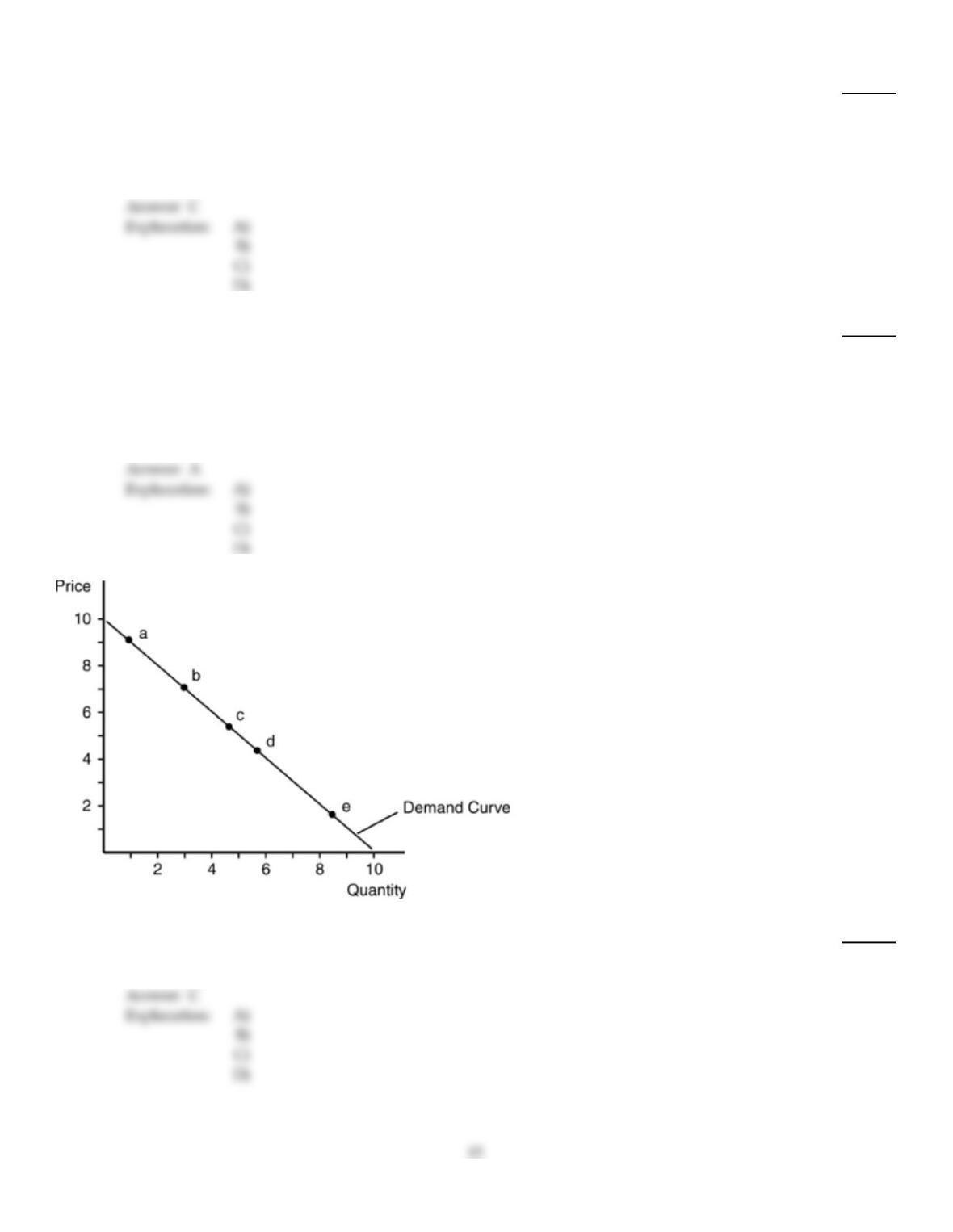
20)
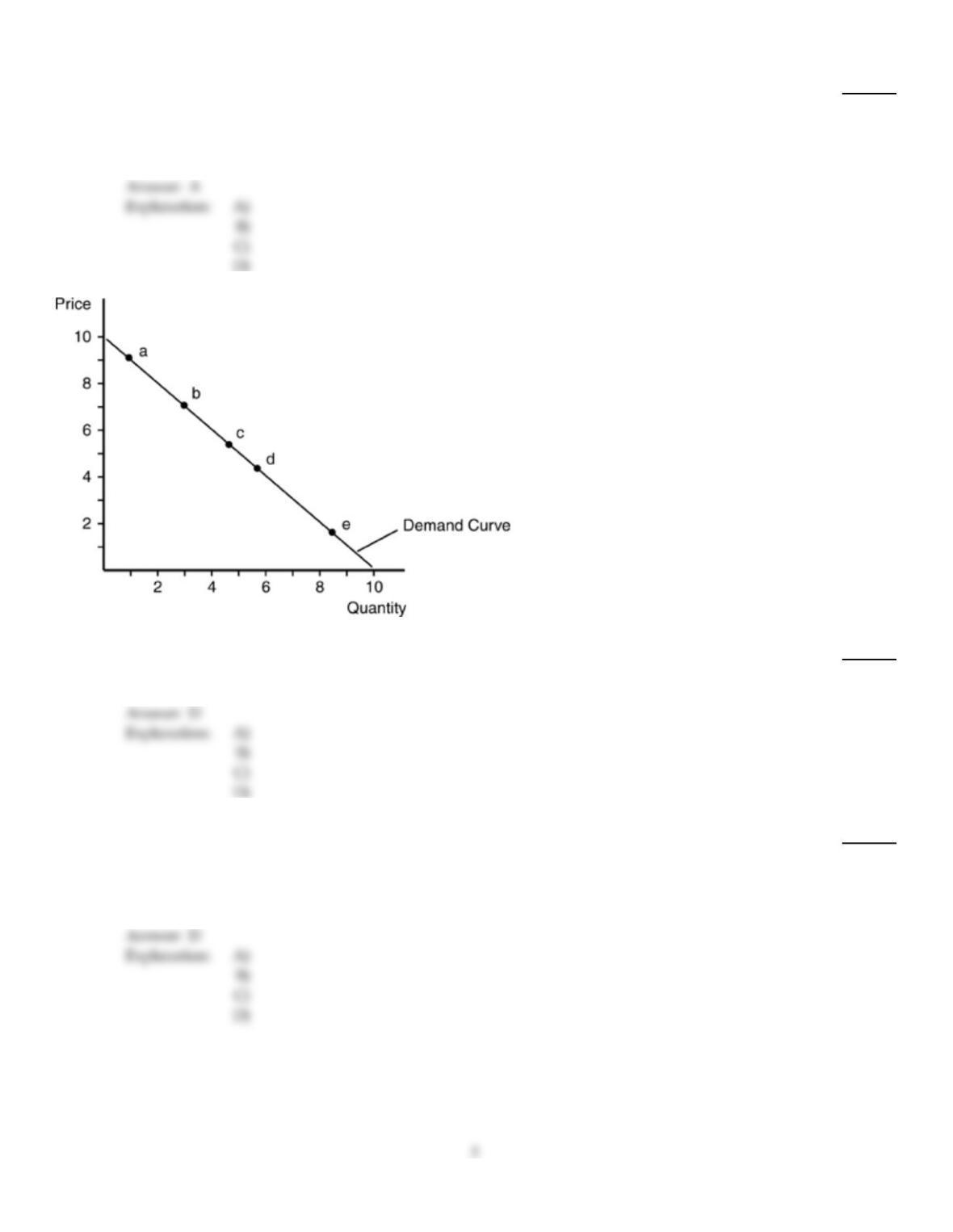
In the above figure, along which range would total revenue rise by raising prices?
20)
A)
between point c and point d
B)
above point a
C)
between point a and point b
D)
between point d and point e
21)
An increase in total revenue will result if
21)
A)
demand is elastic and price increases.
B)
demand is inelastic and price decreases.
C)
demand is unitary elastic and price increases.
D)
demand is elastic and price decreases.
22)
If the value of the cross elasticity of demand is negative, the two goods are
22)
A)
normal goods.
B)
complementary goods.
C)
inferior goods.
D)
substitute goods.
23)
If the cross price elasticity of demand between two goods is positive, then the two goods are
23)
A)
complements.
B)
substitutes.
C)
independent.
D)
unrelated.
24)
A perfectly elastic demand curve exhibits
24)
A)
zero responsiveness to changes in price.
B)
a change in quantity demanded that is proportional to the change in price.
C)
that quantity demanded will decrease to zero when there is a slight increase in the price level.
D)
a change in quantity demanded that is always twenty percent of the change in price.
25)
The price elasticity of demand would most likely be the lowest for
25)
A)
Shell gasoline.
B)
a Toyota sport utility vehicle.
C)
salt.
D)
a McDonald’s hamburger.
26)
A decrease in total revenue will result if
26)
A)
demand is elastic and price increases.
B)
demand is elastic and price decreases.
C)
demand is unitary elastic and price decreases.
D)
demand is inelastic and price decreases.
27)
The cross price elasticity between X and Y is 1.2. We can conclude that
27)
A)
perfect substitutes
B)
goods X and Y are substitutes.
C)
goods X and Y are unrelated.
D)
goods X and Y are complements.
28)
Price elasticity of demand basically measures
28)
A)
the reliability of a product.
B)
the percentage change in market price as a result of a change in demand.
C)
the responsiveness of consumers to price changes.
D)
the variability of price changes.
29)
A vertical demand curve has
29)
A)
positive elasticity.
B)
zero elasticity.
C)
infinite elasticity.
D)
negative elasticity.
30)
When the price of gasoline is $2.20 per gallon, 11 million gallons are demanded, and when the price
of gasoline goes up to $2.60 per gallon, 10 million gallons are demanded. The gasoline in this range
has a(n)
30)
A)
inelastic demand.
B)
elastic demand.
C)
perfectly elastic demand.
D)
unit elastic demand.
31)
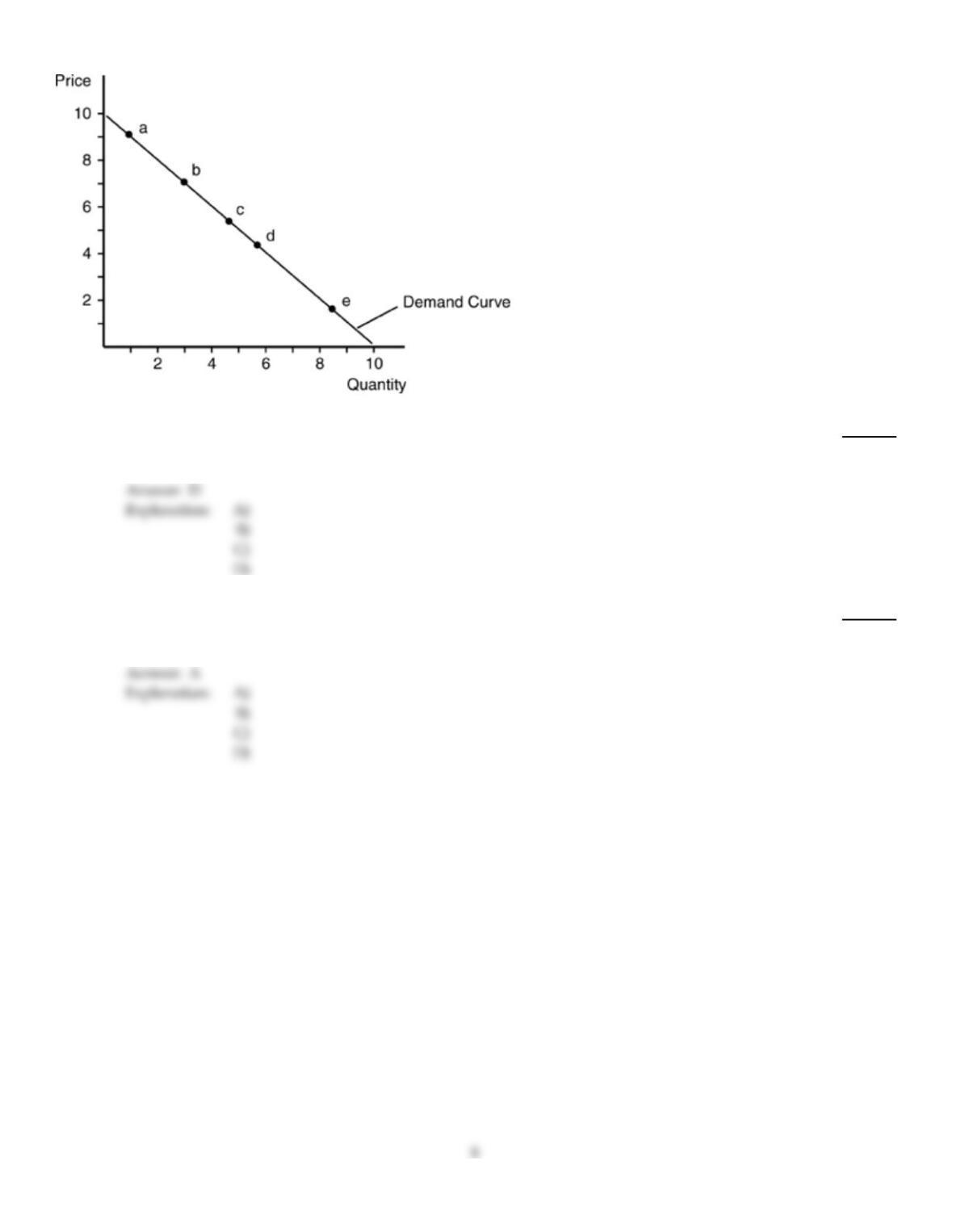
In the above figure, along which range would total revenue rise by lowering prices?
31)
A)
between point d and point e
B)
below point e
C)
between point c and point d
D)
between point a and point b
32)
No matter what the price of coffee is in the cafeteria, Jack spends $20 a week on coffee. We can
conclude that the absolute value of the price elasticity of demand for coffee for Jack is
32)
A)
equal to 1.
B)
less than 1.
C)
equal to 0.
D)
greater than 1.
Price Quantity Demanded
Per Unit Per Week
$10.00 25
9.50 30
9.00 35
8.50 40
8.00 45
7.50 50
7.00 55
6.50 60
6.00 65
5.50 70
5.00 75
33)
Refer to the above table. For which prices is demand unit–elastic?
33)
A)
in a range of prices between $5 and $10
B)
in a range of prices below $6.50
C)
in a range of prices between $6 and $6.50
D)
in a range of prices above $6.50
Px Qx Py Qy Pz Qz
$10 100 $20 50 $25 200
10 90 18 60 25 225
10 70 15 90 25 275
12 50 15 100 25 290
15 25 15 120 25 320
34)
Refer to the above table. Based on the information in the table, we can say that
34)
A)
all three goods are complements.
B)
X and Y are complements, Y and Z are substitutes, and X and Z are complements.
C)
X and Y are substitutes, Y and Z are complements, and X and Z are substitutes.
D)
all three goods are substitutes for each other.
35)
Refer to the above table. The price of Y decreases from $18 to $15. What is the cross price elasticity
of demand between Y and X?
35)
A)
–1.0
B)
+1.83
C)
–0.73
D)
+1.38
Month PXQXPYQYPZQZ
Jan $10 100 $20 50 $25 200
Feb 10 90 18 60 25 225
Mar 10 70 15 90 25 275
Apr 12 50 15 100 25 290
May 15 25 15 120 25 320
36)
In the above table, the cross price elasticity of demand for good Z with good Y when PY rises from
$15 to $18 is
36)
A)
–1.10.
B)
+1.10.
C)
+2.20.
D)
–2.20.
37)
The absolute price elasticity of demand for a vertical demand curve
37)
A)
depends on where one is on the demand curve.
B)
is 1.0.
C)
is infinite.
D)
is 0.
38)
The greater is the absolute price elasticity of demand, the
38)
A)
higher is the change in demand to an income change.
B)
smaller is the responsiveness to a price change.
C)
larger is the income of the buyer.
D)
larger is the responsiveness of quantity demanded to the price change.
39)
The value of the absolute price elasticity of demand for good X is 3. The absolute price elasticity for
good Y is 2. Which good’s quantity demanded is less responsive to a change in price?
39)
A)
Good X
B)
Good Y
C)
They are equally responsive.
D)
Not enough information is given.
40)
Suppose that when the price of milk rises 10%, the quantity demanded of milk falls 2%. Based on
this information, what is the approximate absolute price elasticity of demand for milk?
40)
A)
0.5
B)
5.0
C)
0.2
D)
2.0
41)
An inelastic demand indicates that
41)
A)
relatively large changes in price are required to obtain a relatively small change in quantity
demanded.
B)
quantity demanded does not vary with changes in the price.
C)
relatively large changes in quantity demanded lead to relatively large changes in price.
D)
relatively small changes in price lead to relatively large changes in quantity demanded.
42)
A perfectly elastic demand curve
42)
A)
has a slope of –1.
B)
shows that a slight increase in price will reduce quantity demanded to zero.
C)
shows that a slight change in income will lead to a large reduction in price.
D)
is a horizontal line drawn across from the quantity axis.
43)
When demand is elastic, a decrease in price will
43)
A)
decrease total revenue.
B)
increase total revenue.
C)
reduce quantity demanded.
D)
not change total revenue.
44)
Which of the following is NOT a determinant of the price elasticity of demand?
44)
A)
existence of substitutes
B)
the amount of time allowed for adjustment to changes in the price of the commodity
C)
the price level in a country
D)
expenditures on the good as a share of a consumer’s budget
45)
When demand is elastic
45)
A)
a proportionately small change in price leads to a proportionately large change in quantity
supplied.
B)
a proportionately small change in price leads to a proportionately large change in quantity
demanded.
C)
a proportionately small change in price leads to a proportionately small change in quantity
supplied.
D)
a proportionately small change in price leads to a proportionately small change in quantity
demanded.
46)
When Fred’s income was $100 per week, 10 units of good X were demanded. Now his income is
$150 per week and 12 units of good X are demanded. Using the percentage change formula, the
income elasticity of demand for good X equals
46)
A)
2.20.
B)
0.45.
C)
2.50.
D)
0.40.
47)
A perfectly inelastic supply curve is
47)
A)
downward sloping.
B)
horizontal.
C)
an upward sloping straight line that intersects the origin.
D)
vertical.
48)
The longer any price change persists, the
48)
A)
greater is the price elasticity of demand.
B)
more likely price will return to its original level.
C)
lower is the price elasticity of demand.
D)
more difficult it is to alter quantity demanded.
49)
When the absolute price elasticity of demand is less than 1, demand is
49)
A)
elastic.
B)
unit–elastic.
C)
inelastic.
D)
undetermined without more information.
50)
The price elasticity of demand measures
50)
A)
how much the market price changes in response to a change in demand.
B)
the consumers’ sensitivity to a price change.
C)
the producers’ sensitivity to a price change.
D)
how much the demand changes in response to a change in income.
51)
When economists want to obtain a measure of the responsiveness of quantity demanded to changes
in price, they use
51)
A)
the slope of the demand curve.
B)
the price elasticity of demand.
C)
the cross–price elasticity of demand.
D)
only the percentage change in quantity demanded.
52)
The price elasticity of demand is
52)
A)
always equal to zero, so there is no reason to consider the absolute value of the price elasticity
of demand.
B)
always positive, so there is no reason to consider the absolute value of the price elasticity of
demand.
C)
always equal to –1, which by convention economists typically express as an absolute value, or
1.
D)
always negative, but by convention, economists typically express the price elasticity of
demand as an absolute value.
53)
When the price of a textbook is $100, 60 copies are demanded; and when the price of that textbook
goes up to $120, 30 copies are demanded. In the price range between $100 and $120, the demand
for the textbook is
53)
A)
unit elastic.
B)
perfectly elastic.
C)
elastic.
D)
inelastic.
54)
If the price of one good increases, and as a result the demand for another related good falls, the
goods are
54)
A)
inferior goods.
B)
substitutes.
C)
complements.
D)
normal goods.
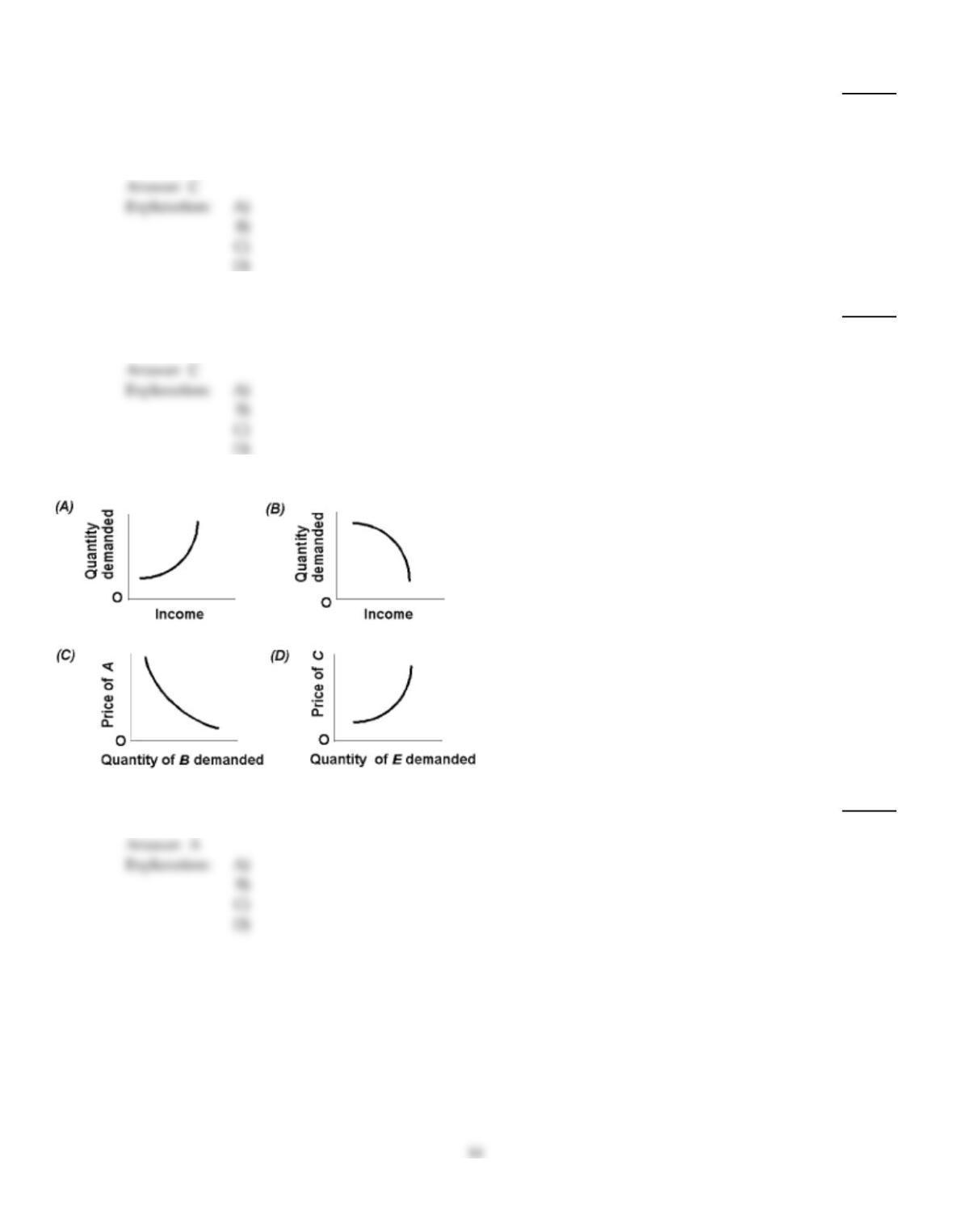
55)
Use the above figure. Which graph depicts a normal good?
55)
A)
A
B)
B
C)
C
D)
D
56)
If the bus fare of a city increases from $1.00 to $1.25 per ride and as a result total revenue increases,
then we know that
56)
A)
percentage change in fare is less than percentage change in number of rides.
B)
percentage change in fare is equal to the percentage change in number of rides.
C)
percentage change in fare is greater than percentage change in number of rides.
D)
it is impossible to tell.
57)
All of the following are true regarding the relationship between price elasticity of demand and total
revenues EXCEPT
57)
A)
when market demand is inelastic, if the market price rises, then total revenues will decrease.
B)
when market demand is elastic, if the market price declines, then total revenues will rise.
C)
when market demand is inelastic, if the market price falls, then total revenues will decrease.
D)
when market demand is unit elastic, if the market price rises, then total revenues will not
change.
58)
In the above figure, along which range would the demand for this good be most elastic?
58)
A)
at point e
B)
between point d and point e
C)
between point a and point b
D)
between point c and point d
59)
A movie theatre raises ticket prices from $8 to $10 in order to raise revenues. The theatre’s
management is assuming the absolute value of the price elasticity of demand for tickets is
59)
A)
less than 1.
B)
infinity.
C)
greater than 1.
D)
equal to 1.
60)
If the absolute price elasticity of demand is equal to 1 in the short run, then in the long run, other
things being equal, the absolute price elasticity of demand will be
60)
A)
greater than one.
B)
less than zero.
C)
less than one.
D)
equal to zero.
Px Qx Py Qy Pz Qz
$10 100 $20 50 $25 200
10 90 18 60 25 225
10 70 15 90 25 275
12 50 15 100 25 290
15 25 15 120 25 320
61)
Refer to the above table. Suppose the price of Y rises from $18 to $20. What is the cross price
elasticity of demand between Y and Z?
61)
A)
–1.1176
B)
+1.7273
C)
–0.8947
D)
–1.7273
62)
An elastic response in the quantity of a good demanded would be caused by
62)
A)
a lack of substitutes.
B)
the good representing a small portion of a person’s budget.
C)
the availability of many substitutes.
D)
a lack of sensitivity to the good’s price.
63)
Moving upward along a downward sloping straight–line demand curve, as the price of the product
goes up
63)
A)
the price elasticity of demand does not change.
B)
the price elasticity of demand goes from negative to positive.
C)
the price elasticity of demand goes from being inelastic to being elastic.
D)
the price elasticity of demand goes from being elastic to being inelastic.
64)
Suppose that the number of units of good X consumed falls 12 percent when the price of good Y
falls 8 percent. The cross price elasticity of demand between goods X and Y is
64)
A)
1.5.
B)
2.0.
C)
0.66.
D)
1.75.
Px Qx Py Qy Pz Qz
$10 100 $20 50 $25 200
10 90 18 60 25 225
10 70 15 90 25 275
12 50 15 100 25 290
15 25 15 120 25 320
65)
Refer to the above table. Suppose the price of Y rises from $18 to $20. What is the cross price
elasticity of demand between X and Y?
65)
A)
0
B)
+1
C)
–1
D)
–2
66)
A 10 percent increase in the price of neckties leads to a 5 percent decrease in the quantity
demanded of neckties. The absolute price elasticity of demand is
66)
A)
0.33.
B)
2.
C)
0.5.
D)
3.
Price Quantity Demanded
Per Unit Per Week
$10.00 25
9.50 30
9.00 35
8.50 40
8.00 45
7.50 50
7.00 55
6.50 60
6.00 65
5.50 70
5.00 75
67)
Refer to the above table. What is the absolute price elasticity of demand when price changes from
$6.00 to $6.50?
67)
A)
0.65
B)
0.60
C)
1.00
D)
1.60
68)
If an individual’s income rises 40 percent and his clothing purchases increase 50 percent in
response, the income elasticity for clothing by the individual is
68)
A)
0.8.
B)
–0.8.
C)
1.25.
D)
–1.25.
69)
Which of the following goods is most likely to have the lowest price elasticity?
69)
A)
gasoline
B)
pasta
C)
movie tickets
D)
DVD rentals
70)
If an item has an absolute price elasticity of demand that is greater than 1, we say the demand for
the item is
70)
A)
unit elastic.
B)
perfectly inelastic.
C)
elastic.
D)
inelastic.
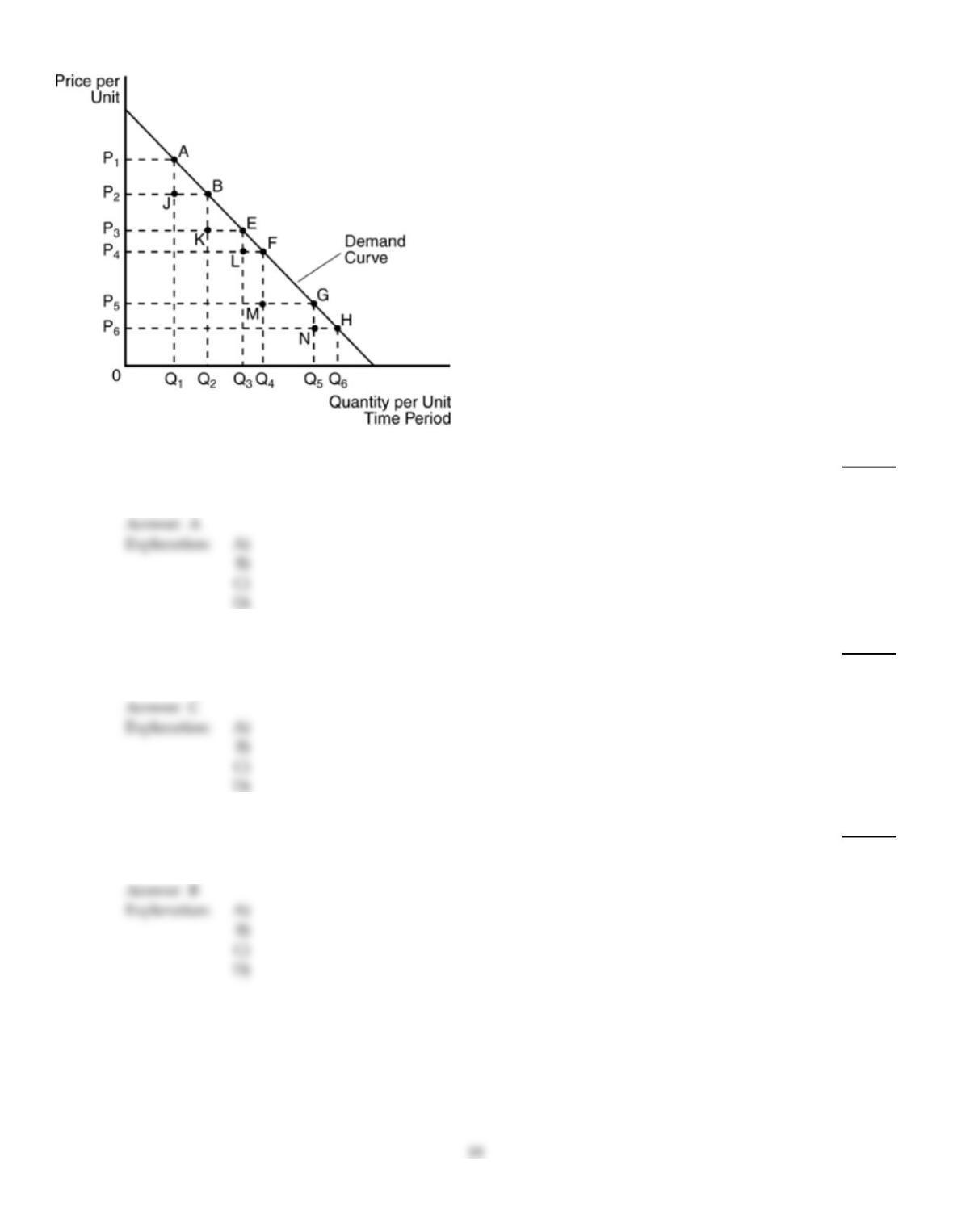
71)
In the above figure, over the price range P1P2, demand is
71)
A)
elastic.
B)
unit elastic.
C)
inelastic.
D)
perfectly elastic.
72)
The absolute price elasticity of demand would be the lowest for
72)
A)
Pizza Hut pizza.
B)
automobiles.
C)
salt.
D)
movie tickets.
73)
Given a price elasticity of demand of –0.33, a decrease in price will
73)
A)
increase total revenue.
B)
reduce total revenue.
C)
leave total revenue unchanged.
D)
decrease quantity.
74)
If your income rises by 15 percent and, as a result, you buy more steak, then steak is a(n)
74)
A)
inferior good.
B)
substitute.
C)
normal good.
D)
complement.
75)
Which of the following statements about demand and price elasticity of demand is TRUE?
75)
A)
As the demand curve has a negative slope, the price elasticity of demand is negative.
B)
As the demand curve has a positive slope, the price elasticity of demand is negative.
C)
As the demand curve has a negative slope, the price elasticity of demand is positive.
D)
As the demand curve has a positive slope, the price elasticity of demand is positive.
A
76)
If the absolute price elasticity of demand for a product is greater than 1, then
76)
A)
producers are relatively insensitive to price changes.
B)
consumers are relatively insensitive to price changes.
C)
there is a positive relationship between price changes and total revenue.
D)
consumers are relatively sensitive to price changes.
D
77)
The actual value of price elasticity of demand
77)
A)
will change when the units good is measured in changes.
B)
is always negative.
C)
measures the relative change in quantity demanded when there is a change in price.
D)
varies with changes in supply.
B
C