Environment: Science Behind the Stories, 2e Cdn. Ed. (Withgott)
Chapter 19 Environmental Health and Hazards
19.1 Graph and Figure Interpretation Questions
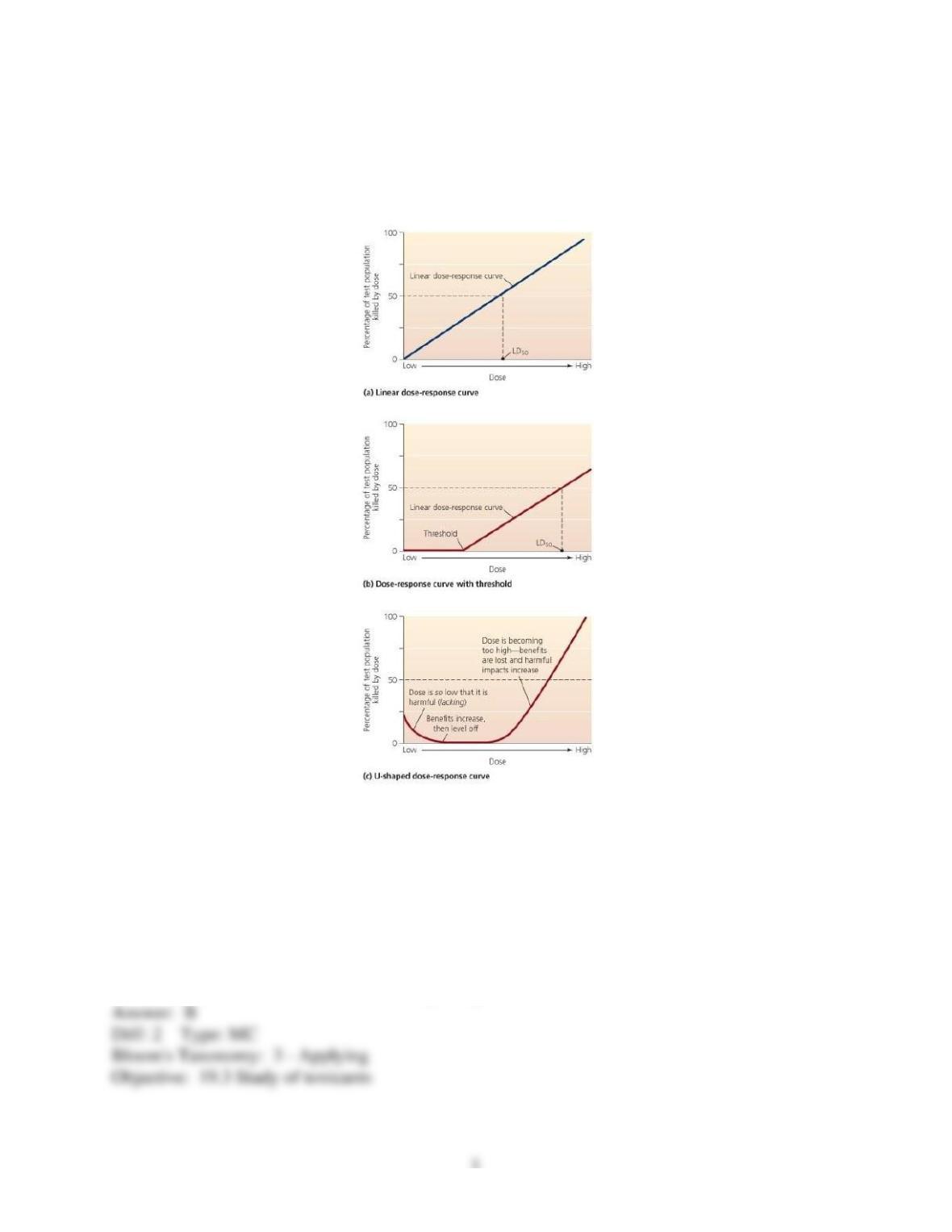
Figure 19.1
Use Figure 19.1 to answer the following questions.
1) Refer to Figure 19.1. Figures such as these ________.
A) are used by scientists in epidemiological assessments of a toxicant’s effect
B) are used by scientists in risk assessment
C) are used to report the effects of a toxicant on wildlife populations
D) represent typical dose-response curves for endocrine disruptors
E) allow scientists to determine the exact quantity of a toxicant that will harm humans

2) Refer to Figure 19.1. The LD50 indicates the ________.
A) amount of toxicant it takes to kill half the population
B) lowest dose that kills any member of the population
C) lowest dose that kills 50 out of 1000 members of the population
D) lowest dose required to cure half of the population
E) lowest dose required to cure the entire population
3) Refer to Figure 19.1. Assume that the scales for graphs (a) and (b) are identical. Compare the
graphs. Which of the following statements is true?
A) The toxicant shown in (b) has a lower LD50 compared to the toxicant shown in (a).
B) The toxicant shown in (b) has a higher toxicity than the toxicant shown in (a).
C) The toxicant shown in (b) has a lower toxicity than the toxicant shown in (a).
D) In high doses, toxicant (b) has a higher toxicity than toxicant (c).
E) Graphs (a) and (b) show results for the same toxicant, but graph (b) shows a higher dose than
graph (a).

19.2 Matching Questions
Match the following.
A) cadmium
B) mercury
C) DDT
D) asbestos
E) nicotine
F) thalidomide
G) arsenic
H) atrazine
I) lead
J) bisphenol-A
K) BPA
1) Widely used herbicide in Canada; an endocrine disruptor
2) Insecticide used to kill mosquitos; banned in Canada in 1985 because of its toxicity
3) Toxicant present in paint; damages the brain, liver, kidney, and stomach when ingested
4) Toxicant used as a flame retardant and insulator; scars the lungs when inhaled
5) Was used as a sleeping pill for pregnant women; teratogen that is now banned for use in
pregnant women, but is used to treat some diseases in non-pregnant people
6) Neurotoxin that magnifies within food webs; typically found in polluted bodies of water; it
poisoned thousands of people when it was dumped into the waters off Japan; people who ate
contaminated fish from the waters exhibited convulsions, slurred speech, loss of muscle control,
and sudden fits of laughter; some people died
Diff: 2 Type: MA
Bloom’s Taxonomy: 1 – Remembering
Objective: 19.3 Study of toxicants
19.3 Short Answer Questions
1) How have artificially produced chemicals played a role in giving us the standard of living we
enjoy today?
2) List the properties that determine the rate of degradation of toxicants.
3) What does the field of environmental health cover?
4) In what products is migratable lead of greatest concern?
5) Describe the biological effects of chemical pollution in Lake Apopka.
6) Explain what killed many sea otters off the California coast in 1998-2001.
7) Briefly comment on the possible health hazards of bisphenol-A.
8) Toxicants, especially those that are lipid-soluble, may build up in an animal in the process
termed ________.

9) Briefly explain the dose-response relationship.
10) ________ are substances that cause changes in an organism’s DNA.
11) “New furniture” and “new carpet” smells are often associated with emissions of ________.
12) One of the observed effects of DDT on ospreys was their failure to reproduce. DDT caused
________.
13) Why do we perceive driving a car to be a less dangerous mode of transportation than flying
by plane, even though the statistics indicate otherwise?
14) ________ are used in industry as heat-exchange fluids, in electrical transformers and
capacitors, and as additives in paint, sealants, and plastics. They have been found many
thousands of kilometres away in the milk of polar bears.

15) Why are wood frogs increasingly suffering limb abnormalities?
19.4 Multiple-Choice Questions
1) Rachel Carson’s book Silent Spring primarily focuses on the environmental problems
associated with ________.
A) aquifer depletion
B) pesticide toxicity
C) loss of biodiversity
D) overpopulation
E) deforestation
2) A person with cancer may have been exposed to ________.
A) allergens
B) teratogens
C) carcinogens
D) neurotoxins
E) vectors
3) A child was born with birth defects. This could have been caused by exposure to ________.
A) allergens
B) teratogens
C) carcinogens
D) neurotoxins
E) vectors

8
4) Tobacco and asbestos industries for decades denied that their products may cause cancers.
One of the reasons why it was difficult to prove the carcinogenic nature of these products was
the fact that carcinogens ________.
A) are the least common toxicants
B) have a long lag time between exposure and disease
C) are rare in nature
D) are difficult to measure
E) are usually invisible
5) PCB contamination ________.
A) is the main focus of the book Silent Spring
B) caused penis abnormalities in Taiwanese boys whose mothers used contaminated cooking oil
C) has never been documented outside the United States
D) was the main environmental problem in Lake Apopka
E) results from the overapplication of pesticides
6) If your immune system does not work properly and, instead, makes you sick, you have been
most likely exposed to ________.
A) neurotoxins
B) allergens
C) teratogens
D) hormones
E) antibiotics
7) The results of Guillette’s team was important because it focused on ________.
A) Lake Apopka’s water pollution problems
B) Lake Apopka’s environmental problems with DDT
C) the impacts of endocrine-disrupting chemicals on humans at Lake Apopka
D) disputing claims made in Rachel Carson’s book Silent Spring
E) Lake Apopka’s ability to handle waste solids
8) The worldwide drop in sperm counts among men has been attributed to ________.

9
A) DDT
B) endocrine disruptors
C) teratogens
D) radon
E) allergens
9) Bisphenol-A is ________.
A) an estrogen mimic that is used in plastic manufacturing
B) produced when fossil fuels are burned
C) released from aerosol spray cans
D) a currently used herbicide
E) a banned insecticide
10) Transport of airborne toxicants, a specific problem in agricultural environments, is called
pesticide ________.
A) leaching
B) drift
C) runoff
D) transposition
E) globalization
11) ________ is/are one of the “dirty dozen” persistent organic pollutants, produced by
incomplete combustion and in chemical manufacturing. It is/They are released in some types of
metal recycling, pulp and paper bleaching, automobile exhaust, tobacco smoke, and wood and
coal smoke.
A) DDT
B) Dioxins
C) Atrazine
D) Methylmercury
E) DDE
12) The Chemicals Management Plan reviews the safety of ________.

10
A) industrial chemicals
B) prescription drugs
C) non-prescription drugs
D) food additives
E) cosmetics
13) What is the most likely reason for the government of Canada to block international efforts to
regulate the global trade in asbestos?
A) because chrysotile is used only in countries that enforce prior informed consent
B) because there are strong doubts about the science linking asbestos with cancer
C) because it wants to continue lucrative exports of chrysotile to the United States
D) because it wants to be able to use chrysotile in the Canadian construction industry
E) because it wants to continue exports of chrysotile to India and other developing countries
14) Frogs are especially good indicators of pollution because ________.
A) they are easy to catch
B) these organisms are the most abundant on Earth
C) most chemicals are water soluble so they enter these organisms through drinking or skin
absorption
D) all chemical toxicants are found in water
E) the metabolism of these organisms is most like ours
15) Which of the following is the least likely to persist in an active form after one year?
A) DDT
B) DDE
C) PCBs
D) PBDEs
E) Bt toxin
16) The bald eagle, brown pelican, and peregrine falcon are all ________.
A) found only in British Columbia
B) Canadian invasive species

C) over-hunted for their feathers
D) extinct
E) susceptible to eggshell damage caused by DDT
17) Children exposed to pesticides may suffer ________.
A) loss of hearing
B) loss of taste
C) acute skin inflammation
D) from Toxoplasma
E) developmental impairments
18) Chemicals used in cosmetics in Canada are ________.
A) reviewed before being sold
B) marketed using the precautionary principle
C) reviewed and approved by the CFIA before they are sold
D) reviewed and approved by the PHAC before they are sold
E) reviewed and approved by the CEPA before they are sold
19) Canada’s approach to chemicals is to assume they are toxic until they are shown to be
harmless. This is called the ________.
A) nonexistent approach
B) buyer-beware approach
C) let-the-industry-regulate-itself approach
D) innocent-until-proven-toxic approach
E) precautionary principle approach