College Physics: A Strategic Approach, 3e (Knight)
Chapter 19 Optical Instruments
19.1 Conceptual Questions
1) The focal length of the lens of a simple digital camera is 40 mm, and it is originally focused
on a person 25 m away. In what direction must the lens be moved to change the focus of the
camera to a person 4.0 m away?
A) It does not make any difference.
B) sideways from the CCD sensors
C) away from the CCD sensors
D) towards the CCD sensors
2) The closest object that a typical young person with normal vision can focus on clearly is
closest to
A) 1 cm.
B) 10 cm.
C) 25 cm.
D) 50 cm.
E) 75 cm.
3) If the lens in a person’s eye is too highly curved, this person is suffering from
A) farsightedness.
B) spherical aberration.
C) astigmatism.
D) chromatic aberration.
E) nearsightedness.
4) If the back of a person’s eye is too close to the lens, this person is suffering from
A) nearsightedness.
B) spherical aberration.
C) astigmatism.
D) chromatic aberration.
E) farsightedness.
5) Nearsightedness is usually corrected with
A) converging lenses.
B) diverging lenses.
C) convex mirrors.
D) cylindrical lenses.
E) concave mirrors.
6) Farsightedness can usually be corrected with
A) converging lenses.
B) diverging lenses.
C) convex mirrors.
D) cylindrical lenses.
E) concave mirrors.
7) A little known fact is that both Robinson Crusoe and Friday wore eyeglasses. As it so
happens, Robinson Crusoe was farsighted while Friday was nearsighted. Whose eyeglasses did
they use whenever they wanted to start a fire by focusing the sun’s rays?
A) Robinson Crusoe’s
B) Friday’s
C) Both would work equally well.
D) Both actually worked, but Friday’s was a little bit better.
E) Neither’s worked, but fortunately they were in possession of matches.
8) What type of lens is used to make a magnifying glass?
A) converging
B) diverging
C) Either type would work equally well.
9) In a compound microscope
A) both the objective and the eyepiece form real images.
B) magnification is provided by the objective lens and not by the eyepiece. The eyepiece merely
increases the resolution of the image viewed.
C) magnification is provided by the objective and not by the eyepiece. The eyepiece merely
increases the brightness of the image viewed.
D) the magnification is m1 + M2, where m1 is the lateral magnification of the objective and M2
is the angular magnification of the eyepiece.
E) the image of the objective serves as the object for the eyepiece.
10) A simple compound microscope normally uses
A) a short focal length objective and a shorter focal length eyepiece.
B) a short focal length objective and a longer focal length eyepiece.
C) a long focal length objective and a shorter focal length eyepiece.
D) a very long focal length objective and a longer focal length eyepiece.
11) For relaxed viewing with a microscope or a telescope, the eyepiece is adjusted to place the
image at
A) the near point of the eye.
B) the pupil of the eye.
C) the focal point of the eyepiece.
D) infinity.
E) the focal point of the objective lens.
12) Jack and Mary view the same microorganism through the same compound microscope.
Mary’s near point distance, NM, is twice as large as Jack’s near point distance, NJ. If Mary sees
the microorganism with magnification MM, with what magnification does Jack see it?
A) 2 MM
B) MM/2
C) 4 MM
D) MM/4
E) 8 MM
13) You have a choice between two lenses of focal lengths fa and fb, where fb = 2fa, to use as the
objective lens in building a compound microscope. If the magnification you obtain using lens a
is Ma, what will be the magnification when using lens b?
A) Mb = 2 Ma
B) Mb = 4 Ma
C) Mb = 8 Ma
D) Mb = Ma/4
E) Mb = Ma/2
14) Which one of the following is a characteristic of a compound microscope?
A) The objective is a diverging lens.
B) The eyepiece is a diverging lens.
C) The final image is real.
D) The image formed by the objective is virtual.
E) The image formed by the objective is real.
15) Which one of the following statements is correct?
A) The image formed by the objective of a microscope is smaller than the object.
B) The image formed by the objective lens of a telescope is larger than the object.
C) The image formed by the eyepiece is real for both a microscope and a telescope.
D) The image formed by the objective lens of a microscope is larger than the object.
16) You are given two converging lenses to build a compound microscope. Lens A has focal
length 0.50 cm and lens B has focal length of 3.0 cm. Which one of the two lenses would you
use for the objective?
A) Lens A, because it has the shorter focal length.
B) Lens B, because it has the longer focal length.
C) It makes no difference which lens I use for the objective.
D) None, because the objective should be a diverging lens.
17) To maximize the magnification of a refracting telescope, what lenses should you choose?
A) The objective lens and eyepiece should both have small focal lengths.
B) The objective lens and eyepiece should both have large focal lengths.
C) The objective lens should have a small focal length and the eyepiece should have a large focal
length.
D) The objective lens should have a large focal length and the eyepiece should have a small focal
length.
E) The objective lens should have a large focal length, but it doesn’t matter what the focal length
of the eyepiece is.
18) Which one of the following is normally not a characteristic of a simple two-lens refracting
astronomical telescope?
A) The angular size of the final image is larger than that of the object.
B) The final image is virtual.
C) The objective forms a virtual image.
D) The final image is inverted.
19) A simple refracting telescope provides large magnification by employing
A) a short focal length objective and a short focal length eyepiece.
B) a short focal length objective and a long focal length eyepiece.
C) a long focal length objective and a short focal length eyepiece.
D) a long focal length objective and a long focal length eyepiece.
20) You have a choice between two lenses of focal lengths fa and fb, where fb = 2fa, to use as the
objective lens in building a refracting telescope. If the magnification you obtain using lens a is
Ma, what will be the magnification when using lens b?
A) Mb = 2 Ma
B) Mb = 4 Ma
C) Mb = 8 Ma
D) Mb = Ma/4
E) Mb = Ma/2
21) A refracting telescope has a magnification M. If the focal length of the objective lens is
doubled and the eyepiece focal length is halved, what is the new magnification?
A) 4M
B) 2M
C) M/2
D) M/4
E) M
22) Given perfect lenses, what is the main reason that a telescope with a large-diameter objective
lens can produce a sharper image than one with a small-diameter lens?
A) A larger lens can gather more light than a smaller lens.
B) A larger lens can focus more accurately than a smaller lens.
C) There is less diffraction with a larger lens than with a smaller lens.
D) A larger lens can focus more wavelengths of light than a smaller lens.
E) A larger lens has a longer focal length than a smaller lens.
23) With what color light would you expect to be able to see the finest detail when using a
microscope?
A) red, because of its long wavelength
B) yellow, because of its intermediate wavelength
C) blue, because of its shorter wavelength
D) The color does not matter.
24) If the diameter of a radar dish is doubled, what happens to its resolving power assuming that
all other factors remain unchanged?
A) The resolving power quadruples.
B) The resolving power doubles.
C) The resolving power is cut in half.
D) The resolving power is reduced to one-quarter its original value.
25) Chromatic aberration in lenses is due to the
A) reflection of light by the lens.
B) refraction of light by the lens.
C) dispersion of light by the lens.
D) polarization of light by the lens.
E) None of the other choices is correct.
26) Spherical lenses suffer from
A) both spherical and chromatic aberration.
B) spherical aberration, but not chromatic aberration.
C) chromatic aberration, but not spherical aberration.
D) neither spherical nor chromatic aberration.
27) Which of the following statements are correct? (There could be more than one correct
choice.)
A) Spherical aberration, but not chromatic aberration, occurs for lenses.
B) Chromatic aberration, but not spherical aberration, occurs for lenses.
C) Both chromatic aberration and spherical aberration occur for lenses.
D) Both chromatic aberration and spherical aberration occur for spherical mirrors.
1) A 35-mm digital camera using a standard 50.0 mm lens is focused on a 1.80 m tall person who
is standing 3.25 m from the lens. You now refocus the camera on a 15.0 cm tall flower that is
75.0 cm from the lens.
(a) In refocusing, by how much did you move the lens? Did you move it toward the film or away
from it?
(b) What is the height of the flower’s image on the CCD sensor?
2) A slide projector needs to focus the image of a 24.0-mm × 36.0-mm slide onto a square screen
1.50 m on each side. You want to fill the screen as completely as possible without any of the
image falling beyond the screen. Due to space constraints in the projector, the slide must be
placed 10.5 cm from the lens.
(a) What magnification does the projector produce?
(b) How far from the lens should the screen be placed?
(c) What focal length projector lens is needed?
3) A 35-mm camera equipped with a 40-mm focal length lens is used to photograph a tree 17 m
tall. If a 32-mm high image of the tree on the CCD sensor is required, how far should the camera
lens be from the tree?
A) 21 m
B) 22 m
C) 23 m
D) 24 m
E) 26 m
4) The focal length of the lens of a simple film camera is 40.0 mm. By what amount should the
distance between the lens and the film be increased or decreased to change the focus from a
person who is 25 m from the lens to one who is 4.0 m from the lens?
A) 0.2 mm
B) 0.3 mm
C) 0.4 mm
D) 0.5 mm
E) 0.7 mm
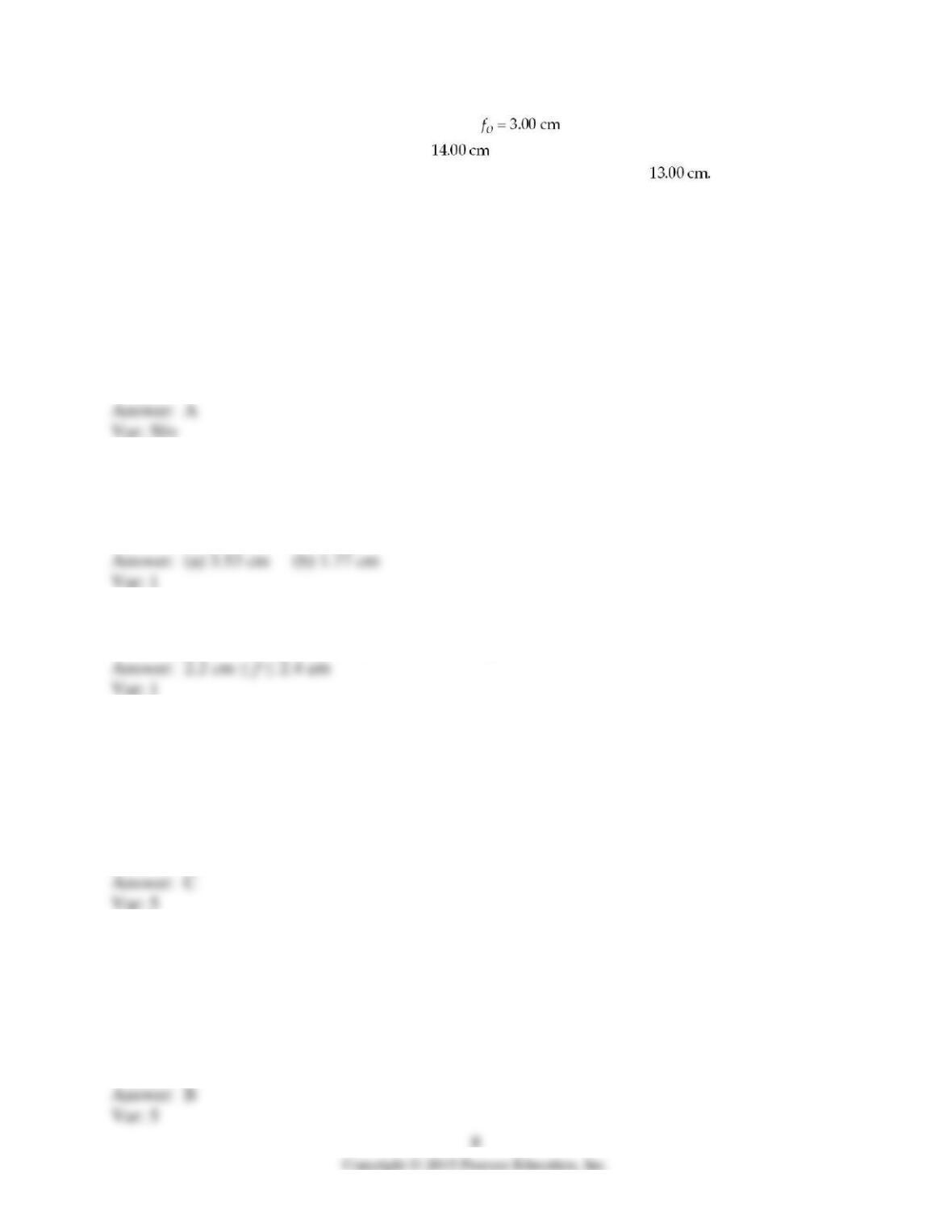
5) A simple digital camera lens with focal length perfectly focuses the image of an
object on a CCD sensor located a distance away from the lens. The object now moves
away from the lens and the new distance between the lens and sensor is
(a) By what amount did the object change its distance from the lens?
(b) What is the new magnification?
A) (a) 0.08 cm
(b) 3.33
B) (a) 0.03 cm
(b) 0.30
C) (a) 990.00 cm
(b) 0.23
D) (a) 12.22 cm
(b) 4.33
6) A 35-mm single lens reflex (SLR) digital camera is using a lens of focal length 35.0 mm to
photograph a person who is 1.80 m tall and located 3.60 m from the lens.
(a) How far is the CCD sensor from the lens when the person is in focus?
(b) How tall is the person’s image on the CCD sensor?
7) For an eye that is 2.4 cm in diameter, what must be the range of focal lengths of the lens to
focus objects from the near point (25 cm) to infinity on the retina?
8) A person’s near point is 25 cm, and her eye lens is 2.7 cm away from the retina. What must be
the focal length of this lens for an object at the near point of the eye to focus on the retina?
A) -3.4 cm
B) -2.4 cm
C) 2.4 cm
D) 3.4 cm
E) 2.6 cm
9) A person’s eye lens is 2.8 cm from the retina, and his near point is at 25 cm. What must be the
focal length of his eye lens so that an object at the far point of the eye will focus on the retina?
A) -2.8 cm
B) 2.8 cm
C) -2.4 cm
D) 2.4 cm
E) 2.2 cm
10) What power (in diopters) of corrective contact lens is required to correct the vision of a
myopic eye whose far point is at 170 cm?
11) A person is nearsighted with a far point of 75.0 cm.
(a) What focal length contact lens is needed to give him normal vision?
(b) What is the power of the corrective lens?
12) A nearsighted person has a near point of 12 cm and a far point of 17 cm. If the corrective
lens is 2.0 cm from his eye, (a) what lens power will enable this person to see distant objects
clearly, and (b) what then will be the new near point of his eye?
13) A person uses corrective glasses of power -8.5 D that are worn 2.0 cm from her eye.
(a) Is she nearsighted or farsighted?
(b) What is her far point without glasses?
14) A nearsighted man wears contact lenses of -3.00 diopters. With these lenses, his corrected
near point is 25.0 cm. What is his uncorrected near point?
15) A person’s hyperopic (farsighted) eye can focus on objects that are 75 cm away and farther.
What power and what focal length contact lenses should be prescribed so this person can see
objects 25 cm and farther from the eye?
16) A nearsighted person has a far point of 50 cm for his right eye and 150 cm for his left eye.
For each eye, what power contact lens will allow the person to see gorgeous sunsets?
17) What is the power of the lens that has a focal length of 40 cm and a diameter if 5.0 cm?
A) -2.5 diopters
B) +20 diopters
C) +0.20 diopters
D) +2.5 diopters
E) +2.7 diopters
18) What is the power of a lens that has a focal length of -40 cm and a width of 2.0 cm?
A) -2.5 diopters
B) -0.50 diopters
C) +4.0 diopters
D) +2.5 diopters
E) -50 diopters
19) The power of a lens is 4.0 diopters and its diameter is 5.0 cm. What is the focal length of this
lens?
A) 25 cm
B) 55 cm
C) 10 cm
D) 0.25 cm
E) 2.5 cm
20) A farsighted boy has a near point at 2.3 m and requires contact lenses to correct his vision to
the normal near point. What is the correct choice of lens power for the contact lenses?
A) -0.28 diopters
B) +0.28 diopters
C) -3.6 diopters
D) +3.6 diopters
E) +1.8 diopters
21) A farsighted girl has a near point at 2.0 m but has forgotten her glasses at home. The girl
borrows eyeglasses that have a power of +2.75 diopters. With these eyeglasses, what is the near
point of the girl, assuming that she wears them extremely close to her eyes?
A) 28 cm
B) 31 cm
C) 33 cm
D) 37 cm
E) 40 cm
22) A myopic (nearsighted) child wears contact lenses that allow her to have clear distant vision.
The power of the lenses of her eyeglasses is -3.00 diopters. Without the corrective lenses, what is
the far point of the girl?
A) 0.33 m
B) 0.25 m
C) 0.17 m
D) 0.42 m
E) 0.50 m
23) A machinist with normal vision has a near point at 25 cm. This machinist wears +4.25-
diopter eyeglasses in order to do very close work. With these eyeglasses, what is the near point
of the machinist? Assume that he wears the glasses extremely close to his eyes.
A) 12 cm
B) 10 cm
C) 7 cm
D) 15 cm
E) 17 cm
24) As a treatment for cataracts (a cloudiness of the lens of the eye), the natural lens is removed
and a plastic lens is implanted. After this is done a person can see distant objects clearly, but he
cannot accommodate to focus on nearby objects. If such a person wanted to read a book at a
distance of 25 cm, he would have to wear contact lenses having a diopter power of
A) +2.78 diopters
B) +3.33 diopters
C) -1.78 diopters
D) +4.00 diopters
E) -4.00 diopters
25) What is the focal length of the corrective contact lens needed by a nearsighted person whose
far point is at 60 cm?
A) -60 cm
B) -30 cm
C) +30 cm
D) +60 cm
E) +130 cm
26) The near point of a farsighted person is 65 cm. What power contact lens must he use to
correct this problem and be able to read a book at a normal near point of 25 cm?
A) -4.2 diopters
B) -2.5 diopters
C) -2.4 diopters
D) +4.2 diopters
E) +2.5 diopters
27) A nearsighted person has a far point that is 4.2 m from his eyes. What focal length lenses
must he use in his contact lenses to allow him to focus on very distant mountains?
A) -4.2 m
B) 4.2 m
C) -5.2 m
D) 5.2 m
E) -4.8 m
28) A nearsighted person has a far point that is 4.2 m from his eyes. What power contact lenses
must he wear to allow him to focus on distant mountains?
A) 0.48 diopters
B) -0.48 diopters
C) -0.36 diopters
D) -0.24 diopters
E) 0.24 diopters
29) What is the focal length of a contact lens that will allow a person with a near point of 125 cm
to read a physics book held 25.0 cm from his eyes?
A) -100 cm
B) -31.3 cm
C) 10.2 cm
D) 20.8 cm
E) 31.3 cm
30) What power contact lens should be used to correct the vision of a farsighted person whose
near point is 80 cm so she can see things clearly that are 25 cm in front of her?
A) +2.8 diopters
B) -2.8 diopters
C) -4.0 diopters
D) -4.2 diopters
E) +4.2 diopters
31) What power contact lens must be used to correct the vision of a nearsighted person whose far
point is 40 cm?
A) +2.5 diopters
B) -2.5 diopters
C) -3.6 diopters
D) -4.0 diopters
E) +4.0 diopters
32) What is the uncorrected near point of a farsighted person who can comfortably read a
newspaper held 25 cm from his eyes when he wears +3.33-diopter contact lenses?
A) 1.5 m
B) 0.50 m
C) 1.9 m
D) 0.75 m
E) 0.60 m
33) Without glasses, a person can comfortably read a magazine when it is held at 60 cm from his
eyes. What should be the focal length of his contact lenses to allow him to read the magazine
comfortably at a distance of 30 cm?
A) -30 cm
B) +30 cm
C) -60 cm
D) +60 cm
E) +90 cm
34) Diego is nearsighted and cannot see things beyond 110 cm from his eyes. What is the focal
length of the contact lenses that will enable him to comfortably see distant hills clearly?
A) +50 cm
B) -50 cm
C) -110 cm
D) +110 cm
E) -30 cm
35) Olga is nearsighted and cannot see things beyond 90 cm cm from her eyes. What is the
refractive power of the contact lenses that will enable her to comfortably see distant buildings
clearly?
A) +1.1 diopters
B) -1.1 diopters
C) -1.7 diopters
D) -2.2 diopters
E) +2.2 diopters
36) Mahmood is farsighted and cannot see objects clearly that are closer to his eye than 80.0 cm.
What is the focal length of the contact lenses that will enable him to comfortably see objects at a
distance of 25.0 cm from his eyes?
A) +36.4 cm
B) -36.4 cm
C) -21.2 cm
D) +21.2 cm
E) +32.5 cm
37) Alice is farsighted and cannot see objects clearly that are closer to her eye than 80.0 cm.
What is the refractive power of the contact lenses that will enable her to comfortably see objects
at a distance of 25.0 cm from her eyes?
A) +2.75 diopters
B) -2.75 diopters
C) -4.72 diopters
D) +4.72 diopters
E) +7.00 diopters
38) A nearsighted person cannot see objects beyond 80 cm from his eyes. Which one of the
following combinations represents the correct focal length and the refractive power of the
contact lenses that will enable him to comfortably see the distant objects clearly?
A) +80 cm, +1.3 diopters
B) -80 cm, +1.3 diopters
C) +80 cm, -1.3 diopters
D) -80 cm, -1.3 diopters
E) -1.3 cm, +1.3 diopters
39) A farsighted person cannot see clearly objects that are closer to her eyes than 60.0 cm.
Which one of the following combinations represents the correct focal length and the refractive
power of the contact lenses that will enable her to comfortably see the objects at a distance of
25.0 cm from her eyes?
A) -42.9 cm, +2.33 diopters
B) -42.9 cm, -2.33 diopters
C) +42.9 cm, +2.33 diopters
D) +42.9 cm, -2.33 diopters
E) +60 cm, +42.9 diopters
40) A nearsighted person has a far point of 18 cm. What power contact lenses will allow this
person to comfortably see distant objects clearly?
A) +5.6 diopters
B) -5.6 diopters
C) +0.056 diopters
D) -0.056 diopters
41) A person cannot see clearly objects more than 70.0 cm away. What power of corrective lens
should be prescribed if the glass is to be worn 1.00 cm in front of the eye?
A) 1.45 diopters
B) -1.45 diopters
C) 0.0145 diopters
D) -0.0145 diopters
42) A nearsighted person wears contact lenses having a power of -0.15 diopters. What is the
person’s uncorrected far point?
A) 1.5 m
B) 3.3 m
C) 6.0 m
D) 6.7 m
43) What power contact lens is needed to correct for farsightedness where the uncorrected near
point is 75 cm?
A) +2.7 D
B) -2.7 D
C) +5.3 D
D) -5.3 D
44) The near point of a farsighted person is 100 cm. She places reading glasses very close to her
eyes, and with them she can comfortably read a book at a distance of 25 cm. What is the power
of the lenses in her reading glasses?
A) +2.5 diopters
B) +3.0 diopters
C) +3.2 diopters
D) -2.0 diopters
45) When a person with a near point at 28 cm uses a certain magnifying glass, it produces an
angular magnification of 7.0 with the image very distant. What is the focal length of the lens of
this magnifying glass?
A) 2.0 cm
B) 3.0 cm
C) 4.0 cm
D) 5.0 cm
E) 6.0 cm