7) In the United States, over the past 40 years federal revenues as a share of gross domestic
product have
A) risen steadily and now are about 40 percent.
B) ranged between 17 and 19 percent.
C) fallen below 10 because of rapid economic growth.
D) been limited by law to no more than 20 percent.
8) The term “payroll taxes” is often used to refer to
A) individual income taxes that are withheld from paychecks.
B) corporate income taxes.
C) Social Security and Medicare taxes.
D) sales taxes.
9) The largest source of tax revenue for state and local governments in the United States in 2010
was
A) sales taxes.
B) the corporate income tax.
C) the property tax.
D) the individual income tax.
10) A regressive tax is a tax for which people with lower incomes
A) pay a lower percentage of their incomes in tax than do people with higher incomes.
B) pay a higher percentage of their incomes in tax than do people with higher incomes.
C) pay the same percentage of their incomes in tax as do people with higher incomes.
D) do not have to pay unless their incomes exceeds a certain amount.
11) Since lower-income people spend a larger proportion of their incomes on groceries than do
higher-income people, if grocery stores were required by law to charge a 10-cent fee for
disposable bags, this fee could be considered a
A) proportional tax.
B) progressive tax.
C) regressive tax.
D) income tax.
12) In reference to the federal income tax system, a tax bracket is
A) the estimated amount of federal income tax firms withhold from their employees’ paychecks.
B) the formula the federal government uses to determine the dollar amount of the personal
exemption and the amounts taxpayers are allowed for deductions from their incomes.
C) used to determine the average tax rate.
D) the income range within which a tax rate applies.
13) Which of the following is an example of a federal mandate?
A) an excise tax
B) the Medicaid program
C) the personal tax exemption
D) the Food and Drug Administration (FDA)
14) A proportional tax is a tax for which people with lower incomes
A) pay a higher percentage of their incomes in tax than do people with higher incomes.
B) pay a lower percentage of their incomes in tax than do people with higher incomes.
C) pay the same percentage of their incomes in tax as do people with higher incomes.
D) pay the same amount of taxes as people with higher incomes pay.
15) In the United States, taxpayers are allowed to exclude from taxation a certain amount of
income, called
A) the personal income exclusion.
B) the income allowance.
C) the income tax credit.
D) the personal exemption.
Table 18-3
Income
Consumption Spending
$20,000
$18,000
24,000
20,700
Table 18-3 contains data on household spending at different income levels. Suppose that a 3
percent tax is levied on all consumption spending.
16) Refer to Table 18-3. Calculate the percent of income paid in taxes by a family with $20,000
income and by a family with $24,000 income.
A) The family with a $20,000 income pays 2.7 percent of its income in consumption taxes and
the family with a $24,000 income pays 2.6 percent of its income in consumption taxes.
B) Each family pays 3 percent of their respective incomes in consumption taxes.
C) The family with a $20,000 income pays 15 percent of its income in consumption taxes and the
family with a $24,000 income pays 33.3 percent of its income in consumption taxes.
D) There is insufficient information to make these calculations.
17) Refer to Table 18-3. The consumption tax is
A) proportional.
B) progressive.
C) income neutral.
D) regressive.
Table 18-4
Taxable Income
Tax Payments
$10,000
$1,000
12,000
1,240
16,000
1,780
22,000
2,740
Table 18-4 shows the amount of taxes paid on various levels of income.
18) Refer to Table 18-4. The tax system is
A) progressive throughout all levels of income.
B) proportional throughout all levels of income.
C) regressive throughout all levels of income.
D) progressive between $10,000 and $12,000 of income and regressive between $16,000 and
$22,000.
19) According to projections for 2011 by the Tax Policy Center, the 20 percent of U.S. taxpayers
who make the highest incomes
A) use loopholes and tax exemptions to reduce their share of federal income taxes to less than 20
percent.
B) pay almost 70 percent of federal income taxes.
C) pay about 90 percent of federal income taxes but only about 20 percent of Social Security and
Medicare payroll taxes.
D) pay more in excise and other taxes than they pay in Social Security and Medicare payroll
taxes.
Table 18-5
Taxable Income
Tax Payments
$10,000
$1,000
12,000
1,080
16,000
1,360
22,000
1,760
Table 18-5 shows the amount of taxes paid on various levels of income.
20) Refer to Table 18-5. The tax system is
A) progressive throughout all levels of income.
B) proportional throughout all levels of income.
C) regressive throughout all levels of income.
D) progressive between $10,000 and $12,000 of income and regressive between $12,000 and
$22,000.
21) In the United States, the federal income tax is an example of a
A) progressive tax.
B) regressive tax.
C) proportional tax.
D) flat tax.
22) The average tax rate is calculated as
A) total income divided by the total tax paid.
B) the change in total tax paid divided by the change in income.
C) total tax paid divided by total income.
D) the change in income divided by the change in total tax paid.
23) When considering changes in tax policy, economists usually focus on
A) the average tax rate.
B) the marginal tax rate.
C) people’s willingness to pay taxes.
D) people’s ability to pay taxes.
24) The marginal tax rate is
A) the amount of taxes paid as a percentage of income.
B) the amount of per-capita taxes paid.
C) the amount of taxes paid as a percentage of gross domestic product (GDP).
D) the fraction of each additional dollar of income that must be paid in taxes.
25) An income tax system is ________ if marginal tax rates increase as income increases.
A) progressive
B) regressive
C) efficient
D) equitable
Table 18-6
Income Tax Bracket
Marginal Tax
Rate
$0 – 6,000
10%
6,001 – 20,000
15%
20,001 – 44,500
22%
44,501 and over
30%
Table 18-6 shows the income tax brackets and tax rates for single taxpayers in Monrovia.
26) Refer to Table 18-6. Calculate the income tax paid by Sylvia, a single taxpayer with an
income of $70,000.
A) $21,000
B) $15,740
C) $15,400
D) $13,475
27) Refer to Table 18-6. Sylvia is a single taxpayer with an income of $70,000. What is her
marginal tax rate and what is her average tax rate?
A) marginal tax rate = 30%; average tax rate = 30%
B) marginal tax rate = 8%; average tax rate = 19.3%
C) marginal tax rate = 30%; average tax rate = 22.5%
D) marginal tax rate = 20%; average tax rate = 30%
28) A tax is efficient if
A) individuals with the lowest incomes pay proportionately lower taxes than individuals with the
highest incomes.
B) it is based on profits earned and not on wages.
C) it encourages saving and investment.
D) it imposes a small excess burden relative to the revenue it raises.
29) The excess burden of a tax
A) measures the efficiency loss to the economy that results from a tax, causing a reduction in the
quantity of goods and services produced.
B) is measured by the administrative costs required to implement a tax system.
C) is a measure of the hardship imposed on low-income individuals in a society.
D) is a measure of the foregone consumption as a result of having to pay taxes.
30) A tax on interest earned from saving is an example of a tax with a high deadweight loss
because
A) it compels retired individuals to rely more heavily on Social Security.
B) it encourages people to consume less and save more for their future expenditures.
C) doing so amounts to double taxation since savings often come from income that has already
been taxed once.
D) the savings that are taxed could have been spent on capital goods which will benefit society.
31) According to the ability-to-pay principle of taxation,
A) individuals who receive the benefit of a good or service should bear a greater share of the tax
burden.
B) it is fair to expect a greater share of the tax burden to be borne by people who have a greater
ability to pay.
C) people in the same economic situation should bear an equal share of the tax burden.
D) individuals who are willing to bear a greater share of the tax burden should be compensated
with non-monetary benefits.
32) For many U.S. individuals and households, replacing the federal income tax with a
consumption tax would not make a major change in their tax liability – the amount they would be
taxed. Which of the individuals described would be least affected by replacing the income tax
with a consumption tax?
A) A person in the lowest income bracket. This person would pay little or no tax under either
system.
B) A high-income individual who saves 35 percent of this income and uses his savings to
purchase stocks and bonds.
C) A female head of family, with no husband present.
D) A taxpayer who puts part of her savings into a 401(k) retirement plan and in an Individual
Retirement Account.
33) Which of the following explains one difference between a consumption tax and an income
tax?
A) An income tax is a regressive tax; a consumption tax is a progressive tax.
B) Under a consumption tax, households pay taxes only on the part of income they spend; under
an income tax, households pay taxes on all income earned.
C) Under an income tax, present consumption is taxed more heavily than future consumption;
under a consumption tax, future consumption is taxed more heavily than present consumption.
D) Savings are taxed more heavily under a consumption tax than under an income tax.
34) U.S. taxpayers spend many hours during the year maintaining records for tax purposes and
preparing their income tax returns. This administrative cost
A) is part of the deadweight loss of taxation.
B) is equal to the value of consumer surplus associated with the income tax system.
C) can be claimed as a deduction on income tax returns.
D) is larger for individuals in the lowest income quintile than for individuals in the highest
income quintile.
35) According to the horizontal-equity principle of taxation,
A) individuals who receive the benefits of a good or service should bear a greater share of the tax
burden.
B) individuals who are most able to pay should bear a greater share of the tax burden.
C) people in the same economic situation should be treated equally.
D) individuals who are willing to bear a greater share of the tax burden should be compensated
with non-monetary benefits.
36) The horizontal-equity principle of taxation is not easy to use in practice because
A) some people engage in rent seeking to reduce their taxes below the level other people pay.
B) people can use tax loopholes to reduce their incomes below the incomes of other taxpayers.
C) different people receive different levels of government benefits even if their incomes are the
same.
D) it is difficult to determine whether people are in the same economic situation.
37) According to the benefits-received principle of taxation,
A) individuals who receive the benefits from a government program should pay the taxes that
support the program.
B) because high income individuals receive the most benefits from government programs, they
should pay more taxes than lower income individuals.
C) people in the same economic situation should bear an equal share of the tax burden.
D) the benefits of government programs such as national defense are shared equally by all
people; therefore, the burden of paying for these programs should be shared equally.
38) Vertical-equity is most closely associated with which of the following goals or principles?
A) the horizontal-equity principle
B) the goal of economic efficiency
C) the goal of attaining social objectives
D) the ability-to-pay principle
39) Suppose the government wants to finance housing for low-income families by placing a tax
on the purchase of luxury homes. Assume the government defines a luxury home as a home that
is purchased for at least $1 million. This tax is consistent with the
A) benefits-received principle.
B) social equity principle.
C) ability-to-pay principle.
D) horizontal-equity principle.
40) Horizontal equity is achieved when taxes are collected from those who benefit from the
government expenditure of the tax revenue.
41) According to the benefits-received principle, those who receive the benefits from a
government program should pay the taxes that support the program.
42) A change from an income tax to a consumption tax system would cause the greatest increase
in taxes owed by those who currently put part of their savings into 401(k) retirement plans and
Individual Retirement Accounts.
43) A tax is efficient if it imposes a small excess burden relative to the tax revenue it raises.
44) In 2010, which type of tax raised the most revenue for the U.S. federal government? Which
type of tax raised the most revenue for state and local governments?
45) Many state governments use lotteries to raise revenue. If a lottery is viewed as a tax, is it
most likely a progressive tax or a regressive tax? What information would you need to determine
whether the burden of a lottery is progressive or regressive?
46) If you pay $14,000 in taxes on an income of $125,000, and $17,400 in taxes on an income of
$144,000, what is your marginal tax rate? Show your work.
47) If your income is $92,000 and you pay taxes of $19,475, what is your average tax rate? Show
your work.
48) The complexity of the U.S. federal income tax system results in significant annual
deadweight losses. The opportunity cost of the hours taxpayers spend on record keeping and
completing their tax returns amounts to billions of dollars.
a. If the tax system was simplified, how would this benefit the economy?
b. Why hasn’t the tax system been simplified?
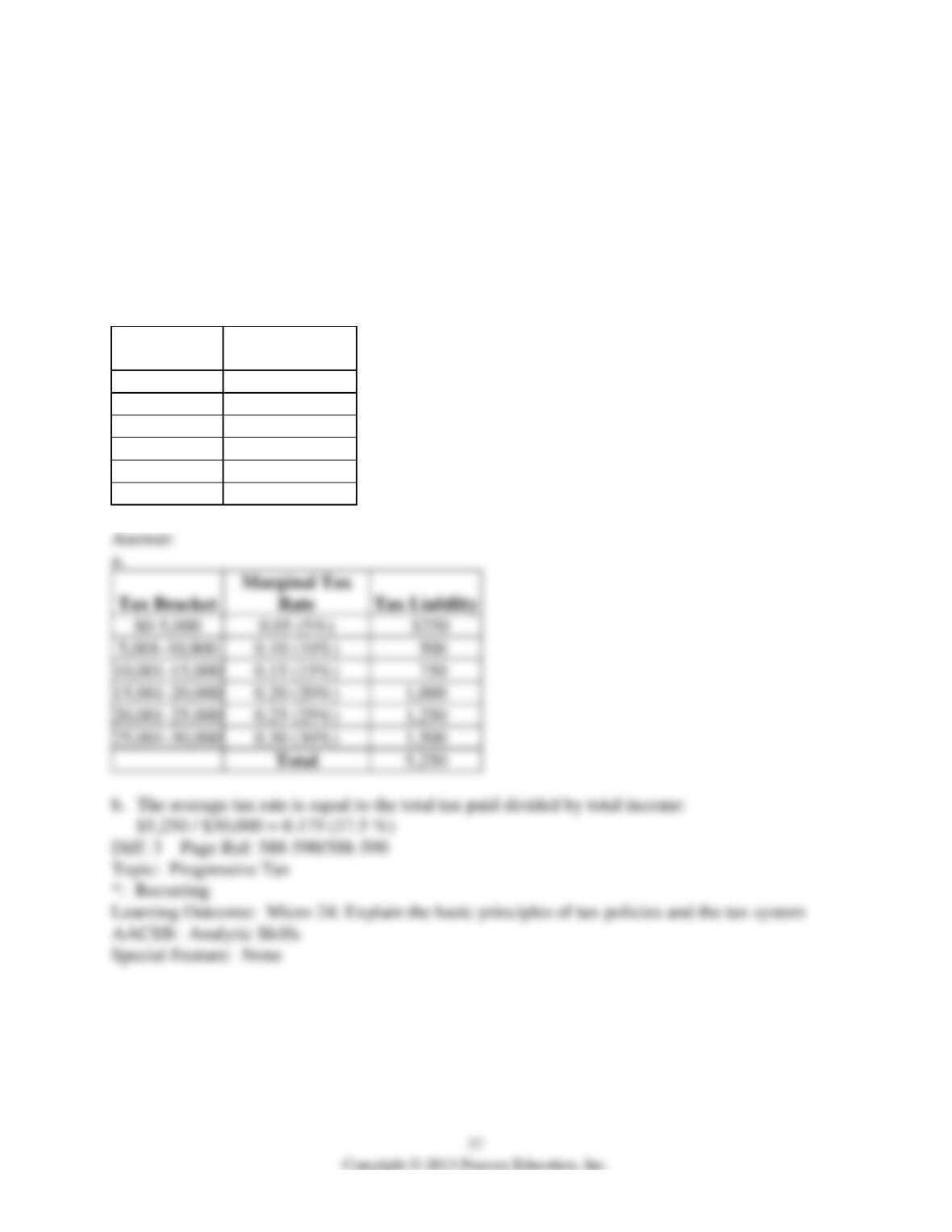
49) Last year, Anthony Millanti earned exactly $30,000 of taxable income. Assume that the
income tax system used to determine Anthony’s tax liability is progressive. The table below lists
the tax brackets and the marginal tax rates that apply to each bracket.
a. Draw a new table that lists the amounts of income tax that Anthony is obligated to pay for
each tax bracket, and the total tax he owes the government. (Assume that there are no allowable
tax deductions, tax credits, personal exemptions or any other deductions that Anthony can use to
reduce his tax liability).
b. Determine Anthony’s average tax rate.
Tax Bracket
Marginal Tax
Rate
$0-5,000
0.05 (5%)
5,001-10,000
0.10 (10%)
10,001-15,000
0.15 (15%)
15,001-20,000
0.20 (20%)
20,001-25,000
0.25 (25%)
25,001-30,000
0.30 (30%)
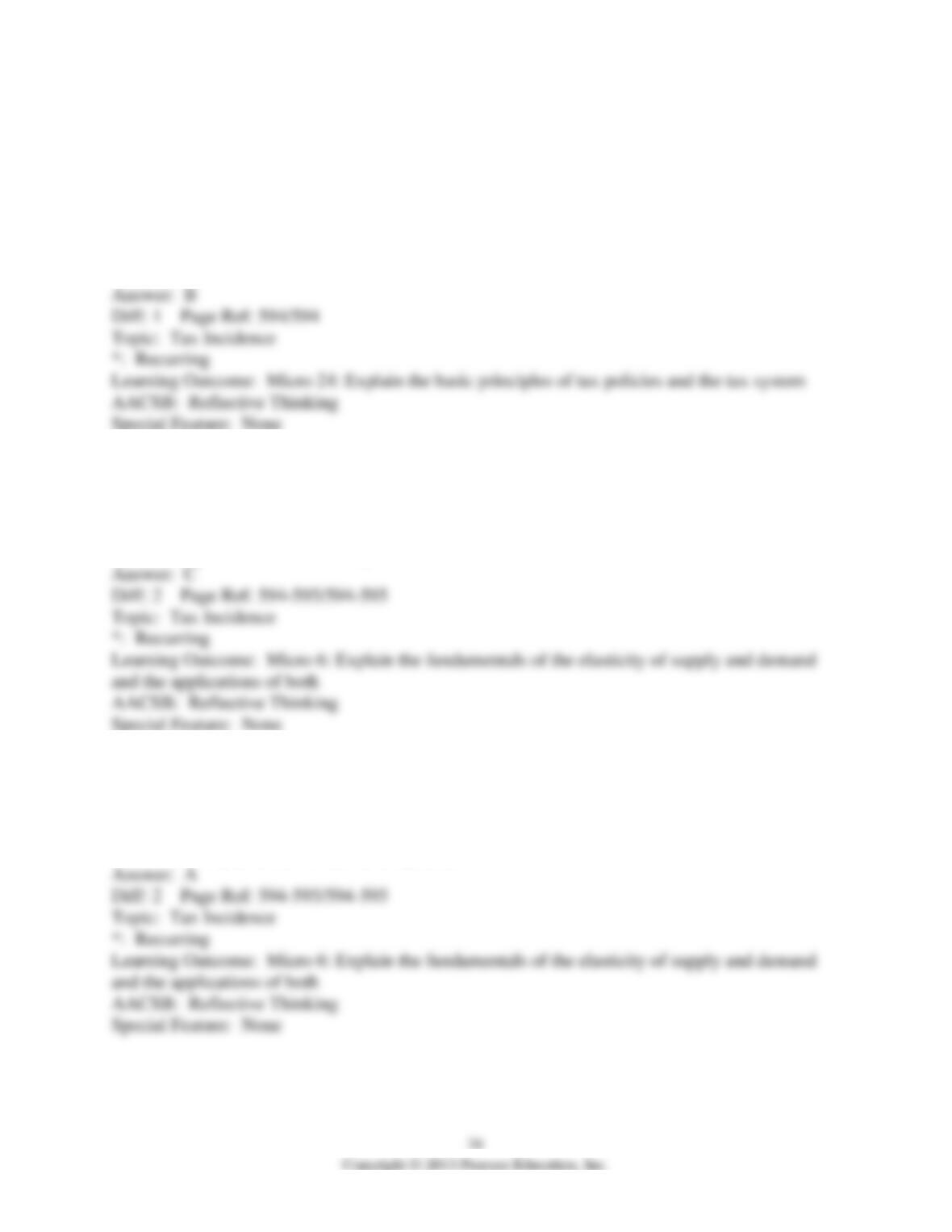
5,001-10,000
10,001-15,000
15,001-20,000
20,001-25,000
25,001-30,000
18.3 Tax Incidence Revisited: The Effect of Price Elasticity
1) The term tax incidence refers to
A) the degree of progression of a tax.
B) the actual division of the burden of a tax between buyers and sellers in a market.
C) the amount of revenue government collects from a tax imposed on a good or service.
D) whether the burden of a tax rests more heavily on those with higher incomes or those with
lower incomes.
2) When the demand for a product is more elastic than the supply,
A) consumers pay the majority of the tax on the product.
B) consumers pay the entire tax on the product.
C) firms pay the majority of the tax on the product.
D) firms pay the entire tax on the product.
3) When the demand for a product is less elastic than the supply,
A) consumers pay the majority of the tax on the product.
B) firms pay the majority of the tax on the product.
C) firms pay the entire tax on the product.
D) consumers pay the entire tax on the product.
4) There is a difference between who is legally required to send a tax payment to the government
and who bears the burden of the tax. Which of the following would have the most impact on who
bears the burden of an excise tax?
A) whether the tax is imposed by the federal government or a state government
B) whether the tax is based on the ability-to-pay principle or the benefits-received principle
C) The motive for the tax. If the tax is designed to raise revenue, more of the burden will fall on
firms. If the tax is designed to achieve a social objective (for example, to discourage smoking)
more of the burden will fall on consumers.
D) The elasticity of demand for the item that is taxed.
5) How would the elimination of a sales tax affect the market for a product that had been subject
to the tax?
A) The demand for the product would rise and the equilibrium price would fall by the amount of
the tax.
B) The equilibrium price for the product would fall by less than the amount of the tax.
C) The reduction in government revenue from the tax would be made up by an increase in
property taxes.
D) The supply of the product would become more elastic.
40
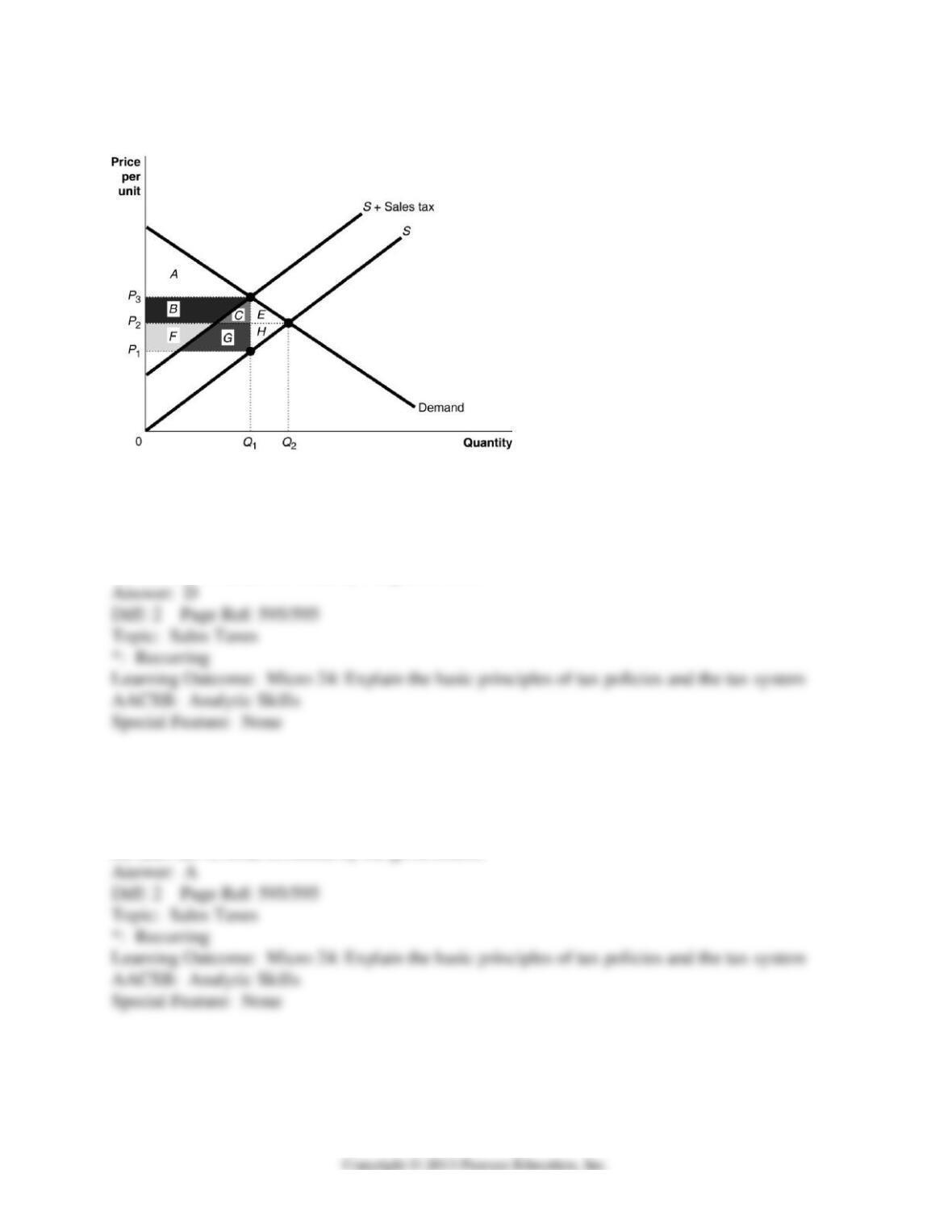
Figure 18-1
6) Refer to Figure 18-1. Area B+C+F+G represents
A) the portion of sales tax revenue borne by consumers.
B) the portion of sales tax revenue borne by producers.
C) the excess burden of the sales tax.
D) sales tax revenue collected by the government.
7) Refer to Figure 18-1. Area B+C represents
A) the portion of sales tax revenue borne by consumers.
B) the portion of sales tax revenue borne by producers.
C) the excess burden of the sales tax.
D) sales tax revenue collected by the government.