Microeconomics, 4e – Testbank 2 (Hubbard)
Chapter 18 Public Choice, Taxes, and the Distribution of Income
18.1 Public Choice
1) With respect to the tax cut on dividends that occurred in the early 2000s, President Obama
argued that the tax cut ________ the burden on individuals with low and moderate incomes, and
________ the burden on the wealthy and on corporations, thereby increasing the level of income
inequality.
A) increased; increased
B) increased; decreased
C) decreased; increased
D) decreased; decreased
2) Both presidents Kennedy and Reagan proposed significant cuts in income taxes because
A) at the time of their proposals the federal government was experiencing budget surpluses; that
is, tax revenue exceeded government expenditures.
B) they wanted to offset their proposals to increase other taxes.
C) state governments had increased their taxes and they believed the tax cuts they proposed
would result in most citizens paying about the same total state and federal taxes.
D) they believed that the tax cuts would enhance economic efficiency.
3) Both presidents Kennedy and Reagan proposed significant cuts in income taxes. Opponents of
these tax cut proposals argued that
A) the tax cuts would benefit high-income taxpayers.
B) cutting state sales taxes, rather than federal income taxes, would result in greater economic
efficiency.
C) while the tax cuts would result in greater economic efficiency, there was too much opposition
to the tax cuts in Congress. As it turned out, Congress ultimately approved both tax cut
proposals.
D) it would be better to cut taxes on corporate profits.
4) Economists James Buchanan and Gordon Tullock are well-known for developing
A) the impossibility theorem.
B) the voting paradox.
C) the public choice model.
D) the concept of government failure.
5) The public choice model assumes that government policy makers
A) must promote the public interest at the expense of their own self-interests in order to be re-
elected.
B) will pursue their self-interests in personal affairs but only if it does not conflict with the
public interest.
C) will often act irrationally in their personal affairs, but will act rationally when they promote
the public interest.
D) are likely to pursue their own self-interests, even if their self-interests conflict with the public
interest.
6) When members of Congress vote to pass new legislation, they will
A) always vote for the alternative favored by a majority of the voters.
B) fail to consistently represent the underlying preferences of voters.
C) always vote for the alternative favored by a plurality of the voters if there is no majority
position.
D) always fail to represent the underlying preferences of voters.
7) Economist Kenneth Arrow has shown mathematically that no system of voting will
consistently represent the underlying preferences of voters. This finding is called
A) the Arrow impossibility theorem.
B) Arrow’s median voter model.
C) Arrow’s Amendment to the public choice model.
D) Arrow’s majority vote paradox.
8) The Arrow impossibility theorem explains
A) why there is no system of voting that will consistently represent the underlying preferences of
voters.
B) why government regulation of private markets will always result in a reduction in economic
efficiency in these markets.
C) why voters are always rationally ignorant.
D) why it is not possible to provide the economically efficient amount of any public good.
9) The proposition that the outcome of a majority vote is likely to represent the preferences of
the voter who is in the political middle is called
A) the mean (or average) voter theorem.
B) the voting paradox.
C) the Arrow impossibility theorem.
D) the median voter theorem.
Table 18-1
Policy
John Cornyn
Herb Kohl
Ben Nelson
Homeland security
1st
2nd
3rd
Education
2nd
3rd
1st
Medical research
3rd
1st
2nd
10) Refer to Table 18-1. The table above lists three policy alternatives that the U.S. Senate will
vote on, along with the ranking of these alternates. The Senate must decide which of these
alternatives should receive an additional $1 billion of funding, and there is enough money in the
federal budget for only one of these alternatives. If a series of votes is taken in which each pair
of alternatives is considered (homeland security and education; homeland security and medical
research; education and medical research) which of the following will result from these votes?
A) When the vote is between homeland security and education, the Senators will vote for
education to receive funding.
B) The Senators’ votes will demonstrate transitivity.
C) The results will illustrate the voting paradox.
D) The results from the voting will illustrate the median voter theorem.
11) The Arrow impossibility theorem
A) explains why people can be rational as well as ignorant at the same time.
B) explains why voting systems do not consistently represent the preferences of voters.
C) explains why candidates for public office must represent the preferences of the political
middle.
D) explains why it is impossible, in most cases, to eliminate special-interest legislation after it
has become law.
12) A common belief among political analysts is that someone running for his or her party’s
nomination for president of the United States must choose a different strategy once the
nomination is secured. To be nominated, the candidate must appeal to voters from one party –
Democrat or Republican – but in a general election a party’s nominee must appeal to voters from
both parties as well as independent voters. Which of the following offers the best explanation
for this change in strategy?
A) the Arrow impossibility theorem
B) the voting paradox
C) the median voter theorem
D) rent seeking
13) Congressman Gallstone seeks support from his colleagues for a bill he sponsors that will
establish a new national park in his district. He offers to support Congresswoman Disrail’s
proposal to build a new library in her district in exchange for her vote for his national park bill.
This is an example of
A) regulatory capture.
B) logrolling.
C) rational ignorance.
D) government failure.
14) The political process is more likely to serve the interests of individuals whose preferences
are in the middle, rather than individuals with preferences that are much to the left or right of the
political center. This statement is best explained by which of the following?
A) logrolling
B) the voting paradox
C) the Arrow impossibility theorem
D) the median voter theorem
15) Which of the following is used to argue that the self-interest of public policymakers will
often lead to actions that are inconsistent with the preferences of the voters they represent?
A) the voting paradox
B) the median voter theorem
C) rent seeking
D) transitivity of voters’ preferences
16) Some individuals seek to use government action to make themselves better off at the expense
of others. The actions of these individuals
A) are examples of fraud; but these individuals usually avoid prosecution because of logrolling
and rational ignorance.
B) are examples of rent seeking.
C) offer proof that Adam Smith’s “invisible hand” is not valid.
D) are evidence of the voting paradox.
17) Which of the following is an example of rent seeking behavior?
A) Apple earned large profits from the development and sale of the iPhone.
B) Amazon introduced the Kindle to compete with Sony’s Digital Reader. Amazon was
motivated by the desire to earn profits from the Kindle but also increased the choice of digital
music players available to consumers.
C) U.S. sugar firms convinced Congress to impose a quota on imports of sugar.
D) Recent increases in cigarette taxes faced little opposition from voters, many of whom were
rationally ignorant with respect to the tax.
18) Which of the following statements refers to rent seeking?
A) “Laws passed by the federal government often provide benefits for a small number of
individuals. These individuals, in turn, have an incentive to contribute to the campaigns of
politicians who pass these laws.”
B) “The federal government should spend more money on programs that help low income
citizens and less money on national defense.”
C) “The role of the federal government in the U.S. economy grew significantly after the Great
Depression. Government spending and taxes are a much greater proportion of total income today
than they were in 1929.”
D) “There is an opportunity cost whenever the federal government spends tax revenue. For
example, an additional $1 billion spent on national defense means there will be less revenue for
highway construction and maintenance or some other program.”
19) Which of the following is a consequence of the voting paradox?
A) A majority of voters elect a candidate that does not represent the preferences of the voter who
is in the political middle.
B) Politicians support small groups of individuals and firms that benefit from special interest
legislation, rather than a much larger group of voters who pay the cost for this legislation.
C) Individuals and firms who benefit from government actions engage in rent seeking.
D) The collective preferences of voters are not transitive and voting outcomes are inconsistent.
20) What is the term that explains why voters often lack knowledge of pending legislation, and
lack knowledge of the views of candidates for office on a range of issues that affect their own
(the voters’) welfare?
A) the voting paradox
B) logrolling
C) rational ignorance
D) regulatory capture
21) The public choice model can be used to examine voting models that contrast the manner in
which collective decisions are made by governments (state, local and federal) and the manner in
which individual choices are made in markets. Which of the following descriptions is consistent
with the difference between collective decision-making and decision-making in markets?
A) Everyone who votes must agree with a decision made collectively through government, but in
markets individuals can make their own choices.
B) Individuals are less likely to see their preferences represented in the outcomes of government
policies than in the outcomes of markets.
C) The cost of a government policy is determined by a majority vote of members of the public;
decisions made in markets are based on individual willingness to pay.
D) Choices made through government policies are more important than decisions individuals
make through markets.
22) Economists often analyze the interaction of individuals and firms in markets. Economists
also examine the actions of individuals and firms as they attempt to use government to make
themselves better off at the expense of others, a process that is referred to as
A) rent seeking.
B) logrolling.
C) government failure.
D) the public choice initiative.
23) Financial contributions to the campaigns of members of Congress, state legislators and other
elected officials by firms that seek special interest legislation that make the firms better off are
A) examples of rent seeking.
B) illegal.
C) the result of the voting paradox.
D) irrational because elected officials will almost always act in the interest of the voters who
have to pay the cost of the legislation.
24) Congressman Flack votes for a program that will benefit the constituents of Congressman
Walpole. Which of the following explanations for Flack’s vote is most consistent with the public
choice model?
A) Congressman Flack did not have time to read and understand all of the legislation he voted
on. Members of Congress often depend on their staffs to read proposed legislation and
recommend how they should vote.
B) Legislators such as Congressman Flack are similar to other decision-makers in that they
sometimes make irrational choices.
C) Congressman Flack will support programs of legislators from his own party, regardless of
who benefits from these programs.
D) Congressman Flack expects Congressman Walpole’s support for programs that will benefit
Flack’s constituents.
25) Congressman Flack votes for a program that will benefit the constituents of Congressman
Walpole. The public choice model suggests that Flack’s vote is best explained by which of the
following?
A) rational ignorance
B) party loyalty
C) logrolling
D) the voting paradox
26) Many economists believe that when the federal government establishes an agency to regulate
a particular industry, the regulated firms try to influence the agency even if these actions do not
benefit the public. Economists refer to this result of government regulation by which of the
following terms?
A) regulatory capture
B) logrolling
C) special interest regulation
D) the regulatory paradox
27) One result of the public choice model is that most economists believe that
A) when market failure occurs, government intervention will always lead to a more efficient
outcome.
B) government intervention will always result in a reduction in economic efficiency in regulated
markets.
C) policymakers may have incentives to intervene in the economy in ways that do not promote
economic efficiency.
D) the voting paradox will prevent voters from selecting the best person for public office.
28) The public choice model raises questions about the government’s ability to regulate
economic activity efficiently. Which of the following statements represents the views of most
economists with regard to the role of government?
A) Congress should abolish the Food and Drug Administration, the Environmental Protection
Agency and other agencies and commissions because the costs of their actions exceed the
benefits they provide to the public.
B) Government should do more to regulate markets. The public choice model has shown that
rent seeking and rational ignorance affect more markets than are currently subject to regulation.
C) U.S. citizens can afford more government regulation if the cost of this regulation is borne
mostly by taxpayers with the highest incomes.
D) Agencies such as the Food and Drug Administration and the Environmental Protection
Agency can serve a useful purpose, but we need to take the costs of regulation into account along
with the benefits.
29) A key insight of the public choice model is that public policymakers are likely to pursue the
public’s interest, even if their self-interests conflict with the public interest.
30) The median voter theorem states that the outcome of a majority vote is likely to represent the
preferences of the voter who is in the political middle.
31) Logrolling refers to attempts by individuals to use government action to make themselves
better off at the expense of others.
32) Rent seeking behavior, unlike profit maximizing behavior in competitive markets, wastes
society’s scarce resources.
33) A key assumption of the public choice model is that government policymakers will pursue
their own self-interests. Economists assume that consumers and firms pursue their own self–
interests when they interact in competitive markets and this interaction results in efficient
economic outcomes. Does the pursuit of self-interest by policymakers result in efficient
economic outcomes?
34) Former Alabama Governor George Wallace ran for president several times, once as a third-
party candidate in 1968. Wallace claimed there was “not a dime’s worth of difference” between
the Democratic and Republican parties during one of his campaigns. How does Wallace’s
comment relate to the median voter theorem?
Table 18-2
Foreign Aid
Post-Secondary
Education
Roads and
Bridges
Tom
3rd
1st
2nd
Dick
2nd
3rd
1st
Harriet
1st
2nd
3rd
35) Refer to Table 18-2. The table above outlines the rankings of three members of the U.S.
House of Representatives on three spending alternatives. Assume that Congress can spend
additional revenue on only one of the three spending alternatives and that Tom, Dick and Harriet,
all members of the House of Representatives, participate in a series of votes in which they are to
determine which of the spending alternatives should receive funding. Three votes will be taken:
(1) Foreign Aid and Post-Secondary Education (2) Foreign Aid and Roads and Bridges and (3)
Post-Secondary Education and Roads and Bridges.
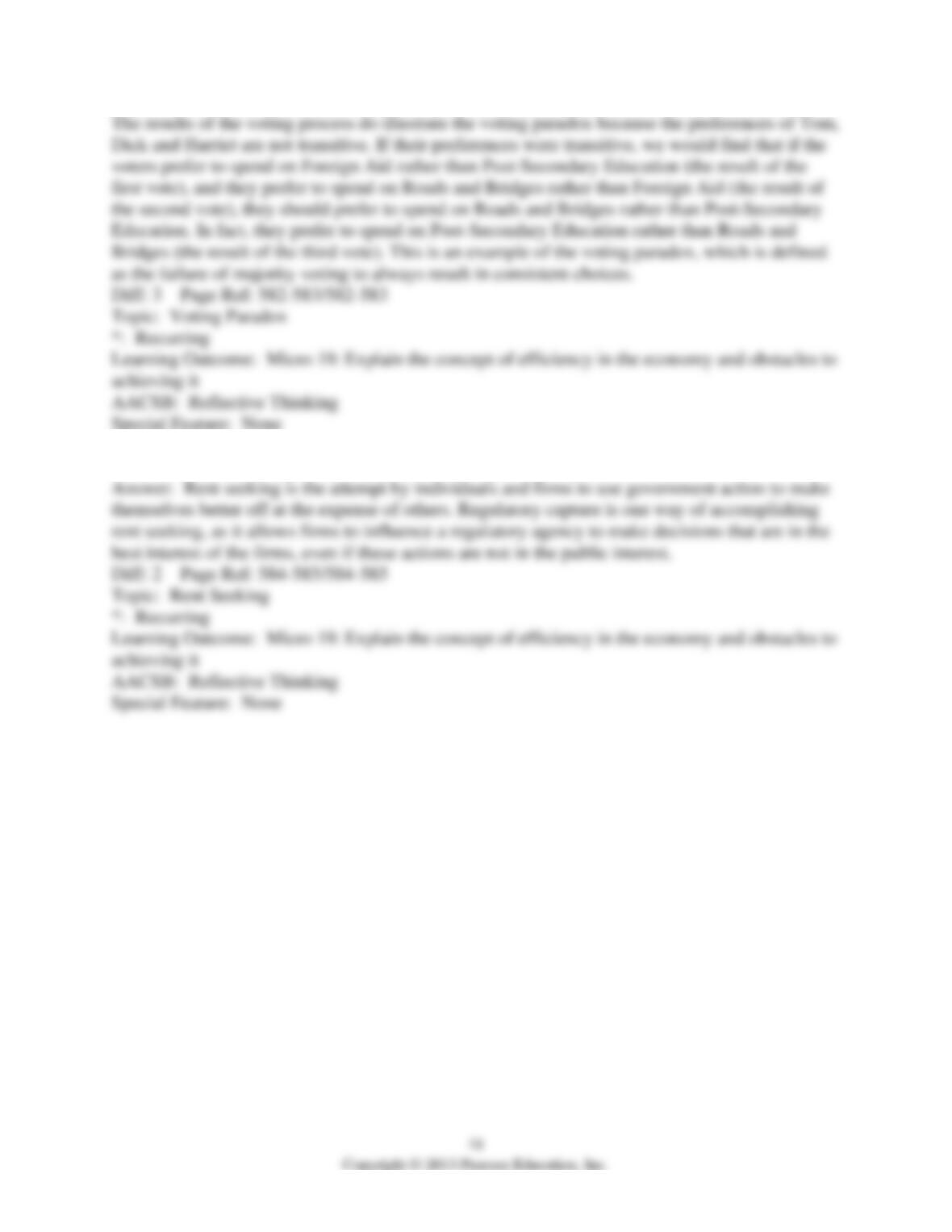
Determine whether the voting paradox will occur as a result of these votes.
Post-Secondary
Education
Tom
3rd
Dick
2nd
Harriet
1st
2nd
Tom
3rd
Dick
2nd
Harriet
1st
Education
Tom
Harriet
2nd
36) What is rent seeking and how is it related to regulatory capture?
18.2 The Tax System
1) Which of the following is the largest source of revenue for the U.S. federal government?
A) the individual income tax
B) social insurance taxes
C) sales taxes
D) property taxes
2) In the United States, the largest source of funds for public schools is
A) the federal income tax.
B) the property tax.
C) the consumption tax.
D) sales taxes.
3) Which of the following is the source of revenue for Medicare and Social Security in the
United States?
A) individual income taxes
B) sales taxes
C) social insurance taxes
D) property taxes
4) A tax imposed by a state or local government on retail sales of most products is
A) an excise tax.
B) a social service tax.
C) a consumption tax.
D) a sales tax.
5) The federal government and some state governments levy taxes on specific goods such as
gasoline, cigarettes and beer. These are known as
A) sales taxes.
B) sin taxes.
C) specific taxes.
D) excise taxes.
6) In 2010, over 75 percent of the revenue of the U.S. federal government was raised through
A) individual income and social insurance taxes.
B) property and social insurance taxes.
C) sales and corporate income taxes.
D) individual income and property taxes.