Corporate Finance, 3e (Berk/DeMarzo)
Chapter 18 Capital Budgeting and Valuation with Leverage
18.1 Overview of Key Concepts
1) Which of the following is NOT one of the simplifying assumptions made for the three main
methods of capital budgeting?
A) The firm pays out all earnings as dividends.
B) The project has average risk.
C) Corporate taxes are the only market imperfection.
D) The firm’s debt-equity ratio is constant.
2) Which of the following methods are used in capital budgeting decisions?
A) WACC method
B) APV method
C) FTE method
D) All of the above are used in capital budgeting decisions.
18.2 The Weighted Average Cost of Capital Method
1) Which of the following statements is FALSE?
A) Because the WACC incorporates the tax savings from debt, we can compute the levered value
of an investment, which is its value including the benefit of interest tax shields given the firm’s
leverage policy, by discounting its future free cash flow using the WACC.
B) The WACC incorporates the benefit of the interest tax shield by using the firm’s before-tax
cost of capital for debt.
C) When the market risk of the project is similar to the average market risk of the firm’s
investments, then its cost of capital is equivalent to the cost of capital for a portfolio of all of the
firm’s securities; that is, the project’s cost of capital is equal to the firm’s weighted average cost
of capital (WACC).
D) A project’s cost of capital depends on its risk.

2) Which of the following statements is FALSE?
A) The WACC can be used throughout the firm as the company wide cost of capital for new
investments that are of comparable risk to the rest of the firm and that will not alter the firm’s
debt-equity ratio.
B) A disadvantage of the WACC method is that you need to know how the firm’s leverage policy
is implemented to make the capital budgeting decision.
C) The intuition for the WACC method is that the firm’s weighted average cost of capital
represents the average return the firm must pay to its investors (both debt and equity holders) on
an after-tax basis.
D) To be profitable, a project should generate an expected return of at least the firm’s weighted
average cost of capital.
3) Which of the following is NOT a step in the WACC valuation method?
A) Compute the value of the investment, including the tax benefit of leverage, by discounting the
free cash flow of the investment using the WACC.
B) Compute the weighted average cost of capital.
C) Determine the free cash flow of the investment.
D) Adjust the WACC for the firm’s current debt/equity ratio.
4) Consider the following equation:
rwacc = rE + rD(1 – τc)
the term E in this equation is:
A) the dollar amount of equity.
B) the dollar amount of debt.
C) the required rate of return on debt.
D) the required rate of return on equity.

5) Consider the following equation:
rwacc = rE + rD(1 – τc)
the term D in this equation is:
A) the dollar amount of debt.
B) the required rate of return on equity.
C) the required rate of return on debt.
D) the dollar amount of equity.
6) Consider the following equation:
rwacc = rE + rD(1 – τc)
the term rE in this equation is:
A) the after tax required rate of return on debt.
B) the required rate of return on debt.
C) the required rate of return on equity.
D) the dollar amount of equity.
7) Consider the following equation:
rwacc = rE + rD(1 – τc)
the term rD(1 – τc) in this equation is:
A) the required rate of return on debt.
B) the dollar amount of equity.
C) the after tax required rate of return on debt.
D) the required rate of return on equity.
8) Consider the following equation:
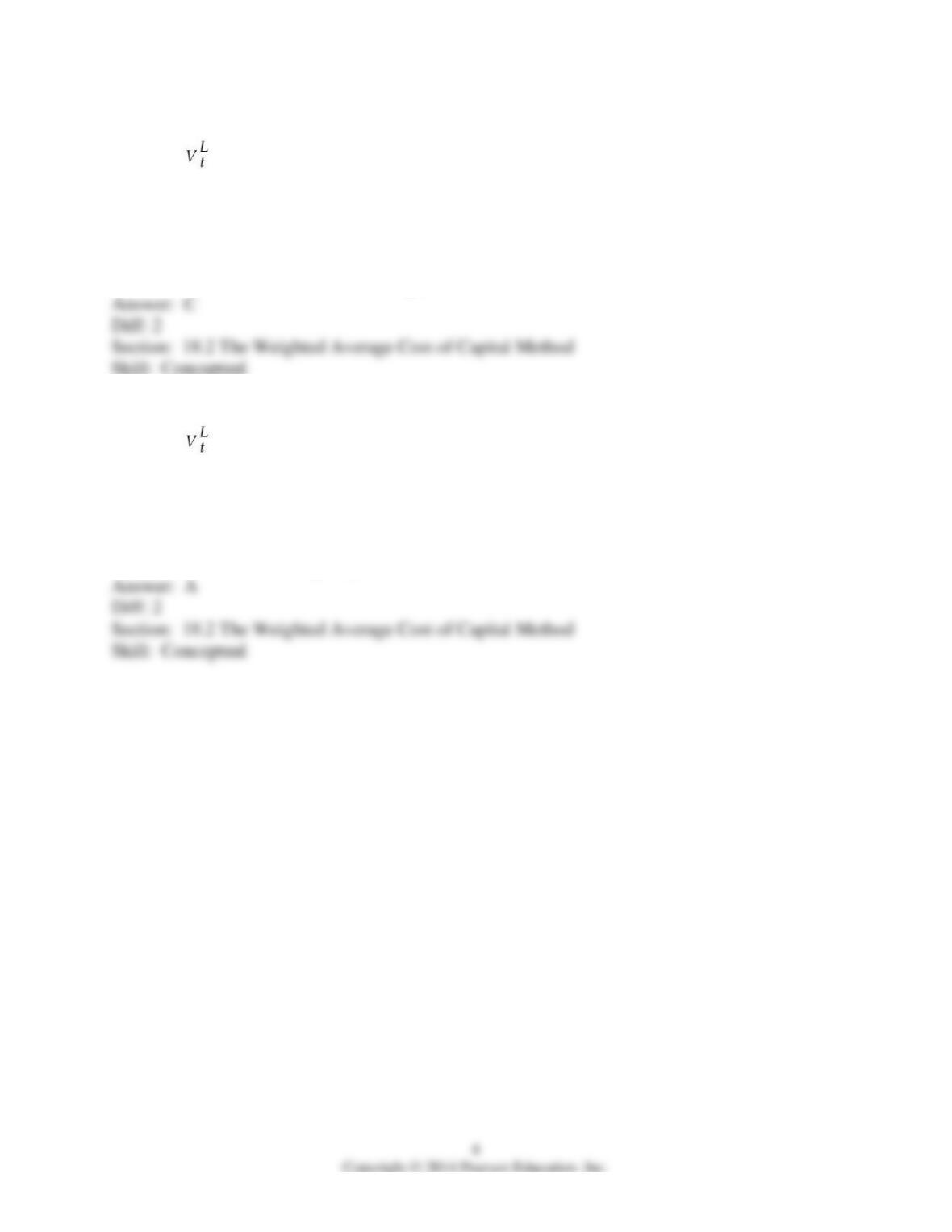
Dt = d ×
the term Dt in this equation is:
A) the firms target debt to value ratio.
B) the firms target debt to equity ratio.
C) the investment’s debt capacity.
D) the dollar amount of debt outstanding at time t.
9) Consider the following equation:
Dt = d ×
the term d in this equation is:
A) the firms target debt to value ratio.
B) the dollar amount of debt outstanding at time t.
C) the firms target debt to equity ratio.
D) the investment’s debt capacity.
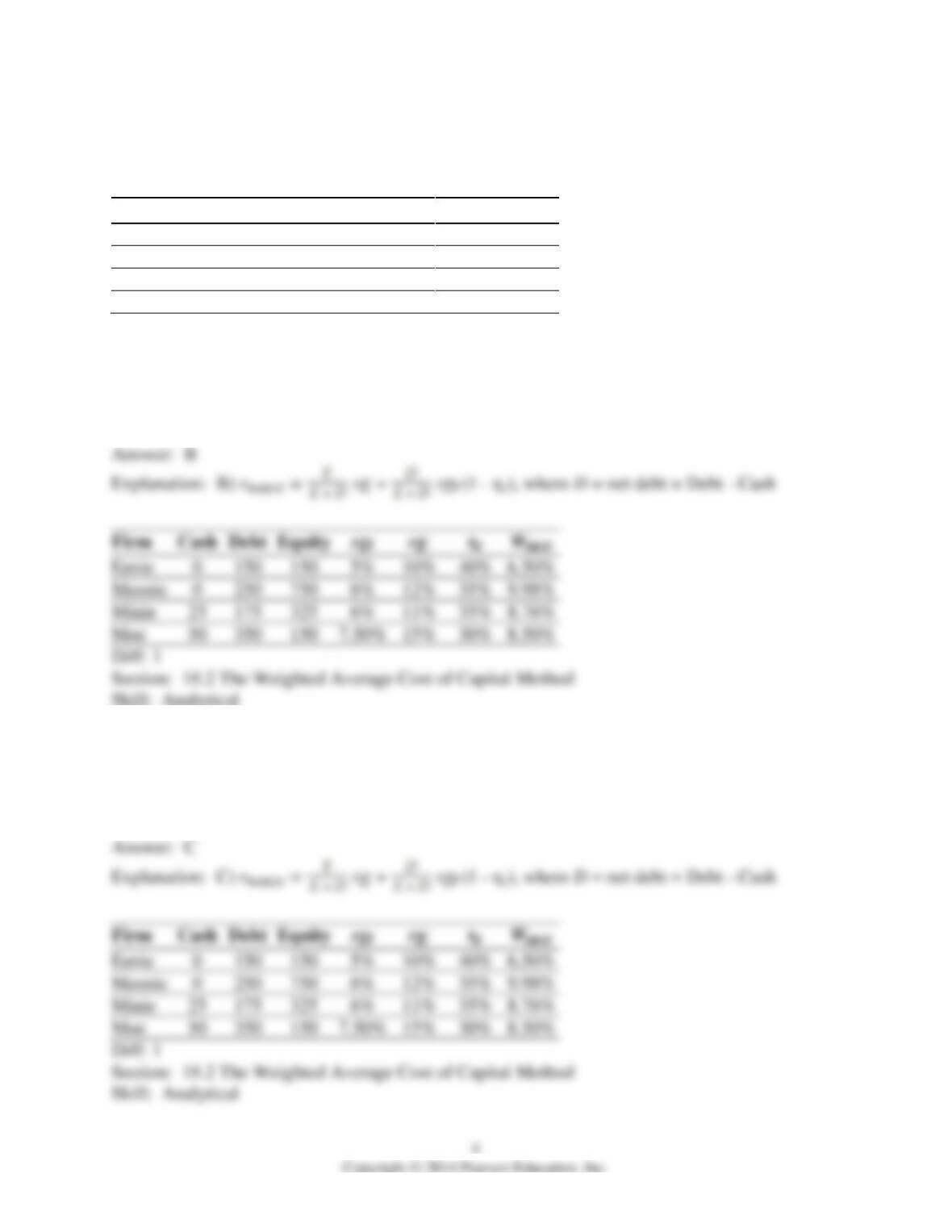
Use the table for the question(s) below.
Consider the information for the following four firms:
Firm
Cash
Debt
Equity
rD
rE
τc
Eenie
0
150
150
5%
10%
40%
Meenie
0
250
750
6%
12%
35%
Minie
25
175
325
6%
11%
35%
Moe
50
350
150
7.50%
15%
30%
10) The weighted average cost of capital for “Eenie” is closest to:
A) 6.0%
B) 6.5%
C) 7.5%
D) 5.5%
Eenie
150
Meenie
750
Minie
325
Moe
150
11) The weighted average cost of capital for “Meenie” is closest to:
A) 10.5%
B) 7.4%
C) 10.0%
D) 8.8%
Firm
Eenie
150
Meenie
750
Minie
325
Moe
150
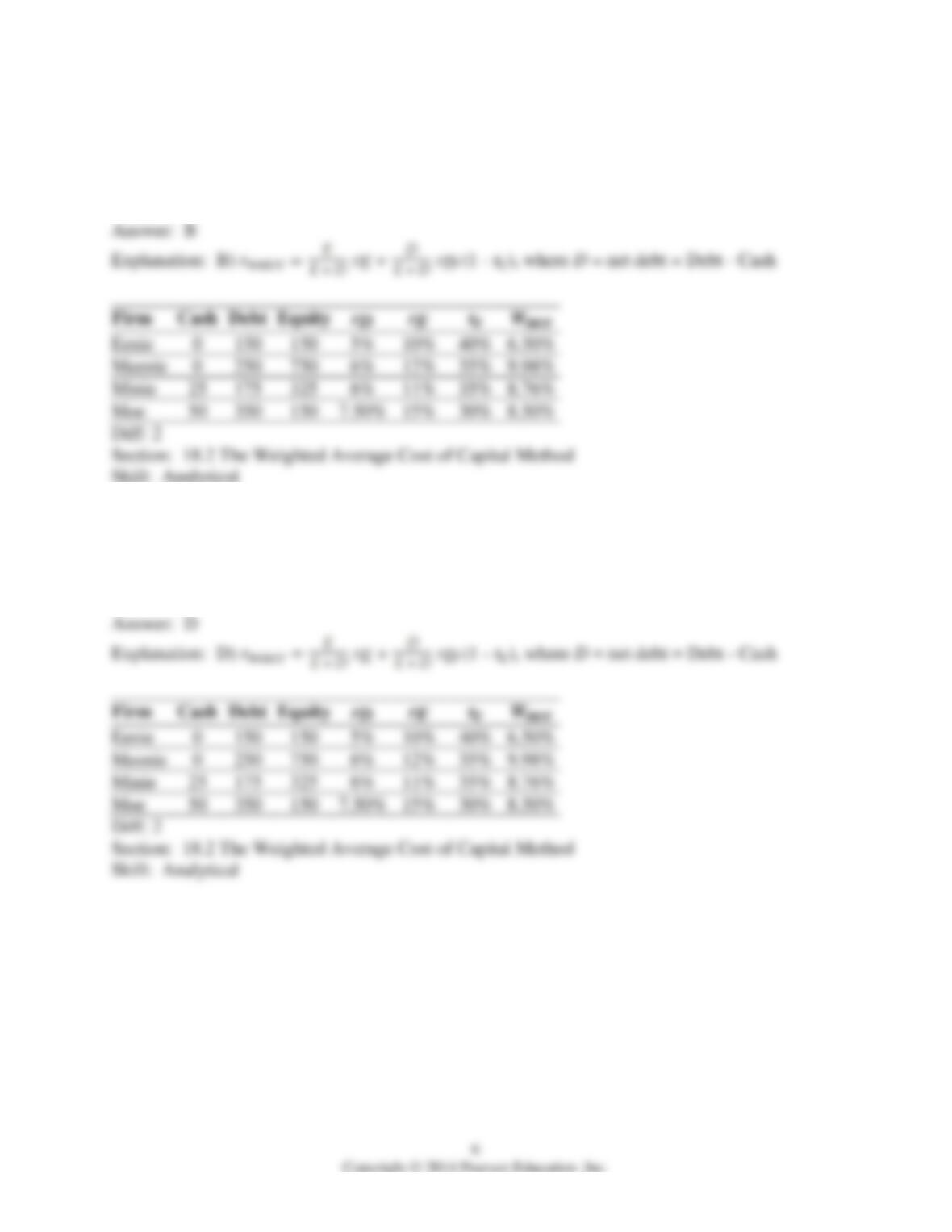
12) The weighted average cost of capital for “Minie” is closest to:
A) 9.50%
B) 8.75%
C) 6.75%
D) 8.25%
13) The weighted average cost of capital for “Moe” is closest to:
A) 10.00%
B) 7.75%
C) 8.25%
D) 8.50%

Use the information for the question(s) below.
Omicron Industries’ Market Value Balance Sheet ($ Millions)
and Cost of Capital
Assets
Liabilities
Cost of Capital
Cash
0
Debt
200
Debt
6%
Other Assets
500
Equity
300
Equity
12%
τc
35%
Omicron Industries New Project Free Cash Flows
Year
0
1
2
3
Free Cash Flows
($100)
$40
$50
$60
Assume that this new project is of average risk for Omicron and that the firm wants to hold
constant its debt to equity ratio.
14) Omicron’s weighted average cost of capital is closest to:
A) 7.10%
B) 7.50%
C) 9.60%
D) 8.75%
15) The NPV for Omicron’s new project is closest to:
A) $23.75
B) $27.50
C) $28.75
D) $25.75
16) The Debt Capacity for Omicron’s new project in year 0 is closest to:
A) $38.75
B) $75.50
C) $50.25
D) $10.25
17) The Debt Capacity for Omicron’s new project in year 1 is closest to:
A) $38.75
B) $48.25
C) $50.25
D) $58.00
18) The Debt Capacity for Omicron’s new project in year 2 is closest to:
A) $55.25
B) $38.75
C) $22.00
D) $33.00
Use the information for the question(s) below.
Iota Industries Market Value Balance Sheet ($ Millions) and Cost of Capital
Assets
Liabilities
Cost of Capital
Cash
250
Debt
650
Debt
7%
Other Assets
1200
Equity
800
Equity
14%
τc
35%
Iota Industries New Project Free Cash Flows
Year
0
1
2
3
Free Cash Flows
($250)
$75
$150
$100
Assume that this new project is of average risk for Iota and that the firm wants to hold constant
its debt to equity ratio.
19) Iota’s weighted average cost of capital is closest to:
A) 8.40%
B) 9.75%
C) 10.85%
D) 11.70%
20) The NPV for Iota’s new project is closest to:
A) $25.25
B) $13.25
C) $9.00
D) $18.50

11
21) The Debt Capacity for Iota’s new project in year 0 is closest to:
A) $263.25
B) 87.75
C) $50.25
D) $118.00
22) Calculate the NPV for Iota’s new project.
Use the information for the question(s) below.
Omicron Industries’ Market Value Balance Sheet ($ Millions)
and Cost of Capital
Assets
Liabilities
Cost of Capital
Cash
0
Debt
200
Debt
6%
Other Assets
500
Equity
300
Equity
12%
τc
35%
Omicron Industries New Project Free Cash Flows
Year
0
1
2
3
Free Cash Flows
($100)
$40
$50
$60
Assume that this new project is of average risk for Omicron and that the firm wants to hold
constant its debt to equity ratio.
12
23) Calculate the debt capacity of Omicron’s new project for years 0, 1, and 2.
24) Suppose Luther Industries is considering divesting one of its product lines. The product line
is expected to generate free cash flows of $2 million per year, growing at a rate of 3% per year.
Luther has an equity cost of capital of 10%, a debt cost of capital of 7%, a marginal tax rate of
35%, and a debt-equity ratio of 2. If this product line is of average risk and Luther plans to
maintain a constant debt-equity ratio, what after- tax amount must it receive for the product line
in order for the divestiture to be profitable?
18.3 The Adjusted Present Value Method
1) Which of the following is NOT a step in the adjusted present value method?
A) Deducting costs arising from market imperfections
B) Calculating the unlevered value of the project
C) Calculating the after-tax WACC
D) Calculating the value of the interest tax shield
2) Which of the following statements is FALSE?
A) The firm’s unlevered cost of capital is equal to its pre-tax weighted average cost of capital–
that is, using the pre-tax cost of debt, rd, rather than its after-tax cost, rd (1 – τc ).
B) A firm’s levered cost of capital is a weighted average of its equity and debt costs of capital.
C) When the firm maintains a target leverage ratio, its future interest tax shields have similar risk
to the project’s cash flows, so they should be discounted at the project’s unlevered cost of capital.
D) The first step in the APV method is to calculate the value of free cash flows using the
project’s cost of capital if it were financed without leverage.
3) Which of the following statements is FALSE?
A) To determine the project’s debt capacity for the interest tax shield calculation, we need to
know the value of the project.
B) To compute the present value of the interest tax shield, we need to determine the appropriate
cost of capital.
C) Because we don’t value the tax shield separately, with the APV method we need to include
the benefit of the tax shield in the discount rate as we do in the WACC method.
D) A target leverage ratio means that the firm adjusts its debt proportionally to the project’s
value or its cash flows.
4) Which of the following statements is FALSE?
A) The APV approach explicitly values the market imperfections and therefore allows managers
to measure their contribution to value.
B) We need to know the debt level to compute the APV, but with a constant debt-equity ratio we
need to know the project’s value to compute the debt level.
C) The WACC method is more complicated than the APV method because we must compute
two separate valuations: the unlevered project and the interest tax shield.
D) Implementing the APV approach with a constant debt-equity ratio requires solving for the
project’s debt and value simultaneously.
Use the table for the question(s) below.
Consider the information for the following four firms:
Firm
Cash
Debt
Equity
rD
rE
τc
Eenie
0
150
150
5%
10%
40%
Meenie
0
250
750
6%
12%
35%
Minie
25
175
325
6%
11%
35%
Moe
50
350
150
7.50%
15%
30%
5) The unlevered cost of capital for “Eenie” is closest to:
A) 6.0%
B) 5.5%
C) 7.5%
D) 6.5%
Eenie
0
150
5%
7.50%
Meenie
0
750
6%
10.50%
Minie
25
325
6%
9.42%
Moe
50
150
10.00%
6) The unlevered cost of capital for “Moe” is closest to:
A) 8.25%
B) 7.75%
C) 8.50%
D) 10.00%
Firm
Debt
Eenie
0
150
5%
7.50%
Meenie
0
750
6%
10.50%
Minie
25
325
6%
9.42%
Moe
50
150
10.00%
Use the information for the question(s) below.
Suppose Luther Industries is considering divesting one of its product lines. The product line is
expected to generate free cash flows of $2 million per year, growing at a rate of 3% per year.
Luther has an equity cost of capital of 10%, a debt cost of capital of 7%, a marginal tax rate of
35%, and a debt-equity ratio of 2. This product line is of average risk and Luther plans to
maintain a constant debt-equity ratio.
7) Luther’s Unlevered cost of capital is closest to:
A) 8.0%
B) 8.5%
C) 9.0%
D) 6.4%
8) The unlevered value of Luther’s Product Line is closest to:
A) $25 million
B) $60 million
C) $45 million
D) $40 million
Use the information for the question(s) below.
Omicron Industries’ Market Value Balance Sheet ($ Millions)
and Cost of Capital
Assets
Liabilities
Cost of Capital
Cash
0
Debt
200
Debt
6%
Other Assets
500
Equity
300
Equity
12%
τc
35%
Omicron Industries New Project Free Cash Flows
Year
0
1
2
3
Free Cash Flows
($100)
$40
$50
$60
Assume that this new project is of average risk for Omicron and that the firm wants to hold
constant its debt to equity ratio.
9) Omicron’s Unlevered cost of capital is closest to:
A) 8.75%
B) 7.10%
C) 9.60%
D) 7.50%
10) The unlevered value of Omicron’s new project is closest to:
A) $96
B) $124
C) $126
D) $25
11) The interest tax shield provided by Omicron’s new project in year 1 is closest to:
A) $3.00
B) $1.05
C) $50.25
D) $17.60
Use the information for the question(s) below.
Suppose that Rose Industries is considering the acquisition of another firm in its industry for
$100 million. The acquisition is expected to increase Rose’s free cash flow by $5 million the
first year, and this contribution is expected to grow at a rate of 3% every year there after. Rose
currently maintains a debt to equity ratio of 1, its marginal tax rate is 40%, its cost of debt rD is
6%, and its cost of equity rE is 10%. Rose Industries will maintain a constant debt-equity ratio
for the acquisition.
12) Rose’s unlevered cost of capital is closest to:
A) 8.0%
B) 7.5%
C) 7.0%
D) 9.0%
13) The unlevered value of Rose’s acquisition is closest to:
A) $63 million
B) $50 million
C) $167 million
D) $100 million
14) Given that Rose issues new debt of $50 million initially to fund the acquisition, the present
value of the interest tax shield for this acquisition is closest to:
A) $24 million
B) $50 million
C) $20 million
D) $15 million
15) Given that Rose issues new debt of $50 million initially to fund the acquisition, the total
value of this acquisition using the APV method is closest to:
A) $100 million
B) $120 million
C) $124 million
D) $115 million