
21
Use the information for the question(s) below.
Omicron Industries’ Market Value Balance Sheet ($ Millions)
and Cost of Capital
Assets
Liabilities
Cost of Capital
Cash
0
Debt
200
Debt
6%
Other Assets
500
Equity
300
Equity
12%
τc
35%
Omicron Industries New Project Free Cash Flows
Year
0
1
2
3
Free Cash Flows
($100)
$40
$50
$60
Assume that this new project is of average risk for Omicron and that the firm wants to hold
constant its debt to equity ratio.
22
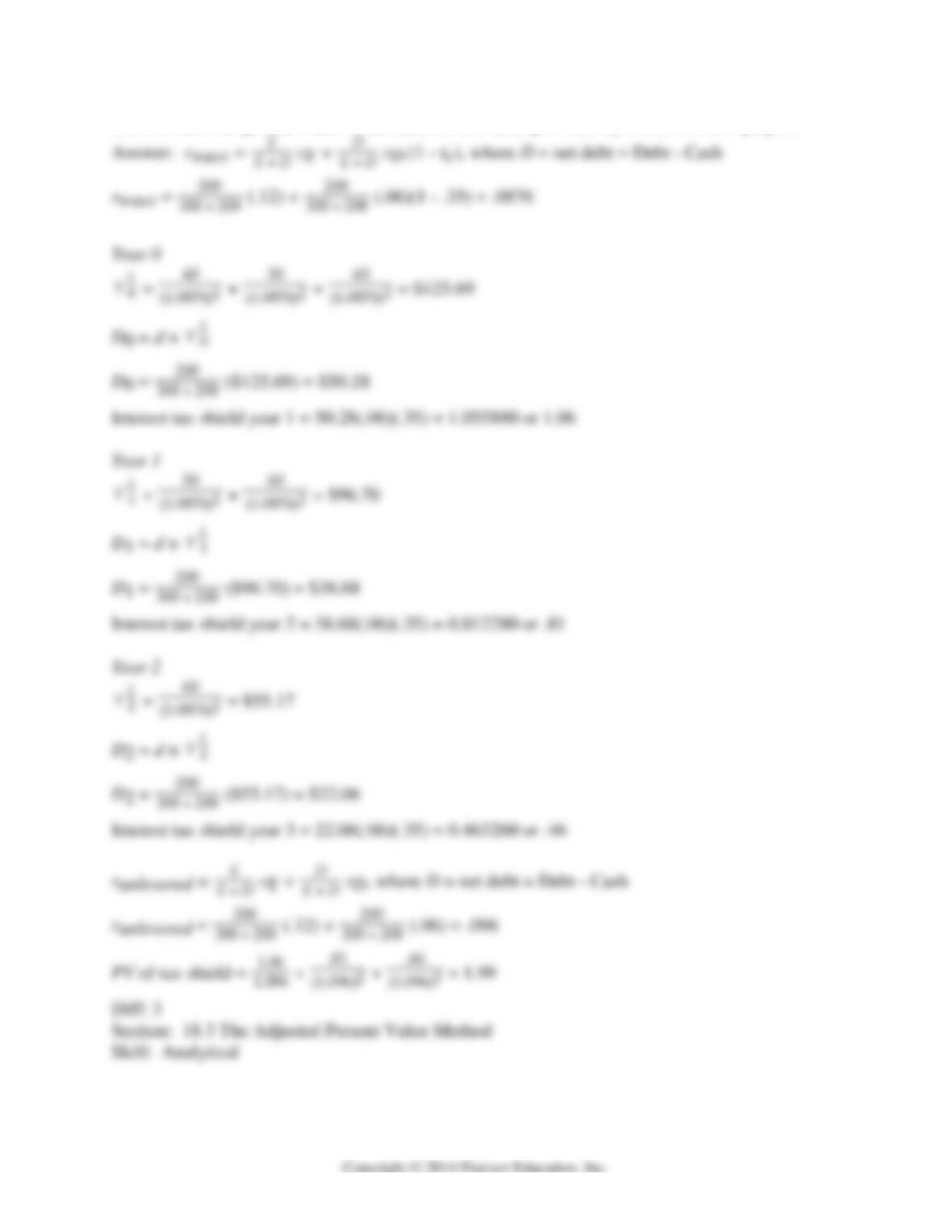
16) Calculate the present value of the interest tax shield provided by Omicron’s new project.
Use the information for the question(s) below.
Suppose that Rose Industries is considering the acquisition of another firm in its industry for
$100 million. The acquisition is expected to increase Rose’s free cash flow by $5 million the
first year, and this contribution is expected to grow at a rate of 3% every year there after. Rose
currently maintains a debt to equity ratio of 1, its marginal tax rate is 40%, its cost of debt rD is
6%, and its cost of equity rE is 10%. Rose Industries will maintain a constant debt-equity ratio
for the acquisition.
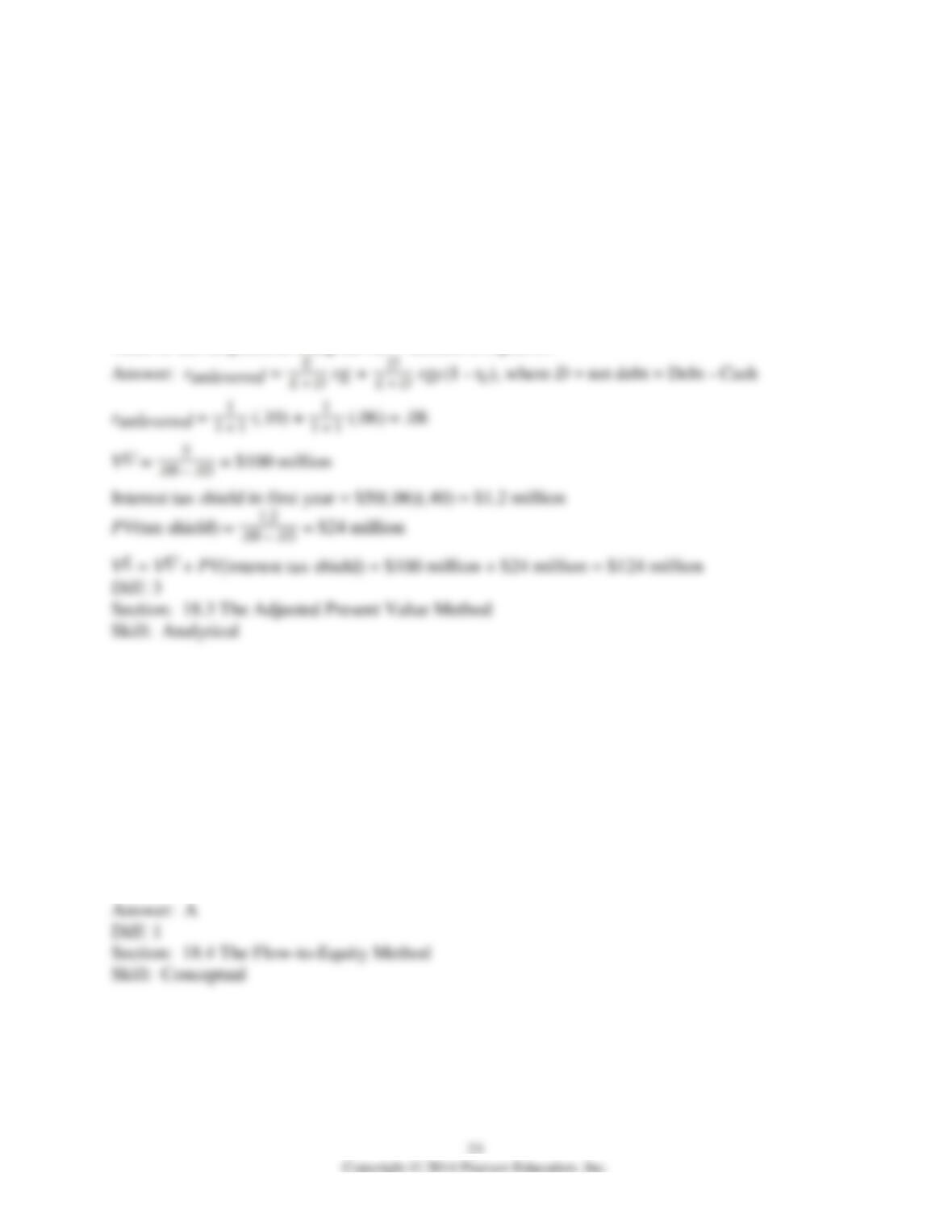
17) Given that Rose issues new debt of $50 million initially to fund the acquisition, the total
value of this acquisition using the APV method is equal to?
18.4 The Flow-to-Equity Method
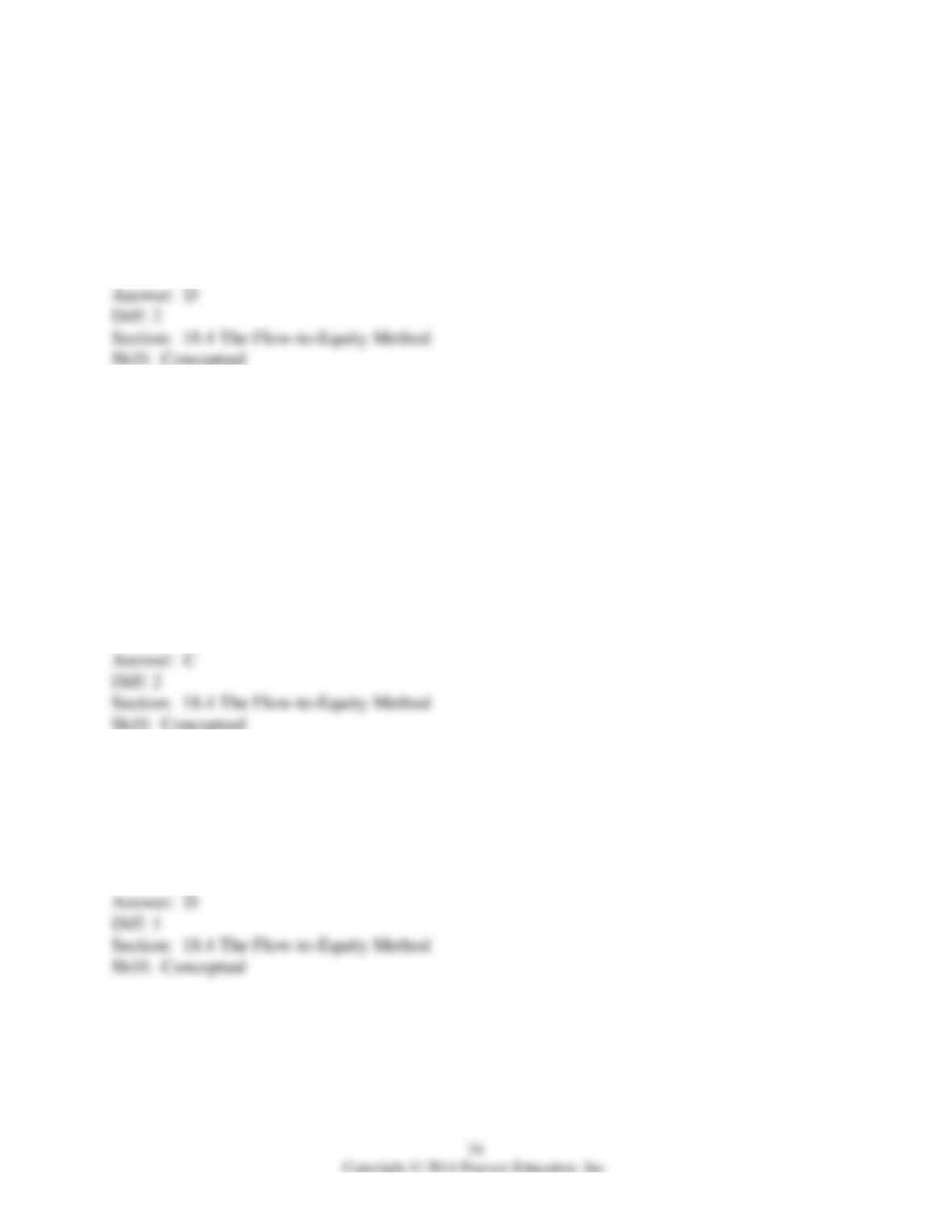
1) Which of the following statements is FALSE?
A) In the flow-to-equity valuation method, the cash flows to equity holders are then discounted
using the weighted average cost of capital.
B) In the WACC and APV methods, we value a project based on its free cash flow, which is
computed ignoring interest and debt payments.
C) In the flow-to-equity (FTE) valuation method, we explicitly calculate the free cash flow
available to equity holders taking into account all payments to and from debt holders.
D) The first step in the FTE method is to determine the project’s free cash flow to equity
(FCFE).
2) Which of the following statements is FALSE?
A) The project’s free cash flow to equity shows the expected amount of additional cash the firm
will have available to pay dividends (or conduct share repurchases) each year.
B) The value of the project’s FCFE should be identical to the NPV computed using the WACC
and APV methods.
C) The value of the project’s FCFE represents the gain to shareholders from the project.
D) Because interest payments are deducted before taxes, we adjust the firm’s FCF by their
before-tax cost.
3) Which of the following statements is FALSE?
A) If the debt-equity ratio changes over time, the risk of equity–and, therefore, its cost of
capital–will change as well.
B) The FTE method can offer an advantage when calculating the value of equity for the entire
firm, if the firm’s capital structure is complex and the market values of other securities in the
firm’s capital structure are not known.
C) The FTE approach does not have the same disadvantage associated with the APV approach:
We don’t need to compute the project’s debt capacity to determine interest and net borrowing
before we can make the capital budgeting decision.
D) The WACC and APV methods compute the firm’s enterprise value, so that a separate
valuation of the other components of the firm’s capital structure is needed to determine the value
of equity.
4) Which of the following is NOT a step in valuation using the flow to equity method?
A) Determine the equity cost of capital, rE.
B) Compute the equity value, E, by discounting the free cash flow to equity using the
equity cost of capital.
C) Determine the free cash flow to equity of the investment.
D) Determine the before-tax cost of capital, rU.
Use the information for the question(s) below.
Suppose that Rose Industries is considering the acquisition of another firm in its industry for
$100 million. The acquisition is expected to increase Rose’s free cash flow by $5 million the
first year, and this contribution is expected to grow at a rate of 3% every year there after. Rose
currently maintains a debt to equity ratio of 1, its marginal tax rate is 40%, its cost of debt rD is
6%, and its cost of equity rE is 10%. Rose Industries will maintain a constant debt-equity ratio
for the acquisition.
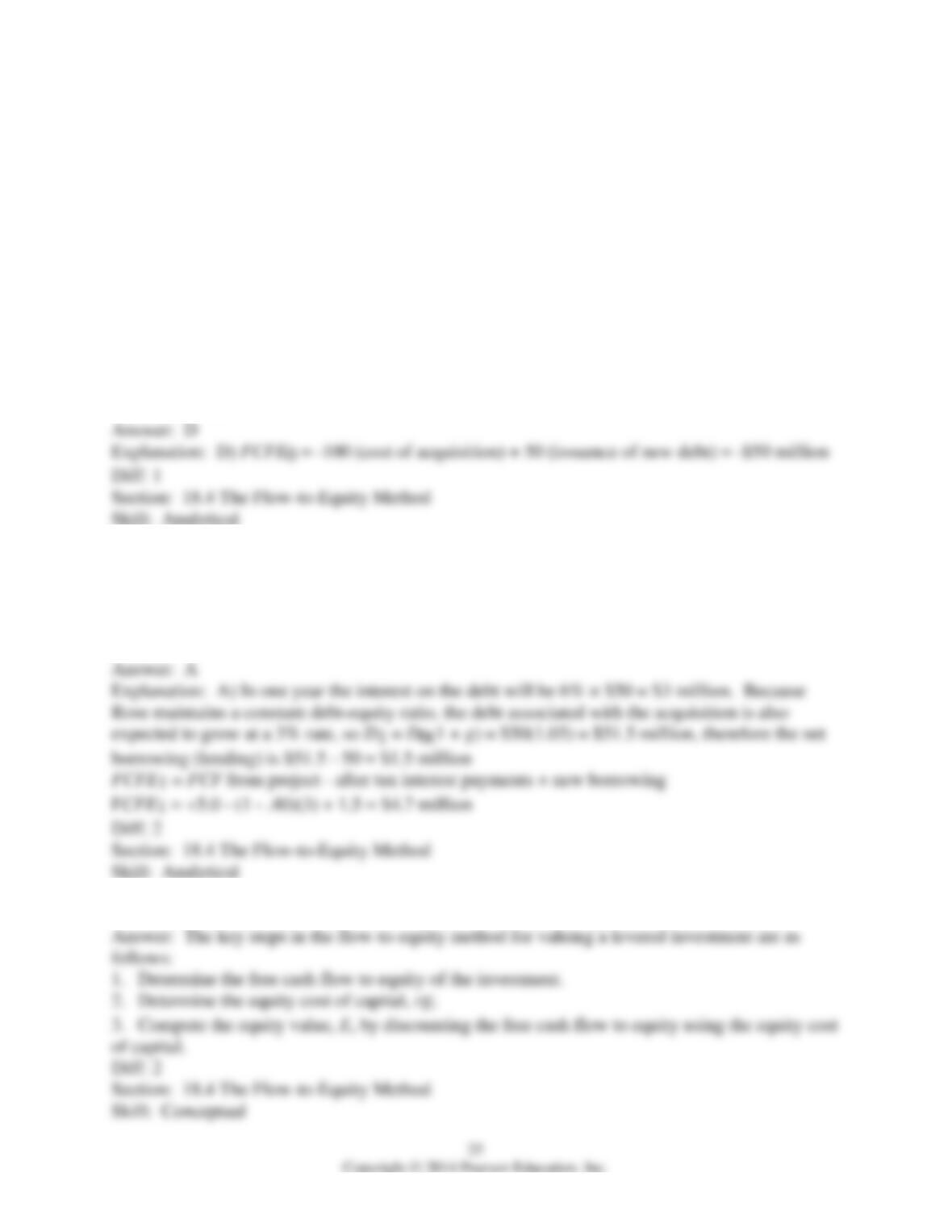
5) The Free Cash Flow to Equity (FCFE) for the acquisition in year 0 is closest to:
A) $5 million
B) $100 million
C) -$100 million
D) -$50 million
6) The Free Cash Flow-to-Equity (FCFE) for the acquisition in year 1 is closest to:
A) $4.7 million
B) $6.5 million
C) $8.3 million
D) $6.8 million
7) Describe the key steps in the flow to equity method for valuing a levered investment.
18.5 Project-Based Costs of Capital
Use the following information to answer the question(s) below.
Nielson Motors (NM) is a newly public firm with 25 million shares outstanding. You are doing a
valuation analysis of Nielson and you estimate its free cash flow in the coming year to be $40
million. You expect the firm’s free cash flows to grow by 4% per year in subsequent years.
Because the firm has only been listed on the stock exchange for a short time, you do not have an
accurate assessment of Nielson’s equity beta. However, you do have the following data for
another firm in the same industry:
Equity Beta
Debt Beta
Debt-Equity Ratio
1.8
0.4
1.5
Nielson has a much lower debt-equity ratio of .5, which is expected to remain stable, and
Nielson’s debt is risk free. Nielson’s corporate tax rate is 40%, the risk-free rate is 5%, and the
expected return on the market portfolio is 10%.
1) Nielson’s estimated equity beta is closest to:
A) 0.95
B) 1.00
C) 1.25
D) 1.45
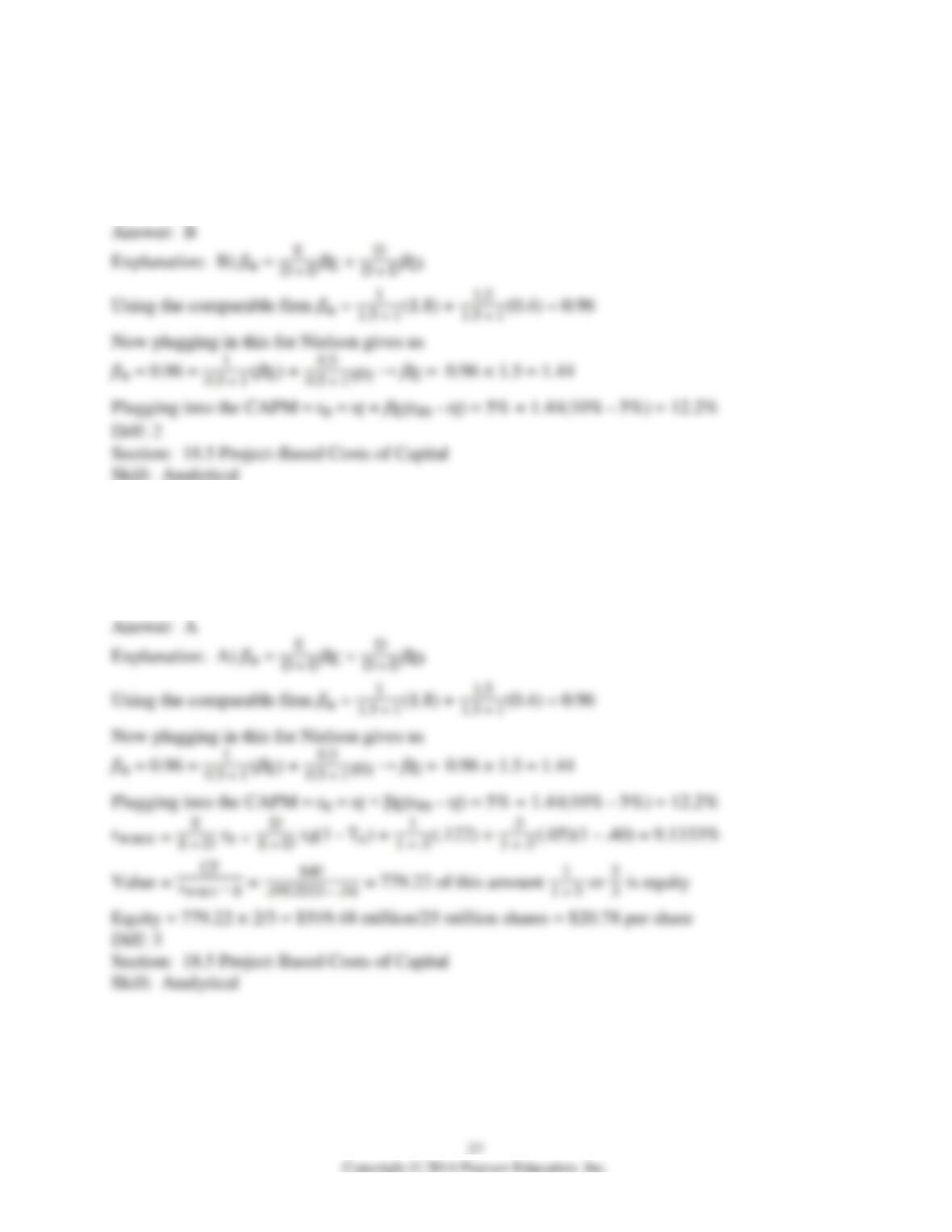
2) Nielson’s equity cost of capital is closest to:
A) 11.3%
B) 12.2%
C) 14.0%
D) 14.4%
3) Nielson’s share price is closest to:
A) $20.80
B) $24.40
C) $27.50
D) $31.20
4) Which of the following statements is FALSE?
A) In the real world, specific projects should differ only slightly from the average investment
made by the firm.
B) We can estimate rU for a new project by looking at single-division firms that have similar
business risks.
C) The project’s equity cost of capital depends on its unlevered cost of capital, rU, and the debt-
equity ratio of the incremental financing that will be put in place to support the project.
D) Projects may vary in the amount of leverage they will support–for example, acquisitions of
real estate or capital equipment are often highly levered, whereas investments in intellectual
property are not.
5) Which of the following statements is FALSE?
A) For capital budgeting purposes, the project’s financing is the incremental financing that
results if the firm takes on the project.
B) Projects with safer cash flows can support more debt before they increase the risk of financial
distress for the firm.
C) If the positive free cash flow from a project will increase the firm’s cash holdings, then this
growth in cash is equivalent to a reduction in the firm’s leverage.
D) The incremental financing of a project corresponds directly to the financing that is directly
tied to the project.
6) Consider the following equation:
rwacc = rU – τcdrD
The term d in this equation is:
A) the project’s unlevered cost of capital.
B) the project’s dollar amount of debt.
C) the firm’s unlevered cost of debt.
D) the project’s debt to value ratio.
7) Consider the following equation:
rwacc = rU – τcdrD
The term rU in this equation is:
A) the firm’s unlevered cost of debt.
B) the firm’s cost of debt.
C) the project’s unlevered cost of capital.
D) the project’s debt to value ratio.
Use the information for the question(s) below.
The Aardvark Corporation is considering launching a new product and is trying to determine an
appropriate discount rate for evaluating this new product. Aardvark has identified the following
information for three single division firms that offer products similar to the one Aardvark is
interested in launching:
Comparable Firm
Equity Cost
of Capital
Debt Cost of
Capital
Debt-to-Value
Ratio
Anteater Enterprises
12.50%
6.50%
50%
Armadillo Industries
13%
6.10%
40%
Antelope Inc.
14%
7.10%
60%
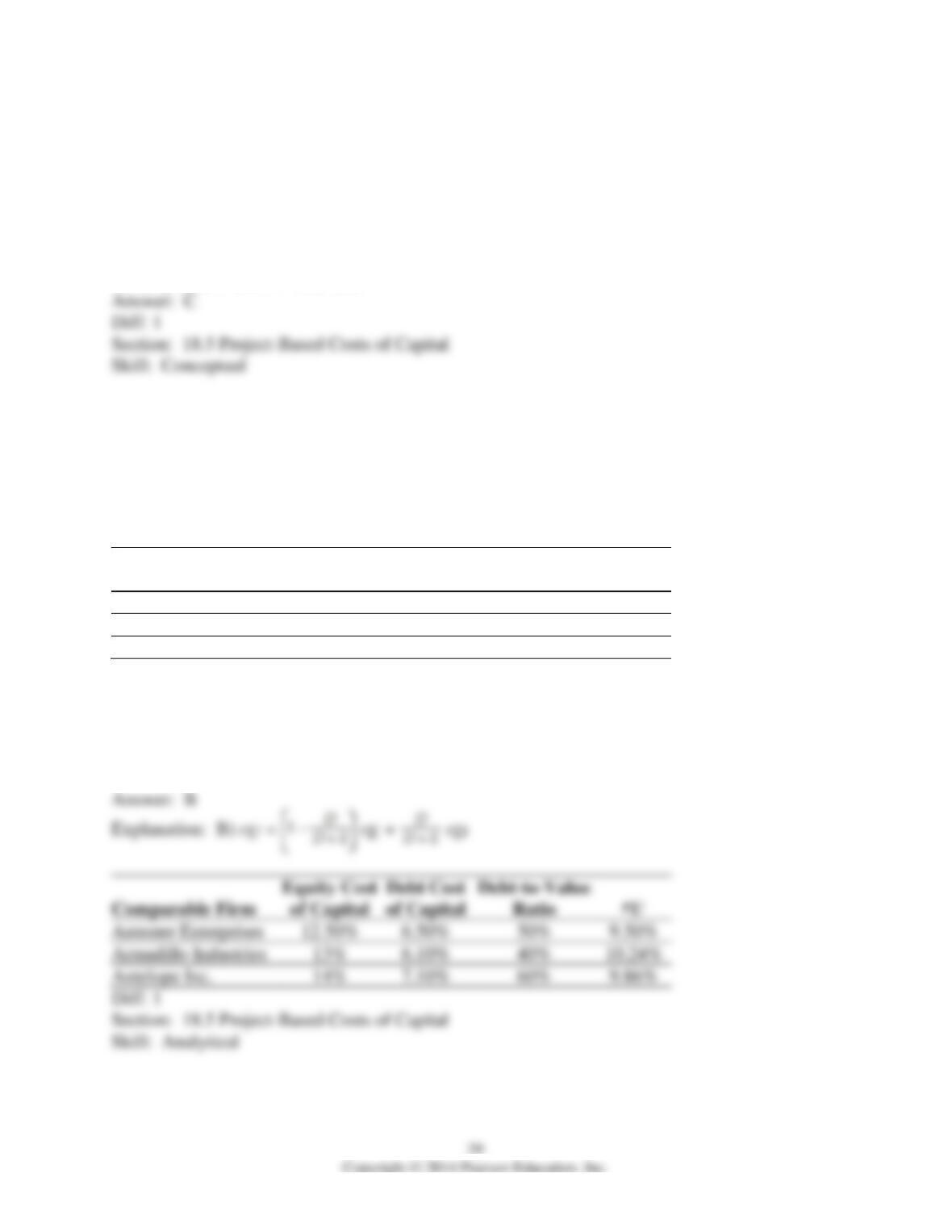
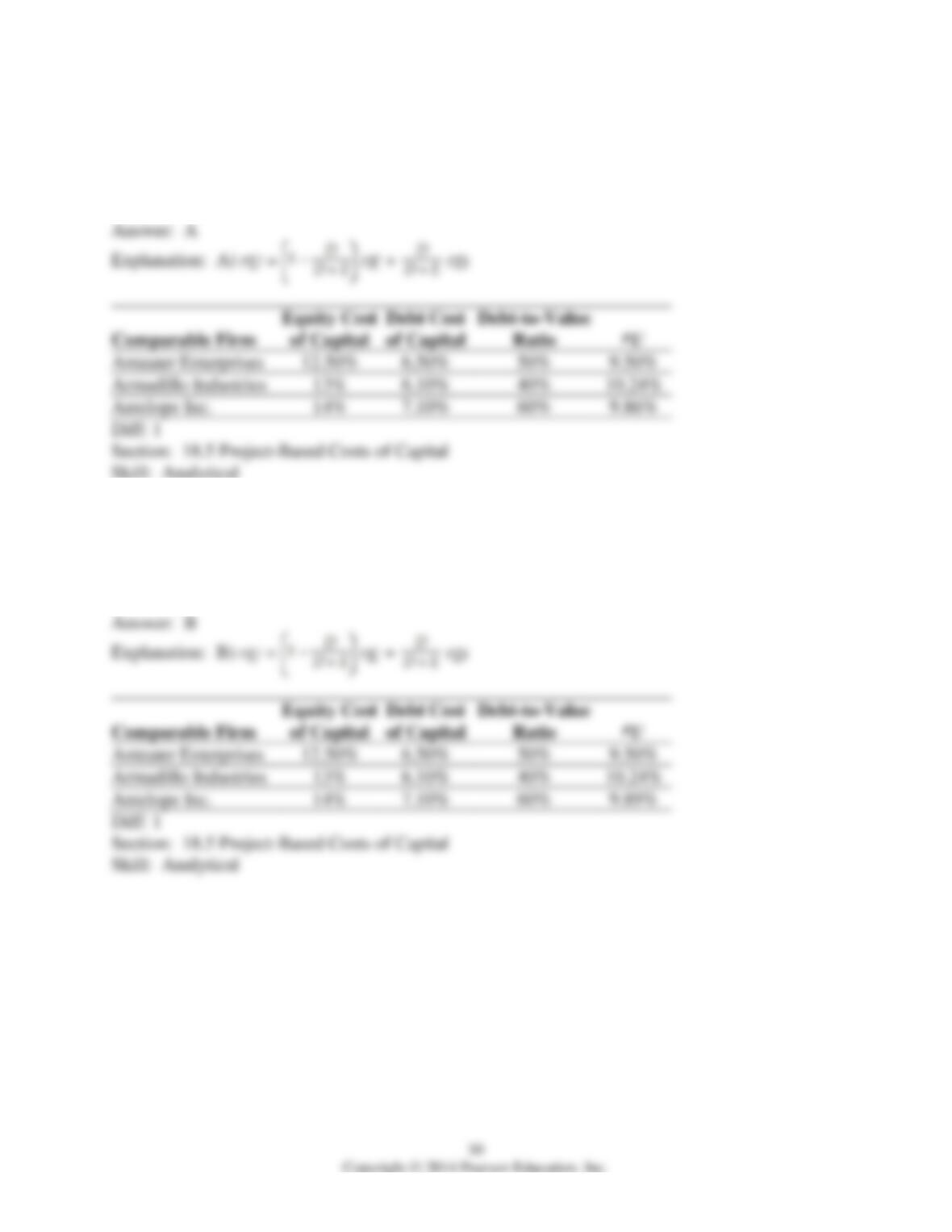
8) The unlevered cost of capital for Anteater Enterprises is closest to:
A) 10.1%
B) 9.5%
C) 9.9%
D) 10.3%
Comparable Firm
Anteater Enterprises
Armadillo Industries
Antelope Inc.
9) The unlevered cost of capital for Armadillo Industries is closest to:
A) 10.3%
B) 10.0%
C) 9.5%
D) 9.9%
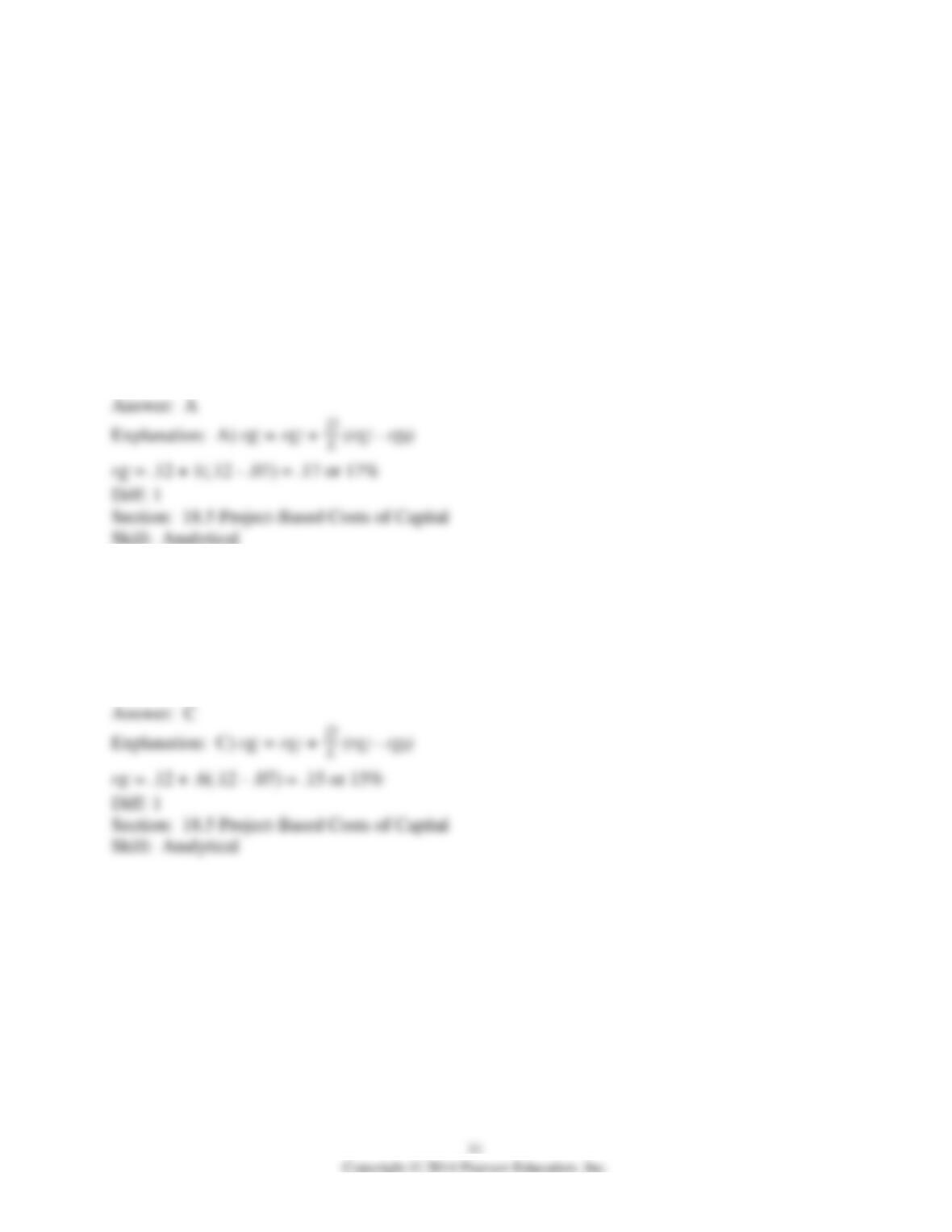
10) The unlevered cost of capital for Antelope Incorporated is closest to:
A) 10.3%
B) 9.9%
C) 10.1%
D) 9.5%
Use the information for the question(s) below.
KT Enterprises is considering undertaking a new project. Based upon analysis of firms with
similar projects, KT has determined that an unlevered cost of equity of 12% is suitable for their
project. KT’s marginal tax rate is 35%, its borrowing rate is 7%, and KT does not believe that its
borrowing rate will change if the new project is accepted.
11) If KT expects to maintain a debt to equity ratio for this project of 1, then KT’s equity cost of
capital, rE, for this project is closest to:
A) 17.0%
B) 5.0%
C) 15.0%
D) 12%
12) If KT expects to maintain a debt to equity ratio for this project of .6 then KT’s equity cost of
capital, rE, for this project is closest to:
A) 5.0%
B) 12%
C) 15.0%
D) 17.0%
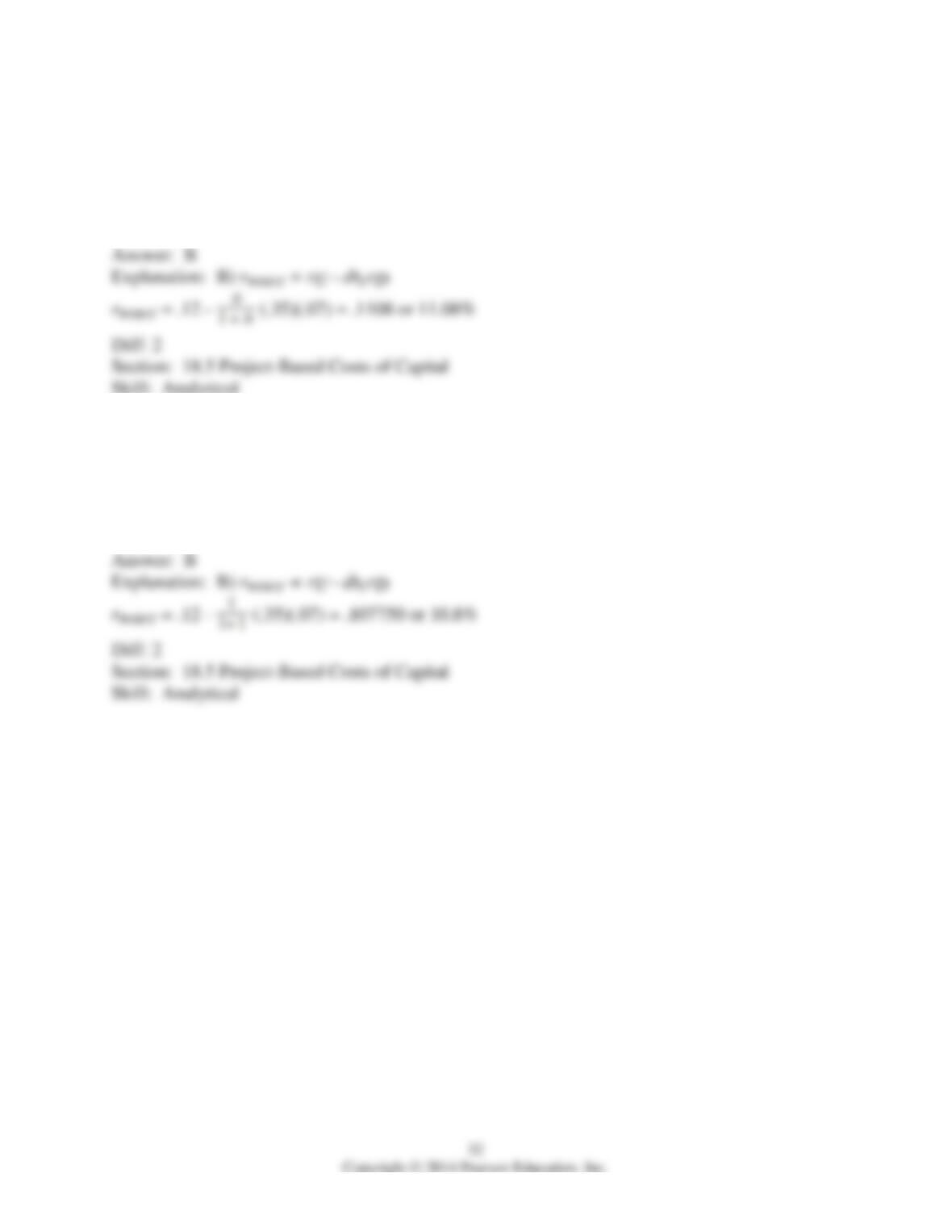
13) If KT expects to maintain a debt to equity ratio for this project of .6 then KT’s project based
WACC, rwacc, for this project is closest to:
A) 10.5%
B) 11.1%
C) 9.6%
D) 10.8%
14) If KT expects to maintain a debt to equity ratio for this project of 1 then KT’s project based
WACC, rwacc, for this project is closest to:
A) 11.1%
B) 10.8%
C) 9.6%
D) 10.5%
33
Use the information for the question(s) below.
The Aardvark Corporation is considering launching a new product and is trying to determine an
appropriate discount rate for evaluating this new product. Aardvark has identified the following
information for three single division firms that offer products similar to the one Aardvark is
interested in launching:
Comparable Firm
Equity Cost
of Capital
Debt Cost of
Capital
Debt-to-Value
Ratio
Anteater Enterprises
12.50%
6.50%
50%
Armadillo Industries
13%
6.10%
40%
Antelope Inc.
14%
7.10%
60%
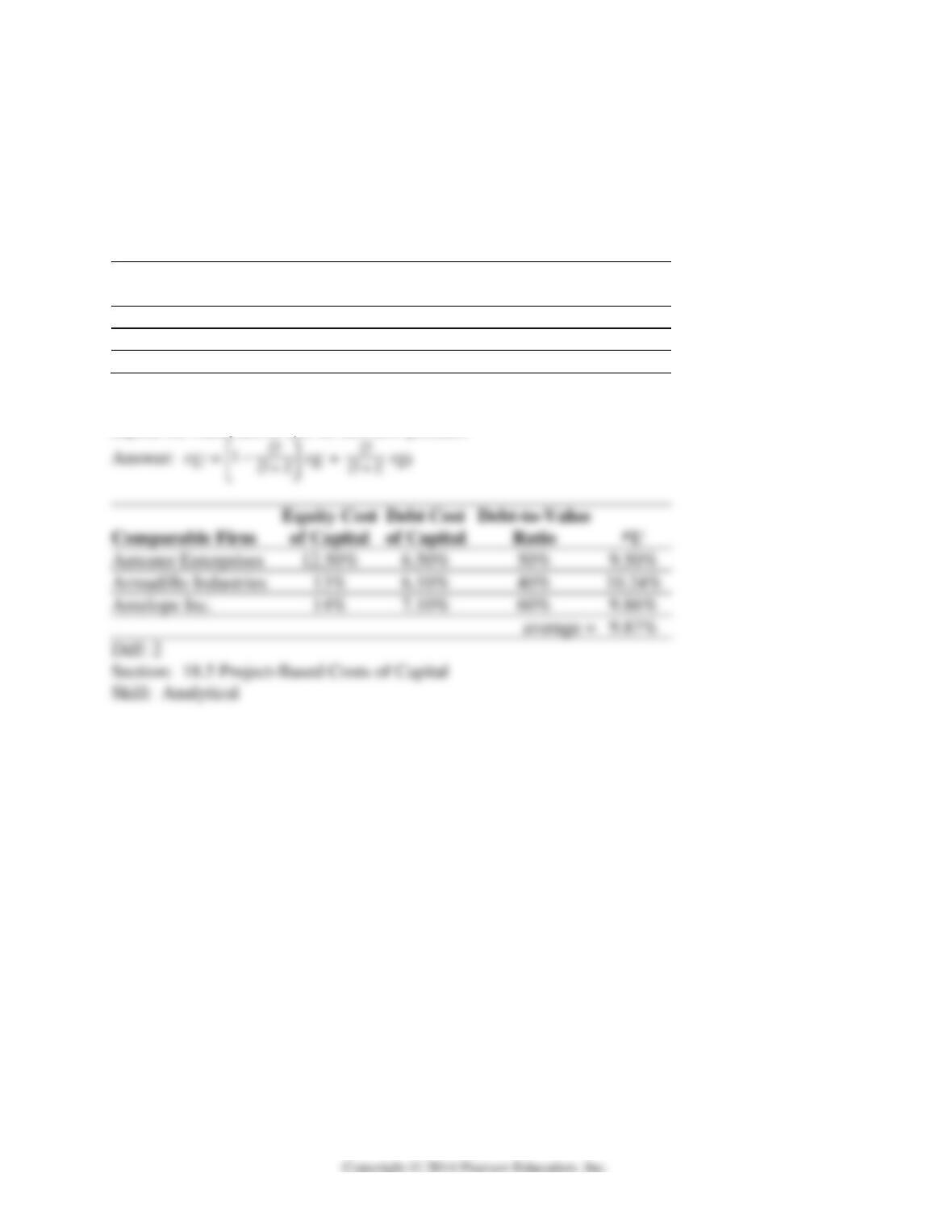
15) Based upon the three comparable firms, calculate that most appropriate unlevered cost of
capital for Aardvark to use on this new product.
Comparable Firm
Debt Cost
Anteater Enterprises
Armadillo Industries
Antelope Inc.
18.6 APV with Other Leverage Policies
Use the following information to answer the question(s) below.
Rearden Metal is evaluating a project that requires an investment of $150 million today and
provides a single cash flow of $180 million for sure one year from now. Rearden decides to use
100% debt financing for this investment. The risk-free rate is 5% and Rearden’s corporate tax
rate is 40%. Assume that the investment is fully depreciated at the end of the year.
1) The NPV of this project using the APV method is closest to:
A) $10 million
B) $13 million
C) $42 million
D) $71 million
2) The WACC for this project is closest to:
A) 3.0%
B) 5.0%
C) 7.0%
D) 8.2%