Format: Multiple Choice
71.
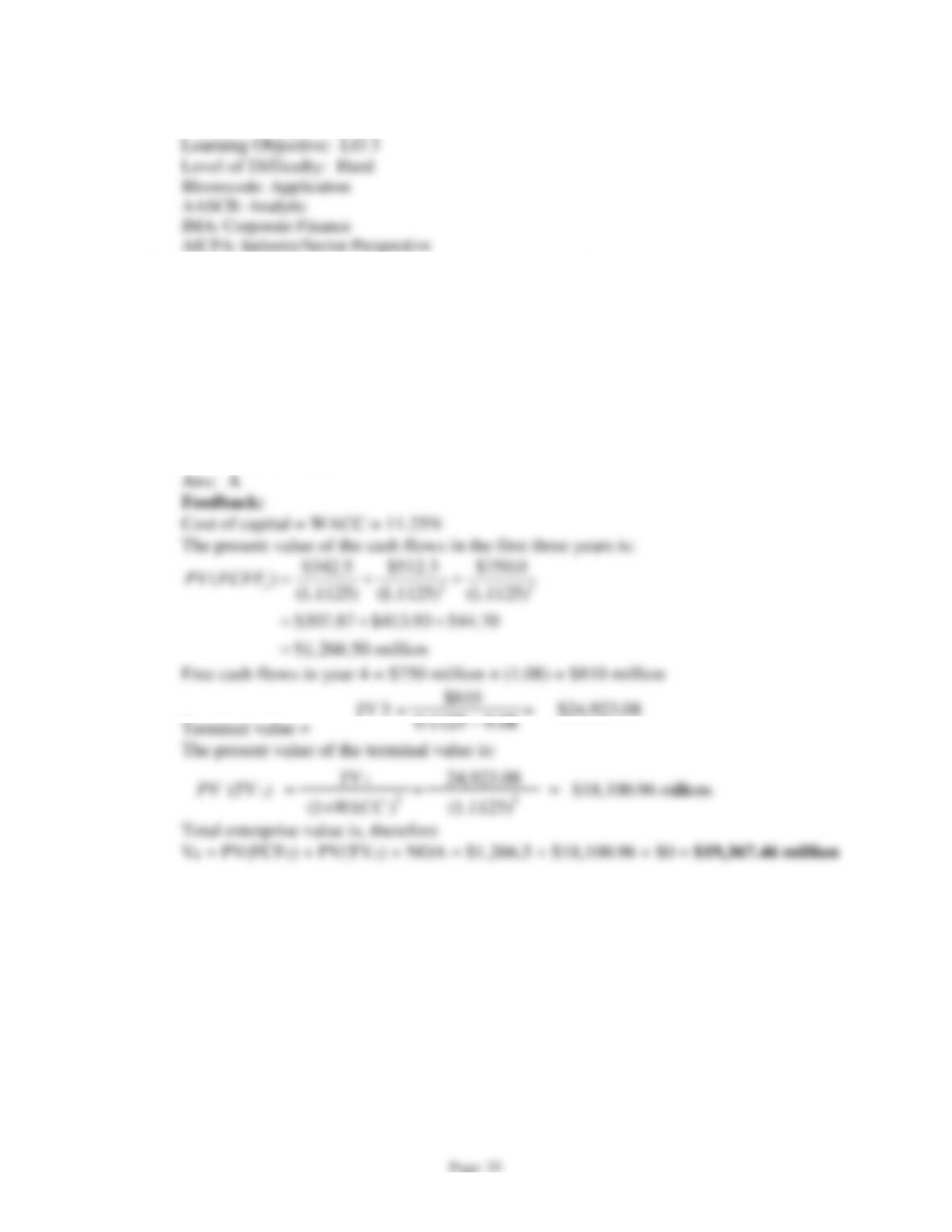
Factrack Inc., a biotech firm, is expected to grow rapidly in the next three years and
then have a level growth rate for the foreseeable future. The firm expects free cash
flows of $342.5 million, $512.3 million, and $750 million over the next three years, and
thereafter its cash flows will grow at a steady rate of 8 percent per annum. The
company has no nonoperating assets (NOA). If the appropriate WACC is 11.25 percent,
what is the enterprise value of this business? (Round to the nearest million.)
A)
$19,367 million
B)
$18,101 million
C)
$26,190 million
D)
$24,923 million
Ans:
A
Page 36
72.
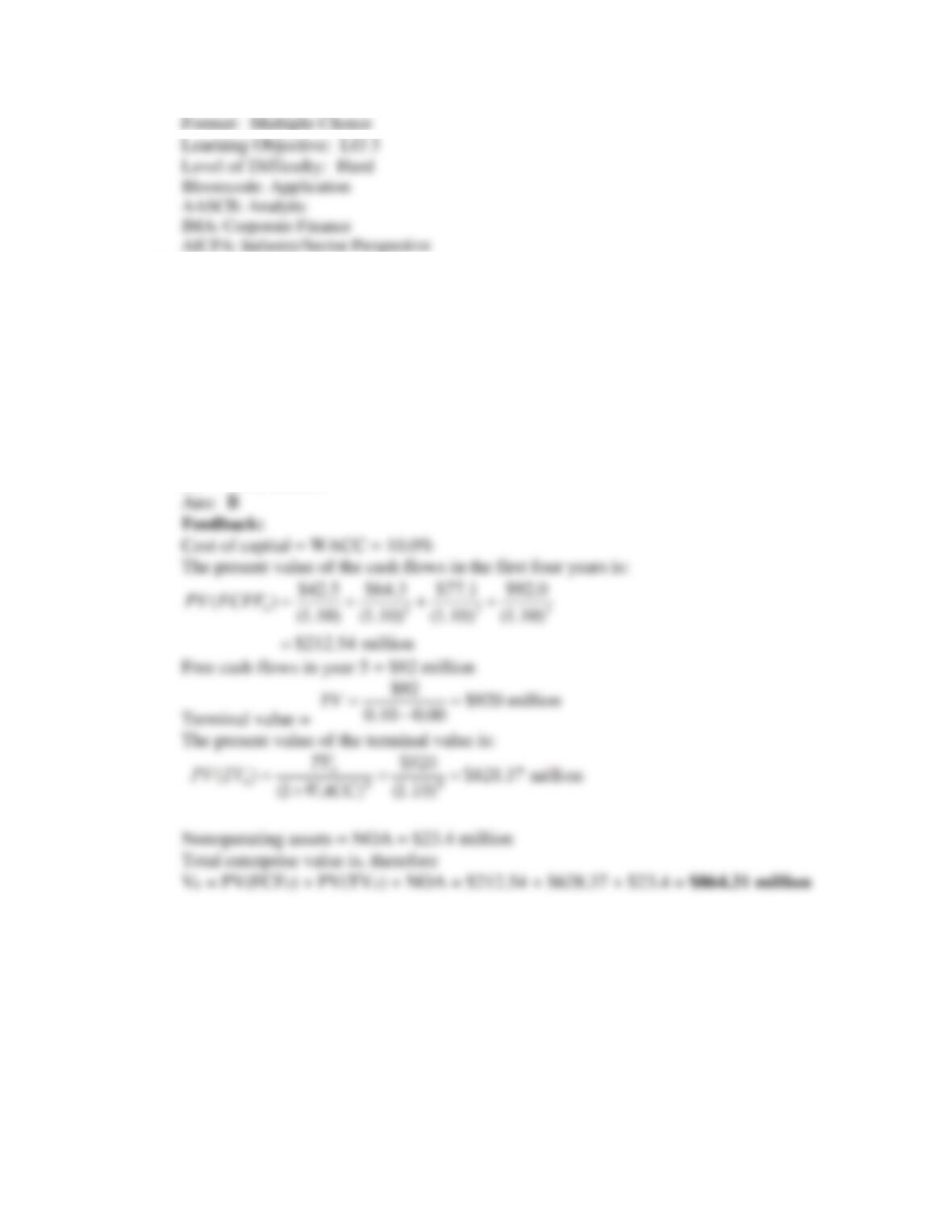
ProtoSeis Corp. is expected to grow rapidly in the next four years and then have a zero
growth rate for the foreseeable future. The firm expects free cash flows of $42.5
million, $64.3 million, $77.1 million and $92 million over the next four years, and
thereafter its cash flows will stay constant. The company has cash to the tune of $23.4
million. If the appropriate WACC is 10 percent, what is the enterprise value of this
business? (Do not round intermediate computations. Round final answer to the nearest
million.)
A)
$628 million
B)
$864 million
C)
$811 million
D)
$818 million
Ans:
B
Page 37
73.
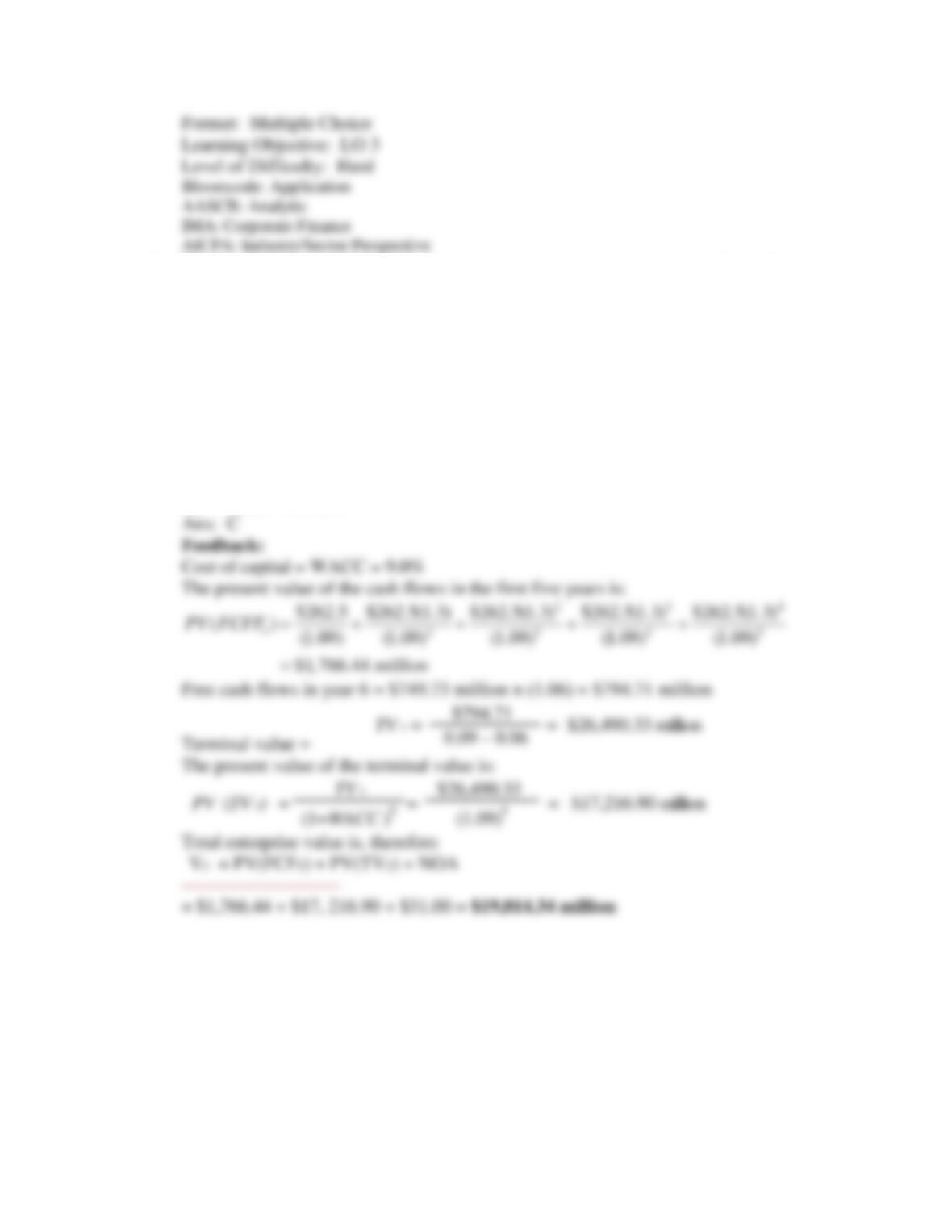
Symbyrec Phonic, an electronics manufacturer, is expected to grow rapidly in the next
five years and then have a stable growth rate for the foreseeable future. The firm
expects free cash flows of $262.5 million next year. These cash flows are expected to
grow at a 30 percent rate over the following four years, and thereafter its cash flows
will grow at a steady rate of 6 percent per annum. The company has nonoperating
assets (NOA) of $31 million in the form of cash. If the appropriate WACC is 9 percent,
what is the enterprise value of this business? (Do not round intermediate computations.
Round final answer to the nearest million.)
A)
$26,490 million
B)
$22,222 million
C)
$19,014 million
D)
$22,191 million
Ans:
C
74.
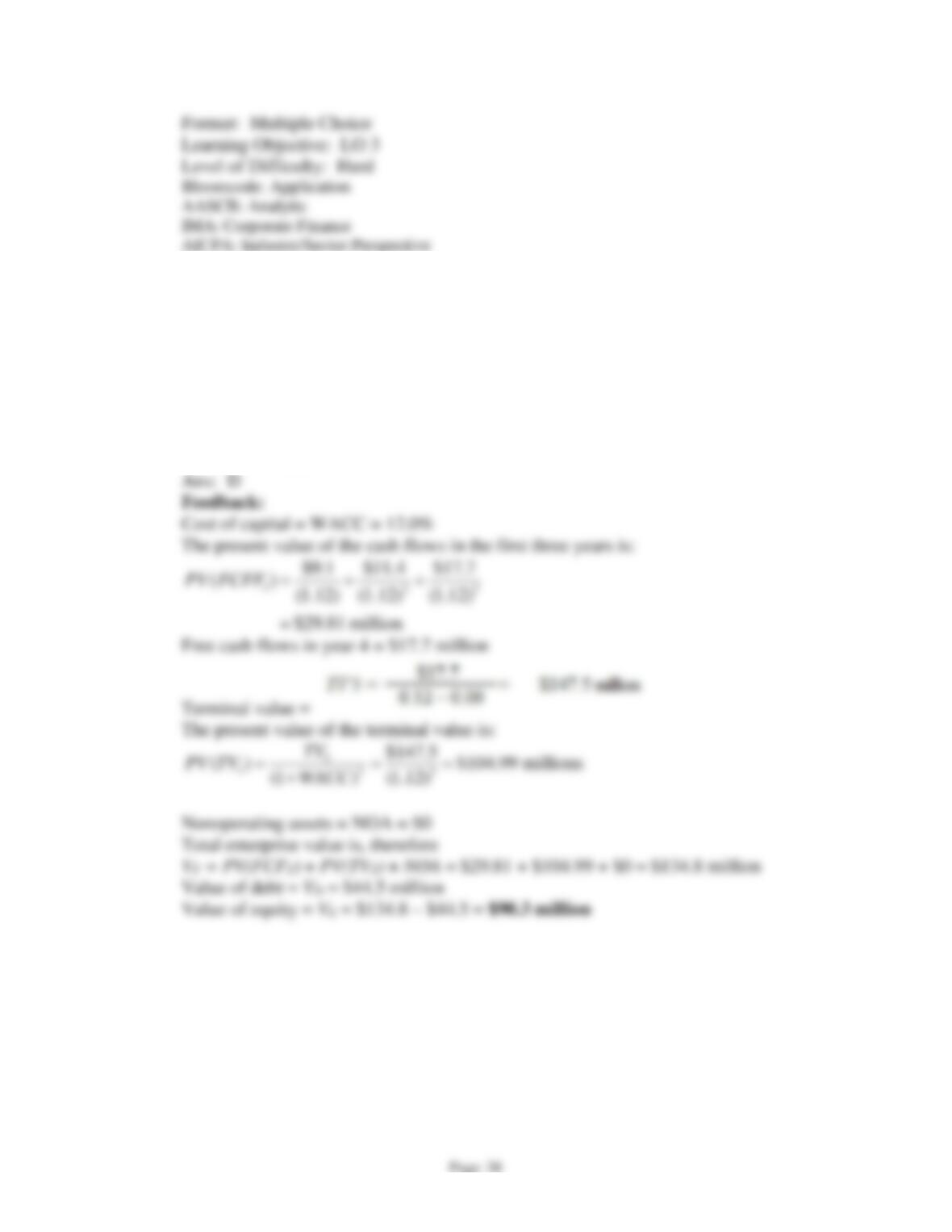
Simpltar Co. is expected to grow rapidly in the next three years and then have no
growth for the foreseeable future. The firm expects free cash flows of $9.1 million,
$11.4 million, and $17.7 million over the next three years, and thereafter its cash flows
will stay constant. The company has no nonoperating assets. If the appropriate WACC
is 12 percent and debt of 44.5 million, what is the equity value of this business? (Round
final answer to the nearest million.)
A)
$135 million
B)
$105 million
C)
$45 million
D)
$90 million
Ans:
D

Page 39
75.
You are using the FCFF approach to value a business. The estimated FCFF for next
year will be $13.6 million, and it will increase at a rate of 6 percent for each of the
following five years. After that point, the FCFF will increase at a rate of 3 percent
forever. If the WACC for this firm is 8 percent, what is it worth? (Round final answer
to the nearest million.)
A)
$301 million
B)
$354 million
C)
$241 million
D)
$144 million
Ans:
A
76.
Phosfranc Inc. is valuing the equity of a company using the free cash flow from equity,
FCFE, approach and has estimated that the FCFE in the next three years will be $6.25,
$7.70, and $8.36 million respectively. Beginning in year 4, the company expects the
cash flows to increase at a rate of 4 percent per year for the indefinite future. It is
estimated that the cost of equity is 12 percent. What is the value of equity in this
company? (Do not round intermediate computations. Round final answer to the nearest
million.)
A)
$77 million
B)
$95 million
C)
$109 million
D)
$60 million
Ans:
B
77.
You are valuing the equity of NewNil Corp. using the FCFE approach and have
estimated that the FCFE in the next three years will grow at 8 percent rate from last
year’s FCFE of $2.1 million. Beginning in year 4, you expect the cash flows to increase
at a constant rate of 5 percent per year for the indefinite future. The cost of equity for
the firm is10 percent. What is the value of equity in this company? (Round final answer
to the nearest million dollars.)
A)
$42 million
B)
$56 million
C)
$48 million
D)
$6 million
Ans:
C
78.
You are interested in investing in a private company. Based on earnings multiples of
similar publicly traded firms, you estimate the value of the private company’s stock to
be $13.44 per share. You plan to acquire a majority of the shares in the company. The
expected control premium is 12 percent, while the marketability discount for such a
firm is 15 percent. The discount for the key person, one of the founders who may leave
the firm upon your control of the firm, is 15 percent. What price should you be willing
to pay for these shares? (Round final answer to two decimal places.)
A)
$14.92 per share
B)
$16.65 per share
C)
$11.80 per share
D)
$10.88 per share
Ans:
D
79.
Shuman Wolf is interested in investing in a private company. Based on earnings
multiples of similar publicly traded firms, he estimates the value of the private
company’s stock to be $20 per share. He plans to acquire a majority of the shares in the
company. The expected control premium is 9 percent. Shuman estimates the
marketability discount for such a firm to be 11 percent. The discount for the key person,
one of the founders who may leave the firm upon Shuman’s control of the firm, is 19
percent. What price should he be willing to pay for these shares? (Round final answer
to two decimal places.)
A)
$16.47 per share
B)
$31.45 per share
C)
$15.72 per share
D)
$32.94 per share
Ans:
C
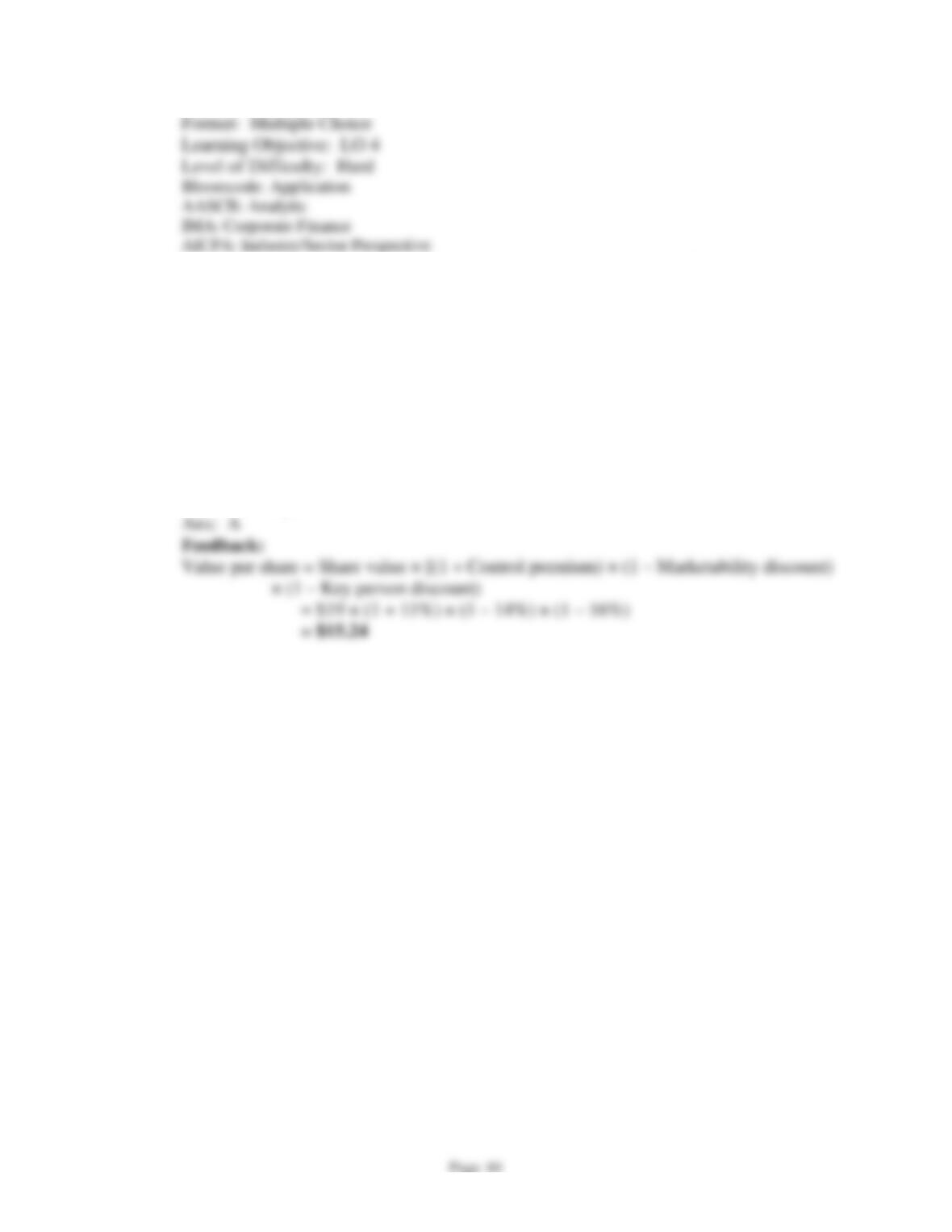
80.
Alfred Sautin wants to invest in Dieciring, Inc., a private company. Based on earnings
multiples of similar publicly traded firms, Alfred estimates the value of the private
company’s stock to be $19 per share. He plans to acquire a majority of the shares in the
company. The expected control premium is 11 percent. He estimates the marketability
discount for such a firm to be 14 percent. The discount for the key person, one of the
founders who may leave the firm upon Alfred’s control of the firm, is 16 percent. What
price should he be willing to pay for these shares? (Round final answer to two decimal
places.)
A)
$15.24 per share
B)
$18.10 per share
C)
$14.05 per share
D)
$20.70 per share
Ans:
A
81.
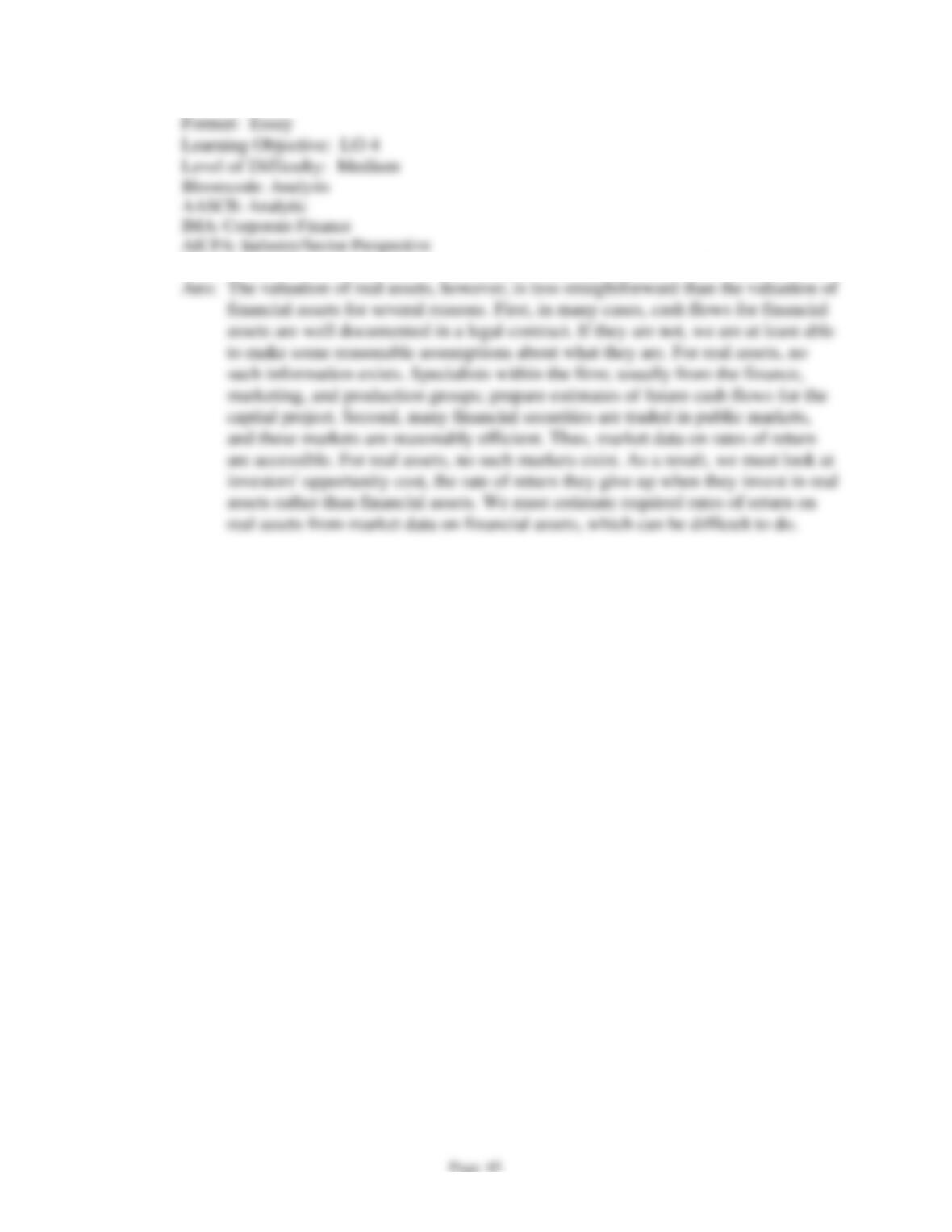
What difficulties are associated with valuing real assets compared to financial assets?
82.
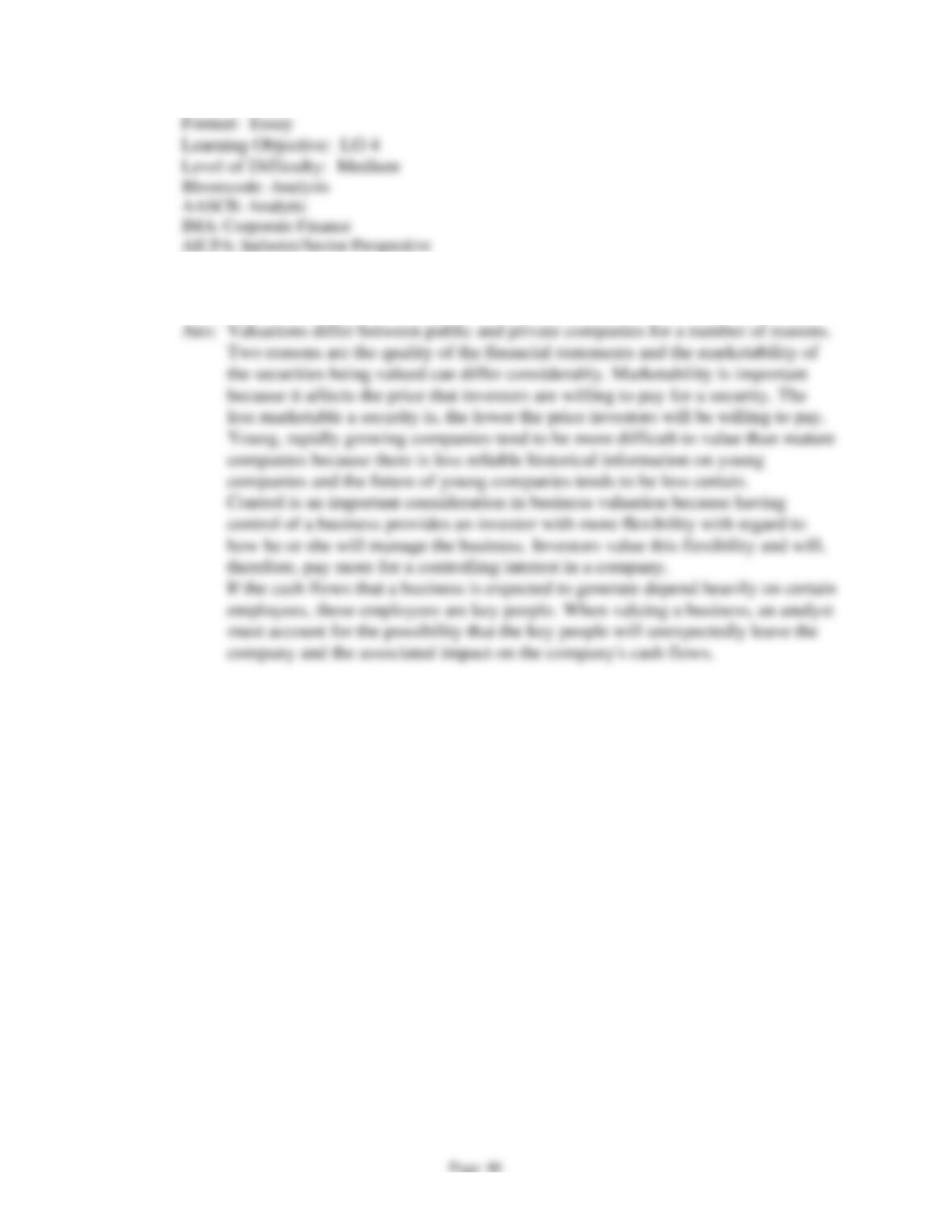
Explain how valuations can differ between public and private companies and between
young and mature companies as well as the importance of marketability, control, and
key person considerations in valuation.
83.
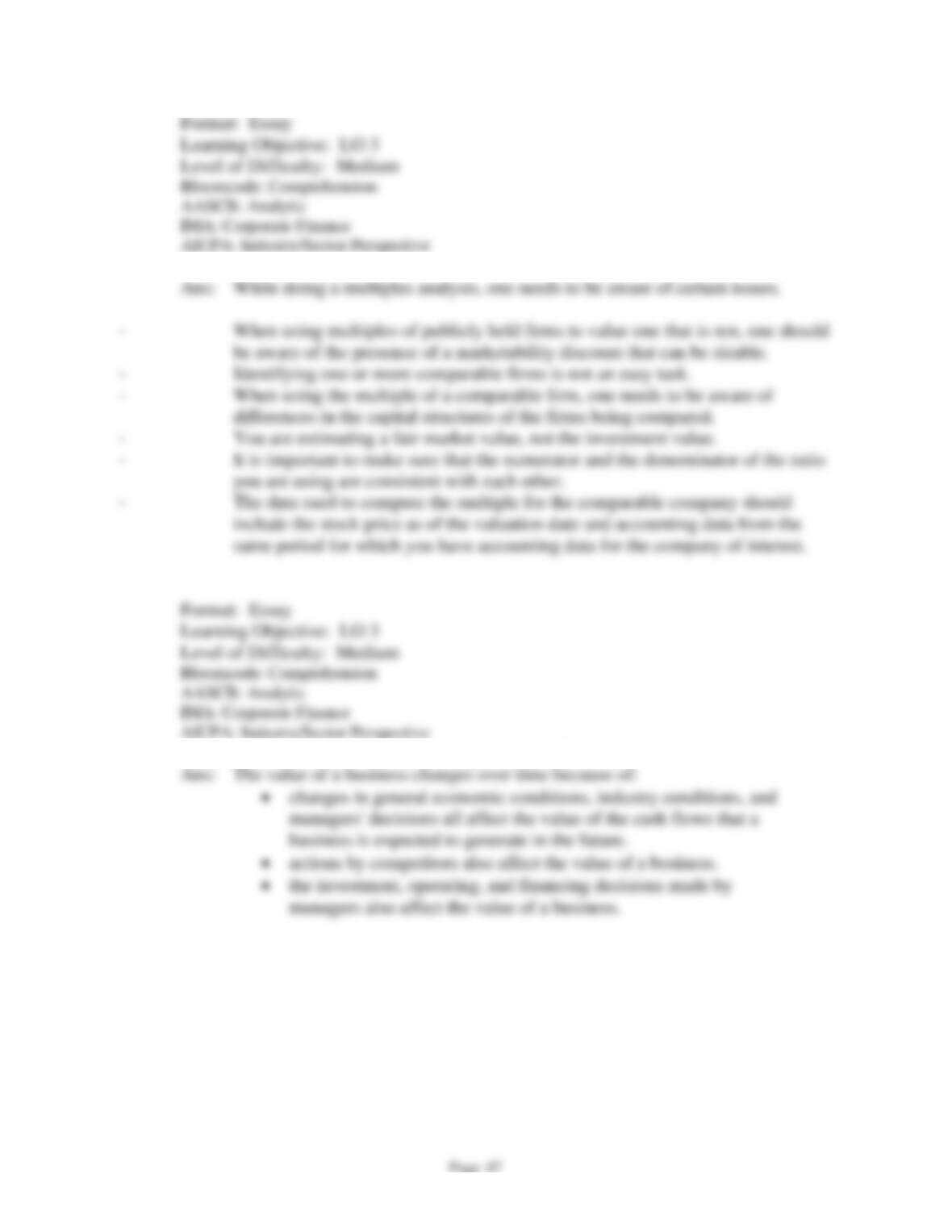
What are some things to watch out for when doing multiples analysis?
be aware of the presence of a marketability discount that can be sizable.
·
Identifying one or more comparable firms is not an easy task.
differences in the capital structures of the firms being compared.
·
You are estimating a fair market value, not the investment value.
same period for which you have accounting data for the company of interest.
84.
Why does the value of a business change over time?