
Format: Multiple Choice
53.
The transaction approach is difficult to use because:
A)
transactions data are typically as reliable as the data available for multiples
analysis, especially when they are associated with a private firm.
B)
transactions involving the purchase or sale of an entire business in an industry
tend to occur frequently and hence the amount of data is immense.
C)
the terms of the transactions can be easy to assess.
D)
the terms of the transactions can be difficult to assess.
Ans:
D
54.
Which of the following statements about the free cash flow from the firm (FCFF)
approach is true?
A)
The present value of these cash flows exceeds the total value of the firm, or its
enterprise value.
B)
We include the cash necessary to pay short-term liabilities that do not have
interest charges associated with them, such as accounts payable and accrued
expenses.
C)
The costs associated with noninterest-bearing current liabilities, which are
included in the firm’s cost of sales and other operating expenses, are added in the
calculation of FCFF.
D)
The total value of the firm, VF, is computed as the present value of the FCFF,
discounted by the firm’s weighted average cost of capital, WACC.
Ans:
D
55.
The costs associated with noninterest-bearing current liabilities, which are included in
the firm’s cost of sales and other operating expenses:
A)
are subtracted in the calculation of free cash flow from the firm (FCFF).
B)
are added in the calculation of FCFF.
C)
are not a factor in the calculation of FCFF.
D)
are added to the value of equity claims.
Ans:
A
56.
In the free cash flow from the firm (FCFF) approach, the total value of the firm, VF, is
computed as the present value of the FCFF:
A)
discounted by the firm’s cost of equity.
B)
discounted by the firm’s WACC.
C)
discounted by the firm’s cost of debt.
D)
discounted by the inflation rate prevailing in the economy.
Ans:
B
57.
The free cash flow to equity (FCFE) approach uses only the portion of the cash flows
that are available:
A)
for distribution to bondholders.
B)
for distribution to bondholders and stockholders.
C)
for distribution to stockholders.
D)
for distribution to board of directors.

58.
The three specific cash flows associated that are included in the free cash flow to equity
(FCFE) approach are:
A)
the interest expense on existing debt, the repayment of debt principal, and the
proceeds from new debt issues.
B)
the interest expense on existing term debt, the repayment of debt principal, and
the proceeds from new equity issues.
C)
the interest expense on existing debt, the repayment of debt principal, and the
payment of dividends.
D)
the interest expense on existing debt, the repayment of debt principal, and the
payment of dividends.
Ans:
A
59.
In contrast to the FCFE approach, the dividend discount model (DDM) approach
values:
A)
cash flows that are available for distribution to stockholders.
B)
the stream of cash flows that stockholders expect to receive through dividend
payments.
C)
the stream of cash flows that stockholders expect to receive through bonus issue.
D)
the stream of cash flows that stockholders expect to receive through stock
repurchase.
Ans:
B

60.
Important issues that one must consider in valuing young private firms include:
A)
whether key people remain in the firm, the amount of dividends that one may
receive in the coming years, and whether a controlling ownership interest or a
minority interest is being valued.
B)
the difficulty in valuing young, rapidly growing companies in contrast to mature,
stable companies, the amount of dividends that one may receive in the coming
years, and whether a controlling ownership interest or a minority interest is being
valued.
C)
the difficulty in valuing young, rapidly growing companies in contrast to mature,
stable companies, whether key people remain in the firm, and whether a
controlling ownership interest or a minority interest is being valued.
D)
whether the key people remain in the firm, the pretax operating cash flows
generated by the firm in the coming years, and whether a controlling ownership
interest or a minority interest is being valued.
Ans:
C
Page 25
61.
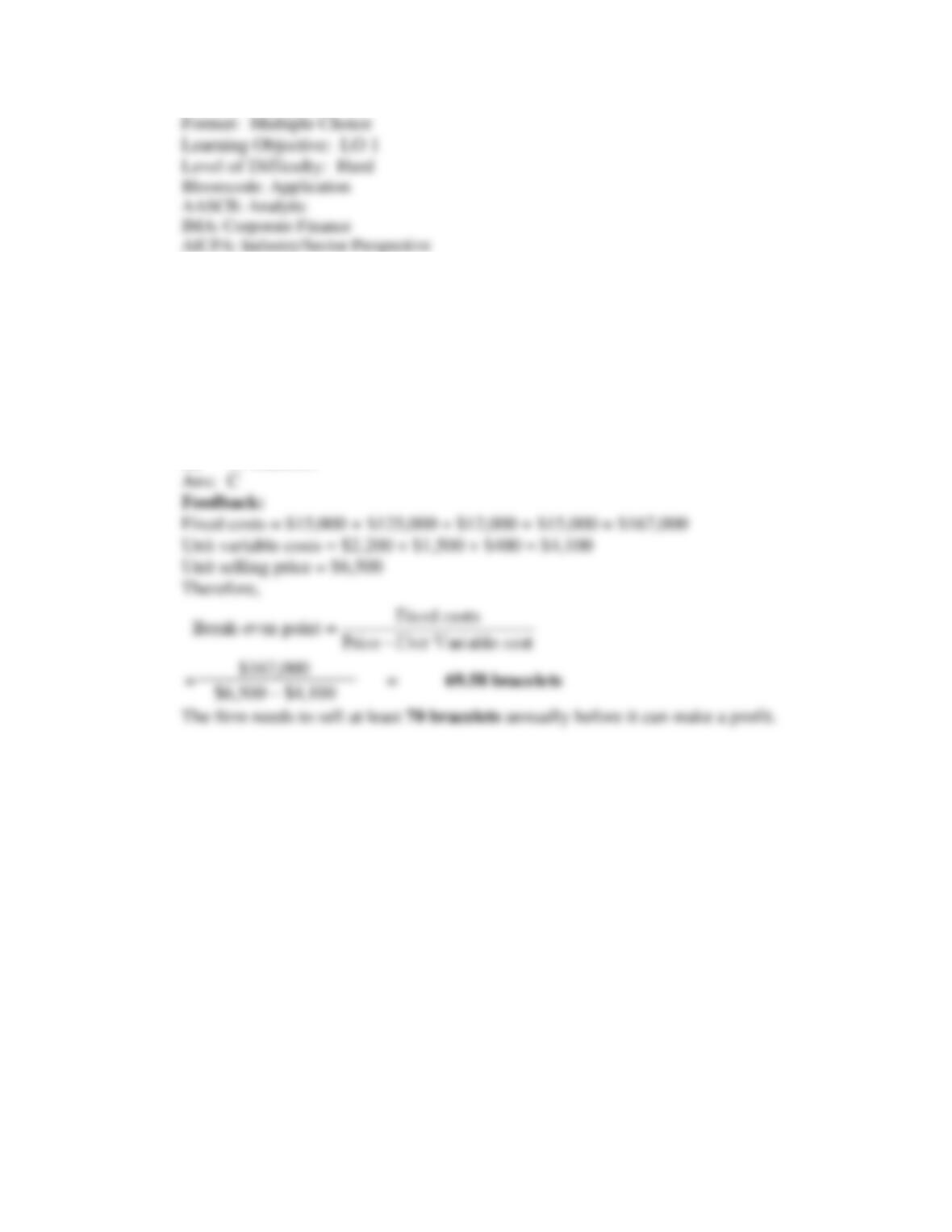
Sonicmony Soft, makes designer gold bracelets. Its annual costs include shop rent of
$15,000, salaries for two jewelers of $125,000, design software costs of $12,000, and
other overhead costs of $15,000. An average bracelet is priced at $6,500. It costs
$2,200 in raw material, $1,500 in labor, and $400 in other expenses. What is the
minimum number of bracelets that need to be sold to earn a profit? (Round to nearest
whole unit.)
A)
18 bracelets
B)
47 bracelets
C)
70 bracelets
D)
14 bracelets
Ans:
C
62.
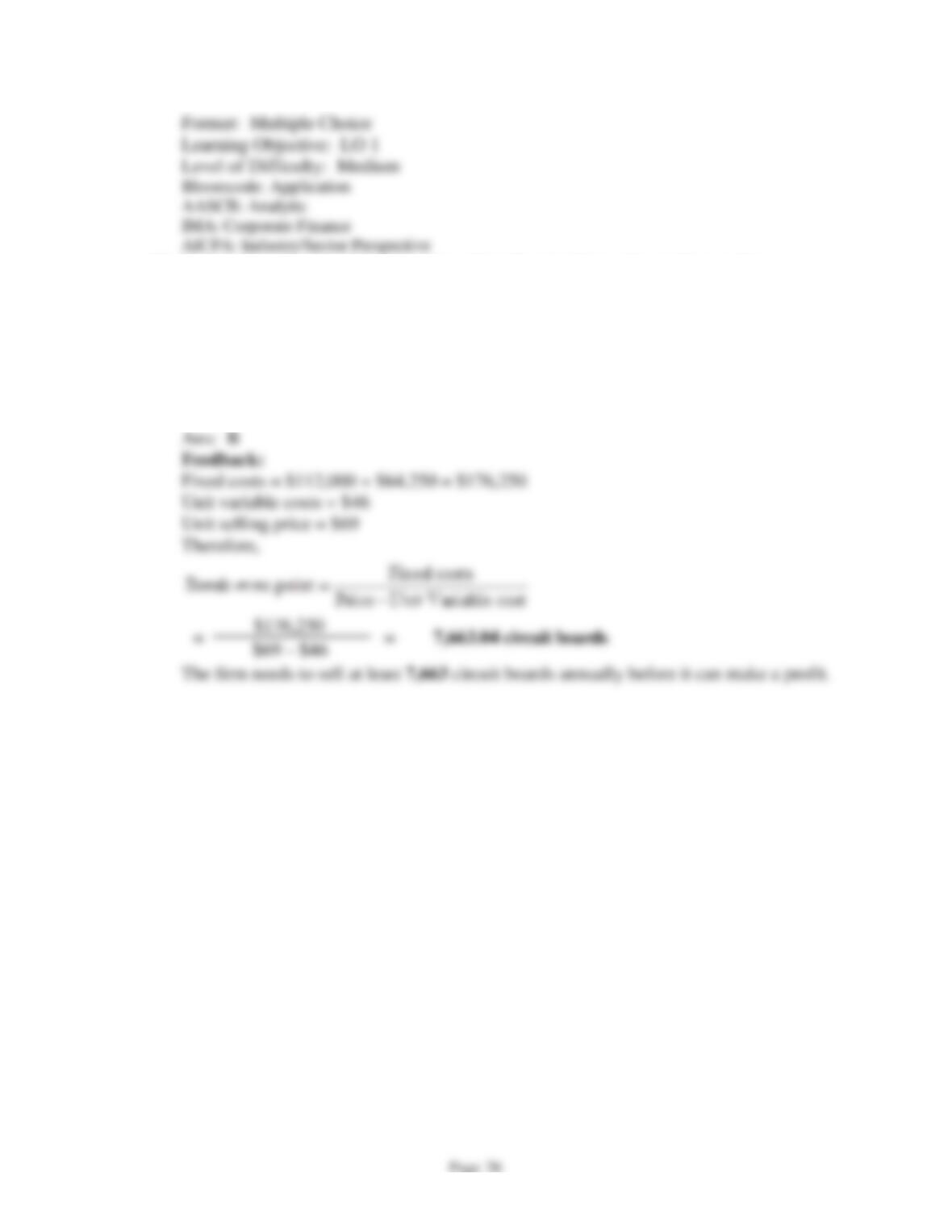
Atamony makes circuit boards and markets them to electronic goods manufacturers.
The firm has nonsalary fixed costs of $112,000 and salary costs of $64,250. Each
circuit board is sold at a price of $69 and involves variable costs of $46 per unit. What
is the break-even point for Atamony? (Round to nearest whole unit.)
A)
5,105 circuit boards
B)
7,663 circuit boards
C)
6,237 circuit boards
D)
2,714 circuit boards
Ans:
B
Page 27
63.
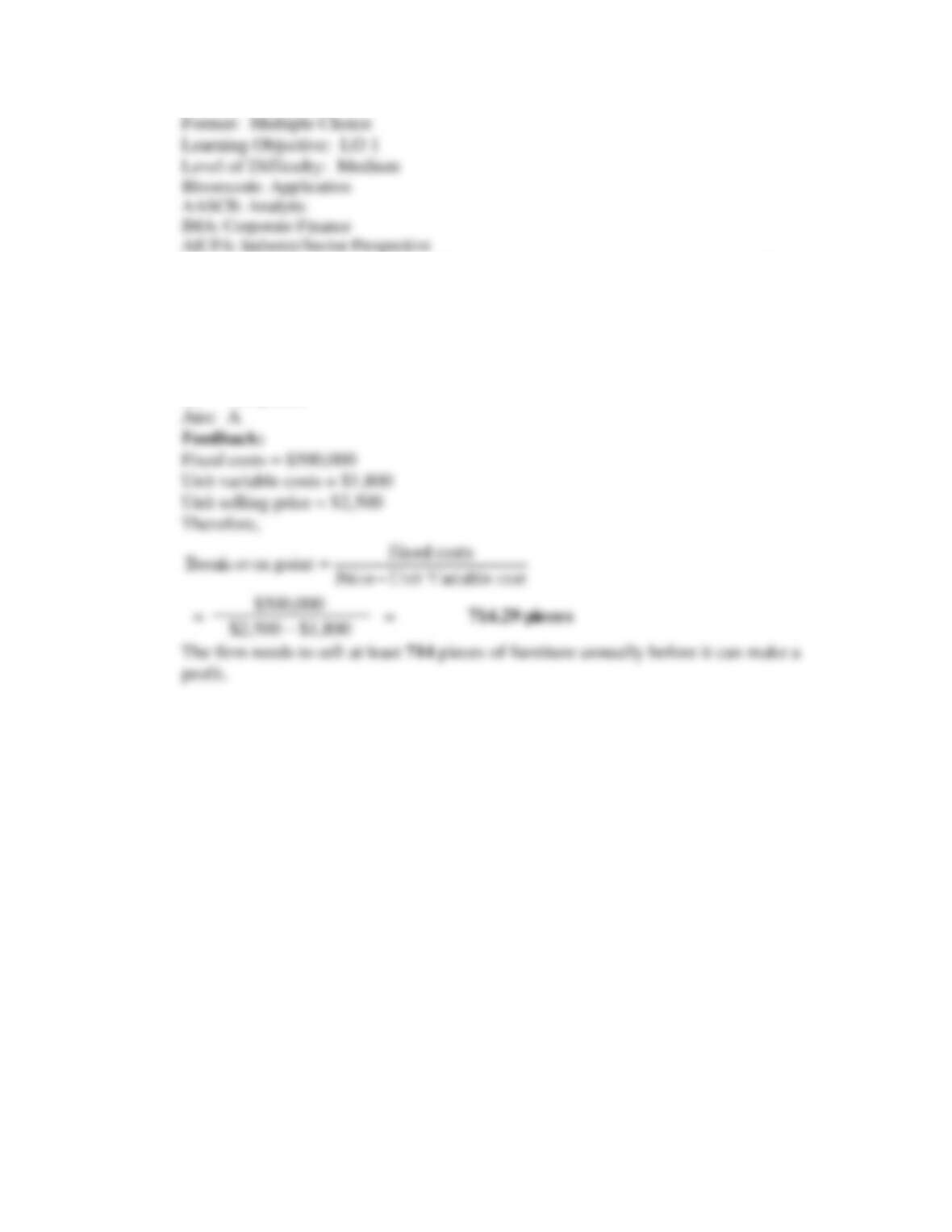
Warren Soft makes period pieces. The firm has total fixed costs of $500,000. The
average piece is sold at a price of $2,500 and involves variable costs of $1,800 per unit.
What is the break-even point for this firm? (Round to nearest whole unit.)
A)
714 pieces
B)
928 pieces
C)
617 pieces
D)
738 pieces
Ans:
A
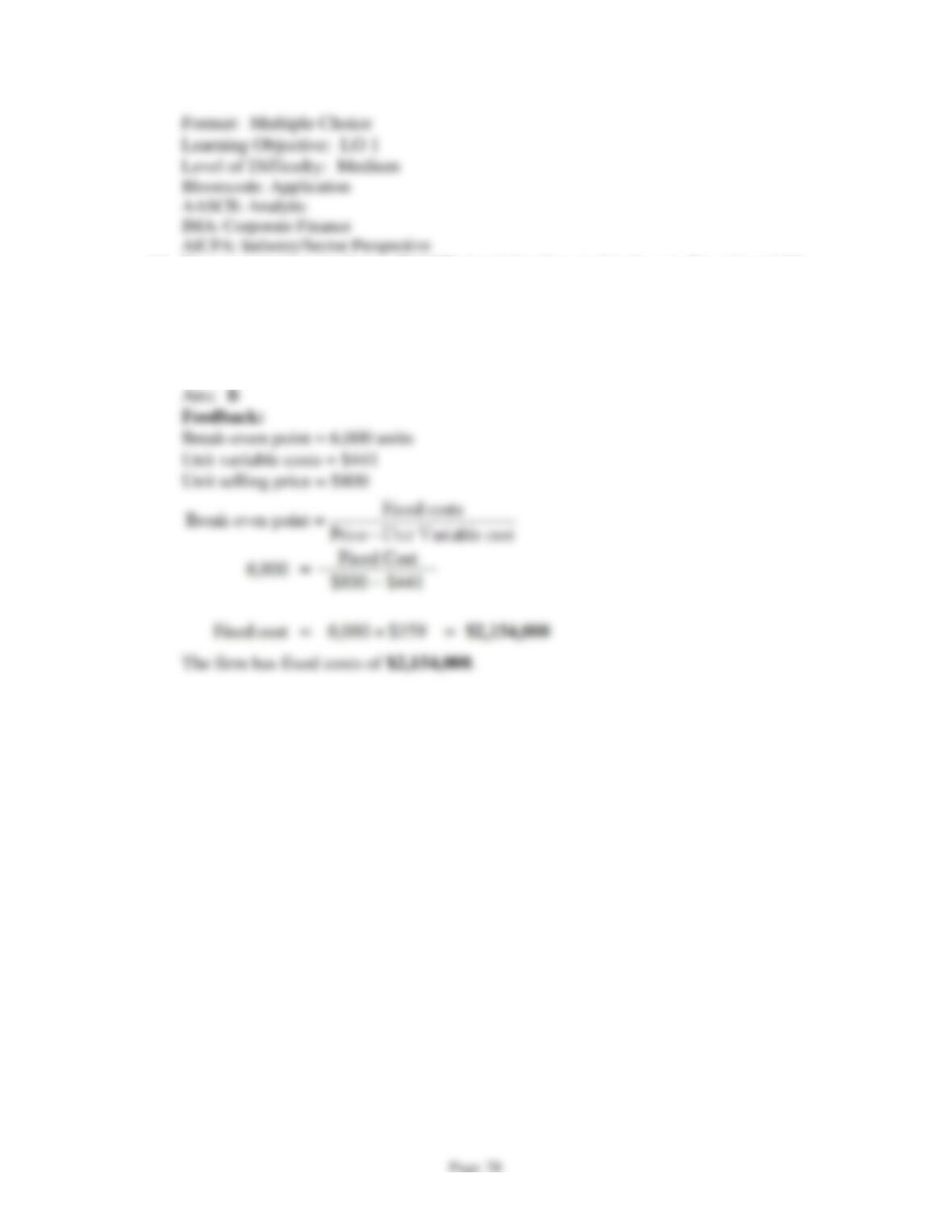
64.
Neucon company needs to sell 6,000 circuit breakers to break even. Its unit variable
cost is $441, and its unit selling price is $800. What is the fixed cost of this company?
A)
$1,497,250
B)
$2,154,000
C)
$2,855,250
D)
$4,652,500
Ans:
B
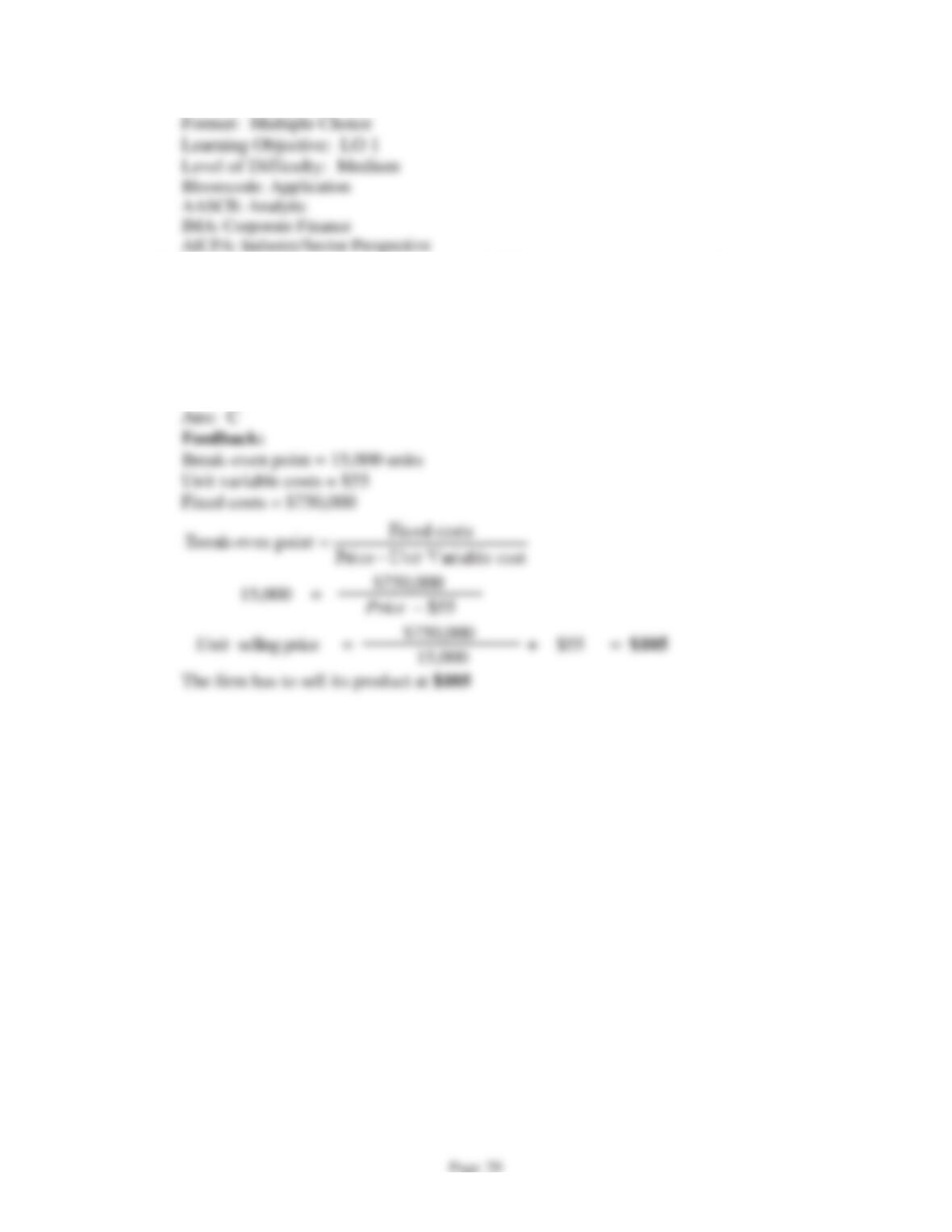
65.
FifeSiete Corp. wants to break even at 15,000 units on its only product. Its unit variable
cost is $55, and its fixed cost is $750,000. What should be the company’s unit selling
price?
A)
$85
B)
$92
C)
$105
D)
$78
Ans:
C
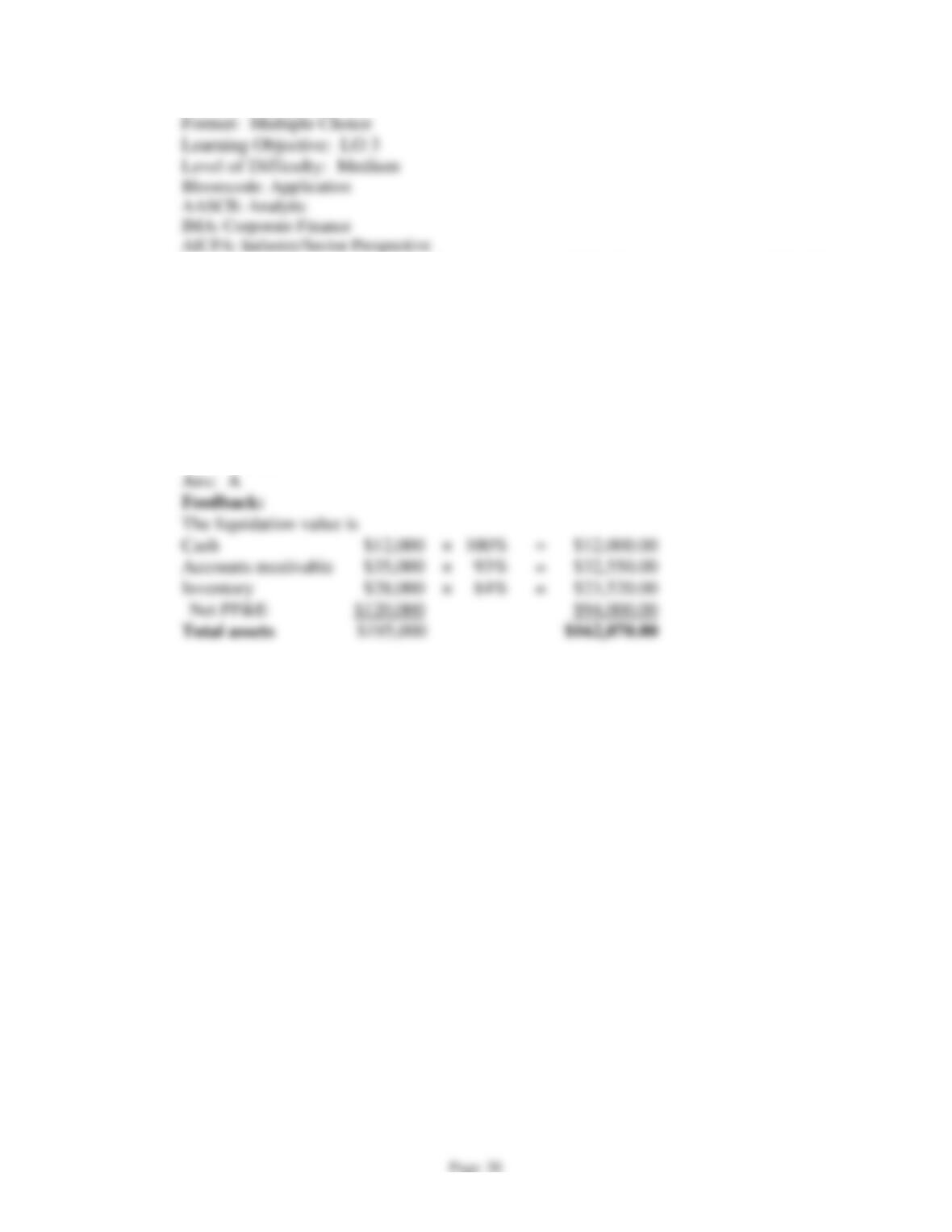
66.
Settetocol, Inc., has cash of $12,000, receivables of $35,000, and inventory of $28,000.
In addition, the firm has fixed assets of $120,000. Management has also told you that
you can reasonably expect to collect 93 percent of the receivables, that the inventory
could be sold to realize 84 percent of its book value, and that the sale of the property,
plant, and equipment would yield $94,000. What is the liquidation value of this
company? (Round to the nearest dollar.)
A)
$162,070
B)
$139,695
C)
$174,866
D)
$138,695
Ans:
A
The liquidation value is
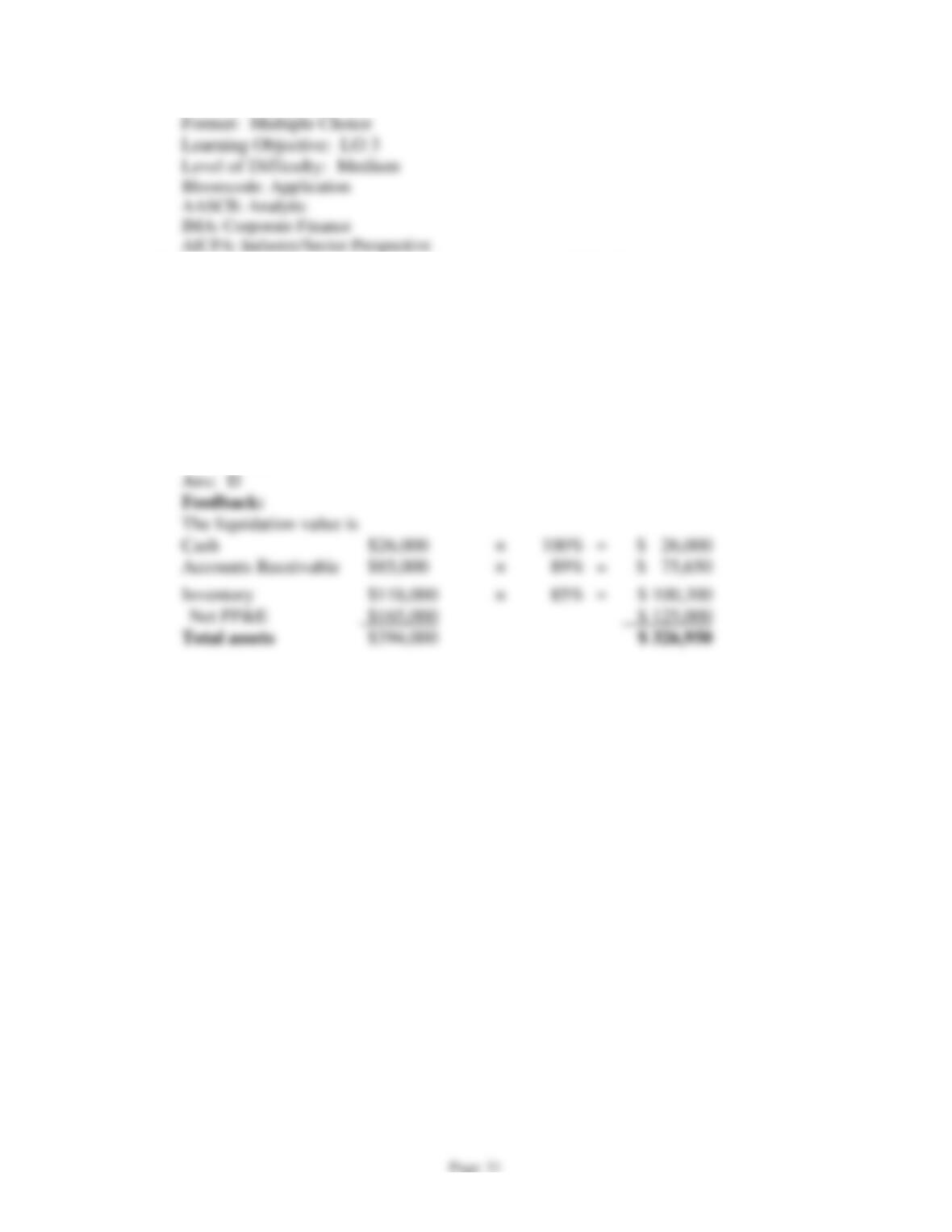
67.
Foursonic Labs has cash of $26,000, receivables of $85,000, and inventory of
$118,000. In addition, the firm has property, plant, and equipment of $165,000.
Management has also told you that you can reasonably expect to collect 89 percent of
the receivables, that the inventory could be sold to realize 85 percent of its book value,
and that the sale of the property, plant, and equipment would yield $125,000. What is
the liquidation value of this company? (Round to the nearest dollar.)
A)
$201,950
B)
$229,000
C)
$394,000
D)
$326,950
Ans:
D
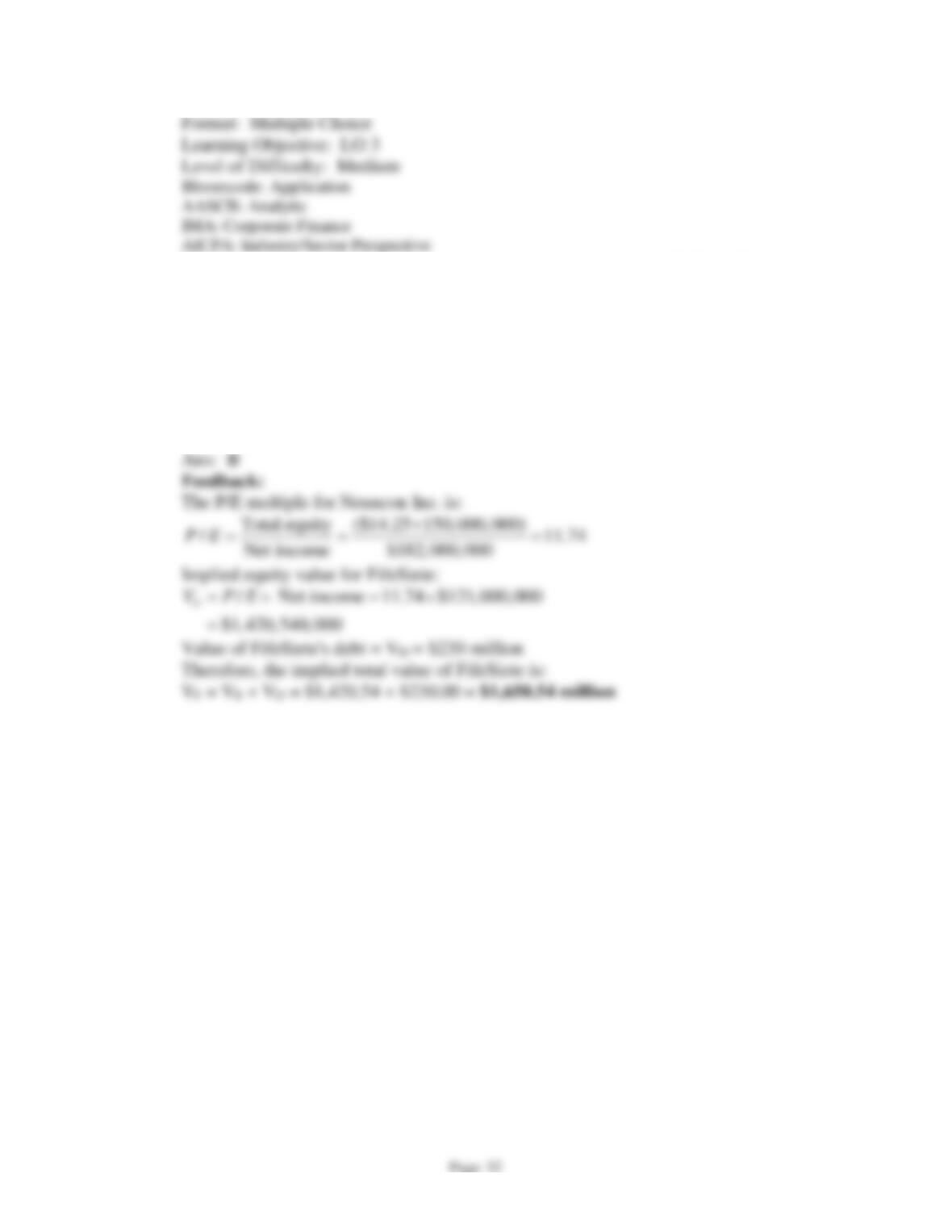
68.
FifeSiete. has debt of $230 million and generated a net income of $121 million in the
last fiscal year. In attempting to determine the total value of the firm, an investor
identified a similar firm in Neuncon, Inc., an all-equity firm. This firm had 150 million
shares outstanding, a share price of $14.25, and net income of $182 million. What is the
total value of FifeSiete? (Round to the nearest million dollars.)
A)
$1,421 million
B)
$1,651 million
C)
$1,191 million
D)
$1,715 million
Ans:
B
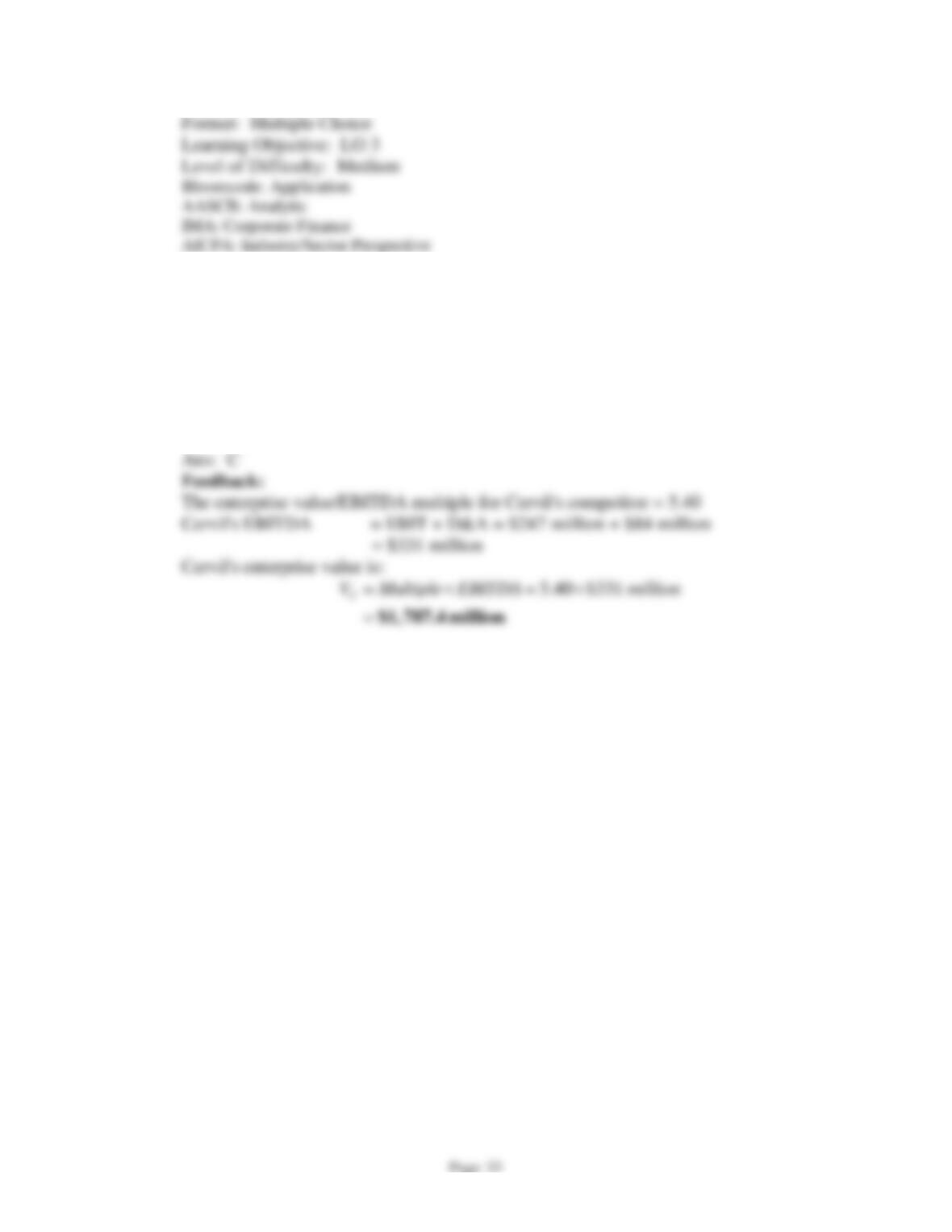
69.
Cervil had an EBIT of $247 million in the last fiscal year. Its depreciation and
amortization expenses amounted to $84 million. The firm has 135 million shares
outstanding and a share price of $12.80. A competing firm that is very similar to Cervil
has an enterprise value/EBITDA multiple of 5.40. What is the enterprise value of
Cervil? (Round to the nearest million dollars.)
A)
$1,334 million
B)
$453 million
C)
$1,787 million
D)
$1,315 million
Ans:
C
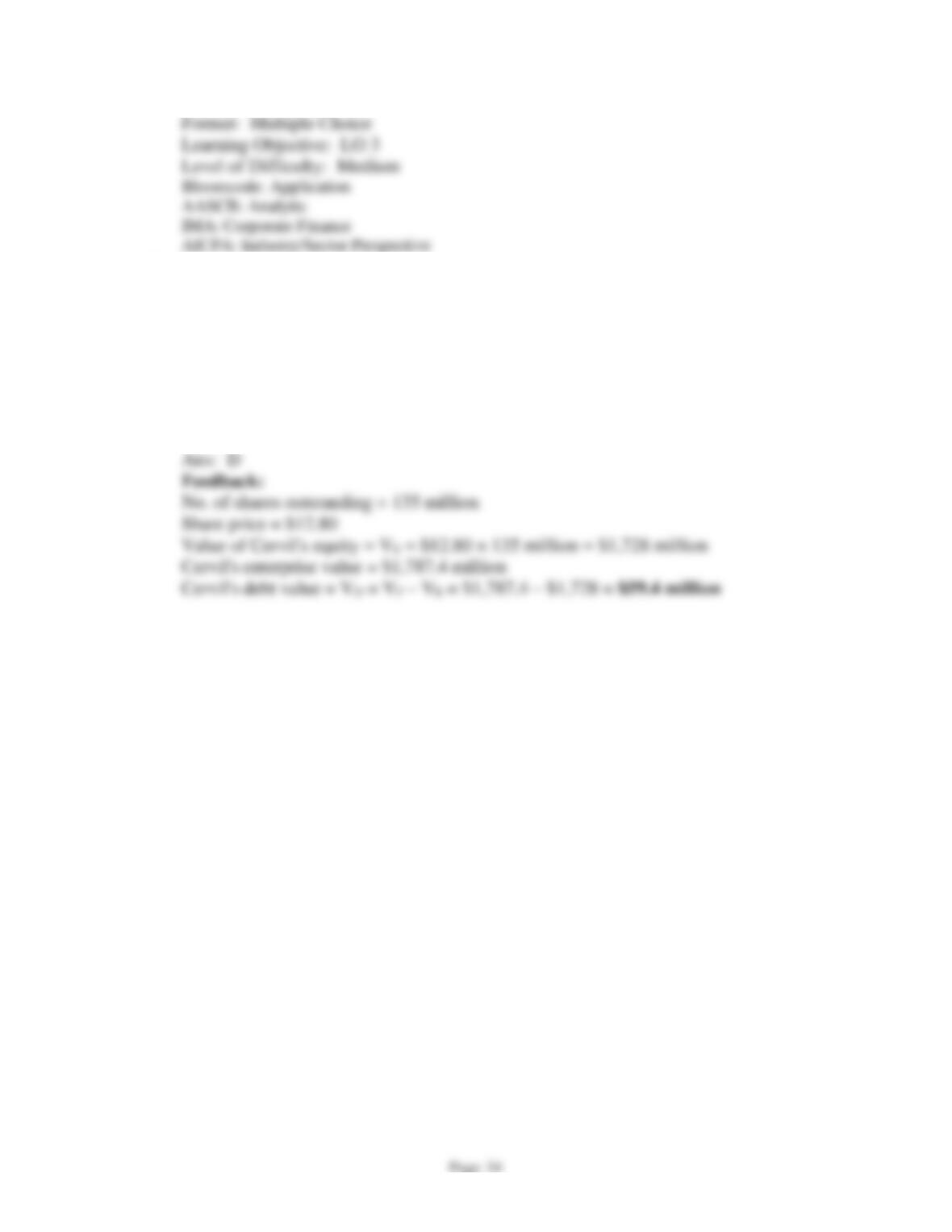
70.
Cervil had an EBIT of $247 million in the last fiscal year. Its depreciation and
amortization expenses amounted to $84 million. The firm has 135 million shares
outstanding and a share price of $12.80. A competing firm that is very similar to Cervil
has an enterprise value/EBITDA multiple of 5.40. What is the value of Cervil’s debt?
(Round to the nearest million dollars.)
A)
$121 million
B)
$165 million
C)
$97 million
D)
$59 million
Ans:
D
No. of shares outstanding = 135 million
Share price = $12.80
Value of Cervil’s equity = VE = $12.80 × 135 million = $1,728 million
Cervil’s enterprise value = $1,787.4 million