Cost Accounting: A Managerial Emphasis, 6e
Chapter 18 – Spoilage, Rework, and Scrap
10) What are the amounts of direct materials and conversion costs assigned to ending work in process
using the weighted-average process costing method?
A) $18,720; $24,000
B) $22,900; $19,820
C) $24,000; $18,720
D) $28,560; $14,160
E) $33,650; $14,140
11) Total cost per equivalent unit using the weighted-average method equals
A) the cost per equivalent unit of direct materials plus cost per spoiled unit.
B) the cost per equivalent unit of conversion costs plus cost per unit of spoiled materials.
C) the total costs divided by total equivalent units.
D) the cost per equivalent unit of direct materials plus the cost per equivalent unit of conversion costs.
E) the cost per equivalent unit of indirect materials plus cost per spoiled unit.
12) The goal of separately identifying abnormal spoilage is to
A) properly cost units in the system.
B) assist in performance measurement.
C) ensure that such units do not reach finished goods inventory.
D) reduce abnormal spoilage to an acceptable level.
E) reduce abnormal spoilage to nil.
13) Under the FIFO method, all spoilage costs are assumed to be
A) related to the units in beginning inventory, plus the units completed during the period.
B) related to the units completed during the period.
C) related to the units in ending inventory.
D) related to the units in both beginning and ending inventory plus the units completed during the
period.
E) related to the units completed in both beginning and ending inventory.
Cost Accounting: A Managerial Emphasis, 6e
Chapter 18 – Spoilage, Rework, and Scrap
Use the information below to answer the following question(s).
Cartwright Custom Carpentry manufactures chairs in its Processing Department, and uses the FIFO cost
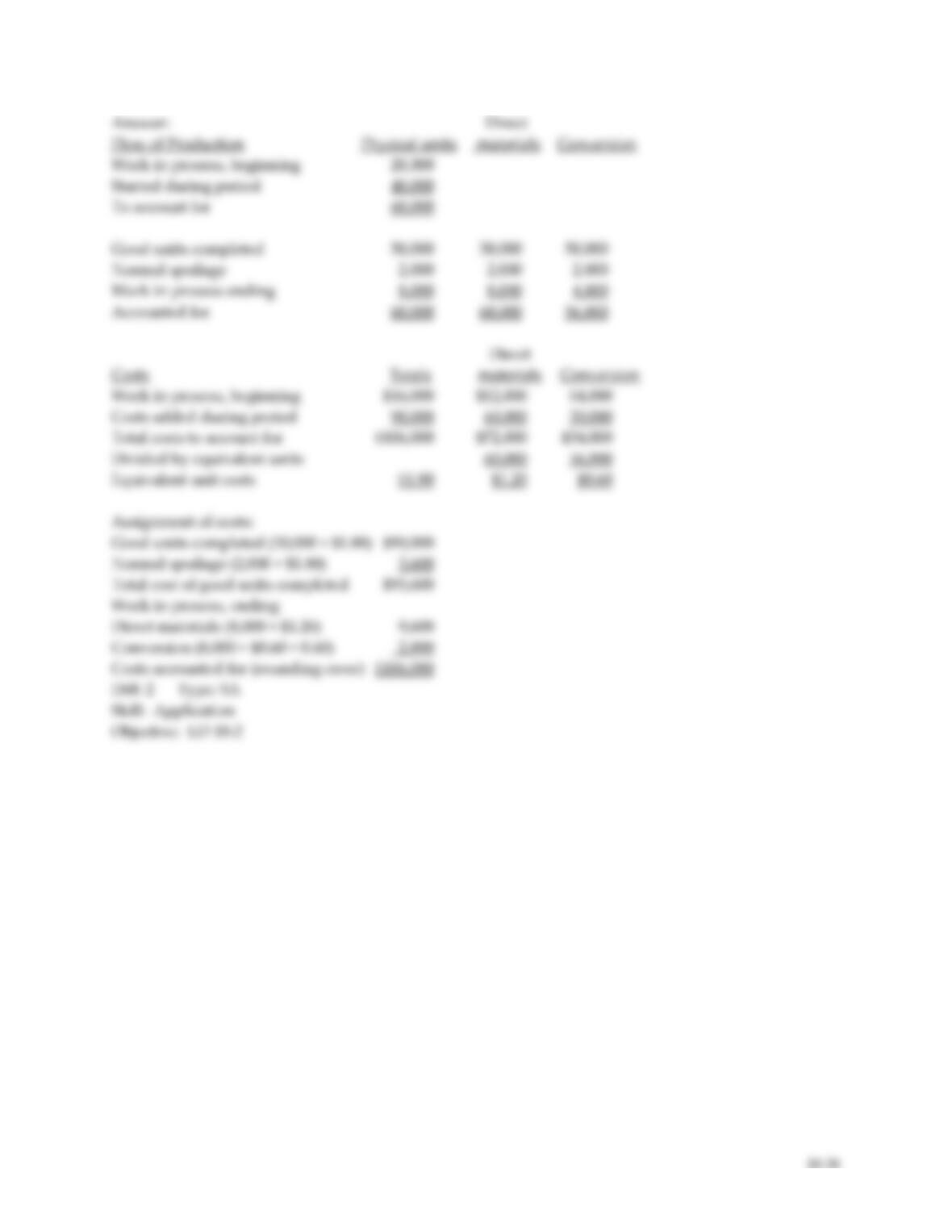
flow assumption. Direct Materials are included at the inception of the production cycle and must be
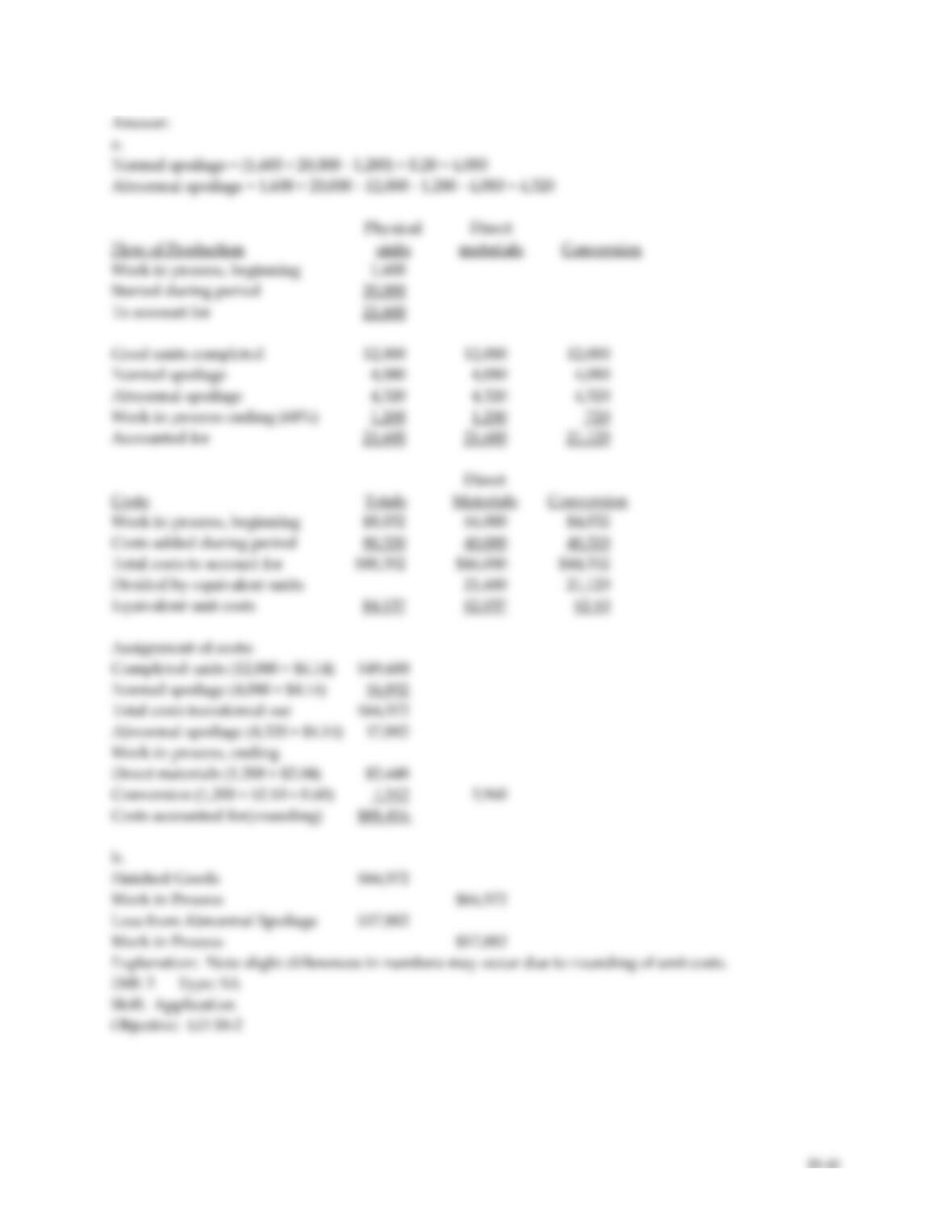
bundled in single kits for each unit. Conversion costs are incurred evenly throughout the production
cycle. Inspection takes place at the end of the process, and spoiled units generally constitute 3 percent of
the good output. Information provided for March is as follows:
WIP, Beginning inventory March 1
30,000 units
Direct materials: 100% complete
Conversion costs: 89.5% complete
Started during March
80,000 units
Completed & Transferred Out
86,000 units
WIP, Ending inventory March 31
20,000 units
Direct materials: 100% complete
Conversion costs: 75% complete
Costs:
WIP, Beginning Inventory:
Direct materials
$70,000
Conversion costs
40,000
Direct materials added
160,000
Conversion costs added
120,000
14) What are the normal and abnormal spoilage units, respectively, for March?
A) 2,580 units; 1,420 units
B) 1,950 units; 1,390 units
C) 1,690 units; 1,050 units
D) 1,420 units; 2,580 units
E) 1,140 units; 1,140 units
Cost Accounting: A Managerial Emphasis, 6e
Chapter 18 – Spoilage, Rework, and Scrap
15) What are the costs per equivalent unit for direct materials and conversion respectively?
A) $2.00; $1.54
B) $1.45; $1.54
C) $2.11; $1.62
D) $2.11; $1.18
E) $2.00; $1.18
Cost Accounting: A Managerial Emphasis, 6e
Chapter 18 – Spoilage, Rework, and Scrap
Use the information below to answer the following question(s).
Cartwright Custom Carpentry manufactures chairs in its Processing Department, and uses the FIFO cost
flow assumption. Direct Materials are included at the inception of the production cycle and must be
bundled in single kits for each unit. Conversion costs are incurred evenly throughout the production
cycle. Inspection takes place at the end of the process and spoiled units generally constitute 3 percent of
the good output Information provided for March is as follows:
WIP, Beginning inventory March 1
30,000 units
Direct materials: 100% complete
Conversion costs: 89.5% complete
Started during March
80,000 units
Completed & Transferred Out
86,000 units
WIP, Ending inventory March 31
20,000 units
Direct materials: 100% complete
Conversion costs: 75% complete
Costs:
WIP, Beginning Inventory:
Direct materials
$70,000
Conversion costs
40,000
Direct materials added
160,000
Conversion costs added
120,000
16) What costs are allocated to the ending work in process inventory for direct materials and conversion
costs, respectively?
A) $28,250; $24,850
B) $30,000; $23,100
C) $30,000; $21,590
D) $39,500; $13,600
E) $40,000; $23,100
Cost Accounting: A Managerial Emphasis, 6e
Chapter 18 – Spoilage, Rework, and Scrap
18–25
Use the information below to answer the following question(s).
Cartwright Custom Carpentry manufactures chairs in its Processing Department. Direct Materials are
included at the inception of the production cycle and must be bundled in single kits for each unit.
Conversion costs are incurred evenly throughout the production cycle. Inspection takes place at the end
of the process and spoiled units generally constitute 3 percent of the good units. Data provided for March
is as follows:
WIP, Beginning inventory March 1
30,000 units
Direct materials: 100% complete
Conversion costs: 89.5% complete
Started during March
80,000 units
Completed & Transferred Out
86,000 units
WIP, Ending inventory March 31
20,000 units
Direct materials: 100% complete
Conversion costs: 75% complete
Costs:
WIP, Beginning Inventory:
Direct materials
$70,000
Conversion costs
40,000
Direct materials added
160,000
Conversion costs added
120,000
Cost Accounting: A Managerial Emphasis, 6e
Chapter 18 – Spoilage, Rework, and Scrap
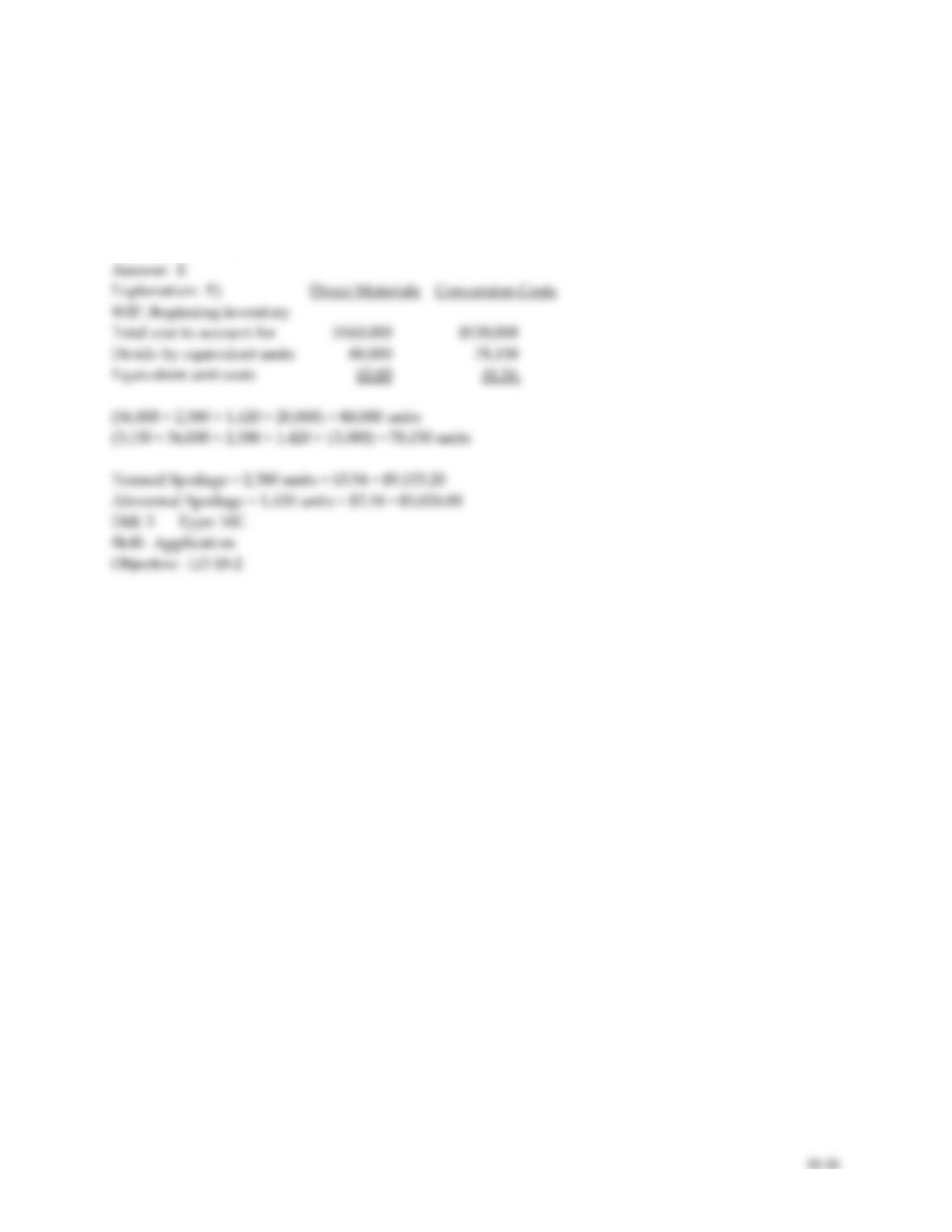
17) What costs would be associated with normal and abnormal spoilage, respectively, using the FIFO
method of process costing?
A) $5,890.64; $9,133.20
B) $5,890.64; $5,826.00
C) $6,469.64; $7,690.36
D) $7,690.36; $5,026.80
E) $9,133.20; $5,026.80
Cost Accounting: A Managerial Emphasis, 6e
Chapter 18 – Spoilage, Rework, and Scrap
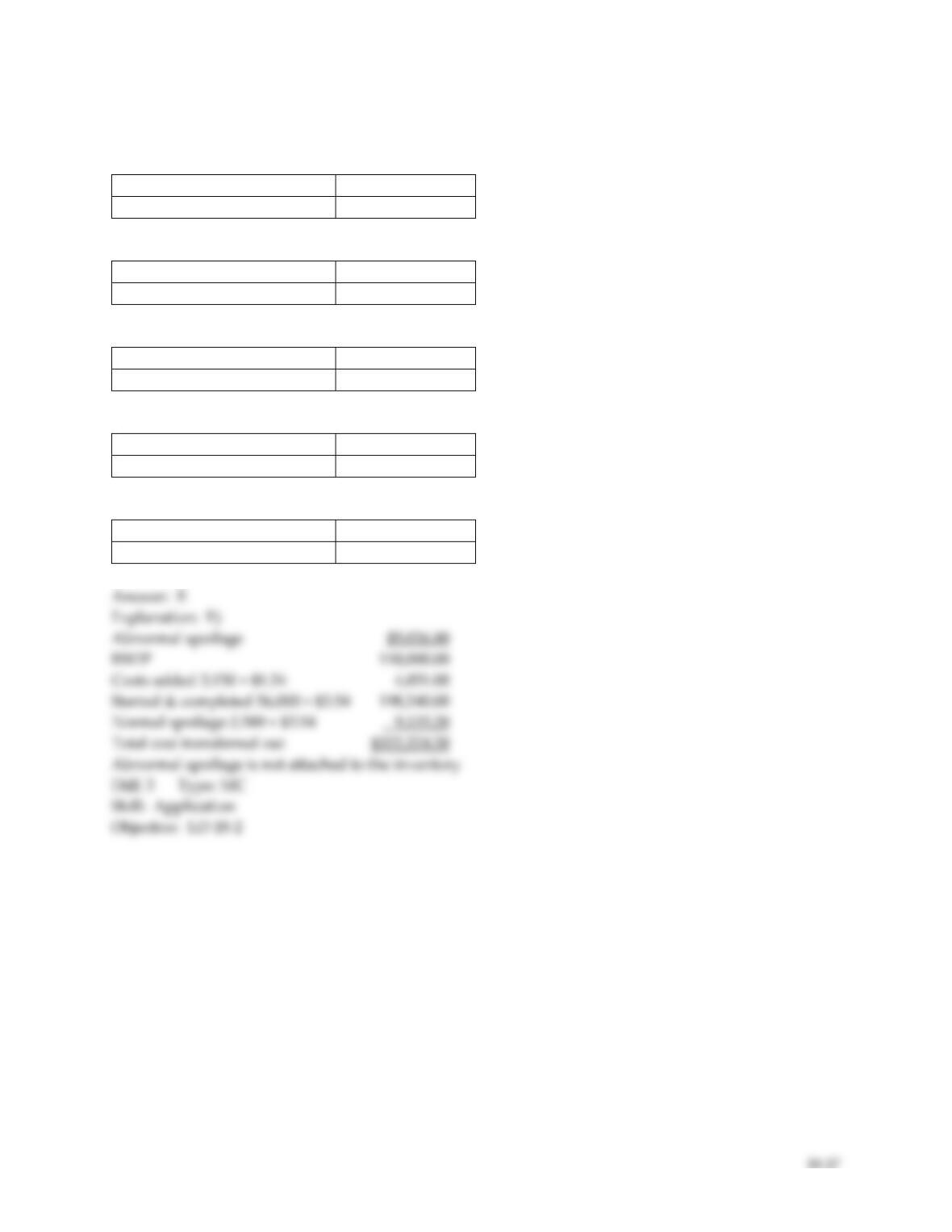
18) Which of the following journal entries correctly represents the transfer of completed goods for the
current period using the FIFO method of process costing?
A)
Finished Goods
$10,560.28
Loss from Spoilage
$10,560.28
B)
Loss from Spoilage
$5,026.80
Finished Goods
$5,026.80
C)
Finished Goods
$311,500.00
Work in Process
$311,500.00
D)
Finished Goods
$401,700.00
Work in Process
$401,700.00
E)
Finished Goods
$322.224.20
Work in Process
$322,224.20
Cost Accounting: A Managerial Emphasis, 6e
Chapter 18 – Spoilage, Rework, and Scrap
19) Boss Cycle generally has spoiled goods during each job. Costs are assigned to normal spoilage at
$10.00 per unit and abnormal spoilage at $20.00 per unit. Disposal fees typically run $5.00 per item. Boss
Cycle has a policy never to rework spoiled units. Management believes that once a unit is damaged it
cannot be reworked into a quality product. The losses are charged back to the specific job.
What is the appropriate journal entry if 300 units are considered abnormal spoilage and are not disposed
of in a process costing system?
A)
Loss from Abnormal Spoilage
$6,000
Work in Process Control
$6,000
B)
Work in Process Control
$1,500
Loss from Abnormal Spoilage
$1,500
C)
Loss from Abnormal Spoilage
$6,000
Inventory
$6,000
D)
Loss from Abnormal Spoilage
$1,500
Work in Process
$1,500
E)
Loss from Abnormal Spoilage
$1,500
Work in Process Control
$1,500
Cost Accounting: A Managerial Emphasis, 6e
Chapter 18 – Spoilage, Rework, and Scrap
Answer the following question(s) using the information below.
Samantha’s Office Supplies manufactures desk organizers in its Processing Department. Direct materials
are added at the beginning of the process and conversion costs are incurred evenly throughout the
production cycle. Inspection takes place at the end of the process and spoiled units generally constitute
4% of the good units. Data provided for February are as follows:
WIP, beginning inventory February 1
25,000 units
Direct materials (100% complete)
Conversion costs (50% complete)
Started during February
82,000 units
Completed and transferred out
81,000 units
WIP, ending inventory February 28
15,000 units
Direct materials (100% complete)
Conversion costs (25% complete)
Costs:
WIP, beginning inventory:
Direct materials
$150,000
Conversion costs
44,000
Direct materials added
209,916
Conversion costs added
109,893
20) What are the normal and abnormal spoilage units, respectively, for February when using FIFO?
A) 1,400 units; 1,480 units
B) 3,280 units; 1,640 units
C) 3,240 units; 7,760 units
D) 3,240 units; 11,000 units
E) 7,760 units; 1,640 units
Cost Accounting: A Managerial Emphasis, 6e
Chapter 18 – Spoilage, Rework, and Scrap
21) What costs would be associated with normal and abnormal spoilage, respectively, using the FIFO
method of process costing?
A) $12,571; $30,108
B) $30,108; $12,571
C) $1,257; $3,010
D) $8,000; $4,000
E) $10,627; $25,453
Cost Accounting: A Managerial Emphasis, 6e
Chapter 18 – Spoilage, Rework, and Scrap
22) What costs are allocated to the ending work-in-process inventory for direct materials and conversion
costs, respectively, using the FIFO method of process costing?
A) $38,250; $4,850
B) $40,000; $23,100
C) $38,400; $4,950
D) $49,500; $38,400
E) $38,400; $19,800
Cost Accounting: A Managerial Emphasis, 6e
Chapter 18 – Spoilage, Rework, and Scrap
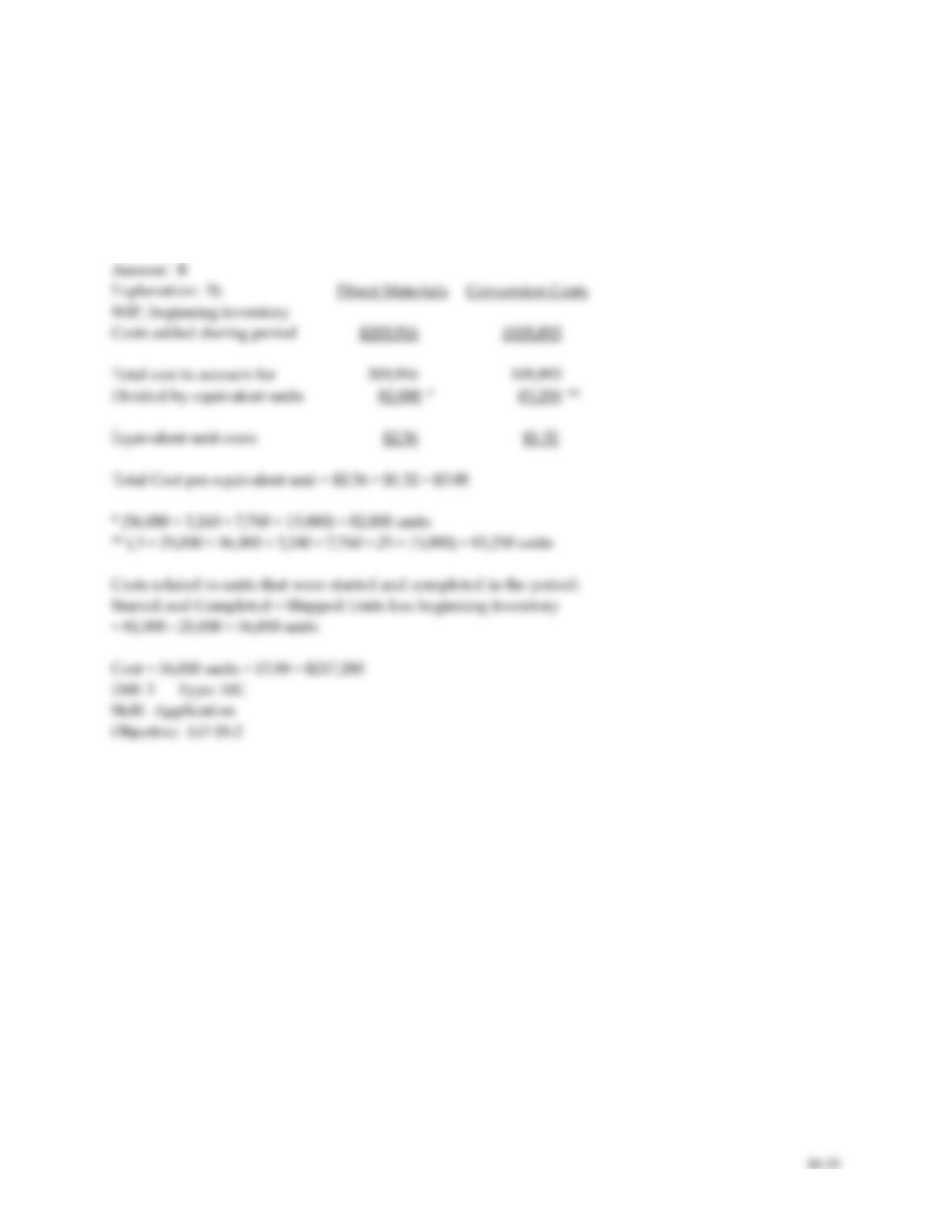
23) Using the FIFO method of process costing, what are the total costs of all the units that were initially in
the beginning work-in-process inventory and were subsequently shipped?
A) $194,000
B) $16,500
C) $210,500
D) $97,000
E) $274,500
Cost Accounting: A Managerial Emphasis, 6e
Chapter 18 – Spoilage, Rework, and Scrap
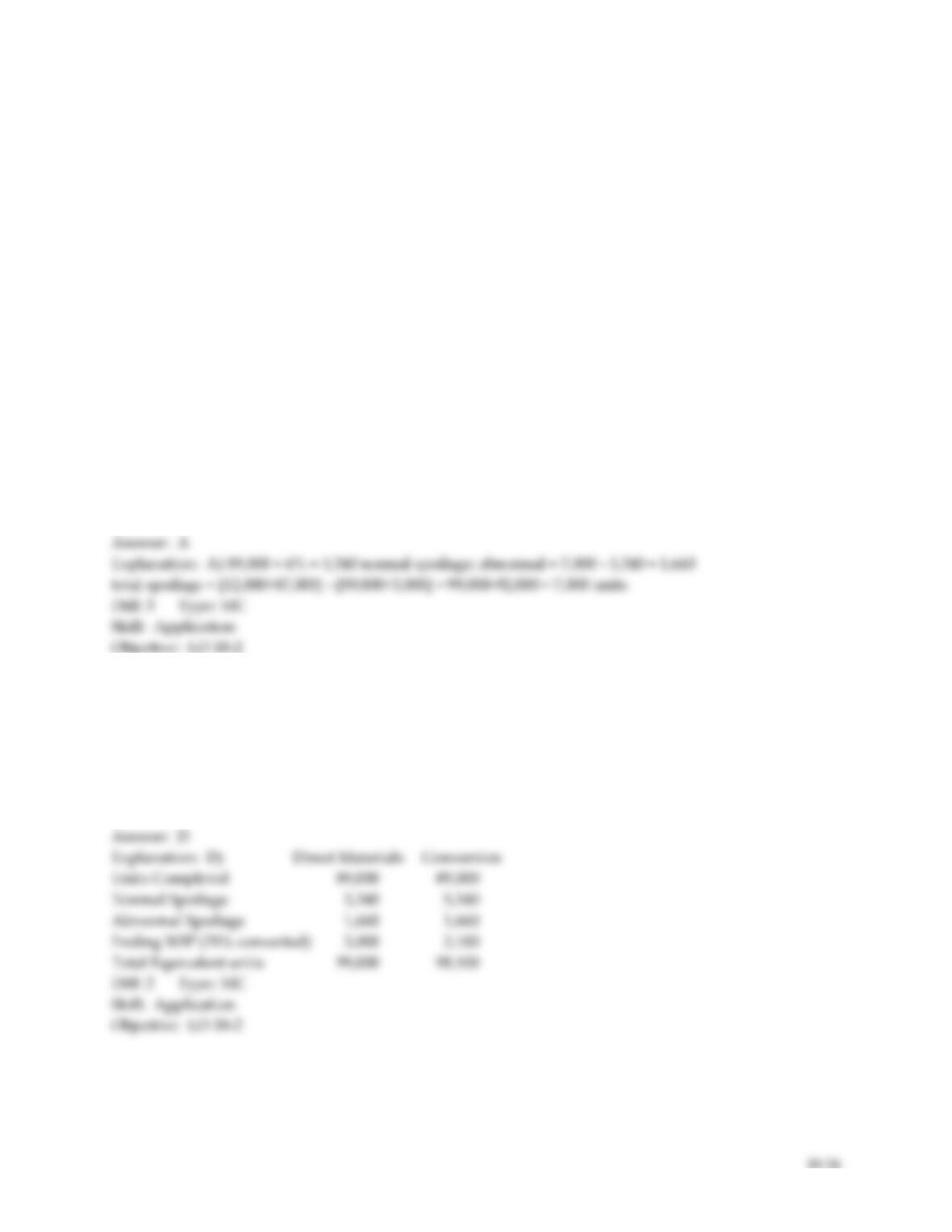
24) What are the direct materials and conversion costs of all the units that were started and completed
during February?
A) $314,280
B) $217,280
C) $318,160
D) $153,500
E) $143,360
Cost Accounting: A Managerial Emphasis, 6e
Chapter 18 – Spoilage, Rework, and Scrap
Answer the following question(s) using the information below:
Hawk Ltd. uses process costing in its Fabricating Department. At the beginning of October, it had 12,000
units in beginning work in process that were 40% complete with respect to conversion. During October it
put 87,000 units into production and completed 89,000 good units. At October 31, there were 3,000 units
in ending work in process that were 70% complete with respect to conversion. Direct materials are added
at the beginning of the process. Inspection occurs at the end of the process and normal spoilage is 6% of
good output.
Costs related to the beginning inventory were $36,800 for direct materials and $28,600 for conversion
costs. During the month, the company issued $280,000 of direct materials and incurred $599,400 of
conversion costs.
25) What are the normal and abnormal spoilage units, respectively, for October assuming Hawk uses the
weighted average method of process costing?
A) 5,340 units; 1,660 units
B) 7,000 units; 1,660 units
C) 5,220 units; 1,780 units
D) 5,340 units; 1,780 units
E) 5,940 units; 1,060 units
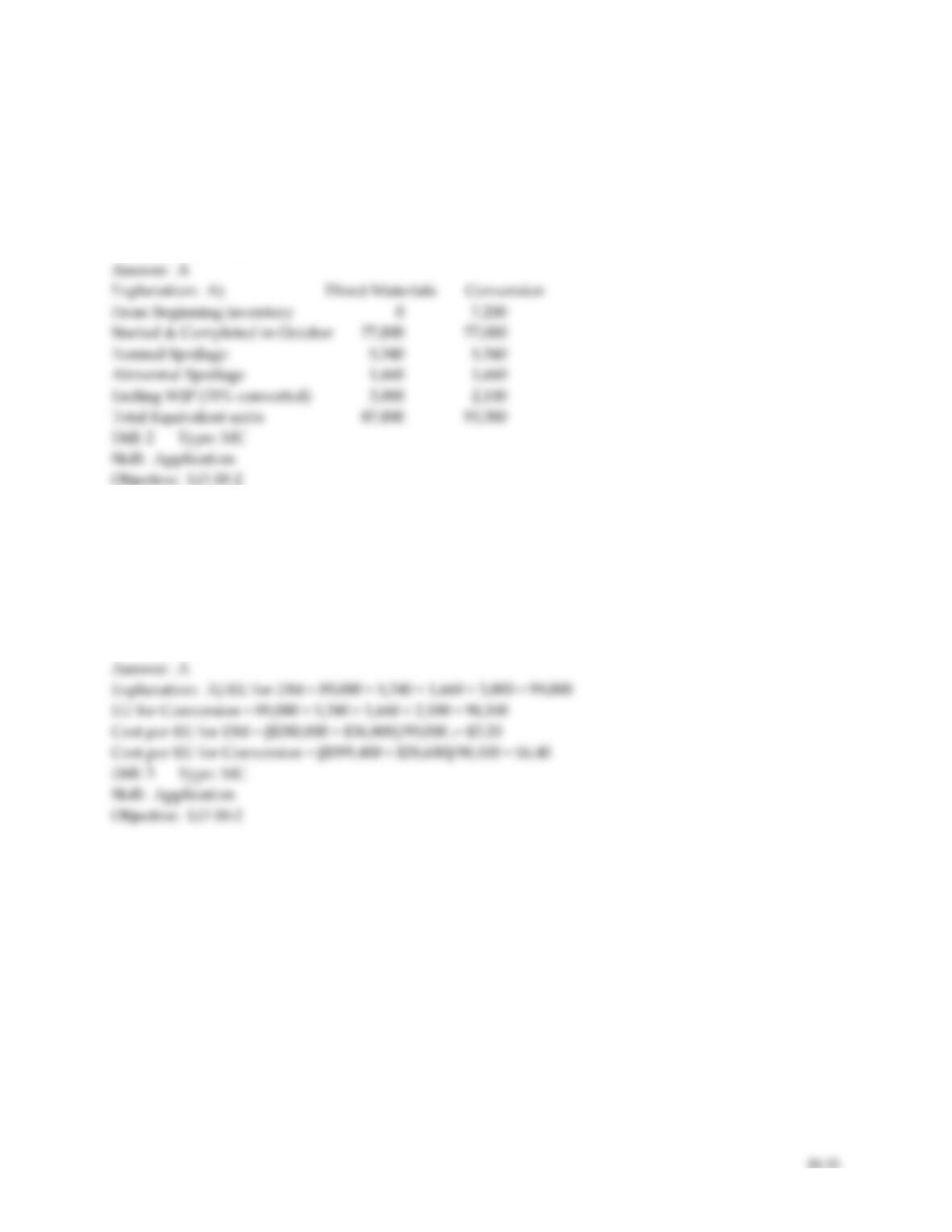
26) Assuming Hawk uses the weighted average method for process costing, the equivalent units for
direct materials and conversion for October are:
A) 89,000 units; 88,100 units
B) 87,000 units; 93,300 units
C) 82.000 units; 91.100 units
D) 99,000 units; 98,100 units
E) 92,000 units; 90,200 units
Cost Accounting: A Managerial Emphasis, 6e
Chapter 18 – Spoilage, Rework, and Scrap
27) Assuming Hawk uses the FIFO method of process costing, the equivalent units for direct materials
and conversion costs respectively for October are:
A) 87,000 units; 93,300 units
B) 87,000 units; 94,200 units
C) 80,000 units; 86,300 units
D) 87,000 units; 90,900 units
E) 99,000 units; 94,200 units
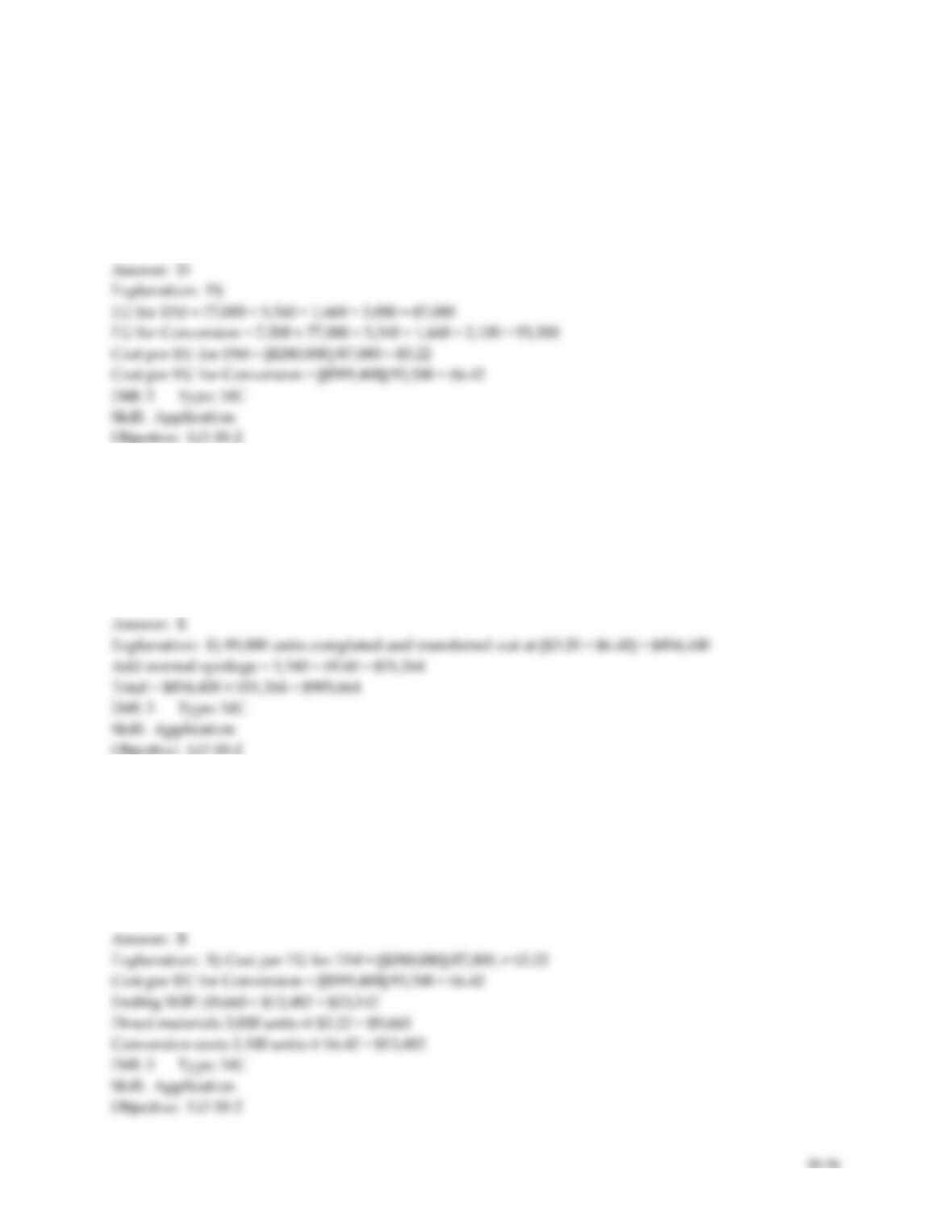
28) Assuming Hawk uses the weighted average method of process costing, the cost per equivalent unit
for direct materials and conversion costs respectively are:
A) $3.20; $6.40
B) $3.44; $6.89
C) $2.81; $6.09
D) $3.64; $6.40
E) $3.22; $6.42
Cost Accounting: A Managerial Emphasis, 6e
Chapter 18 – Spoilage, Rework, and Scrap
29) Assuming Hawk uses the FIFO method of process costing, the cost per equivalent unit for direct
materials and conversion costs respectively are:
A) $3.20; $6.40
B) $3.64; $6.40
C) $2.81; $6.09
D) $3.22; $6.42
E) $3.44; $6.89
30) Assuming Hawk uses the weighted average method for process costing, the total cost of goods
completed and transferred to finished goods is:
A) $854,400
B) $921,600
C) $877,440
D) $928,704
E) $905,664
31) Assuming Hawk uses the FIFO method of process costing, the cost of the ending work in process
inventory is:
A) $23,040
B) $23,142
C) $28,800
D) $28,920
E) $19,200
Cost Accounting: A Managerial Emphasis, 6e
Chapter 18 – Spoilage, Rework, and Scrap
18–37
32) Viking Sports is a manufacturer of sportswear. It produces all of its products in one department. The
information for the current month is as follows:
Beginning work in process 20,000 units
Units started 40,000 units
Units completed 50,000 units
Ending work in process 8,000 units
Spoilage 2,000 units
Beginning work in process direct materials $12,000
Beginning work in process conversion $4,000
Direct materials added during month $60,000
Direct manufacturing labour during month $20,000
Beginning work in process was half complete as to conversion. Direct materials are added at the
beginning of the process. Factory overhead is applied at a rate equal to 50 percent of direct manufacturing
labour. Ending work in process was 60 percent complete. All spoilage is normal and is detected at end of
the process.
Required:
Prepare a production cost worksheet assuming that spoilage is recognized and the weighted-average
method is used.
Cost Accounting: A Managerial Emphasis, 6e
Chapter 18 – Spoilage, Rework, and Scrap
Cost Accounting: A Managerial Emphasis, 6e
Chapter 18 – Spoilage, Rework, and Scrap
18–39
33) The Skate Board Company uses a process cost system for making skateboard wheels. Materials are
added at the beginning of the process and conversion costs are uniformly incurred. At the beginning of
September the work in process is 40 percent complete and at the end of the month it is 60 percent
complete. Spoilage is detected at the end of the process. Other data for the month include:
Beginning work in process inventory 1,600 units
Units started 20,000 units
Units placed in finished goods 12,000 units
Ending work in process inventory 1,200 units
Normal spoilage of units finished 20 percent
Conversion costs $40,320
Cost of direct materials $40,000
Beginning work in process costs:
Materials $4,000
Conversion $4,032
Required:
a. Prepare a production cost worksheet using the weighted-average method of process costing.
Recognize spoilage.
b. Prepare journal entries to record transferring out of cost from the work in process accounts.
Cost Accounting: A Managerial Emphasis, 6e
Chapter 18 – Spoilage, Rework, and Scrap