Cost Accounting: A Managerial Emphasis, 6e
Chapter 18 – Spoilage, Rework, and Scrap
18–41
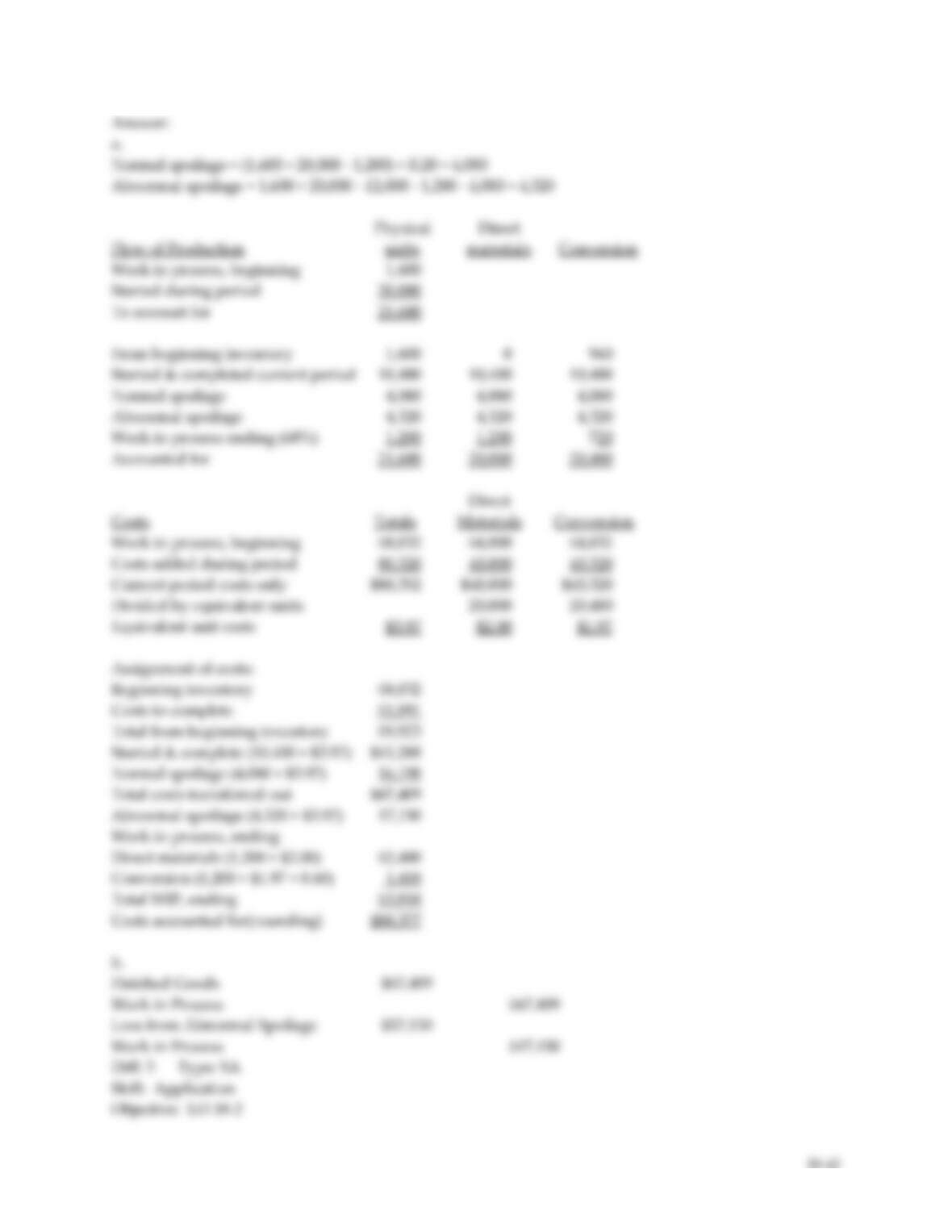
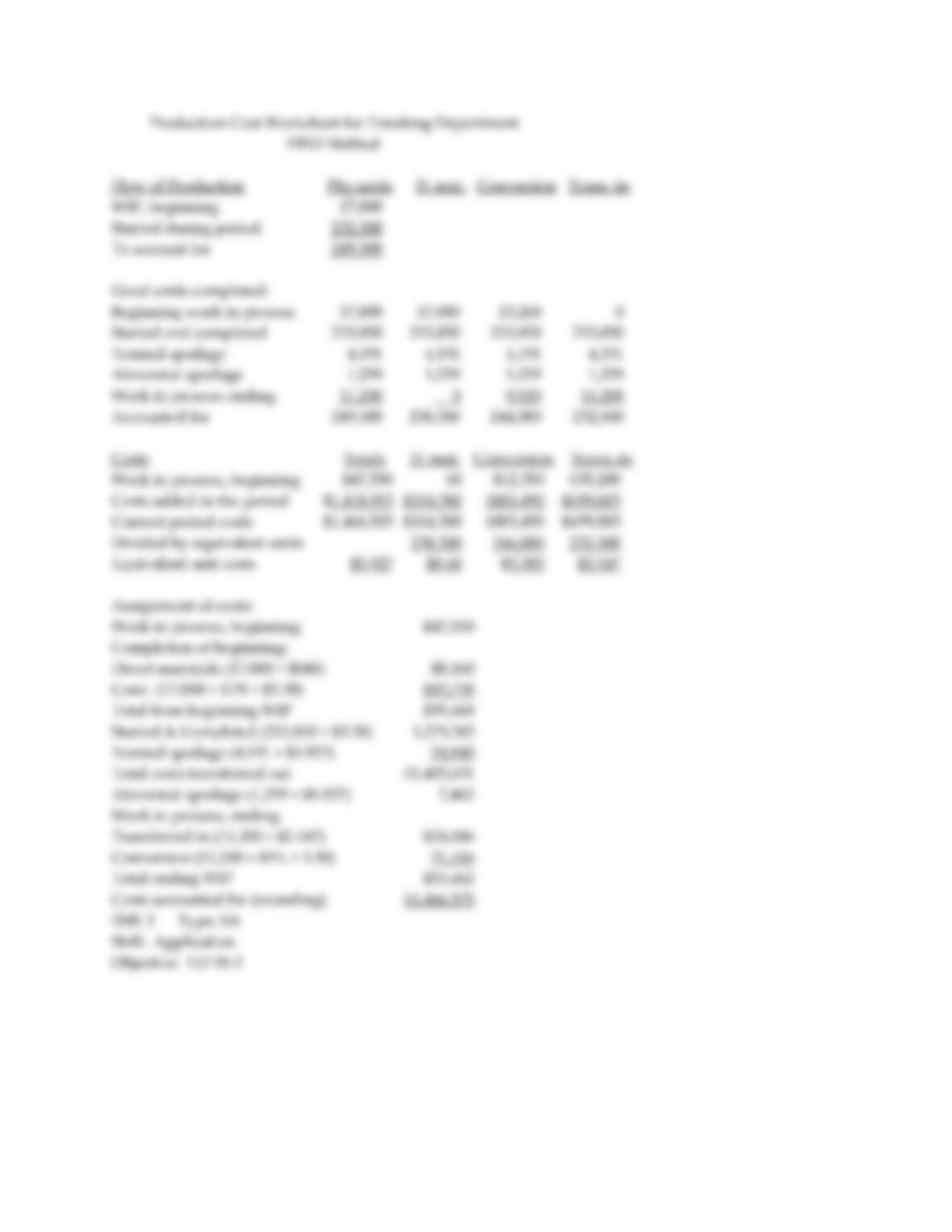
34) The Skate Board Company uses a process cost system for making skateboard wheels. Materials are
added at the beginning of the process and conversion costs are uniformly incurred. At the beginning of
September the work in process is 40 percent complete and at the end of the month it is 60 percent
complete. Spoilage is detected at the end of the process. Other data for the month include:
Beginning work in process inventory 1,600 units
Units started 20,000 units
Units placed in finished goods 12,000 units
Ending work in process inventory 1,200 units
Normal spoilage of units finished 20 percent
Conversion costs $40,320
Cost of direct materials $40,000
Beginning work in process costs:
Materials $4,000
Conversion $4,032
Required:
a. Prepare a production cost worksheet using the FIFO method of process costing. Recognize spoilage.
b. Prepare journal entries to record transferring out of cost from the work in process accounts.
Cost Accounting: A Managerial Emphasis, 6e
Chapter 18 – Spoilage, Rework, and Scrap
Cost Accounting: A Managerial Emphasis, 6e
Chapter 18 – Spoilage, Rework, and Scrap
18–43
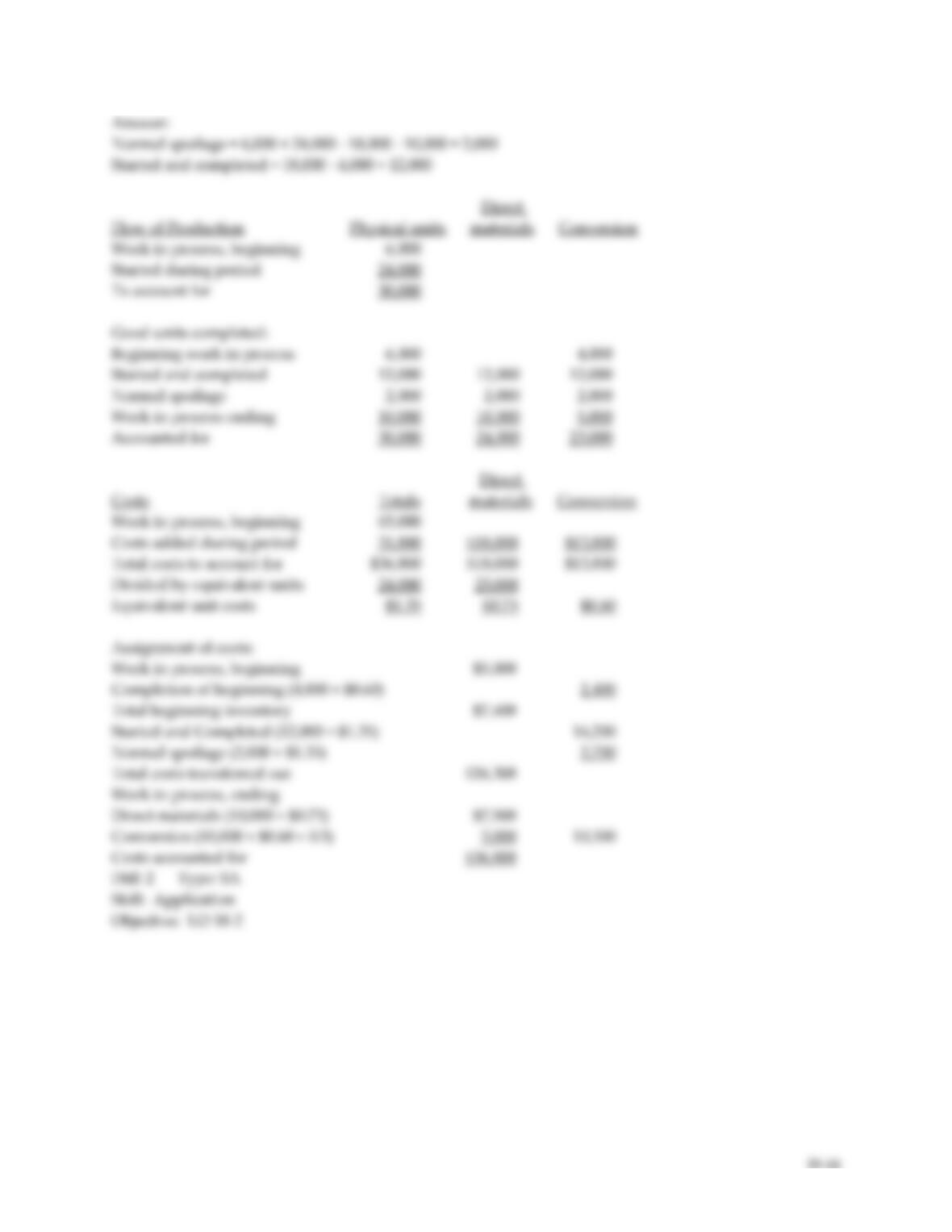
35) New Image Sports uses a process costing system. Direct materials are placed into production at the
beginning of the process. All spoilage is normal and is detected at the end of the process. For March the
company had the following activities:
Beginning work in process inventory 6,000 units, one third complete
Units placed in production 24,000 units
Good units completed 18,000 units
Ending work in process inventory 10,000 units, one half complete
Cost of beginning work in process $5,000
Direct material costs, current $18,000
Conversion costs, current $13,800
Required:
Prepare a production cost worksheet using the FIFO method.
Cost Accounting: A Managerial Emphasis, 6e
Chapter 18 – Spoilage, Rework, and Scrap
Cost Accounting: A Managerial Emphasis, 6e
Chapter 18 – Spoilage, Rework, and Scrap
18–45
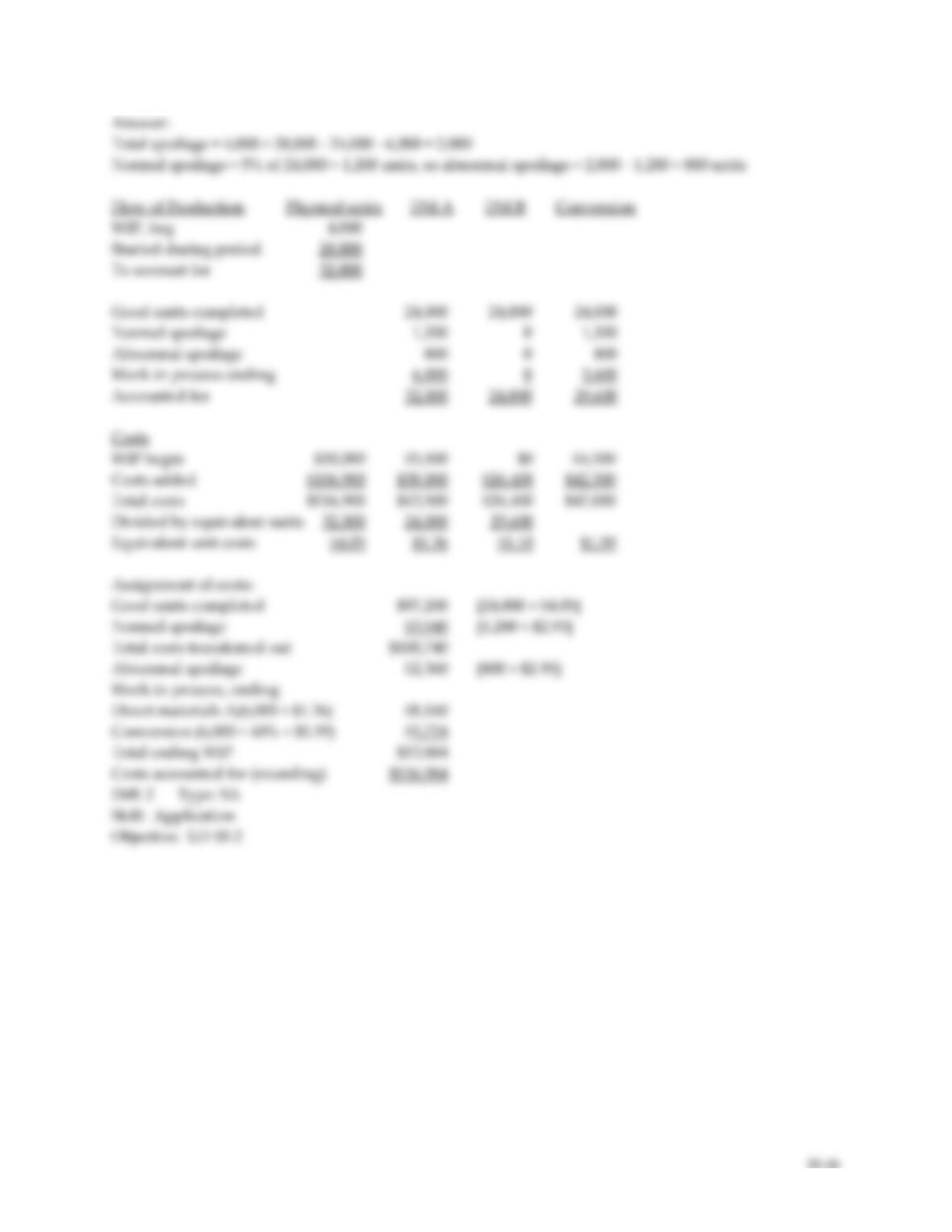
36) Wilson Sports uses a process costing system. Direct material A is placed into production at the
beginning of the process, while direct material B is placed into production at the end of the process.
Inspection occurs at the end of the process, before the addition of direct material B. Normal spoilage is 5%
of good units. For March the company had the following activities:
Beginning work in process inventory 4,000 units, 30% complete
Units placed in production 28,000 unit
Good units completed 24,000 units
Ending work in process inventory 6,000 units, 60% complete
Cost of beginning work in process $10,000 ($5,500 direct material A, $4,500 conversion)
Direct material A costs, current $38,000
Direct material B costs, current $26,400
Conversion costs, current $42,500
Required:
Prepare a production cost worksheet using the weighted average method.
Cost Accounting: A Managerial Emphasis, 6e
Chapter 18 – Spoilage, Rework, and Scrap

Cost Accounting: A Managerial Emphasis, 6e
Chapter 18 – Spoilage, Rework, and Scrap
18–47
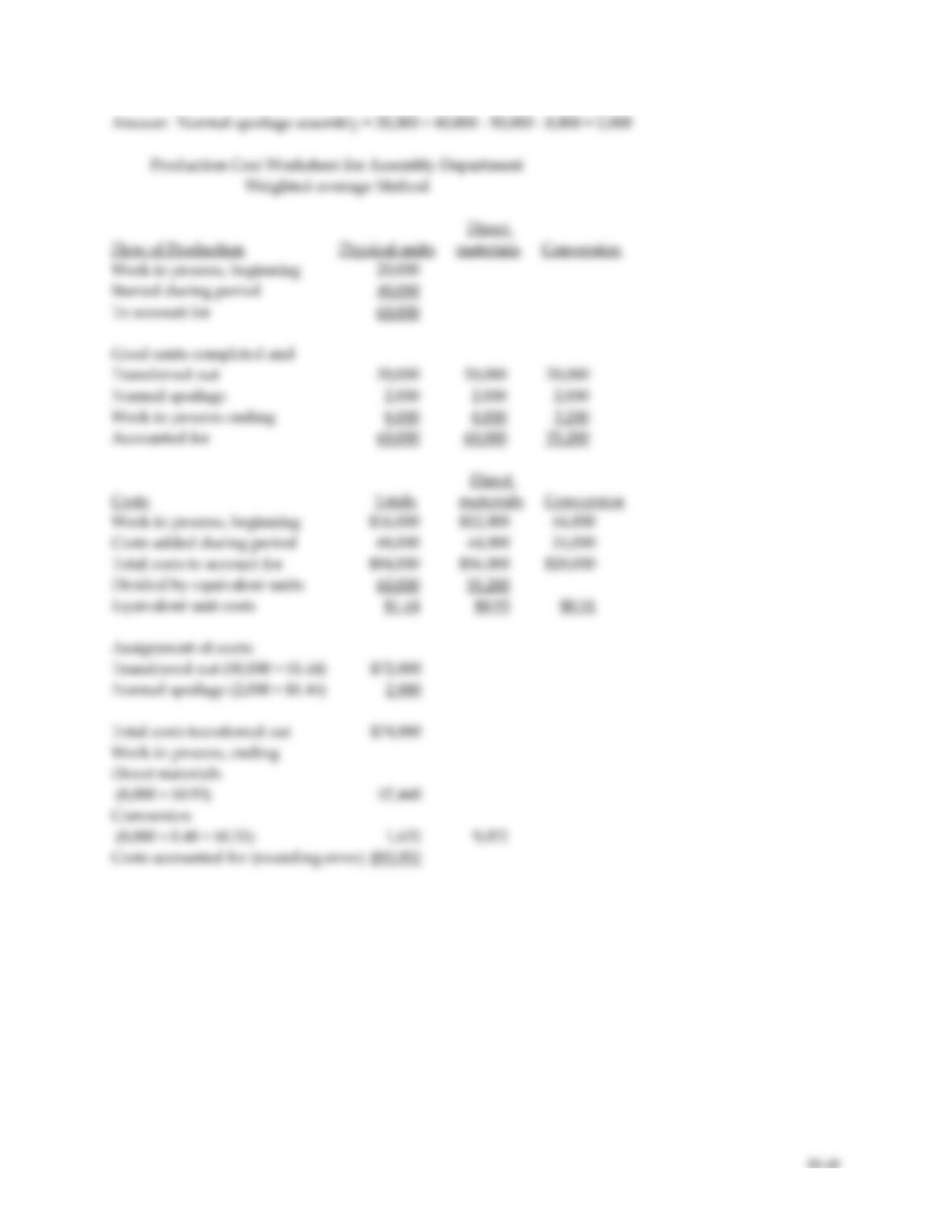
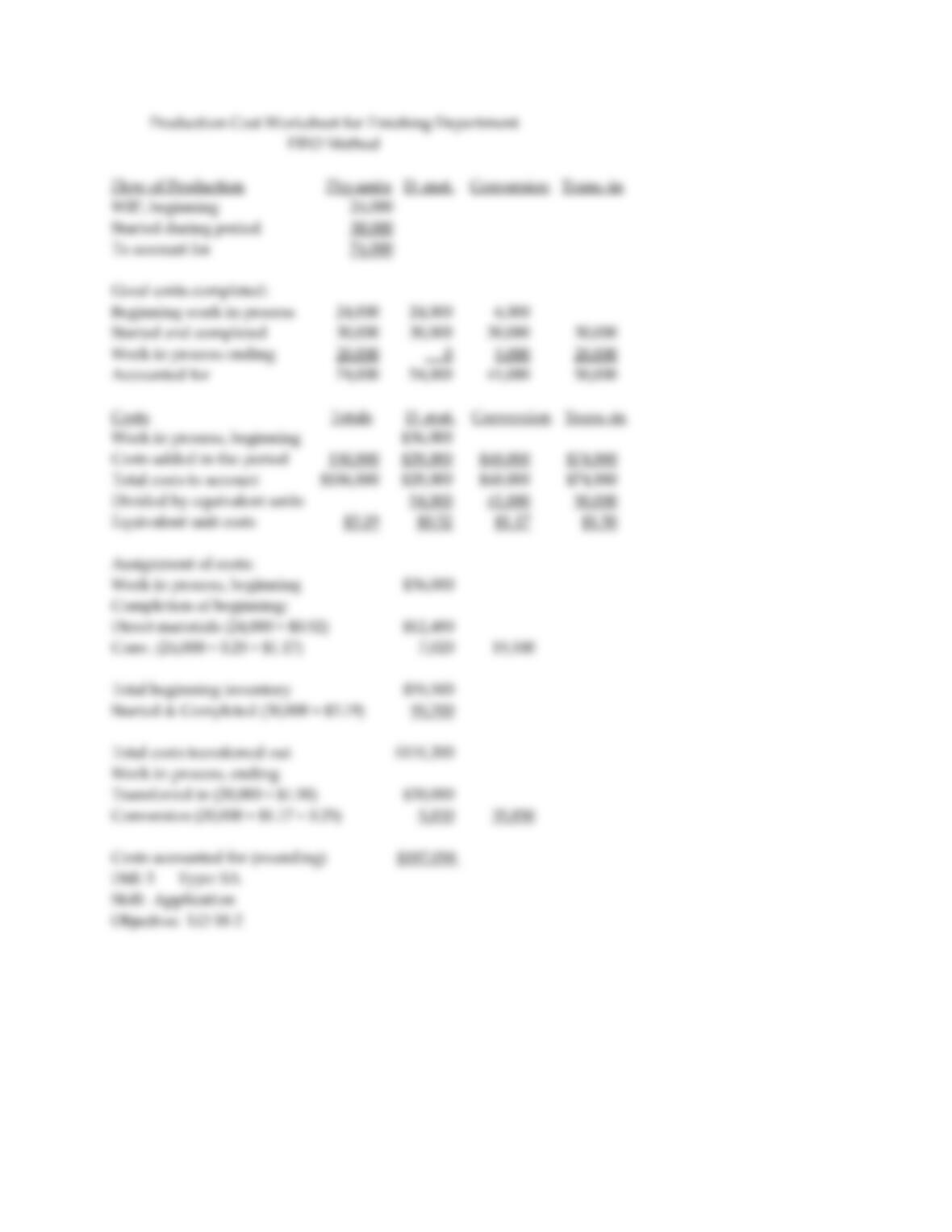
37) Weather Instruments assembles products from component parts. It has two departments that process
all products. During January the beginning work in process in the assembly department was half
completed as to conversion and complete as to direct materials. The beginning inventory included
$12,000 for materials and $4,000 for conversion costs. Overhead is applied at the rate of 50 percent of
direct manufacturing labour costs. Ending work in process inventory in the assembly department was 40
percent complete. All spoilage is considered normal and is detected at the end of the process. Beginning
work in process in the finishing department was 75 percent complete as to conversion and ending work
in process was 25 percent converted. Direct materials are added at the end of the process. Beginning
inventories included $16,000 for transferred-in costs and $10,000 for conversion costs. Overhead in this
department is equal to direct manufacturing labour costs. Additional information about the two
departments follows:
Assembly Finishing
Beginning work in process units 20,000 24,000
Units started this period 40,000 ?
Units transferred this period 50,000 54,000
Ending work in process units 8,000 20,000
Material costs added $44,000 $28,000
Direct manufacturing labour $16,000 $24,000
Required:
Prepare a production cost worksheet using weighted-average for the assembly department and FIFO for
the finishing department.
Cost Accounting: A Managerial Emphasis, 6e
Chapter 18 – Spoilage, Rework, and Scrap
Cost Accounting: A Managerial Emphasis, 6e
Chapter 18 – Spoilage, Rework, and Scrap
18–49

Cost Accounting: A Managerial Emphasis, 6e
Chapter 18 – Spoilage, Rework, and Scrap
18–50
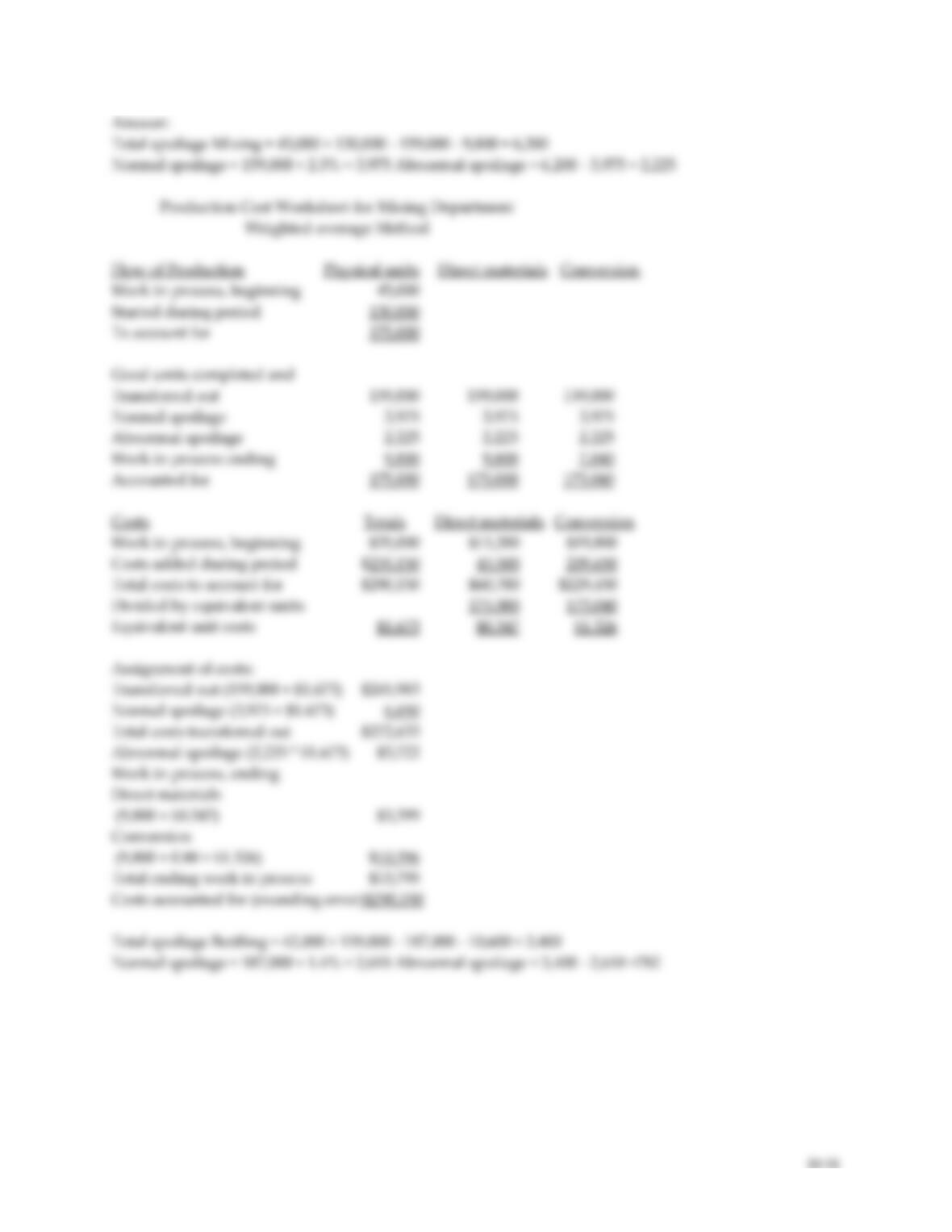
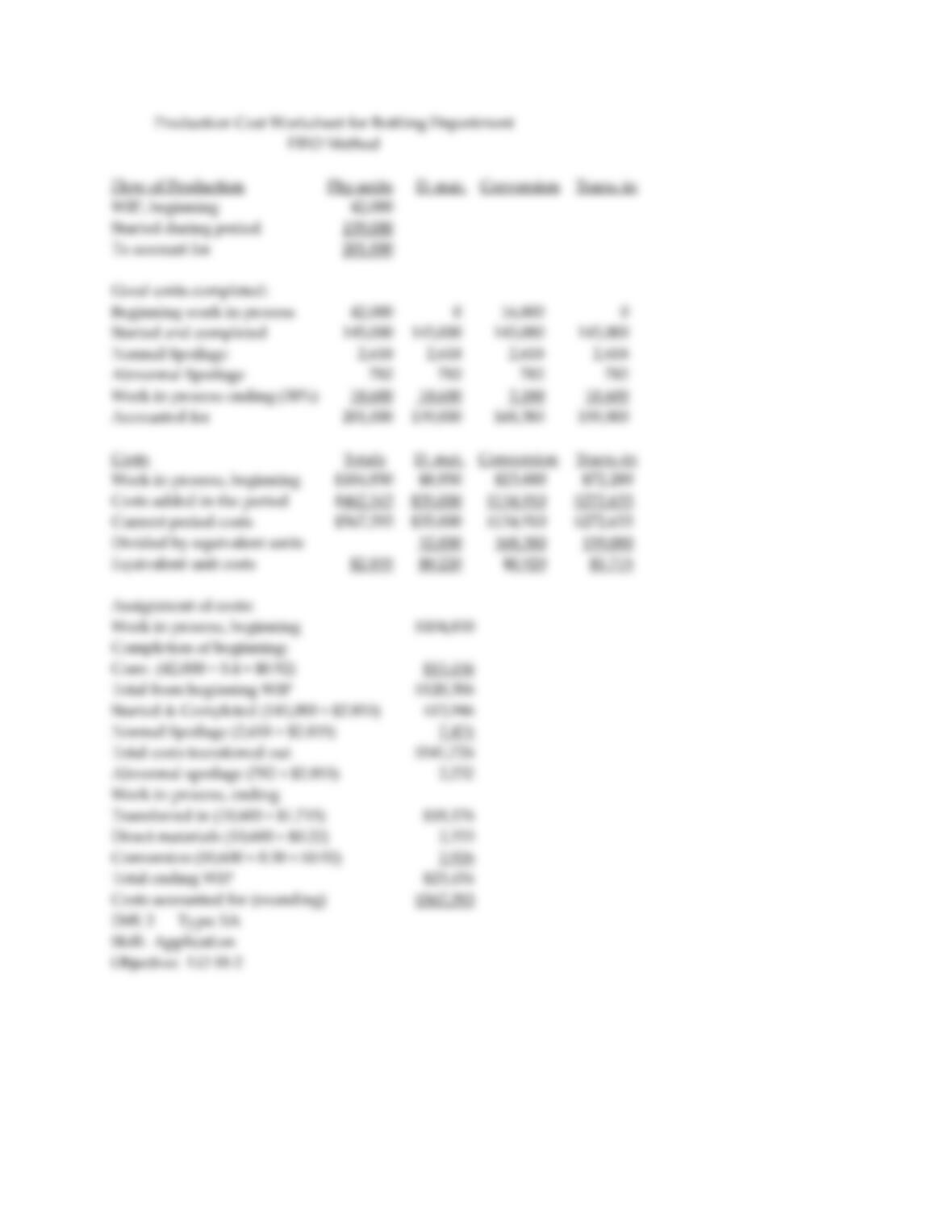
38) Dutton Industries is a manufacturer of cleaning products. Its main product goes through two
departments: Mixing and Bottling. During June, the beginning WIP in the Mixing department was 32%
complete as to conversion cost. The beginning inventory included $15,200 for materials and $19,800 for
conversion costs. Ending WIP in the Mixing department was 80% complete. All direct materials are
added at the beginning of the process in each department. Inspection occurs at the end of the process in
both departments. Normal spoilage is 2.5% of good output in Mixing and 1.4% of good output in
Bottling. Beginning WIP in Bottling was 60% complete with respect to conversion costs and ending WIP
was 30% converted. Beginning WIP included $8,850 for direct materials, $72,200 for transferred in costs
and $23,800 for conversion costs. Additional information follows:
Mixing Bottling
Beginning work in process units 45,000 42,000
Units started this period 130,000 ?
Units transferred this period 159,000 187,000
Ending work in process units 9,800 10,600
Material costs added $45,500 $35,000
Conversion costs added $209,650 $154,910
Required:
Prepare a production cost worksheet using weighted-average for the Mixing department and FIFO for the
Bottling department.
Cost Accounting: A Managerial Emphasis, 6e
Chapter 18 – Spoilage, Rework, and Scrap
Cost Accounting: A Managerial Emphasis, 6e
Chapter 18 – Spoilage, Rework, and Scrap
18–52

Cost Accounting: A Managerial Emphasis, 6e
Chapter 18 – Spoilage, Rework, and Scrap
18–53
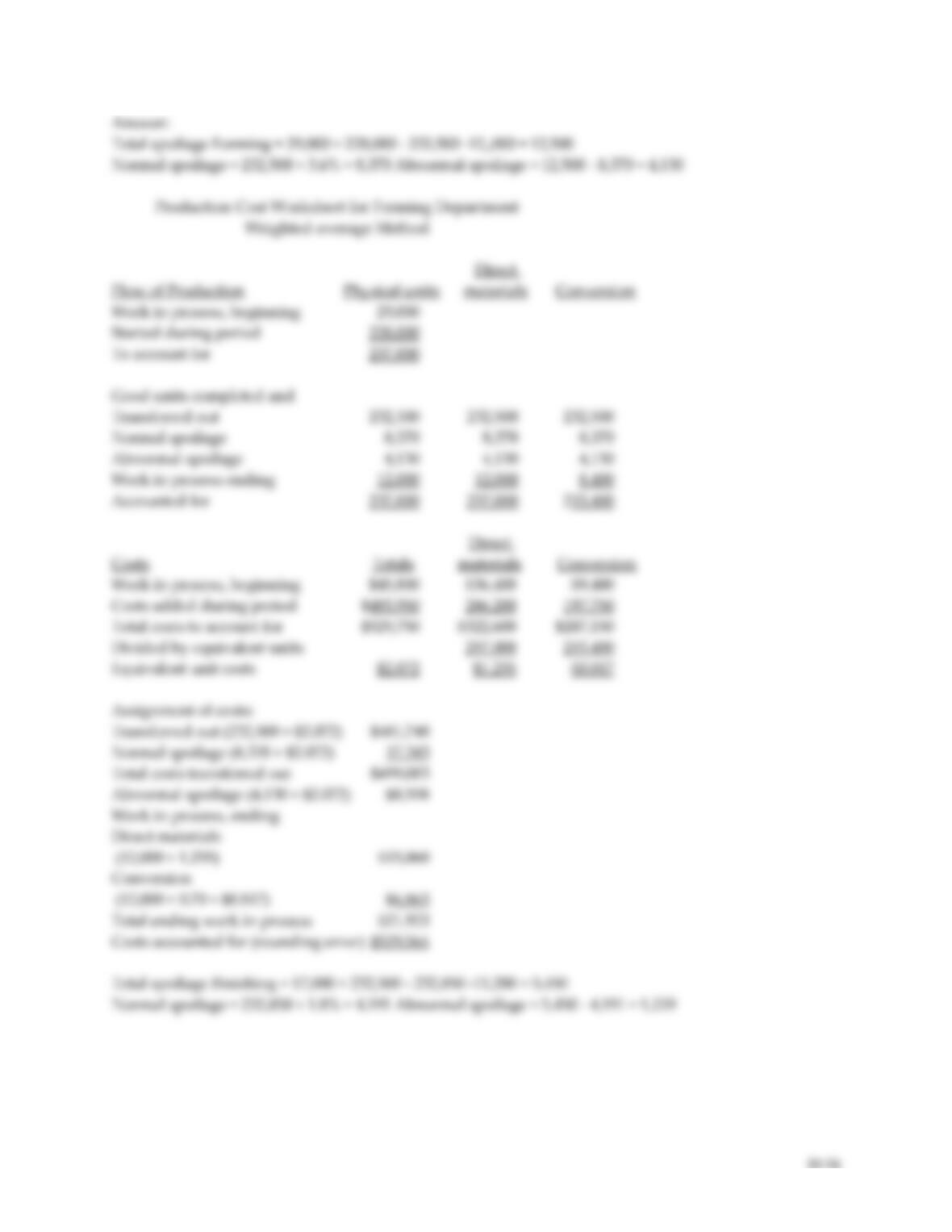
39) Playtime Ltd. manufactures toys in two departments: Forming and Finishing. During August, the
beginning WIP in the Forming Department was 38% complete with respect to conversion, direct materials
are added at the beginning of the process. The beginning inventory in Forming included $36,400 for
materials and $9,400 for conversion costs. Ending WIP in the Forming department was 70% complete. In
the second department, Finishing, direct materials are added at the end of the process. Beginning WIP in
Finishing was 22% complete with respect to conversion costs and ending WIP was 85% converted.
Beginning WIP included $35,200 for transferred in costs and $12,350 for conversion costs. Additional
information follows:
Forming Finishing
Beginning work in process units 29,000 17,000
Units started this period 228,000 ?
Units transferred this period 232,500 232,850
Ending work in process units 12,000 11,200
Material costs added $286,200 $114,380
Conversion costs added $197,750 $805,490
Normal spoilage 3.6% 1.8%
Inspection (degree of completion) 100% 100%
Required:
Prepare a production cost worksheet using weighted-average for the Forming department and FIFO for
the Finishing department.
Cost Accounting: A Managerial Emphasis, 6e
Chapter 18 – Spoilage, Rework, and Scrap
Cost Accounting: A Managerial Emphasis, 6e
Chapter 18 – Spoilage, Rework, and Scrap
18–55
Cost Accounting: A Managerial Emphasis, 6e
Chapter 18 – Spoilage, Rework, and Scrap
18.3 Apply the standard-costing method to account for spoilage, and allocate costs of
normal spoilage.
1) Under standard costing, there is no need to calculate a cost per equivalent unit.
2) Process costing is simplified when using standard costs.
3) The calculation of equivalent units under standard costing is the same as under FIFO.
4) Which of the following can be used in accounting for spoilage?
A) standard costs
B) FIFO
C) Weighted average
D) FIFO and weighted average but not standard costs
E) FIFO and weighted average and standard costs
5) The standard-costing method
A) adds a layer of complexity to the calculation of equivalent-unit costs in a process-costing environment.
B) makes calculating equivalent-unit costs unnecessary.
C) requires an analysis of the spoilage costs in beginning inventory.
D) requires an analysis of the spoilage costs in ending inventory.
E) requires a calculation of the cost allocation rate.
Cost Accounting: A Managerial Emphasis, 6e
Chapter 18 – Spoilage, Rework, and Scrap
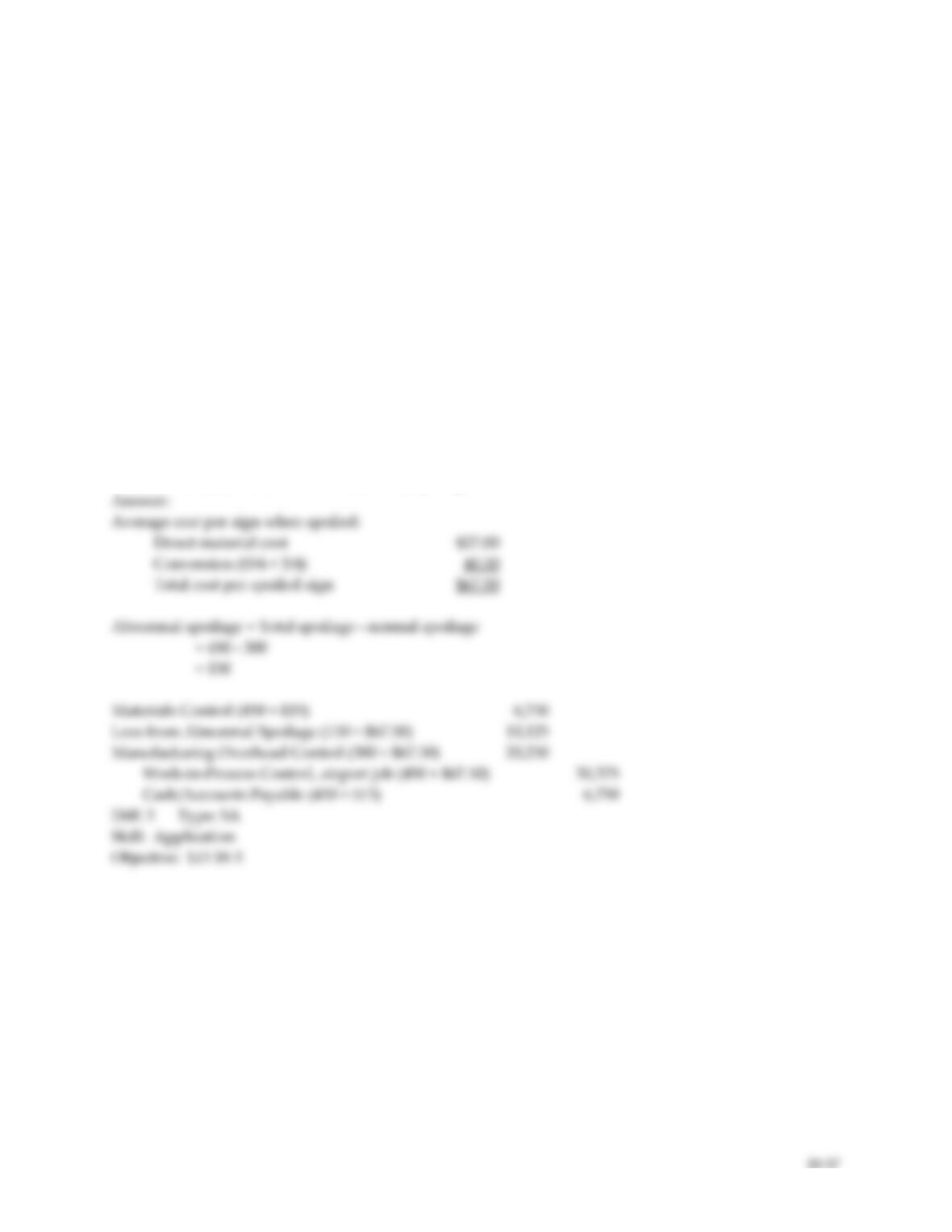
6) Springfield Sign Shop manufactures only specific orders. It uses a standard cost system. During one
large order for the transit authority, an unusual number of signs were spoiled. The normal spoilage rate is
10% of units started. The point of first inspection is half way through the process, the second is three–
fourths through the process, and the final inspection is at the end of the process. Other information about
the job is as follows:
Signs started 3,000
Signs spoiled 450
Direct materials put into process at beginning $60,000
Conversion costs for job $120,000
Standard direct material costs per sign $27
Standard conversion cost per sign $54
Average point of spoilage is the 3/4 completion point
Average current disposal cost per spoiled sign $15
Required:
Make necessary journal entries to record all spoilage.
Cost Accounting: A Managerial Emphasis, 6e
Chapter 18 – Spoilage, Rework, and Scrap
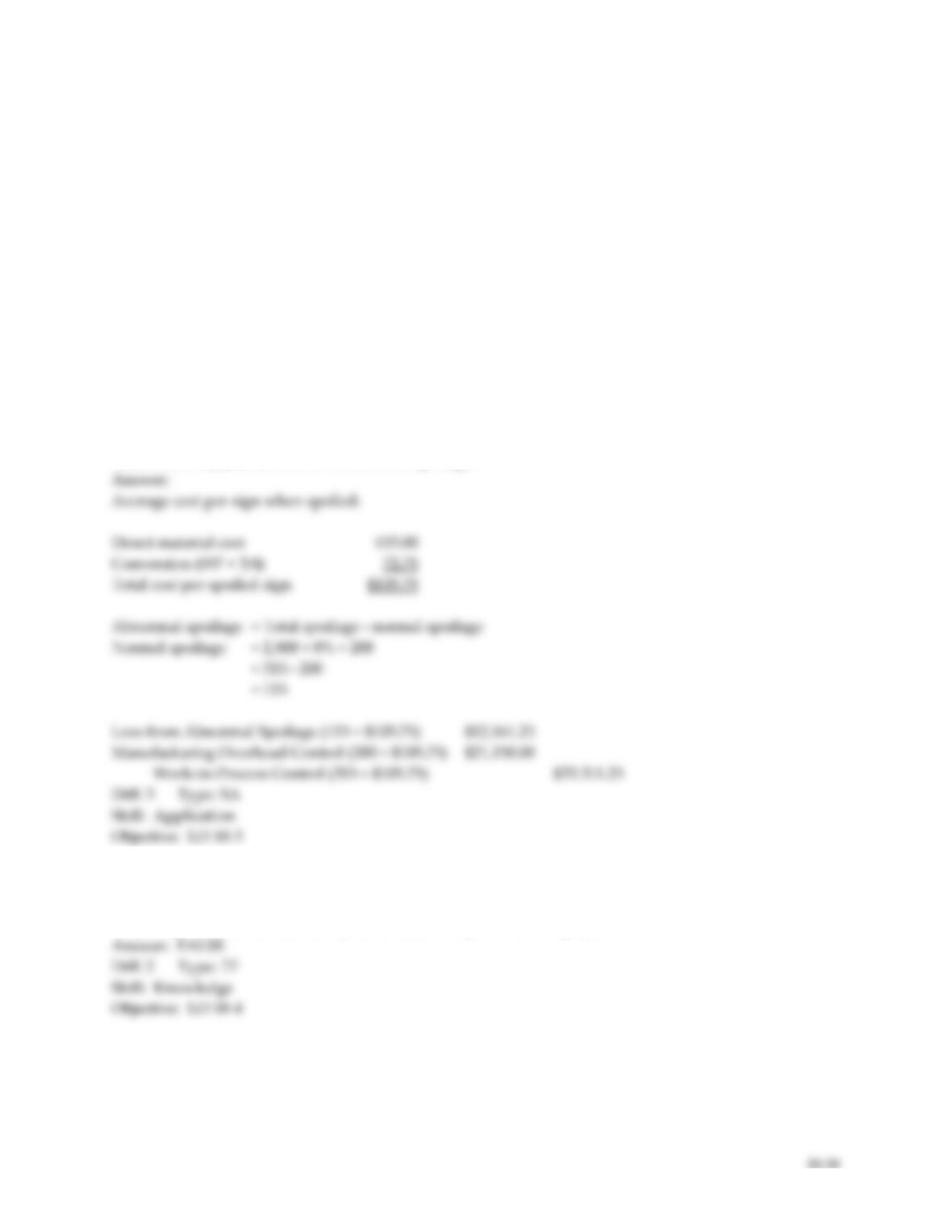
7) Hogan Ltd. uses a standard cost system in its manufacturing process. During a recent job, it noticed
that its spoilage rate was high. Normal spoilage rate averages 8% of units started. Direct materials are
added at the beginning of the process. Inspection occurs at the 50% point. Other information about the job
follows:
Units started 2,500
Units spoiled 315
Direct materials $87,500
Conversion costs on job $262,500
Standard direct material cost per unit $33
Standard conversion cost per unit $97
Spoiled units have no salvage value.
Required:
Make necessary journal entries to record all spoilage.
18.4 Apply job cost allocation procedures to account for spoilage in job costing.
1) Spoilage can be attributed to a particular job in a process costing system.
Cost Accounting: A Managerial Emphasis, 6e
Chapter 18 – Spoilage, Rework, and Scrap
2) The costs of normal spoilage are assigned to individual jobs in process costing, and in job costing.
3) When normal spoilage is detected, the work–in-process control account is debited in a job costing
system.
4) In job costing, costs of abnormal spoilage are not considered as inventoriable costs and are therefore
written off as costs of the period in which detection occurs.
5) Costs incurred due to spoilage in a job order costing system, may be treated in all of the following
ways, EXCEPT
A) added to abnormal spoilage and written off.
B) added to the total cost of that particular job.
C) allocated equally to all units at an inspection point.
D) added to all jobs through manufacturing overhead.
E) allocated between normal and abnormal spoilage.
6) What is the effect of the following journal entry?
materials control
280
manufacturing overhead control
320
work-in-process control (job #219)
600
A) $320 of spoilage is attributed to job #219
B) $280 of spoilage is attributed to job #219
C) $600 of spoilage is attributed to job #219
D) $320 of spoilage is attributed to all jobs evenly
E) $280 of spoilage is attributed to all jobs evenly