
Elements of Ecology, 9e (Smith)
Chapter 18 Community Dynamics
18.1 Short Answer Questions
1) The sequence of communities from the pioneer community to the climax community is called
a(n) ________.
2) Early successional species are referred to as ________ species.
3) Succession that occurs on a site that was previously unoccupied by another community is
called ________ succession.
4) Habitats in which resources are limited favor ________ species that allocate resources to
maintenance.
5) The ________ model of succession proposes that early successional species modify the
environment so that it becomes more suitable for later successional species.
6) The ________ model of succession proposes that later successional species are neither
inhibited nor aided by species of earlier stages.
7) ________ environmental change is a direct result of the organisms within the community.

8) The hypothesis that moderate frequencies of disturbance result in the highest species diversity
is called the ________ disturbance hypothesis.
9) The study of the distribution and abundance of ancient organisms and their relationship to the
environment is referred to as ________.
10) The organismal view of communities is a ________ concept, while the continuum view of
communities is a ________ concept.
18.2 Multiple-Choice Questions
1) Changes in community composition and structure over time are called
A) succession.
B) stratification.
C) zonation.
D) characterization.
2) Early successional species are characterized by
A) low body growth rates.
B) smaller body size.
C) low degree of dispersal.
D) low per capita population growth rate.
3) Which of the following are late successional species?
A) trees
B) grass
C) weeds
D) forbs
4) The Hubbard Brook Experimental Forest is best known for what occurring after forest
clearing?
A) primary succession
B) sere
C) secondary succession
D) final succession
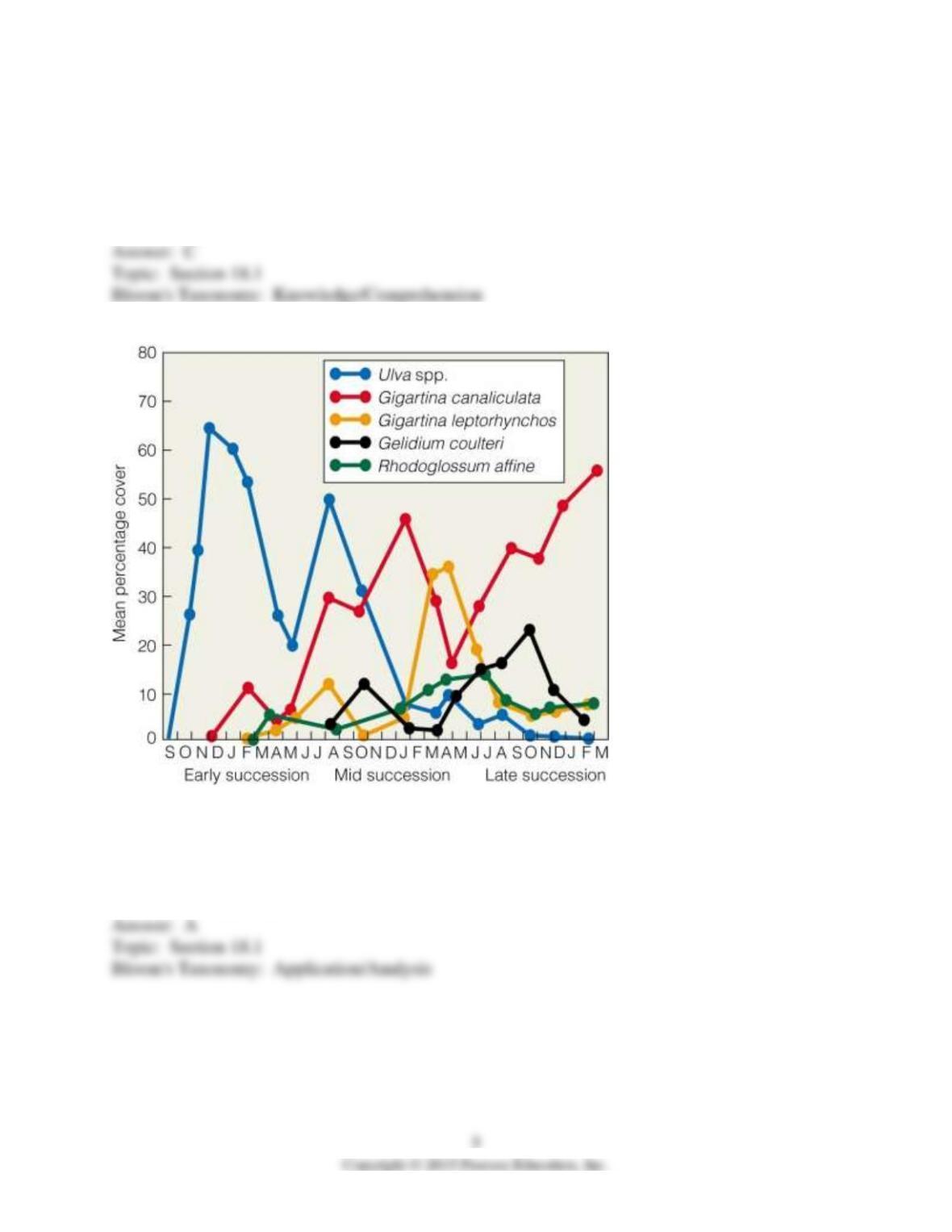
5)
According to the figure, which species is considered a pioneer species?
A) Ulva spp.
B) Gigartina canaliculata
C) Gigartina coulteri
D) Gigartina leptorhynchos

6) An example of secondary succession is
A) grasses colonizing sand dunes.
B) lichens colonizing a rock.
C) weeds colonizing a volcanic lava flow.
D) crabgrass colonizing an abandoned wheat field.
7) Chronosequences are useful because one can
A) view several taxa in one sere.
B) view several seres in one region.
C) measure the impacts of disturbance.
D) count the number of trees in one sere.
8) Beach grass colonizing newly formed sand dunes is
A) primary succession.
B) secondary succession.
C) chronosequence.
D) autogenic change.
9) Overgrazing of kelp forests and their subsequent regrowth is
A) primary succession.
B) chronosequence.
C) secondary succession.
D) allogenic change.
10) Which is an example of secondary succession?
A) Beach grasses colonize a newly formed sand dune.
B) Retreating glaciers leave alluvial soils for cottonwood trees to colonize.
C) A shift in river flow introduces sediment to a rocky area.
D) A farmer allows an agricultural field to return to native grassland.

11) The inhibition model of succession proposes that
A) early successional species modify the environment so that it becomes more suitable for later
successional species.
B) the first species to arrive make the site less suitable for later-arriving species.
C) later successional species are neither inhibited nor aided by species of earlier stages.
D) competition does not occur between early successional and late successional species.
12) Who developed the monoclimax hypothesis?
A) Joseph Connell
B) Frank Egler
C) Henry Cowles
D) Frederick Clements
13) According to Grime, which strategy is followed by stress-tolerant species?
A) C strategy
B) S strategy
C) R strategy
D) T strategy
14) What is the resource-ratio hypothesis?
A) Late successional species are not affected by species of previous stages.
B) There are three strategies in terms of resource use by plants.
C) There is a pattern of changing allocation of carbon to aboveground and belowground tissues.
D) The process of succession is determined by who gets there first.
15) Which of the following is a characteristic of a late successional plant species?
A) high photosynthetic rates
B) high stomatal conductance
C) high efficiency at low light
D) high acclimation potential

16) Which of the following is considered a ruderal species?
A) one that is a strong competitor
B) one that colonizes well
C) one that is highly stress tolerant
D) one that requires abundant resources
17) In succession, which type of environmental change occurs when the physical environment
changes, such as an increase in temperature or salinity?
A) allopatric
B) allogenic
C) autozygous
D) autogenic
18) Which of the following is an autogenic change?
A) decrease in water depth due to seismic shift
B) increase in salinity due to tides
C) global climate change due to increased CO2 emissions
D) decreased light due to canopy cover
19) An old pine tree in the front yard is beginning to die as the neighborhood deciduous trees
have grown. Why might this be?
A) Deciduous trees have depleted the soil of nutrients.
B) The pine tree is shade intolerant.
C) The pine tree has depleted the soil of nutrients.
D) Deciduous trees are shade intolerant.
20) Which of the following best describes diversity change through time in succession?
A) steady increase over time
B) steady decrease over time
C) starting and ending with high diversity
D) highest diversity in middle successional stages

21) The intermediate disturbance hypothesis predicts
A) low disturbance will increase diversity.
B) intermediate disturbance will increase diversity.
C) intermediate disturbance will decrease diversity.
D) high disturbance will increase diversity.
22) Groups of sites within an area that are at different stages of succession are known as
A) autosequences.
B) ecotypes.
C) clines.
D) chronosequences.
23) The number of species within a community is usually greatest when
A) no disturbance occurs.
B) a low frequency of disturbance occurs.
C) an intermediate frequency of disturbance occurs.
D) a high rate of disturbance occurs.
24) Succession in a community involves
A) only autotrophic species.
B) only heterotrophic species.
C) both autotrophic and heterotrophic species.
D) only detritivorous species.
25) Which backyard would you predict to have the greatest diversity of birds?
A) one with newly planted seedlings
B) one with 5- to 10-year-old trees
C) one with 25- to 50-year-old trees
D) one with 60- to 100-year-old trees

26) As succession proceeds, what occurs with animals living in the habitat?
A) Animals adapt to the new vegetation.
B) Animals leave as their habitat disappears.
C) New animal species evolve in response to vegetation.
D) Animal species diversity continually decreases.
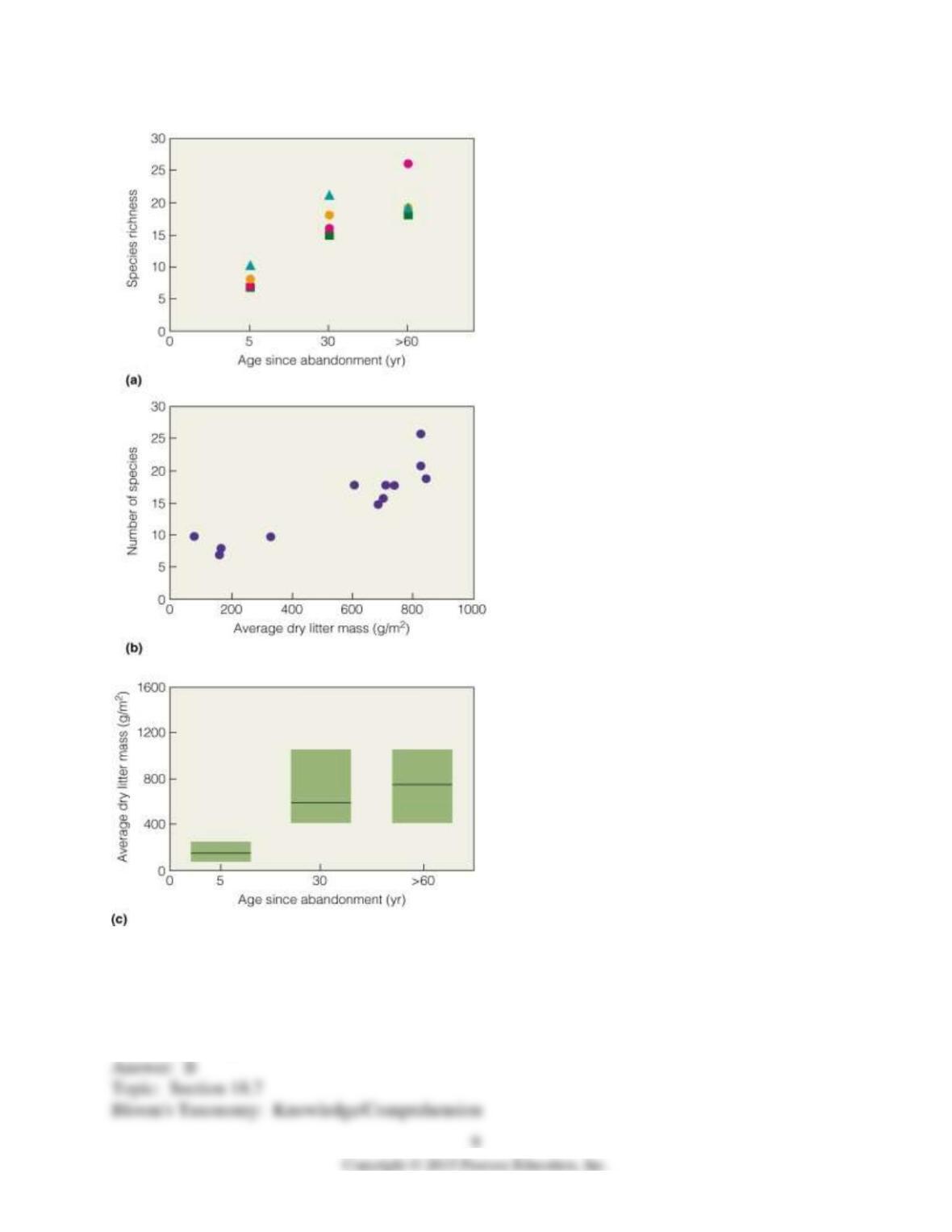
27)
What does this figure suggest is responsible for increasing species diversity?
A) time alone
B) increasing leaf litter
C) decreasing leaf litter
D) increase in agriculture

28) What is the timescale for succession to occur?
A) years
B) decades
C) millennia
D) All of the above are suitable timeframes.
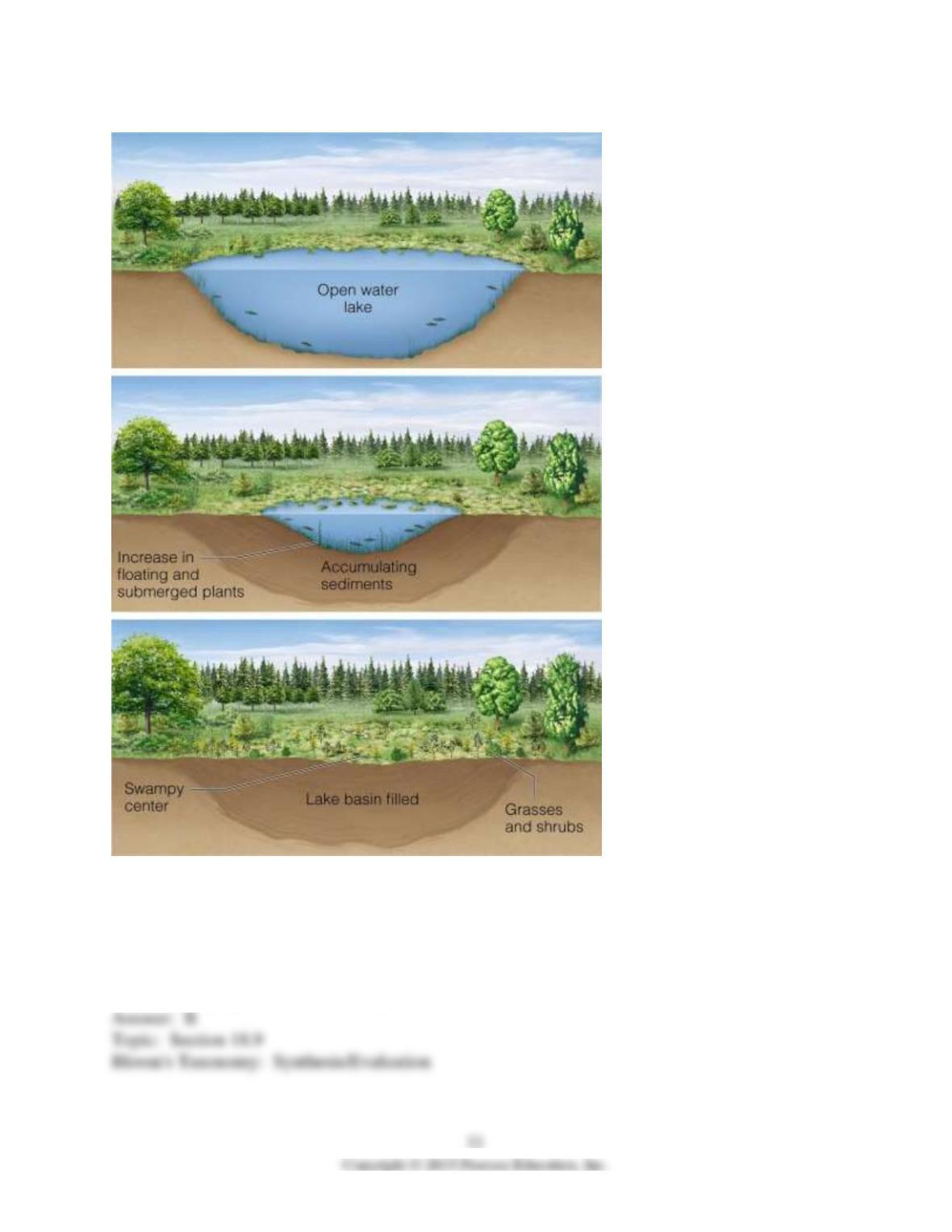
29)
For processes such as those in the figure that can take thousands of years, how can we know that
succession can occur in this way?
A) via carbon dating
B) via chronosequences
C) via long-term studies
D) via the phytoplankton community

30) Which of the following is an example of an allogenic change that drives succession?
A) seasonal changes in temperature, photoperiod, and light intensity
B) increased shading of seedlings by adult trees in a forest
C) increased nitrogen availability in soil due to the presence of leguminous plants
D) reduced salinity due to surface shading by grasses in a salt marsh
31) As glaciers in North America melted, formerly glaciated areas were invaded by
A) ice.
B) tundralike vegetation.
C) boreal forest, dominated by spruce and jack pine.
D) various species of trees, including spruce, white pine, oaks, and maples.
32) Why do we think that the forest communities of eastern North America have changed
dramatically over the past 18,000 years?
A) Glacial retreat exposed land for primary succession that long ago.
B) Large fires exposed land for secondary succession that long ago.
C) Successional changes are typically very rapid and all communities change at this speed.
D) Pollen evolved at this time.
33) What can paleoecologists utilize to assess which tree species existed in an area?
A) climate models
B) soil types
C) DNA from current trees
D) ancient pollen
34) Which is the more correct view of communities?
A) Gleason’s individualistic concept
B) Clement’s organismal concept
C) It depends upon the perspective.
D) Both views were completely wrong.

35) Recent data indicate what regarding forests in eastern North America?
A) a steady increase in forest since the late 1800s
B) no change over the past 200 years
C) no change in the past 50 years
D) a decline in forested area in the past 50 years
18.3 True/False Questions
1) Communities vary in composition over space but usually not in composition over time.
2) Succession occurs in both aquatic and terrestrial environments.
3) Grasses are usually the first plant species to colonize sand dunes.
4) Succession does not occur in communities subjected to periodic disturbances.
5) The monoclimax hypothesis views succession as the gradual and progressive development of
the community to the ultimate stage.
6) The initial floristic composition hypothesis proposes that the process of succession at any site
is dependent on which species arrive first.

7) The facilitation model of succession involves strong competitive interactions among
colonizing species.
8) Autogenic environmental change always occurs in plant succession.
9) In the early stages of plant succession, shade-intolerant species are often common.
10) Light is the only environmental factor that changes during the course of succession in a
community.
11) Although community composition changes during succession, diversity rarely changes.
12) Diversity often decreases during the later stages of succession.
13) Disturbances, such as fire, can sometimes increase coexistence between species and can
increase diversity.
14) Succession usually involves only autotrophic species such as plants.
15) During plant succession, animals can quickly lose their habitat by vegetation change.

16) Community structure changes over relatively short timescales through succession, but it
tends to be stable over longer geological timescales.
17) Pollen preserved within lake sediments can be used to reconstruct historical changes in the
geographic ranges of plant species.
18) The organismal concept of communities argues that species distributions along
environmental gradients form clusters because they are interdependent.
19) Most forests in the eastern United States are more than 100 years old.
18.4 Essay Questions
1) Discuss the ecological differences between early successional species and late successional
species within a sere.
2) Using specific examples for each, explain the differences between primary and secondary
succession.
3) Define and describe three models of succession within a community.
4) Discuss the differences between autogenic and allogenic environmental changes that drive
succession. Which of these always occurs during succession?

5) Describe the process of succession of heterotrophic organisms associated with decomposition
of a fallen tree.
6) Explain the difference between the organismal concept of communities and the individualistic
continuum concept. Which do you think more accurately describes real communities and why?
7) Explain the link between the rise of large-scale, commercial agriculture in the American West
and increases in forest habitat in the East, as well as the role of succession in this link.