CHAPTER 18: PRICING AND PROFITABILITY ANALYSIS
1. The relationship between supply and demand helps set pricing.
a. True
b. False
2. Price elasticity of demand is the percent change in price demanded for a given percent change in quantity.
a. True
b. False
3. Goods that are price elastic have few substitutes while those that are inelastic have many substitutes.
a. True
b. False
4. Market structure affects price as well as the costs necessary to support that price.
a. True
b. False
5. The perfectly competitive market has many buyers and sellers, none of which are large enough to influence the
market.
a. True
b. False
6. There are three types of market structure: monopoly, oligopoly, and perfect competition.
a. True
b. False
7. Many companies base prices on cost while other companies use target-costing strategies.
a. True
b. False
8. The markup is pure profit, it does not include all costs not included in the base cost.
a. True
b. False
Chapter 18: Pricing and Profitability Analysis
9. Cost-based pricing involves the calculated product cost plus the desired profit.
a. True
b. False
10. Target costing sets costs based on the price that customers are willing to pay.
a. True
b. False
11. The legal system supports business competition by allowing an open policy on pricing.
a. True
b. False
12. Predatory pricing and dumping are outlawed practices that set prices below cost intending to injure competitors.
a. True
b. False
13. Price discrimination is the charging of different prices to different customers to promote fairer competition.
a. True
b. False
14. Profits are measured to determine the viability of a firm and its adherence to government regulations, to measure
managerial performance, and to signal the market to encourage stockholders.
a. True
b. False
15. Absorption costing is used to calculate two measures of profit: gross profit and operating income.
a. True
b. False
16. Unlike absorption costing, variable costing only assigns unit-level manufacturing costs to a product.
a. True
b. False
Chapter 18: Pricing and Profitability Analysis
17. Profit-related variances focus on the difference between budgeted and actual prices, volumes, and
contribution margin.
a. True
b. False
18. The sales volume variance communicates the impact the difference between actual and expected units
sold has on revenues.
a. True
b. False
19. The overall sales variance is the sum of the contribution margin and the sales price variance.
a. True
b. False
20. The sales volume variance is the difference between actual and expected volume sold multiplied by the
expected price.
a. True
b. False
21. The product life cycle describes the profit history of a product according to its introduction, growth,
maturity, and decline stages.
a. True
b. False
22. Product-level costs are highest in the maturity phase and fall through the decline phase.
a. True
b. False
23. Profits are lower in the introductory phase because revenues are low and investment and learning may be
high.
a. True
b. False
Chapter 18: Pricing and Profitability Analysis
24. The biggest limitation to profitability analysis is its focus on past, not future performance.
a. True
b. False
25. Firms enjoy greater success when they include the impact of profits on their employees and the
community.
a. True
b. False
26. The two factors that influence the ability of companies to adjust price are price
elasticity and __________ structure.
27. The percent change in quantity demanded for a given percent change in price is
called price __________ .
28. The pricing of a new product at a low initial price to build market share quickly is called .
29. When companies with market power price products too high it’s called price .
30. When a company charges different prices for the same product to different customers it is referred to as
price
__________ .
31. Another term for predatory pricing in the international market is .
32. Using variable costing procedures, net income will be less than when production is less
than sales volume.
33. The income measurement required for external financial reporting is called costing.
34. The variance that compares actual volume with expected volume multiplied by
expected price is the __________ variance.
Chapter 18: Pricing and Profitability Analysis
35. The variances used to analyze changes in profit from one period to
another are called variances.
36. The variance is the difference between actual and budgeted contribution margin.
37. The profit history of a product according to four stages is called the product .
38. The stage where revenues always decrease is the stage.
39. One limitation to profitability analysis is its focus on performance.
40. Too much emphasis on short-run optimization can lead to problems.
41. Which of the following is true regarding expenses related to specific market structure types?
a. Monopolistic competition and oligopolies are the only structures where costs of
differentiation have an impact.
b. Both monopolies and monopolistic competition structures normally must expend legal and lobbying costs.
c. In perfect competition and monopolistic competition, differentiation costs have an impact.
d. In perfect competition and oligopolies, there are no special expenses related to the
structure of the organization.
42. Which of the following is NOT an example of a market structure?
a. oligopoly
b. monopoly
c. barrier market
d. perfectly competitive
43. Monopolistic competition is best defined as
a. a structure that has many buyers and sellers, but the products are differentiated on some basis.
b. a structure where customers are willing to pay a little more for the unique feature that appeals to them.
c. a structure that combines perfect competition and monopoly, but is closer to a competitive situation.
d. all of the above.
Chapter 18: Pricing and Profitability Analysis
44. Which type of expenses does a monopoly usually incur that are different from the other types of market
structures?
a. marketing costs such as advertising, positioning, discounting, and coupons
b. costs of differentiation such as advertising, rebates, coupons
c. no special expenses
d. legal and lobbying expenditures
45.
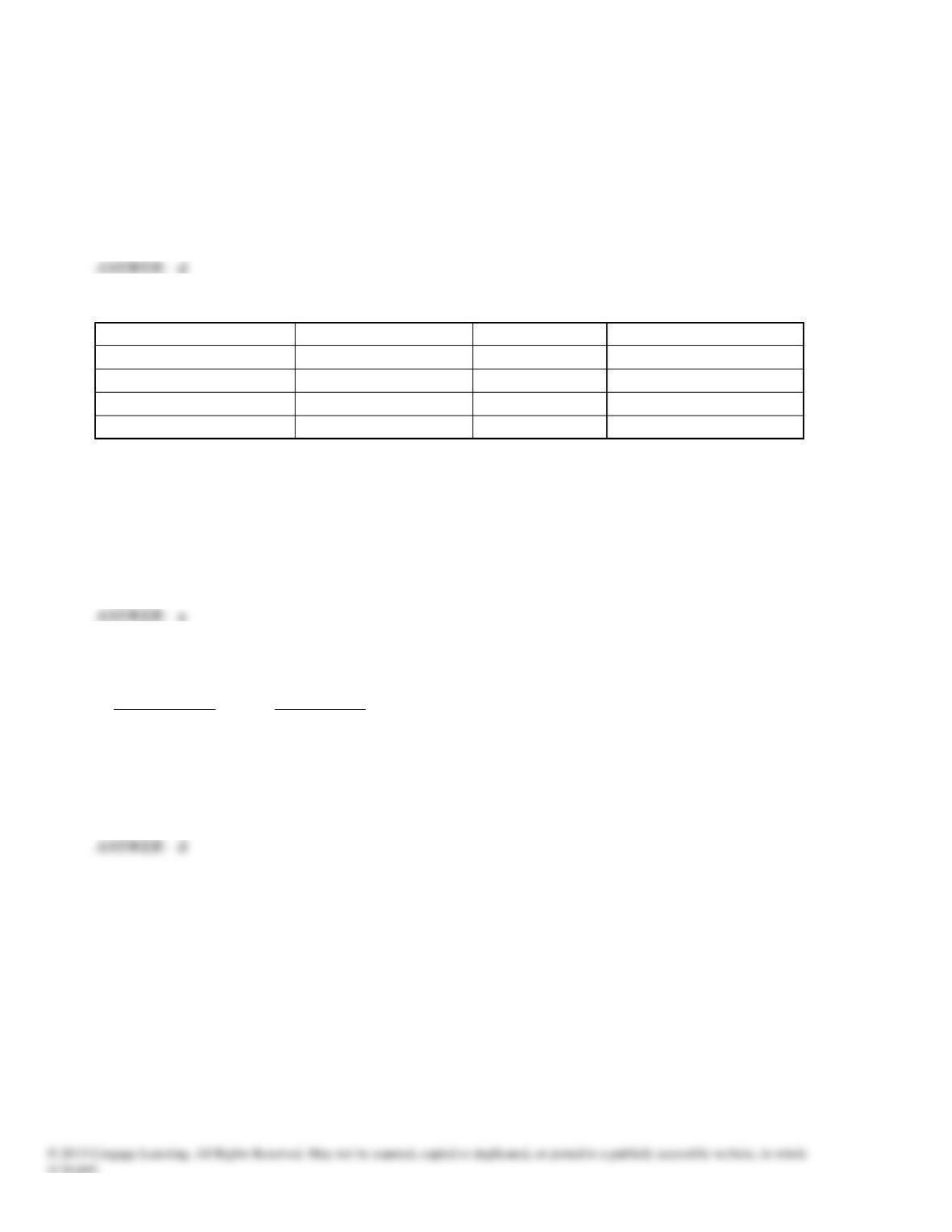
Market Structure Type
# of firms in industry
Barriers to entry
Uniqueness of product
Perfect Competition
Many
(a)
Not unique
Monopolistic Competition
(b)
Some unique features
Oligopoly
Few
(c)
Monopoly
Very High
(d)
Fill in the correct responses for the blanks with letters:
a. (a)very low, (b)many, (c)high, (d)very unique
b. (a)very low, (b)few, (c)high, (d)not unique
c. (a)very high, (b)few, (c)low, (d)fairly unique
d. (a)low, (b)one, (c)high, (d)very unique
46. Which of the following correctly describes the slope of the demand and supply curves?
Demand Curve Supply Curve
a. upward sloping downward sloping
b. no slope upward sloping
c. downward sloping no slope
d. downward sloping upward sloping
Chapter 18: Pricing and Profitability Analysis
47. The following information pertains to three different products being sold by Modular Company:
Product
Old Price
New Price
Old Quantity
New Quantity
A
$10.00
$11.00
2,000
1,900
B
20.00
18.00
4,000
4,600
C
30.00
33.00
6,000
5,500
Which products have an inelastic demand curve?
a. Product C
b. Product B
c. Product A
d. both Product A and Product C
48. The following information pertains to three different products being sold by Modular Company:
Product
Old Price
New Price
Old Quantity
New Quantity
A
$10.00
$11.00
2,000
1,900
B
20.00
18.00
4,000
4,600
C
30.00
33.00
6,000
5,500
Which products have an elastic demand curve?
a. Product B
b. Product A
c. Product C
d. both a and c
49. Which of the following markets is characterized by the following: many firms in the industry, a
somewhat unique product, fairly easy entry into the industry, and spending for differentiation of the
product?
a. perfectly competitive market
b. monopolistic competition
c. monopoly
d. oligopoly
Chapter 18: Pricing and Profitability Analysis
50. Which of the following markets is characterized by the following: only a few firms in the industry, a
fairly unique product, difficult entry into the industry, and spending for differentiation of the product?
a. perfectly competitive market
b. monopolistic competition
c. monopoly
d. oligopoly
51. Which of the following markets is characterized by the following: many buyers and sellers, a
homogeneous product, easy entry into and exit from the industry, and all firms are price takers?
a. perfectly competitive market
b. monopolistic competition
c. monopoly
d. oligopoly
52. Which of the following markets is characterized by the following: a single firm in the industry, a unique
product, and difficult entry into the industry?
a. perfectly competitive market
b. monopolistic competition
c. monopoly
d. oligopoly
Chapter 18: Pricing and Profitability Analysis
Figure 18–1
The Lancashire Corporation manufactures bottled water with an average manufacturing cost of $2 per
case (a case contains 24 bottles). Bayview sold 1,000,000 cases last year to the following types of
customers:
CUSTOMER
PRICE PER CASE
CASES SOLD
Drugstore chains
$5.00
375,000
Gas station chains
$5.50
125,000
Supermarket chains
$6.50
500,000
Local pharmacies
$6.00
250,000
The drugstore chains have special handling costs of $0.20 a case and increased administrative assistance
costing $45,000 per year.
The gas station chains require special marketing promotions that cost $50,000. Sales commissions of 10%
are paid.
The supermarket chains order electronically through EDI which costs $25,000 annually. Bayview is
responsible for shipping costs, which totaled $0.50 a case and special labels costing $0.02 per bottle
Local pharmacies have special handling costs of $0.10 per case and sales commissions are paid to
agents costing
$0.25 per case. Bad debt expense averages 10% of sales.
53. Refer to Figure 18–1. What is the total cost per case for drugstore chains?
a. $2.12 per case
b. $2.32 per case
c. $2.20 per case
d. $2.45 per case
Chapter 18: Pricing and Profitability Analysis
54. Refer to Figure 18–1. What is the profit per case for drugstore chains?
a. $5.00 per case
b. $2.20 per case
c. $2.68 per case
d. $2.32 per case
55. Refer to Figure 18–1. What customer type has the least total cost per case ?
a. drugstore chains
b. gas station chains
c. supermarket chains
d. local pharmacies
Chapter 18: Pricing and Profitability Analysis
56. Refer to Figure 18–1. What customer type is the most profitable ?
a. local pharmacies
b. drugstore chains
c. supermarket chains
d. gas station chains
Chapter 18: Pricing and Profitability Analysis
57. Johanson Company had the following information:
Revenues
Cost of goods sold:
Direct materials
$100,000
$400,000
Direct labor
50,000
Overhead
50,000
200,000
Gross profit
$200,000
Selling and administrative expenses
75,000
Operating income
$125,000
What is the markup based on cost of goods sold?
a. 100.0%
b. 50.0%
c. 37.5%
d. 62.5%
58. Johanson Company had the following information:
Revenues $400,000
Cost of goods sold:
Direct materials $100,000
Direct labor 50,000
Overhead 50,000 200,000
Gross profit $200,000
Selling and administrative
expenses 75,000
Operating income $125,000
What is the markup based on prime costs?
a. 300.0%
b. 166.7%
c. 50.0%
d. 133.3%
Chapter 18: Pricing and Profitability Analysis
59. Scottish Company manufactures a variety of toys and games. John Chisholm, president, is disappointed in the sales
of a new board game. The game sold only 10,000 units in 2016 when 30,000 were projected. Sales for 2017 look no
better. At $100 per game, it is not a hot seller. Direct costs of the board game are $56 variable cost and $100,000
fixed. John is considering several options. Option One: Cut the price to $70 and perhaps sell 15,000 units. Option
Two: Cut the price to $60, reduce material costs by $10, and cut advertising by $60,000. Anticipated volume for this
option is 10,000 units. Option Three: Cut the price to $80 and include a $10 mail–in rebate offer. It is anticipated that
15,000 units could be sold and only 30 percent of the rebate coupons would be redeemed.
What is the profit (loss) from Option One?
a. $1,050,000
b. $110,000
c. $950,000
d. $210,000
60. Scottish Company manufactures a variety of toys and games. John Chisholm, president, is disappointed in the sales
of a new board game. The game sold only 10,000 units in 2016 when 30,000 were projected. Sales for 2017 look no
better. At $100 per game, it is not a hot seller. Direct costs of the board game are $56 variable cost and $100,000
fixed. John is considering several options. Option One: Cut the price to $70 and perhaps sell 15,000 units. Option
Two: Cut the price to $60, reduce material costs by $10, and cut advertising by $60,000. Anticipated volume for this
option is 10,000 units. Option Three: Cut the price to $80 and include a $10 mail–in rebate offer. It is anticipated that
15,000 units could be sold and only 30 percent of the rebate coupons would be redeemed.
What is the profit (loss) from Option Two?
a. ($100,000)
b. $600,000
c. $100,000
d. $40,000
Chapter 18: Pricing and Profitability Analysis
61. Scottish Company manufactures a variety of toys and games. John Chisholm, president, is disappointed in the sales
of a new board game. The game sold only 10,000 units in 2016 when 30,000 were projected. Sales for 2017 look no
better. At $100 per game, it is not a hot seller. Direct costs of the board game are $56 variable cost and $100,000
fixed. John is considering several options. Option One: Cut the price to $70 and perhaps sell 15,000 units. Option
Two: Cut the price to $60, reduce material costs by $10, and cut advertising by $60,000. Anticipated volume for this
option is 10,000 units. Option Three: Cut the price to $80 and include a $10 mail–in rebate offer. It is anticipated that
15,000 units could be sold and only 30 percent of the rebate coupons would be redeemed.
What is the profit (loss) from Option Three?
a. $110,000
b. $1,200,000
c. $215,000
d. ($60,000)
62. Scottish Company manufactures a variety of toys and games. John Chisholm, president, is disappointed in the sales
of a new board game. The game sold only 10,000 units in 2016 when 30,000 were projected. Sales for 2017 look no
better. At $100 per game, it is not a hot seller. Direct costs of the board game are $56 variable cost and $100,000
fixed. John is considering several options. Option One: Cut the price to $70 and perhaps sell 15,000 units. Option
Two: Cut the price to $60, reduce material costs by $10, and cut advertising by $60,000. Anticipated volume for this
option is 10,000 units. Option Three: Cut the price to $80 and include a $10 mail–in rebate offer. It is anticipated that
15,000 units could be sold and only 30 percent of the rebate coupons would be redeemed.
Which option is preferred?
a. Options One and Three are equally preferred.
b. Option Three
c. Option Two
d. Option One
Chapter 18: Pricing and Profitability Analysis
63. Which of the following statements is FALSE?
a. The markup is a percentage applied to base cost.
b. The markup is an absolute rule.
c. A major advantage of markup pricing is that standard markups are easy to apply.
d. The markup can be calculated using a variety of bases.
64. Consolidated Corporation had the following information:
Revenues
$250,000
Cost of goods sold:
Direct materials
$50,000
Direct labor
37,500
Overhead
62,500
150,000
Gross profit
$100,000
Selling and administrative expenses
37,500
Operating income
$ 62,500
What is the markup based on materials?
a. 71.4%
b. 185.7%
c. 42.9%
d. 400.0%
Chapter 18: Pricing and Profitability Analysis
Revenues
$900,000
Cost of Goods Sold
60%
Selling and administrative expenses
What is the markup on Cost of Goods sold?
$195,000
65. Consolidated Corporation had the following information:
Revenues
Cost of goods sold:
$250,000
Direct materials
$50,000
Direct labor
37,500
Overhead
62,500
150,000
Gross profit
$100,000
Selling and administrative expenses
37,500
Operating income
$ 62,500
What would be the price for a product that has a cost of $500, assuming that the markup is based on cost of goods
sold?
a.$65
b. $708
c. $834
d. $2,000
66. Soloist Company had the following information:
a. .1833
b. .3611
c. .6667
d. none of the above
Chapter 18: Pricing and Profitability Analysis
Revenues
Cost of Goods Sold:
$600,000
Direct Materials
$250,000
Direct Labor
100,000
Overhead
80,000
430,000
Gross Profit
170,000
Selling and Administrative
70,000
Operating Income
$100,000
67. Girasol Products is thinking of expanding their product line. Their current income statement is as follows:
The cost of the new product is $95 per unit made up of $50 of direct materials, $35 of direct labor and $10 of
overhead per unit. What is the bid price assuming Girasol utilizes a mark-up on direct materials?
a. $119
b. $133
c. $70
d. $19.77
68. Which of the following is a FALSE statement about target costing?
a. Target costing is a method of determining the cost of a product or service based on the price that customers
are willing to pay.
b. The cost is calculated by subtracting the desired profit from the target price.
c. Target costing is an interactive process.
d. Target costing is cost driven.
Chapter 18: Pricing and Profitability Analysis
69. New England businesses were trying to sell lumber for 50 percent above their regular prices right after 2011
hurricane Irene hit. This is an example of:
a. predatory prices.
b. price gouging.
c. price discrimination.
d. penetration pricing.
70. Price skimming occurs in which of the following life-cycle stages?
a. Introduction
b. Growth
c. Maturity
d. Decline
71. The pricing of a new product at a low initial price to build market share quickly is called:
a. Target costing
b. Predatory pricing
c. Price skimming
d. Penetration pricing
72. When a higher price is charged at the beginning of a product’s life cycle it is called:
a. Penetration pricing
b. Predatory pricing
c. Target costing
d. Price skimming
73. When firms with market power price products “too high“, companies are:
a. Price gouging
b. Price discrimination
c. Predatory prices
d. Penetration pricing
Chapter 18: Pricing and Profitability Analysis
74. The charging of different prices to different customers for essentially the same product is called:
a. Gouging
b. Penetration pricing
c. Skimming
d. Price discrimination
75. The Robinson-Patman Act allows price discrimination under which of the following circumstances?
a. if revenues justify it
b. if the competitive situation demands it
c. if the costs remain the same for all customers
d. The Robinson-Patman Act does not allow price discrimination under any situation.
76. Dumping in the international market is a form of:
a. Price discrimination
b. Price skimming
c. Predatory pricing
d. Penetration pricing
77. Lorillard Corporation has the following information for April, May, and June 2016:
April
May
June
Units produced
12,500
12,500
12,500
Units sold
8,750
10,625
13,125
Production costs per unit (based on 12,500 units) are as follows:
Direct materials $15
Direct labor 10
Variable factory overhead 7.50
Fixed factory overhead 5
Variable selling and admin. expenses 12.50
Fixed selling and admin. expenses 5
There were no beginning inventories for April 2016, and all units were sold for $50. Costs are stable over the three
months.
What is the May ending inventory cost for Lorillard Corporation using the absorption costing method?
a. $44,375.00
b. $35,625.00
c. $70,000.00
d. $210,937.50
Chapter 18: Pricing and Profitability Analysis
78. Lorillard Corporation has the following information for April, May, and June 2016:
April
May
June
Units produced
12,500
12,500
12,500
Units sold
8,750
10,625
13,125
Production costs per unit (based on 12,500 units) are as follows:
Direct materials
$15
Direct labor
10
Variable factory overhead
7.50
Fixed factory overhead
5
Variable selling and admin. expenses
12.50
Fixed selling and admin. expenses
5
There were no beginning inventories for April 2016, and all units were sold for $50. Costs are stable over the three
months.
What is the April ending inventory for Lorillard Corporation using the variable costing method?
a. $312,500
b. $187,500
c. $121,875
d. $140,000