
Exam
Name___________________________________
MULTIPLE CHOICE. Choose the one alternative that best completes the statement or answers the question.
1)
The quantity called the “enclosed mass” M(<r) represents ALL of the mass inside radius r. If the
enclosed mass M(<r) is constant with increasing radius, where is the mass?
1)
A)
spread out over a large volume
B)
distributed in the shape of a doughnut, with a hole in the center
C)
concentrated in the center
D)
impossible to say
Refer to this scenario for the following questions:
A multi–dimensional being reaches down to Earth and pulls you out of the universe. You are then thrown back into the
universe at a place and time of the being’s choosing, and you are permitted to leave only after you have identified your
surroundings. This process is repeated several times. Through a scientifically unexplainable miracle, you are able to survive
in every one of the places that you find yourself. In each scenario below, identify your surroundings (and potentially your
cosmic era) from among the choices given.
2)
As far as you look, there seems to be nothing at all. Even the nearest electron is light–years away.
No matter how far you travel, you can find no solid matter, not even a single proton. It’s as if all of
the matter in the universe has disintegrated. You do, however, detect a few strong gravitational
fields—probably due to supermassive black holes—at enormous distances from you. Where are
you?
2)
A)
You are in the universe when it is 1040 years old.
B)
You are in the central regions of a quasar.
C)
You are in the universe when it is 10100 years old.
D)
You are in the GUT era of the early universe during the period of inflation.
E)
You are in the Planck Era of the early universe.

3)
A moment before, you were enveloped in a bright plasma. You could not see very far as free
electrons zipped around your head, scattering photons. But now, the universe has suddenly
become transparent and you can see clearly. There seem to be no planets or stars, only a gas filled
with mostly neutral hydrogen atoms. Where are you?
3)
A)
You are in the universe when it was about 500 million years old, just before galaxies began to
form.
B)
You are in the universe about 380,000 year after the Big Bang during the formation of the
cosmic background radiation.
C)
You are in intergalactic space within a rich cluster of galaxies.
D)
You are in the universe about 5 minutes after the Big Bang just as the nucleosynthesis era is
ending.
E)
You are in a closed universe just as it begins to re–collapse.
4)
Which of the following items would not be considered “dark matter” by astronomers?
4)
A)
basketballs
B)
black holes
C)
people
D)
red giants
E)
weakly interacting massive particles
5)
If WIMPs really exist and make up most of the dark matter in galaxies, which of the following is not
one of their characteristics?
5)
A)
They travel at speeds close to the speed of light.
B)
They can neither emit nor absorb light.
C)
They are subatomic particles.
D)
They tend to orbit at large distances from the galactic center.

6)
What do we mean when we say that particles such as neutrinos or WIMPs are weakly interacting?
6)
A)
The light that they emit is so weak that it is undetectable to our telescopes.
B)
They are only weakly bound by gravity, which means they can fly off and escape from
galaxies quite easily.
C)
They respond to the weak force but not to the electromagnetic force, which means they cannot
emit light.
D)
They interact with other matter only through the weak force and not through gravity or any
other force.
7)
Spiral galaxy rotation curves are generally fairly flat out to large distances. Suppose that spiral
galaxies did not contain dark matter. How would their rotation curves be different?
7)
A)
The rotation curve would be a straight, upward sloping diagonal line, like the rotation curve
of a merry–go–round.
B)
The orbital speeds would rise upward with increasing distance from the galactic center,
rather than remaining approximately constant.
C)
The orbital speeds would fall off sharply with increasing distance from the galactic center.
D)
The rotation curve would look the same with or without the presence of dark matter.
8)
The actual matter density of the universe, accounting for all of the luminous matter and all of the
dark matter known to exist in galaxies and clusters, is what fraction of the critical density?
8)
A)
10 percent
B)
1 percent
C)
25 percent
D)
200 percent
E)
100 percent

9)
When we measure the broadening of absorption lines in the spectrum of an elliptical galaxy, we
can infer
9)
A)
how fast the stars in the galaxy are moving relative to one another.
B)
the galaxy’s rotation curve.
C)
the amount of gas and dust in the galaxy.
D)
the mass of the black hole at the galaxy’s center.
E)
how quickly the galaxy is forming new stars.
10)
When we say that a cluster of galaxies is acting as a gravitational lens, what do we mean?
10)
A)
The overall shape of the cluster is that of a lens.
B)
It is an unusually large cluster that has a lot of gravity.
C)
It magnifies the effects of gravity that we see in the cluster.
D)
It bends or distorts the light coming from galaxies located behind it.
11)
The text states that luminous matter in the Milky Way seems to be much like the tip of an iceberg.
This refers to the idea that ________.
11)
A)
black holes are much more interesting than ordinary stars that give off light
B)
the luminous matter of the Milky Way is essentially floating on the surface of a great sea of
dark matter
C)
luminous matter emits white light, much like the light reflected from icebergs
D)
dark matter represents much more mass and extends much further from the galactic center
than the visible stars of the Milky Way
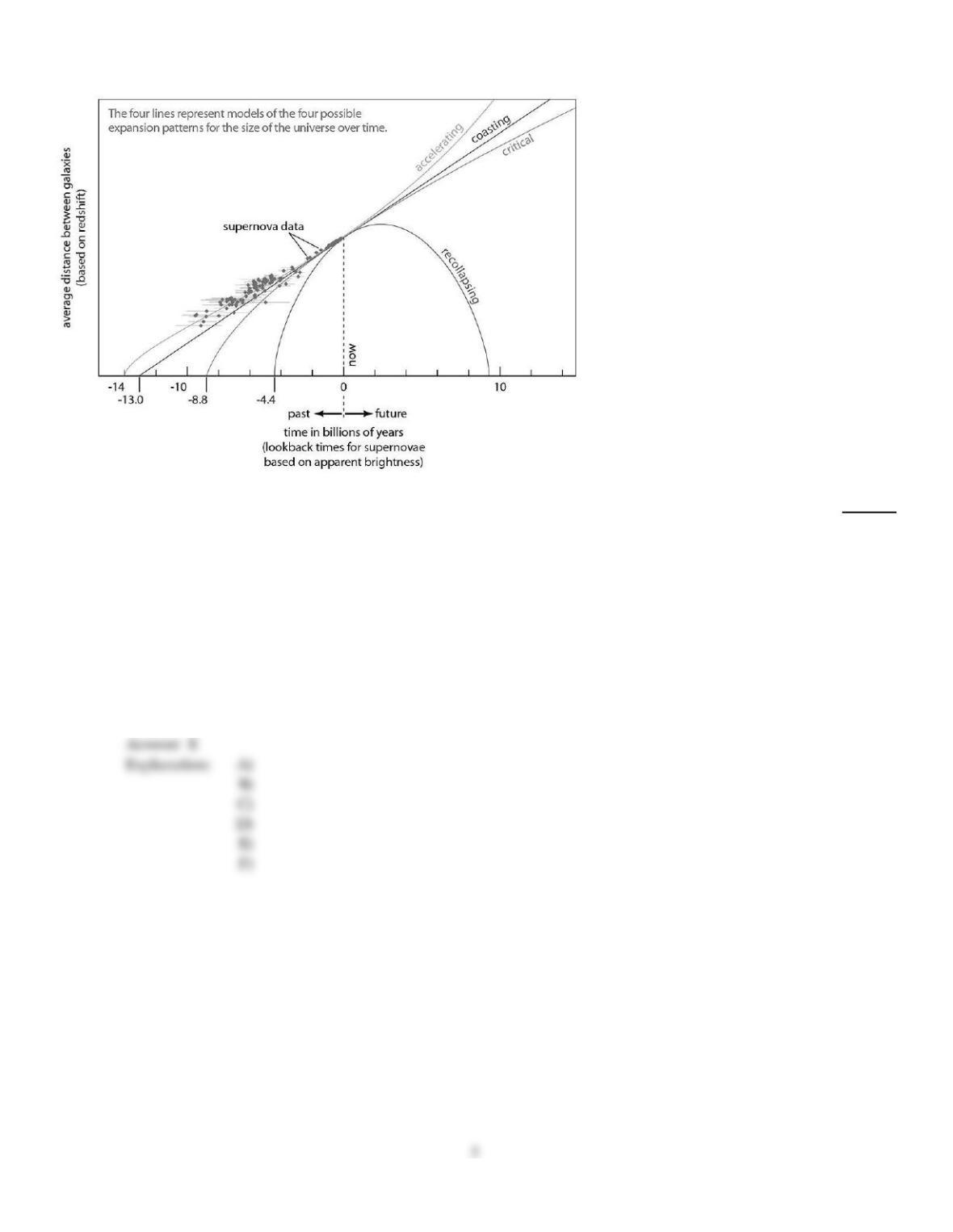
12)
The graph above shows 4 models for how the average distance between galaxies could change with
time, from the past (left) to now (middle ) to the future (right hand side ). The graph also shows
real data, based on studies of supernovae. Each black dot on the graph is for one supernova
explosion. The data are plotted with dots and black lines that indicate the range of uncertainty of
each individual measurement. Use this graph to answer the following questions about
cosmological models for the expansion of the universe. (Note that the models are in the same order,
from top to bottom, whether on the right hand side of the graph or the left hand side. For example
the accelerating model is the top line on both sides of the graph. You should also have a handout
with a better version of this graph.)
Which model(s) predict that galaxies are getting farther apart NOW?
12)
A)
accelerating
B)
coasting
C)
critical
D)
recollapsing
E)
all of them
F)
none of them

13)
Based on current evidence, how does the actual average density of matter in the universe compare
to the critical density?
13)
A)
The actual density of dark matter and luminous matter combined is no more than about 1% of
the critical density.
B)
The actual density, even with dark matter included, is less than about a third of the critical
density.
C)
The actual density of matter is many times higher than the critical density.
D)
If we include dark matter, the actual density equals the critical density.
14)
Which galaxy rotation curve, based on hydrogen gas speeds and locations, would indicate an
unusually large amount of dark matter?
14)
A)
Orbital speeds decline, beyond where the stars are.
B)
Orbital speeds rise, beyond where the stars are.
C)
Orbital speeds remain constant, beyond where the stars are.
15)
Which of the following best describes how galaxies are distributed on large scales in the universe?
15)
A)
Galaxies are distributed in a great shell expanding outward from the center of the universe.
B)
Galaxies are uniformly distributed.
C)
Galaxies are distributed in a hierarchy of clusters, superclusters, and hyperclusters.
D)
Galaxies appear to be distributed in chains and sheets that surround great voids.
E)
Galaxies are randomly distributed.
16)
Which of the following best sums up current scientific thinking about the nature of dark energy?
16)
A)
Dark energy most likely consists of a form of photons that we can’t see or detect.
B)
Dark energy is the source of the mind weapon used by Sith Lords in Star Wars.
C)
Dark energy probably exists, but we have little (if any) idea what it is.
D)
Dark energy is most likely made up of weakly interacting particles that do not interact with
light.

17)
Which of the following would not be considered evidence for dark matter in clusters of galaxies?
17)
A)
the temperature of the intergalactic gas
B)
the velocities and radii of galaxy orbits around the center of mass in the cluster
C)
the curvature of gravitationally–lensed galaxies
D)
the total amount of stars
18)
Considering only the role of dark matter and keeping all other factors the same, which hypothetical
universe is oldest?
18)
A)
the one with more dark matter
B)
the one with less dark matter
C)
Dark matter doesn’t affect the inferred age of the universe.
19)
Which of the following statements best summarizes current evidence concerning dark matter in
individual galaxies and in clusters of galaxies?
19)
A)
Dark matter is present between galaxies in clusters, but not within individual galaxies.
B)
Dark matter is the dominant form of mass in both clusters and in individual galaxies.
C)
Dark matter is present in individual galaxies, but there is no evidence that it can exist
between the galaxies in a cluster.
D)
Within individual galaxies, dark matter is always concentrated near the galactic center, and
within clusters it is always concentrated near the cluster center.
20)
The idea of inflation makes one clear prediction that, until the discovery of an accelerating
expansion, seemed to contradict the available observations. What is this prediction?
20)
A)
Inflation predicts that the early universe should have regions of enhanced density that could
have acted as “seeds” for the formation of galaxies and large structures.
B)
The universe should be geometrically “flat” (in the four dimensions of spacetime).
C)
Inflation predicts that the entire universe must be far larger than the observable universe.
D)
Inflation predicts that the temperature of the cosmic microwave background should be almost
(but not exactly) the same everywhere.

21)
What is the distinguishing characteristic of what we call ordinary matter (such as the matter that
makes up stars, planets, and people)?
21)
A)
It is made of subatomic particles that scientists call WIMPs.
B)
It emits a great deal of light.
C)
It consists of atoms or ions with nuclei made from protons and neutrons.
D)
It can attract other matter through the force of gravity.
22)
Is space expanding within clusters of galaxies?
22)
A)
No, because expansion of the universe affects only empty space, not space in which matter is
present.
B)
No, because their gravity is strong enough to hold them together even while the universe as a
whole expands.
C)
No, because the universe is not old enough yet for these objects to have begun their
expansion.
D)
Yes, and that is why clusters tend to grow in size with time.
23)
A gravitational lens occurs when
23)
A)
a massive object causes more distant objects to appear much larger than they should, and we
can observe the distant objects with better resolution.
B)
a telescope lens is distorted by gravity.
C)
a massive object bends light beams that are passing nearby.
D)
dark matter builds up in a particular region of space, leading to a very dense region and an
extremely high mass–to–light ratio.

24)
The gravitational lens effect has been verified by
24)
A)
single images of highly distorted, high–redshift galaxies seen towards massive galaxy
clusters.
B)
observations of multiple images of the same background galaxy seen towards a massive
galaxy cluster.
C)
observations of the bending of starlight by the Sun during a 1919 eclipse.
D)
all of the above
E)
None of the above; this effect is purely hypothetical.
Refer to this scenario for the following questions:
A multi–dimensional being reaches down to Earth and pulls you out of the universe. You are then thrown back into the
universe at a place and time of the being’s choosing, and you are permitted to leave only after you have identified your
surroundings. This process is repeated several times. Through a scientifically unexplainable miracle, you are able to survive
in every one of the places that you find yourself. In each scenario below, identify your surroundings (and potentially your
cosmic era) from among the choices given.
25)
You find yourself in a very low–density gas that is extremely hot. In fact, the temperature of the gas
is so high that it is emitting lots of X–rays. There are no stars anywhere within about 10,000
light–years of you, but at slightly greater distances, your sky is brightened by hundreds (perhaps
thousands) of beautiful, star–filled structures, some with majestic spiral shapes. Where are you?
25)
A)
You are in the outskirts of a galaxy whose nucleus is a powerful quasar.
B)
You are in the universe about 380,000 years after the Big Bang when the cosmic microwave
background radiation was formed.
C)
You are in the universe when it was about 500 million years old, just before galaxies began to
form.
D)
You are in the center of the Milky Way Galaxy, looking outward into the Local Group.
E)
You are in intergalactic space within a rich cluster of thousands of galaxies.

26)
Which of the following best sums up current scientific thinking about the nature of dark matter?
26)
A)
Most dark matter probably consists of weakly interacting particles of a type that we have not
yet identified.
B)
About 90% of dark matter consists of ordinary matter in the halo of the galaxy, and of the
other 10% of WIMPs.
C)
There is no longer any doubt that dark matter is made mostly of WIMPs.
D)
Dark matter probably does not really exist, and rather indicates a fundamental problem in
our understanding of gravity.
27)
Which model of the universe gives the youngest age for its present size and expansion rate?
27)
A)
a critical universe
B)
a coasting universe
C)
an accelerating universe
D)
a re–collapsing universe
E)
All models give the same age.
Refer to this scenario for the following questions:
A multi–dimensional being reaches down to Earth and pulls you out of the universe. You are then thrown back into the
universe at a place and time of the being’s choosing, and you are permitted to leave only after you have identified your
surroundings. This process is repeated several times. Through a scientifically unexplainable miracle, you are able to survive
in every one of the places that you find yourself. In each scenario below, identify your surroundings (and potentially your
cosmic era) from among the choices given.
28)
You are in a place that is extremely hot and dense. You can’t see far because your surroundings are
opaque to light. Around you, nuclear fusion is converting carbon into oxygen and other elements.
Where are you?
28)
A)
You are in the early universe during the era of nucleosynthesis.
B)
You are in the center of a white dwarf.
C)
You are inside a nuclear power plant on Earth.
D)
You are in the center of a massive star near the end of its life.
E)
You are in the center of a star very much like our Sun.

29)
What do we mean when we say that a particle is weakly interacting?
29)
A)
It interacts only with other weak particles, such as neutrinos.
B)
It interacts with other particles only through the weak force.
C)
It interacts with other particles only through the weakest force, gravity.
D)
It doesn’t interact with any type of baryonic matter.
E)
It interacts with other particles only through the weak force and the force of gravity.
30)
Which of the following is not one of the three main strategies used to measure the mass of a galaxy
clusters?
30)
A)
studying X–ray emission from hot gas inside the cluster
B)
measuring the temperatures of stars in the halos of the galaxies
C)
observing how the cluster bends light from galaxies located behind it
D)
measuring the speeds of galaxies orbiting the cluster’s center
B
Explanation:
31)
Which statement correctly describes the role of dark matter in galaxy formation?
31)
A)
Where dark matter collects, the baryons follow.
B)
Dark matter plays very little role in galaxy formation.
C)
Where baryons collect, dark matter follows.
A
Explanation:
32)
What evidence suggests that the Milky Way contains dark matter?
32)
A)
When we look at the galactic center, we are able to observe a large black hole that is
composed of dark matter.
B)
We see many lanes of dark material blocking out the light of stars behind them along the
band of the Milky Way.
C)
We observe clouds of atomic hydrogen far from the galactic center orbiting the galaxy at
unexpectedly high speeds, higher speeds than they would have if they felt only the
gravitational attraction from objects that we can see.
D)
When we observe in different wavelengths, such as infrared or radio, we see objects that don’t
appear in visible–light observations.
E)
We see many dark voids between the stars in the halo of the Milky Way.
C
Explanation:
E
Explanation:

33)
What is a rotation curve?
33)
A)
a curve used to decide whether a star’s orbit places it in the disk or the halo of a spiral galaxy
B)
a graph showing how orbital velocity depends on distance from the center for a spiral galaxy
C)
a precise description of the shape of a star’s orbit around the center of the Milky Way Galaxy
D)
a graph that shows a galaxy’s mass on the vertical axis and size on the horizontal axis
34)
Which of the following best summarizes what we mean by dark energy?
34)
A)
It is the energy of black holes.
B)
It is a name given to whatever is causing the expansion of the universe to accelerate with
time.
C)
It is a type of energy that is associated with the “dark side” of The Force that rules the cosmos.
D)
It is the energy contained in dark matter.
35)
Visible, luminous matter (such as the stars within galaxies) amounts to what percentage of the
critical density (the density of mass–energy needed to make the geometry of the universe flat)?
35)
A)
25 percent
B)
less than 1 percent
C)
50 percent
D)
10 percent
36)
How do we know that galaxy clusters contain a lot of mass in the form of hot gas that fills spaces
between individual galaxies?
36)
A)
We detect this gas with X–ray telescopes.
B)
The hot gas shows up as bright pink in visible–light photos of galaxy clusters.
C)
We infer its existence by observing its gravitational effects on the galaxy motions.
D)
We can observe the frictional effects of the hot gas in slowing the speeds of galaxies in the
clusters.

37)
Which observation(s) support(s) the idea that dark energy accounts for about 70% of the total
mass–energy density of the universe?
37)
A)
This is just the right amount of a repulsive force to explain the observed acceleration in the
expansion of the universe.
B)
This is just the right amount of energy, in addition to the observed matter and dark matter, to
explain the pattern of temperatures in the cosmic microwave background.
C)
It is the right amount of energy to make the universe geometrically flat, which is
mathematically easier to work with than a curved geometry.
D)
A and B
E)
B and C
38)
What might be causing the universe to accelerate?
38)
A)
brown dwarfs
B)
dark energy
C)
gravitation
D)
WIMPs
E)
white–dwarf supernovae
39)
What is the best alternative explanation for the dark matter in the Milky Way based on the
observed orbital motions of stars and gas?
39)
A)
There is something wrong with our understanding of how gravity works.
B)
We are not measuring the distances to gas clouds and stars properly.
C)
We are not attributing enough mass to the visible matter in the Milky Way.
D)
We are not measuring the orbital velocities of gas clouds and stars properly.
E)
We are not observing all the visible matter in the Milky Way.
40)
The distribution of the dark matter in a spiral galaxy is
40)
A)
flattened in a disk and about the same size as the stellar disk.
B)
predominantly concentrated in the spiral arms.
C)
approximately spherical and about the same size as the galaxy halo.
D)
approximately spherical and about ten times the size of the galaxy halo.
E)
flattened in a disk but about ten times larger than the stellar disk.
41)
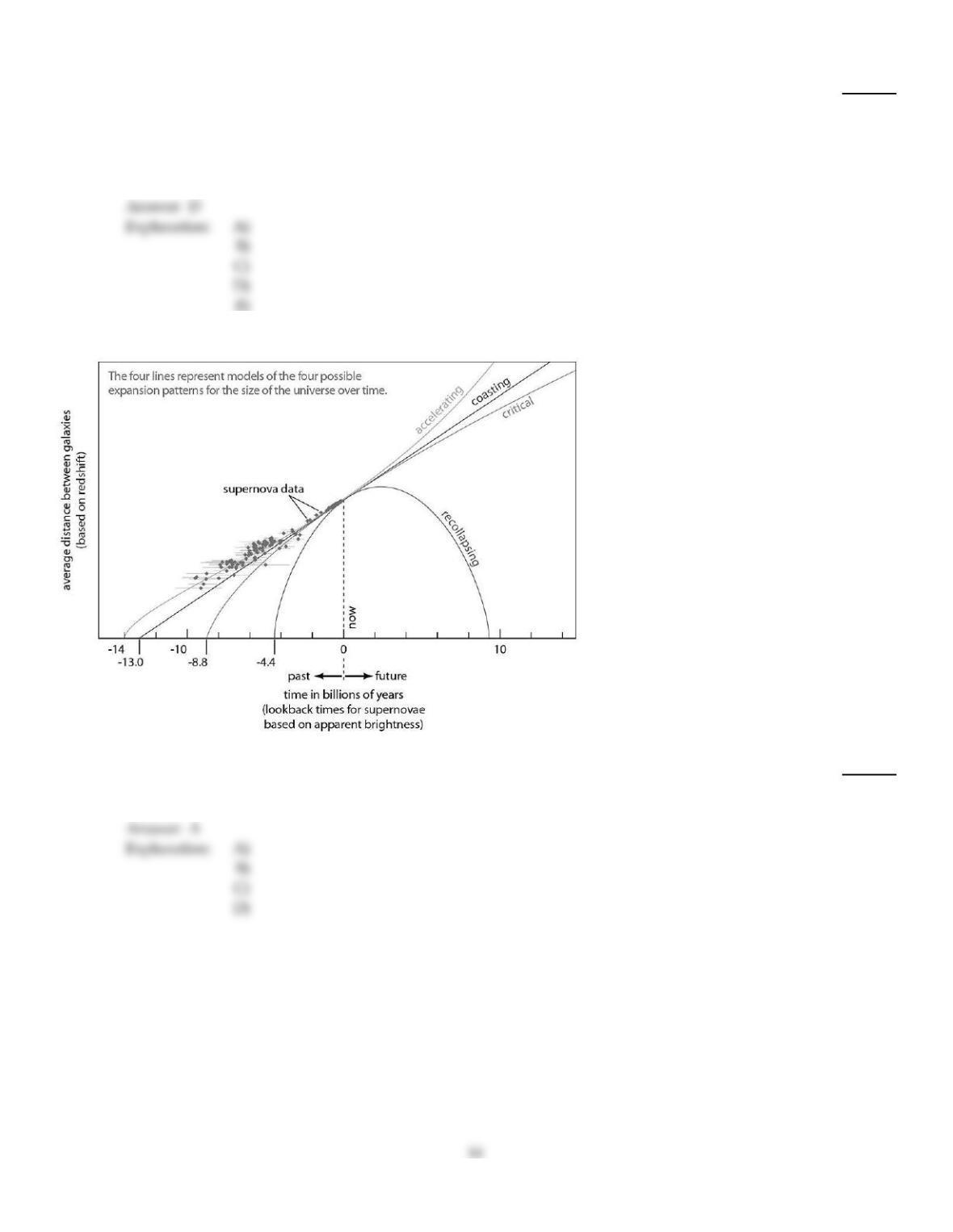
Comparing the following 4 models, which model predicts that galaxies had the largest separations
in the past? (Use the graph of expansion models as a guide.)
41)
A)
accelerating
B)
coasting
C)
critical
D)
recollapsing

42)
Based on observations of the cosmic microwave background, the overall composition of the
universe is approximately ________.
42)
A)
4% ordinary (baryonic) matter, 23% non–ordinary (nonbaryonic) dark matter, 73% dark
energy
B)
15% ordinary (baryonic) matter, 85% non–ordinary (nonbaryonic) dark matter
C)
100% ordinary (baryonic) matter
D)
1% ordinary (baryonic) matter, 99% non–ordinary (nonbaryonic) dark matter
43)
Some dark matter may be ordinary matter that orbits in the halo of the galaxy. Which of the
following would not be considered a type of ordinary dark matter?
43)
A)
planets in the halo of the galaxy
B)
globular clusters in the halo of the galaxy
C)
you, if you happened to be floating in the halo of the galaxy
D)
brown dwarfs in the halo of the galaxy
B
44)
How do X–ray measurements help us measure the amount of dark matter in galaxy clusters?
44)
A)
X–rays are emitted by hot gas, and the intracluster gas is heated by collisions with dark
matter particles. More dark matter leads to greater heating, and hence stronger X–ray
emission.
B)
X–rays are emitted by hot gas, and the intracluster gas is heated by the gravitational effects of
dark matter. More dark matter leads to greater heating, and hence stronger X–ray emission.
C)
Dark matter absorbs X–rays. Therefore, more dark matter leads to weaker X–ray emission
from galaxy clusters.
B
45)
Which of the following is not evidence for dark matter?
45)
A)
the expansion of the universe
B)
gravitational lensing around galaxy clusters
C)
X–ray observations of hot gas in galaxy clusters
D)
the flat rotation curves of spiral galaxies
E)
the broad absorption lines found in the spectra of elliptical galaxies
A
A

46)
Which of the following methods used to determine the mass of a cluster of galaxies does not
depend on Newton’s law of gravity?
46)
A)
measuring the temperature of X–ray gas in the intracluster medium
B)
measuring the orbital velocities of galaxies in the cluster
C)
measuring the amount of distortion caused by a gravitational lens
D)
none of the above
Refer to this scenario for the following questions:
A multi–dimensional being reaches down to Earth and pulls you out of the universe. You are then thrown back into the
universe at a place and time of the being’s choosing, and you are permitted to leave only after you have identified your
surroundings. This process is repeated several times. Through a scientifically unexplainable miracle, you are able to survive
in every one of the places that you find yourself. In each scenario below, identify your surroundings (and potentially your
cosmic era) from among the choices given.
47)
You are in a hot, dense place. You are surrounded by nuclear reactions that are rapidly fusing
hydrogen into helium. You notice that your surroundings are cooling and rapidly dropping in
density. Within about 5 minutes, the fusion reactions stop. Where are you?
47)
A)
You are in the center of a massive star near the end of its life.
B)
You are inside a nuclear power plant on Earth.
C)
You are in the center of a star much smaller than the Sun.
D)
You are in the center of a star very much like our Sun.
E)
You are in the early universe during the era of nucleosynthesis.
48)
What is the primary form of evidence that has led astronomers to conclude that the expansion of
the universe is accelerating?
48)
A)
measurements of the rotation curve for the universe
B)
measurements of how galaxy speeds away from the Milky Way have increased during the
past century
C)
observations of the speeds of individual galaxies in clusters
D)
observations of white dwarf supernovae
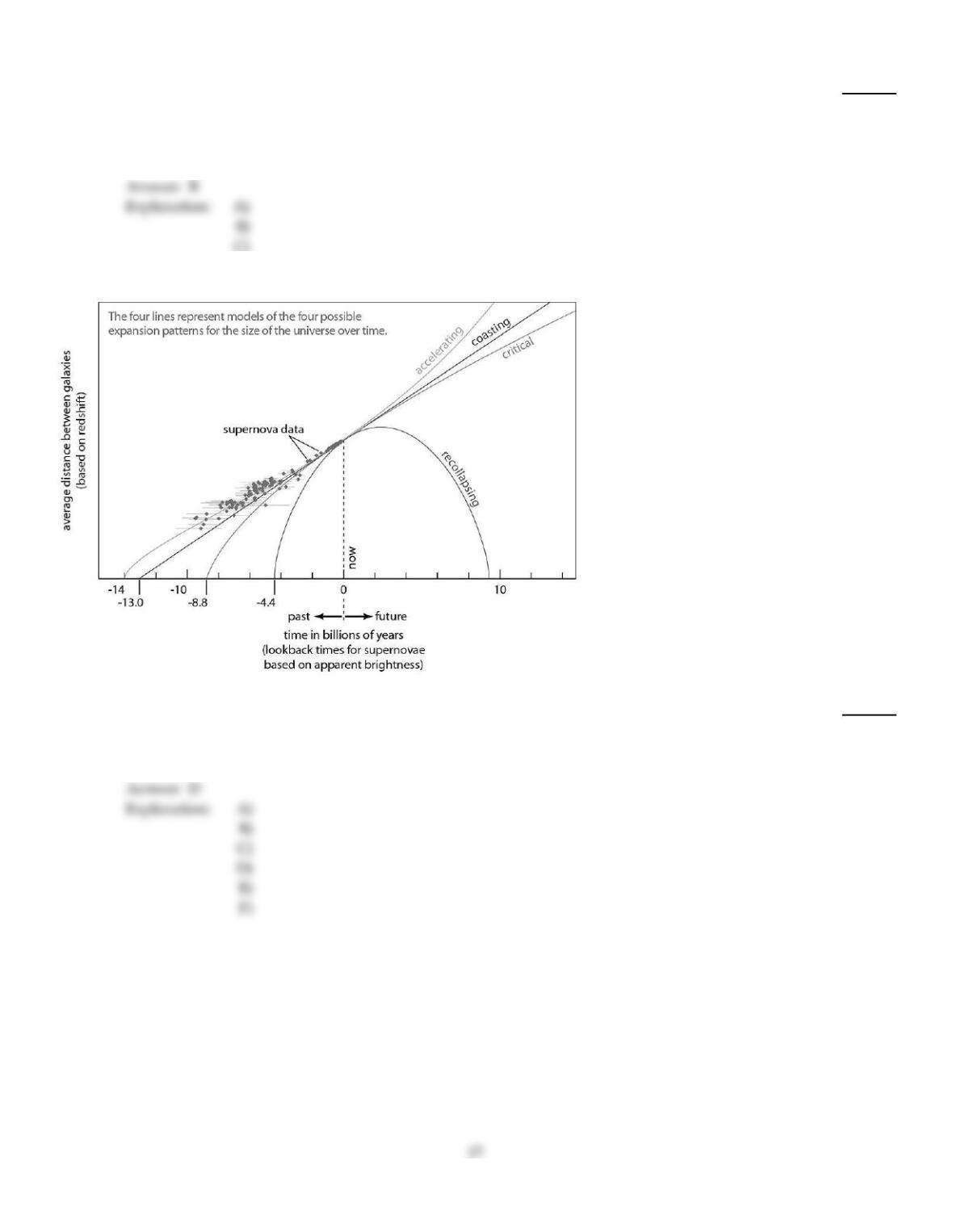
49)
How have astronomers measured the acceleration of the universe?
49)
A)
by measuring changes in galaxies’ redshifts from year to year
B)
by comparing lookback times for white–dwarf supernovae (by measuring their apparent
brightness) with the average distance between galaxies (based on their cosmological redshifts)
C)
They have not. It is a purely hypothetical idea.
50)
Consider the graph of expansion models. Which model(s) predicts that galaxies will eventually get
closer together?
50)
A)
accelerating
B)
coasting
C)
critical
D)
recollapsing
E)
all of them
F)
none of them

51)
Weakly interacting particles (WIMPs) interact with other particles using gravity and the weak
nuclear force. They cannot emit or absorb light. Therefore, how does the behavior of hydrogen and
helium gas differ from that of WIMPs?
51)
A)
Hydrogen and helium gas affects particles that we can see.
B)
Hydrogen and helium gas interacts with other forms of matter gravitationally.
C)
Hydrogen and helium gas can cool by radiating energy.
52)
Why isn’t the space within our solar system or the Milky Way expanding according to Hubble’s
Law?
52)
A)
The universe is not old enough for the solar system or Milky Way to have begun their
expansion.
B)
The gravity exerted by the solar system and the Milky Way is strong enough to hold them
together against the expansion of the universe.
C)
As we are inside our solar system and the Milky Way, we cannot observe their expansion.
D)
Hubble’s law of expansion applies only to the space between galaxies.
B
53)
Based on current evidence, a supercluster is most likely to have formed in regions of space where
________.
53)
A)
the density of dark matter was slightly higher than average when the universe was very
young
B)
the acceleration of the expansion was proceeding faster than elsewhere
C)
there was an excess concentration of hydrogen gas when the universe was very young
D)
supermassive black holes were present in the very early universe
A
54)
The mass enclosed in any orbit can be estimated from the equation M(<r) = v2r / G. If the quantity
v is constant, regardless of radius, where is the mass located?
54)
A)
The mass is distributed like a doughnut, with a hole in the center.
B)
The mass is spread out over large radius.
C)
The mass is concentrated in the center.
D)
Cannot be determined from the information given.
B
C
55)
Compared to the critical density of matter, about how much matter and dark energy is there?
55)
A)
100% matter, 0% dark energy
B)
1% matter, 99% dark energy
C)
99% matter, 1% dark energy
D)
30% matter, 70% dark energy
56)
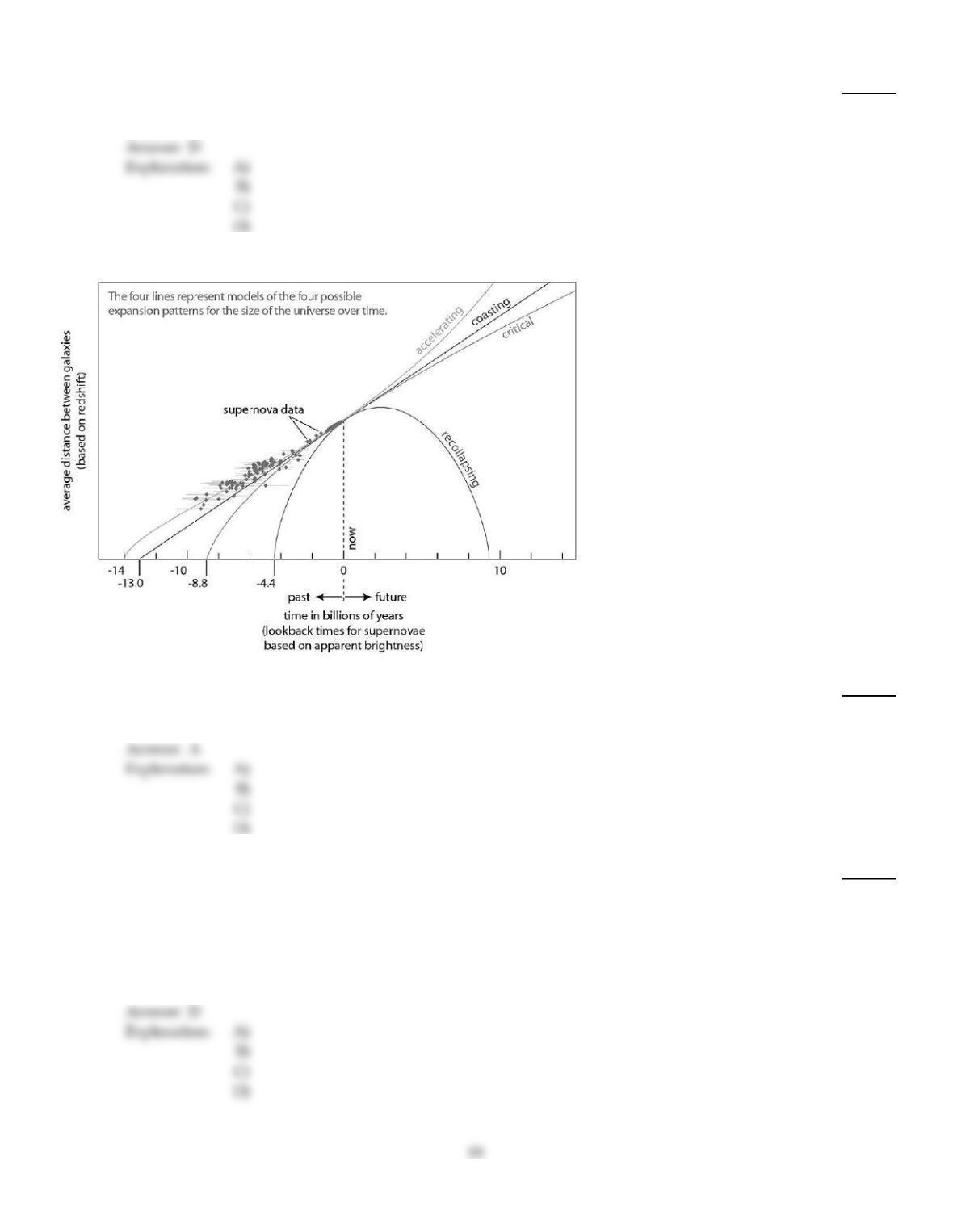
Consider the data points together with the models in the graph of expansion models. Which model
is most strongly supported by the data?
56)
A)
accelerating
B)
coasting
C)
recollapsing
D)
critical
57)
The flat rotation curves of spiral galaxies tell us that they contain a lot of dark matter. Do they tell
us anything about where the dark matter is located within the galaxy?
57)
A)
No, we cannot determine anything about the location of dark matter from the rotation curve.
B)
Yes, they tell us that dark matter is spread uniformly throughout the galactic disk.
C)
Yes, they tell us that dark matter is concentrated near the center of the galaxy.
D)
Yes, they tell us that dark matter is spread throughout the galaxy, with most located at large
distances from the galactic center.

58)
Which of the following best summarizes what we mean by dark matter?
58)
A)
matter that may inhabit dark areas of the cosmos where we see nothing at all
B)
matter for which we have theoretical reason to think it exists, but no observational evidence
for its existence
C)
matter consisting of black holes
D)
matter that we have identified from its gravitational effects but that we cannot see in any
wavelength of light
59)
It is more difficult to determine the total amount of dark matter in an elliptical galaxy than in a
spiral galaxy. Why?
59)
A)
Elliptical galaxies contain much less dark matter than spiral galaxies, so it’s much more
difficult to measure.
B)
Elliptical galaxies lack the atomic hydrogen gas that we use to determine orbital speeds at
great distances from the centers of spiral galaxies.
C)
We cannot observe spectral lines for elliptical galaxies.
D)
Stars in elliptical galaxies are dimmer, making them harder to study.
60)
Why do we call dark matter “dark”?
60)
A)
It blocks out the light of stars in a galaxy.
B)
It emits no or very little radiation of any wavelength.
C)
It emits no visible light.
D)
We cannot detect the type of radiation that it emits.

61)
Which of the following statements best describes the current state of understanding regarding the
apparent acceleration of the expansion of the universe?
61)
A)
We have moderately strong evidence that the acceleration is real, but essentially no idea what
is causing it.
B)
The acceleration is very important in the cosmos today, but the evidence indicates that it will
eventually slow down, allowing the universe to recollapse.
C)
The cause of the acceleration is well–understood, and attributed to the particles that make up
dark energy.
D)
The acceleration probably is not real, and what we attribute to acceleration is probably just a
misinterpretation of the data.
62)
How do astronomers create three–dimensional maps of the universe?
62)
A)
by using a galaxy’s position on the sky and its redshift to determine its distance along the line
of sight
B)
by using a galaxy’s position on the sky and its brightness as a measure of distance along the
line of sight
C)
through the comparison of computer models of galaxy formation with observations
D)
by carefully measuring the parallax of each galaxy
E)
by interpreting the peculiar velocities of each galaxy
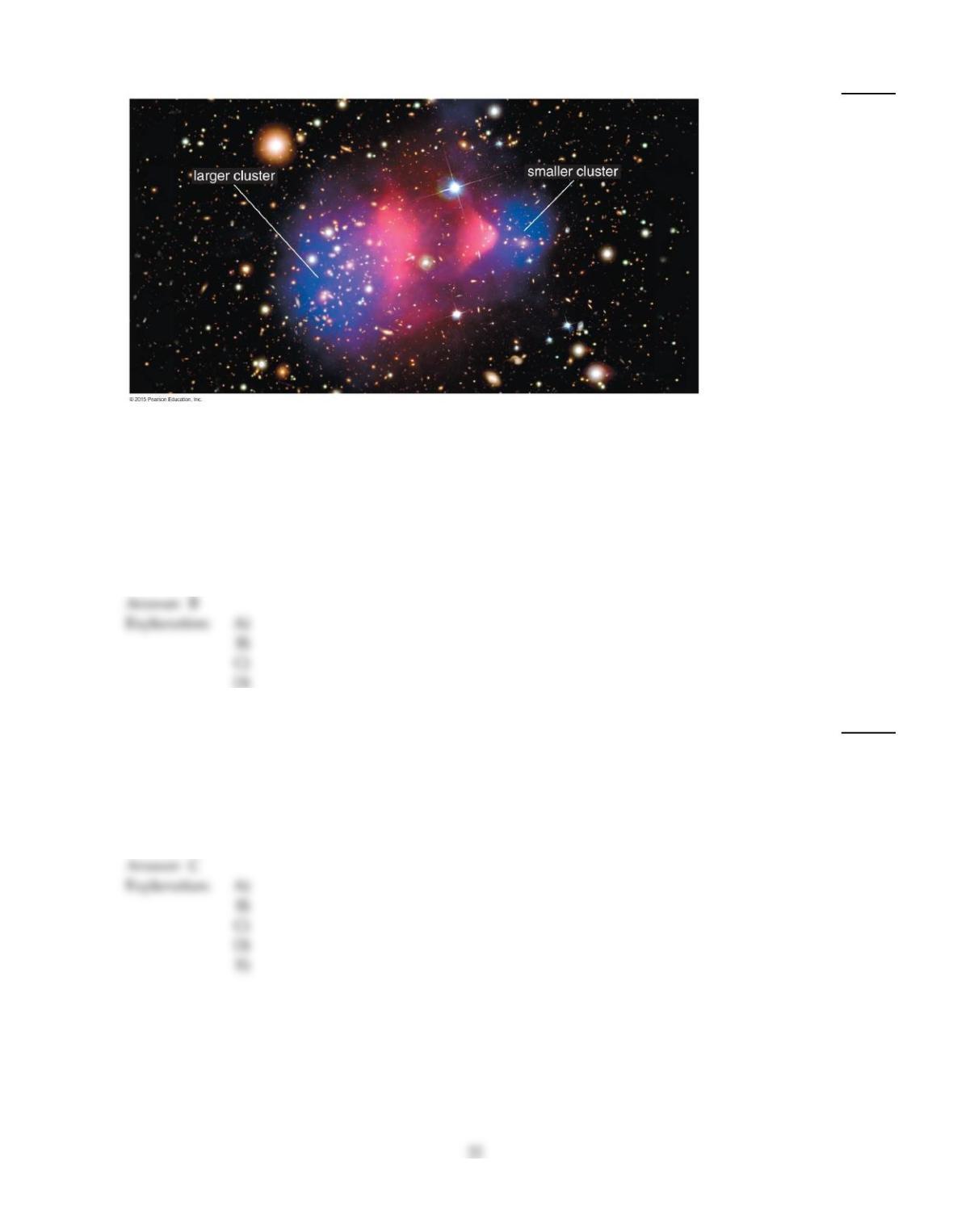
63)
This figure shows the X–ray emission from hot gas in two colliding galaxy clusters (red) and the
distribution of mass (blue). Which of these are reasonable conclusions that can be drawn from this
image?
I) The mass found by gravitational lensing in these colliding galaxy clusters is in a separate
physical location from the hot gas that resulted from the collision.
II) Dark matter does not physically interact with regular matter, other than through gravity.
III) Hot intracluster gas makes up the majority of the mass of galactic clusters.
63)
A)
only I
B)
I and II
C)
I and III
D)
I, II, and III
64)
Based on the observed amount of deuterium in the universe, we can conclude that
64)
A)
most of the deuterium that was created during the era of nucleosynthesis has since been
destroyed.
B)
ordinary (baryonic) matter makes 75 percent of the mass of the universe.
C)
the density of ordinary (baryonic) matter is about 5 percent of the critical density.
D)
we live in a critical–density universe.
E)
neutrons outnumber protons 7 to 1 in the universe.

65)
A mass–to–light ratio for a galaxy of much greater than one indicates that
65)
A)
the galaxy is not very massive.
B)
most stars in the galaxy are more massive than our Sun.
C)
the galaxy is very massive.
D)
on average, each solar mass of matter in the galaxy emits much more light than our Sun.
E)
on average, each solar mass of matter in the galaxy emits much less light than our Sun.
66)
Why is the cause of the acceleration of the universe called “dark energy”?
66)
A)
We’re pretty sure that whatever is causing the acceleration is pure evil.
B)
Dark energy and dark matter are just two forms of the same thing.
C)
The term dark energy was the one that caught on with other astronomers.
67)
How do we determine the amount of dark matter in elliptical galaxies?
67)
A)
We measure how fast the galaxy rotates as a whole.
B)
We search for dark lanes of dust and black holes within the galaxy.
C)
We measure the orbital velocities of star–forming gas clouds in the outer portion of the
galaxy.
D)
We count the number of stars in the galaxy. Combining this with the galaxy’s volume, we can
calculate the galaxy’s density.
E)
We measure the broadening of the galaxy’s absorption lines to infer the speeds of stars at
different distances from the galactic center.
68)
The enclosed mass M(<r) represents ALL of the mass inside the radius r. If the enclosed mass M(<r)
increases out to larger radii, where is the mass?
68)
A)
distributed like a doughnut, with a hole in the center
B)
concentrated in the center
C)
spread out over a large range of radii

69)
What is one of the alternatives to the hypothesized existence of dark matter?
69)
A)
The astronomers are misrepresenting the observations.
B)
The observations are incorrect.
C)
The theory of gravity is wrong.
D)
The current theory of gravity is being used incorrectly.
70)
What do we mean when we say that the rotation curve for a spiral galaxy is “flat”?
70)
A)
All the galaxy’s mass is concentrated in its flat, gaseous disk.
B)
The disk of a spiral galaxy is quite flat rather than spherical like the halo.
C)
The amount of light emitted by stars at different distances is about the same throughout the
galaxy.
D)
Gas clouds orbiting far from the galactic center have approximately the same orbital speed as
gas clouds located further inward.
71)
Which hypothetical universe will eventually contract, if there were no dark energy?
71)
A)
the universe with 0.5 times the critical density of matter
B)
the universe with 1.0 times the critical density of matter
C)
the universe with 1.5 times the critical density of matter
72)
If all the “dark matter” in our universe were to be instantaneously removed, which of the following
would not happen?
72)
A)
The universe would expand forever.
B)
The Solar System would fly apart.
C)
Clusters of galaxies would fly apart.
D)
The Milky Way would fly apart.
E)
All of the above

Refer to this scenario for the following questions:
A multi–dimensional being reaches down to Earth and pulls you out of the universe. You are then thrown back into the
universe at a place and time of the being’s choosing, and you are permitted to leave only after you have identified your
surroundings. This process is repeated several times. Through a scientifically unexplainable miracle, you are able to survive
in every one of the places that you find yourself. In each scenario below, identify your surroundings (and potentially your
cosmic era) from among the choices given.
73)
You find yourself in a place that is unimaginably hot and dense. A rapidly changing gravitational
field randomly warps space and time. Gripped by these huge fluctuations, you notice that there is
but a single, unified force governing the universe. Where are you?
73)
A)
You are inside the nucleus of an atom.
B)
You are in the universe shortly after inflation.
C)
You are in the early universe before the Planck time.
D)
You are in the center of a young star.
E)
You are floating somewhere in the universe near its end, 10100 years from now.
74)
Your friend left your house and is now driving 40 miles per hour, but she has been speeding up the
whole time since she left your house, and has gone 10 miles. How long has she been driving?
74)
A)
15 minutes
B)
longer than 15 minutes
C)
shorter than 15 minutes
75)
Although most astronomers assume dark matter really exists, there is at least one other possible
explanation for the phenomena attributed to dark matter. What is it?
75)
A)
There could be something wrong with our understanding of how atoms produce light.
B)
We could just be having a hard time understanding the observations because they involve
very distant galaxies.
C)
There could be something wrong or incomplete with our understanding of how gravity
operates on galaxy–size scales.
D)
The so–called dark matter is really just ordinary stars that are enshrouded in clouds of dust.

76)
How do we know the expansion of the universe is accelerating?
76)
A)
We see more of the universe every night, as the observable universe grows in size.
B)
We’re really not that sure the expansion is accelerating; it‘s all just a theory.
C)
White dwarf supernova in distant galaxies are fainter than they would be if the expansion
were not accelerating.
D)
Redshifts of distant galaxies are increasing with time, so when we repeat the measurements,
the redshifts are larger.
E)
The rotation curves of galaxies indicate the universe is speeding up.
77)
Why can we not measure the mass of elliptical galaxies using the 21–cm line of hydrogen gas?
77)
A)
Supermassive black holes in the center of elliptical galaxies disturb measurements of the
21–cm line.
B)
All elliptical galaxies are too far away for us to detect the 21–cm line.
C)
The disorderly motion of the material in elliptical galaxies prevents us from measuring
different velocities at different sides of the galaxy.
D)
Elliptical galaxies have little gas, so do not have strong 21–cm line emission.
78)
Although we know less about dark matter in elliptical galaxies than in spiral galaxies, what does
current evidence suggest?
78)
A)
Elliptical galaxies probably contain far more dark matter than spiral galaxies.
B)
Elliptical galaxies probably contain far less dark matter than spiral galaxies.
C)
Unlike the broad distribution of dark matter in spiral galaxies, elliptical galaxies probably
contain dark matter only near their centers.
D)
Elliptical galaxies probably contain about the same proportion of their mass in the form of
dark matter as do spiral galaxies.

79)
Which of the following are candidates for galactic dark matter?
79)
A)
Jupiter–size objects
B)
faint red stars
C)
brown dwarfs
D)
WIMPs
E)
all of the above
80)
Considering only the role of dark energy and keeping all other factors the same, which hypothetical
universe is oldest?
80)
A)
the one with more dark energy
B)
the one with less dark energy
C)
Dark energy doesn’t affect the inferred age of the universe.
81)
Your friend left your house and has been driving 60 miles per hour the whole time since then, and
has gone 30 miles. How long has she been driving?
81)
A)
1/2 minute
B)
2 minutes
C)
30 minutes
D)
60 minutes
E)
1800 minutes

Refer to this scenario for the following questions:
A multi–dimensional being reaches down to Earth and pulls you out of the universe. You are then thrown back into the
universe at a place and time of the being’s choosing, and you are permitted to leave only after you have identified your
surroundings. This process is repeated several times. Through a scientifically unexplainable miracle, you are able to survive
in every one of the places that you find yourself. In each scenario below, identify your surroundings (and potentially your
cosmic era) from among the choices given.
82)
It is bright everywhere. You have been able to travel around, and it’s clear that you are not inside a
star. Yet your surroundings seem as bright as looking directly at the Sun. As you travel around,
you notice that you cannot find a single neutral atom anywhere, nor can you find any nucleus
besides those of hydrogen and helium. While it is hot (a few thousand degrees Kelvin), it is
nowhere near the temperature needed for nuclear fusion. Where are you?
82)
A)
You are in an accretion disk around a supermassive black hole.
B)
You are in the universe more than 10100 years in the future.
C)
You are in the planetary nebula that the Sun will form about 5 billion years from now.
D)
You are in the universe during its first 380,000 years.
E)
You are in the central regions of a quasar.
83)
The more baryons there are in the universe (a higher density of baryonic matter), the lower the ratio
of deuterium to hydrogen is. Therefore, if Harry measures a higher ratio of deuterium to hydrogen
than Sally, Harry infers
83)
A)
a lower density of baryons than Sally.
B)
a higher density of baryons than Sally.
C)
the same density of baryons as Sally.
84)
Why does the temperature of the gas between galaxies in galaxy clusters tell us about the mass of
the cluster?
84)
A)
The temperature tells us the average speeds of the gas particles, which are held in the cluster
by gravity, so we can use these speeds to determine the cluster mass.
B)
The temperature of the gas tells us the gas density, so we can use the density to determine the
cluster’s mass.
C)
Temperature is always directly related to mass, which is why massive objects are always
hotter than less massive objects.
D)
The question is nonsensegas temperature cannot possibly tell us anything about mass.

85)
When we speak of the large–scale structure of the universe, we mean ________.
85)
A)
the overall shape of the observable universe
B)
the structure of any large galaxy
C)
the structure of any individual cluster of galaxies
D)
the overall arrangement of galaxies, clusters of galaxies, and superclusters in the universe
86)
Some people wish that we lived in a recollapsing universe that would eventually stop expanding
and start contracting. For this to be the case, which of the following would have to be true (based
on current understanding)?
86)
A)
Dark energy is the dominant form of energy in the cosmos.
B)
Dark energy does not exist and there is much more dark matter than we are aware of to date.
C)
Neither dark energy nor dark matter really exist.
D)
Dark energy exists but dark matter does not.
B
87)
The idea of dark matter arose to explain gravitational effects observed in galaxies and clusters of
galaxies. However, studies of the early universe (especially of the cosmic microwave background
and of chemical abundances) also tell us something about dark matter. What do they tell us?
87)
A)
They tell us that dark matter was produced during the era of nuclei.
B)
They add further support to the idea that dark matter really exists and is made of
non–ordinary (nonbaryonic) matter, such as WIMPs.
C)
They tell us that dark matter probably exists, but that it must be made of ordinary matter in
the form of dim objects in galactic halos.
D)
They do not support the conclusion that dark matter is the dominant form of matter in the
universe.
B
88)
What is the primary way in which we determine the mass distribution of a spiral galaxy?
88)
A)
We construct its rotation curve by measuring Doppler shifts from gas clouds at different
distances from the galaxy’s center.
B)
We apply Newton’s version of Kepler’s third law to the orbits of globular clusters in the
galaxy’s halo.
C)
We count the number of stars we can see at different distances from the galaxy’s center.
D)
We calculate its mass–to–light ratio.
A
D

89)
How does gravitational lensing tell us about the mass of a galaxy cluster?
89)
A)
The lensing allows us to determine the orbital speeds of galaxies in the cluster, so that we can
determine the mass of the cluster from the orbital velocity law.
B)
Using Einstein’s general theory of relativity, we can calculate the cluster’s mass from the
precise way in which it distorts the light of galaxies behind it.
C)
Newton’s universal law of gravitation predicts how mass can distort light, so we can apply
Newton’s law to determine the mass of the cluster.
D)
The lensing broadens spectral lines, and we can use the broadening to “weigh” the cluster.
90)
Why do we expect WIMPs to be distributed throughout galactic halos, rather than settled into the
galaxy’s disk?
90)
A)
Shock waves from generations of supernovae have blown the WIMPs out into the halo.
B)
WIMPs annihilate when they come into contact with ordinary matter, such as stars.
C)
WIMPs are light enough that they have expanded out into the halo.
D)
WIMPs were produced in the early stages of galaxy evolution, and objects in the halo, such as
globular clusters, were formed first.
E)
WIMPS cannot produce photons, therefore they rarely interact and exchange energy with
other particles.
91)
Measuring the amount of deuterium in the universe allows us to set a limit on
91)
A)
the temperature of the universe at the end of the era of nuclei.
B)
the total amount of mass in the universe.
C)
the expansion rate of the universe.
D)
the current age of the universe.
E)
the density of ordinary (baryonic) matter in the universe.

92)
Which of the following statements about large–scale structure is probably not true?
92)
A)
Many cluster and superclusters are still in the process of formation as their gravity gradually
pulls in new members.
B)
Voids between superclusters began their existence as regions in the universe with a slightly
lower density than the rest of the universe.
C)
Galaxies and clusters have grown around tiny density enhancements that were present in the
early universe.
D)
Clusters and superclusters appear to be randomly scattered about the universe, like dots
sprinkled randomly on a wall.
93)
Why do we call dark matter “dark”?
93)
A)
It contains large amounts of dark–colored dust.
B)
It blocks out the light of stars in a galaxy.
C)
It emits no radiation that we have been able to detect.
D)
It is dark brown or dark red in color.
94)
Which statement correctly describes the role of gravity in galaxy formation?
94)
A)
Gravity makes the universe more uniform and smooth than it was at the beginning.
B)
Gravity makes the dense regions denser.
C)
Gravity slows down photons so they collect into galaxies.
D)
Gravity makes galaxies spin.
95)
The mass enclosed in any orbit can be estimated from the equation M(<r) = v2r/ G. If the quantity
(v2r) is constant, regardless of radius, where is the mass located?
95)
A)
The mass is concentrated in the center.
B)
The mass is distributed like a doughnut, with a hole in the center.
C)
The mass is spread out over large radius.
D)
Cannot be determined from the information given.

Refer to this scenario for the following questions:
A multi–dimensional being reaches down to Earth and pulls you out of the universe. You are then thrown back into the
universe at a place and time of the being’s choosing, and you are permitted to leave only after you have identified your
surroundings. This process is repeated several times. Through a scientifically unexplainable miracle, you are able to survive
in every one of the places that you find yourself. In each scenario below, identify your surroundings (and potentially your
cosmic era) from among the choices given.
96)
You are on the surface of an object, and you have a fairly clear view out into space. Unfortunately,
you are also very squashed. The light you observe from distant objects is slightly blueshifted. The
surface of the object is composed primarily of carbon and oxygen, and the distance to the horizon
seems about the same as that on Earth. By observing the sky for a few weeks, you realize that there
are several planets orbiting your object. Where are you?
96)
A)
You are on the surface of a white dwarf.
B)
You are “on” an accretion disk around a black hole.
C)
You are on the surface of a neutron star.
D)
You are on the surface of the Earth.
E)
You are on the surface of a planet that is somewhat more massive than the Earth.
97)
The critical density of the universe is the ________.
97)
A)
actual average density of the universe
B)
average density the universe would need for gravity to someday halt the current expansion if
dark energy did not exist
C)
density of water
D)
density of dark matter in the universe
B
98)
Why can’t the dark matter in galaxies be made of neutrinos?
98)
A)
Neutrinos travel at extremely high speeds and can escape a galaxy’s gravitational pull.
B)
We know that dark massive objects, such as planets and neutron stars, are not made of
neutrinos.
C)
Neutrinos have zero mass like the photon.
D)
There are not enough neutrinos to make up all the dark matter.
A
A
99)
How are rotation curves of spiral galaxies determined for distances beyond where starlight can be
detected?
99)
A)
by observations of spectral lines emitted by dark matter
B)
by watching the galaxies rotate over a period of decades
C)
by measuring the broadening of the galaxy’s absorption lines
D)
by extrapolation of the measured rotation curve
E)
by observations of the 21 cm line of atomic hydrogen
100)
Measuring the amount of deuterium in the universe allows us to set a limit on ________.
100)
A)
the total amount of mass in the universe
B)
the current age of the universe
C)
the acceleration of the universe
D)
the density of ordinary (baryonic) matter in the universe
D
SHORT ANSWER. Write the word or phrase that best completes each statement or answers the question.
101)
Briefly describe two different ways of measuring the mass of a cluster of galaxies.
101)
102)
Explain how observations of white–dwarf supernovae provide information on the
expansion of the universe when it was younger.
102)
E
103)
How do we know that there can only be insignificant amounts of dark matter in our solar
system?
103)
104)
Briefly explain why astronomers think that dark matter must be composed of Weakly
Interacting Massive Particles (WIMPs) rather than difficult to see normal objects like
planets, brown dwarfs, and the faintest low mass main sequence stars.
104)
105)
Briefly describe the four possible expansion patterns (or fates) of the universe.
105)
TRUE/FALSE. Write ‘T’ if the statement is true and ‘F’ if the statement is false.
106)
Recent measurements of temperature fluctuations in the cosmic microwave background radiation
indicate that about 70 percent of the mass–energy in the universe must be in the form of dark
energy.
106)
107)
The visible parts of galaxies contribute about 10 percent of the critical density of the universe.
107)
108)
A galaxy with a lot of dark matter would have a high mass–to–light ratio compared to the Sun.
108)

109)
If the universe is accelerating, it will expand forever.
109)
110)
Dark matter particles were definitively detected in 2013.
110)
111)
One possible ingredient of dark matter is known as WIMPs, or weakly interacting massive
particles. Our best guess is that WIMPs probably are made of protons and neutrons.
111)
112)
Some galaxy clusters have not finished forming and are still attracting new members today.
112)
113)
GUT theories predict that protons will eventually decay, causing all solid objects in the universe to
fall apart if the universe keeps expanding forever.
113)
114)
Dark matter in galaxies and clusters of galaxies is purely hypothetical because we have no way of
detecting its presence.
114)
115)
If we were to learn that the universe is a re–collapsing universe, then we must have misinterpreted
Hubble’s Law because the universe must be contracting, rather than expanding as generally
believed.
115)
ESSAY. Write your answer in the space provided or on a separate sheet of paper.
116)
New Perspectives? Chapter 18 ends the discussion of the origin and evolution of the universe. Galaxy and star
formation, as well as the origin of planetary systems, were discussed in earlier chapters. It is perhaps time to
reflect upon what has been learned. There is an oft–quoted line in T.S. Eliot’s poem Little Gidding (1942): “And
the end of all our exploring will be to arrive where we started and know the place for the first time.” Have you
gained any new perspectives on the position of the Earth (and human beings) within the universe through your
study of the science of astronomy? If so, what are they?
117)
An Accelerating Universe? Current evidence that the expansion of the universe is accelerating is based entirely
upon observations of distant white dwarf supernova. List all of the assumptions that you can think of that are
made in using white dwarf supernova as distance indicators. Is it conceivable that any of these assumptions
may be incorrect?
118)
“Beauty” in Astronomy: In the absence of observational evidence, scientists often rely on other considerations to
make decisions. One such consideration that we have met before (Chapter 3) is Occam’s razor: the simplest
explanation is to be preferred. Another consideration that is often used (and sometimes championed) by
astronomers is the perceived “beauty” of the ideas themselves. Imagine you lived at a time before observational
tests could be brought to bear on which of the ultimate fates (re–collapsing, critical, coasting, or accelerating)
applies to our universe. Which fate would you support based on your own personal idea of “beauty”? Give your
arguments, even if you think they are not scientific. Did you choose the observationally supported theory? What
do you think of the role such considerations play in science? Are they sometimes necessary?
119)
Gravitational Lensing: Summarize the observational evidence that a gravitational field can deflect the path of
light. In figures such as 18.7 on page 467, how would you prove to a skeptic that the distorted images indicated
by the arrows are indeed multiple images of a single gravitationally–lensed galaxy? Muster as much
observational evidence as you can.
120)
Changing minds: From the time the idea of dark matter was first proposed in the 1930s, it took nearly 50 years
for astronomers to universally accept the existence of dark matter. Discuss the process by which that acceptance
came about. What evidence was collected, and how was it checked?
Answer Key
Testname: C18
Answer Key
Testname: C18
Answer Key
Testname: C18
39
Answer Key
Testname: C18
40