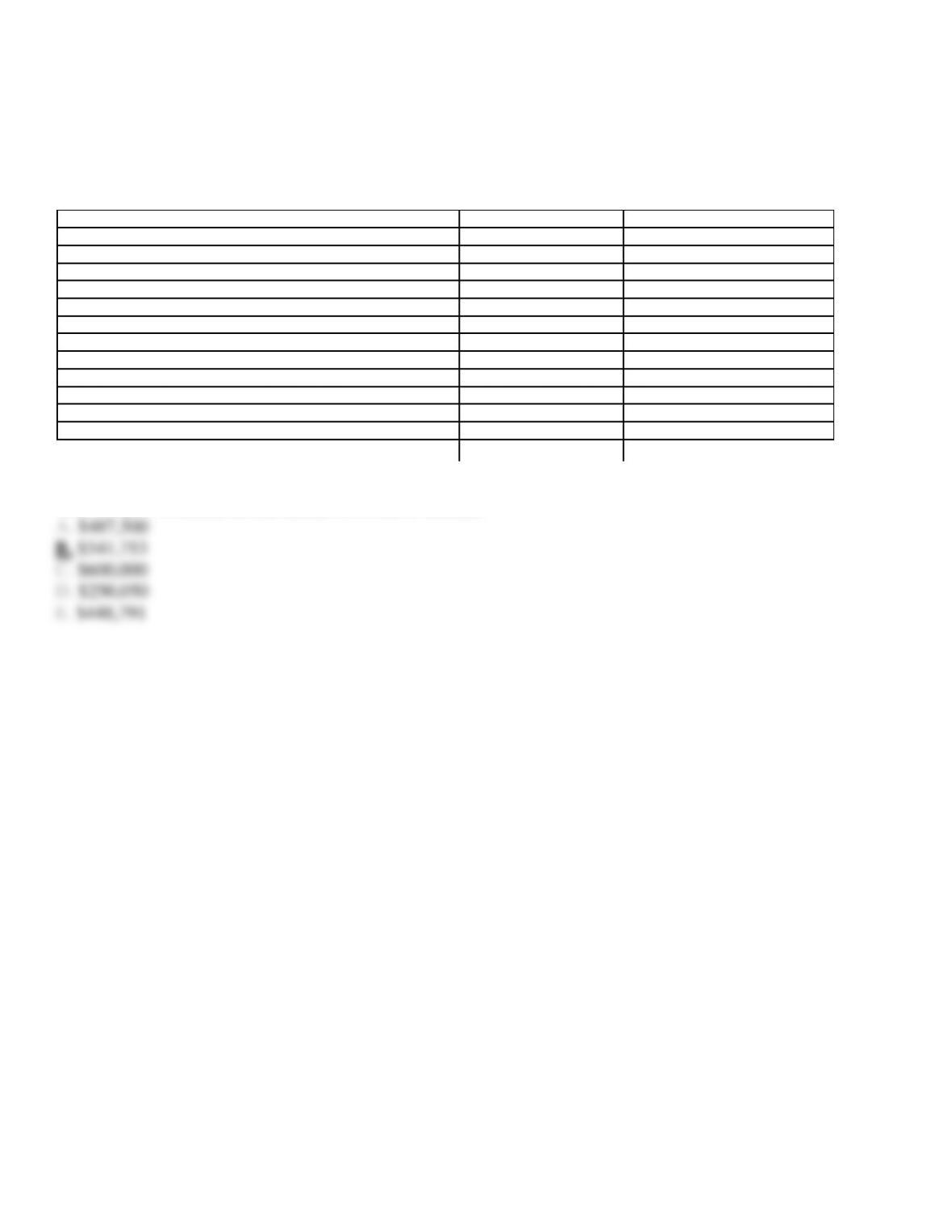
92. Figure 7-2.
Steller Manufacturing has two classes of distributors: JIT distributors and non-JIT distributors. The JIT
distributor places small, frequent orders and the non-JIT distributor tends to place larger, less frequent orders.
Both types of distributors purchase the same product. The customer activities and costs for the previous quarter
are found below:
Activity
JIT distributors
Non-JIT distributors
Sales Orders
400
25
Sales Calls
20
20
Service Calls
180
80
Average Order Size
75
1,200
Manufacturing cost/unit
$40
$40
Customer Costs:
Processing Sales Orders
$150,000
Selling Goods
$145,000
Servicing Goods
$185,000
Total
$480,000
Refer to Figure 7-2. Calculate the total customer cost for the JIT distributor.
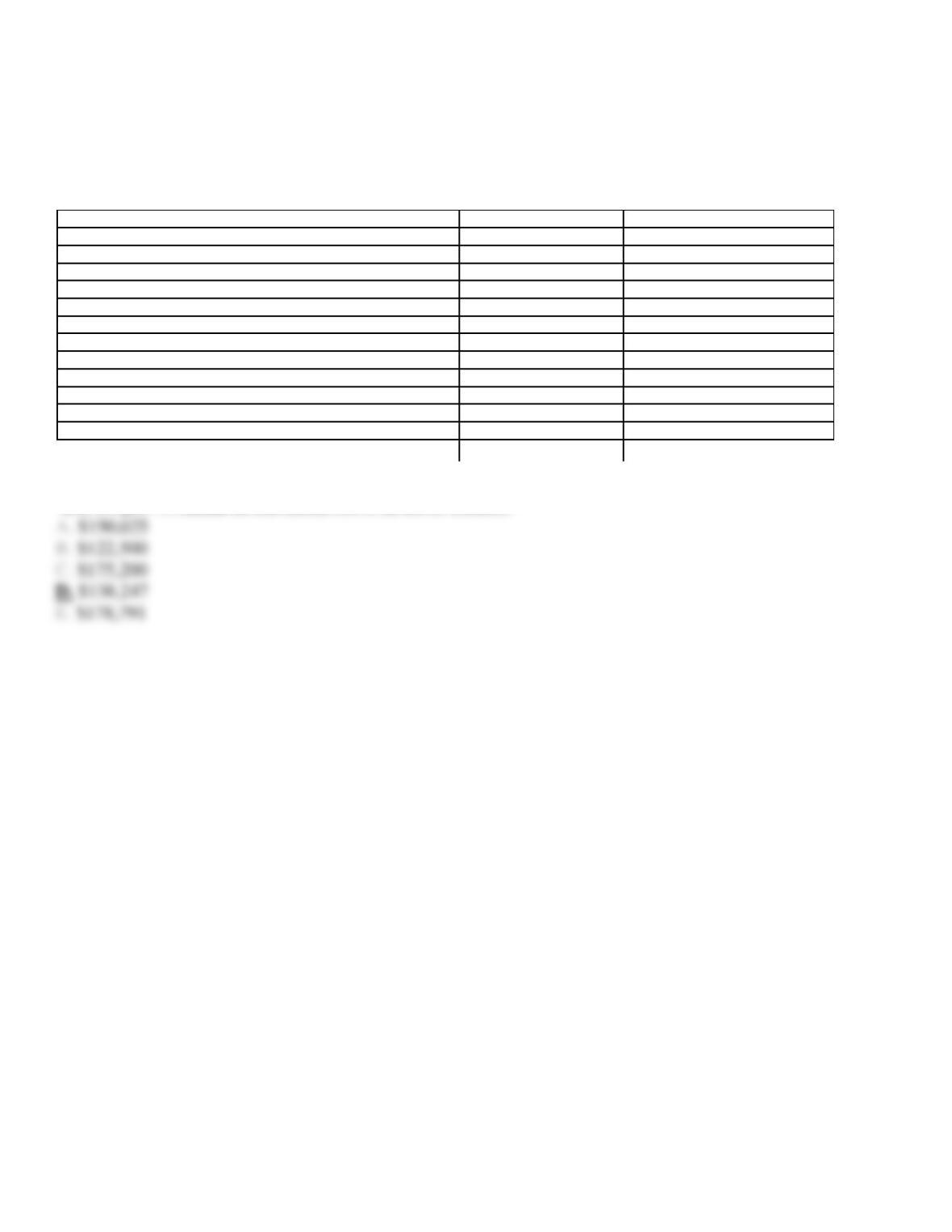
93. Figure 7-2.
Steller Manufacturing has two classes of distributors: JIT distributors and non-JIT distributors. The JIT
distributor places small, frequent orders and the non-JIT distributor tends to place larger, less frequent orders.
Both types of distributors purchase the same product. The customer activities and costs for the previous quarter
are found below:
Activity
JIT distributors
Non-JIT distributors
Sales Orders
400
25
Sales Calls
20
20
Service Calls
180
80
Average Order Size
75
1,200
Manufacturing cost/unit
$40
$40
Customer Costs:
Processing Sales Orders
$150,000
Selling Goods
$145,000
Servicing Goods
$185,000
Total
$480,000
Refer to Figure 7-2. Calculate the total customer cost for the non-JIT distributor.
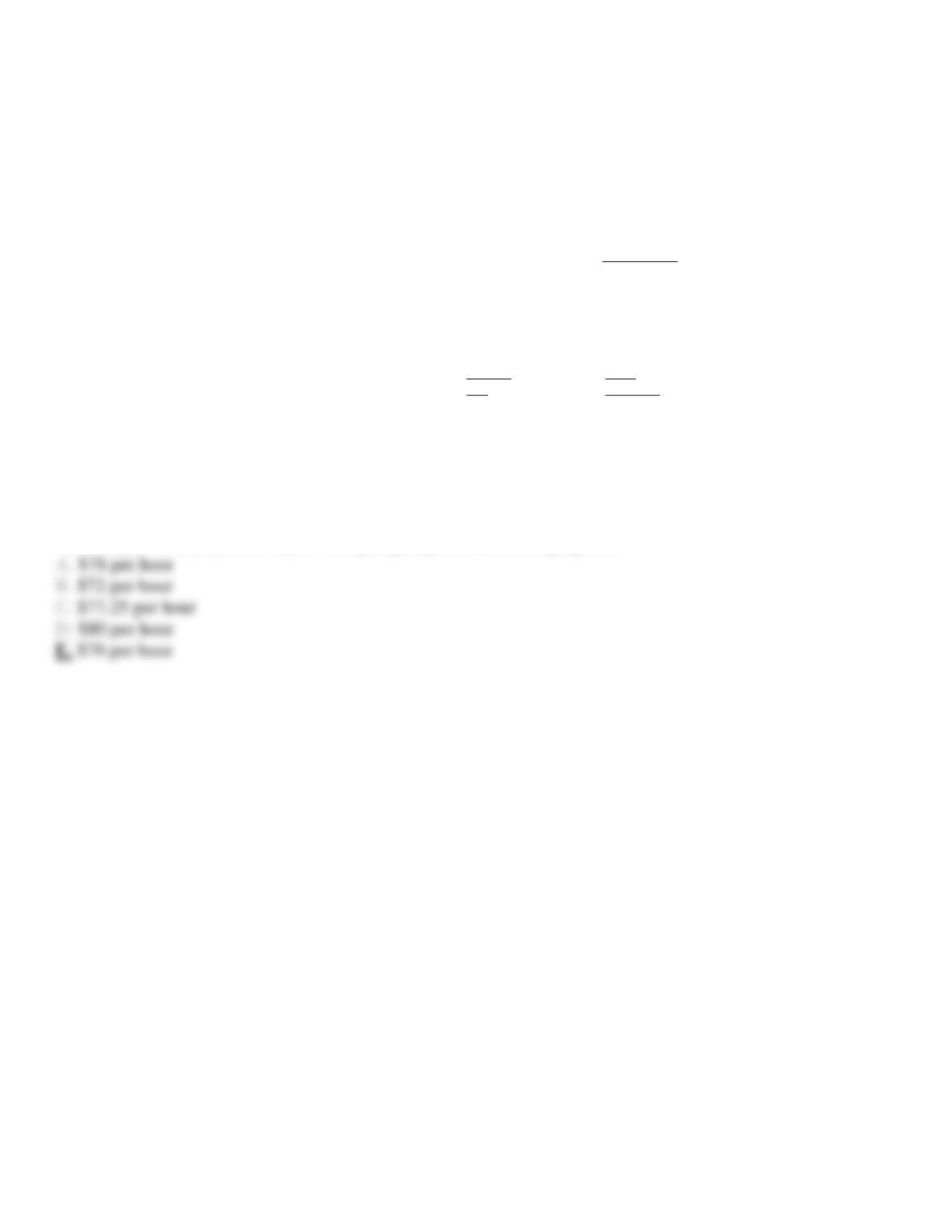
94. Figure 7-3.
Hamilton Company manufactures engines. Hamilton produces all the parts necessary for its engines except for
one electronic component, which is purchased from two local suppliers: Traynor Inc. and Bello Company. Both
suppliers are reliable and rarely deliver late; however, Traynor sells the component for $10.00 per unit and
Bello sells the same component for $8.95. Hamilton purchases 70 percent of its components from Bello,
because of the lower price. The total annual demand is 75,000 units.
I. Activity Data
Activity Cost
Inspecting components (sampling only)
$ 190,000
Reworking products (due to failed component)
$2,254,000
Warranty work (due to failed component)
$1,723,000
II. Supplier Data
Traynor
Bello
Inc.
Company
Unit Purchase Price
$10.00
$8.95
Units Purchased
22,500
52,500
Sampling Hours
50
2,450
Rework hours
135
3,625
Warranty hours
475
6,000
Refer to Figure 7-3. Calculate the activity rate for inspecting components based on sampling hours.
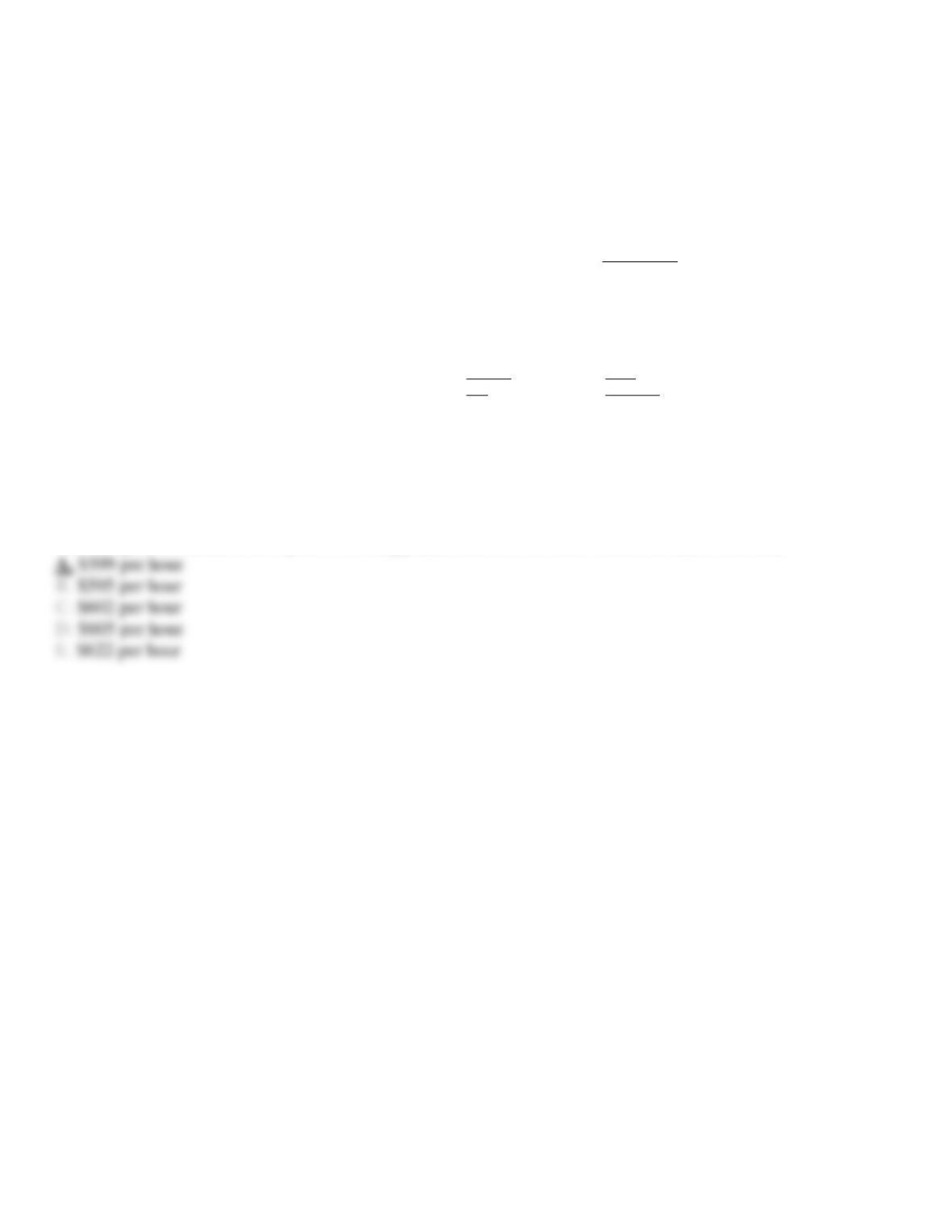
95. Figure 7-3.
Hamilton Company manufactures engines. Hamilton produces all the parts necessary for its engines except for
one electronic component, which is purchased from two local suppliers: Traynor Inc. and Bello Company. Both
suppliers are reliable and rarely deliver late; however, Traynor sells the component for $10.00 per unit and
Bello sells the same component for $8.95. Hamilton purchases 70 percent of its components from Bello,
because of the lower price. The total annual demand is 75,000 units.
I. Activity Data
Activity Cost
Inspecting components (sampling only)
$ 190,000
Reworking products (due to failed component)
$2,254,000
Warranty work (due to failed component)
$1,723,000
II. Supplier Data
Traynor
Bello
Inc.
Company
Unit Purchase Price
$10.00
$8.95
Units Purchased
22,500
52,500
Sampling Hours
50
2,450
Rework hours
135
3,625
Warranty hours
475
6,000
Refer to Figure 7-3. Calculate the activity rate for reworking products based on rework hours. Round to the nearest whole dollar.
96. Figure 7-3.
Hamilton Company manufactures engines. Hamilton produces all the parts necessary for its engines except for
one electronic component, which is purchased from two local suppliers: Traynor Inc. and Bello Company. Both
suppliers are reliable and rarely deliver late; however, Traynor sells the component for $10.00 per unit and
Bello sells the same component for $8.95. Hamilton purchases 70 percent of its components from Bello,
because of the lower price. The total annual demand is 75,000 units.
I. Activity Data
Activity Cost
Inspecting components (sampling only)
$ 190,000
Reworking products (due to failed component)
$2,254,000
Warranty work (due to failed component)
$1,723,000
II. Supplier Data
Traynor
Bello
Inc.
Company
Unit Purchase Price
$10.00
$8.95
Units Purchased
22,500
52,500
Sampling Hours
50
2,450
Rework hours
135
3,625
Warranty hours
475
6,000
Refer to Figure 7-3. Calculate the activity rate for warranty work based on warranty hours. Round to the nearest whole dollar.
97. Figure 7-3.
Hamilton Company manufactures engines. Hamilton produces all the parts necessary for its engines except for
one electronic component, which is purchased from two local suppliers: Traynor Inc. and Bello Company. Both
suppliers are reliable and rarely deliver late; however, Traynor sells the component for $10.00 per unit and
Bello sells the same component for $8.95. Hamilton purchases 70 percent of its components from Bello,
because of the lower price. The total annual demand is 75,000 units.
I. Activity Data
Activity Cost
Inspecting components (sampling only)
$ 190,000
Reworking products (due to failed component)
$2,254,000
Warranty work (due to failed component)
$1,723,000
II. Supplier Data
Traynor
Bello
Inc.
Company
Unit Purchase Price
$10.00
$8.95
Units Purchased
22,500
52,500
Sampling Hours
50
2,450
Rework hours
135
3,625
Warranty hours
475
6,000
Refer to Figure 7-3. Calculate the total activity cost per component associated with using Traynor Inc., as the supplier.
98. Figure 7-3.
Hamilton Company manufactures engines. Hamilton produces all the parts necessary for its engines except for
one electronic component, which is purchased from two local suppliers: Traynor Inc. and Bello Company. Both
suppliers are reliable and rarely deliver late; however, Traynor sells the component for $10.00 per unit and
Bello sells the same component for $8.95. Hamilton purchases 70 percent of its components from Bello,
because of the lower price. The total annual demand is 75,000 units.
I. Activity Data
Activity Cost
Inspecting components (sampling only)
$ 190,000
Reworking products (due to failed component)
$2,254,000
Warranty work (due to failed component)
$1,723,000
II. Supplier Data
Traynor
Bello
Inc.
Company
Unit Purchase Price
$10.00
$8.95
Units Purchased
22,500
52,500
Sampling Hours
50
2,450
Rework hours
135
3,625
Warranty hours
475
6,000
Refer to Figure 7-3. Calculate the total cost per component associated with using Bello Company as the supplier.
99. Figure 7-3.
Hamilton Company manufactures engines. Hamilton produces all the parts necessary for its engines except for
one electronic component, which is purchased from two local suppliers: Traynor Inc. and Bello Company. Both
suppliers are reliable and rarely deliver late; however, Traynor sells the component for $10.00 per unit and
Bello sells the same component for $8.95. Hamilton purchases 70 percent of its components from Bello,
because of the lower price. The total annual demand is 75,000 units.
I. Activity Data
Activity Cost
Inspecting components (sampling only)
$ 190,000
Reworking products (due to failed component)
$2,254,000
Warranty work (due to failed component)
$1,723,000
II. Supplier Data
Traynor
Bello
Inc.
Company
Unit Purchase Price
$10.00
$8.95
Units Purchased
22,500
52,500
Sampling Hours
50
2,450
Rework hours
135
3,625
Warranty hours
475
6,000
Refer to Figure 7-3. Suppose that Hamilton loses $2,500,000 in sales per year because of its reputation for defective units attributable to failed
components. Using warranty hours, assign the proportional cost of lost sales to Traynor Inc. Then determine what effect this would have on the cost
per component.
100. Figure 7-3.
Hamilton Company manufactures engines. Hamilton produces all the parts necessary for its engines except for
one electronic component, which is purchased from two local suppliers: Traynor Inc. and Bello Company. Both
suppliers are reliable and rarely deliver late; however, Traynor sells the component for $10.00 per unit and
Bello sells the same component for $8.95. Hamilton purchases 70 percent of its components from Bello,
because of the lower price. The total annual demand is 75,000 units.
I. Activity Data
Activity Cost
Inspecting components (sampling only)
$ 190,000
Reworking products (due to failed component)
$2,254,000
Warranty work (due to failed component)
$1,723,000
II. Supplier Data
Traynor
Bello
Inc.
Company
Unit Purchase Price
$10.00
$8.95
Units Purchased
22,500
52,500
Sampling Hours
50
2,450
Rework hours
135
3,625
Warranty hours
475
6,000
Refer to Figure 7-3. Suppose that Hamilton loses $2,500,000 in sales per year because of its reputation for defective units attributable to failed
components. Using warranty hours, assign the proportional cost of lost sales to Bello Company. Then determine what effect this would have on the
cost per component.
101. ____ is the length of time required to produce one product; ____ is the number of units that can be
produced in a given period of time.
102. The identification and elimination of activities that fail to add value refers to
103. The process of choosing among different sets of activities caused by competing strategies refers to
104. The process of decreasing the time and resources required by an activity is known as
105. Increasing the efficiency of necessary activities by using economies of scale is known as
106. ____ is concerned with identifying the root causes of activity costs.
107. Which of the following is not one of the three conditions necessary to be classified as a discretionary
activity?
108. ____ activities are unnecessary activities.
109. All of the following are supplier-driven activities except
110. Activity-based management attempts to
111. Which is not a component of process value analysis?
112. Complying with the filing requirements of the IRS is an example of a
113. Which of the following is not an example of a nonvalue-added activity?
114. ____ focuses on the relationship of activity inputs to activity outputs.
115. ____ is concerned with doing the activity right the first time it is performed.
116. ____ activities are performed in response to poor quality.
117. Packaging inspection and process acceptance are examples of ____.
118. Field trials and quality engineering are examples of ____.
119. Scrap and retesting are examples of ____ failure costs.
120. Environmental costs which the firm is not financially responsible are called ____ costs.
121. Assume that a company takes 3,500 hours to produce 10,000 units of a product. What is the cycle time?
122. A company takes 8,000 hours to produce 24,000 units of a product. What is the velocity?
123. Consider the following two activities: (1) performing warranty work, cost: $60,000. The warranty cost of
the most efficient competitor is $10,000. (2) Purchasing components, cost: $100,000 (5,000 purchase orders). A
study reveals that the most efficient level would use 2,500 purchase orders and entail a cost of $55,000.
What is the total nonvalue-added cost?
124. A company spends $12,000 a year for inspecting, $41,000 for purchasing, and $22,000 for reworking
products. A good estimate of nonvalue-added costs would be:
125. A manual process takes 18 minutes of direct labor time and six pounds of material to produce a product.
Automating the process requires 12 minutes of machine time and 5 pounds of material. The cost per labor hour
is $9, the cost per machine hour is $7, and the cost per pound of materials is $11.
Find the nonvalue-added cost for the above situation.
126. Using the original design, a machine requires 12 hours of setup time. By redesigning the machine, the
setup time is reduced by 25 percent. The cost per setup hour is $225. Calculate the reduction in nonvalue-added
cost per setup.
127. A product currently requires 5 moves. By changing the plant layout, the number of moves can be reduced
to 1. The cost per move is $30. Calculate the reduction in nonvalue-added cost of the moving activity.
128. Inspection time for a plant is 10,000 hours per year. The cost of inspection consists of salaries of four
inspectors, totaling $60,000. Inspection also used supplies costing $3 per inspection hour. The company has a
close to zero defect state and has eliminated the need for any inspection activity. Calculate the nonvalue-added
cost of inspection per year.
129. Each unit of a product requires four components. The average number of components is 4.25 due to
component failure. Purchasing higher quality components can reduce the average number of components to four
per unit. The cost per component is $350. Calculate the reduction in failure costs per unit due to purchasing
higher quality components.
130. A plant produces 75 different electronic products. Each product requires an average of six components that
are purchased externally. By redesigning the products, it is possible to produce the 75 products so that they all
have three components in common. This will reduce the demand for purchasing, receiving, and paying bills.
Estimated savings from the reduced demand are $1,200,000 per year. Calculate the nonvalue-added cost of
purchasing, receiving and paying bills.
131. A factory produces 124,000 televisions per quarter. A total of 8,000 production hours are used within the
factory per quarter. Calculate the cycle time in minutes.
132. A factory produces 124,000 televisions per quarter. A total of 8,000 production hours are used within the
factory per quarter. Compute the velocity in units per hour.
133. Which is not defined as a category of quality-related costs?
134. Which is defined as a category of quality-related costs?
135. Costs incurred to determine whether products and services are conforming to their requirements or
customer needs are
136. Costs incurred to prevent poor quality in the products or services being produced are
137. Costs incurred when products and services fail to conform to requirements or satisfy customer needs after
being delivered to customers are
138. Costs incurred when products and services prior to being delivered do not conform to specifications or
customer needs are
139. Nonvalue-added activities
140. Which of the following is a value-added activity?
141. The time required to produce one unit of a product is the
142. Randy Company produces candy sticks (hooked and straight). Both products pass through two producing
departments. The hooked stick’s production is much more labor-intensive than the straight stick. The straight
stick is also more popular. The following data have been gathered for the two products:
Product Data
Hooked
Straight
Units produced per year
200,000
2,000,000
Direct labor hours
10,000
40,000
Machine hours
10,000
70,000
Total overhead costs equal $400,000. Randy applies overhead based on direct labor hours.
A.
Calculate the plantwide overhead rate based on direct labor hours.
B.
Using the plantwide overhead rate, calculate the overhead cost per unit for hooked sticks.
C.
Using the plantwide overhead rate, calculate the overhead cost per unit for straight sticks.
D.
Recalculate the plantwide overhead rate assuming Randy Company applies overhead based on machine hours.
E.
Assuming the prime costs for hooked sticks $.47, what is the total cost using the overhead rate developed in part A?
F.
Assuming the prime costs for hooked sticks $.47, what is the total cost using the overhead rate developed in part D?
Plant-wide overhead rate = $400,000/50,000 = $8 per direct labor hour
B.
Overhead cost per unit hooked sticks = ($8 ´ 10,000)/200,000 = $0.40 per unit
C.
Overhead cost per unit straight sticks = ($8 ´ 40,000)/2,000,000 = $0.16 per unit
D.
Plant-wide overhead rate = $400,000/80,000 = $5 per machine hour
143. Figure 7-6.
Xander Company produces televisions. One of its plants produces two versions of televisions: a basic model
and a premium model. At the beginning of the year, the following data were prepared for the plant:
Basic
Premium
Model
Model
Expected Quantity
20,000
10,000
Selling Cost
$90
$200
Prime Costs
$40
$ 80
Machine Hours
2,500
2,500
Number of requisitions
500
1,500
Maintenance hours
2,000
6,000
Number of setups
8
32
Additionally, the following overhead activity costs are reported:
Maintaining equipment
$220,000
Setting up equipment
$112,000
Purchasing materials
$ 87,000
Total
$419,000
Xander uses activity-based costing to calculate product cost.
Refer to Figure 7-6.
A.
What is the activity rate for maintaining equipment based on maintenance hours?
B.
What is the activity rate for setting up equipment based on number of setups?
C.
What is the activity rate for purchasing materials based on number of requisitions?
D.
What is the unit cost of the basic model (rounded to the nearest cent)?
E.
What is the unit cost of the premium model (rounded to the nearest cent)?
Unit cost of basic model:
Basic
Prime Costs
$40.00
Maintenance
($27.50 ´ 2,000)/20,000
2.75
Setups
($2,800 ´ 8)/20,000
1.12
Purchasing
($43.50 ´ 500)/20,000
1.09
Unit cost of basic
$44.96
E.
Unit cost of premium model:
Premium
Prime Costs
$ 80.00
144. Figure 7-6.
Xander Company produces televisions. One of its plants produces two versions of televisions: a basic model
and a premium model. At the beginning of the year, the following data were prepared for the plant:
Basic
Premium
Model
Model
Expected Quantity
20,000
10,000
Selling Cost
$90
$200
Prime Costs
$40
$ 80
Machine Hours
2,500
2,500
Number of requisitions
500
1,500
Maintenance hours
2,000
6,000
Number of setups
8
32
Additionally, the following overhead activity costs are reported:
Maintaining equipment
$220,000
Setting up equipment
$112,000
Purchasing materials
$ 87,000
Total
$419,000
Xander uses activity-based costing to calculate product cost.
Refer to Figure 7-6.
A.
What is the plantwide overhead rate based on machine hours?
B.
Assuming a plantwide overhead rate, what is the unit cost of the basic model?
C.
Assuming a plantwide overhead rate, what is the unit cost of the premium model?
145. Taylor Corporation produces two models of their leather brief cases: deluxe and standard. The four
activities and four drivers are as follows:
Hours
Activities:
Cost
Driver
Deluxe
Standard
Total
Cutting
$ 96,000
Cutting hours
2,200
1,300
3,500
Assembling
42,000
Assembly hours
1,150
980
2,130
Inspecting
15,000
Inspection hours
800
500
1,300
Reworking
8,000
Rework hours
20
35
55
Required:
A. Calculate the consumption ratios for the four drivers.
B. Calculate the activity rates that would be used to assign costs to each product. Round your answer to two decimal places.
C. Calculate the unit cost assuming that 500 deluxe models were produced and 700 standard models were produced.
Cutting hours
0.63
0.37
Assembly hours
0.54
0.46
Inspection hours
0.62
0.38
Rework hours
0.36
0.64
Cutting
$ 96,000
3,500
27.43
Assembling
42,000
2,130
19.72
Inspecting
15,000
1,300
11.54
Reworking
8,000
145.45
Deluxe
60,346.00
22,676.06
9,230.77
2,909.09
95,158.77
190.32
Standard
35,657.14
19,323.94
5,769.23
5,090.91
65,841.23
94.06