Chapter 18: Accounting for Income Taxes
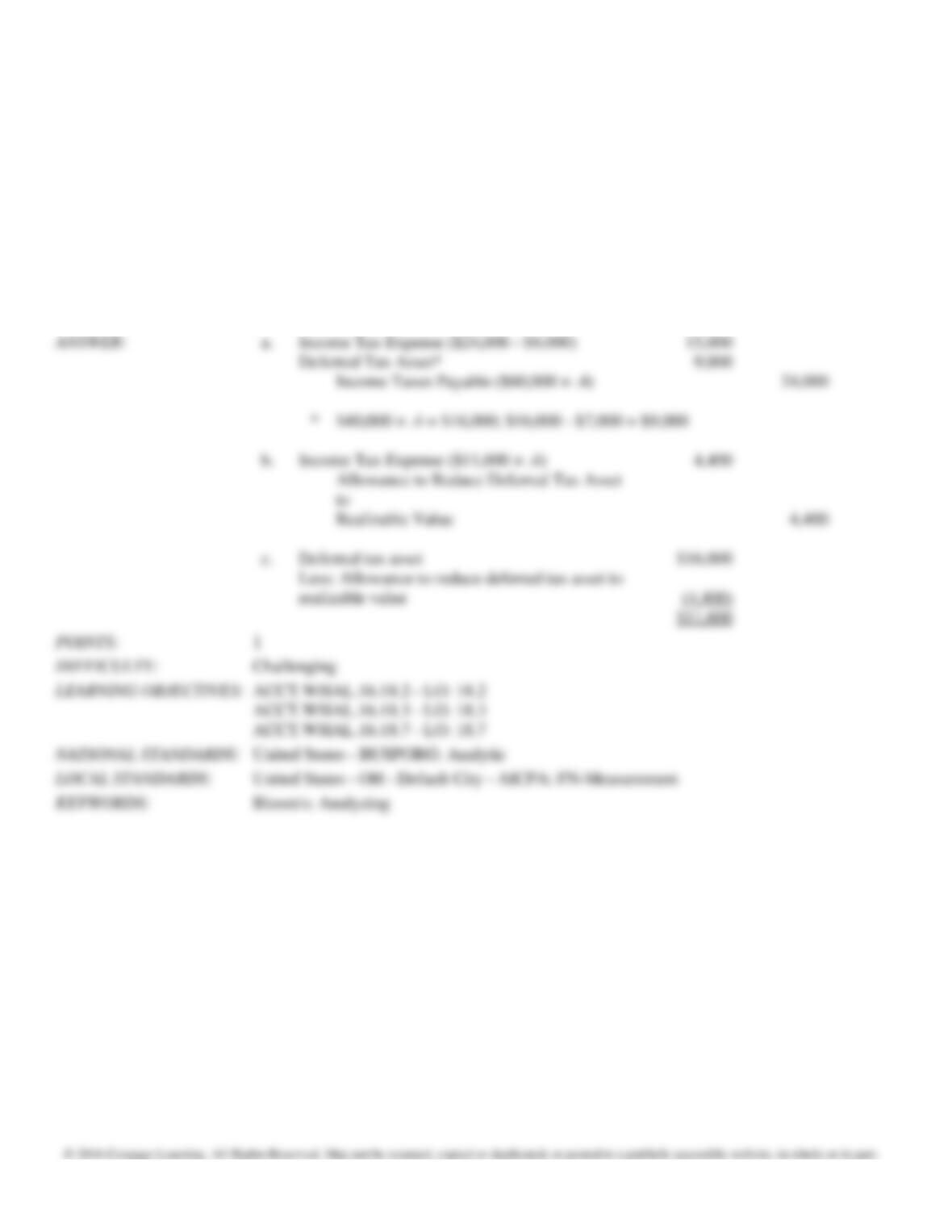
96. At the beginning of 2016, Jasper Company had a deferred tax asset of $7,000 related to the warranty liability on its
balance sheet. At the end of 2016, the company estimates that its ending warranty liability is $40,000. Taxable income
is $60,000, and the tax rate is 40%.
Required:
a.
Prepare the journal entry to record income taxes for the year.
b.
Assume the company decides at the end of the year that it is “more likely than
not” that $11,000 of the deductible temporary difference will not be realized.
Prepare the appropriate journal entry.
c.
Show how the deferred tax asset would be reported on the balance sheet for
2016.
Challenging
ACCT.WHAL.16.18.2 – LO: 18.2
ACCT.WHAL.16.18.3 – LO: 18.3
ACCT.WHAL.16.18.7 – LO: 18.7
United States – BUSPORG: Analytic
United States – OH – Default City – AICPA: FN-Measurement
Bloom’s: Analyzing
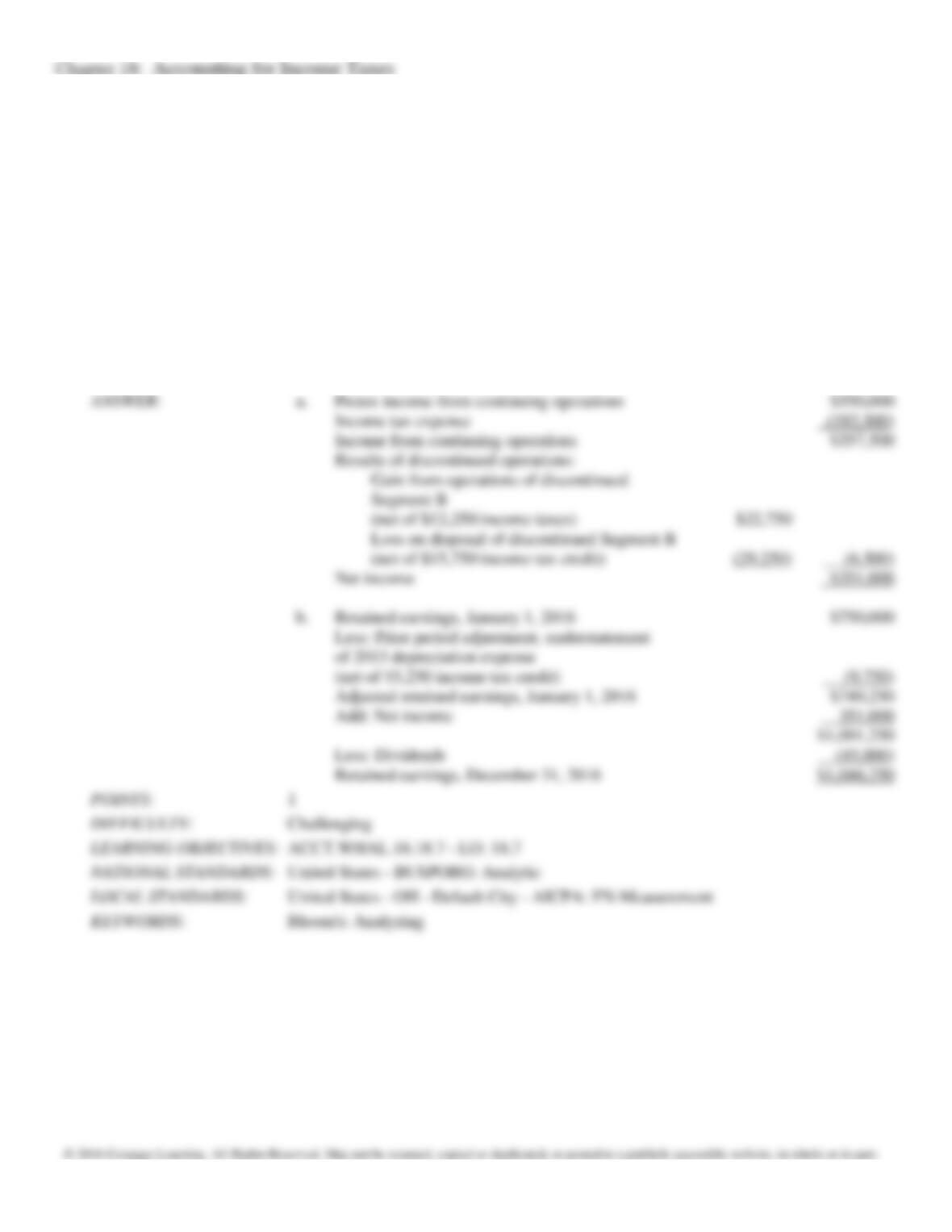
97. Lakeland Corporation reported the following pretax (and taxable) information for 2016:
Income from continuing operations
$550,000
Loss on disposal of Segment B
45,000
Prior period adjustment-Depreciation was understated in 2015
15,000
Gain from operations of discontinued Segment B
35,000
Income tax rate
35%
Required:
a.
Prepare the lower portion of Lakeland’s 2016 income statement, beginning with
pretax income for continuing operations. (Omit the heading.)
b.
Prepare Lakeland’s 2016 statement of retained earnings, assuming that retained
earnings at January 1, 2016, was $750,000 and the company paid $45,000 of
dividends in 2016. (Omit the heading.)
Pretax income from continuing operations
Income tax expense
Income from continuing operations
Results of discontinued operations:
(net of $12,250 income taxes)
Loss on disposal of discontinued Segment B
(net of $15,750 income tax credit)
Net income
b.
Retained earnings, January 1, 2016
Less: Prior period adjustment, understatement
of 2015 depreciation expense
(net of $5,250 income tax credit)
Adjusted retained earnings, January 1, 2016
Add: Net income
Less: Dividends
Retained earnings, December 31, 2016
Bloom’s: Analyzing
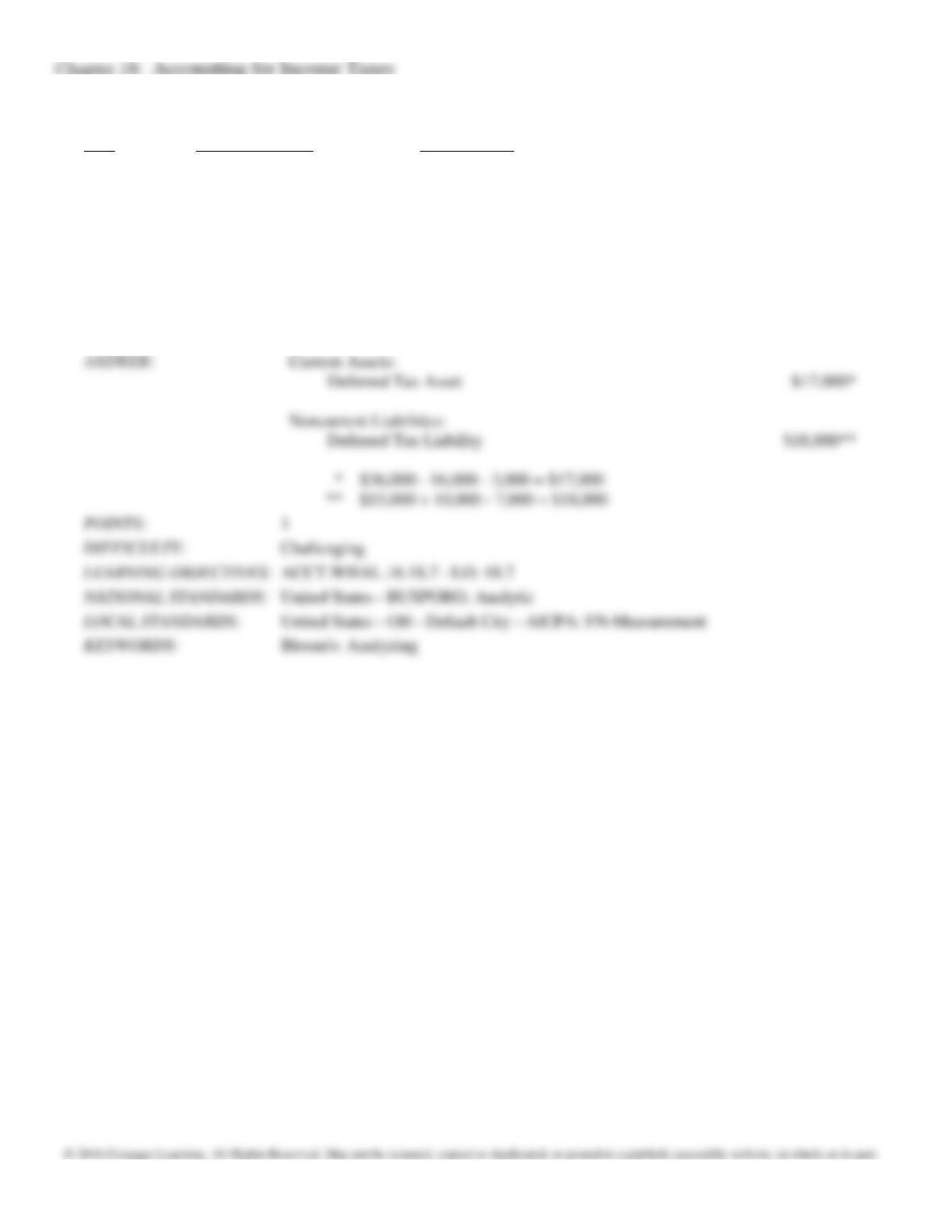
98. Port Deposit, Inc. reports the following deferred tax items at the end of 2016:
Item
Account Balance
Classification
1
$36,000 (dr.)
Current asset
2
15,000 (cr.)
Noncurrent liability
3
10,000 (cr.)
Noncurrent liability
4
16,000 (cr.)
Current liability
5
7,000 (dr.)
Noncurrent asset
6
3,000 (cr.)
Current liability
Required:
Show how the deferred tax items will be reported on the December 31, 2016 balance sheet.
1
Challenging
ACCT.WHAL.16.18.7 – LO: 18.7
United States – BUSPORG: Analytic
United States – OH – Default City – AICPA: FN-Measurement
Bloom’s: Analyzing
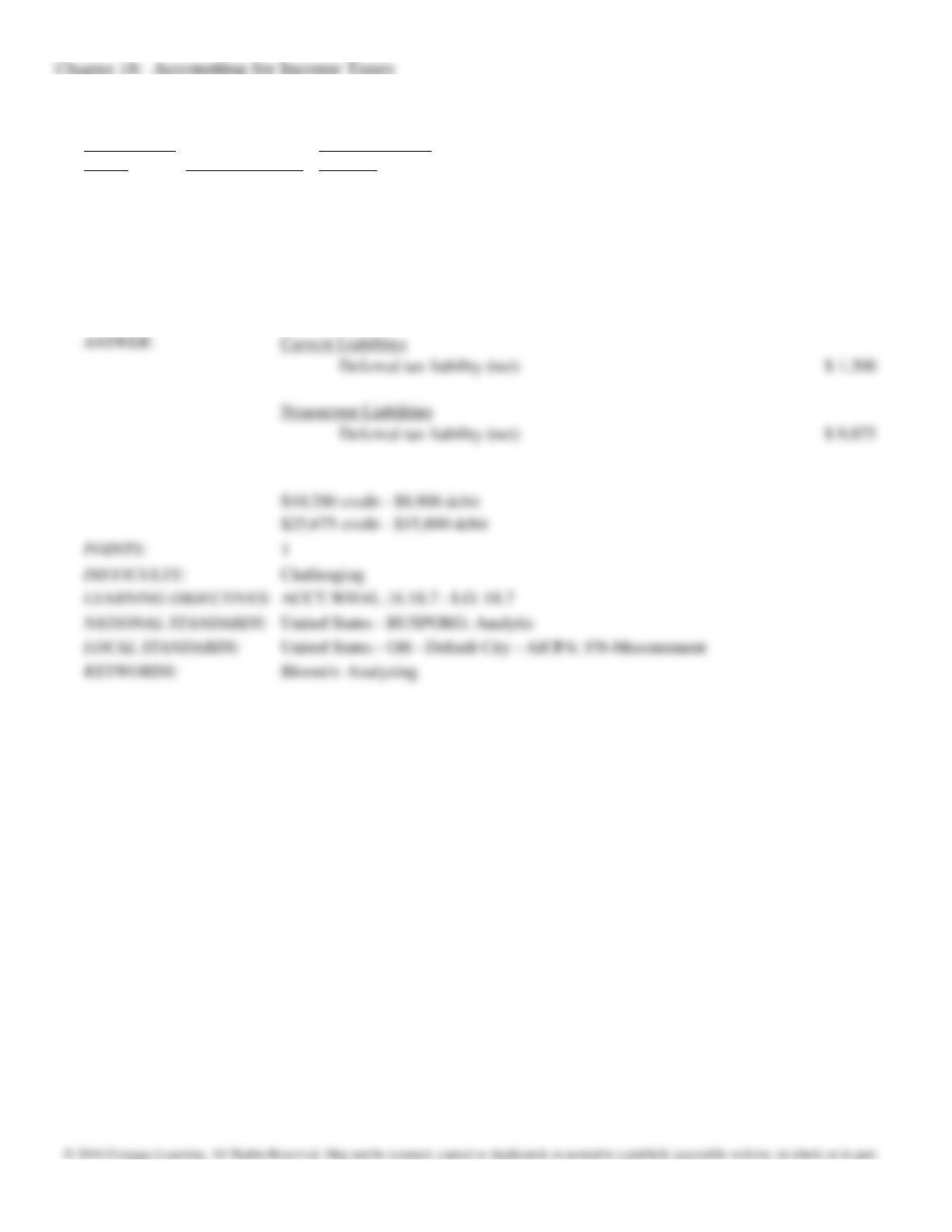
99. James Company reports the following information related to their deferred tax items at the end of 2017:
Deferred Tax
Item #
Account Balance
Related Asset or
Liability
1
$8,900 debit
Current Asset
2
10,200 credit
Current liability
3
15,800 debit
Noncurrent asset
4
25,675 credit
Noncurrent liability
Required:
Show how the information would be reported on James’s December 31, 2017, balance sheet.
1
Challenging
ACCT.WHAL.16.18.7 – LO: 18.7
United States – BUSPORG: Analytic
United States – OH – Default City – AICPA: FN-Measurement
Bloom’s: Analyzing
100. At the end of the current year, Brothers company claims a $225,000 tax credit on its income tax return. Brothers is
uncertain about whether the IRS will accept the credit. After some research it is determined that the IRS may not
accept all of the tax credit. Brothers estimates the likelihood using the following probability distribution:
Dollar Amount of Tax
Benefit that it Anticipates
will be upheld
Probability that the Tax
Position will be Upheld
Cumulative Probability that
the Tax Position will be
Upheld
$ 225,000
20%
35%
$ 150,000
55%
65%
$ 75,000
25%
100%
Required:
For the current year determine:
1) the amount Brothers will be able to recognize as a current tax benefit
2) the amount that will be record as the unrecognized tax benefit.
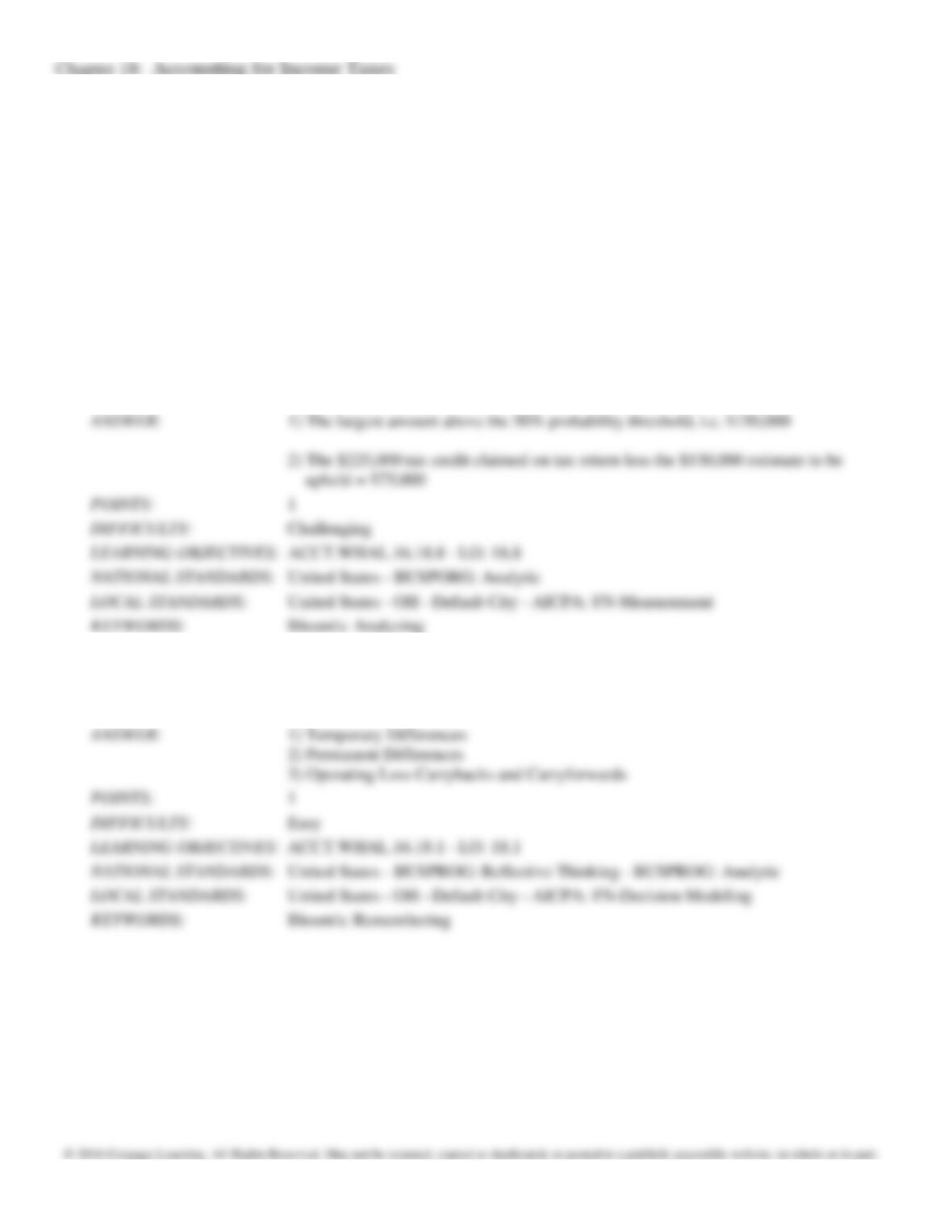
1) The largest amount above the 50% probability threshold, i.e. $150,000
2) The $225,000 tax credit claimed on tax return less the $150,000 estimate to be
upheld = $75,000
1
Challenging
ACCT.WHAL.16.18.8 – LO: 18.8
United States – BUSPORG: Analytic
United States – OH – Default City – AICPA: FN-Measurement
Bloom’s: Analyzing
101. Differences arising between financial accounting and tax accounting fall into three categories, what are the three
categories?
1) Temporary Differences
1
Easy
ACCT.WHAL.16.18.1 – LO: 18.1
United States – BUSPROG: Reflective Thinking – BUSPROG: Analytic
United States – OH – Default City – AICPA: FN-Decision Modeling
Bloom’s: Remembering
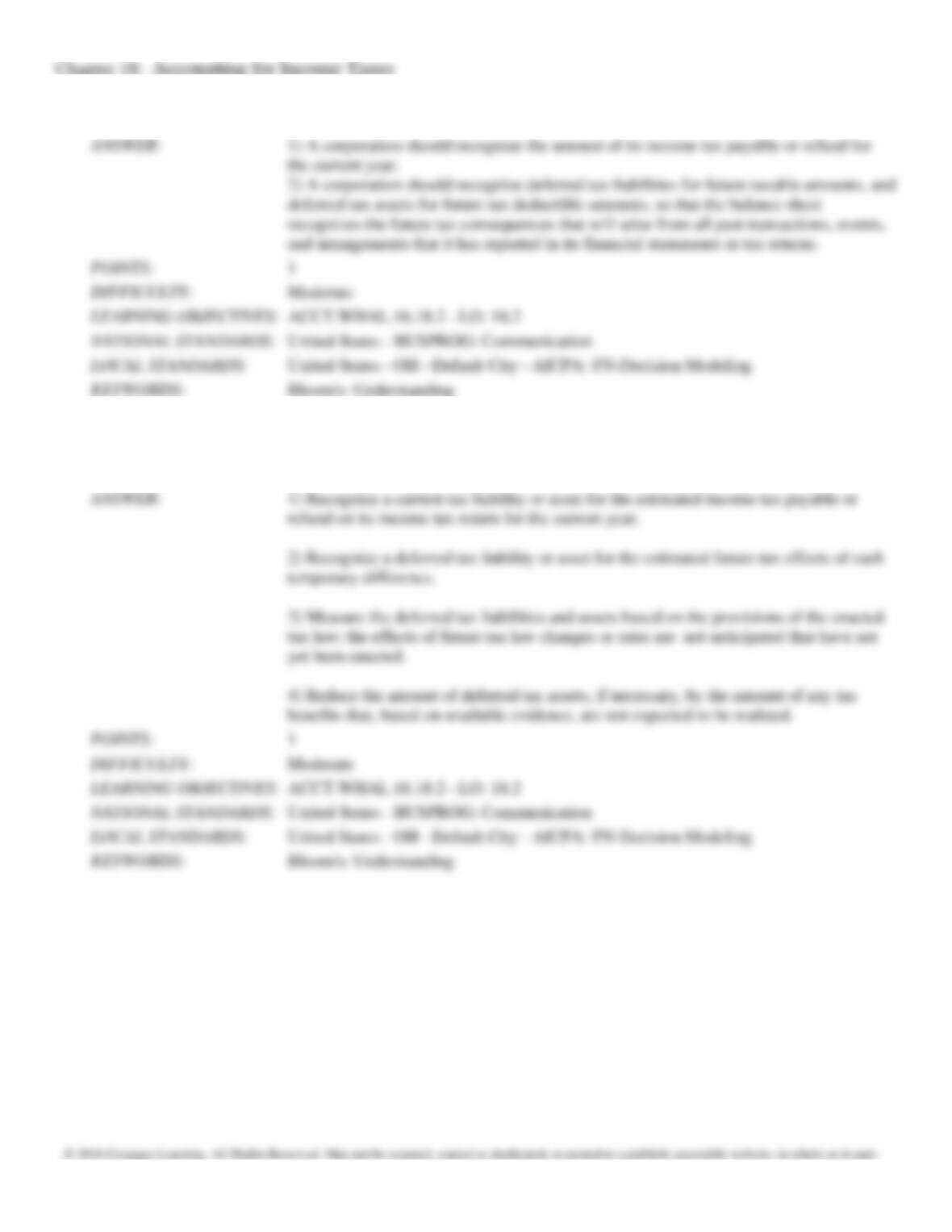
102. What two objectives did the FASB identify for accounting for income taxes?
103. In order to implement the FASB’s objectives what four principles must a corporation apply to account for its income
taxes?
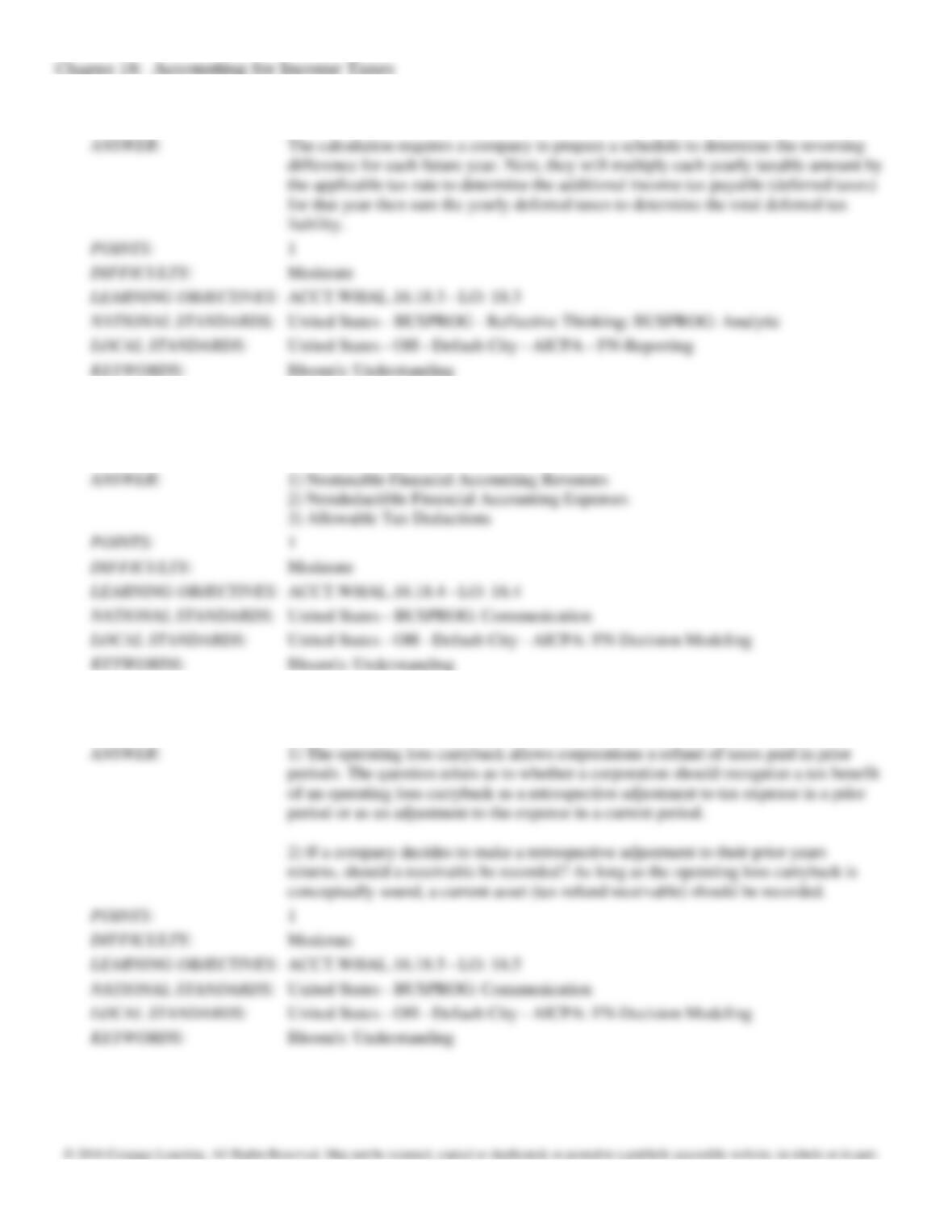
104. Describe the process for determining deferred tax liability when future tax rates are different than current tax rates.
105. What are the three types of permanent differences between a corporation’s pretax financial income and taxable
income?
106. What two issues does a company need to consider in regards to operating loss carrybacks?
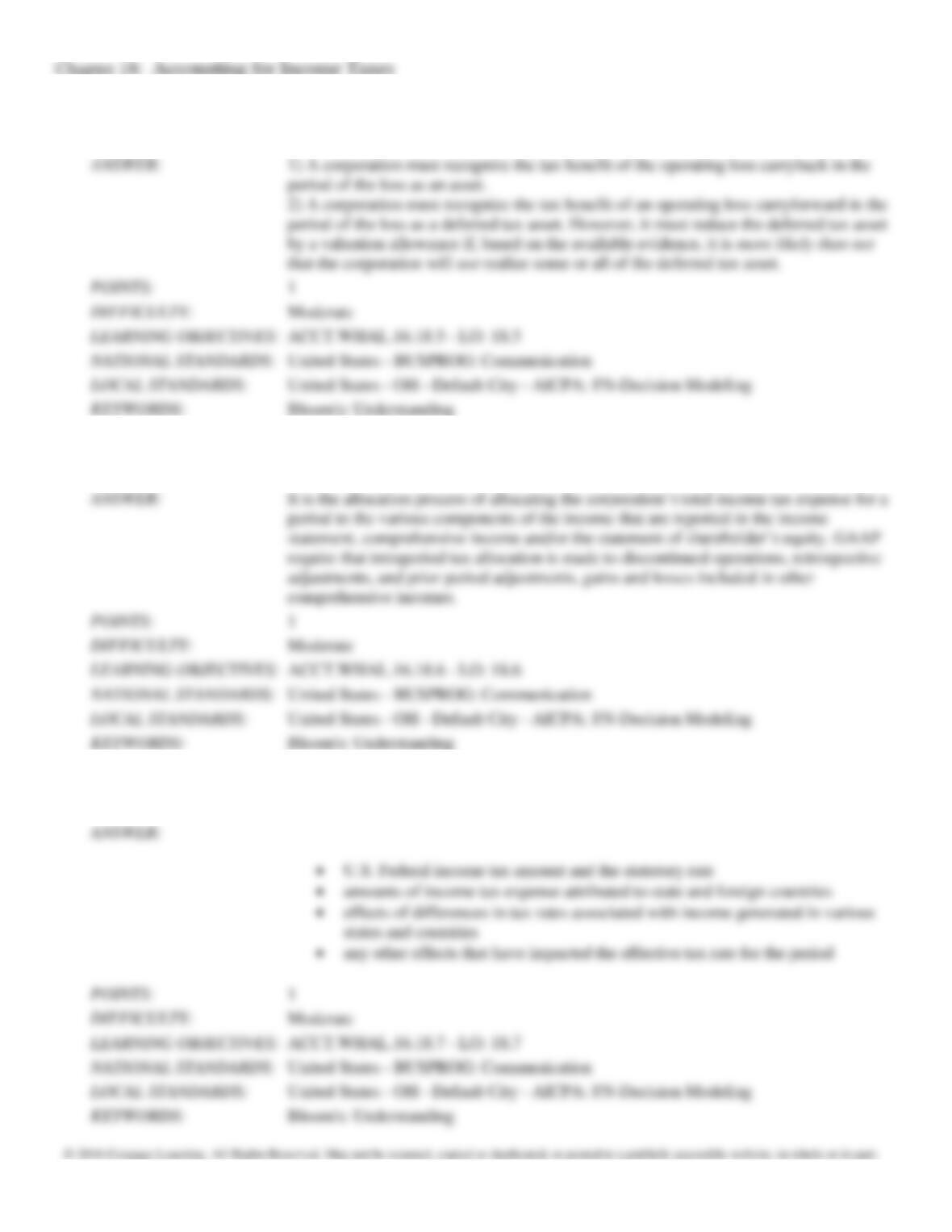
107. What conclusion did the FASB come to in regards to GAAP for the financial reporting of operating loss carrybacks
and carryforwards?
108. What is intraperiod tax allocation?
109. What should a corporation disclose for the provisions for income taxes and the effective tax rates?
110. What disclosures are required for “uncertain tax positions” where the position is “more likely than not” of being
upheld during a tax audit by the IRS?
111. Compare and contrast interperiod and intraperiod tax allocation methods.
112. Discuss what criteria a company should employ to determine whether a deferred tax asset is considered impaired or
“more likely than not” to be realized.
113. Identify the three essential characteristics of an asset and explain how deferred tax assets meet these characteristics.
114. Deferred tax liabilities and deferred tax assets must be reported on the balance sheet.
Required:
Explain the procedure for classifying and reporting deferred tax liabilities and deferred tax assets.
115. Briefly describe the four major differences between IFRS and GAAP in the measurement procedures used in
accounting for deferred income taxes.