
CHAPTER 18—ALTERNATIVE FINANCING ARRANGEMENTS &
CORPORATE RESTRUCTURING
TRUE/FALSE
1. Leasing is typically a financing decision and not a capital budgeting decision. Thus, the
availability of lease financing cannot affect the capital budgeting decision.
2. The full amount of a lease payment is tax deductible if the contract is a genuine lease.
3. Operating leases help to pass the risk of obsolescence from the user to the lessor.
4. Leasing is often referred to as off-balance sheet financing because lease payments are shown as
operating expenses on a firm’s income statement, and under certain conditions, leased assets and
associated liabilities do not appear on the firm’s balance sheet.
5. An option is a contract which gives its holder the right to buy (sell) an asset at a predetermined
price within a specified period of time.
6. The striking price is different from the exercise price and deals with convertibles rather than with
warrants.
7. As the price of a stock rises, the premium investors are willing to pay for a call option increases
because of the immediate capital gain that can be realized by exercising the option and from the
possibility that the stock price could go higher.
8. A warrant is an option; therefore, it cannot be used as a “sweetener.”
9. The problem of dilution never arises with call options, but it can arise with warrants.
10. A detachable warrant is a warrant that can be detached and traded separately from the bond with
which it was issued. Generally, warrants start off attached to other securities.
11. The owner of a convertible bond owns, in effect, both a bond and a call option.

Chapter 18 Alternative Financing Arrangements & Corporate Restructuring 383
12. Convertible securities are bonds or preferred stocks that, under specified terms and conditions,
can be exchanged for common stock at the option of the holder.
13. Firms generally do not call their convertibles unless their conversion value is greater than their
call price.
14. In a synergistic merger, the post-merger value exceeds the sum of the separate companies’ pre–
merger values.
15. Most defensive mergers occur as a result of managers’ actions to maximize shareholders’ wealth.
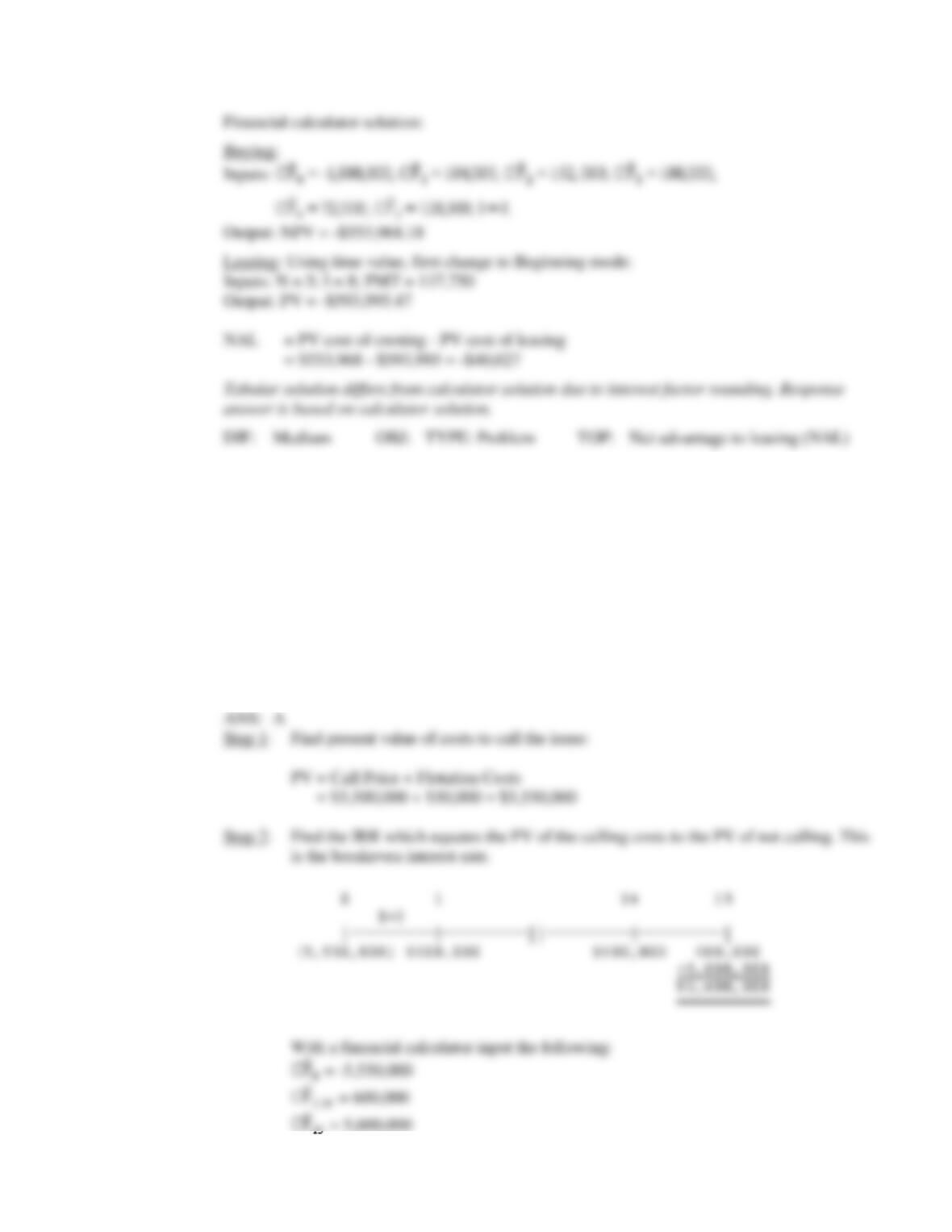
16. Leveraged buyouts (LBOs), popularized in the 1980s, occur when a firm’s managers decide to try
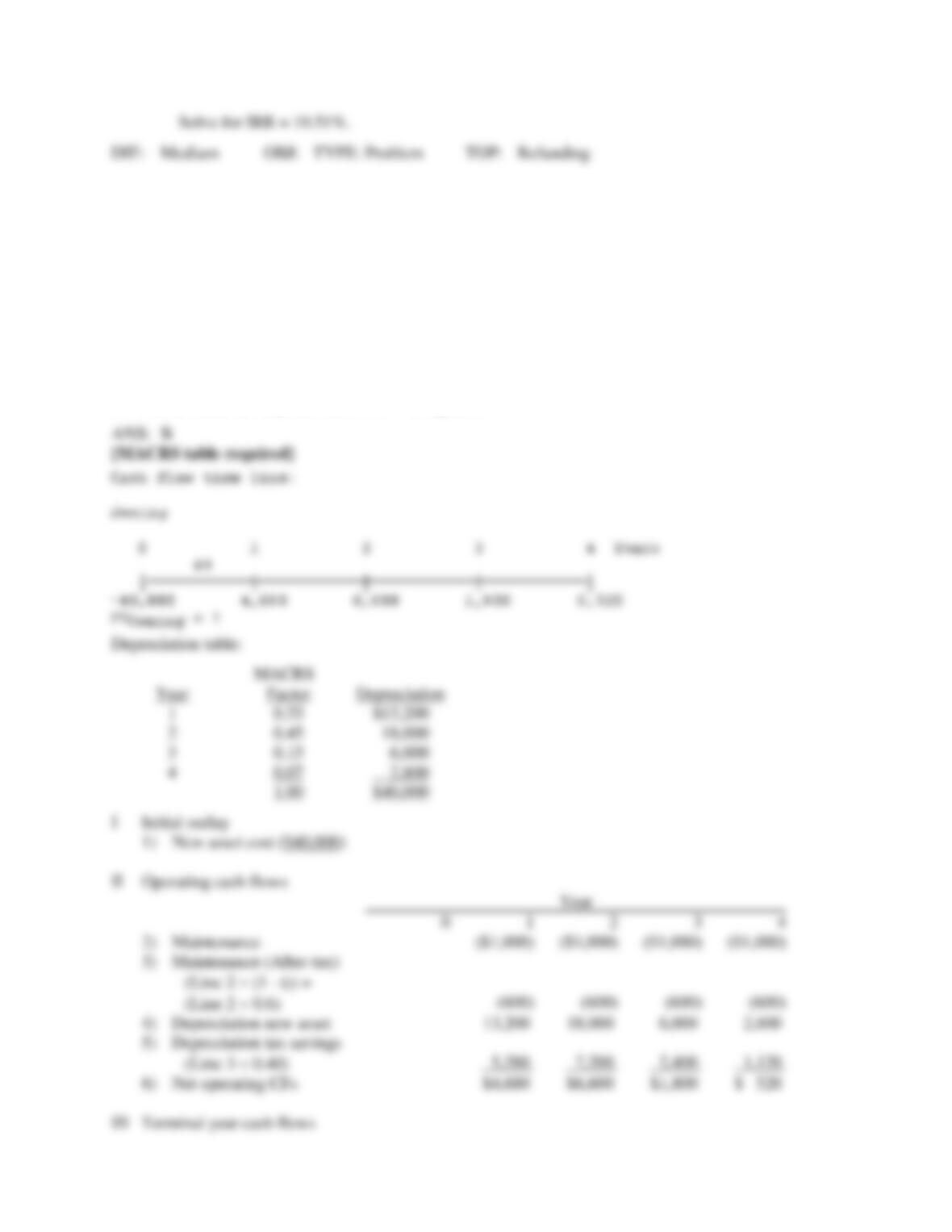
and gain control of their publicly owned company by buying out existing shareholders using large
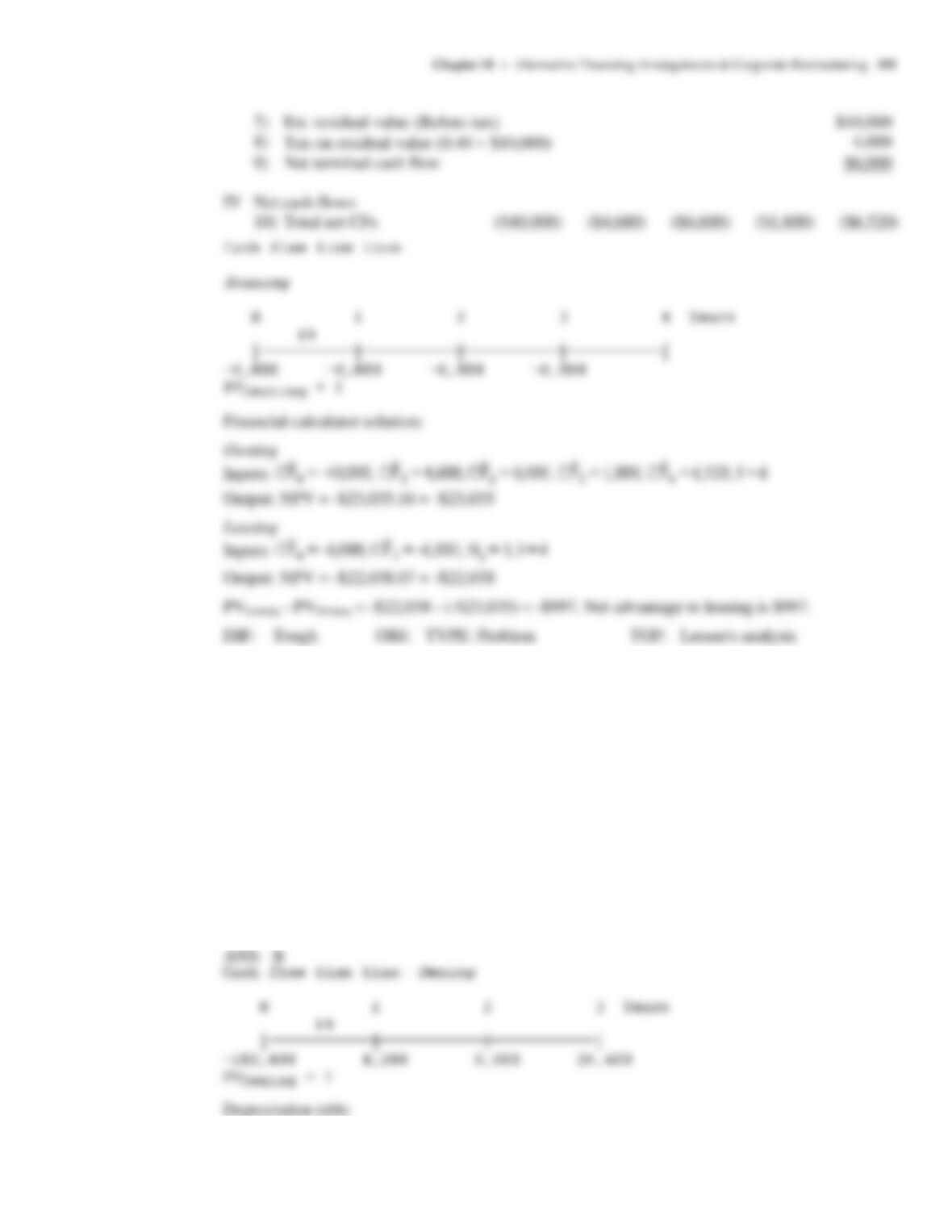
amounts of borrowed money.
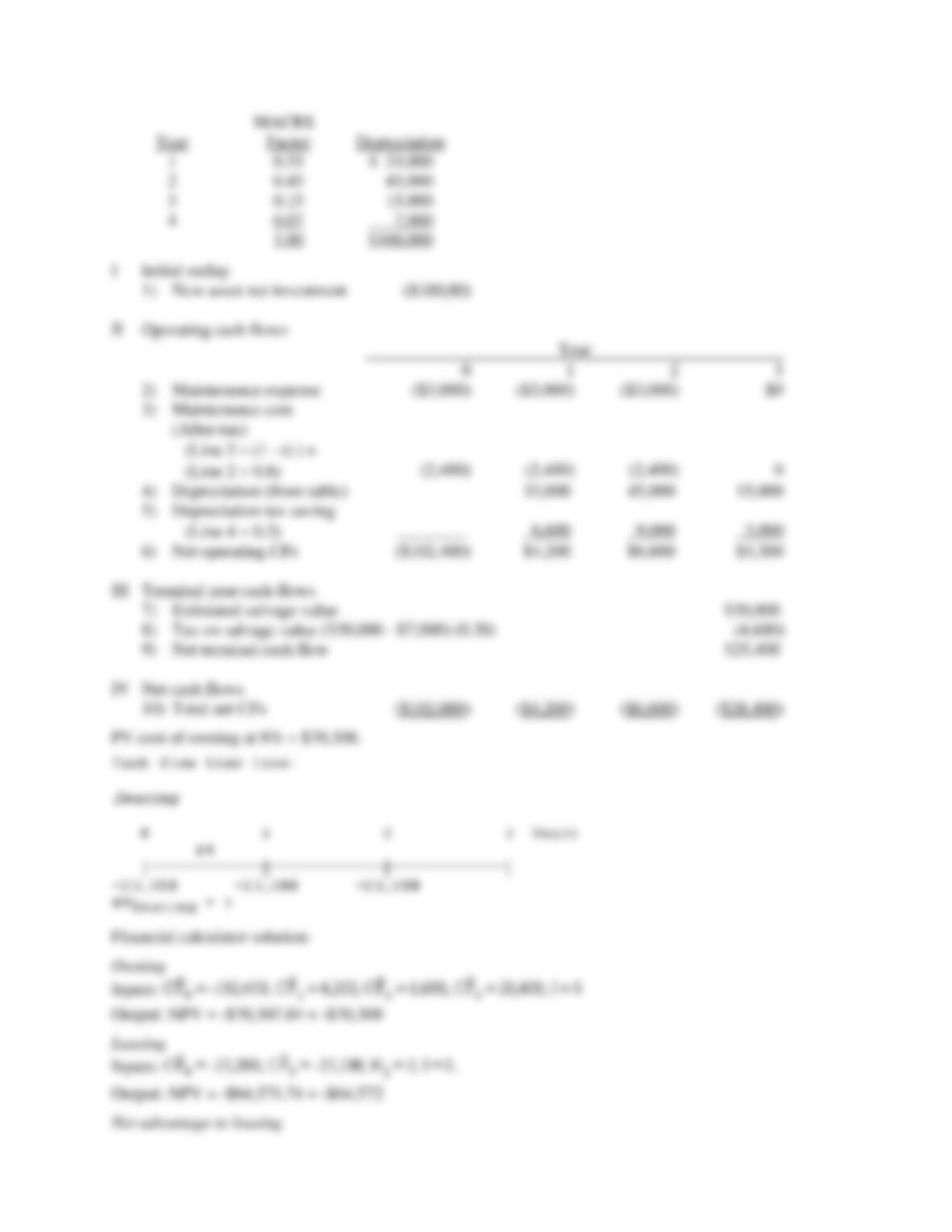
17. Call provisions on preferred stock generally state that the company must pay an amount greater
than the par value of the preferred stock when the preferred stock is called.
18. One of the primary benefits of issuing preferred stock to fund capital budgeting projects is that
failure to pay preferred dividends does not trigger bankruptcy.
19. The estimated end-of-lease value of the property is called the residual value.
20. A call option on a share of common stock Verizon Inc. that has an exercise price of $25.00 when
the shares of Verizon stock are selling for $22.00 is said to be an in-the-money option.
21. A put option on a share of AT&T stock has an exercise price of $12.50, if AT&T stock currently
sells for $10.00 a share the put option is said to be out-of-the-money.
22. To compute the primary earnings per share the earnings available to common stockholders are
divided by the average number of shares actually outstanding during the period.
23. A conglomerate merger is merger of companies in totally different industries.
384 Chapter 18 Alternative Financing Arrangements & Corporate Restructuring
24. Preferred stockholders have priority over common stockholders with respect to earnings.
Dividends must be paid on preferred stock before they can be paid on common stock. In
exchange for this priority to dividends, preferred stockholders give up their priority claims to
common stockholders in the event of bankruptcy.
25. Preferred stock can provide a financing alternative for some firms when market conditions are
such that those firms can neither issue pure debt or common stock at reasonable cost.
26. Assume that a piece of leased equipment has a high rather than a low residual value. From the
lessee’s viewpoint, it might be better to own the asset than to lease it because with a high residual
value the lessee will likely face a higher lease rate.
27. If a petrochemical firm merged with an oil producer which had assets including oil reserves, a
refinery, and a drilling subsidiary, this would be an example of a vertical merger.
28. The purchase of assets at below their replacement cost and tax considerations are two factors that
have stimulated mergers historically.
29. Since managers’ central goal is to maximize stock price, any merger offer which provides
stockholders with significant gains over the current stock price will not be opposed by incumbent
management.
30. One of the main reasons why foreign firms are interested in buying U.S. companies is to gain
entrance to the U.S. market. A decline in the value of the dollar relative to most foreign
currencies makes this competitive strategy more feasible.
31. If we have two identical call options with different strike prices, the option with higher strike
price will have a higher price.
32. If we have two identical put options with different exercise prices, the put option with the higher
exercise price will have a higher price.
33. Managers often claim that diversification helps to stabilize the firm’s earnings and thus reduces
corporate risk.
34. Refunding decisions actually involve two separate questions: (1) Is it profitable to call an
outstanding issue in the current period and replace it with a new issue; and (2) even if refunding is
profitable now, would it be more profitable later?

Chapter 18 Alternative Financing Arrangements & Corporate Restructuring 385
35. The appropriate discount rate to use in the discounting process when analyzing a refunding
decision is the after-tax cost of new debt, in part because there is relatively little risk to the
interest savings.
36. If the firm applies the after-tax cost of marginal debt as the discount rate in analyzing a refunding
decision, and the NPV of refunding is positive, the firm should immediately refund the
outstanding debt issue and replace it with a cheaper issue.
37. When a firm refunds a debt issue, the firm gains and bondholders lose. This points out the risk of
a call provision to bondholders and why bonds without a call feature command higher prices than
callable bonds.
MULTIPLE CHOICE
1. The riskiness of the cash flows to the lessee, with the possible exception of residual value, is
about the same as the riskiness of the lessee’s
a.
Equity cash flows.
b.
Capital budgeting project cash flows.
c.
Debt cash flows.
d.
Pension fund cash flows.
e.
None of the above.
2. The value of an option depends on the stock’s price, the risk-free rate, and the
a.
Exercise price.
b.
Variability of the stock price.
c.
Option’s time to maturity.
d.
All of the above.
e.
None of the above.
3. Which of the following are methods of reporting earnings when warrants or convertibles are
outstanding?
a.
Simple EPS.
b.
Primary EPS.
c.
Fully diluted EPS.
d.
All of the above.
e.
None of the above.
4. Which of the following statements is correct?
a.
The tax code explains why preferred stock is almost exclusively held by individual
investors and not by corporations.
b.
The par value of preferred stock is an accounting convention which has no real meaning.
c.
The lessor in an operating lease is generally required to service and maintain the asset
386 Chapter 18 Alternative Financing Arrangements & Corporate Restructuring
which is being leased.
d.
Financial leases are generally not cancelable, whereas operating leases often contain a
cancellation clause.
e.
Answers c and d are both correct.
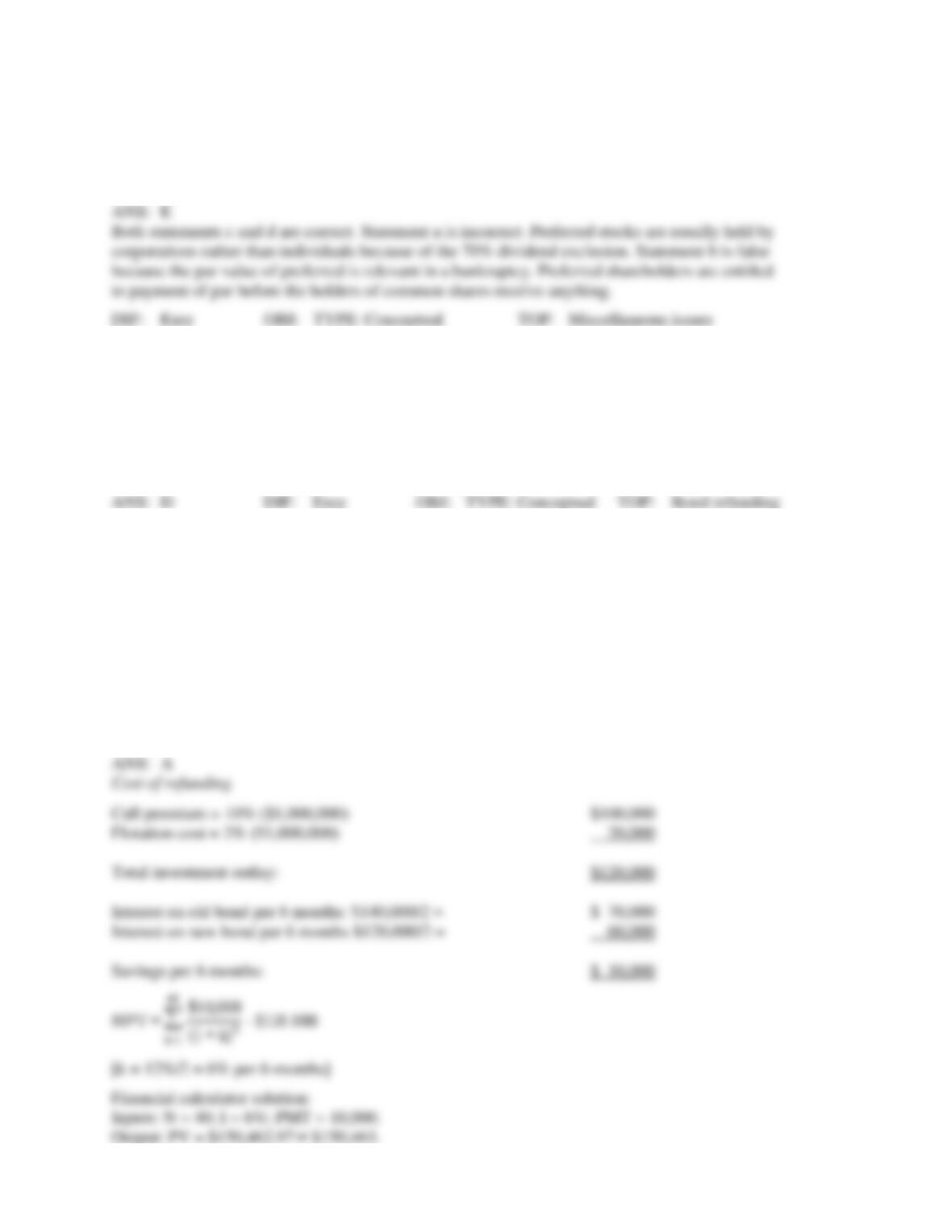
5. Corporations call their bonds (1) for refunding or (2) to satisfy sinking fund provisions.
Generally, refunding calls
a.
Involve the entire issue.
b.
Are beneficial to the bondholder.
c.
Are made at a premium above par value.
d.
Only answers a and c above.
e.
Answers a, b, and c above.
6. The City of Gainesville issued $1,000,000 of 14 percent coupon, 30-year, semiannual payment,
tax-exempt municipal bonds 10 years ago. The bonds had 10 years of call protection, but now
Gainesville can call the bonds if it chooses to do so. The call premium would be 10 percent of the
face amount. New 20-year, 12 percent, semiannual payment bonds can be sold at par, but
flotation costs on this issue would be 2 percent, or $20,000. What is the net present value of the
refunding?
a.
$30,463
b.
$29,389
c.
$150,000
d.
$400,000
e.
$50,317

Chapter 18 Alternative Financing Arrangements & Corporate Restructuring 387
7. A security that pays a fixed dividend which if not paid does not force the firm into bankruptcy is
called
a.
common stock.
b.
preferred stock
c.
convertible bonds.
d.
junk bonds.
e.
callable bonds.
8. Which of the following is not a common feature of preferred stock?
a.
Preferred stockholders have priority over common stockholders with regard to earnings
and stock.
b.
Preferred stock always has a par value.
c.
Preferred stock typically provide for cumulative dividends.
d.
Failure to pay preferred stock dividends triggers bankruptcy.
e.
All of the above are common features of preferred stock.
9. A lease in which the lessor maintains and finances the property is called a(n)
a.
preferred lease.
b.
financial lease.
c.
leaseback.
d.
operating lease.
e.
maintenance lease.
10. A lease that does not provide for maintenance services, is not cancelable, and is fully amortized
over its life is called a(n)
a.
operating lease.
b.
leaseback.
c.
capital lease.
d.
service lease.
e.
maintenance lease.
11. FASB #13 requires that
a.
firms must deduct lease payments as operating expense in the accounting period in which
they occur.
b.
the assets of a firm equals the sum of the firm’s liabilities and equity.
c.
financial leases are not capitalized and are not considered fixed assets.
d.
firms that enter into financial leases must restate their balance sheets to report leased
assets as fixed assets and the present value of future lease payments as a debt.
e.
firms that enter into financial leases must identify the nature of the lease in the footnotes to
the financial statements.

388 Chapter 18 Alternative Financing Arrangements & Corporate Restructuring
12. The cost of leasing should be compared to the cost of __________ regardless of how the asset is
actually financed.
a.
debt financing
b.
retained earnings
c.
common equity
d.
government securities
e.
preferred stock
13. An option which gives the holder the right to buy a stock at a specified price at some time in the
future is called a(n)
a.
naked option.
b.
put option.
c.
call option.
d.
in-the-money option.
e.
out-of the money option.
14. A long-term option issued by a corporation to buy a stated number of shares of common stock at
a specified price is a(n)
a.
preferred stock.
b.
convertible bond.
c.
warrant.
d.
put option.
e.
retained earnings option.
15. A transaction in which a firm’s publicly owned stock is bought up in a mostly debt-financed
tender offer, and a privately owned, highly leveraged firm results is called a(n)
a.
initial public offering.
b.
leveraged buyout.
c.
stock repurchase.
d.
seasoned equity offering.
e.
debt issue.
16. Synergistic effects from mergers can arise from which of the following sources?
a.
operating economies of scale
b.
financial economies
c.
differential management efficiency
d.
increased market power
e.
all of the above

Chapter 18 Alternative Financing Arrangements & Corporate Restructuring 389
17. A combination of two firms that produce the same type of good or service is a
a.
vertical merger.
b.
defensive merger.
c.
horizontal merger.
d.
conglomerate merger.
e.
congeneric merger.
18. Which of the following statements is correct?
a.
Floating rate preferred stock has an advantage over fixed rate preferred stock because its
price is more stable and this makes floating rate preferred more suitable as a liquid asset.
b.
Convertible preferred stock would likely appeal more to income-oriented investors
because they can convert their capital gains into bond income simply by converting their
preferred stock into bonds.
c.
One advantage of preferred stock from an issuer’s perspective is that it has a lower after-
tax cost than that of debt.
d.
One principal advantage of preferred stock is that preferred stockholders have a legal
enforceable right to their stock dividend, thus, preferred stock is generally less risky than
unsecured debt.
e.
Because of the 70% dividend exclusion rule for preferred stock dividends, the higher a
company’s tax bracket, the more likely it is to issue preferred stock.
19. In the lease versus buy decision, leasing is often preferable
a.
Since it does not limit the firm’s ability to borrow to make other investments.
b.
Because, generally, no down payment is required, and there are no indirect interest costs.
c.
Because lease obligations do not affect the riskiness of the firm.
d.
All of the above are correct statements.
e.
None of the above are correct statements.
20. Which of the following statements is correct?
a.
Firms which use “off balance sheet” financing, such as leasing, will show lower debt ratios
once the effects of their leases are reflected in their financial statements.
b.
Capitalizing a lease means that the firm issues equity capital in proportion to its current
capital structure, in an amount sufficient to support the lease payment obligation.
c.
The fixed charges associated with a lease can be as high as, but never be greater than, the
fixed payments associated with a loan.
d.
Capital, or financial, leases generally provide for maintenance service on the part of the
lessor and can be refinanced at the discretion of the lessee.
e.
A key difference between a capital lease and an operating lease is that with a capital lease,
the total lease payments on the asset are roughly equal to the full price of the asset plus a
return on the investment in the asset.

390 Chapter 18 Alternative Financing Arrangements & Corporate Restructuring
21. Which of the following statements is most correct?
a.
If a stock suddenly becomes riskier and its price becomes extremely volatile, this is likely
to decrease the value of the call options on the stock.
b.
As a call option approaches its expiration date, it premium is likely to be small.
c.
When investors exercise warrants this provides the firm with additional equity while
leaving low interest rate debt on the books.
d.
Answers a, b, and c are all correct.
e.
Answers b and c are both correct.
22. Which of the following statements is correct?
a.
A warrant is basically a long-term option that enables the holder to sell common stock
back to the firm at an agreed upon price, at a specified time in the future.
b.
Generally, warrants are distributed along with preferred stock in order to make the
preferred stock less risky.
c.
If a company issuing coupon paying debt wanted to reduce the cash outflows associated
with the coupon payments, it could issue warrants with the debt to accomplish this.
d.
One of the disadvantages of warrants to the issuing firm is that they can be detachable and
can be traded separately from the debt with which they are issued.
e.
Warrants are attractive to investors because when they are issued with stock, investors
receive dividends on the warrants they own as well as on the underlying stock.
23. Which of the following conditions will require that a lease be classified as a capital lease?
a.
Under the terms of the lease, ownership of the property effectively is transferred from the
lessor to the lessee.
b.
The lease runs for a period equal to or greater than 75 percent of the asset’s life.
c.
The lessee can purchase the property or renew the lease at less than a fair market price
when the lease expires.
d.
The present value of the lease payments is equal to or greater than 90 percent of the initial
value of the asset.
e.
Any of the above conditions being met requires that a lease be classified as a capital lease.
24. A call option whose exercise price is greater than current market of the underlying asset is said to
be
a.
a covered option.
b.
in-the-money.
c.
at-the-money.
d.
out-of-the-money.
e.
none of the above.
Chapter 18 Alternative Financing Arrangements & Corporate Restructuring 391
25. A put option whose exercise price is greater than the current market price of the underlying asset
is said to be
a.
out-of-the-money.
b.
at-the-money.
c.
in-the-money.
d.
a naked put.
e.
none of the above.
26. When the conversion value of convertible bond exceeds the call price of a convertible bond,
rational investors will __________ when the bond is called.
a.
take the call price
b.
sell the bonds to the market
c.
purchase new bonds
d.
convert the bonds into equity
e.
none of the above
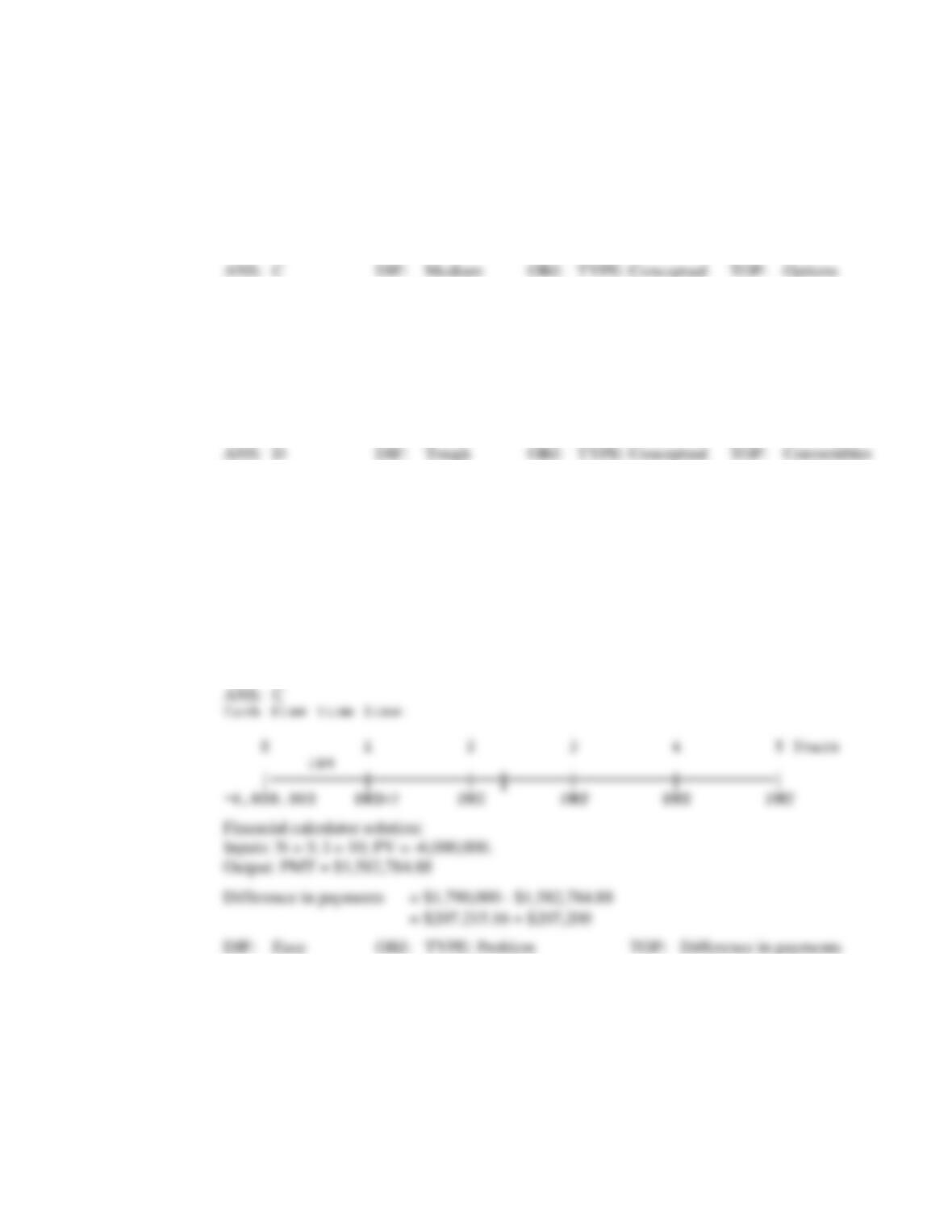
27. Stanley Corporation is considering a five year, $6,000,000 bank loan to finance service
equipment. The loan has an interest rate of 10 percent and is amortized over five years with end
of year payments. Stanley can also lease the equipment for an end of year payment of $1,790,000.
What is the difference in the actual out of pocket cash flows between the two payments, that is,
by how much does one payment exceed the other?
a.
$90.0 thousand
b.
$125.5 thousand
c.
$207.2 thousand
d.
$251.0 thousand
e.
$316.8 thousand
28. Suppose you believe that Du Pont’s stock price is going to decline from its current level of $82.50
sometime during the next 5 months. For $510.25 you could buy a 5-month put option giving you
the right to sell 100 shares at a price of $83.00 per share. If you bought a 100-share contract for
$510.25 and Du Pont’s stock price actually dropped to $63.00, you would make
a.
$1,950.00
b.
$1,439.75
c.
$1,489.75
d.
$2,000.00
e.
$2,435.00
392 Chapter 18 Alternative Financing Arrangements & Corporate Restructuring
29. Northeast Company has 200,000 shares of common stock and 50,000 warrants outstanding. Each
warrant entitles its owner to buy one share before 2002 at a price of $20. Undiluted earnings per
share (simple EPS) are $2.50. What are the fully diluted earnings per share?
a.
$2.50
b.
$2.25
c.
$1.50
d.
$3.00
e.
$2.00
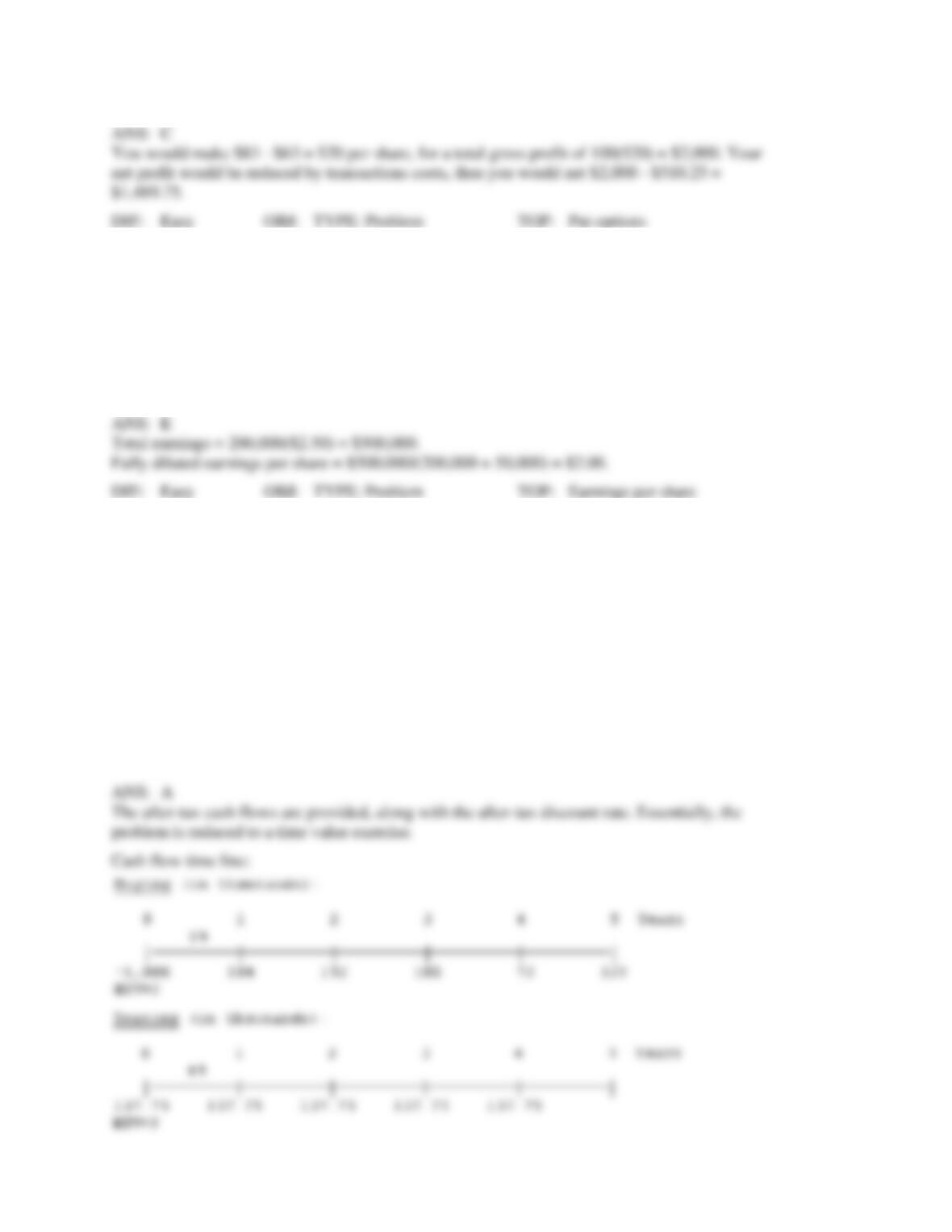
30. Votron Enterprises is considering whether to lease or buy some special manufacturing equipment
to be placed on a new production line. The net cash flows associated with owning the equipment
are as follows. The initial purchase price is $1,000,000; the net cash inflows (after-tax
considerations) in Years 1 through 5 are: Year 1 = $104,000; Year 2 = $152,000; Year 3 =
$100,000; Year 4 = $72,000; Year 5 = $128,000. The lease agreement calls for five beginning of
year payments. The net cash outflow of each payment (after-tax considerations) is $137,750.
Compare the present values of the two alternatives using the relevant after-tax discount rate of 8.0
percent. What is the net advantage to leasing the equipment?
a.
-$40,027
b.
-$3,972
c.
+$3,972
d.
+$60,000
e.
+$22,458
Chapter 18 Alternative Financing Arrangements & Corporate Restructuring 393
31. Leyland Enterprises has $5,000,000 in bonds outstanding. The bonds each have a maturity value
of $1,000, an annual coupon of 12 percent, and 15 years left until maturity. The bonds can be
called at any time at a call price of $1,100 per bond. If the bonds are called, the company must
pay flotation costs of $50,000 ($10 for every $1,000 of bonds outstanding). Ignore tax
considerations. Assume that the tax rate is zero. The company’s decision whether to call the bonds
depends critically on the current interest rate it would pay on new bonds issued. What is the
breakeven interest rate, below which it is profitable to call in the bonds?
a.
10.51%
b.
11.21%
c.
12.57%
d.
13.33%
e.
14.89%
394 Chapter 18 Alternative Financing Arrangements & Corporate Restructuring
32. Carolina Trucking Company (CTC) is evaluating a potential lease agreement on a truck that costs
$40,000 and falls into the MACRS 3-year class. The loan rate would be 10 percent, if CTC
decided to borrow money and buy the asset rather than lease it. The truck has a 4-year economic
life, and its estimated residual value is $10,000. If CTC buys the truck, it would purchase a
maintenance contract which costs $1,000 per year, payable at the end of each year. The lease
terms, which include maintenance, call for a $10,000 lease payment at the beginning of each year.
CTC’s tax rate is 40 percent. Should the firm lease or buy? [MACRS table required]
a.
Lease, it costs $842 less than buying.
b.
Lease, it costs $997 less than buying.
c.
Buy, it costs $997 less than leasing.
d.
Buy, it costs $842 less than leasing.
e.
Neither lease nor buy, the truck’s NPV is negative.
33. Furman Industries is negotiating a lease on a new piece of equipment which would cost $100,000
if purchased. The equipment falls into the MACRS 3-year class, and it would be used for 3 years
and then sold, because Furman plans to move to a new facility at that time. It is estimated that the
equipment could be sold for $30,000 after 3 years of use. A maintenance contract on the
equipment would cost $3,000 per year, payable at the beginning of each of the 3 years of usage.
Conversely, Furman could lease the equipment for 3 years for a lease payment of $29,000 per
year, payable at the beginning of each year. The lease would include maintenance. Furman is in
the 20 percent tax bracket, and it could obtain a loan to purchase the equipment at a before-tax
cost of 10 percent. Furman should
a.
Either lease or buy; the costs are the same.
b.
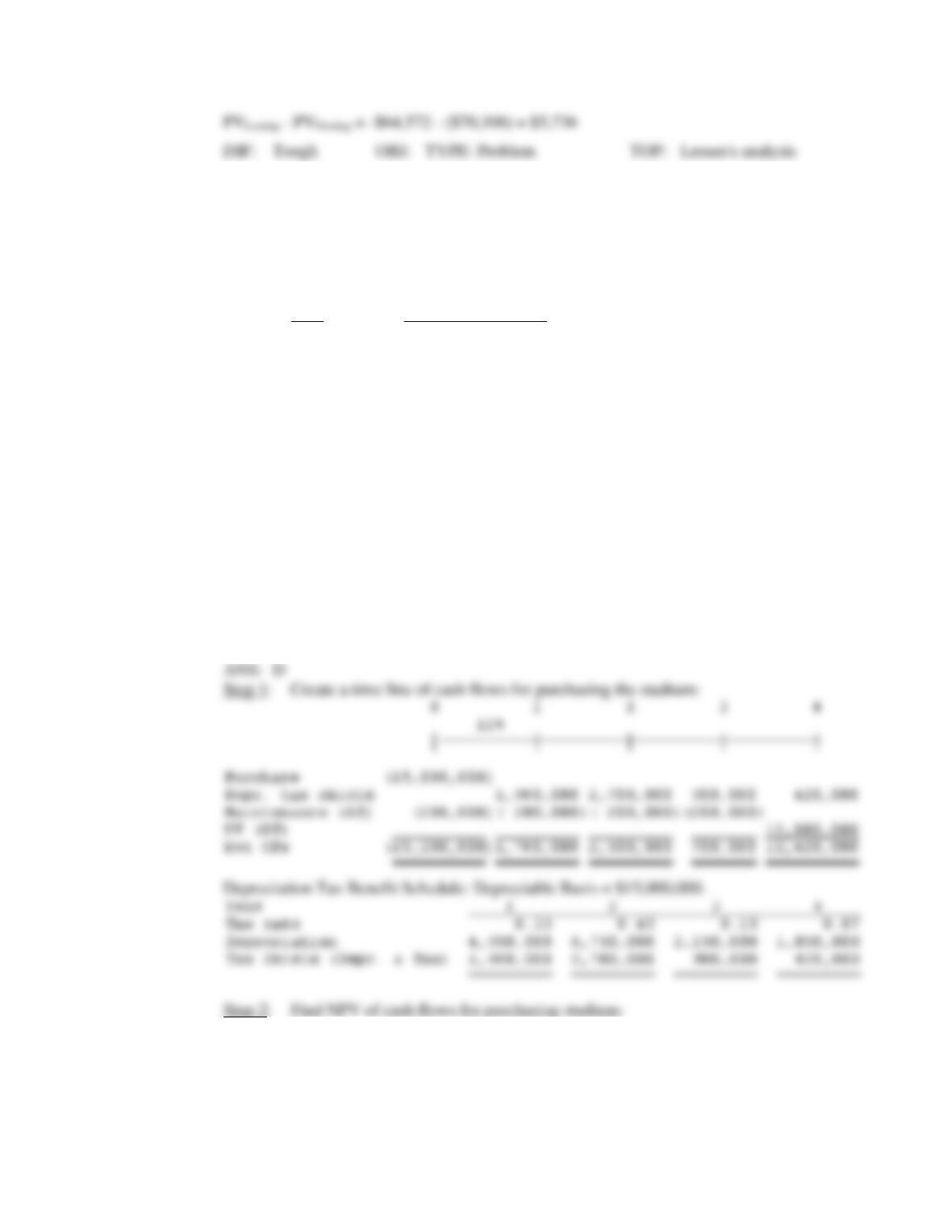
Lease; the PV of leasing costs is $5,736 less than the PV of owning costs.
c.
Lease; the PV of leasing costs is $1,547 less than the NPV of owning costs.
d.
Buy; the PV of owning costs is $5,736 less than the PV of leasing costs.
e.
Buy; the PV of owning costs is $1,547 less than the PV of leasing costs.
396 Chapter 18 Alternative Financing Arrangements & Corporate Restructuring
Chapter 18 Alternative Financing Arrangements & Corporate Restructuring 397
34. You have been hired as a consultant to the Pittsburgh Pirates baseball team. The team is unsure
whether it should buy its stadium or lease it from the city of Pittsburgh. The current owners have
a time frame of 4 years, after which time they expect to sell the team. The team could buy the
stadium today for $15,000,000. The firm’s cost of capital is 12 percent. The team has a 40 percent
tax rate. An accountant has indicated that if the team purchased the stadium it could depreciate
the stadium over the next four years at the following rates each year:
Year
Rate of Depreciation
t=1
0.33
t=2
0.45
t=3
0.15
t=4
0.07
If the team purchased the stadium it would also have to purchase a maintenance contract that
would require an after-tax payment of $200,000 at the beginning of each year (i.e., the first
payment will be made on the day of purchase). The team is certain that at the end of the fourth
year from now that the stadium will be worth $12,000,000, after taxes (i.e., this is its “residual
value”). If the team instead leased the stadium for the next four years it would not have to
purchase a maintenance contract. What annual lease payment made at the beginning of each
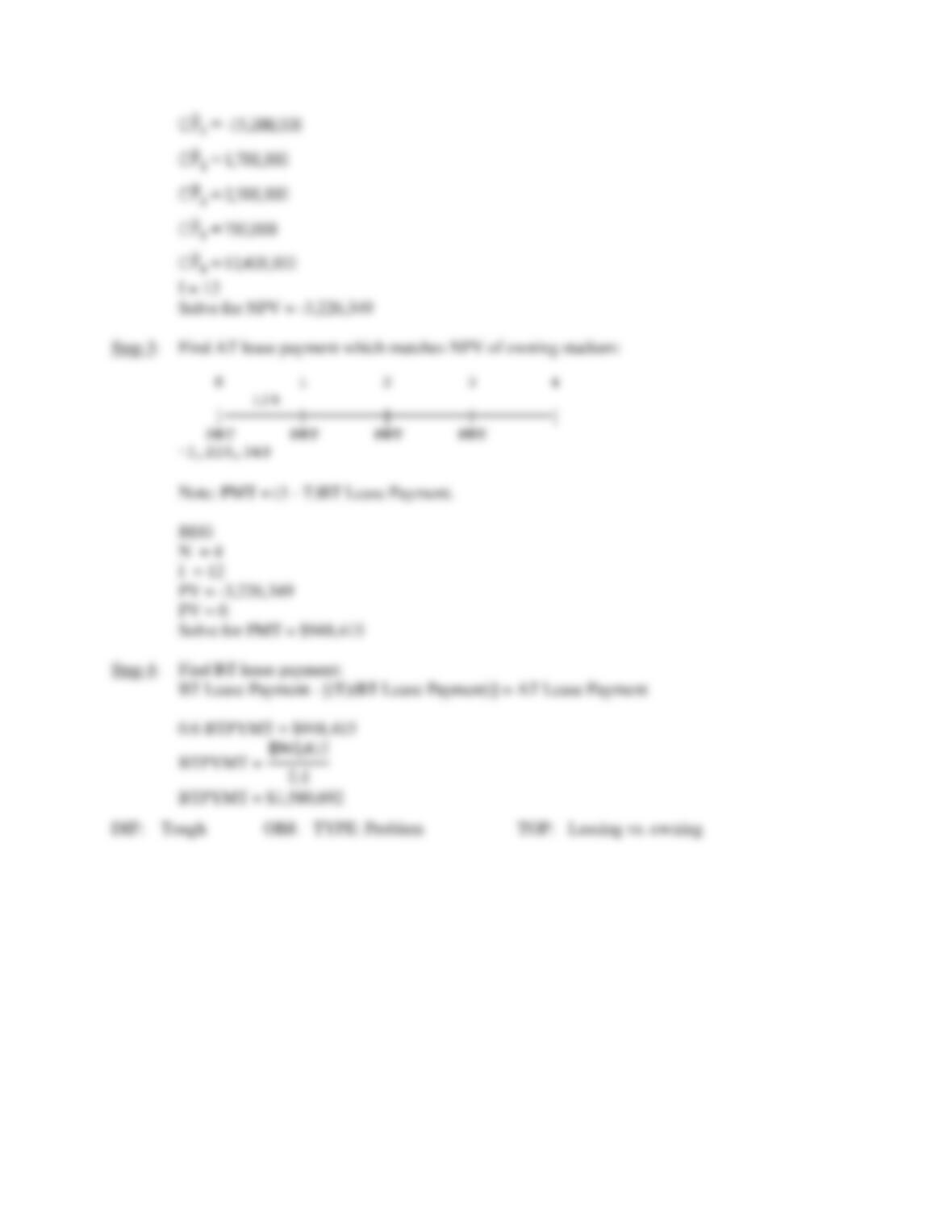
year for four years would make the team indifferent between buying and leasing the stadium?
a.
$948,415
b.
$1,025,000
c.
$1,333,667
d.
$1,580,692
e.
$1,613,598
398 Chapter 18 Alternative Financing Arrangements & Corporate Restructuring