146. Figure 7-7.
Armstrong Company produces a variety of bicycles. One of its plants produces two bicycles: a mountain model
and a racing model. At the beginning of the year, the following data were prepared for this plant:
Mountain
Racing
Quantity
250,000
125,000
Selling Price
$1,200
$1,000
Unit Prime Cost
$ 400
$ 500
In addition, the following information was provided so that overhead costs could be assigned to each product:
Activity Name
Activity Driver
Activity Cost
Racing
Mountain
Machining
Machine hours
$20,000,000
250,000
250,000
Engineering
Engineering hours
$ 8,000,000
75,000
50,000
Packing
Packing orders
$ 3,500,000
50,000
125,000
Refer to Figure 7-7.
A.
Calculate the activity rate for machining.
B.
Calculate the activity rate for engineering.
C.
Calculate the activity rate for packing.
A.
Machining rate= $20,000,000/500,000 = $40 per machine hour
B.
Engineering rate = $8,000,000/125,000 = $64 per engineering hour
C.
Packing rate = $3,500,000/175,000 = $20 per packing order
147. Figure 7-7.
Armstrong Company produces a variety of bicycles. One of its plants produces two bicycles: a mountain model
and a racing model. At the beginning of the year, the following data were prepared for this plant:
Mountain
Racing
Quantity
250,000
125,000
Selling Price
$1,200
$1,000
Unit Prime Cost
$ 400
$ 500
In addition, the following information was provided so that overhead costs could be assigned to each product:
Activity Name
Activity Driver
Activity Cost
Racing
Mountain
Machining
Machine hours
$20,000,000
250,000
250,000
Engineering
Engineering hours
$ 8,000,000
75,000
50,000
Packing
Packing orders
$ 3,500,000
50,000
125,000
Refer to Figure 7-7. Armstrong Company uses activity-based costing to calculate product costs.
A.
Calculate the per unit product cost for a mountain bike.
B.
Calculate the per unit product cost for a racing bike.
C.
Assume Armstrong Company adds 40% to the cost of a mountain bike and 35% to the cost of a racing bike obtain the selling prices.
Calculate the selling prices for a mountain bike and a racing bike.
A.
Mountain bike product cost per unit = $463.20
Racing bike product cost per unit = $625.60
Engineering rate = $8,000,000/(75,000 + 50,000)
Calculation of unit product costs:
Mountain
Racing
Machining:
$40 ´ 250,000
10,000,000
$40 ´ 250,000
$10,000,000
Engineering:
$64 ´ 75,000
$ 4,800,000
Packing:
$20 ´ 50,000
$ 1,000,000
$20 ´ 125,000
$ 2,500,000
Total Overhead
$15,800,000/
$15,700,000/
Units
250,000
125,000
Overhead per unit
$63.20
Prime cost per unit
$400.00
$500.00
Unit Cost
$463.20
$625.60
148. Tires Unlimited Corp. produces two types of tires, regular and snow tires. The company uses activity-
based costing and has identified two activities and their budgeted costs:
Molding
$ 75,000
Assembly
$ 260,000
Molding is based on mixing hours and assembly is based on machine hours. Information regarding each product is as follows:
Regular tire
Snow tire
Units produced
5,000
2,000
Mixing hours
525
275
Machine hours
1,000
460
Required:
A. Calculate the activity rate for molding and assembly. Round your answer to two decimal places.
B. Calculate how much total overhead is assigned to each type of tire.
C. Calculate the unit overhead assigned to each type of tire.
D. Assume the company does not use ABC costing. Calculate the plantwide overhead rate, based on machine hours. Round your answer to two
decimal places.
E. Calculate the total overhead assigned to each type of tire using the plantwide overhead rate.
Molding
$75,000
$93.75
Assembly
$260,000
$178.08
1,460
$93.75
x 525
49,218.75
$178.08
x 1,000
178,080.00
$ 227,298.75
$93.75
x 275
25,781.25
$178.08
x 460
81,916.80
$107,698.05
$227,300.94
45.46
$107,699.06
53.85
5,000
2,000
Plantwide overhead rate
$335,000
$229.45
1,460
149. Randy Company produces candy sticks (hooked and straight). Both products pass through two producing
departments. The hooked sticks’s production is much more labor-intensive than the straight sticks. The straight
stick is also more popular. The following data have been gathered for the two products:
Product Data
Hooked
Straight
Units produced per year
200,000
2,000,000
Machine hours
10,000
40,000
Packing orders
30,000
30,000
Randy has decided to use activity-based costing and has developed two types of activities, machine related (based on machine hours), and other
overhead (based on packing orders). Machine-related costs equal $160,000. Other overhead costs equal $240,000.
A.
Calculate the activity rate for machine-related costs based on machine hours.
B.
Calculate the activity rate for other overhead costs based on packing orders.
C.
Using the two activity rates, calculate the overhead cost per unit for hooked sticks. (Carry out computations to three decimal places.)
D.
Using the two activity rates, calculate the overhead cost per unit for straight sticks. (Carry out computations to three decimal places.)
C.
Overhead cost per unit for Hooked
= [($3.20 ´ 10,000) +
($4 ´ 30,000)]/200,000 = $0.76
Overhead cost per unit for Straight
= [($3.20 ´ 40,000) +
($4 ´ 30,000)]/2,000,000 = $0.124
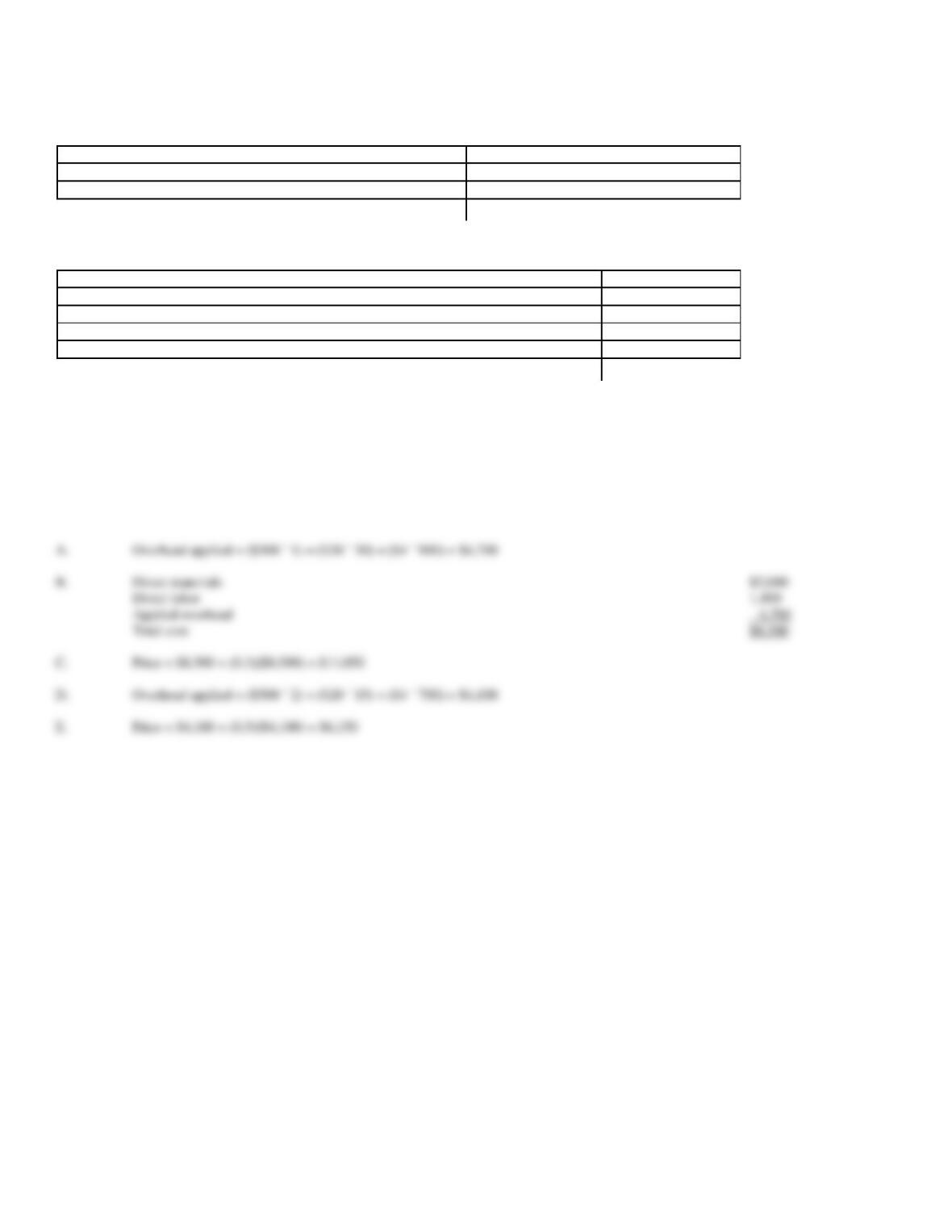
150. The Thompson Company uses activity-based costing to determine product cost. Three activities and their
rates have been calculated as shown below.
Setting up equipment
= $500 per setup
Moving goods
= $20 per move
Machining
= $4 per machine hour
Thompson provided the following data from the job order cost sheet for Job #345
Direct materials
$2,000
Direct labor
1,800
Setups
1
Moves
30
Machine hours
900
A.
Calculate the overhead applied to Job #345.
B.
Calculate the total cost of Job #345.
C.
If price is calculated by applying a 30% markup on cost, what is the price for Job #345?
D.
Assume Job #345 required 2 setups, 15 moves, and 700 machine hours. Calculate the overhead applied to Job #345.
E.
Assuming a 50% markup on cost, what is the price of Job #345 using the overhead rate calculated in part D.
Overhead applied = ($500 ´ 1) + ($20 ´ 30) + ($4 ´ 900) = $4,700
B.
Direct materials
$2,000
Direct labor
1,800
Applied overhead
4,700
Total cost
$8,500
C.
Price = $8,500 + (0.3)($8,500) = $11,050
Overhead applied = ($500 ´ 2) + ($20 ´ 15) + ($4 ´ 700) = $4,100
E.
Price = $4,100 + (0.5)($4,100) = $6,150
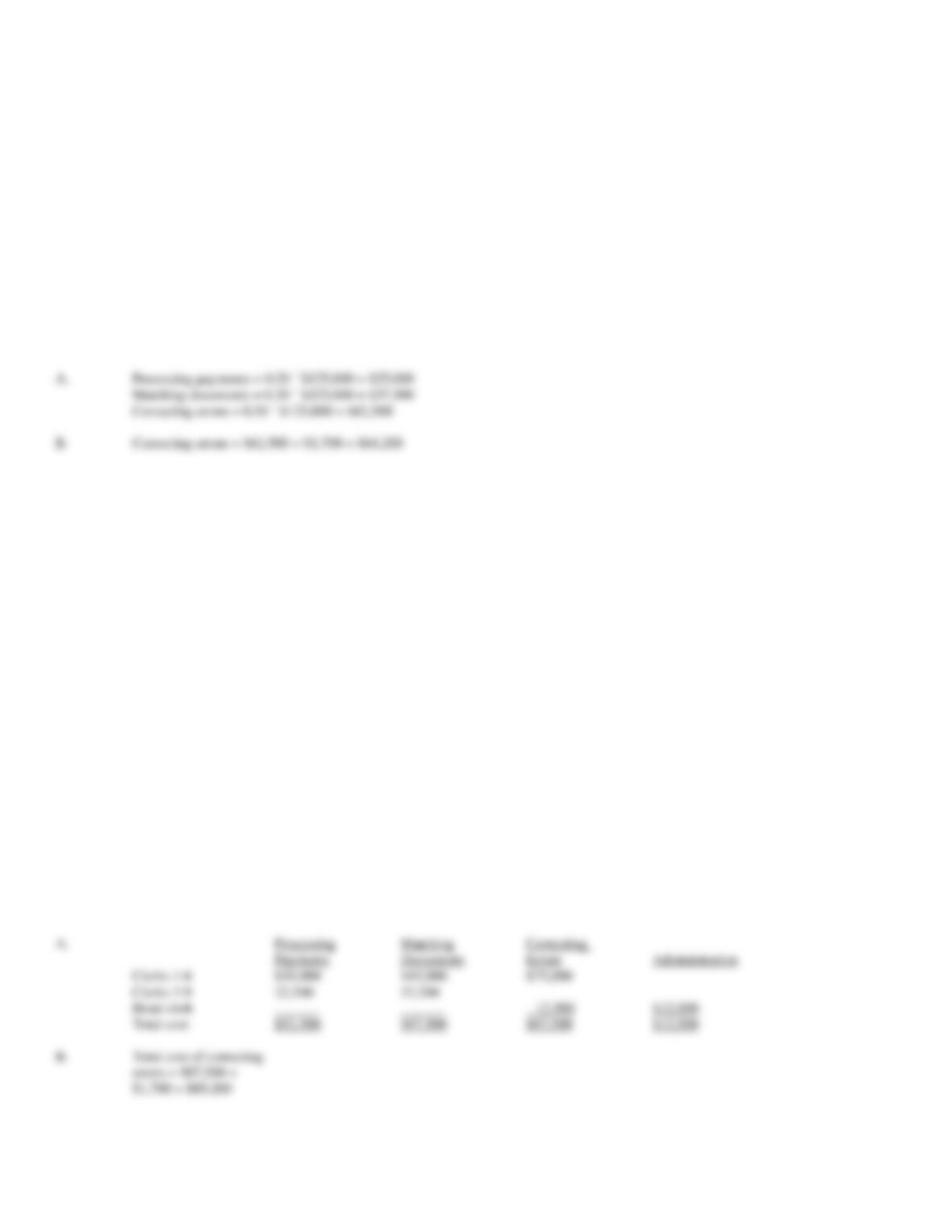
151. Assume that the accounts payable department of a company has 5 clerks; each one is paid $25,000 per year
($125,000 total clerical salaries). On average, the clerks spend:
20% of their time on processing payments
30% of their time matching invoices, receiving documents, and billing statement
50% of their time correcting errors in the various documents
In addition, long distance telephone costs of $1,700 are directly traced to the activity “correcting errors.”
A.
Assign the clerical salary cost to each of the three activities.
B.
What is the total cost of the “correcting errors” activity?
152. Assume that the accounts payable department of a company has 10 clerks; each one is paid $25,000 per
year ($250,000 total clerical salaries). Six of the clerks spend the following percentages of time on the three
activities:
20% of their time on processing payments
30% of their time matching invoices, receiving documents, and billing statement
50% of their time correcting errors in the various documents
One clerk, the head clerk, spends 50% of her time on administrative duties, and the remainder on error
correction. The remaining three clerks spend 30% of their time on processing payments and the remaining 70%
of their time on matching documents.
Long distance telephone costs of $1,700 are directly traced to the activity “correcting errors.”
A.
Assign the clerical salary cost to each of the three activities, and to administration.
B.
What is the total cost of the “correcting errors” activity?
A.
Processing
Matching
Correcting
Payments
Documents
Errors
Administration
Clerks 1-6
$30,000
$45,000
$75,000
Clerks 7-9
22,500
52,500
Head clerk
12,500
$12,500
Total cost
$52,500
$97,500
$87,500
$12,500
$1,700 = $89,200
A.
Processing payments = 0.20 ´ $125,000 = $25,000
Matching documents = 0.30 ´ $125,000 = $37,500
Correcting errors = 0.50 ´ $125,000 = $62,500
B.
Correcting errors = $62,500 + $1,700 = $64,200
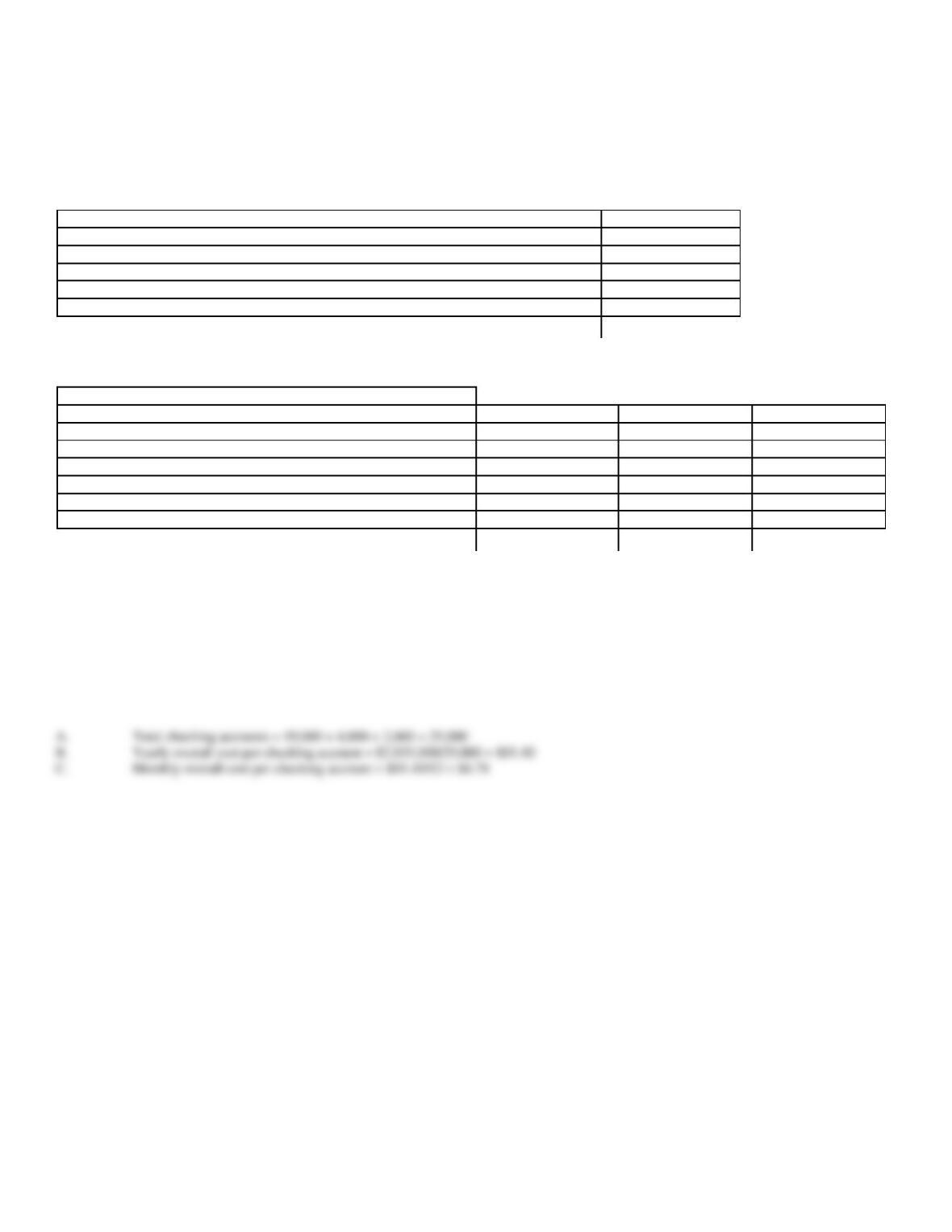
153. Figure 7-8.
Sallisaw Savings & Loan has requested an analysis of checking account profitability by customer type.
Customers are categorized according to size of their account: low balances, medium balances, and high
balances. The activities associated with the three different customer categories and their associated annual costs
are as follows:
Opening and closing statements
$ 100,000
Issuing monthly statements
$ 150,000
Processing transactions
$1,025,000
Customer inquiries
$ 200,000
Providing ATM services
$ 560,000
Total cost
$2,035,000
Additional data concerning the usage of the activities by the various customers are also provided:
Account Balance
Low
Medium
High
Number of accounts opened/closed
7,500
1,500
1,000
Number of statements issued
225,000
50,000
25,000
Processing transactions
9,000,000
1,000,000
250,000
Number of telephone minutes
500,000
300,000
200,000
Number of ATM transactions
675,000
100,000
25,000
Number of checking accounts
19,000
4,000
2,000
Refer to Figure 7–8.
A.
Calculate the total number of checking accounts.
B.
Calculate the yearly overall cost per checking account.
C.
Calculate the monthly overall cost per checking account.
Total checking accounts = 19,000 + 4,000 + 2,000 = 25,000
B.
Yearly overall cost per checking account = $2,035,000/25,000 = $81.40
Monthly overall cost per checking account = $81.40/12 = $6.78
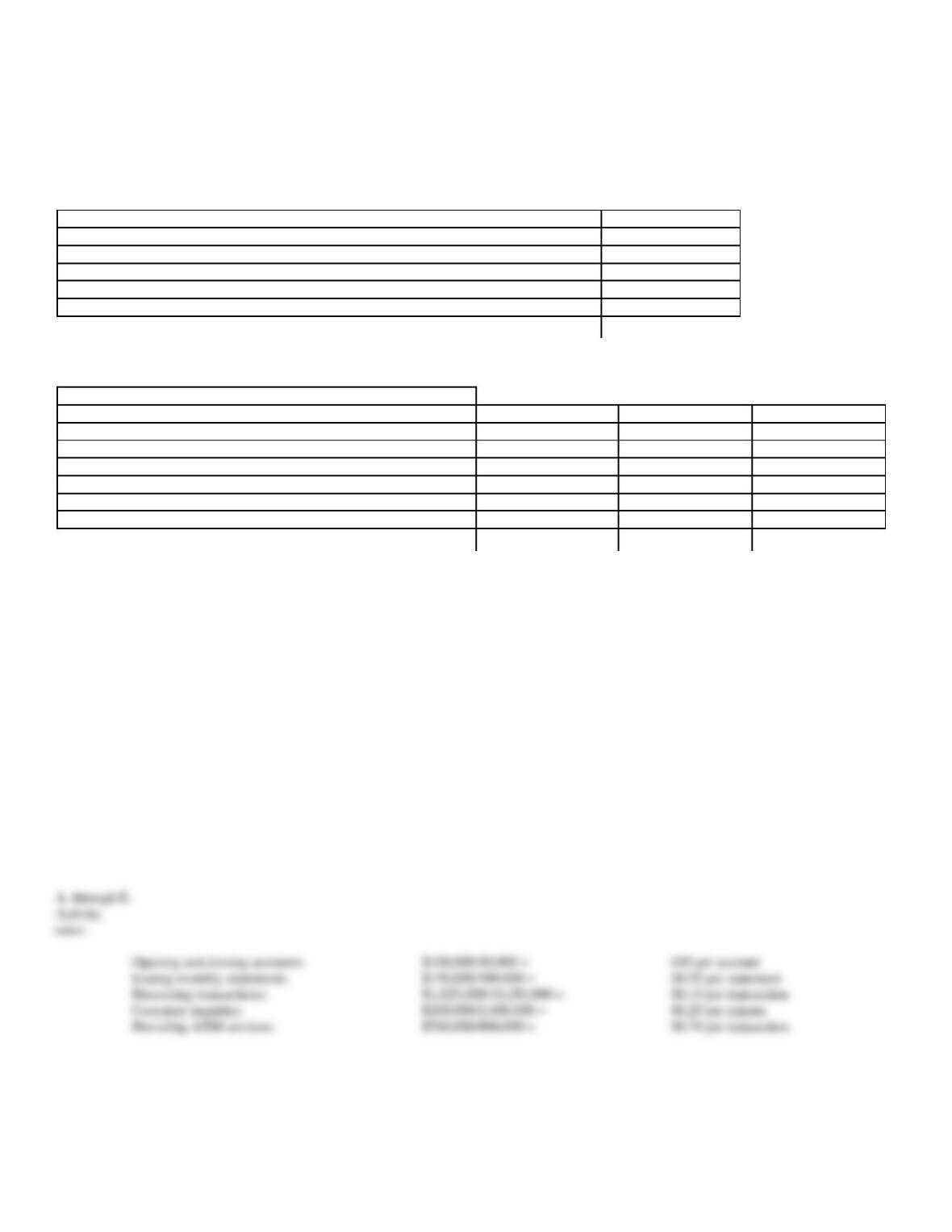
154. Figure 7-8.
Sallisaw Savings & Loan has requested an analysis of checking account profitability by customer type.
Customers are categorized according to size of their account: low balances, medium balances, and high
balances. The activities associated with the three different customer categories and their associated annual costs
are as follows:
Opening and closing statements
$ 100,000
Issuing monthly statements
$ 150,000
Processing transactions
$1,025,000
Customer inquiries
$ 200,000
Providing ATM services
$ 560,000
Total cost
$2,035,000
Additional data concerning the usage of the activities by the various customers are also provided:
Account Balance
Low
Medium
High
Number of accounts opened/closed
7,500
1,500
1,000
Number of statements issued
225,000
50,000
25,000
Processing transactions
9,000,000
1,000,000
250,000
Number of telephone minutes
500,000
300,000
200,000
Number of ATM transactions
675,000
100,000
25,000
Number of checking accounts
19,000
4,000
2,000
Refer to Figure 7-8. Sallisaw uses an activity-based costing system. The activity rate for opening and closing statements is based on the number of
accounts opened and closed. The activity rate for issuing monthly statements is based on the number of statements issued. The activity rate for
processing transactions is based on the number of transactions processed. The activity rate for customer inquiries is based on the number of telephone
minutes. The rate for ATM services is based on the number of ATM transactions.
A.
Calculate the activity rate for opening and closing accounts.
B.
Calculate the activity rate for issuing monthly statements.
C.
Calculate the activity rate for processing transactions.
D.
Calculate the activity rate for customer inquiries.
E.
Calculate the activity rate for providing ATM services.
F.
Calculate the cost per account by customer category using the five activity rates.
G.
Sallisaw Savings & Loan offers free checking to all its customers. Overall, the interest revenues average $105 per account; however,
the interest revenues earned per account by category are $95, $115, and $180 from the low, medium and high balance accounts,
respectively. Calculate the overall average profit per account. Then calculate the average profit per account for each of the three
customer categories. Refer to part F for the cost per account by customer category.
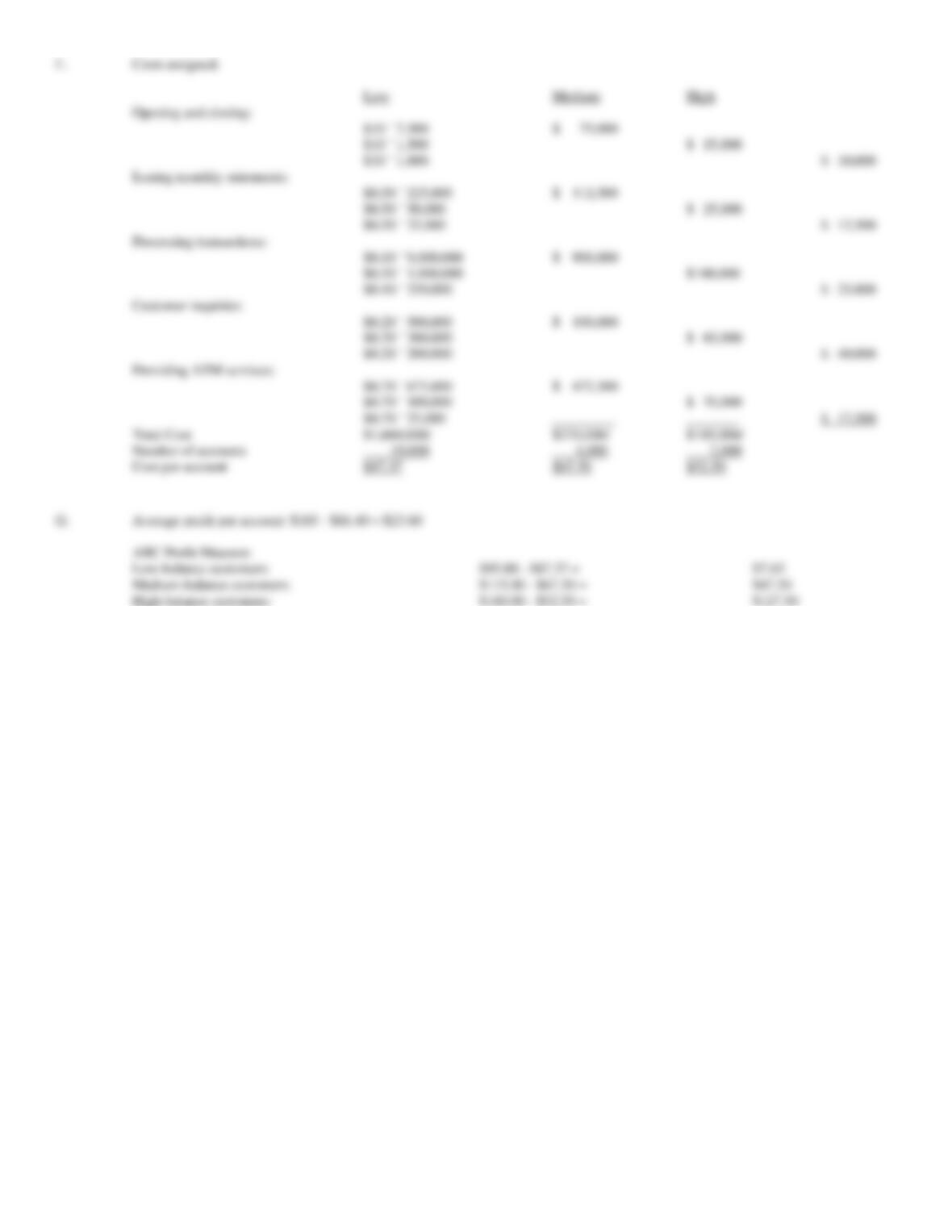
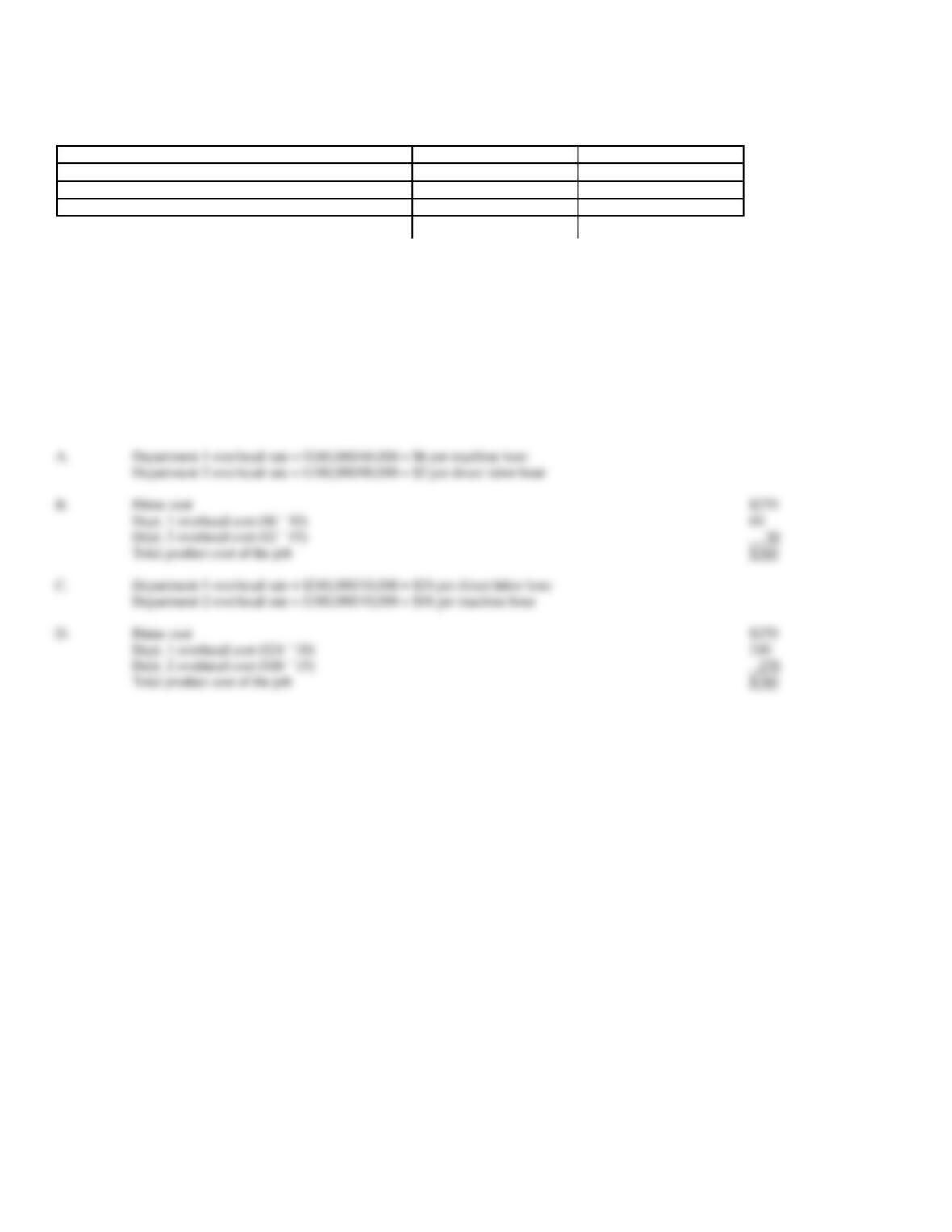
Opening and closing accounts:
$100,000/10,000 =
$10 per account
Issuing monthly statements:
$150,000/300,000 =
$0.50 per statement
Processing transactions:
$1,025,000/10,250,000 =
$0.10 per transaction
Customer inquiries:
$200,000/1,000,000 =
$0.20 per minute
Providing ATM services:
$560,000/800,000 =
$0.70 per transaction
155. Heedy Company makes a product using two departments – Department 1 and Department 2. Information
on these departments is as follows:
Department 1
Department 2
Direct labor hours
10,000
90,000
Machine hours
40,000
10,000
Overhead cost
$240,000
$180,000
A.
Calculate the department overhead rate for each department. Use machine hours as the base in Department 1 and direct labor hours
as the base in Department 2.
B.
A job has prime cost of $270. It uses 10 machine hours in Department 1 and 15 direct labor hours in Department 2. Calculate the
total product cost for the job.
C.
Recalculate the department overhead rate for each department. Use direct labor hours as the base in Department 1 and machine hours
as the base in Department 2.
D.
A job has prime cost of $270. It uses 10 direct labor hours in Department 1 and 15 machine hours in Department 2. Using the rates
calculated in part C, calculate the total product cost for the job.
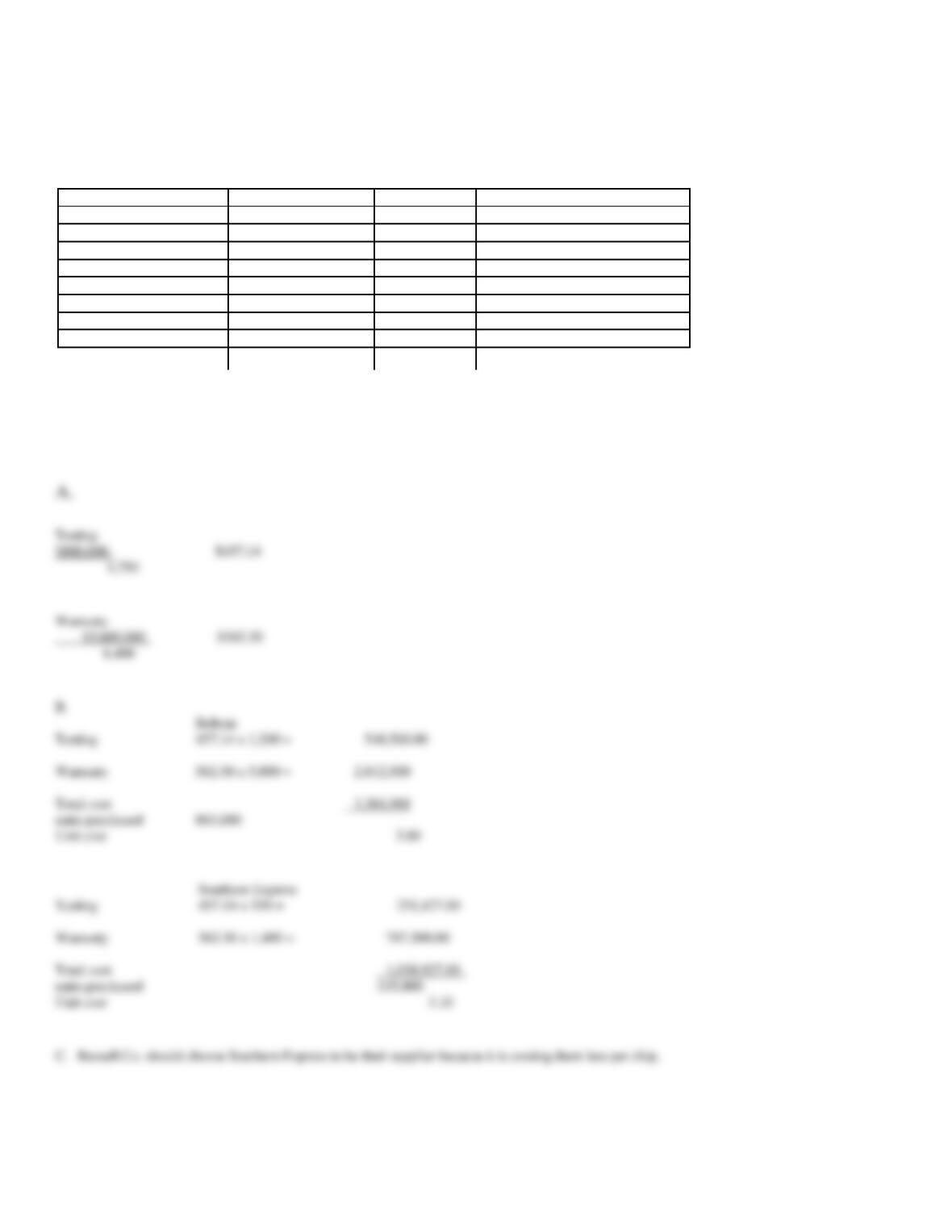
Department 1 overhead rate = $240,000/40,000 = $6 per machine hour
Department 2 overhead rate = $180,000/90,000 = $2 per direct labor hour
Prime cost
$270
Dept. 1 overhead cost ($6 ´ 10)
Dept. 2 overhead cost ($2 ´ 15)
30
Total product cost of the job
$360
Department 1 overhead rate = $240,000/10,000 = $24 per direct labor hour
Department 2 overhead rate = $180,000/10,000 = $18 per machine hour
Prime cost
$270
Dept. 1 overhead cost ($24 ´ 10)
Dept. 2 overhead cost ($18 ´ 15)
270
Total product cost of the job
$780
156. Russell Company uses Beltran Company and Southern Express Inc. to buy the electronic chip used in the
manufacturing of its GPS device. Russell Co. has been using these two companies for several years and would
like to cut down to only one supplier to purchase the 1,200,000 chips needed per year. In order to determine
which supplier is the most cost effective Russell Co. compiled the following data:
Activity
Activity Cost
Testing
800,000
Warranty work
3,600,000
Beltran Co.
Southern Express Inc.
Unit price
$ 60
$ 63
Units purchased
865,000
335,000
Testing hours
1,200
550
Warranty hours
5,000
1,400
Required:
A. Calculate the activity rate for each activity. Round your answer to two decimal places.
B. Calculate the cost per chip for each supplier.
C. Which supplier should Russell Company choose?
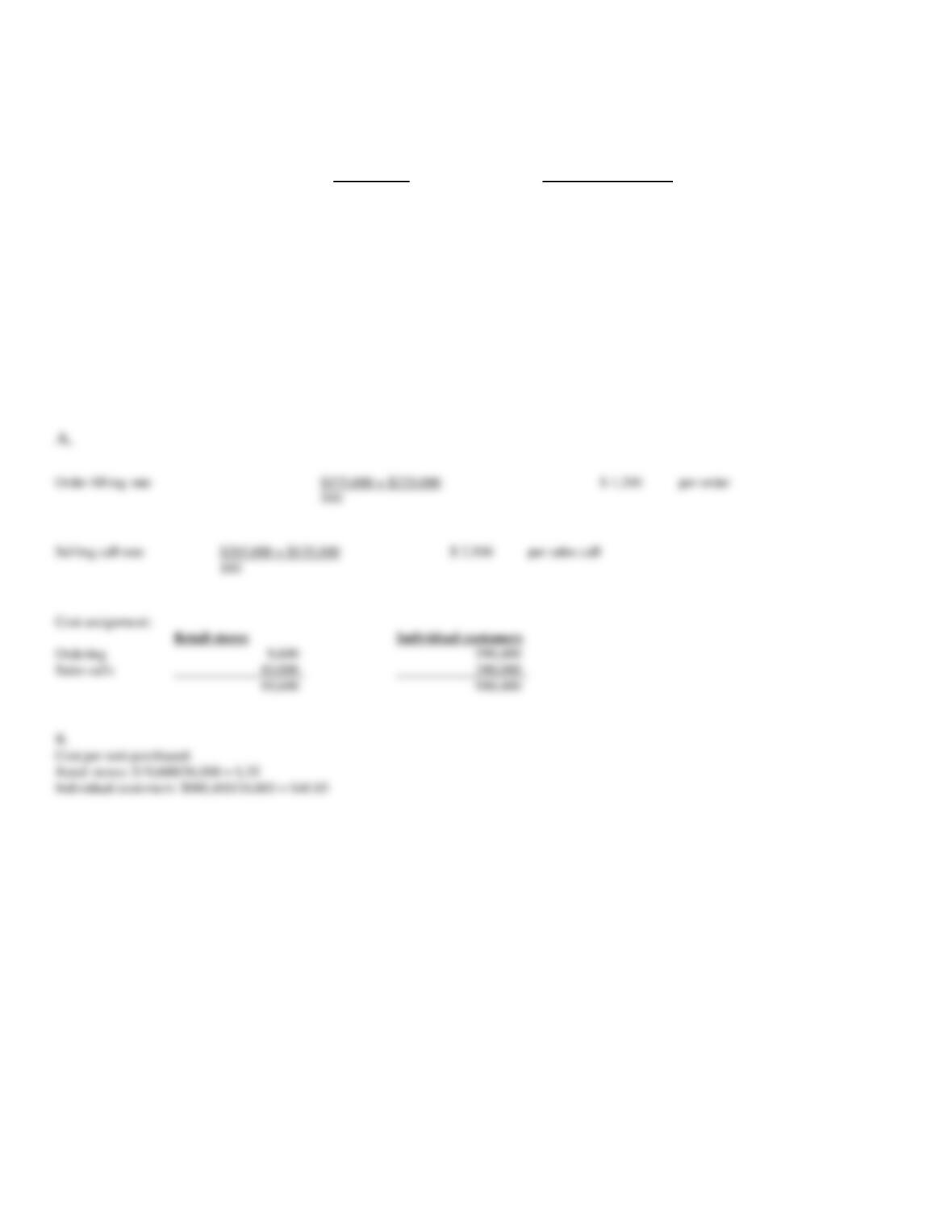
Testing
$800,000
$457.14
1,750
Warranty
$3,600,000
$562.50
6,400
Beltran
Testing
457.14 x 1,200 =
548,568.00
Warranty
562.50 x 5,000 =
2,812,500
Total cost
3,361,068
units purchased
865,000
Unit cost
3.89
Southern Express
Testing
457.14 x 550 =
251,427.00
Warranty
562.50 x 1,400 =
787,500.00
Total cost
1,038,927.00
units purchased
335,000
Unit cost
3.10
157. Stinler Corporation manufactures curtains for retail stores and for individual customers. The retail chain
buys 70% of the curtains produced. The individual customers purchase curtains in approximately equal
quantities, where the orders are about the same size. Data concerning Stinler’s customer activity are as follows:
Retail Stores
Individual Customers
Units purchased
56,000
24,000
Orders placed
8
492
Number of sales calls
4
156
Manufacturing costs
8,000,000
3,500,000
Order filling costs allocated
375,000
225,000
Sales force costs allocated
265,000
135,000
Currently customer-driven costs are assigned to customers based on units sold, a unit-level driver.
Required:
A. Assign costs to customers by using an ABC approach.
B. Determine cost per unit sold for each type of customer.
Order filling rate
$375,000 + $225,000
$ 1,200
per order
Selling call rate
$265,000 + $135,000
$ 2,500
per sales call
Cost assignment:
Ordering
9,600
590,400
Sales calls
10,000
390,000
19,600
980,400
158. Flynn Company has a JIT system in place. Each manufacturing cell is dedicated to the production of a
single product or major subassembly. One cell, dedicated to the production of guitar pickups, has four
operations: machining, finishing, assembly, and testing.
For the coming year, the pickup cell has the following budgeted costs and cell time (both at theoretical
capacity):
Cell time:
8,000 hours
Theoretical output:
60,000 pickups
During the year, the following actual results were obtained:
Actual cell time:
8,000 hours
Actual output:
50,000 pickups
A.
Compute the theoretical velocity for the cell per hour.
B.
Compute the theoretical cycle time in minutes.
C.
Compute the actual velocity for the cell per hour.
D.
Compute the actual cycle time in minutes.
A.
Theoretical velocity = 60,000/8,000 = 7.5 pickups per hour
B.
Theoretical cycle time = (8,000)(60 minutes per hour)/60,000 = 8 minutes per unit
C.
Actual velocity = 50,000/8,000 = 6.25 pickups per hour
D.
Actual cycle time = (8,000)(60 minutes per hour)/50,000 = 9.6 minutes per unit
159. Lorimer Company had sales of $2,500,000 for last year. Data on quality-related costs for last year are as
follows:
Inspection
$ 80,000
Scrap
10,000
Rework
45,000
Quality training
20,000
Warranty work
100,000
Customer complaints
30,000
A.
Classify each of the quality-related costs as control (prevention and appraisal), internal failure, or external failure.
B.
What percentage of sales is accounted for by quality-related costs?
C.
If quality-related costs could be reduced to 2% of sales, by how much would Lorimer’s profit increase?
A.
Control costs: inspection, quality training
Internal failure costs: scrap, rework
External failure costs: warranty work, customer complaints
B.
Quality-related costs = $285,000
Percentage of sales = $285,000/$2,500,000 = 0.114 or 11.4% of sales
C.
Current quality-related costs
$285,000
Quality-related costs at 2% of sales
50,000
Increase in profit
$235,000
160. Consider the following information on activities:
Amount of
Driver That
Actual
Cost per unit
Activity (driver)
Should be Used
Amount Used
of driver
Purchasing (purchase orders)
48,000
53,000
$40
Inspection (inspection hours)
0
22,000
$30
Rework (labor hours)
0
13,000
$20
A.
Which of the three activities, if any, is value-added?
B.
What is the nonvalue-added cost of each activity?
C.
What is the total value-added cost of the activities?
C.
Total value-added cost
= Value-added cost of Purchasing
= 48,000($40) = $1,920,000
161. A company was evaluating the activity-based environmental cost of two different products – Product X and
Product Y. Information on two environmental activities is as follows:
Activity
Driver
Cost
Maintaining pollution equipment
Maintenance hours
$120,000
Toxic waste disposal
Pounds of waste
80,000
Data on Product X and Product Y follows:
Product X
Product Y
Production costs (nonenvironmental)
$400,000
$500,000
Units produced
100,000
200,000
Maintenance hours for pollution equipment
1,000
4,000
Pounds of toxic waste
10,000
30,000
A.
Assign the environmental activity costs to Product X and to Product Y.
B.
Calculate the unit environmental cost of Product X.
C.
Calculate the unit environmental cost of Product Y.
D.
Calculate the overall unit cost of Product X.
E.
Calculate the overall unit cost of Product Y.
Environmental cost of
= [$120,000(1,000/5,000) + $80,000(10,000/40,000)]
Product X
= $24,000 + $20,000 = $44,000
Environmental cost of
Product Y
= $96,000 + $60,000 = $156,000
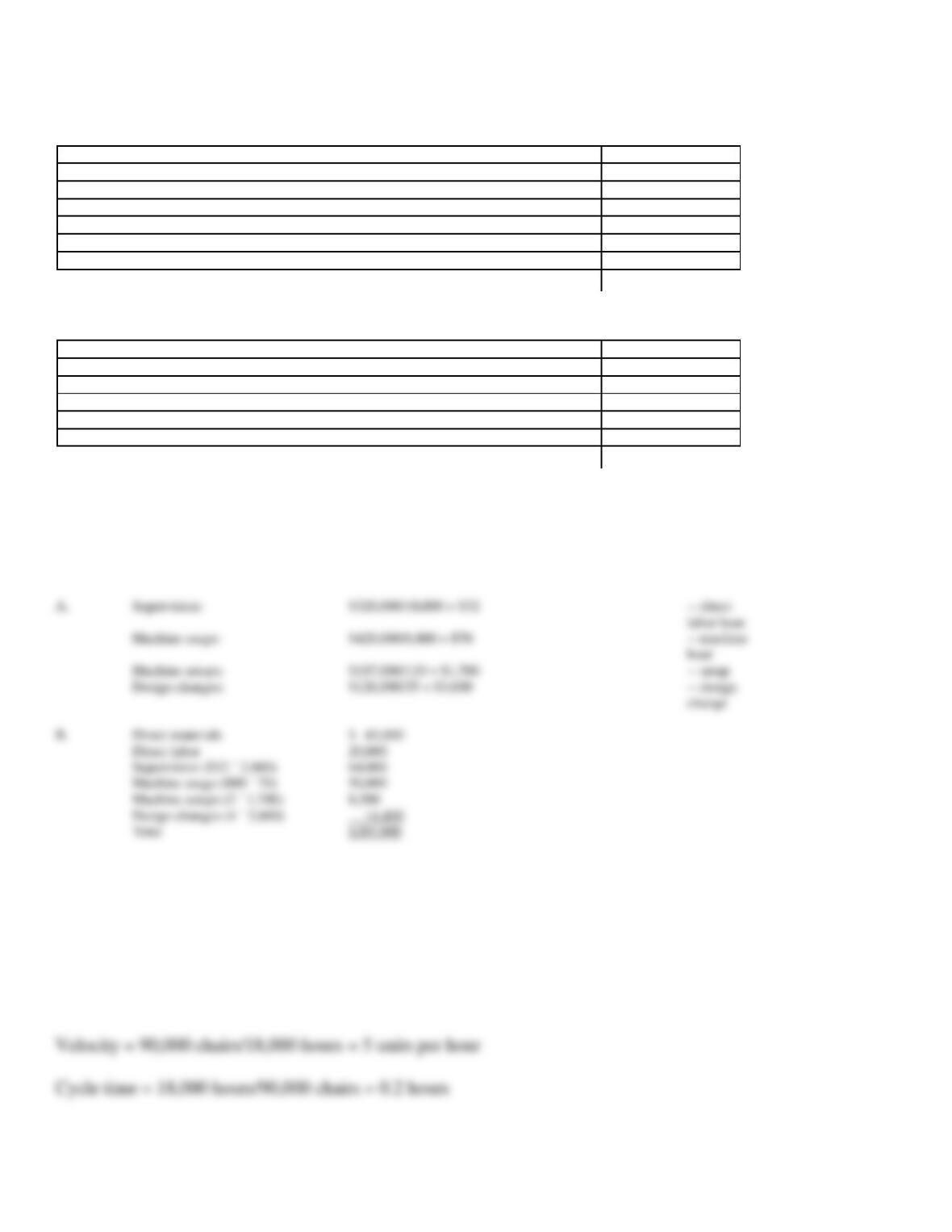
162. Browning Manufacturing Company uses activity-based costing. The overhead budget for the coming
period is $1,053,000, consisting of the following:
Budgeted
Cost Pool
Amount
Supervision
$ 320,000
Machine usage
420,000
Machine setups
187,000
Design changes
126,000
Totals
$1,053,000
The potential allocation bases and their estimated amounts were as follows:
Allocation
Budgeted
Base
Amount
Number of design changes
35
Number of setups
110
Machine hours
6,000
Direct labor hours
10,000
A.
Determine the overhead rate for each cost pool, using the most appropriate allocation base for each pool.
B.
Job 80130 required $45,000 for direct materials, $20,000 for direct labor, 2,000 direct labor hours, 800 machine hours, five setups,
and four design changes. Determine the cost of Job 80130.
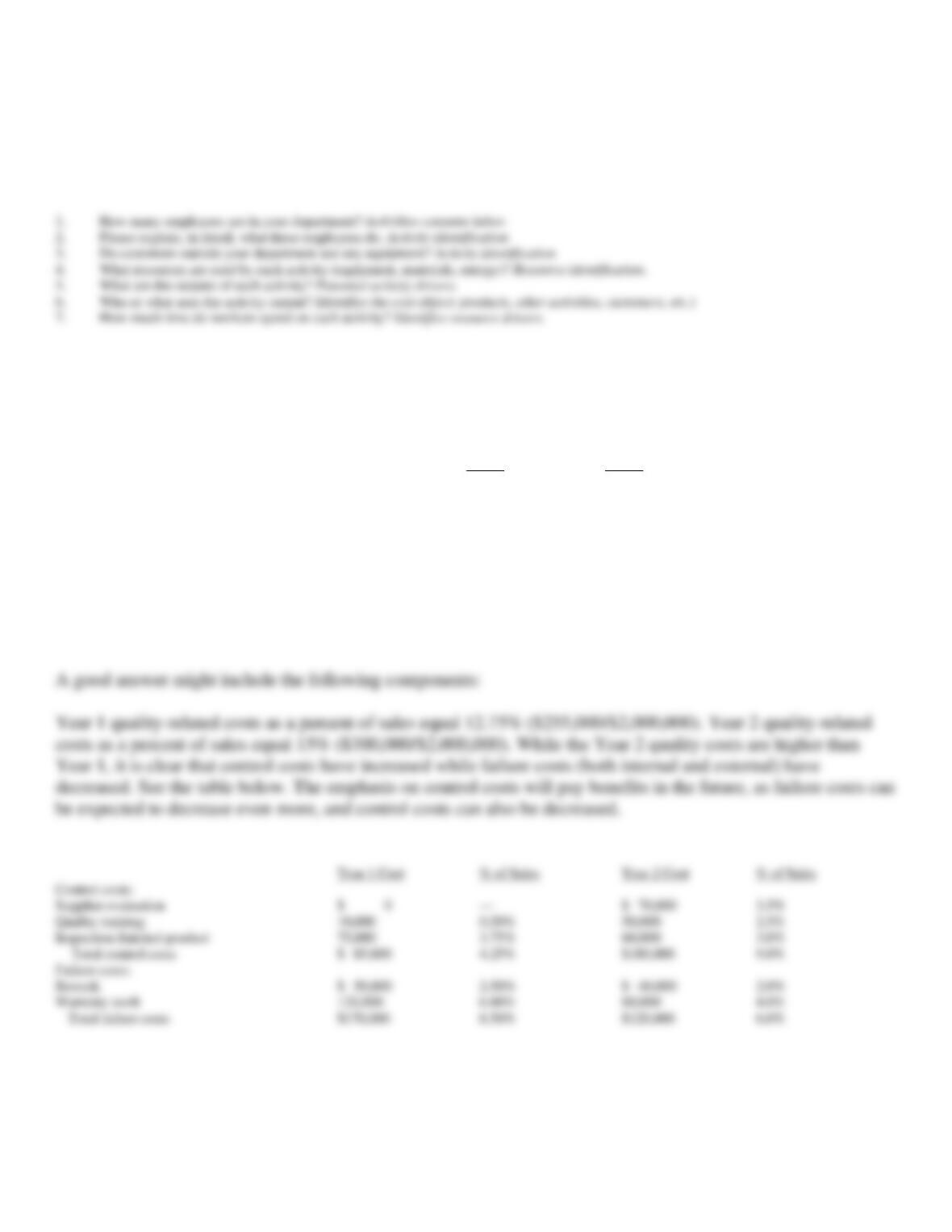
163. Charlotte Company produces folding chairs. It takes the company 18,000 hours to produce 90,000 chairs.
Required:
A. What is the velocity in hours?
B. What is the cycle time in hours?
Machine setups:
$187,000/110 = $1,700
Direct materials
$ 45,000
Direct labor
20,000
Supervision ($32 ´ 2,000)
64,000
Machine usage (800 ´ 70)
56,000
Machine setups (5 ´ 1,700)
8,500
Design changes (4 ´ 3,600)
14,400
Total
$207,900
164. Develop a set of at least five interview questions that could be used in the construction of an activity
dictionary. Also explain why you would ask each question, i.e., what information you hope to acquire and how
it would apply to the activity dictionary.
Answers will vary widely. The following is simply an illustration.
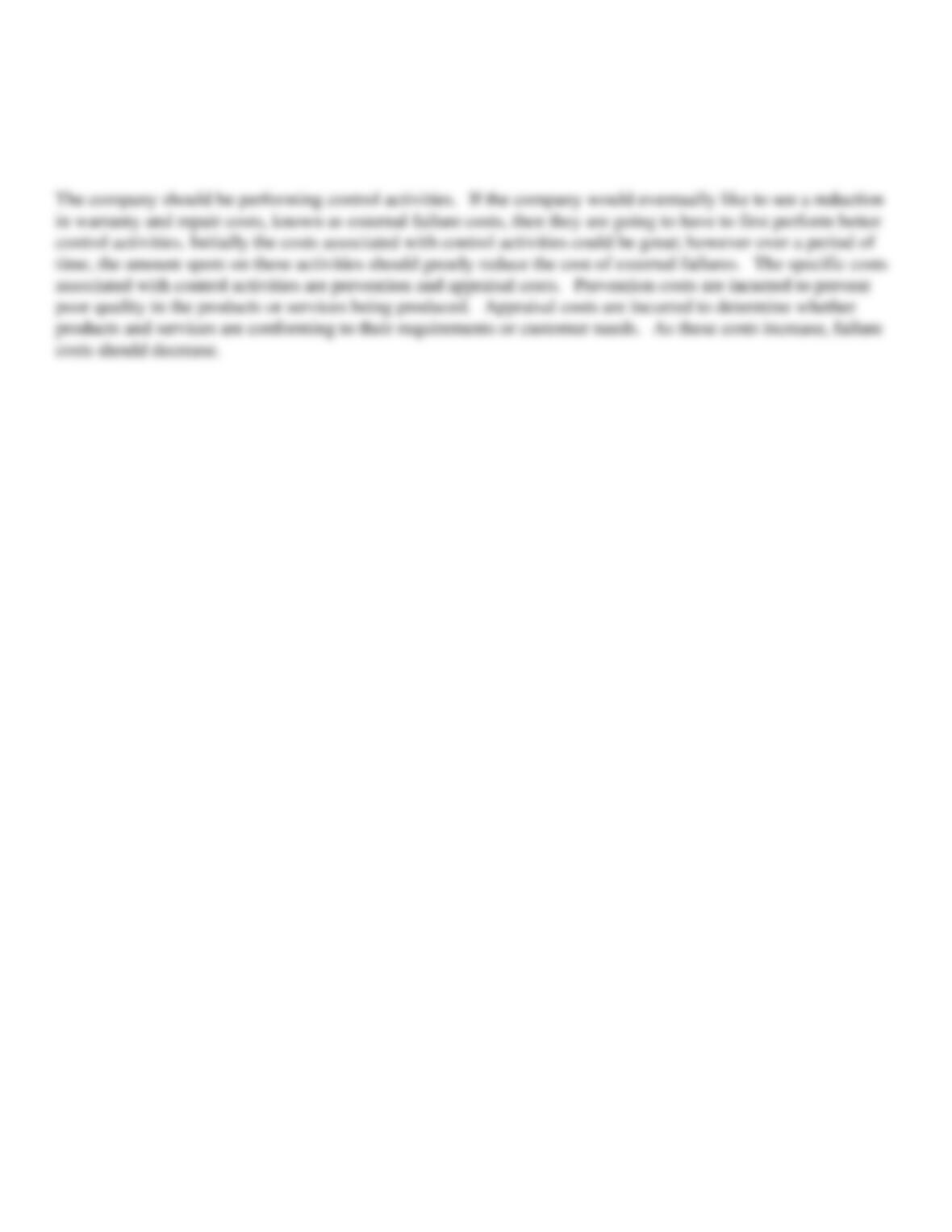
165. A company has developed a list of quality-related costs as follows:
Year 1
Year 2
Supplier evaluation
$ 0
$ 70,000
Quality training
10,000
50,000
Inspection of finished product
75,000
60,000
Rework
50,000
40,000
Warranty work
120,000
80,000
Sales
$2,000,000
$2,000,000
The company’s controller is pleased with the Year 2 results and commented that the company is now on its way toward total quality. Is the controller
right? Explain.
Year 1 Cost
% of Sales
Year 2 Cost
% of Sales
Control costs:
Supplier evaluation
$ 70,000
3.5%
Quality training
10,000
0.50%
50,000
2.5%
Inspection finished product
75,000
3.75%
60,000
3.0%
Total control costs
$ 85,000
4.25%
$180,000
9.0%
Failure costs:
Rework
$ 50,000
2.50%
$ 40,000
2.0%
Warranty work
120,000
6.00%
80,000
4.0%
Total failure costs
$170,000
8.50%
$120,000
6.0%
How many employees are in your department? Activities consume labor.
Please explain, in detail, what these employees do. Activity identification
Do customers outside your department use any equipment? Activity identification
What resources are used by each activity (equipment, materials, energy)? Resource identification.
What are the outputs of each activity? Potential activity drivers.
Who or what uses the activity output? Identifies the cost object: products, other activities, customers, etc.)
How much time do workers spend on each activity? Identifies resource drivers.
166. You decide
The Tilman Corporation has seen a significant increase in the amount spent on such items as warranty and
recall repairs. They would like to be able to reduce these costs and have asked you, the cost accountant, for
some advice. What would be your recommendation?