Chapter 18 – Principles of Endocrinology – The Central Endocrine Glands
a.
True
b.
False
False
50. Thyrotropes secrete thyroid-stimulating hormone (TSH), which stimulates secretion of thyroid hormone and growth of
the thyroid gland.
a.
True
b.
False
True
51. Lactotropes secrete prolactin (PRL), which enhances breast development and lactation in females.
a.
True
b.
False
True
52. Almost all blood supplied to the anterior pituitary must first pass through the hypothalamus.
a.
True
b.
False
True
53. The most common blood-borne factors that influence hypothalamic neurosecretion are the positive feedback effects of
peptide hormones.
a.
True
b.
False
False
54. Unlike other regions of the brain, portions of the hypothalamus are not guarded by the blood–brain barrier, so the
hypothalamus can easily monitor chemical changes in the blood.
a.
True
b.
False
True
55. Children display two periods of rapid growth: a postnatal growth spurt during their first 2 years of life and a pubertal
growth spurt during adolescence.
a.
True
b.
False
True
56. Growth hormone directly influences both IGF-I and IGF-II production.
a.
True
b.
False
False
57. A long bone consists of a fairly uniform cylindrical shaft, the epiphysis, with a flared articulating knob at either end, a
diaphysis.
a.
True
b.
False
False
58. Growth hormone uses up fat stores and promotes synthesis of body proteins, so it encourages a change in body
composition away from adipose deposition toward an increase in muscle.
a.
True
b.
False
True
59. Hyposecretion of growth hormone in an adult is one cause of dwarfism.
a.
True
b.
False
False
60. Sex steroids are potent growth stimulators and contribute to the pubertal growth spurt, but they ultimately stop further
growth by closing the epiphyseal plates.
a.
True
b.
False
True
61. Thyroid hormone is directly responsible for promoting growth.
a.
True
b.
False
False
62. The master biological clock that serves as the pacemaker for the body’s circadian rhythms is the suprachiasmatic
nucleus (SCN).
a.
True
b.
False
True
63. On its own, the biological clock generally cycles a bit faster than the 24-hour environmental cycle.
a.
True
b.
False
False
64. Melatonin is an effective antioxidant, a defense tool against biologically damaging free radicals.
a.
True
Chapter 18 – Principles of Endocrinology – The Central Endocrine Glands
b.
False
True
65. The two biggest self-prescribed uses of melatonin are as prevention for the common cold and as a reproductive aid.
a.
True
b.
False
False
66. Steroid hormones, produced by the adrenal __________ and reproductive endocrine glands, are neutral lipids derived
from __________.
67. A tropic hormone’s actions aimed at maintaining the structural integrity of its target gland are specifically known as
__________ actions.
trophic
68. The same chemical messenger may be either a hormone or a(n) __________, depending on its source and mode of
delivery to the target cell.
neurotransmitter
69. The most abundant form of thyroid hormone secreted by the thyroid gland is __________, but the most powerful form
of thyroid hormone in the blood is __________.
70. Hydrophilic peptides most commonly are inactivated by __________ of peptide bonds.
71. __________ feedback exists when the output of a system counteracts a change in input.
72. Primary __________ occurs when an endocrine gland is secreting too little of its hormone because of an abnormality
within that gland.
73. The anterior pituitary consists of glandular epithelial tissue and accordingly is also called the __________.
74. The posterior pituitary consists of neuronal terminals plus glial-like supporting cells known as __________.
75. The posterior pituitary releases into the blood two small peptide hormones, vasopressin and __________, which are
synthesized by the neuronal cell bodies in the __________.
76. Gonadotropes secrete two hormones that act on the gonads: __________ and luteinizing hormone.
77. The anatomic and functional link between the hypothalamus and the anterior pituitary is an unusual capillary-to–
capillary connection called the __________.
78. The axons of the neurosecretory neurons that produce the hypothalamic regulatory hormones terminate on the
__________ at the origin of the portal system.
79. Fetal growth is promoted largely by certain hormones from the __________ and not impacted by __________
hormone.
80. To exert its metabolic effects, growth hormone binds directly with its target organs, namely, __________ tissue,
skeletal muscles, and __________.
81. __________synthesis is stimulated by growth hormone and mediates most of this hormone’s growth-promoting
actions.
82. Growth hormone promotes growth of soft tissues by __________ and hyperplasia.
83. In a growing bone, the diaphysis is separated at each end from the epiphysis by a layer of cartilage known as the
Chapter 18 – Principles of Endocrinology – The Central Endocrine Glands
__________.
84. Bones lengthen as a result of activity of __________ in the epiphyseal plates.
85. Adults who are GH deficient tend to have reduced skeletal __________ mass and strength and decreased __________
density.
86. Because insulin promotes __________ synthesis, its growth-promoting effects should not be surprising.
87. The master biological clock that serves as the pacemaker for the body’s circadian rhythms is the __________.
88. The fluctuating levels of __________ bring about cyclic changes in neural output from the suprachiasmatic nucleus
that, in turn, lead to cyclic changes in effector organs throughout the day.
89. __________, a protein found in a special type of retinal ganglion cell, is the receptor molecule for light that keeps the
body in tune with external time.
90. The specialized retinal ganglion cells cue the pineal gland about the presence or absence of light by sending their
signals along the __________ to the suprachiasmatic nucleus.
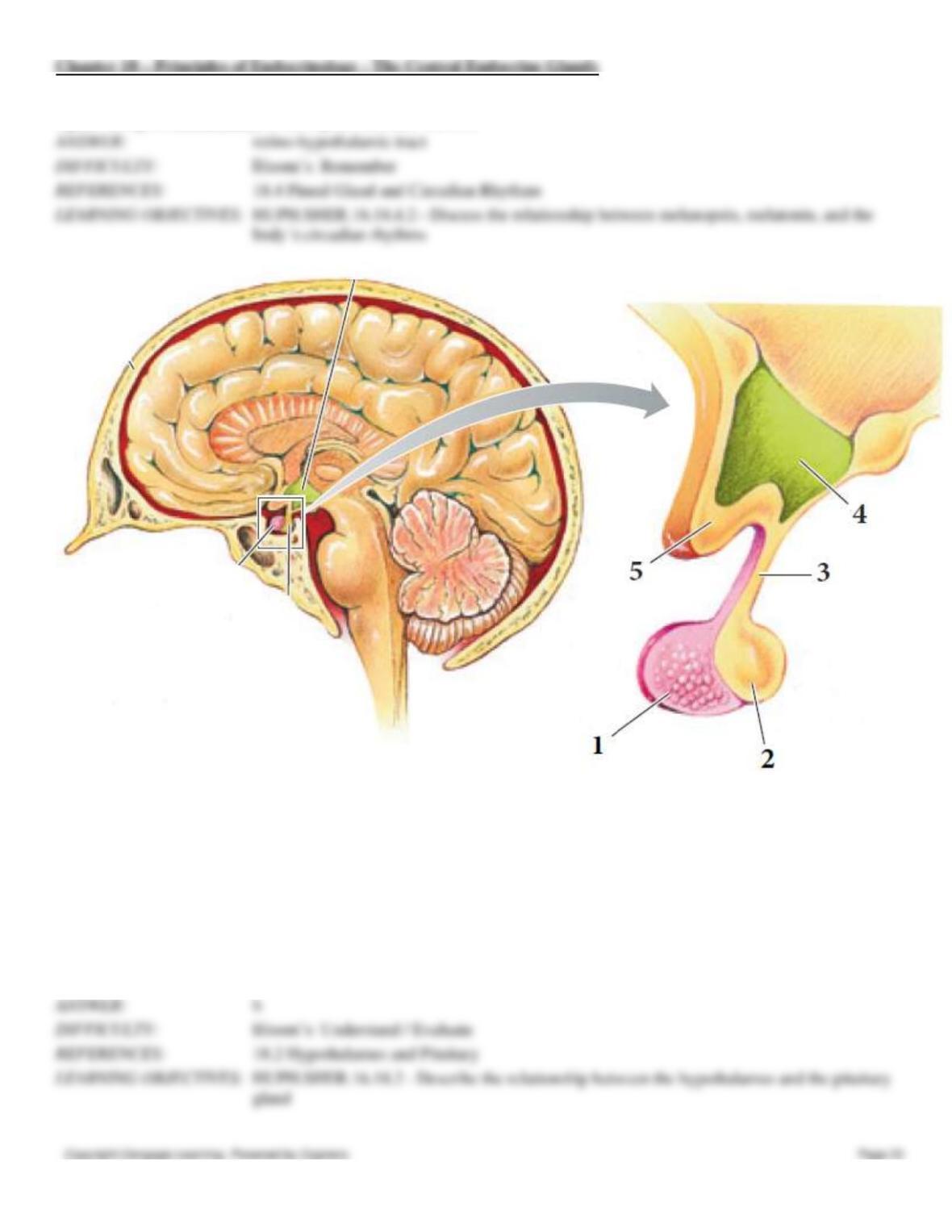
Use the figure above (Figure 18–3) to answer the corresponding questions.
91. Which number in the figure represents the posterior lobe of the pituitary gland?
a.
1
b.
2
c.
3
d.
4
e.
5
b
92. Which number in the figure represents the hypothalamus?
a.
1
b.
2
c.
3
d.
4
e.
5
d
93. Which number in the figure represents the connecting stalk?
a.
1
b.
2
c.
3
d.
4
e.
5
94. Which number in the figure represents the anterior lobe of the pituitary gland?
a.
1
b.
2
c.
3
d.
4
e.
5
95. Which number in the figure represents the optic chiasm?
a.
1
b.
2
c.
3
d.
4
e.
5
96. Define synergism and give an example.
97. Discuss estrogen in terms of target cells and major functions.
98. Discuss the various roles of oxytocin.
99. Discuss the effects of growth hormone (GH) deficiency with examples.
100. Discuss the greatest disrupter to our natural circadian rhythms.