Chapter 18: Pricing and Profitability Analysis
79. Lorillard Corporation has the following information for April, May, and June 2016:
April
May
June
Units produced
12,500
12,500
12,500
Units sold
8,750
10,625
13,125
Production costs per unit (based on 12,500 units) are as follows:
Direct materials
$15
Direct labor
10
Variable factory overhead
7.50
Fixed factory overhead
5
Variable selling and admin. expenses
12.50
Fixed selling and admin. expenses
5
There were no beginning inventories for April 2016, and all units were sold for $50. Costs are stable over the three
months.
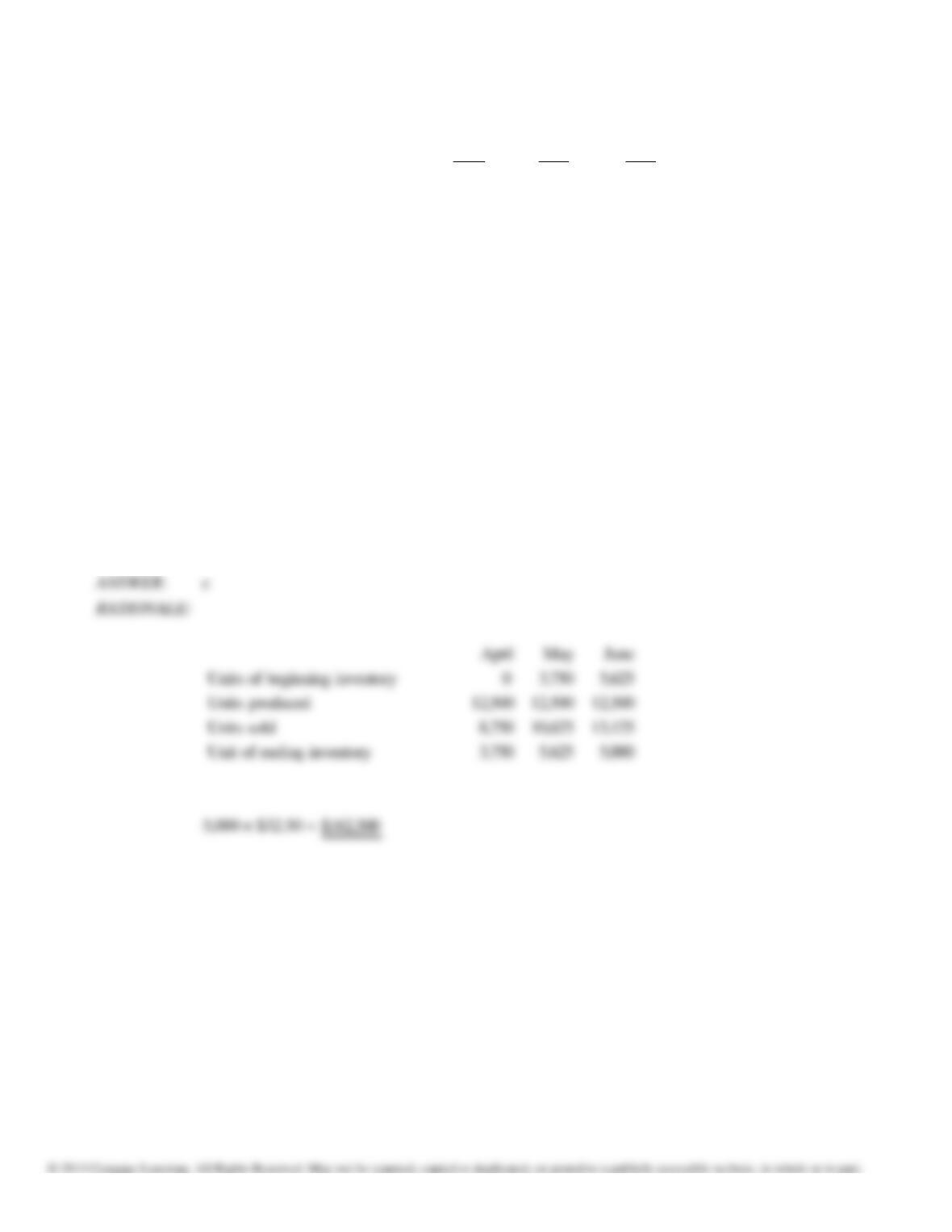
What is the June ending inventory cost for Lorillard Corporation using the variable costing method?
a. $75,000
b. $125,000
c. $162,500
d. $187,500
Units of beginning inventory
Units produced
Units sold
Chapter 18: Pricing and Profitability Analysis
80. Lorillard Corporation has the following information for April, May, and June 2016:
April
May
June
Units produced
12,500
12,500
12,500
Units sold
8,750
10,625
13,125
Production costs per unit (based on 12,500 units) are as follows:
Direct materials
$15
Direct labor
10
Variable factory overhead
7.50
Fixed factory overhead
5
Variable selling and admin. expenses
12.50
Fixed selling and admin. expenses
5
There were no beginning inventories for April 2016, and all units were sold for $50. Costs are stable over the three
months.
What is the May ending inventory cost for Lorillard Corporation using the variable costing method?
a. $182,812.50
b. $187,500
c. $312,500
d. $162,500
81. The following information pertains to Guillotine Corporation:
Beginning inventory
1,000 units
Ending inventory
6,000 units
Direct labor per unit
$40
Direct materials per unit
20
Variable overhead per unit
10
Fixed overhead per unit
30
Variable selling and admin. costs per unit
6
Fixed selling and admin. costs per unit
14
What is the value of the ending inventory using the absorption costing method?
a. $240,000
b. $360,000
c. $420,000
d. $600,000
Chapter 18: Pricing and Profitability Analysis
82. The following information pertains to Guillotine Corporation:
Beginning inventory
1,000 units
Ending inventory
6,000 units
Direct labor per unit
$40
Direct materials per unit
20
Variable overhead per unit
10
Fixed overhead per unit
30
Variable selling and admin. costs per unit
6
Fixed selling and admin. costs per unit
14
How much greater or less than variable costing net income is the absorption costing net income?
a. $150,000 less than
b. $150,000 greater than
c. $240,000 less than
d. $240,000 greater than
Chapter 18: Pricing and Profitability Analysis
83. The following information pertains to Guillotine Corporation:
Beginning inventory
1,000 units
Ending inventory
6,000 units
Direct labor per unit
$40
Direct materials per unit
20
Variable overhead per unit
10
Fixed overhead per unit
30
Variable selling and admin. costs per unit
6
Fixed selling and admin. costs per unit
14
What is the value of the ending inventory using the variable costing method?
a. $240,000
b. $420,000
c. $360,000
d. $350,000
84. A disadvantage of absorption costing is
a. that it is not a useful format for decision making.
b. that it might encourage inventory buildup.
c. both a and b.
d. none of the above.
Chapter 18: Pricing and Profitability Analysis
85. Octagonal Company has the following information for 2016:
Selling price
$150 per unit
Variable production costs
$40 per unit produced
Variable selling and admin. expenses
$16 per unit sold
Fixed production costs
$200,000
Fixed selling and admin. expenses
$140,000
Units produced
10,000 units
Units sold
8,000 units
There were no beginning inventories.
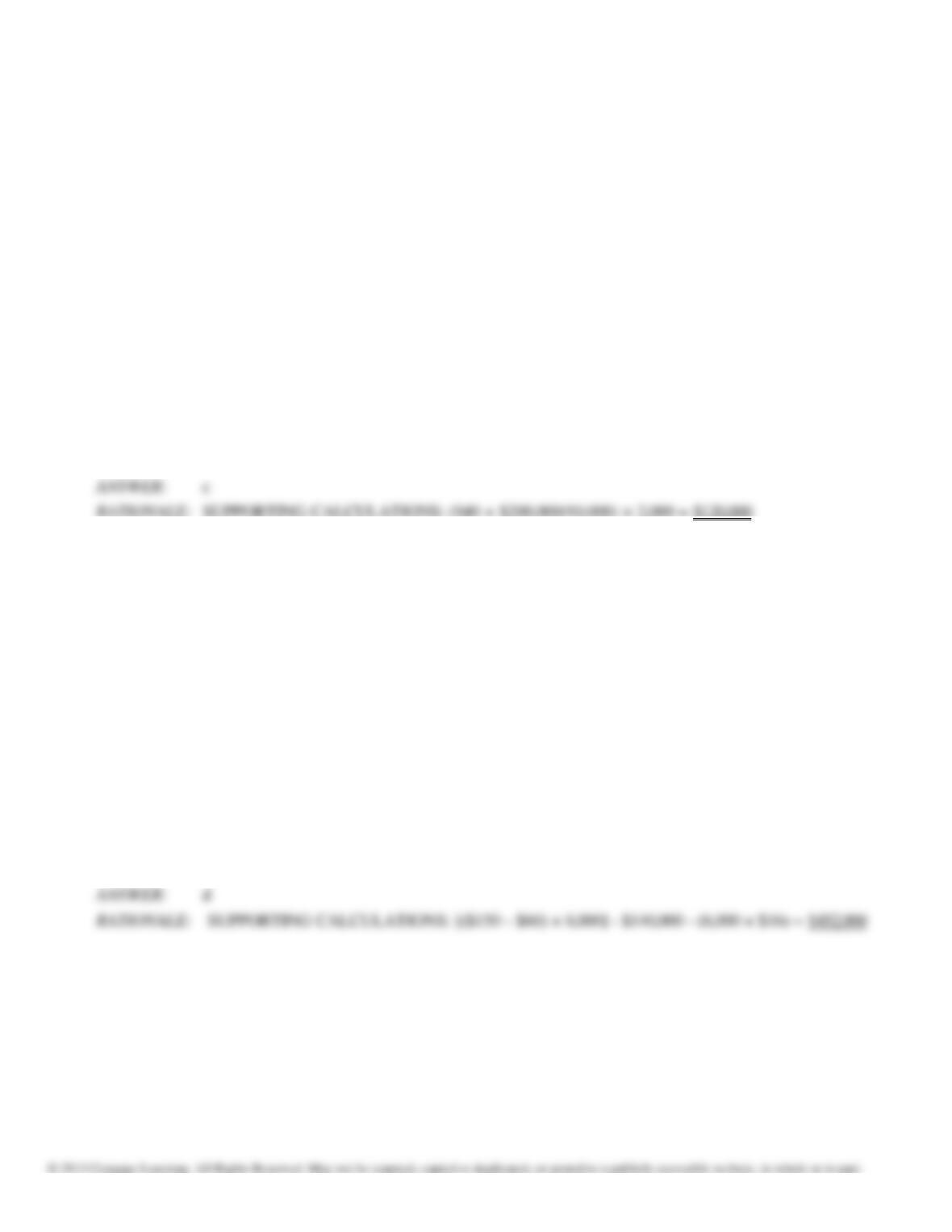
What is the ending inventory for Eastwood using the absorption costing method?
a. $300,000
b. $180,000
c. $120,000
d. $80,000
86. Octagonal Company has the following information for 2016:
Selling price $150 per unit
Variable production costs $40 per unit produced
Variable selling and admin. expenses $16 per unit sold
Fixed production costs $200,000
Fixed selling and admin. expenses $140,000
Units produced 10,000 units
Units sold 8,000 units
There were no beginning inventories.
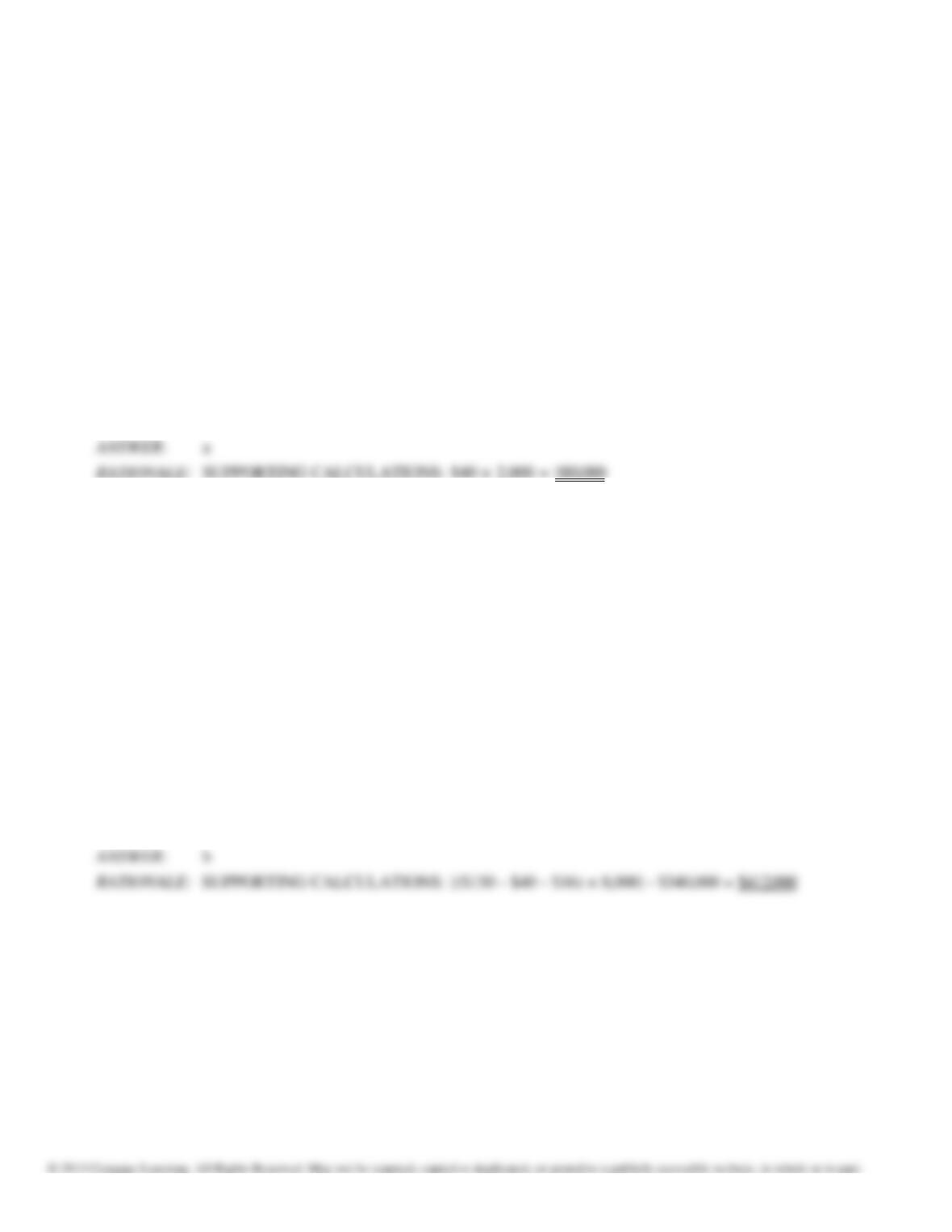
What is the net income for Octagonal using the absorption costing method?
a. $600,000
b. $480,000
c. $1,200,000
d. $452,000
Chapter 18: Pricing and Profitability Analysis
87. Octagonal Company has the following information for 2016:
Selling price $150 per unit
Variable production costs $40 per unit produced
Variable selling and admin. expenses $16 per unit sold
Fixed production costs $200,000
Fixed selling and admin. expenses $140,000
Units produced 10,000 units
Units sold 8,000 units
There were no beginning inventories.
What is the cost of ending inventory for Octagonal using the variable costing method?
a. $80,000
b. $180,000
c. $120,000
d. $300,000
88. Octagonal Company has the following information for 2016:
Selling price $150 per unit
Variable production costs $40 per unit produced
Variable selling and admin. Expenses $16 per unit sold
Fixed production costs $200,000
Fixed selling and admin. expenses $140,000 Units
produced 10,000 units
Units sold 8,000 units
There were no beginning inventories.
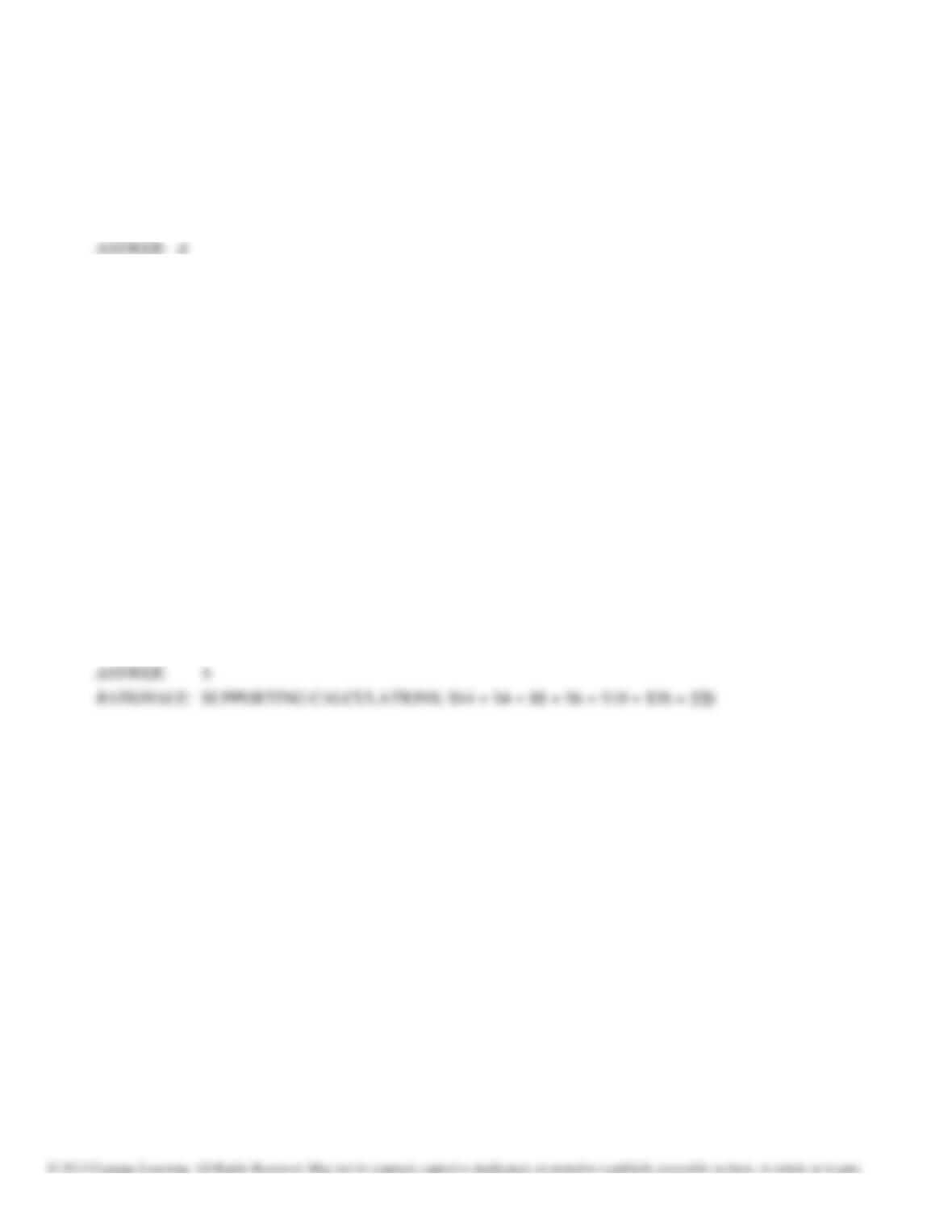
What is the net income for Octagonal using the variable costing method?
a. $480,000
b. $412,000
c. $1,200,000
d. $600,000
Chapter 18: Pricing and Profitability Analysis
89. Absorption costing is to gross margin as variable costing is to:
a. gross profit
b. territory margin
c. net income
d. contribution margin
90. Kasawaki Company incurred the following costs in manufacturing digital cameras:
Direct materials
$14
Indirect materials (variable)
4
Direct labor
8
Indirect labor (variable)
6
Other variable factory overhead
10
Fixed factory overhead
28
Variable selling expenses
20
Fixed selling expenses
14
During the period, the company produced and sold 1,000 units.
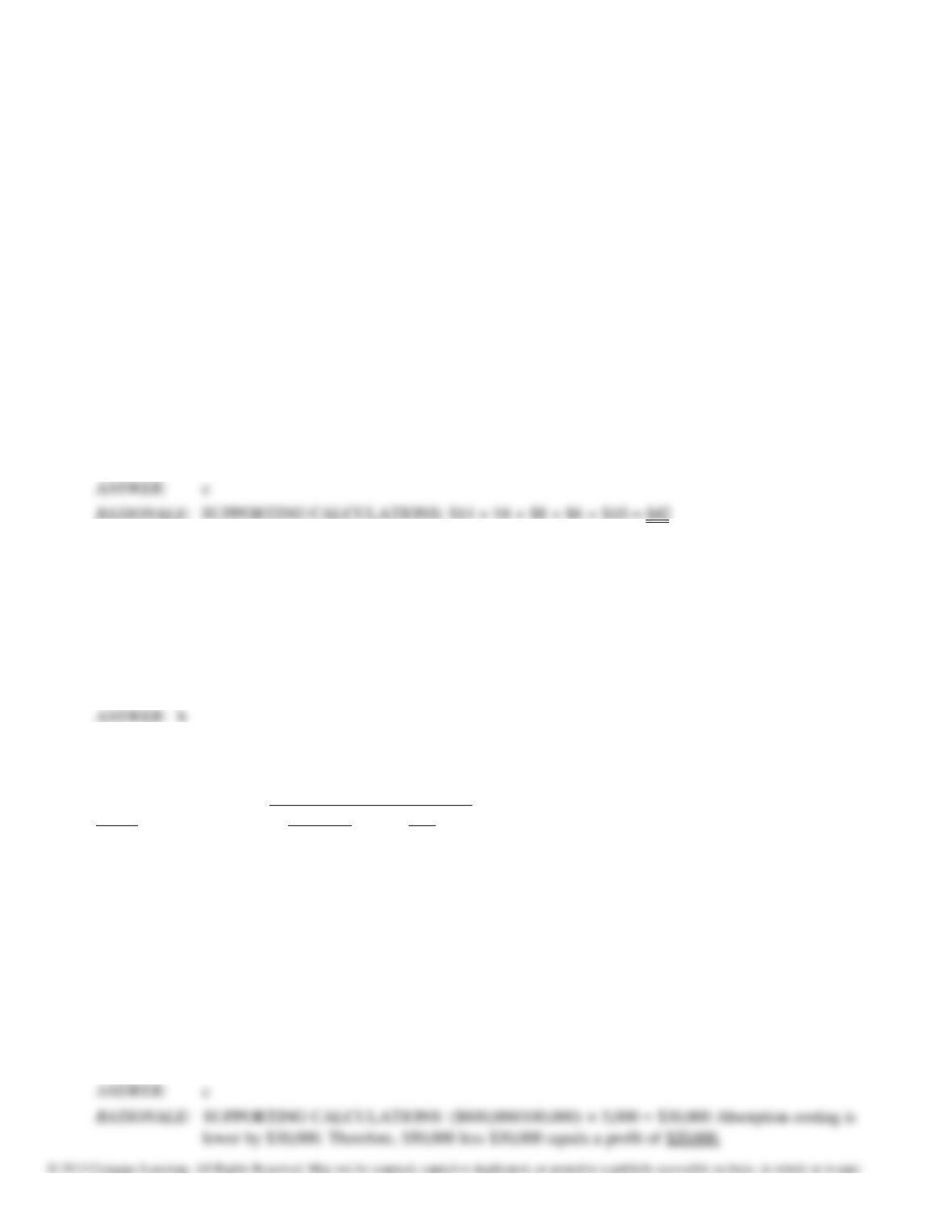
What is the inventory cost per unit using absorption costing?
a. $104
b. $70
c. $84
d. $32
Chapter 18: Pricing and Profitability Analysis
91. Kasawaki Company incurred the following costs in manufacturing digital cameras:
Direct materials
$14
Indirect materials (variable)
4
Direct labor
8
Indirect labor (variable)
6
Other variable factory overhead
10
Fixed factory overhead
28
Variable selling expenses
20
Fixed selling expenses
14
During the period, the company produced and sold 1,000 units.
What is the inventory cost per unit using variable costing?
a. $52
b. $62
c. $42
d. $70
92. When monthly production volume is constant and sales volume is less than production, net income determined with
variable costing procedures will
a. always be greater than net income determined using absorption costing.
b. always be less than net income determined using absorption costing.
c. be equal to net income determined using absorption costing.
d. be equal to contribution margin per unit times units sold.
93. Bernardo Company reported the following units of production and sales for August and September 2016:
Units
Month
Produced
Sold
August 2016
100,000
90,000
September 2016
100,000
105,000
Net income under absorption costing for August was $40,000; net income under variable costing for September
was $50,000. Fixed manufacturing costs were $600,000 for each month.
How much was net income for September using absorption costing?
a. $50,000
b.$80,000
c.$20,000
d.$40,000
Chapter 18: Pricing and Profitability Analysis
94. Bernardo Company reported the following units of production and sales for August and September 2016:
Units
Month Produced Sold
August 2016 100,000 90,000
September 2016 100,000 105,000
Net income under absorption costing for August was $40,000; net income under variable costing for September
was $50,000. Fixed manufacturing costs were $600,000 for each month.
How much was net income for August using variable costing?
a. $40,000
b. $20,000
c .$(20,000)
d $(40,000)
95. Under absorption costing, when production is less than sales volume, the profits, using variable costing procedures,
will be:
a. less than
b. greater than
c. equal to
d. randomly different than
96. Inventory values calculated using variable costing as opposed to absorption costing will generally be
a. equal.
b. less.
c. greater.
d. twice as much.
Chapter 18: Pricing and Profitability Analysis
97. The following information pertains to Fondueland Corporation:
Beginning inventory
0 units
Ending inventory
5,000 units
Direct labor per unit
$20
Direct materials per unit
16
Variable overhead per unit
4
Fixed overhead per unit
10
Variable selling costs per unit
12
Fixed selling costs per unit
16
What is the value of ending inventory using the variable costing method?
a. $310,000
b. $250,000
c. $390,000
d. $200,000
98. Which of the following statements is TRUE?
a. Absorption costing net income exceeds variable costing net income when units produced and sold are equal.
b. Variable costing net income exceeds absorption costing net income when units produced exceed units sold.
c. Absorption costing net income exceeds variable costing net income when units produced are less than units
sold.
d. Absorption costing net income exceeds variable costing net income when units produced are greater than
units sold.
99. All of the following costs are included in inventory under absorption costing EXCEPT
a. direct materials.
b. direct labor.
c. fixed selling expenses.
d. fixed factory overhead.
100. What is the primary difference between variable and absorption costing?
a. inclusion of fixed selling expenses in product costs
b. inclusion of variable factory overhead in period costs
c. inclusion of fixed selling expenses in period costs
d. inclusion of fixed factory overhead in product costs
Chapter 18: Pricing and Profitability Analysis
101. Which of the following could be considered a segment?
a. division
b. product-line
c. sales territory
d. all of the above
102. Normandy Company has the following information pertaining to its two divisions for 2016:
Division X
DivisionY
Variable selling and admin. expenses
$70,000
$90,000
Direct fixed manufacturing expenses
35,000
100,000
Sales
200,000
400,000
Direct fixed selling and admin. expenses
30,000
70,000
Variable manufacturing expenses
40,000
100,000
Common expenses are $24,000 for 2016.
What is the segment margin for Division Y?
a. $310,000
b. $210,000
c. $240,000
d. $40,000
Chapter 18: Pricing and Profitability Analysis
103. Normandy Company has the following information pertaining to its two divisions for 2016:
Variable selling and admin. expenses
Division X
$70,000
Division Y
$90,000
Direct fixed manufacturing expenses
35,000
100,000
Sales
200,000
400,000
Direct fixed selling and admin. expenses
30,000
70,000
Variable manufacturing expenses
40,000
100,000
Common expenses are $24,000 for 2016.
What is the operating income for Normandy Company?
a. $65,000
b. $325,000
c. $41,000
d. $300,000
104. Consider the following portion of a segmented income statement for the year just ended. Assume that the fixed
expenses of Division X include $30,000 of direct expenses and that the discontinuance of the department will not
affect the sales of the other departments nor reduce the common expenses.
Division X
Sales
$100,000
Variable manufacturing costs
60,000
Gross profit
$ 40,000
Fixed expenses (direct and allocated)
50,000
Operating income (loss)
$(10,000)
What is X’s divisional segment margin?
a. $(10,000)
b. $40,000
c. $10,000
d. $100,000
Chapter 18: Pricing and Profitability Analysis
105. Sarandon Company has the following information pertaining to its two divisions for 2016:
Division A
Division B
Variable selling and admin. expenses
$35,000
$45,000
Direct fixed manufacturing expenses
17,500
50,000
Sales
100,000
200,000
Direct fixed selling and admin. expenses
15,000
35,000
Variable manufacturing expenses
Common expenses are $12,000 for 2016.
20,000
50,000
What is the segment margin for Division B?
a. $155,000
b. $105,000
c. $55,000
d. $20,000
106. Sarandon Company has the following information pertaining to its two divisions for 2016:
Division A
Division
Variable selling and admin. expenses
$35,000
$45,000
Direct fixed manufacturing expenses
17,500
50,000
Sales
100,000
200,000
Direct fixed selling and admin. expenses
15,000
35,000
Variable manufacturing expenses
Common expenses are $12,000 for 2016.
20,000
50,000
What is the operating income for Sarandon Company?
a. $300,000
b. $32,500
c. $150,000
d. $20,500
Chapter 18: Pricing and Profitability Analysis
107. Deep Pit Mining mines three products. Gold ore sells for $1,000 per ton, variable costs are $600 per ton, and fixed
mining costs are $250,000. The segment margin for 2016 was $(100,000). The management of Deep Pit Mining
was considering dropping the mining of gold ore. Only one–half of the fixed expenses are direct and would be
eliminated if the segment was dropped.
What were the sales (in tons) for 2016?
a. 1,000 tons
b. 375 tons
c. 250 tons
d. 200 tons
108. Division B earns a contribution margin of $200,000 and has a divisional margin of $70,000. If Division B is closed,
all of the direct divisional expenses and $110,000 of common expenses can be eliminated. These facts indicate that
closing the division will cause the firm’s operating income to
a. increase by $90,000.
b. decrease by $90,000.
c. increase by $40,000.
d. decrease by $40,000.
109. The Crested Butte Company recorded the following data for a product line:
Sales
$250,000
Variable manufacturing expenses
50,000
Direct fixed manufacturing expenses
37,500
Variable selling and administrative expenses
25,000
Direct fixed selling and admin. expenses
30,000
What is the contribution margin of the product line?
a. $175,000
b. $162,500
c. $142,500
d. $170,000
Chapter 18: Pricing and Profitability Analysis
110. The Crested Butte Company recorded the following data for a product line:
Sales
$250,000
Variable manufacturing expenses
50,000
Direct fixed manufacturing expenses
37,500
Variable selling and administrative expenses
25,000
Direct fixed selling and admin. expenses
What is the segment margin of the product line?
a. $107,500
30,000
b. $162,500
c. $75,000
d. $175,000
111. Common segment costs, when contrasted with direct segment costs, are
a. costs of all segments such as direct labor.
b. costs related to more than one segment and not directly traceable to a particular segment.
c. incurred at one level for the benefit of two or more segments.
d. both b and c.
112. Consider the following portion of a segmented income statement for the year just ended. Assume that the fixed
expenses of Division X include $30,000 of direct expenses and that the discontinuance of the department will not
affect the sales of the other departments nor reduce the common expenses.
Division X
Sales
$100,000
Variable manufacturing costs
60,000
Gross profit
$ 40,000
Fixed expenses (direct and allocated)
50,000
Operating income (loss)
$(10,000)
What would be the effect on the firm’s operating income if Division X were discontinued?
a. increase $10,000
b. decrease $40,000
c. decrease $100,000
d. decrease $10,000
113. The following information pertains to Cumberland Corporation:
Beginning inventory
0 units
Ending inventory
6,000 units
Direct labor per unit
$20
Direct materials per unit
16
Variable overhead per unit
4
Fixed overhead per unit
10
Variable selling costs per unit
12
Fixed selling costs per unit
16
Absorption costing net income would be how much greater or less than the variable costing net income?
a. $80,000 less than
b. $80,000 greater than
c. $60,000 greater than
d. $60,000 less than
114. The following information pertains to Cumberland Corporation:
Beginning inventory
0 units
Ending inventory
6,000 units
Direct labor per unit
$20
Direct materials per unit
16
Variable overhead per unit
4
Fixed overhead per unit
10
Variable selling costs per unit
12
Fixed selling costs per unit
16
What is the value of ending inventory using the absorption costing method?
a. $410,000
b. $300,000
c. $600,000
d. $216,000
Chapter 18: Pricing and Profitability Analysis
115. Hammerhold Company has two divisions with the following segment margins for the current year: Northern,
$250,000; Southern, $450,000. Common expenses of the company are $55,000. What is Hammerhold Company‘s
net income?
a. $165,000
b. $700,000
c. $645,000
d. $750,000
116. Taylor Company’s budgeted sales were 10,000 units at $200 per unit. Actual sales were 9,200 units at $210 per
unit. Taylor’s sales price variance is
a. $92,000 (F).
b. $100,000 (U).
c. $8,000 (U).
d. $68,000 (U).
117. Taylor Company’s budgeted sales were 10,000 units at $200 per unit. Actual sales were 9,200 units at $210 per
unit. Taylor’s sales volume variance is
a. $68,000 (U).
b. $8,000 (U).
c. $160,000 (U).
d. $168,000 (U).
118. Taylor Company’s budgeted sales were 10,000 units at $200 per unit. Actual sales were 9,200 units at $210 per
unit. Taylor’s total sales variance is
a. $100,000 (U).
b. $68,000 (U).
c. $4,000 (U).
d. $92,000 (U).
Chapter 18: Pricing and Profitability Analysis
119. Franklin Company’s expected sales were 2,000 units at $100 per unit. During 2016, it had actual sales of 1,800 units
at $110 per unit. Budgeted variable costs were $60 per unit. What is Franklin‘s sales price variance?
a. $18,000 (F)
b. $20,000 (U)
c. $8,000 (U)
d. $2,000 (U)
120. Franklin Company’s expected sales were 2,000 units at $100 per unit. During 2016, it had actual sales of 1,800 units
at $110 per unit. Budgeted variable costs were $60 per unit. What is Franklin’s sales volume variance?
a. $8,000 (U)
b. $20,000 (U)
c. $18,000 (F)
d. $2,000 (U)
121. Franklin Company’s expected sales were 2,000 units at $100 per unit. During 2016, it had actual sales of 1,800 units
at $110 per unit. Budgeted variable costs were $60 per unit. What is Franklin’s total sales variance?
a. $8,000 (U)
b. $20,000 (U)
c. $18,000 (F)
d. $2,000 (U)
122. The sales price variance is created by a difference between:
a. actual and standard contribution margin.
b. actual and expected sales price.
c. expected and standard net income.
d. actual and expected sales volume.
Chapter 18: Pricing and Profitability Analysis
123. The contribution margin variance is the difference between the actual contribution margin and the:
a. actual unit price
b. budgeted contribution margin
c. budgeted variable expenses
d. actual variable expenses
124. The contribution margin variance is favorable if the budgeted contribution margin is less than the:
a. budgeted unit price
b. actual unit price
c. actual contribution margin
d. budgeted variable expenses
125. The budgeted contribution margin of two products is $1,000 the actual contribution margin is $500 and the total
variable expenses are $750. The contribution margin variance is:
a. $500(F)
b. $500(U)
c. $750(F)
d. $750(U)
126. The budgeted average unit contribution margin is the budgeted total contribution margin divided by the:
a. budgeted total units
b. budgeted total price
c. budgeted fixed expenses
d. budgeted variable expenses
127. The contribution margin volume variance is the difference between the actual and budgeted quantities sold
multiplied by the:
a. budgeted sales price
b. actual contribution margin variance
c. budgeted contribution margin variance
d. budgeted average unit contribution margin
Chapter 18: Pricing and Profitability Analysis
128. The budgeted quantity sold of a product is 200 units. The actual quantity sold is 100 units. The budgeted average
unit contribution margin is $3.00. What is the contribution margin volume variance?
a. $600(F)
b. $600(U)
c. $300(U)
d. $300(F)
129. The sum of the change in units for each product multiplied by the difference between the budgeted contribution
margin and the budgeted average unit contribution margin is called the:
a. market share variance
b. sales mix variance
c. overall sales variance
d. market size variance
130. The sales mix variance tells managers what impact a difference between actual and expected percentages of
products sold has on:
a. volume variance
b. sales variance
c. contribution margin
d. market share
131. In order for an effect of changing sales mix on profit to exist, a company must produce:
a. one product
b. more than one product
c. more than one location
d. even number of products