
Chapter 18: Accounting for Income Taxes
48. On January 1, 2016, Bedrock Company began recognizing revenues from all sales under the accrual method for
financial reporting purposes and under the installment sales method for income tax purposes. Bedrock reported the
following gross margin on sales for 2016 and 2017:
Accrual
Installment
Year
Method
Sales Method
2016
$1,200,000
$1,000,000
2017
1,800,000
1,400,000
The enacted tax rate for both 2016 and 2017 was 30%. Assuming there are no other temporary differences, 2017 what
is the amount of deferred tax liability that Bedrock should report on its December 31, 2017 balance sheet?
a.
$60,000
b.
$120,000
c.
$180,000
d.
$450,000
c
1
Moderate
ACCT.WHAL.16.18.3 – LO: 18.3
United States – BUSPORG: Analytic
United States – OH – Default City – AICPA: FN-Measurement
Bloom’s: Analyzing
49. Interperiod tax allocation is required for all of the following situations except
a.
warranty expenses that are expensed in the year of sale for accounting purposes but are deductible in the year
of payment for tax purposes.
b.
percentage depletion that exceeds cost depletion for the current period.
c.
MACRS depreciation for tax purposes and straight-line method for accounting purposes.
d.
installment sales method for tax purposes and accrual method for accounting purposes.
b
1
Moderate
ACCT.WHAL.16.18.3 – LO: 18.3
United States – BUSPROG – Reflective Thinking; BUSPROG: Analytic
United States – OH – Default City – AICPA – FN-Reporting
Bloom’s: Analyzing

Chapter 18: Accounting for Income Taxes
50. All of the following involve a temporary difference for purposes of income tax allocation except
a.
interest on municipal bonds.
b.
gross profit on installment sales for tax purposes.
c.
MACRS depreciation for tax purposes and straight-line for accounting purposes.
d.
product warranty expenses.
a
1
Moderate
ACCT.WHAL.16.18.3 – LO: 18.3
United States – BUSPROG – Reflective Thinking; BUSPROG: Analytic
United States – OH – Default City – AICPA – FN-Reporting
Bloom’s: Analyzing
51. All of the following involve a temporary difference for purposes of income tax allocation except
a.
revenues or gains that are included in pretax financial income prior to the time they are included in taxable
income.
b.
expenses or losses that are deducted to compute taxable income prior to the time they are deducted to compute
pretax financial income.
c.
revenues or gains that are included in taxable income prior to the time they are included in pretax financial
income.
d.
deductions that are allowed for income tax purposes but that do not qualify as expenses under generally
accepted accounting principles.
d
1
Moderate
ACCT.WHAL.16.18.3 – LO: 18.3
United States – BUSPROG – Reflective Thinking; BUSPROG: Analytic
United States – OH – Default City – AICPA – FN-Reporting
Bloom’s: Analyzing

52. In 2016, the Puerto Rios Company received insurance proceeds of $300,000 payable upon the death of its previous top
executive officer. For financial reporting purposes, Puerto Rios included the $300,000 in pretax accounting income.
The life insurance proceeds are exempt from income taxes. Assuming an income tax rate of 35%, what should Puerto
Rios report for this event as deferred income taxes in the 2016 income statement of ?
a.
$0
b.
$105,000 deferred tax asset
c.
$105,000 deferred tax liability
d.
$195,000 deferred tax liability
a
1
Moderate
ACCT.WHAL.16.18.4 – LO: 18.4
United States – BUSPORG: Analytic
United States – OH – Default City – AICPA: FN-Measurement
Bloom’s: Analyzing
53. Interperiod income tax allocation is based on the assumption that
a.
permanent differences ultimately reverse and require interperiod tax allocation.
b.
permanent differences do not have deferred tax consequences.
c.
total income tax expense should be apportioned among numerous line items on the income statement.
d.
the amount of income tax expense reported on the income statement should be the same as the income tax
obligation on the corporation’s income tax return.
b
1
Moderate
ACCT.WHAL.16.18.4 – LO: 18.4
United States – BUSPROG: Reflective Thinking – BUSPROG: Analytic
United States – OH – Default City – AICPA: FN-Decision Modeling
Bloom’s: Understanding
54. Permanent differences between pretax financial income and taxable income result when
a.
a company engages in fraudulent activity.
b.
the SEC imposes a penalty on a company.
c.
the IRS imposes interest on a late payment.
d.
the U.S. Patent Office denies a patent application.
b
1
Moderate
ACCT.WHAL.16.18.4 – LO: 18.4
United States – OH – Default City – AICPA: FN-Decision Modeling
55. Which of the following would not result in a permanent difference between pretax financial income and taxable
income?
a.
Product warranty costs
b.
Premiums paid for life insurance policies on officers of the company
c.
Interest revenue received from investments in municipal bonds
d.
Percentage depletion in excess of cost depletion on wasting assets
a
1
Easy
ACCT.WHAL.16.18.4 – LO: 18.4
United States – BUSPROG: Reflective Thinking – BUSPROG: Analytic
Bloom’s: Remembering
56. In accounting for income taxes, percentage depletion in excess of cost depletion is an example of
a.
intraperiod income tax allocation.
b.
a temporary difference.
c.
interperiod income tax allocation.
d.
a permanent difference.
d
1
ACCT.WHAL.16.18.4 – LO: 18.4
United States – BUSPROG: Reflective Thinking – BUSPROG: Analytic
United States – OH – Default City – AICPA: FN-Decision Modeling
Bloom’s: Remembering
57. Which one of the following requires interperiod tax allocation?
a.
Premium paid on key executives’ life insurance
b.
Warranty expenses related to a three-year warranty period
c.
Interest received on municipal obligations
d.
Percentage depletion in excess of cost depletion
b
1
Easy
ACCT.WHAL.16.18.4 – LO: 18.4
United States – BUSPROG: Reflective Thinking – BUSPROG: Analytic
United States – OH – Default City – AICPA: FN-Decision Modeling
Bloom’s: Remembering
58. Revenue from installment sales is recognized in the period received for tax purposes and recognized in the period
earned for accounting purposes. If these periods are different, this is an example of a
a.
permanent difference that gives rise to interperiod tax allocation.
b.
permanent difference that does not give rise to interperiod tax allocation.
c.
temporary difference that gives rise to interperiod tax allocation.
d.
temporary difference that does not give rise to interperiod tax allocation.
c
1
Moderate
ACCT.WHAL.16.18.4 – LO: 18.4
United States – BUSPROG: Reflective Thinking – BUSPROG: Analytic
Bloom’s: Understanding
59. Life insurance proceeds payable to a corporation upon the death of an insured employee are an example of
a.
intraperiod tax allocation.
b.
interperiod tax allocation.
c.
a permanent difference.
d.
a temporary difference.
c
1
ACCT.WHAL.16.18.4 – LO: 18.4
United States – BUSPROG: Reflective Thinking – BUSPROG: Analytic
United States – OH – Default City – AICPA: FN-Decision Modeling
Bloom’s: Understanding
60. Permanent differences impact
a.
current deferred taxes.
b.
current tax liabilities.
c.
deferred tax assets.
d.
deferred tax liabilities.
b
1
Easy
ACCT.WHAL.16.18.4 – LO: 18.4
United States – BUSPROG: Reflective Thinking – BUSPROG: Analytic
United States – OH – Default City – AICPA: FN-Decision Modeling
Bloom’s: Remembering

61. An operating loss carryforward occurs when
a.
prior pretax financial income is insufficient to offset the current period operating loss.
b.
prior taxable income is insufficient to offset the current period operating loss.
c.
future pretax financial income is insufficient to offset a current period operating loss.
d.
future taxable income is insufficient to offset a current period operating loss.
b
1
Easy
ACCT.WHAL.16.18.5 – LO: 18.5
United States – BUSPROG: Reflective Thinking – BUSPROG: Analytic
United States – OH – Default City – AICPA: FN-Decision Modeling
Bloom’s: Remembering
62. Which one of the following statements regarding operating losses is false?
a.
The tax benefit of an operating loss carryback is recognized in the period of loss as a current receivable on the
balance sheet.
b.
Temporary differences and operating loss carryforwards are accounted for similarly.
c.
The journal entry to recognize an operating loss carryback would include a credit to Income Tax Benefit from
Operating Loss Carryback.
d.
The tax benefit of an operating loss carryforward is to be recognized in the period of loss as a current
receivable.
d
1
Easy
ACCT.WHAL.16.18.5 – LO: 18.5
United States – BUSPROG: Reflective Thinking – BUSPROG: Analytic
United States – OH – Default City – AICPA: FN-Decision Modeling
Bloom’s: Remembering

63. Which of the following statements appropriately describe the different effects of operating loss carrybacks and
carryforwards?
a.
operating loss carrybacks result in a current asset and operating loss carryforwards result in a deferred tax
asset.
b.
operating loss carrybacks result in a retrospective asset and operating loss carryforwards result in a prospective
asset.
c.
operating loss carrybacks result in a deferred tax asset and operating loss carryforwards result in a deferred tax
liability.
d.
operating loss carrybacks result in a deferred tax liability and operating loss carryforwards result in a deferred
tax asset.
a
1
Moderate
ACCT.WHAL.16.18.5 – LO: 18.5
United States – BUSPROG – Reflective Thinking; BUSPROG: Analytic
United States – OH – Default City – AICPA – FN-Reporting
Bloom’s: Remembering
64. When accounting for the current impact of loss carrybacks and carryforwards it is proper to recognize
a.
recognize the tax benefit of the operating loss carryback and carryforward as an asset.
b.
recognize the tax benefit of the operating loss carryforward as an asset.
c.
recognize the tax benefit of the operating loss carryback as a deferred liability.
d.
recognize the tax benefit of the operating loss carryforward as a deferred liability.
a
1
Easy
ACCT.WHAL.16.18.5 – LO: 18.5
United States – BUSPROG: Reflective Thinking – BUSPROG: Analytic
United States – OH – Default City – AICPA: FN-Decision Modeling
Bloom’s: Remembering

65. At the end of its first year of operations on December 31, 2016, the Brandon Company reported taxable income of
$100,000 and had a pretax financial loss of $60,000. Differences between taxable income and pretax financial income
included interest revenue received from municipal obligations of $20,000 and warranty expense accruals of $180,000.
Warranty expenses of $90,000 are expected to be paid in 2017 and $110,000 in 2018. The enacted income tax rates
for 2016, 2017, and 2018 are 30%, 35%, and 40%, respectively. The journal entry to record income tax expense on
December 31, 2016, would be
a.
Deferred Tax Asset 75,500
Income Taxes Payable 30,000
Income Tax Benefits from
Operating Loss Carryforward 45,500
b.
Deferred Tax Asset 30,000
Income Taxes Payable 30,000
c.
Income Tax Expense 30,000
Income Taxes Payable 30,000
d.
Deferred Tax Asset 105,500
Income Taxes Payable 30,000
Income Tax Benefit from
Operating Loss Carryforward 75,500
a
1
Moderate
ACCT.WHAL.16.18.5 – LO: 18.5
United States – BUSPROG: Reflective Thinking – BUSPROG: Analytic
United States – OH – Default City – AICPA: FN-Measurement

66. The Wyatt Company reports the following for both pretax financial and taxable income:
Enacted
Year
Income (Loss)
Tax Rates
2016
$ 40,000
30%
2017
60,000
35%
2018
80,000
30%
2019
(200,000)
30%
Wyatt uses the carryback provision for net operating losses when possible. Congress has enacted a tax rate for 2020
and future years of 40%. The entry on December 31, 2019, to record income tax expense would include a
a.
debit to Income Tax Refund Receivable for $24,000.
b.
debit to Income Tax Refund Receivable for $45,000.
c.
credit to Income Tax Benefit from Operating Losses for $45,000.
d.
credit to Income Tax Expense for $45,000.
b
1
Challenging
ACCT.WHAL.16.18.5 – LO: 18.5
United States – BUSPORG: Analytic
United States – OH – Default City – AICPA: FN-Measurement
Bloom’s: Analyzing
67. The Chance Company began operations in 2016 and, for that calendar year, reported an operating loss of $200,000.
Due to sufficient verifiable positive evidence, no valuation allowance was established to reduce the deferred tax asset
as of December 31, 2016. During 2017, Chance reported pretax accounting income of $375,000. Assuming an income
tax rate of 35%, what should Chance record in 2017 as income tax payable at the end of 2017?
a.
$0
b.
$70,000
c.
$61,250
d.
$131,250
c
1
Moderate
ACCT.WHAL.16.18.5 – LO: 18.5
United States – BUSPORG: Analytic
United States – OH – Default City – AICPA: FN-Measurement
Bloom’s: Analyzing

68. Moore Company reported the following operating results during its first three years of operations:
2016 Pretax operating loss
$ (40,000)
2017 Pretax operating loss
$(200,000)
2018 Pretax operating income
$ 300,000
No permanent or temporary differences occurred during these fiscal periods. Assuming an income tax rate of 35%,
what is the amount of current income tax liability that Moore should report as of December 31, 2018?
a.
$0
b.
$21,000
c.
$84,000
d.
$91,000
b
1
Moderate
ACCT.WHAL.16.18.5 – LO: 18.5
United States – BUSPORG: Analytic
United States – OH – Default City – AICPA: FN-Measurement
Bloom’s: Analyzing
69. Intraperiod tax allocation would be appropriate for all of the following except
a.
an unrecognized gain on available-for-sale securities.
b.
a loss from operations of a discontinued segment.
c.
retrospective adjustments.
d.
a loss from impairment of a long-lived asset.
d
1
Easy
ACCT.WHAL.16.18.6 – LO: 18.6
United States – BUSPROG: Reflective Thinking – BUSPROG: Analytic
United States – OH – Default City – AICPA: FN-Decision Modeling
Bloom’s: Remembering

70. Which one of the following would require interperiod tax allocation?
a.
percentage depletion in excess of cost depletion
b.
premiums paid on a life insurance policy of which the company is the beneficiary
c.
interest on state municipal bonds
d.
investment income recognized by the equity method for accounting purposes but as income when received for
tax purposes
d
1
Moderate
ACCT.WHAL.16.18.6 – LO: 18.6
United States – BUSPROG: Reflective Thinking – BUSPROG: Analytic
Bloom’s: Understanding
71. In applying intraperiod income tax allocation to discontinued operations, other comprehensive income, retrospective
adjustments, and prior period adjustments, what tax rate should be used?
a.
expected future income tax rate
b.
average income tax rate
c.
marginal (incremental) income tax rate
d.
normal income tax rate
c
1
Easy
ACCT.WHAL.16.18.6 – LO: 18.6
United States – BUSPROG: Reflective Thinking – BUSPROG: Analytic
United States – OH – Default City – AICPA: FN-Decision Modeling
Bloom’s: Remembering
72. Assuming there are no prior period adjustments during the fiscal year, net income would be affected by
Interperiod Income
Intraperiod Income
Tax Allocation
Tax Allocation
I.
Yes
Yes
II.
No
No
III.
Yes
No
IV.
No
Yes
a.
I
b.
II
c.
III
d.
IV
c
1
Moderate
ACCT.WHAL.16.18.6 – LO: 18.6
United States – BUSPROG: Reflective Thinking – BUSPROG: Analytic
United States – OH – Default City – AICPA: FN-Decision Modeling
Bloom’s: Understanding
73. Income taxes for financial accounting purposes are apportioned to each of the following items except
a.
other comprehensive income.
b.
discontinued operations.
c.
other revenues and expenses.
d.
prior period adjustments.
c
1
Moderate
ACCT.WHAL.16.18.6 – LO: 18.6
United States – BUSPROG: Reflective Thinking – BUSPROG: Analytic
United States – OH – Default City – AICPA: FN-Decision Modeling
Bloom’s: Understanding

74. Which one of the following requires intraperiod tax allocation?
a.
installment sales for tax purposes and accrued revenue recognition for accounting purposes
b.
the excess of accelerated depreciation for tax purposes over depreciation for accounting purposes
c.
interest income on municipal obligations
d.
prior period adjustments
d
1
Easy
ACCT.WHAL.16.18.6 – LO: 18.6
United States – BUSPROG: Reflective Thinking – BUSPROG: Analytic
United States – OH – Default City – AICPA: FN-Decision Modeling
Bloom’s: Remembering
75. Which one of the following transactions would result in the creation of a noncurrent deferred tax liability?
a.
interest received on municipal bonds
b.
a contingent liability expensed in the current period that is expected to require a cash payment in three years
c.
royalties received in advance that are taxable when received, but that will be earned within the next three
months
d.
using an accelerated depreciation method for income tax purposes and the straight-line method for financial
reporting purposes
d
1
Moderate
ACCT.WHAL.16.18.7 – LO: 18.7
United States – BUSPROG: Reflective Thinking – BUSPROG: Analytic
United States – OH – Default City – AICPA: FN-Decision Modeling
Bloom’s: Understanding
76. All of the following are income tax disclosures required by GAAP except:
a.
total deferred taxes from permanent differences and from temporary differences.
b.
total deferred tax assets and total deferred tax liabilities.
c.
total valuation allowance and net change in the allowance.
d.
causes of deferred tax assets and deferred tax liabilities.
a
1
Moderate
ACCT.WHAL.16.18.7 – LO: 18.7
United States – BUSPROG: Reflective Thinking – BUSPROG: Analytic

77. The presentation of the combination or “offsetting” of noncurrent deferred tax assets and liabilities is
a.
not permitted by the FASB because of the separate identification principle.
b.
not permitted by the FASB because of the close relationship between deferred tax assets and liabilities.
c.
required by the FASB to avoid the detailed analysis necessary for more refined classification methods.
d.
required by the FASB because of the close relationship between deferred tax assets and liabilities.
d
1
Easy
ACCT.WHAL.16.18.7 – LO: 18.7
United States – BUSPROG: Reflective Thinking – BUSPROG: Analytic
United States – OH – Default City – AICPA: FN-Decision Modeling
Bloom’s: Remembering
78. Which of the following is false concerning deferred tax assets and liabilities?
a.
a corporation must separate its deferred tax liabilities into current and noncurrent groups.
b.
a corporation must separate its deferred tax assets into current and noncurrent groups.
c.
a corporation must combine the amounts in current groups.
d.
a corporation must not combine the amounts in current groups.
d
1
Easy
ACCT.WHAL.16.18.7 – LO: 18.7
United States – BUSPROG: Reflective Thinking – BUSPROG: Analytic
United States – OH – Default City – AICPA: FN-Decision Modeling
Bloom’s: Remembering

79. The acceptable balance sheet classifications for deferred tax assets and deferred tax liabilities under GAAP and IFRS
are
GAAP
IFRS
I.
current only
noncurrent only
II.
current and noncurrent, respectively
current and noncurrent, respectively
III.
noncurrent only
current only
IV.
current and noncurrent, respectively
noncurrent only
a.
I
b.
II
c.
III
d.
IV
d
1
Easy
ACCT.WHAL.16.18.8 – LO: 18.8
United States – BUSPROG: Reflective Thinking – BUSPROG: Analytic
United States – OH – Default City – AICPA: FN-Decision Modeling
Bloom’s: Remembering
80. Beare Company claims a $2,000,000 R&D tax credit. These credits are often challenged by the IRS. Based on analysis
of probability distributions of possible outcomes, Beare attorneys determine they can recognize $1,800,000 as a
current tax benefit. This means that as a result of claiming this tax credit, Beare Company will
a.
decrease income tax expense $1,800,000 and decrease income tax payable by $1,800,000,
b.
decrease income tax expense $1,800,000, decrease income tax payable by $2,000,000, and increase noncurrent
tax liability $200,000.
c.
decrease income tax expense $2,000,000, decrease income tax payable by $1,8000,000, and decrease
noncurrent tax liability $200,000.
d.
decrease income tax expense $2,000,000, decrease income tax payable by $1,8000,000, and increase
noncurrent tax liability $200,000.
b
1
Moderate
United States – BUSPROG – Reflective Thinking; BUSPROG: Analytic
United States – OH – Default City – AICPA – FN-Reporting
Bloom’s: Understanding

81. For each item listed below, indicate whether it involves a:
a.
permanent difference.
b.
temporary difference that will result in future deductible amounts (giving rise to deferred
tax assets).
c.
temporary difference that will result in future taxable amounts (giving rise to deferred tax
liabilities).
____
1.
Rent is collected in advance from a tenant. Rent is taxable when received.
____
2.
Warranty costs are accrued at the time of sale for accounting purposes, but are not
deductible until paid for income tax purposes.
____
3.
Interest revenue is recorded on municipal bonds.
____
4.
Installment sales are recognized at the point of sale for accounting purposes, but
when the cash is received for income tax purposes.
____
5.
A loss contingency is expensed for accounting purposes. The company expects to
pay the amount involved in three years.
____
6.
Bad debt expense is estimated for accounting purposes, but is not deducted for
income tax purposes until written off.
____
7.
The company paid a fine from the EPA for violation of environmental regulations.
1.
b
5.
2.
b
6.
3.
a
7.
4.
c
Required:
Match each item to its descriptive phrase by placing the appropriate letter in the space provided.
82. Smyrna Company had financial and taxable incomes as follows:
2016
2017
2018
Pretax financial income
$150,000
$140,000
$135,000
Taxable income
115,000
140,000
170,000
The tax rate for all three years was 30%.
Required:
a.
Prepare the journal entries to record income taxes for all three years.
b.
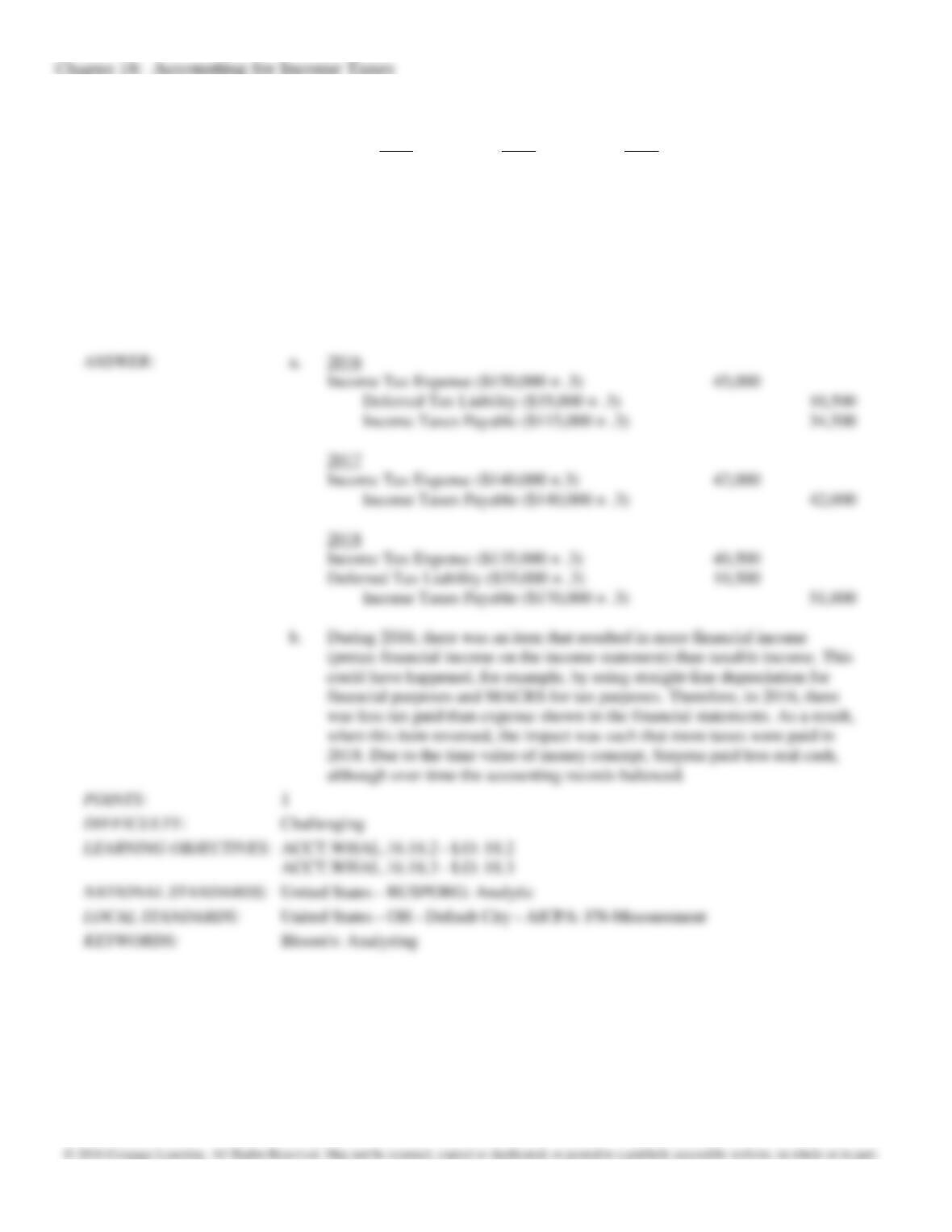
2016
Deferred Tax Liability ($35,000 × .3)
Income Taxes Payable ($115,000 × .3)
2017
Income Tax Expense ($140,000 ×.3)
Income Taxes Payable ($140,000 × .3)
2018
Income Tax Expense ($135,000 × .3)
Deferred Tax Liability ($35,000 × .3)
Income Taxes Payable ($170,000 × .3)
although over time the accounting records balanced.
Challenging
ACCT.WHAL.16.18.2 – LO: 18.2
ACCT.WHAL.16.18.3 – LO: 18.3
Bloom’s: Analyzing
Explain why the taxes paid in 2018 are different from the tax return and the amount
reported in the financial statements and provide an example of what could cause this
difference.

83. On December 31, 2015, Jefferson Lake, Inc. reported a deferred tax liability of $1,875, based on the following
schedule of future taxable amounts and enacted tax rates:
Taxable
Enacted
Year
Amounts
Tax Rate
2016
$3,000
30%
2017
2,000
30%
2018
1,500
25%
On February 7, 2016, Congress amended a previously passed tax law. The amendment changed the tax rate to 35% for
2016 and all future years.
Required:
Prepare the income tax journal entry for Jefferson Lake, Inc. necessary on February 7, 2016.

84. On December 31, 2016, the Town Hall Company had a deferred tax liability balance of $12,570, arising from an
excess of MACRS depreciation for tax purposes over straight-line depreciation for accounting purposes. The tax
effects of that timing difference are expected to reverse in the following years:
Timing
Enacted
Deferred
Year
Difference
Tax Rate
Tax Liability
2017
$ 16,000
30%
$ 4,800
2018
9,500
35%
3,325
2019
12,700
35%
4,445
$12,570
On January 27, 2017, Congress raised the effective income tax rate to 38% for all future years, including the current
year, 2017.
Required:
Prepare the entry to record any adjustments necessary due to the income tax rate increase on January 27, 2017.
85. At December 31, 2016, the Blue Agave Company had a current deferred tax asset of $60,000, arising from cash for
magazine subscriptions received and taxed in 2016 but that will be recognized as income for accounting purposes in
2017; a noncurrent deferred tax liability of $160,000 arising from an excess of MACRS tax depreciation over straight-
line accounting depreciation of plant assets; and a long-term deferred tax asset of $80,000, arising from contingency
expenses for accounting purposes that will be tax deductible when paid (estimated to be in 2018). The 2017 pretax
financial income and taxable income for Blue Agave are as follows:
Pretax financial income
$ 800,000
Estimated bad debt expense
60,000
Magazine subscriptions earned (cash received in 2016)
(200,000)
Rent received in advance
100,000
Excess of MACRS tax depreciation over straight-line
accounting
depreciation
(200,000)
Taxable income
$ 560,000
The income tax rate for all years
30%
Required:
Prepare the income tax journal entry for the Blue Agave Company at the end of 2017.
Income Tax Expense
Deferred Tax Asset (Rent and Bad Debt Expense)
Deferred Tax Asset (Subscription)
Deferred Tax Liability (Depreciation)
Income Taxes Payable